

- Application: File Form COS-1 with the Central Licensing Authority (CDSCO) on the SUGAM portal for every cosmetic product you plan to import.
- Approval: CDSCO reviews the application and grants the Import Registration Certificate in Form COS-2 within up to 180 working days.
- Validity: Form COS-2 is valid for 5 years and must be renewed through a retention application before it expires.
- Eligibility: Only the manufacturer, its authorized Indian agent, Indian subsidiary, or an authorized importer can file COS-1 — foreign brands cannot apply directly.
Introduction
Cosmetic Registration For Importers is the mandatory CDSCO approval under the Cosmetics Rules, 2020 that every business must obtain before importing cosmetics into India. The Indian agent, subsidiary, or authorized importer files Form COS-1 on the SUGAM portal with a Free Sale Certificate, manufacturer authorization, product labels, and safety declarations.
Once CDSCO's Central Licensing Authority reviews the application — typically within 180 working days — it grants Form COS-2, the Import Registration Certificate, valid for 5 years. No cosmetic can legally clear Indian customs without a valid COS-2 covering that specific product, variant, and manufacturing site.
What Is Cosmetic Registration For Importers?
Cosmetic Registration For Importers is the regulatory approval process under Rule 12(1) of the Cosmetics Rules, 2020, which states that no cosmetic shall be imported into India unless it is registered by the Central Licensing Authority. “Cosmetic” is defined broadly under Section 3(aaa) of the Drugs and Cosmetics Act, 1940 to include any article intended to be rubbed, poured, sprinkled, sprayed on, or applied to the human body for cleansing, beautifying, or altering appearance — covering skincare, haircare, makeup, oral care, and fragrance products alike.
The approval is administered centrally by CDSCO, the Drugs Controller General of India (DCGI) acting as the Central Licensing Authority, and works through a simple two-form structure:
- Form COS-1 — The online application filed on the SUGAM portal to register a cosmetic product for import.
- Form COS-2 — The Import Registration Certificate CDSCO grants once the COS-1 application is reviewed and approved.
Unlike manufacturing licenses (which are granted by State Licensing Authorities), import registration is handled entirely at the central level by CDSCO headquarters in New Delhi.
COS-1 vs COS-2: Quick Comparison
| Parameter | Form COS-1 | Form COS-2 |
| Nature | Online application | Import Registration Certificate |
| Filed/Issued By | Manufacturer, Indian agent, subsidiary, or importer | Central Licensing Authority (CDSCO/DCGI) |
| Portal | SUGAM Portal | SUGAM Portal |
| Purpose | Requests registration of a cosmetic for import | Grants legal permission to import, sell, and distribute |
| Processing Time | Up to 180 working days for review | Issued after successful COS-1 review |
| Validity | Not applicable (it's an application) | 5 years from date of grant |
Form COS-1: Application for Import Registration
Form COS-1 is the primary online application filed on the SUGAM portal to register a cosmetic product, its variants, and manufacturing site(s) for import into India. Each COS-1 application can cover multiple products, variants, and manufacturing sites, subject to applicable government fees.
Who Can Apply for COS-1
- The overseas manufacturer directly, if it chooses to hold the Indian registration itself.
- An authorised agent appointed by the manufacturer to represent it in India.
- An Indian subsidiary of the overseas manufacturer.
- An importer authorised by the manufacturer to apply on its behalf.
Foreign brands cannot apply directly to CDSCO — they must appoint one of the above eligible entities, executed and authenticated through a formal authorisation before a First Class Magistrate in India or an equivalent authority in the country of origin.
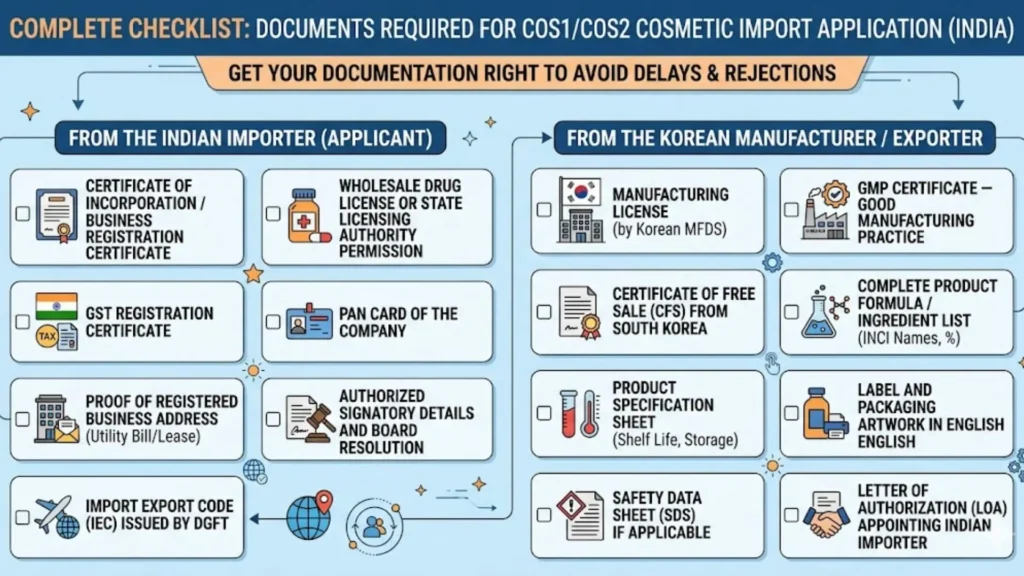
Documents Required for COS-1
- Covering letter with an index of enclosed documents.
- Authorisation letter from the manufacturer to the Indian agent/importer, as per the First Schedule of the Cosmetics Rules, 2020.
- Certificate of Free Sale (CFS) from the National Regulatory Authority of the country of origin, notarised, apostilled, or attested by the Indian Embassy.
- Complete product list with names, variants (shade/fragrance/colour), and pack sizes in the Indian Metric System.
- Category mapping of every product under the Fourth Schedule of the Cosmetics Rules, 2020 (80+ categories).
- Ingredient list and percentage composition (formulation) of each product.
- Inner and outer label copies complying with Chapter VI labelling requirements.
- Non-animal testing declaration and a declaration confirming no Hexachlorophene content.
- Manufacturing site address and GMP/ISO 22716 certification of the overseas facility.
- Fee payment receipt/challan generated through the Bharatkosh gateway.
Step-by-Step COS-1 Application Process
- Identify the eligible applicant — manufacturer, authorised agent, subsidiary, or importer.
- Obtain a notarised/apostilled Free Sale Certificate from the country of origin.
- Map every product and variant to its correct Fourth Schedule category.
- Collect manufacturer authorisation, labels, formulation, and testing declarations.
- Register on the SUGAM portal and select the cosmetic import registration module.
- Fill Form COS-1 with manufacturer, agent, and product details, keeping every document consistent in names and addresses.
- Pay the prescribed fee through the Bharatkosh gateway and upload the challan.
- Submit the application; CDSCO scrutinises the documents and may raise queries.
- Respond to any deficiency memo promptly to avoid delay or rejection.
- On satisfactory review, the Central Licensing Authority grants Form COS-2.

Form COS-2: Grant of Import Registration Certificate
Form COS-2 is the official Import Registration Certificate issued by CDSCO once a COS-1 application clears scrutiny. It is the legal document that permits a registered cosmetic product — in its declared variants and from its declared manufacturing site — to be imported, sold, and distributed anywhere in India, including through e-commerce platforms.
Key Conditions Attached to COS-2
- The registration certificate number must be printed on every product label sold in India.
- CDSCO does not allow post-import registration — the consignment must already be covered by a valid COS-2 before it reaches Indian customs.
- Any change in product composition, labelling, or testing must be reported to CDSCO within 15 days, along with an undertaking of continued BIS compliance.
- A change in the constitution of the registration holder or the overseas manufacturer requires a fresh registration application within 180 days of the change.
- The product's “use before/use by” date must be later than 6 months from the date of import.
Validity, Renewal & Additional Imports
- Validity: Form COS-2 is valid for 5 years from the date of grant.
- Renewal: A retention application with fresh fee payment must be filed before expiry to keep the registration active; once renewed, it remains valid in perpetuity subject to timely retention payments.
- Additional imports of the same registered product: Any other importer can bring in an already-registered cosmetic using Form COS-4 for grant of an Import Registration Number in Form COS-4A, without filing a fresh COS-1.
- Kit exemption: Cosmetics imported as a kit, where every individual product is already separately registered, are generally exempt from a separate kit-level registration.
Cosmetic Products Covered Under COS-1/COS-2 Import Registration
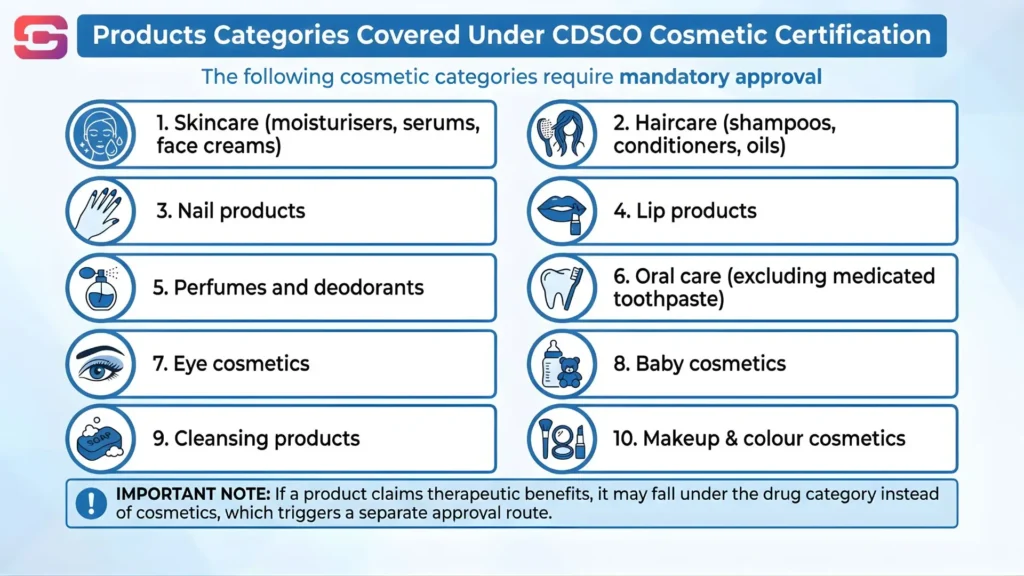
Import registration applies to virtually every finished cosmetic product entering India, categorised under the Fourth Schedule of the Cosmetics Rules, 2020. Common categories importers register include:
| Product Category | Typical Products | Special Documentation Needed |
| Skincare | Creams, lotions, serums, face wash, moisturisers | Standard formulation and label review |
| Makeup | Foundation, lipstick, mascara, eyeliner, nail polish, blush | Shade/variant-wise declaration |
| Sun Care | Sunscreen, SPF foundation/BB cream, after-sun products | SPF substantiation test data |
| Haircare | Shampoo, conditioner, hair oil, hair colourants | pH/stability data for colourants |
| Oral Care | Toothpaste, mouthwash, teeth-whitening products | BIS-specific formulation standards |
| Fragrance | Perfumes, deodorants, body mists | Alcohol content and flammability declaration |
| Baby Care | Baby lotion, baby shampoo, baby powder | Additional safety substantiation typically expected |
| Personal Care | Soaps, body wash, talcum powder, antiperspirants | Standard formulation and label review |
Benefits of Cosmetic Registration For Importers
- Legal customs clearance — a valid COS-2 prevents detention, rejection, or confiscation of consignments at Indian ports.
- Marketplace and retail eligibility — e-commerce platforms and organised retailers require COS-2 details before listing an imported cosmetic brand.
- Consumer trust — the registration number on the label signals that the product meets Indian safety and quality standards.
- Long validity — a single COS-2 stays valid for 5 years, minimising repeat filing effort.
- Multi-product efficiency — one COS-1 application can cover several products, variants, and manufacturing sites of the same brand.
- Access to India's growing beauty and personal care market without setting up local manufacturing.
Eligibility, Requirements & Compliance Checklist
| Requirement | Details |
| Eligible Applicant | Manufacturer, authorised Indian agent, Indian subsidiary, or authorised importer |
| Manufacturer Authorisation | Mandatory, notarised/apostilled as per the First Schedule |
| Free Sale Certificate | Mandatory from the National Regulatory Authority of the country of origin |
| Product Standards | Must comply with the Ninth Schedule / BIS specifications |
| Categorisation | Every product mapped correctly under the Fourth Schedule (80+ categories) |
| Portal | SUGAM (Central Licensing Authority) |
| Timing | Registration required before import — post-import registration is not permitted |
Cosmetic Registration For Importers: Fees
Fees are prescribed under the Third Schedule of the Cosmetics Rules, 2020 and are payable in USD (or INR equivalent) through the Bharatkosh gateway.
| Fee Head | Amount |
| Registration/retention per product category | USD 1,000 (or INR equivalent) |
| Registration of each additional variant (shade/fragrance) | USD 50 |
| Grant/retention of registration for an additional manufacturing site | USD 500 |
| Registration certificate for an imported Kit (if opted for) | No fee, where all individual products are already registered |
| Retention/renewal fee (before 5-year expiry) | Same as the original category/variant/site fees |
Validity, Renewal & Approval Timeline
| Aspect | Details |
| Validity Period | 5 years from the date of grant of Form COS-2 |
| Renewal Trigger | Retention application with fee, filed before expiry |
| Approval Timeline | Up to 180 working days from complete application submission |
| Query Response | Applicant must respond promptly; delays extend the overall timeline |
| Additional Imports | Via Form COS-4/COS-4A once a product is already registered |
| Change Notification | Composition/label changes: within 15 days; constitution changes: within 180 days |
Common Mistakes to Avoid in Cosmetic Registration For Importers
- Importing consignments before COS-2 is granted — CDSCO does not permit post-import registration under any circumstance.
- Mis-categorizing a product under the wrong Fourth Schedule heading, which is one of the leading causes of CDSCO queries and delay.
- Inconsistent product names, addresses, or pack sizes across the Free Sale Certificate, authorization letter, and Form COS-1.
- Submitting a Free Sale Certificate that is not properly notarized, apostilled, or embassy-attested.
- Assuming a foreign manufacturer can apply directly — an authorized Indian entity must always hold the registration.
- Missing the 5-year retention filing deadline, which risks a lapse in the registration's validity.
- Overlooking SPF or performance-claim substantiation data for sunscreen and tinted sun-care products.
Conclusion
Cosmetic Registration For Importers is the gateway to India's cosmetics market for every overseas brand and Indian import business. Getting COS-1 right the first time — accurate Fourth Schedule categorization, a properly authenticated Free Sale Certificate, and consistent documentation — is what keeps the 180-day CDSCO review on track and avoids customs delays at the border.
Because import registration cannot be completed after goods arrive in India, planning the COS-1 filing well ahead of your first shipment, and working with an experienced CDSCO regulatory consultant where needed, is the safest way to enter the Indian market on schedule.
Frequently Asked Questions
What is Cosmetic Registration For Importers?
It is the mandatory CDSCO approval under the Cosmetics Rules, 2020 that allows a cosmetic product manufactured outside India to be legally imported, sold, and distributed in India, obtained by filing Form COS-1 and receiving Form COS-2.
What is the difference between COS-1 and COS-2?
Form COS-1 is the online application filed on the SUGAM portal to register a cosmetic for import. Form COS-2 is the Import Registration Certificate that CDSCO's Central Licensing Authority grants once the COS-1 application is approved.
Who can apply for COS-1?
Only the manufacturer, its authorised Indian agent, an Indian subsidiary of the manufacturer, or an importer authorised by the manufacturer can file Form COS-1. Foreign brands cannot apply directly.
How long does CDSCO cosmetic import registration take?
The Cosmetics Rules, 2020 allow up to 180 working days for CDSCO to process a COS-1 application and grant Form COS-2, depending on document completeness and how quickly queries are answered.
What is the validity of the COS-2 import registration certificate?
Form COS-2 is valid for 5 years from the date of grant and must be renewed through a retention application with the applicable fee before it expires.
Can cosmetics be imported before COS-2 is granted?
No. CDSCO does not permit post-import registration. Every consignment must already be covered by a valid COS-2 before it reaches Indian customs, or it risks detention or confiscation.
What documents are required for COS-1?
Key documents include a Certificate of Free Sale, manufacturer authorisation, product and ingredient list, labels, non-animal testing and Hexachlorophene declarations, and the manufacturing site's GMP details.
What are the CDSCO cosmetic import registration fees?
Fees under the Third Schedule are approximately USD 1,000 per product category, USD 50 per additional variant, and USD 500 per additional manufacturing site, payable through the Bharatkosh gateway.
Can one COS-1 application cover multiple products?
Yes. A single COS-1 application can include multiple cosmetic products, variants, and manufacturing sites of the same brand, subject to the applicable per-category, per-variant, and per-site fees.
Do e-commerce-only cosmetic brands need COS-2?
Yes. Cosmetics sold exclusively through online marketplaces still require a valid CDSCO Import Registration Certificate (COS-2) before they can be legally imported and sold in India.
How is a product's Fourth Schedule category determined?
Categorisation depends on the product's intended use, area of application, form, and any special claims such as SPF, anti-dandruff, or teeth whitening — not on marketing language alone.
Can I import an already-registered product without filing a fresh COS-1?
Yes. If a cosmetic is already registered under Form COS-2 by another entity, you can apply for an Import Registration Number in Form COS-4A using Form COS-4, without a fresh COS-1 filing.