
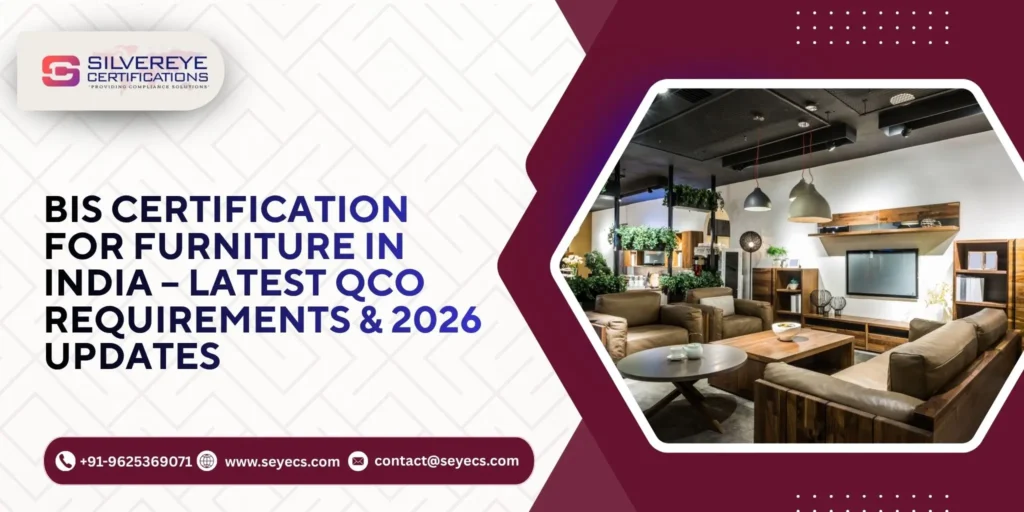
- The Furniture (Quality Control) Order, 2025 covers six furniture categories — work chairs, general-purpose chairs/stools, tables/desks, storage units, beds, and bunk beds — each mapped to its own IS 176xx:2022 standard.
- Certification is mandatory from 13 February 2026 for medium and large manufacturers, and from 13 August 2026 for micro and small enterprises, with furniture made purely for export exempted.
- Two 2026 gazette updates directly affect furniture compliance — a Second Amendment easing certain pre-committed imports, and a Transition Facilitation Order offering a time-bound sourcing route while certification is in process.
- Selling notified furniture without a valid ISI Mark after the applicable deadline can trigger seizure, penalties under the BIS Act, 2016, and blocked customs clearance.
Introduction
BIS Certification for Furniture is the mandatory ISI Mark license required under the Furniture (Quality Control) Order, 2025 for six notified furniture categories sold, manufactured, or imported in India: work chairs (IS 17631:2022), general-purpose chairs and stools (IS 17632:2022), tables and desks (IS 17633:2022), storage units (IS 17634:2022), beds (IS 17635:2022), and bunk beds (IS 17636:2022).

Certification is granted under BIS Scheme-I, combining a factory audit with laboratory testing. The QCO applies from 13 February 2026 for medium and large enterprises and from 13 August 2026 for micro and small enterprises; furniture manufactured solely for export is exempt. Two fresh 2026 gazette updates — a Furniture QCO Second Amendment easing certain in-transit imports, and a Transition Facilitation Order offering a temporary sourcing route — shape how businesses should plan their compliance timeline.
What Is BIS Certification for Furniture?
Furniture is one of those product categories that touches almost every home, office, school, and hospital in the country — and for years, it sat outside any uniform national safety benchmark. A wobbly bunk bed, an office chair that tips under normal use, or a storage unit that collapses under its own load aren't rare complaints; they're the kind of everyday failures a proper standard is built to prevent.
The Ministry of Commerce and Industry, through the Department for Promotion of Industry and Internal Trade (DPIIT), closed that gap with the Furniture (Quality Control) Order, 2025 — notified on 13 February 2025 (Gazette Notification S.O. 801(E)) after consultation with BIS. The Order brings six specific furniture categories under mandatory BIS certification, meaning each covered product must carry the BIS Standard Mark (ISI Mark) before it can legally be manufactured, imported, or sold in India.

Certification runs under BIS Scheme-I — the same product-certification route used for cement, LPG cylinders, and toys — which combines an on-site factory audit with independent laboratory testing, rather than the lighter self-declaration model used for CRS-based electronics registration.
Furniture Categories Covered — Product Table with IS Standards
The Furniture QCO 2025 currently notifies six furniture categories, each governed by its own dedicated Indian Standard published in 2022. Here's the complete breakdown:
| Furniture Category | IS Standard | What It Typically Covers |
|---|---|---|
| Work Chairs | IS 17631:2022 | Ergonomic office/work seating — revolving chairs, executive chairs, task chairs, operator chairs, adjustable seating for adult use in professional environments. Excludes industrial chairs used outside office settings. |
| General-Purpose Chairs & Stools | IS 17632:2022 | Everyday seating for domestic, office, educational, and commercial use — plastic chairs, wooden chairs, metal chairs, folding chairs, dining chairs, visitor chairs, bar stools, counter stools. |
| Tables & Desks | IS 17633:2022 | Dining tables, study tables, office desks, coffee tables, side tables, centre tables, foldable tables, and computer desks, checked for structural, stability, and durability requirements. |
| Storage Units | IS 17634:2022 | Wardrobes, cabinets, bookshelves, cupboards, chest of drawers, sideboards, and TV units — assessed for structural safety and stability under load. |
| Beds | IS 17635:2022 | Single, double, and other standard bed frames intended for household, hospitality, and institutional use, tested for load-bearing and structural strength. |
| Bunk Beds | IS 17636:2022 | Stacked/bunk-style bed structures, with additional safety requirements around guardrails, ladder strength, and fall-prevention given the higher risk profile of this format. |
Each Indian Standard has its own defined product scope and specific exclusions — not every item that looks like it belongs in a category is automatically covered. If you manufacture or import furniture close to these boundaries, it's worth getting a formal scope assessment done against the exact IS clauses rather than assuming applicability either way.
2026 Regulatory Updates You Need to Know
1. Furniture (Quality Control) Order, 2025 — Timeline So Far
The principal Furniture QCO was notified on 13 February 2025 (S.O. 801(E)) and has already gone through two amendments: the first on 12 February 2026 (S.O. 774(E)), and the second — the Furniture (Quality Control) Second Amendment Order, 2026 — on 2 March 2026 (Gazette Notification S.O. 1125(E)).
The base implementation date is 13 February 2026 for medium and large enterprises (annual turnover above ₹50 crore); micro and small enterprises get an extended runway, with the requirement applying from 13 August 2026. Furniture manufactured purely for export remains exempt from the Order.
2. Furniture QCO Second Amendment Order, 2026 — Import Relief for In-Transit Goods
Notified on 2 March 2026 under Section 16 of the BIS Act, 2016, this amendment inserts two additional provisos into paragraph 2 of the Furniture QCO, right after the sixth existing proviso. In effect, it protects import consignments that were already committed before the implementation date from being caught out by the new requirement:
- Consignments where the Bill of Lading was issued before the implementation date, and the Bill of Entry is dated on or before 180 days after implementation, are not required to comply with the QCO for that specific shipment.
- Similarly, goods where the purchase order was placed before the implementation date, and both the Bill of Lading and Bill of Entry fall within 180 days of implementation, are also exempt for that consignment.
- Importers relying on either relief must submit a signed copy of the purchase order, Bill of Lading, Bill of Entry, and other supporting documents to BIS, on their letterhead, within 7 days of clearing the consignment.
This is genuinely useful for furniture importers with shipments already committed before 13 February 2026 — it stops goods ordered in good faith before the deadline from being stranded at customs, as long as the documentation trail is complete and submitted on time.
3. Transition Facilitation (Quality Control) Order, 2026
Separately, DPIIT notified the Transition Facilitation (Quality Control) Order, 2026 on 25 June 2026 (Gazette Notification S.O. 3417(E)). This Order applies to ten listed QCOs — including the Furniture (Quality Control) Order, 2025 as entry 9 in its Schedule — alongside toys, footwear, air conditioners, water heaters, washing machines, hinges, and household electrical appliances.
It doesn't relax IS 1763x:2022 compliance itself — furniture still has to conform to the applicable Indian Standard. What it adds is a structured permission mechanism: a company incorporated under the Companies Act, 2013 can apply to DPIIT for permission to keep sourcing notified furniture from an already BIS-licensed manufacturer (under Scheme-II of the BIS Conformity Assessment Regulations, 2018) while its own certification is still in progress, subject to a risk assessment by a dedicated Implementation Committee.
- Applications for this transition permission are accepted for 24 months from 25 June 2026.
- The Implementation Committee — chaired by a DPIIT Additional/Joint Secretary and including representatives from BIS, Consumer Affairs, Commerce, and the DGFT — assesses applicants on technical capability, quality-assurance practices, compliance history, and their commitment to building India-based supply capacity.
- Permission may be suspended, modified, or withdrawn if conditions are breached, facts are misrepresented, or products fail to conform — after an opportunity to be heard.
- The Order itself remains in force for 5 years from commencement unless extended, and any permission already granted continues for its specified period even if the Order later lapses.
For furniture manufacturers or importers still working through certification as the February or August 2026 deadlines close in, this transition route is worth evaluating seriously — but treat it as a bridge, not a replacement, for holding your own ISI Mark license. Detailed application guidelines are expected on dpiit.gov.in, and it's worth confirming the current requirements there before relying on this route.
Why BIS Certification Matters for Furniture Manufacturers
Legal & Market Access
- A valid ISI Mark license is the legal minimum to manufacture, import, or sell notified furniture in India once the applicable QCO deadline passes.
- Certified products clear customs without the delays and detentions uncertified shipments face after the compliance date.
Safety & Product Reliability
- Structural, load, and stability testing catches design weaknesses in chairs, tables, storage units, and beds before they reach a home or workplace.
- Bunk-bed-specific safety checks address fall-prevention and guardrail strength — genuinely higher-risk features that generic furniture testing wouldn't catch.
Business & Procurement Benefits
- Government offices, PSUs, schools, and large institutional buyers increasingly specify BIS-certified furniture in tenders.
- Corporate procurement and workplace-safety audits favour ISI-marked furniture, reducing compliance risk on both sides of the sale.
- The ISI Mark strengthens retail and e-commerce credibility, especially for brands selling into enterprise, government, and hospitality buyers.
Who Needs BIS Certification for Furniture
- Indian manufacturers producing any of the six notified furniture categories at a facility located in India.
- Foreign manufacturers exporting notified furniture into India, through the Foreign Manufacturers Certification Scheme (FMCS).
- Brand owners and importers selling notified furniture under their own brand, once sourced from a certified or certifying manufacturer.
The ISI Mark license is issued to the manufacturer. Foreign manufacturers must appoint an Authorized Indian Representative (AIR) to handle filings and BIS communication.
Separate licenses are required for each manufacturing location and for each furniture category — a company making both work chairs and beds, for instance, needs separate applications under IS 17631:2022 and IS 17635:2022. Furniture manufactured purely for export is exempt from this requirement.
Eligibility Checklist Before You Apply For Furniture
1. Confirm which of the six furniture categories your product falls under and identify the exact applicable IS 176xx:2022 standard.
2. Have an operational manufacturing facility ready for a BIS factory audit, with the machinery needed for that furniture category.
3. Arrange in-house or accessible testing capability for load, stability, and durability checks as specified under BIS's Scheme of Inspection and Testing.
4. Set up a documented quality-control system with trained personnel and production records.
5. Be ready to accept the factory audit at grant stage and periodic BIS surveillance visits afterward.
Documents Required for BIS Certification of Furniture
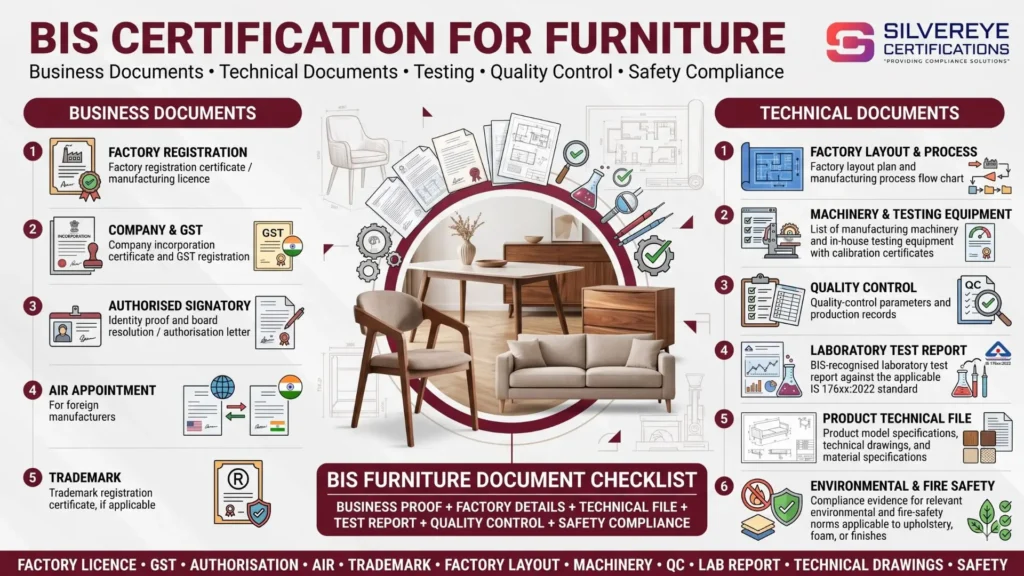
Business Documents
• Factory registration certificate / manufacturing licence
• Company incorporation certificate and GST registration
• Authorised signatory's identity proof and board resolution / authorisation letter
• AIR appointment documents (for foreign manufacturers)
• Trademark registration certificate, if applicable
Technical Documents
• Factory layout plan and manufacturing process flow chart
• List of manufacturing machinery and in-house testing equipment with calibration certificates
• Quality-control parameters and production records
• BIS-recognised laboratory test report against the applicable IS 176xx:2022 standard
• Product model specifications, technical drawings, and material specifications
• Compliance evidence for relevant environmental and fire-safety norms applicable to upholstery, foam, or finishes
Step-by-Step BIS Certification Process for Furniture
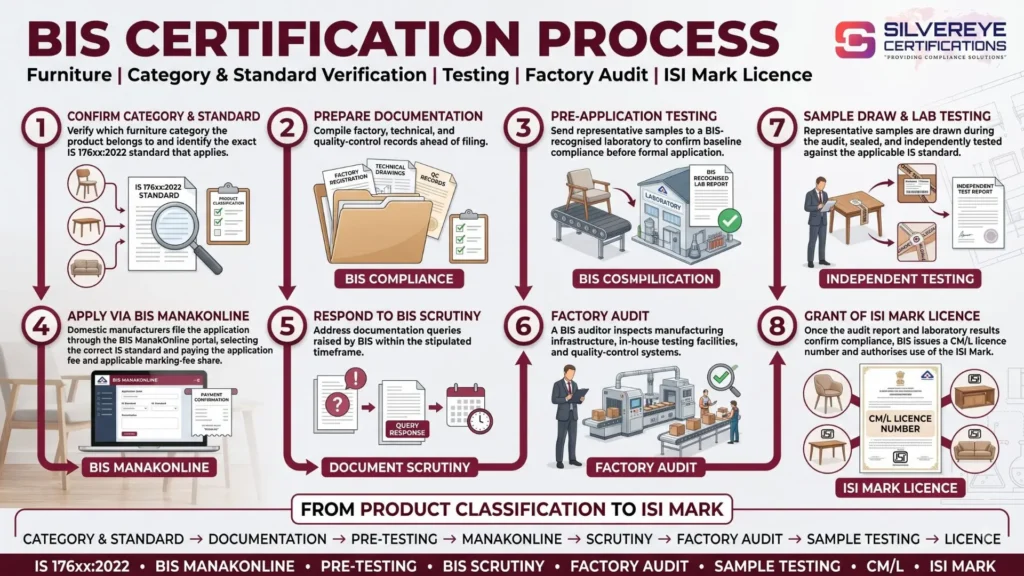
- Confirm category and standard: Verify which furniture category your product belongs to and the exact IS 176xx:2022 standard that applies.
- Prepare documentation: Compile factory, technical, and quality-control records ahead of filing.
- Pre-application testing: Send representative samples to a BIS-recognized laboratory to confirm baseline compliance before formal application.
- Apply via BIS Manak Online portal: Domestic manufacturers file the application selecting the correct IS standard, along with the application fee and applicable marking-fee share.
- Respond to BIS scrutiny: Address any documentation queries raised by BIS within the stipulated timeframe.
- Factory audit: A BIS auditor inspects manufacturing infrastructure, in-house testing facilities, and quality-control systems.
- Sample draw and lab testing: Representative samples are drawn during the audit, sealed, and independently tested against the applicable IS standard.
- Grant of ISI Mark license: Once the audit report and lab results confirm compliance, BIS issues a CM/L license number and authorizes use of the ISI Mark.
BIS Certification Fees for Furniture — Indicative Structure
| Particulars | Approx. Fee | Notes |
|---|---|---|
| Application fee | ₹1,000 | One-time, paid at filing, per category applied for |
| Preliminary inspection charges | ₹7,000 approx. | Covers the initial factory audit visit |
| Annual licence fee | ₹1,000 per year, per category | Payable for each year the licence remains active |
| Minimum marking fee | As applicable, MSME concessions available | Micro ~80% concession, Small ~50%, Medium ~20% — indicative slabs |
| Laboratory testing fee | Varies by lab, category, and models tested | Separate from BIS government fees |
These figures are indicative, based on published BIS Scheme-I fee patterns for factory-audit-based product categories. Actual charges depend on how many furniture categories you're certifying, the number of models within each, and testing scope. Always confirm the current fee schedule on the official BIS website or the ManakOnline portal before budgeting.
Validity, Renewal & Compliance Timeline
| Stage | Timeline | Action Required |
|---|---|---|
| Furniture QCO implementation — medium/large enterprises | 13 February 2026 | ISI licence required before this date for continued sale |
| Furniture QCO implementation — micro/small enterprises | 13 August 2026 | Additional runway before mandatory compliance applies |
| Import relief window (Second Amendment, 2026) | Up to 180 days post-implementation | Applies only to consignments with pre-implementation PO/Bill of Lading, subject to document submission within 7 days of clearance |
| Transition Facilitation application window | 24 months from 25 June 2026 | For companies seeking interim sourcing permission while certification is in process |
| Initial ISI licence validity | 1 year from date of grant | Renewal must be filed before expiry to avoid a lapse |
| Certification processing time | Approx. 30–60 days (Indian manufacturers) | Depends on documentation, lab scheduling, and audit timing |
Because these are recent notifications and BIS periodically issues further amendments or clarifications, always cross-check the current position on bis.gov.in, the ManakOnline portal, or dpiit.gov.in before finalising your compliance timeline.
Enforcement & Penalties for Non-Compliant Furniture
- Seizure of unregistered furniture stock at factories, warehouses, showrooms, or dealer premises during BIS market-surveillance drives.
- Monetary penalties and prosecution under the BIS Act, 2016, for manufacturing, importing, or selling notified furniture without a valid ISI licence after the applicable QCO date.
- Rejection or detention of imported consignments at customs, except where the Second Amendment's import-relief provisos genuinely apply.
- Suspension or cancellation of an existing BIS licence for repeated or serious non-conformance.
- Loss of eligibility for government, institutional, and large corporate tenders that mandate BIS-certified furniture.
Common Mistakes Furniture Manufacturers Should Avoid
- Applying under the wrong IS standard because of overlap between categories — for instance, confusing general-purpose chairs (IS 17632) with ergonomic work chairs (IS 17631).
- Assuming the MSE compliance window (13 August 2026) applies without confirming actual turnover-based enterprise classification.
- Treating the Second Amendment's import relief as automatic — it applies strictly to consignments meeting the specific PO/Bill of Lading/Bill of Entry dating conditions, with mandatory document submission within 7 days of clearance.
- Relying on the Transition Facilitation Order as a permanent substitute for obtaining your own ISI licence rather than a time-bound bridge.
- Filing one certification for a product line that actually spans two categories (e.g., a combo desk-and-storage unit) without confirming whether separate applications are needed.
- Overlooking that export-only furniture is exempt, and unnecessarily certifying stock that will never enter the Indian market.
Getting Your Furniture BIS-Ready — With Silvereye Certifications
With six different IS standards, two fresh amendment orders in 2026, and two separate implementation dates depending on enterprise size, furniture certification has quietly become one of the more layered compliance exercises a manufacturer can take on. Working out which standard actually applies to a borderline product, preparing for a genuine factory audit, and figuring out whether the Second Amendment's import relief or the Transition Facilitation Order's sourcing route is relevant to your specific shipment — all of that is easier with someone who tracks these notifications for a living.
Silvereye Certifications works with furniture manufacturers and importers across all six notified categories — confirming the correct IS 176xx:2022 standard for your product, preparing the factory and documentation for the BIS audit, coordinating load and durability testing with the right recognised laboratories, and mapping out whether the 2026 transition provisions genuinely apply to your business. For overseas manufacturers, the team can also step in as your Authorized Indian Representative under FMCS.
If you're racing the February or August 2026 deadline, sitting on an import shipment that might qualify for relief under the Second Amendment, or simply trying to work out which of the six IS standards your product range actually falls under, Silvereye Certifications is a practical place to get that mapped out before the deadline arrives.
Frequently Asked Questions
Is BIS certification mandatory for all furniture in India?
No — only the six categories notified under the Furniture (Quality Control) Order, 2025 are mandatory: work chairs, general-purpose chairs and stools, tables and desks, storage units, beds, and bunk beds. Other furniture types not listed in the QCO are not currently covered.
Which IS standards apply to which furniture category?
Work chairs fall under IS 17631:2022, general-purpose chairs and stools under IS 17632:2022, tables and desks under IS 17633:2022, storage units under IS 17634:2022, beds under IS 17635:2022, and bunk beds under IS 17636:2022.
When does the Furniture QCO become mandatory?
The QCO applies from 13 February 2026 for medium and large enterprises (turnover above ₹50 crore), and from 13 August 2026 for micro and small enterprises. Furniture manufactured solely for export is exempt.
What does the Furniture QCO Second Amendment Order, 2026 change?
Notified on 2 March 2026, it adds import relief for consignments already committed before the implementation date — specifically where the Bill of Lading was issued, or the purchase order placed, before implementation, with the Bill of Lading and Bill of Entry falling within 180 days after implementation. Supporting documents must be submitted to BIS within 7 days of clearing the consignment.
What is the Transition Facilitation (Quality Control) Order, 2026, and does it apply to furniture?
It's a DPIIT order notified on 25 June 2026 that lists ten QCOs, including the Furniture (Quality Control) Order, 2025. It lets eligible companies apply for time-bound permission to source notified furniture from an already BIS-licensed manufacturer while their own certification is in process — it does not remove the requirement to eventually hold your own ISI licence.
Do I need separate BIS licenses for different furniture categories?
Yes. Each furniture category is certified against its own IS standard, so a manufacturer producing, say, both beds and storage units needs separate applications under IS 17635:2022 and IS 17634:2022 respectively.
Does furniture certification require a factory audit?
Yes. All six categories are certified under BIS Scheme-I, which includes an on-site factory audit of manufacturing infrastructure, in-house testing facilities, and quality-control systems, in addition to laboratory testing.
How long does the certification process take, and how long is the licence valid?
For Indian manufacturers, the process typically takes around 30 to 60 days depending on documentation and audit scheduling. The ISI licence is generally granted for 1 year and must be renewed before expiry.
Can foreign furniture manufacturers get BIS certification?
Yes, through the BIS Foreign Manufacturers Certification Scheme (FMCS). The manufacturer must appoint an Authorized Indian Representative (AIR) in India, and the technical requirements are identical to those for domestic manufacturers.
Is furniture made only for export covered under the QCO?
No. Furniture manufactured exclusively for export is exempt from the Furniture (Quality Control) Order, 2025.
What happens if I sell notified furniture without BIS certification after the deadline?
Non-compliant stock can be seized, penalties can apply under the BIS Act, 2016, and imported consignments can be held or rejected at customs — unless the shipment genuinely qualifies for the Second Amendment's pre-implementation import relief.
Where can I confirm the latest official rules on furniture certification?
Cross-check current process details, QCO notifications, and amendment orders on the official BIS website (www.bis.gov.in), the ManakOnline portal, and DPIIT's website (www.dpiit.gov.in), since these are updated periodically.