
- Any cosmetic manufactured or imported in India must be licensed under the Drugs and Cosmetics Act, 1940 and Cosmetics Rules, 2020 before sale or distribution.
- Manufacturers apply via COS-5 (application) and receive COS-8 (grant of license); importers apply via COS-1 and receive COS-2 from CDSCO.
- Loan licensees — brands that outsource production — must obtain a separate COS-9 license and meet specific eligibility conditions.
- Licenses are valid for 5 years and must be renewed before expiry to avoid penalties, product recalls, or cancellation.
What is CDSCO Cosmetic License Registration?
CDSCO (Central Drugs Standard Control Organization) cosmetic license registration is the mandatory regulatory approval required to manufacture, import, or sell cosmetics in India. Governed by the Drugs and Cosmetics Act, 1940 and the Cosmetics Rules, 2020, it ensures that every cosmetic product — from lipstick to shampoo to sunscreen — meets India's safety, quality, and labelling standards before reaching consumers. The process involves submitting prescribed COS forms to the State Licensing Authority (for manufacturing) or CDSCO (for imports), along with technical documents, and paying the specified fees.
Governing Law and Regulatory Authority
| Regulatory Instrument | Scope | Authority |
| Drugs and Cosmetics Act, 1940 | Primary legislation covering cosmetics definition, offences, penalties | Parliament of India |
| Cosmetics Rules, 2020 | Licensing forms, fees, documents, GMP standards, labelling norms | Ministry of Health & Family Welfare |
| CDSCO | Cosmetic import licensing, port-level enforcement, policy | Central Government |
| State Licensing Authority (SLA) | Manufacture license, loan license, state-level enforcement | State Government |
| Schedule M-II | GMP standards for cosmetic manufacturers | Cosmetics Rules, 2020 |
Types of Cosmetic Licenses in India
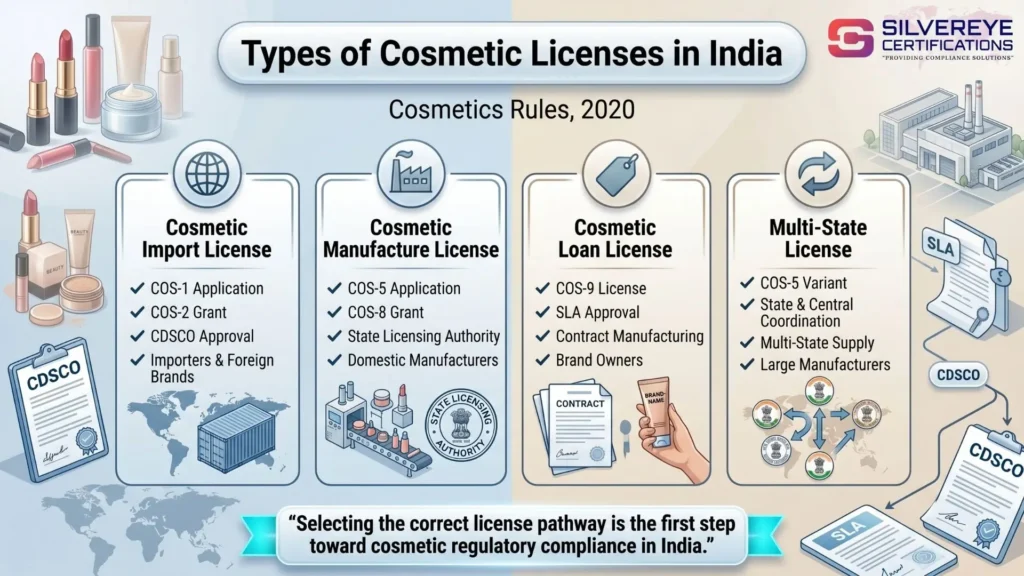
There are four primary licensing pathways for cosmetics under the Cosmetics Rules, 2020. Each pathway uses a specific COS form for application and grant.
| License Type | Applicable Form | Issuing Authority | Who Needs It |
| Cosmetic Import License | COS-1 (Application), COS-2 (Grant) | CDSCO (Central) | Importers / Indian agents of foreign brands |
| Cosmetic Manufacture License | COS-5 (Application), COS-8 (Grant) | State Licensing Authority (SLA) | Domestic manufacturers |
| Cosmetic Loan License | COS-9 (Application & Grant) | State Licensing Authority (SLA) | Brand owners outsourcing production to licensed units |
| Cosmetic Multi-State License | COS-5 variant | State / Central coordination | Manufacturers supplying across multiple states |
Cosmetic Product Categories Requiring License
Under the Cosmetics Rules, 2020, a "cosmetic" is any article intended for use on the human body for cleansing, beautifying, promoting attractiveness, or altering appearance — excluding soap. The following table lists major product categories, representative products, and the applicable license type.
| Category | Representative Products | License Required |
| Skin Care | Moisturiser, sunscreen (SPF), face wash, toner, serum, anti-ageing cream, fairness cream | COS-8 (Manufacture) / COS-2 (Import) |
| Hair Care | Shampoo, conditioner, hair oil, hair dye, hair mask, anti-dandruff treatment | COS-8 / COS-2 |
| Oral Care | Toothpaste, mouthwash, teeth-whitening gel, lip balm with SPF | COS-8 / COS-2 |
| Colour Cosmetics | Lipstick, lip gloss, foundation, mascara, kajal, eye shadow, nail polish, blush | COS-8 / COS-2 |
| Fragrances & Deodorants | Perfume, cologne, body spray, deodorant, antiperspirant | COS-8 / COS-2 |
| Baby Cosmetics | Baby powder, baby oil, baby lotion, baby shampoo, diaper rash cream | COS-8 / COS-2 (enhanced scrutiny) |
| Men's Grooming | Shaving cream, aftershave lotion, beard oil, face scrub | COS-8 / COS-2 |
| Herbal / Ayurvedic Cosmetics | Herbal face pack, neem shampoo, henna, plant-based serum | COS-8 / COS-2 (Ayurveda cosmetics follow D&C Act Schedule Q) |
| Professional Salon Products | Chemical hair relaxer, permanent wave lotion, bleach cream | COS-8 / COS-2 |
| Loan-Licensed Products | Any of above manufactured by third-party unit for brand owner | COS-9 |
Cosmetic Import License Registration (COS-1 & COS-2)
Any person who wishes to import cosmetics into India for sale must obtain a Cosmetic Import License from the CDSCO. The application is made using Form COS-1, and the license is granted in Form COS-2. This process is centralized at CDSCO, New Delhi, and the application may be submitted online via the SUGAM portal.
Who Needs a Cosmetic Import License?
- Foreign cosmetic brand entering the Indian market
- Indian importer / authorized agent acting on behalf of a foreign manufacturer
- E-commerce sellers importing and selling cosmetics directly
- Distributors receiving bulk cosmetics from overseas for repackaging and sale
Form COS-1: Application for Cosmetic Import License
Form COS-1 is the prescribed application format under the Cosmetics Rules, 2020 for obtaining permission to import cosmetics. The applicant submits COS-1 along with the required documents and fees to the Central Licensing Authority (CDSCO).
| Field in COS-1 | Details Required |
| Applicant details | Name, address, PAN, nature of business (importer / Indian agent) |
| Foreign manufacturer details | Name, address, country, manufacturing site address |
| Product details | Brand name, generic name, product category, intended use, formulation (complete ingredient list with INCI names) |
| Pack sizes | All SKU sizes in which the product will be imported |
| Labelling | Draft label for Indian market (compliant with Cosmetics Rules Schedule XI) |
| Safety & stability data | Safety assessment report (SAR), stability data as per Schedule VII |
| Import quantity / period | Estimated import volume and validity period sought |
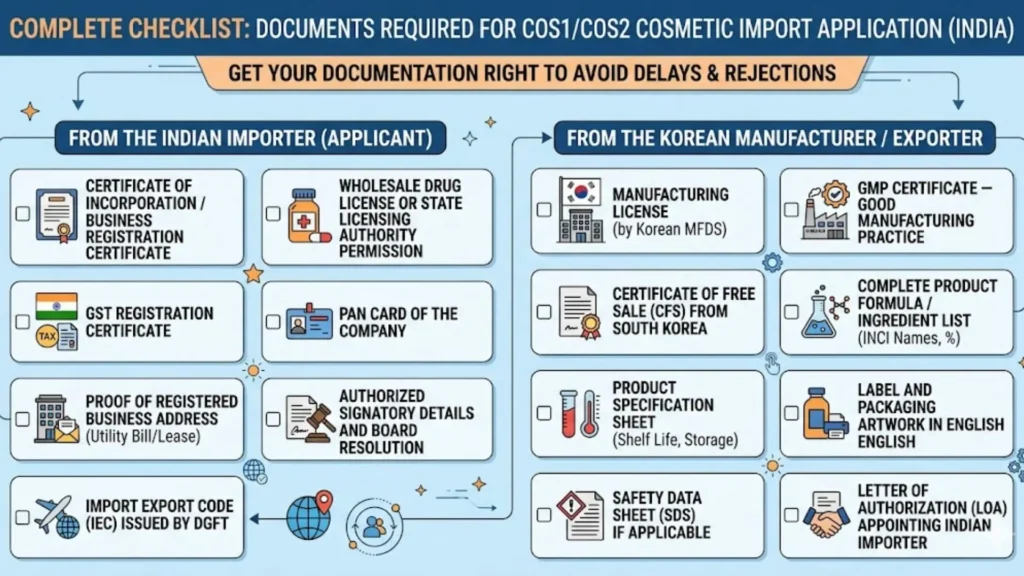
Documents Required for COS-1 Application
- Duly filled Form COS-1
- Certificate of Free Sale (CFS) / Certificate of Pharmaceutical Product (CoPP) from the country of origin — apostilled or notarised
- Good Manufacturing Practice (GMP) certificate of the foreign manufacturer issued by the competent authority
- Complete product formulation with INCI names and percentage composition
- Safety Assessment Report (SAR) as per Schedule VII of Cosmetics Rules, 2020
- Stability data (minimum 6 months accelerated or 12 months real-time) as per Schedule VIII
- Labelling and packaging details (draft label, all languages)
- Power of Attorney / Authorization letter from foreign manufacturer to Indian applicant
- ISO 22716 (Cosmetic GMP) certificate of the foreign manufacturer
- Undertaking regarding product safety and compliance with Indian cosmetics regulations
- Proof of import (import-export code / IEC)
- Challan / fee payment proof
Form COS-2: Grant of Cosmetic Import License
Once CDSCO reviews the COS-1 application, verifies documents, and is satisfied with compliance, it issues the Import License in Form COS-2. COS-2 specifies the licensed products, quantity, pack sizes, and the period of validity. Each product or product range typically requires a separate license, though CDSCO may club related products under one license at its discretion.
| Important: The Indian applicant (importer / authorized agent) bears full responsibility for the product's compliance with Indian regulations throughout the license period. Any change in formulation, brand name, or manufacturer requires fresh application or amendment. |
Import License Fees (COS-1 / COS-2)
| Fee Head | Amount (INR) |
| Application fee per product (COS-1) | Rs. 500 per product |
| License grant fee (COS-2) | Rs. 1,000 per product |
| Renewal fee | Rs. 1,000 per product |
| Amendment fee | Rs. 500 per amendment |
| Late renewal penalty | Additional fee as applicable under Schedule II of Cosmetics Rules, 2020 |
Note: Fee amounts are as specified in the Cosmetics Rules, 2020. Always verify current fees on the CDSCO official website (cdsco.gov.in) or SUGAM portal before applying, as the government revises fee schedules periodically.
Cosmetic Manufacturing License Registration (COS-5 & COS-8)
Any person who intends to manufacture cosmetics in India for sale must obtain a Cosmetic Manufacturing License from the State Licensing Authority (SLA) of the state where the manufacturing premises are located. The application is made in Form COS-5, and the license is granted in Form COS-8.
Who Needs a Cosmetic Manufacturing License?
- Standalone cosmetic manufacturing units
- Pharmaceutical companies adding a cosmetic product line
- MSME units producing herbal, organic, or natural cosmetics
- OEM / contract manufacturers producing for other brands (under loan license arrangement)
- Companies setting up new greenfield cosmetic manufacturing plants
Eligibility Criteria for COS-5 / COS-8
| Criterion | Requirement |
| Premises | Dedicated manufacturing area conforming to Schedule M-II (GMP for cosmetics) |
| Technical Staff | Qualified technical staff — minimum a person with degree/diploma in pharmacy, chemistry, or relevant science |
| Equipment | Appropriate manufacturing, testing, and quality control equipment as per product category |
| Quality Control Lab | In-house or approved third-party lab for raw material and finished product testing |
| Water System | Purified water / deionised water system meeting pharmacopoeial standards (where applicable) |
| Storage | Adequate, hygienic storage for raw materials, packing materials, and finished goods |
| Legal Entity | Proprietorship, partnership, LLP, or company registered in India |
Form COS-5: Application for Manufacture License
Form COS-5 is the prescribed application under Cosmetics Rules, 2020 for a domestic manufacturing license. It is submitted to the State Licensing Authority (SLA), typically the State Drug Controller. Key sections of COS-5 include:
| Section | Information Required |
| Applicant / Firm Details | Name, address, PAN, GST, nature of entity, authorised signatory details |
| Premises Details | Complete address, built-up area, layout plan, ownership / lease deed |
| Products to be Manufactured | Product names, categories, forms (cream, lotion, powder, etc.) |
| Technical Personnel | Details of qualified technical staff (name, qualification, appointment letter) |
| Manufacturing Equipment | List of major equipment with makes and capacities |
| QC Arrangements | In-house or outsourced QC lab details, testing arrangements |
| Water System | Type of water system installed (purified / DM water) |
| Declaration | Undertaking by applicant regarding compliance with Cosmetics Rules, 2020 and Schedule M-II |
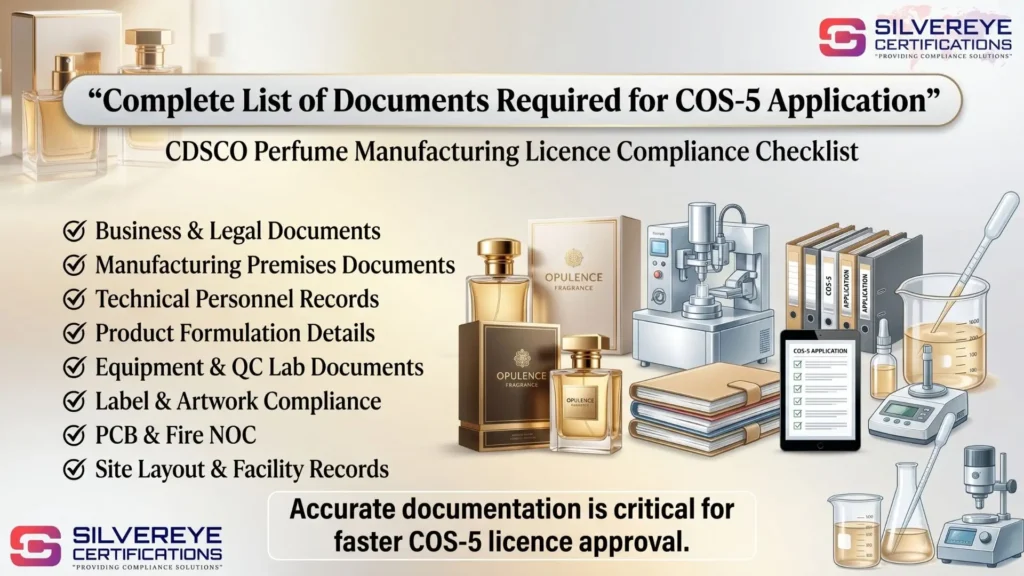
Documents Required for COS-5 Application
- Duly filled Form COS-5
- Site plan / layout plan of the manufacturing premises
- Proof of premises ownership or registered lease deed
- List of machinery and equipment with specifications
- Qualification certificates and appointment letters of technical staff
- Water analysis report (purified water / DM water)
- Product list with categories and intended forms
- Standard Operating Procedures (SOPs) for manufacturing and QC
- Environmental clearance / NOC from Pollution Control Board (if applicable)
- GST registration certificate
- Constitution of firm (MOA/AOA for companies; partnership deed; proprietorship declaration)
- Previous license copy (for renewal or expansion applications)
- Challan / fee payment receipt
Inspection Process
After submission of COS-5, the SLA schedules a physical inspection of the manufacturing premises. The inspection team verifies compliance with Schedule M-II GMP requirements. If deficiencies are observed, a deficiency notice is issued and the applicant must comply within the stipulated timeframe. Upon satisfactory inspection, the SLA grants the manufacturing license in Form COS-8.
- Application submission (Form COS-5 + documents + fee) to SLA
- Acknowledgment and scrutiny of documents by SLA
- Physical inspection of premises by SLA inspector
- Deficiency notice (if any) — applicant rectifies within 30 days
- Re-inspection (if required)
- Grant of Cosmetic Manufacturing License in Form COS-8
Form COS-8: Grant of Cosmetic Manufacturing License
Form COS-8 is the official license document issued by the State Licensing Authority confirming the grant of cosmetic manufacturing permission. COS-8 specifies the licensed premises address, product categories, special conditions (if any), and validity period. The licensee must display COS-8 prominently at the manufacturing premises.
Manufacturing License Fees (COS-5 / COS-8)
| Fee Head | Amount (INR) |
| Application fee (COS-5) | Rs. 3,000 (general categories); fees vary by state and product category |
| License fee (COS-8) | Rs. 5,000 – Rs. 10,000 (state-specific; check with your SLA) |
| Inspection fee | As applicable per state schedule |
| Renewal fee | Varies by state — typically 50–100% of original license fee |
| Amendment / additional product fee | Rs. 1,000 – Rs. 3,000 per amendment (state-specific) |
Note: Manufacturing license fees differ across states. Always confirm the current fee schedule with your State Drug Controller or SLA before submitting COS-5.
Cosmetic Loan License (COS-9)
A Cosmetic Loan License, applied for in Form COS-9, is issued by the State Licensing Authority (SLA) to a brand owner or marketing company that does not own a manufacturing facility but wishes to market cosmetics manufactured by a licensed third-party manufacturer. This arrangement is common for D2C brands, startups, and established FMCG companies launching new product lines.
When Do You Need a Loan License (COS-9)?
- Your brand owns the formula but outsources production to a contract manufacturer
- You are a D2C cosmetics brand without your own manufacturing plant
- You are a distributor who wants your own brand name on products made by an OEM
- You wish to add new product lines without investing in a separate manufacturing facility
| Key Difference: Under a loan license arrangement, the manufacturing facility (loan licensor) holds the COS-8 manufacturing license. The brand owner (loan licensee) holds COS-9, which permits them to manufacture — at the loan licensor's premises — under their own brand/label. The loan licensor and loan licensee must enter into a formal Loan License Agreement. |
Eligibility for Cosmetic Loan License (COS-9)
| Eligibility Criterion | Requirement |
| Loan Licensor (Manufacturer) | Must hold a valid Cosmetic Manufacturing License (COS-8) covering the products to be manufactured under the loan arrangement |
| Loan Licensee (Brand Owner) | Any legal entity (company, LLP, partnership, proprietorship) registered in India |
| Loan License Agreement | A registered or notarised agreement between loan licensor and loan licensee specifying products, responsibilities, quality accountability |
| Technical Responsibility | The loan licensor is technically responsible for manufacturing quality; the loan licensee is responsible for product labelling and marketing compliance |
| Premises | Manufacturing must take place at the loan licensor's licensed premises only — not at the loan licensee's premises |
Form COS-9: Application and Grant of Loan License
Unlike the manufacturing license process (COS-5 / COS-8), the loan license uses a single form — COS-9 — for both application and grant. COS-9 is submitted to the SLA of the state where the manufacturing (loan licensor's) premises are located.
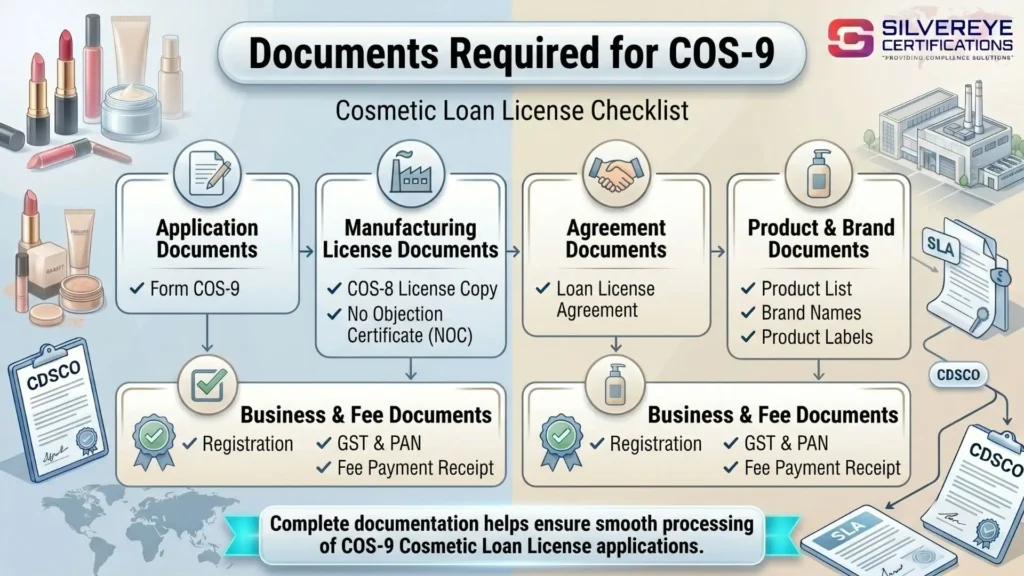
Documents Required for COS-9
- Duly filled Form COS-9
- Copy of valid COS-8 (manufacturing license) of the loan licensor
- Loan License Agreement (notarized / registered) between loan licensor and loan licensee
- Product list to be manufactured under the loan arrangement
- Brand name(s) and draft label for each product
- Proof of identity and address of the loan licensee (company incorporation certificate, GST, PAN)
- No-objection letter from the loan licensor
- Challan / fee payment receipt
COS-9 Process Timeline
- Submit COS-9 with documents to SLA
- SLA scrutinises documents and verifies loan licensor's COS-8 validity
- Site inspection of manufacturing premises (loan licensor's facility) may be conducted
- Grant of Loan License in Form COS-9
| Aspect | Loan Licensor (COS-8) | Loan Licensee (COS-9) |
| License Form | COS-8 | COS-9 |
| Manufacturing Premises | Owns / operates the facility | No manufacturing premises required |
| GMP Compliance | Directly responsible | Indirectly responsible via agreement |
| Label Name | Can appear as manufacturer | Brand name / label owner on product |
| Regulatory Accountability | Manufacturing quality | Labelling, claims, market compliance |
Benefits of Obtaining CDSCO Cosmetic License
- Legal Authorization: Only licensed entities can legally manufacture or import cosmetics for sale in India — the license protects your business from enforcement action.
- Market Access: Licensed products can be sold through all channels — retail, modern trade, e-commerce, and export — without regulatory challenges.
- Consumer Trust: A licensed cosmetic assures consumers of safety, quality, and regulatory oversight, strengthening brand credibility.
- Export Eligibility: Many export markets and international buyers require proof of domestic regulatory compliance as a prerequisite for acceptance.
- Investor Confidence: Licensing demonstrates regulatory maturity, making your brand more attractive to investors and institutional buyers.
- Avoidance of Penalties: Operating without a license under the Drugs and Cosmetics Act can lead to product seizure, fines, and criminal prosecution.
- GMP Compliance Uplift: The licensing process compels manufacturers to implement Schedule M-II GMP practices, improving product quality and reducing batch failures.
License Validity and Renewal
| License Type | Form | Validity Period | Renewal Timeline |
| Cosmetic Import License | COS-2 | 5 years from date of issue | Apply before expiry; renewal in COS-1 (renewal application) |
| Cosmetic Manufacturing License | COS-8 | 5 years from date of issue | Apply 3–6 months before expiry to SLA |
| Cosmetic Loan License | COS-9 | Co-terminus with COS-8 of licensor (max 5 years) | Renew with COS-8 renewal; new agreement required if licensor changes |
Key Points on Renewal
- Licenses not renewed before expiry lapse automatically; manufacturing or importing on an expired license is a violation.
- SLAs may grant a grace period for renewal but this varies by state — do not rely on grace periods.
- For COS-9 (loan license), if the loan licensor's COS-8 expires or is cancelled, all COS-9 licenses issued against that COS-8 are automatically affected.
- Renewal applications should be submitted with updated documents — staff changes, premises modifications, or product additions must be disclosed.
- CDSCO import license renewal (COS-2) requires updated CFS, GMP certificate, and stability data if expiry dates of supporting documents have lapsed.
Step-by-Step Application Process For CDSCO Cosmetic License Registration
For Cosmetic Import License (COS-1 → COS-2)
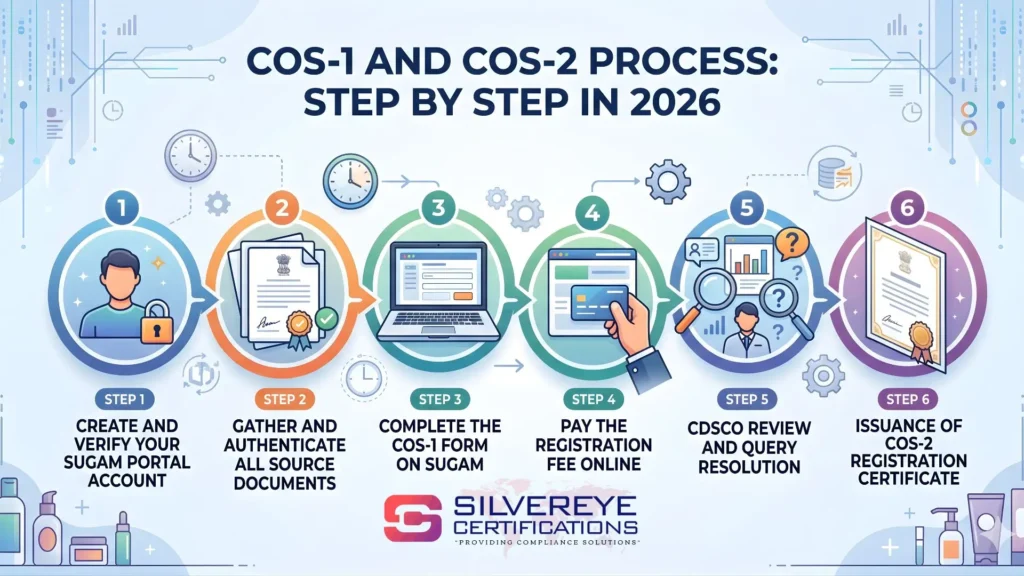
- Register on SUGAM portal as an importer
- Create product profile — upload formulation, SAR, stability data, CFS, GMP certificate
- Fill Form COS-1 online — product details, brand, manufacturer details
- Upload supporting documents and pay application fee online
- Submit application; receive acknowledgment with file number
- CDSCO scrutiny — queries raised, if any, via SUGAM portal
- Respond to queries and upload additional documents within stipulated period
- CDSCO grants import license in Form COS-2; download from SUGAM portal
For Cosmetic Manufacturing License (COS-5 → COS-8)
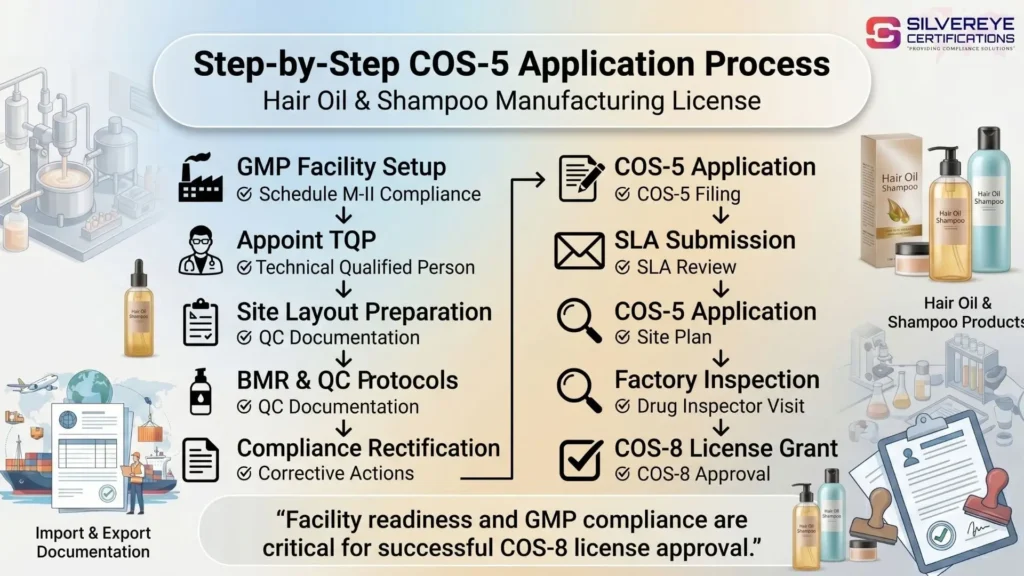
- Ensure premises comply with Schedule M-II GMP requirements
- Appoint qualified technical staff (pharmacist / chemist with relevant qualification)
- Prepare SOPs, equipment list, water analysis report, and product list
- Fill Form COS-5 and compile all required documents
- Submit COS-5 along with fee to the SLA (State Drug Controller's office)
- SLA sends an inspector for physical inspection of premises
- Address deficiencies (if any) within 30 days of deficiency notice
- SLA grants manufacturing license in Form COS-8 — display at premises
For Cosmetic Loan License (COS-9)
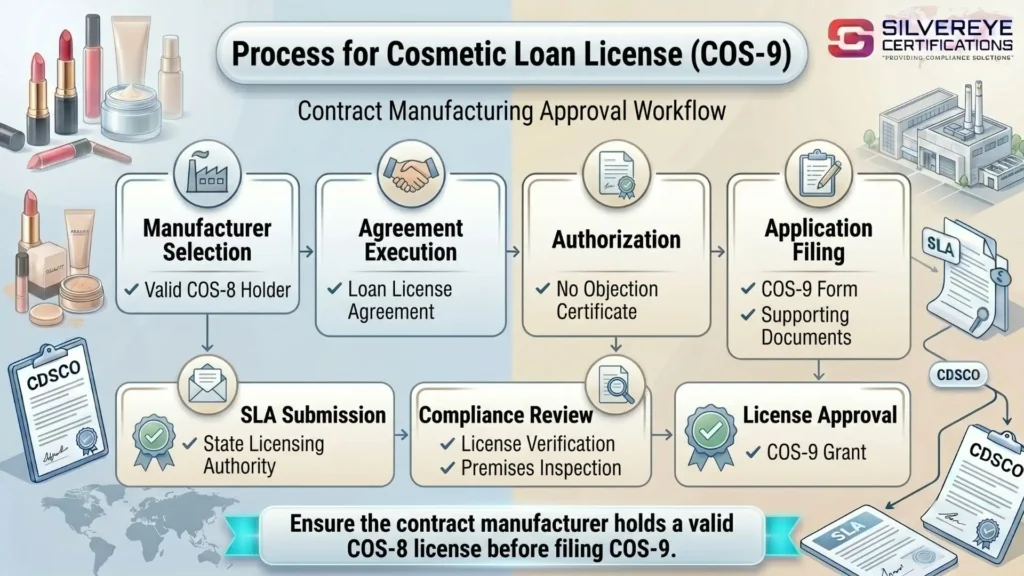
- Identify a licensed contract manufacturer (loan licensor holding valid COS-8)
- Execute a Loan License Agreement (notarized) specifying products and responsibilities
- Obtain a No-Objection Letter from the loan licensor
- Fill Form COS-9 and attach all required documents
- Submit COS-9 to the SLA of the state where the manufacturing premises are located
- SLA verifies loan licensor's COS-8 validity and may inspect premises
- SLA grants Loan License in Form COS-9
Post-License Compliance Requirements For CDSCO Cosmetic License Registration
Holding a cosmetic license comes with ongoing obligations. Non-compliance can lead to license suspension, cancellation, product recalls, and penalties under the Drugs and Cosmetics Act.
| Compliance Area | Requirement |
| Batch Records | Maintain batch manufacturing records (BMR) for every batch produced — minimum 3 years retention |
| Labelling | All products must carry labels compliant with Schedule XI of Cosmetics Rules, 2020 — brand name, INCI ingredient list, batch no., mfg. date, expiry date, net content, MRP, importer/manufacturer details |
| Testing | Every batch must be tested as per in-house or approved lab specifications before release |
| Adverse Event Reporting | Report serious adverse events related to cosmetic products to CDSCO |
| Change Notifications | Inform SLA / CDSCO of any changes in premises, formulation, technical staff, or brand name |
| Schedule M-II GMP | Continuous compliance with GMP standards; subject to periodic SLA inspection |
| Import Records (COS-2) | Maintain import records for each consignment — quantity, batch, country of origin |
Common Mistakes to Avoid CDSCO Cosmetic License Registration
- Submitting incomplete or outdated CFS / GMP certificates — ensure all foreign documents are apostilled and within validity.
- Using incorrect INCI names in the formulation — always verify with the International Nomenclature Cosmetic Ingredient database.
- Not disclosing all product variants (SKUs, pack sizes) in COS-1 — each unlisted variant is technically unlicensed.
- Failing to renew the loan licensor's COS-8 — this voids all COS-9 licenses issued against it.
- Ignoring Schedule M-II GMP compliance post-license — inspections can happen anytime after COS-8 is granted.
- Making label changes without informing the licensing authority — unauthorized label modifications are a compliance violation.
- Using a foreign brand name without proper trademark and authorization documentation.
Why Choose Silvereye Certifications for Your Cosmetic License?
Silvereye Certifications is a specialist regulatory compliance consultancy with deep expertise in CDSCO cosmetic licensing, Schedule M-II GMP advisory, SUGAM portal filings, and post-license compliance management. Our team has guided domestic manufacturers, international brands, and D2C startups through every stage of the cosmetic licensing journey.
- End-to-end assistance: COS-1, COS-2, COS-5, COS-8, and COS-9 applications
- Document preparation: SAR, stability data coordination, CFS apostille guidance
- SUGAM portal filing and status tracking
- Schedule M-II GMP gap assessment and remediation
- Loan License Agreement drafting and SLA liaison
- Post-license compliance audits and renewal management
Frequently Asked Questions
Is a CDSCO cosmetic license mandatory for selling cosmetics online in India?
Yes. Selling cosmetics online in India — on your own website or through e-commerce platforms like Amazon, Flipkart, or Nykaa — requires a valid CDSCO cosmetic license. Marketplaces increasingly demand regulatory compliance documentation before onboarding cosmetic sellers.
What is the difference between COS-1 and COS-5?
COS-1 is the application form for a Cosmetic Import License, submitted to CDSCO for products manufactured outside India. COS-5 is the application form for a Cosmetic Manufacturing License, submitted to the State Licensing Authority for domestically manufactured products. Both are separate pathways with different authorities and document requirements.
How long does it take to get a CDSCO cosmetic import license (COS-2)?
Typically 30 to 90 working days from the date of complete application submission, depending on CDSCO's workload, query responses, and completeness of documents. Applications with deficiencies take longer.
Can a startup or small brand get a cosmetic loan license (COS-9)?
Yes. COS-9 is specifically designed for brand owners who do not have their own manufacturing facility. Startups and D2C brands routinely use the loan license route to launch without capital-intensive factory investments, provided they partner with a licensed contract manufacturer holding a valid COS-8.
What happens if I sell cosmetics without a license in India?
Selling unlicensed cosmetics is a criminal offence under Section 18 of the Drugs and Cosmetics Act, 1940. Penalties include imprisonment up to 3 years, fine, or both. CDSCO and state drug authorities regularly conduct market surveillance and can seize products, issue notices, and initiate prosecution.
Do herbal and ayurvedic cosmetics also need CDSCO license?
Yes. Herbal and ayurvedic cosmetics sold as topical beauty or grooming products — not as medicines — fall under the Cosmetics Rules, 2020 and require the applicable COS license. However, products with therapeutic claims may be regulated as drugs or ayurvedic formulations and require different regulatory approvals under AYUSH.
What is a Safety Assessment Report (SAR) and is it mandatory for imports?
A Safety Assessment Report (SAR) is a scientific document evaluating the safety of a cosmetic formulation for human use, as mandated under Schedule VII of the Cosmetics Rules, 2020. It is mandatory for import license applications (COS-1).
Can I add new products to my existing manufacturing license (COS-8)?
Yes. You can apply to the SLA for an amendment to your existing COS-8 to include additional product categories. An amendment application with supporting documents and applicable fees must be submitted. Certain new categories may require a fresh inspection.
What is Schedule M-II and who does it apply to?
Schedule M-II is the Good Manufacturing Practices (GMP) standard for cosmetic manufacturers in India, prescribed under the Cosmetics Rules, 2020. It applies to all entities holding a COS-8 manufacturing license. It covers premises, equipment, personnel, production processes, quality control, documentation, and distribution records.
How do I renew a cosmetic import license (COS-2) before it expires?
Submit a renewal application (Form COS-1 with renewal indication) on the SUGAM portal at least 3 months before the expiry date. Attach updated CFS, GMP certificate, SAR, stability data (if expired), and pay the renewal fee.