
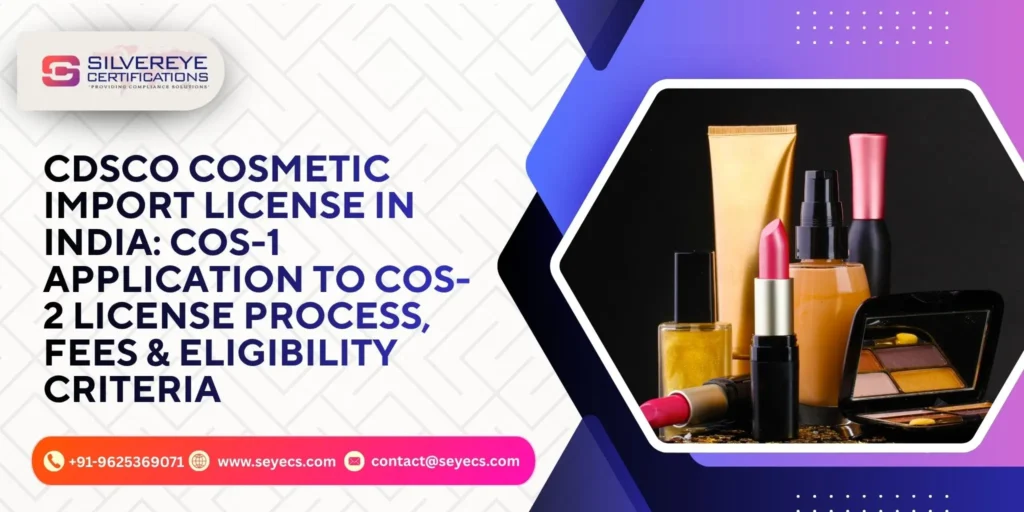
- CDSCO Cosmetic Import License mandates a COS-2 import license for every cosmetic brand entering India — no license means no customs clearance, full stop.
- The COS-1 application is filed online via the SUGAM portal; processing typically takes 30–90 working days depending on document completeness.
- Government fee starts at ₹3,000 per product per year; the license is valid for 3 years and must be renewed before expiry to avoid lapses.
- Missing a single mandatory document — GMP certificate, free sale certificate, or test report — is the single biggest reason applications get rejected or delayed.
Introduction
If you are a brand manager, an importer, or a regulatory consultant trying to bring foreign cosmetic products into India, you already know the process is not simple. The regulatory framework is strict, the paperwork is detailed, and one wrong step can mean months of delay or outright rejection at the port. This guide is designed to walk you through everything — from understanding why a cosmetic import license India CDSCO is legally mandatory, to filing your COS-1 application correctly and converting it into a COS-2 license, all the way to renewal.
Whether you are importing skincare from South Korea, hair care from France, or colour cosmetics from the United States, the rules are the same. And they are enforced. Customs officials at Indian ports routinely hold shipments without a valid import license. So let us get into the details.
Why Does India Regulate Cosmetic Imports So Strictly?
India classifies cosmetics under the Drugs and Cosmetics Act, 1940, and the Cosmetics Rules, 2020. This is the foundational law that governs what can be imported, sold, distributed, and manufactured in the country. The Central Drugs Standard Control Organization (CDSCO) is the apex regulatory body under the Ministry of Health and Family Welfare that issues import licenses for cosmetics.
Products that contain banned ingredients, fail safety tests, or carry false claims can cause genuine harm. India has seen incidents involving heavy metals in skin-lightening creams, undeclared steroids in topical products, and microbial contamination in eye care cosmetics. The import license system is the government's primary gate to filter out non-compliant products before they reach Indian consumers.
From a practical standpoint, if you are an importer and you do not hold a valid COS-2 license, your shipment will be seized at the port of entry. The customs department cross-checks every cosmetic consignment against CDSCO's licensed product database. Importing without a license is not just a regulatory lapse — it is a criminal offence under the Act, carrying fines and potential imprisonment.
It is also worth noting that the 2020 Cosmetics Rules brought sweeping changes to the older 1945 framework. The new rules streamlined online processing through the SUGAM portal, introduced product-specific licensing (each product needs its own license entry), and tightened requirements around GMP certification from the manufacturing country. If you were familiar with the old process, the 2020 rules changed the game significantly.
What Is the CDSCO Cosmetic Import License?
COS-1: The Application Form
COS-1 is the official application form that an importer submits to CDSCO to request permission to import a cosmetic product. Think of it as the formal petition. Each application covers one product (or sometimes a range of products from the same manufacturer, depending on how CDSCO categorizes them). The COS-1 form is filed electronically through the SUGAM portal at sugam.gov.in.
COS-2: The Import License
COS-2 is the actual license document issued by CDSCO after reviewing and approving the COS-1 application. This is the document your customs broker needs at the port of entry. Without a COS-2 license, your shipment cannot legally clear Indian customs. The COS-2 license mentions the product name, the manufacturer's details, the importer's details, the approved quantity (if applicable), and the validity period.
The Importer of Record
Only a licensed importer can hold a COS-2 license. The importer must have a valid drug license under Form 20B and 21B (for cosmetics, this is issued by the State Licensing Authority, or SLA, in the state where the importer's registered office is located). If you do not yet have a state drug license for cosmetics, you need to get that before applying to CDSCO.
| Term | What It Means | Issued By |
| COS-1 | Application form for import licence | Filed by Importer on SUGAM portal |
| COS-2 | The actual import licence document | Issued by CDSCO, New Delhi |
| SUGAM | Online portal for all regulatory submissions | CDSCO / NIC |
| SLA Licence | State-level drug licence for cosmetic import | State Licensing Authority |
| CDSCO | Central Drugs Standard Control Organisation | Ministry of Health & Family Welfare |
| GMP Certificate | Proof manufacturer follows Good Manufacturing Practices | Competent authority in country of origin |
| Free Sale Certificate | Confirms product is legally sold in country of origin | Embassy / Notarised by competent authority |
Who Needs a Cosmetic Import License in India?
This is a question that comes up constantly — and the answer is more inclusive than many people expect.
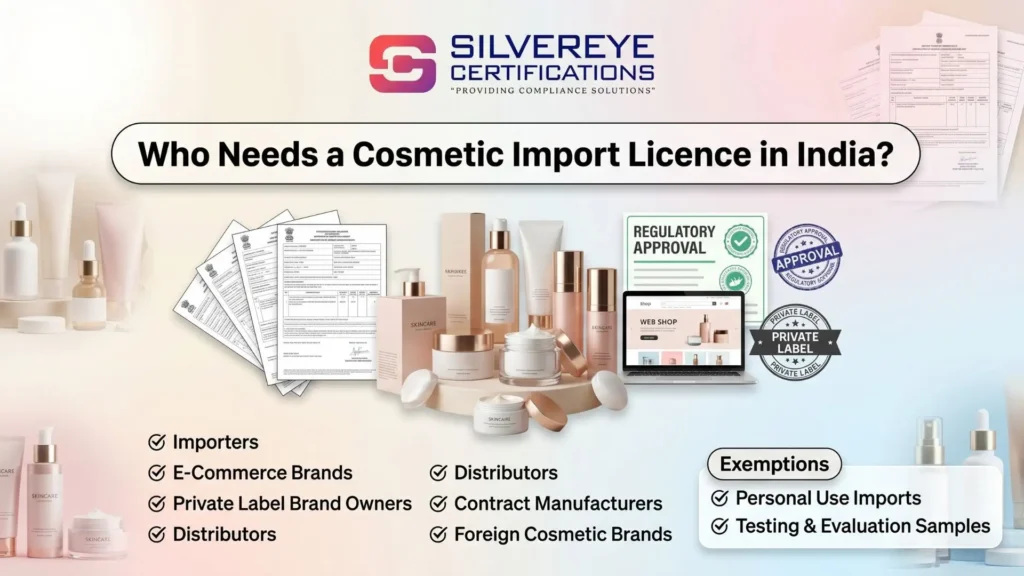
- Any company or individual importing cosmetics for commercial sale in India needs a COS-2 import license from CDSCO.
- E-commerce brands sourcing products from foreign manufacturers for resale on Indian platforms like Amazon, Nykaa, or Flipkart need a license.
- Contract manufacturers importing cosmetic raw materials that fall under the cosmetics definition under the Act need compliance clearance.
- Brand owners who have their products manufactured abroad under private label and then import them into India need their own license — the foreign manufacturer's certifications alone are not enough.
- Distributors who are the official Indian representative for a foreign cosmetic brand need a COS-2 in their name.
Personal use imports of small quantities (typically up to a few units) for personal consumption are generally not covered under the commercial import license requirement. However, if customs officials have reason to suspect commercial intent, they can seek documentation. Also, samples imported for testing or clinical evaluation purposes have a separate regulatory pathway under CDSCO.
Eligibility Criteria to Apply for a Cosmetic Import License India CDSCO
Before you even open the SUGAM portal, check that you meet these eligibility requirements. Missing any one of these will cause your application to fail.
- Valid State Drug License: The applicant company must hold a valid state-level cosmetic import license (Form 20B/21B) issued by the State Licensing Authority of the state where the registered office is situated. This must be current — not expired, not under suspension.
- Registered Indian Entity: The importer must be a legally registered company or firm in India — Private Limited, LLP, Partnership, or Proprietorship. A foreign company without an Indian entity cannot directly hold a CDSCO cosmetic import license.
- Authorized Signatory: The person signing the application must be an authorized representative of the company, with a valid power of attorney or board resolution to that effect.
- Manufacturer's Authorization: The foreign manufacturer must have officially authorized the Indian importer to import and sell their products in India. This is documented through a letter of authorization (LOA) or a distribution agreement. CDSCO scrutinizes this carefully.
- GMP-Compliant Manufacturer: The manufacturing facility abroad must comply with GMP norms recognized by CDSCO. Most countries' national GMP standards are accepted, but the certificate must be current, issued by the appropriate regulatory authority in the origin country, and apostilled or notarized.
Documents Required for Cosmetic Import License India CDSCO
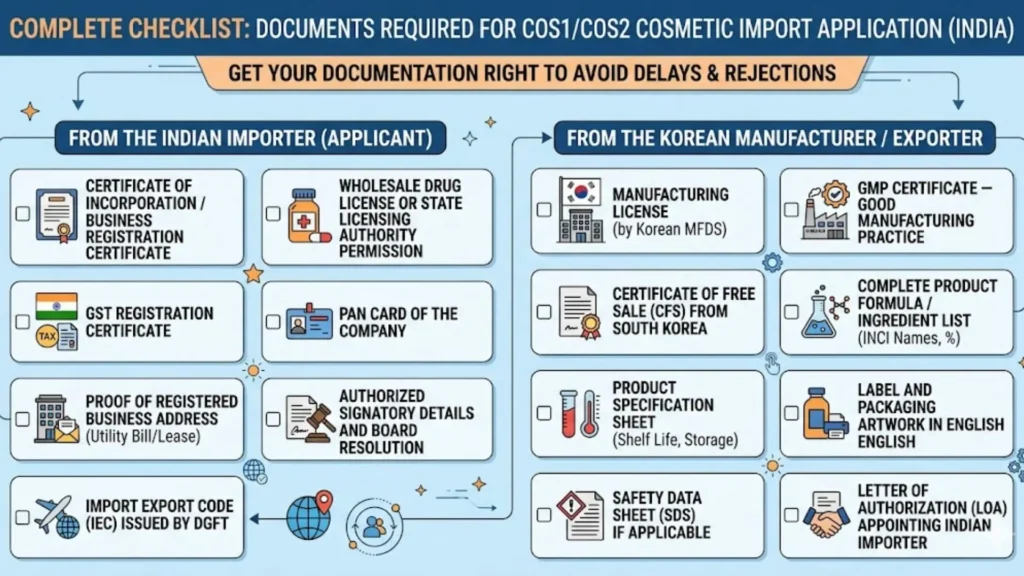
This is where most applications stumble. The document checklist is long, every item is mandatory, and CDSCO officers are thorough. Here is the complete list as applicable for 2025–2026 submissions.
Importer-Side Documents
- Copy of valid State Drug License (Form 20B / 21B) for cosmetics import
- Certificate of Incorporation or Partnership Deed / Registration Certificate of the Indian company
- PAN card of the company
- GST registration certificate
- Authorization letter or board resolution naming the authorized signatory for the application
- Memorandum and Articles of Association (for Private Limited / Limited companies)
Manufacturer-Side Documents
- Valid GMP certificate issued by the competent authority of the origin country — apostilled / notarised / embassy-attested as required
- Free Sale Certificate (FSC) — confirming the product is legally marketed in the country of manufacture
- Certificate of Analysis (CoA) for each product — recent, from an accredited laboratory
- Manufacturing license of the facility (if applicable in the origin country)
- Product composition / ingredient list (INCI format preferred)
- Letter of Authorization (LOA) from the manufacturer to the Indian importer — must be specific, not generic
Product-Specific Documents
- Label and artwork as proposed for the Indian market — must comply with the Legal Metrology rules and Cosmetics Rules 2020
- Product specifications and stability data (for newer or niche categories like sunscreens, anti-dandruff shampoos, or medicated cosmetics)
- Safety data sheet (SDS) if applicable
- Test reports from NABL-accredited or CDSCO-recognized labs (for specific regulated categories)
Step-by-Step Process: From COS-1 Application to COS-2 License
Now let us walk through the actual process. This is the part that trips up most first-time importers because the SUGAM portal, while improved, still has a learning curve.
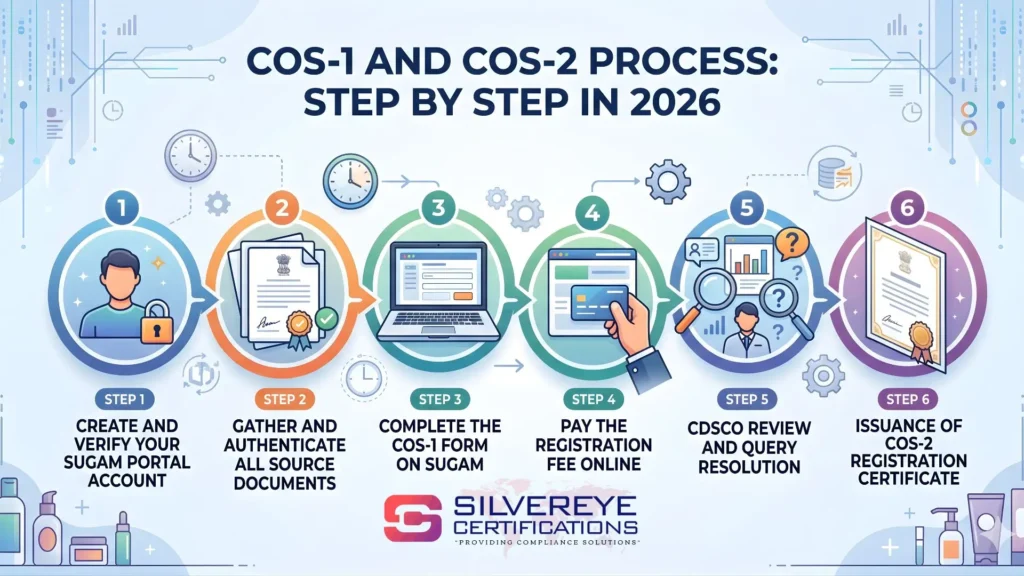
Step 1 — Obtain the State Drug License First
Before you touch the SUGAM portal for CDSCO, secure your state-level cosmetic import license. Apply to the State Licensing Authority (SLA) of your state. Timeframe is typically 30–60 days depending on the state. Do not skip this step — your COS-1 application requires the state license number.
Step 2 — Register on the SUGAM Portal
Go to sugam.gov.in and register your company as an importer. You will need to create a company profile, upload the Certificate of Incorporation, GST, and basic KYC documents. Keep your login credentials secure — all future correspondence from CDSCO will come through this portal.
Step 3 — Compile and Authenticate All Documents
Gather every document from the checklist above. Any foreign document — GMP certificate, FSC, LOA, CoA — must be apostilled (if the originating country is a Hague Convention signatory) or notarised and attested by the Indian Embassy or High Commission in that country. Do not underestimate how long this authentication process takes — in some countries it can take 4–8 weeks.
Step 4 — File the COS-1 Application on SUGAM
Log in to SUGAM, navigate to the import licence section, and select the COS-1 form. You will need to enter: product name, product category, manufacturer details, manufacturing facility address, INCI ingredient list, and the Indian importer's details. Upload all authenticated documents in the specified formats (typically PDF, under specified file size limits). Pay the government fee online.
Step 5 — Pay the Government Fee
The fee is payable online through the SUGAM portal. Current fees as per the Cosmetics Rules 2020 are structured per product per year, with the base fee starting at ₹3,000 per product for a three-year licence. There are additional fees for amendments, certified copies, and accelerated processing if available. Keep the payment receipt — it is part of your application record.
Step 6 — CDSCO Scrutiny and Query Resolution
After submission, CDSCO officers scrutinise the application. This is where deficiencies are raised. You may receive a query asking for additional documents, clarifications, or corrected label text. Respond to every query within the stipulated timeframe — typically 30 days per query. Delays in responding extend your overall processing time significantly. Many importers find it beneficial to engage a regulatory consultant at this stage to manage query responses professionally.
Step 7 — Approval and Issuance of COS-2 License
Once CDSCO is satisfied with the application, they approve it and issue the COS-2 import license. The license is downloadable from the SUGAM portal. It will bear your company name, the product name, manufacturer details, and the validity period (typically 3 years from date of issue). Print this license and keep certified copies — your customs broker needs it for every shipment.
Government Fee Structure for Cosmetic Import License India CDSCO
Understanding the fee structure helps in budgeting, especially if you are importing a portfolio of products. Note that fees are subject to revision — always verify current rates on the CDSCO website or through the SUGAM portal before filing.
| Application Type | Fee (₹) | Validity |
| New COS-2 Import Licence (per product) | ₹3,000 per year (i.e., ₹9,000 for 3 years) | 3 years |
| Import Licence Renewal (per product) | ₹3,000 per year (same as new) | 3 years from renewal date |
| Amendment to existing licence | ₹1,000–₹2,000 (varies by amendment type) | Covers the amendment |
| Duplicate / Certified Copy of Licence | ₹200–₹500 | N/A |
| Test fee (if CDSCO lab testing required) | Varies by product category | Per product per test |
Important note: The fee above is the government fee only. Professional fees for a regulatory consultant, authentication costs for foreign documents, legal fees for drafting the LOA, and logistics for obtaining test reports are additional and can vary significantly based on the number of products, countries of origin, and complexity of the portfolio.
Validity and Renewal of the COS-2 Import License
The COS-2 cosmetic import license is valid for 3 years from the date of issue. This is not automatically renewable — you need to file a renewal application before the license expires.
Renewal Timeline
CDSCO and most regulatory consultants recommend filing the renewal application at least 3 to 6 months before the expiry date. This buffer accounts for the scrutiny period and any query resolution that might extend processing time. If your licence expires before the renewal is processed — and you have not filed on time — you will be in a lapse situation where you legally cannot clear incoming shipments.
What Happens If the License Lapses?
A lapsed license means you are importing without a valid license, which is a legal violation. You cannot clear shipments, you cannot sell products already in Indian warehouses (technically), and you may face scrutiny from CDSCO inspectors. Reinstatement after a lapse is treated more or less like a fresh application in many cases, adding months of delay. Do not let it lapse.
Documents Needed for Renewal
Renewal requires fresh versions of all key documents — updated GMP certificate, fresh FSC (typically not more than 2 years old at time of renewal), updated CoA, and the existing licence number. The SUGAM portal has a separate renewal application flow. Fees are the same as a new application.
| Renewal Milestone | Action Required |
| 6 months before expiry | Start gathering fresh foreign documents (GMP, FSC, CoA) |
| 4–5 months before expiry | Begin authentication / apostille of foreign documents |
| 3 months before expiry | File renewal application on SUGAM |
| During scrutiny | Respond to CDSCO queries promptly |
| Expiry date | Licence must be renewed — no grace period typically |
Common Reasons for COS-1 Application Rejection or Delay
Learning from others' mistakes saves you real time and money. These are the most frequently cited reasons for rejections and delays in CDSCO cosmetic import licence applications:
- GMP certificate expired or not authenticated properly. A GMP certificate that is even a day past its validity date will be rejected. So will one that is not apostilled or embassy-attested as required.
- Free Sale Certificate too old. CDSCO expects the FSC to be recent — generally not more than 2 years old at the time of application. A 5-year-old FSC will not be accepted.
- Letter of Authorization not product-specific. A generic LOA saying 'authorized to import all our products' is often queried. CDSCO prefers product-specific LOAs or at minimum a LOA that specifies the product categories covered.
- Mismatch between product name on documents. If the GMP says Product Name A and your label says Product Name B (even a spelling variation), expect a query.
- Label non-compliance. The proposed label must comply with Cosmetics Rules 2020 — it must carry mandatory declarations like 'Best Before Use', batch number, manufacturer name and address, importer name and address, net quantity in metric units, and a complete ingredient list in descending order of concentration.
- Incomplete INCI ingredient list. CDSCO is strict about ingredient disclosure. Missing even a preservative or fragrance component from the INCI list will trigger a deficiency.
- Wrong product category classification. Certain products that the applicant classifies as cosmetics may fall under drugs in India (e.g., anti-dandruff shampoos with ketoconazole, sunscreens above SPF 4 in some interpretations). Filing under the wrong category wastes months.
- Technical upload errors on SUGAM. Documents uploaded in the wrong format, exceeding file size limits, or with corrupted files are common avoidable issues. Test uploads before the formal submission.
CDSCO Cosmetic Import vs Cosmetic Registration: What Is the Difference?
This confuses a lot of people. Here is the simple distinction:
- Import License (COS-2) is the permission granted to a specific importer to import a specific product into India. It is company-specific and product-specific. If the importer changes, a fresh license is needed. If you change the manufacturer, a fresh application is needed.
- Product Registration, on the other hand, is a concept more associated with certain regulated cosmetic categories or with the National Standard Body process. Most standard cosmetics do not need 'registration' in the same way pharmaceutical drugs do — they need an import license. The confusion often arises because some trade consultants use the terms interchangeably, which is incorrect.
- However, for certain borderline products — sunscreens, tooth whiteners, anti-hairfall preparations with specific active ingredients — CDSCO may require additional technical scrutiny that goes beyond the standard COS-1/COS-2 pathway. In those cases, engaging a specialist regulatory consultant is strongly advisable before filing.
Role of a Regulatory Consultant in the Cosmetic Import License Process
You can absolutely manage a COS-1 to COS-2 application yourself if you have a dedicated regulatory team and experience with the SUGAM portal. However, most importers — especially those handling multiple brands or entering the Indian market for the first time — find that a qualified regulatory consultant delivers significant value.
A good regulatory consultant will: do a product category pre-assessment to confirm your product is indeed a cosmetic and not a drug; review all your documents before filing to catch deficiencies proactively; handle SUGAM portal navigation and submission; manage query correspondence with CDSCO on your behalf; keep track of renewal timelines; and advise on label compliance under Cosmetics Rules 2020 and Legal Metrology Rules.
When choosing a regulatory consultant, verify their track record with cosmetic import licences specifically (not just drug licences), check whether they have experience with products from your specific country of origin (document authentication requirements vary), and ask for client references. Regulatory consultants charge anywhere from ₹15,000 to ₹1,50,000+ per product per application depending on complexity, the number of products, and the extent of support required.
Special Categories and Borderline Products
The line between a cosmetic and a drug in India is not always obvious. Getting this classification wrong at the COS-1 filing stage is one of the costliest mistakes an importer can make.
| Product Type | Classification in India | Regulatory Pathway |
| Regular Shampoo (without anti-dandruff actives) | Cosmetic | COS-2 Import Licence |
| Shampoo with Ketoconazole / Zinc Pyrithione | Drug | Separate Drug Import Licence Required |
| Sunscreen SPF < 4 | Cosmetic (typically) | COS-2 Import Licence |
| Sunscreen SPF ≥ 4 | Drug (under debate / CDSCO may classify as drug) | Consult CDSCO / Regulatory Expert |
| Regular Toothpaste | Cosmetic | COS-2 Import Licence |
| Teeth Whitening (Hydrogen Peroxide-based) | Borderline — often drug | Regulatory pre-assessment required |
| Deodorant / Antiperspirant | Cosmetic (deodorant) / Borderline (antiperspirant) | Pre-assessment recommended |
| Hair Dye | Cosmetic | COS-2 with additional ingredient scrutiny |
| Baby Cosmetics | Cosmetic with stricter safety standards | COS-2 with enhanced safety data |
Post-License Compliance: What Happens After You Get the COS-2?
Getting the COS-2 license is the beginning, not the end, of your compliance journey. Here is what you need to stay on top of once you are licensed.
Label Compliance for Every Shipment
Every product that enters India must bear a label that fully complies with the approved label submitted during the COS-2 application, Cosmetics Rules 2020 requirements, and Legal Metrology (Packaged Commodities) Rules. Any change in label text, design, ingredient list, or product name after license issuance requires an amendment application to CDSCO. Do not change labels without prior amendment approval.
Quality Control at Port of Entry
CDSCO officers at ports of entry have the authority to draw samples from any consignment for quality testing. Products are tested for microbiological quality, heavy metals, restricted ingredients, and label accuracy. If a product fails testing, the entire consignment can be rejected and destroyed. Maintaining consistent quality at the manufacturing level is non-negotiable.
Adverse Event Reporting
If you become aware of any adverse event — consumer complaint about a serious skin reaction, product recall in the country of origin, or manufacturer notification of a quality issue — you are legally required to report it to CDSCO. Failure to report can jeopardise your licence status.
Amendment Requirements
You must file an amendment to your COS-2 license if: the manufacturer changes production facility; there is any change in ingredient formulation; the product name changes; the importer's registered address changes; or ownership of the Indian importing entity changes. Do not treat these as minor administrative matters — unlicensed amendments discovered during an inspection can lead to license suspension.
Importing Cosmetics for E-Commerce: Special Considerations
India's e-commerce sector has grown dramatically, and many foreign cosmetic brands want to sell directly to Indian consumers through marketplaces like Amazon India, Nykaa, Myntra, or through their own DTC websites. The licensing rules apply equally here.
If you are selling cosmetics online in India — whether through a marketplace or your own website — you still need a valid COS-2 import license for every product. Marketplace platforms are increasingly requiring sellers to upload their import license documents before listings are approved. Amazon India, for instance, has specific compliance policies for beauty and personal care products that reference the need for valid import licenses.
Cross-border e-commerce (where products are shipped directly from a foreign warehouse to an Indian consumer) without a CDSCO import license is not legally compliant, even for small quantities. CDSCO and customs have been tightening enforcement on cross-border cosmetic shipments in 2024 and 2025. If you are building a brand in India through e-commerce, get the license before you list products for sale.
Key Updates and Changes in 2025–2026
Regulatory frameworks evolve, and staying current is part of compliance. Here are the most relevant updates as of 2025–2026 that affect cosmetic importers:
- SUGAM portal upgrades in late 2024 improved the application tracking dashboard, making query management more transparent. Importers can now see exactly which officer is handling their application and the status stage in near real-time.
- CDSCO released updated guidance on GMP certificate authentication requirements in 2024, clarifying that apostille is sufficient for Hague Convention signatory countries and specifying which documents need additional Indian Embassy attestation for non-signatory countries.
- Stricter enforcement at ports of entry has been noted in 2025, particularly for shipments from countries with higher rates of product non-compliance. Sampling frequency has increased for certain product categories including sunscreens and baby cosmetics.
- The Ministry of Health and Family Welfare proposed amendments to the Cosmetics Rules 2020 in 2025 that, if finalized, will tighten the ingredient disclosure requirements and introduce mandatory QR codes on labels linking to the product's license information.
- CDSCO's list of prohibited and restricted cosmetic ingredients was updated in 2024. Importers should verify that their product's ingredient list is cross-checked against the current prohibited substances list before filing.
Conclusion: Getting Your Cosmetic Import License India CDSCO Right the First Time
The CDSCO cosmetic import license India process is detailed, document-heavy, and unforgiving of shortcuts. But it is entirely navigable with the right preparation. The importers and brand managers who get through this smoothly share three things in common: they start the process early, they treat document preparation with the same seriousness as the application itself, and they stay on top of post-licence compliance obligations.
The Indian cosmetics market crossed USD 21 billion in 2024 and is projected to grow at over 10% annually through 2030. For foreign brands, that market access is worth protecting. A valid, well-maintained COS-2 license is your commercial passport to that market.
If you are at the beginning of this journey — just figuring out whether your product qualifies as a cosmetic, or what state license you need first — start there. Get the foundational steps right. If you are somewhere in the middle, dealing with a query from CDSCO or a renewal approaching, use this guide to make sure nothing falls through the cracks. And if you are a regulatory consultant building your expertise in this space, we hope this pillar reference serves you well.
The process has a learning curve, but every product that clears the process correctly is a step toward building a compliant, sustainable business in the world's most dynamic cosmetics market.
Frequently Asked Questions
How long does it take to get a cosmetic import license in India from CDSCO?
From the date of filing a complete COS-1 application on SUGAM, CDSCO typically takes 30 to 90 working days if the application is complete. If there are deficiencies or queries, each round of back-and-forth can add 30 to 60 days.
Can I import cosmetics into India without a CDSCO license?
No. Commercial import of cosmetics without a valid COS-2 import license from CDSCO is illegal under the Drugs and Cosmetics Act, 1940. Consignments will be detained at the port, and the importer can face penalties including fines and prosecution.
What is the validity of the COS-2 cosmetic import license?
The COS-2 license is valid for 3 years from the date of issue. It must be renewed before expiry. CDSCO does not typically grant automatic extensions, so plan your renewal application at least 3–6 months before the expiry date.
Can the same COS-2 license cover multiple products from the same manufacturer?
Generally, each product needs its own license entry. However, CDSCO may group products under a single license number if they are from the same manufacturer, in the same category, and filed together
What is the government fee for a cosmetic import license in India?
As per Cosmetics Rules 2020, the government fee is ₹3,000 per product per year, so for a 3-year licence it is ₹9,000 per product. Additional fees apply for amendments, duplicate copies, and testing. These fees are payable online through the SUGAM portal.
Does the foreign manufacturer need to be present in India for the application?
No. The foreign manufacturer does not need a physical presence in India. They need to provide authenticated documents (GMP, FSC, CoA, LOA) to the Indian importer, who files the COS-1 application.
What if my cosmetic product is also sold as a drug in some countries?
This is a critical issue. If a product is classified as a drug in any country, CDSCO may scrutinize it more carefully. Products that contain active pharmaceutical ingredients — even at low concentrations — may be classified as drugs in India too.
Can I change the manufacturer after getting the COS-2 licence?
No, not without filing an amendment. Any change in manufacturing facility — even if the brand and formulation remain the same — requires an amendment application to CDSCO. The new facility's GMP certificate and FSC must be submitted.
Is a regulatory consultant mandatory for the COS-1 application?
No, it is not legally mandatory. You can file directly on the SUGAM portal. However, given the complexity of document requirements, the risk of deficiency notices, and the cost of delays, most importers with more than 2–3 products find the cost of a qualified regulatory consultant to be well justified.
What happens to my shipment if my COS-2 license expires and I have goods in transit?
This is a genuinely difficult situation. If your license expires while goods are in transit, the consignment may be held at the port of entry. Customs may require you to produce a valid license before clearing the goods.