
- CDSCO Cosmetic Registration Importing Hari Dyes are Mandatory Under CDSCO registration (Form COS-2) required before importing any hair dye or coloring product into India.
- Step-by-step application process, document checklist, government fees, and realistic approval timelines for 2026.
- Prohibited ingredients, labelling rules, and port-clearance procedures under the Cosmetics Rules, 2020.
Introduction
India's hair color and hair dye market crossed ₹9,000 crore in 2025 and continues to grow at roughly 12% year on year. With millions of consumers actively seeking professional-grade colour products — from ammonia-free home kits to salon-exclusive oxidative dyes — it is no surprise that importers from Europe, the US, South Korea, Japan, and the Middle East are knocking on India's door.
But here is what trips up most first-time importers: hair dyes are not just a consumer product in India. They are classified and regulated as cosmetics under the Drugs and Cosmetics Act, 1940 (as amended) and the Cosmetics Rules, 2020. That means every brand, every formulation, and every shade you plan to sell in India needs prior approval from the Central Drugs Standard Control Organization — better known as CDSCO.
This guide walks you through everything you need to know about importing hair dyes and colour products to India, including CDSCO registration via Form COS-2, the full document checklist, fees, timelines, labelling requirements, and the most common mistakes importers make.
What is CDSCO cosmetic registration importing hair dyes?
India regulates imported cosmetics — including oxidative and non-oxidative hair dyes — under the Drugs and Cosmetics Act, 1940 and the Cosmetics Rules, 2020, which replaced the earlier Cosmetics, Drugs and Magic Remedies Rules. The Central Drugs Standard Control Organization (CDSCO), operating under the Ministry of Health & Family Welfare, is the national authority that evaluates and grants registration to foreign cosmetic products before they can legally be imported and sold.
Hair dyes fall under a category of cosmetics that CDSCO treats with heightened scrutiny because certain synthetic colorants — particularly p-phenylenediamine (PPD) derivatives and resorcinol-based compounds — carry documented sensitization and allergy risks. As a result, importers must demonstrate both product safety and regulatory compliance in the country of origin before receiving an Indian registration certificate.
Are Hair Dyes Classified as Cosmetics in India?
Yes — absolutely. Under Schedule S of the Cosmetics Rules, 2020, hair dyes, hair colour preparations, bleaches, and tints are classified as cosmetics. This includes:
- Oxidative (permanent) hair dyes containing p-phenylenediamine (PPD) and similar compounds
- Semi-permanent and temporary colour rinses
- Henna-based and herbal hair colour products
- Hair bleaches and lightening preparations
- Colour shampoos and colour-depositing conditioners
- Professional salon-grade oxidative colour formulations
Since they are cosmetics, any entity importing these products must comply with Chapter IV-A of the Drugs and Cosmetics Act and the applicable provisions of the Cosmetics Rules, 2020. There is no separate category for 'natural' or 'organic' hair dyes — they all fall under the same regulatory umbrella.
Who Regulates Cosmetic Imports in India?
The Central Drugs Standard Control Organization (CDSCO), functioning under the Directorate General of Health Services (DGHS), Ministry of Health and Family Welfare, is the apex national regulatory body for cosmetics in India.
For imported cosmetics — including hair dyes — CDSCO operates through its Central Licensing Authority (CLA). It is CDSCO that:
- Reviews and approves import applications for cosmetic products
- Grants Registration Certificates (RCs) to foreign manufacturers
- Issues Import Licenses (Form COS-4) to Indian importers/agents
- Maintains the list of approved and banned cosmetic ingredients
- Coordinates with customs authorities for port-level clearance
State Drugs Licensing Authorities (SDLAs) play a secondary role — they oversee wholesale and retail licences once the product is legally in the country.
What Is Form COS-2 and Why Does Every Importer Need It?
Form COS-2 is the official application form for registration of an imported cosmetic product in India. It was introduced under the Cosmetics Rules, 2020 to replace the older Form 42 system and bring in a more structured, product-specific approval framework.
Here is the key distinction importers must understand:
| Document | Issued To | Purpose | Validity |
| Form COS-2 (Application) | Foreign Manufacturer / Indian Importer | Application for product registration | N/A — Trigger document |
| Registration Certificate (RC) | Foreign Manufacturer | Confirms manufacturer is approved to export to India | 3 Years (renewable) |
| Form COS-4 (Import Licence) | Indian Importer / Agent | Authorises the Indian entity to import the product | 3 Years (renewable) |
| COS-6 (Bulk Import Licence) | Indian Manufacturer / Importer | For importing cosmetic in bulk for repacking | 1 Year (renewable) |
For most standard hair dye imports — finished, packaged products — you will primarily deal with the Registration Certificate and the COS-4 Import Licence. The COS-2 form is the gateway to both.
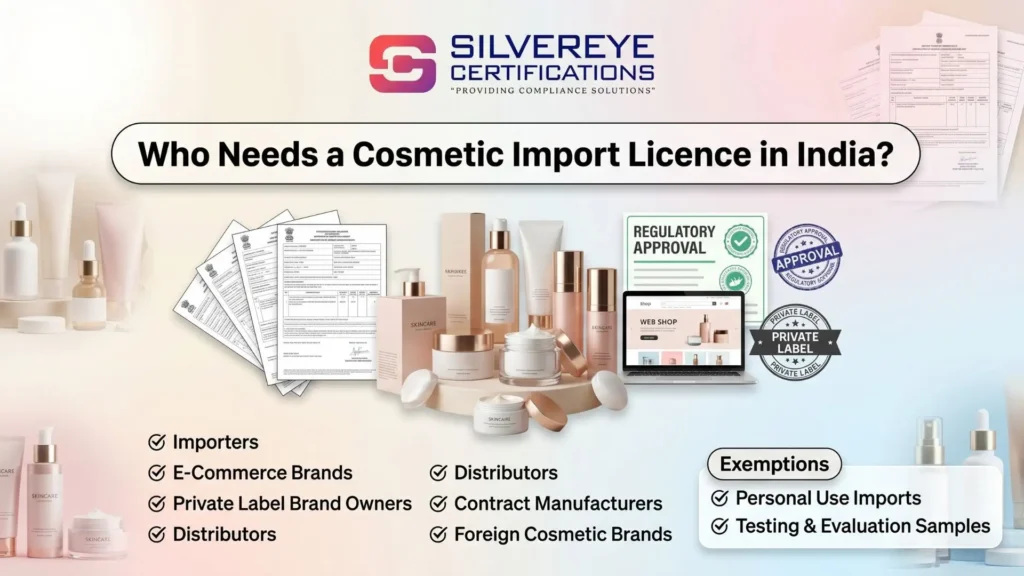
Eligibility: Who Can Apply for CDSCO Cosmetics Registration?
The Foreign Manufacturer
The foreign manufacturer or their authorised representative must apply for the Registration Certificate. To be eligible:
- The manufacturing facility must be GMP (Good Manufacturing Practice) compliant — preferably ISO 22716:2007 certified
- The facility must be legally registered and operating in the country of origin
- The manufacturer must appoint an Indian Agent (if not applying directly) who has a valid Indian business registration
The Indian Importer / Agent
The Indian-side entity that will physically import and sell the product must:
- Be a legally registered business entity in India (Private Ltd, LLP, Proprietorship, etc.)
- Have a valid GST registration
- Obtain a separate Import License (Form COS-4) from the State Licensing Authority of the state where the business is registered
- Not be listed under any debarment or blacklist by CDSCO or any state authority
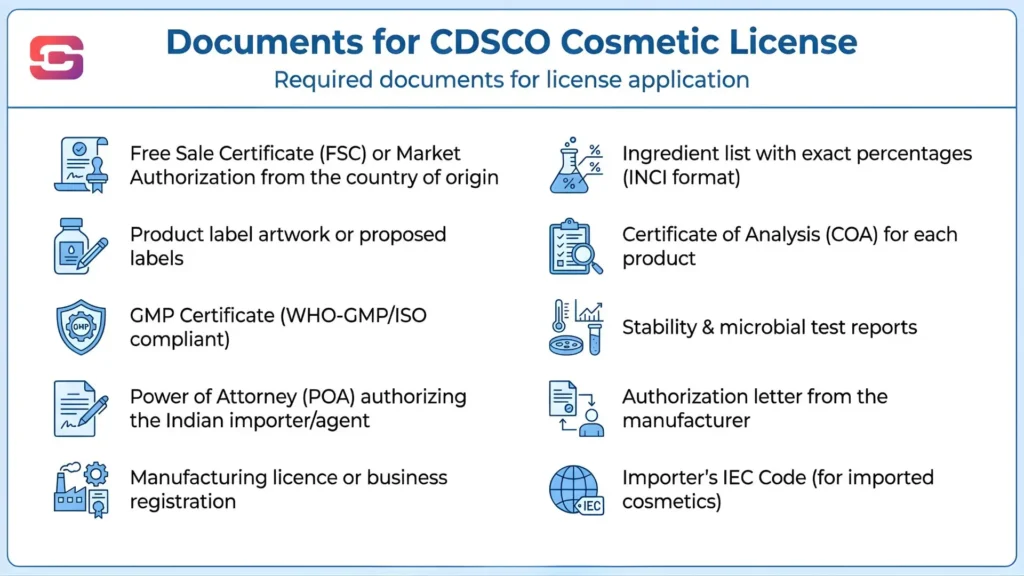
Complete Document Checklist for Importing Hair Dyes to India
Getting your documents right the first time is the single most effective way to avoid delays at CDSCO. Below is the full document checklist as applicable for 2026:
Documents Required from the Foreign Manufacturer
| S.No. | Document | Format / Notes |
| 1 | Completed Form COS-2 Application | Duly signed by authorised signatory |
| 2 | Certificate of Pharmaceutical / Cosmetic Product (CPCP) | Issued by the regulatory authority of the country of manufacture; apostilled if required |
| 3 | GMP Certificate | ISO 22716 or equivalent; valid and not expired |
| 4 | Certificate of Free Sale (CFS) | Issued by the competent authority of the country of origin |
| 5 | Complete Product Formula / Ingredient List | INCI names, % w/w concentration of each ingredient |
| 6 | Safety Data Sheet (SDS / MSDS) | Especially for PPD and other sensitisers in hair dyes |
| 7 | Certificate of Analysis (CoA) | Of the finished product, batch-specific |
| 8 | Product Labels and Artwork | Front, back, side panels — all languages must include English |
| 9 | Stability Data | Accelerated and real-time stability under ICH or equivalent conditions |
| 10 | Authorisation Letter for Indian Agent | Notarised and apostilled power of attorney |
| 11 | Company Registration / Incorporation Certificate | Of the foreign manufacturer |
| 12 | Undertaking / Declaration | That ingredients comply with Schedule S / prohibited list |
Documents Required from the Indian Importer
| S.No. | Document | Notes |
| 1 | Form COS-4 Application | Filed with State Licensing Authority |
| 2 | Business Registration Certificate | Certificate of Incorporation / Partnership deed / etc. |
| 3 | GST Registration Certificate | Current and active |
| 4 | PAN Card of the Business / Proprietor | Self-attested copy |
| 5 | Drug Licence (if also holding drugs) | If the business premises doubles as a drug storage point |
| 6 | Premises Proof (Godown / Office) | Own / rented — rent agreement + ownership proof |
| 7 | Copy of RC granted to foreign manufacturer | Certified true copy |
| 8 | NOC from previous licence holder (if applicable) | In case of change of agent/importer |
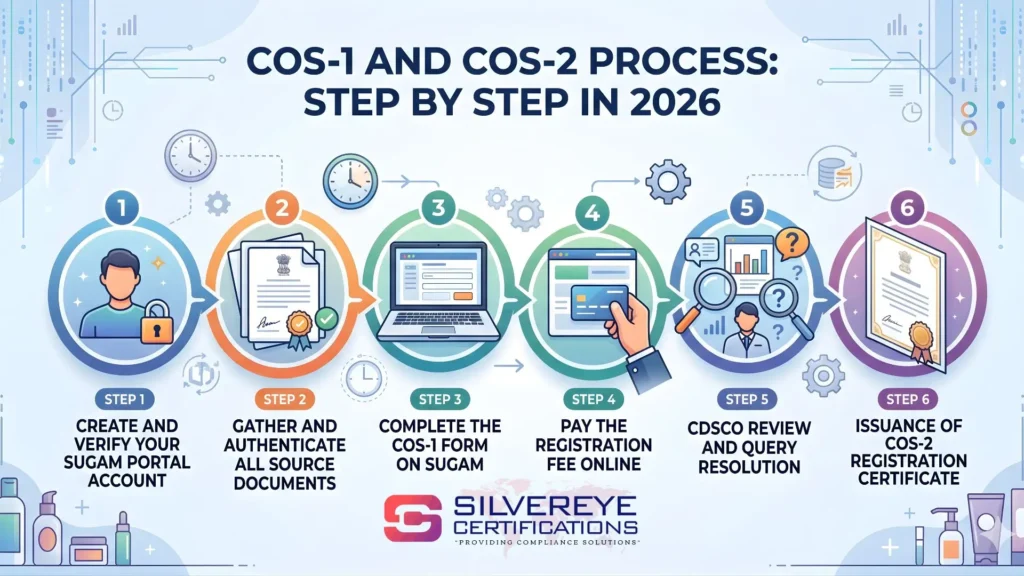
Step-by-Step Application Process for CDSCO COS-2 Registration
Here is how the process works in practice — from day one to the day your product legally enters India:
Step 1: Confirm Formulation Compliance (Weeks 1–2)
Before filing a single paper, review your complete formula against Schedule S (prohibited cosmetic ingredients), Schedule M-II (GMP standards), and the CDSCO's restricted substances list for hair colourants. Common problem ingredients in hair dyes include:
- p-Phenylenediamine (PPD) — permitted below 2% w/w in oxidative hair dyes only
- Resorcinol — permitted below 1.25% as a hair dye ingredient
- Lead acetate — banned for cosmetic use in India
- Mercury compounds — strictly prohibited
- Certain aromatic amines — check against the updated Schedule S list
Step 2: Appoint an Indian Agent / Authorized Representative (Week 2–3)
The foreign manufacturer must appoint a registered Indian business as their authorised agent. This entity will act as the legal representative in India, coordinate the registration, and eventually hold the import licence. The Authorisation Letter must be notarised, apostilled, and submitted on the manufacturer's company letterhead.
Step 3: Prepare and Compile the Complete Dossier (Weeks 3–6)
Compile all documents listed in Section 5 above. Ensure that:
- All foreign documents are apostilled or legalized
- Translations (if any) are certified by a sworn translator
- Stability data covers the proposed shelf life under Indian climatic conditions (Zone IVb: 40°C / 75% RH)
- Labels carry all mandatory information required under the Cosmetics Rules, 2020
Step 4: Online Filing on SUGAM Portal (Week 6–7)
CDSCO's SUGAM portal is the mandatory online gateway for all cosmetic registration applications. You must:
- Create an account for the Indian Agent
- Select the correct application module: 'Cosmetics — Imported Product Registration'
- Upload all soft copies of documents (PDF format, under prescribed file sizes)
- Pay the applicable government fee online
- Generate and note down the application reference number
Step 5: Scrutiny and Deficiency Response (Weeks 8–20)
CDSCO's cosmetics division will scrutinise your application. If there are queries or deficiencies, they issue a Deficiency Letter. You typically get 30–60 days to respond. A well-prepared dossier significantly reduces the number of rounds of queries.
Step 6: Grant of Registration Certificate and Import License
Once satisfied, CDSCO issues the Registration Certificate in the name of the foreign manufacturer. Simultaneously (or shortly after), the Indian importer applies to the State Licensing Authority for Form COS-4 (Import Licence) using the RC as supporting document.
Step 7: Customs Clearance
With both the RC and Import Licence in hand, your Indian importer can begin importing. At the port, the customs officer will verify:
- Import License (COS-4) — must be current and valid
- Registration Certificate — must cover the product being imported
- Bill of Entry, Invoice, Packing List, and Bill of Lading
- Label compliance — physical labels on the product must match what was approved
Government Fees for CDSCO Cosmetic Registration
Here is the current fee structure as prescribed under the Cosmetics Rules, 2020 for imported cosmetics. Note that these are statutory government fees and may be revised — always confirm with the SUGAM portal or the latest Government Gazette notification before filing.
| Application Type | Government Fee (INR) | Approx. USD Equivalent |
| Registration Certificate (per product) | ₹3,000 | ~$36 |
| Renewal of Registration Certificate | ₹1,500 | ~$18 |
| Grant of Import Licence (COS-4) | ₹1,000 | ~$12 |
| Renewal of Import Licence | ₹500 | ~$6 |
| Amendment to RC (minor change) | ₹1,500 | ~$18 |
| Amendment to RC (major change / formula) | ₹3,000 | ~$36 |
| Duplicate RC / Licence | ₹250 | ~$3 |
Timeline: How Long Does CDSCO Registration Actually Take?
This is the question every importer asks — and the honest answer is: it depends. Here is a realistic timeline breakdown for a well-prepared application in 2026:
| Stage | Realistic Timeframe | Key Variables |
| Dossier Preparation | 4 – 8 Weeks | Complexity of formula, apostille timelines, stability data availability |
| Online Filing on SUGAM | 1 – 2 Days | Portal functionality, correct categorisation |
| CDSCO Initial Scrutiny | 4 – 8 Weeks | Queue length at CDSCO cosmetics division |
| Response to Deficiency Letters | 2 – 8 Weeks | Number of queries; quality of original submission |
| Grant of RC | 2 – 4 Weeks after clearance | Internal approval and digital certificate issuance |
| State Licensing (COS-4) | 2 – 6 Weeks | Varies significantly by state — Delhi, Maharashtra faster; others slower |
| TOTAL (Best Case) | ~4 – 5 Months | Single round of queries; strong dossier |
| TOTAL (Typical) | ~6 – 9 Months | 1–2 rounds of deficiency letters |
| TOTAL (Complex Cases) | 12 – 18+ Months | Multiple queries, novel ingredients, GMP issues |
Validity and Renewal of Registration Certificate and Import License
Both the Registration Certificate and Import License have defined validity periods. Missing renewal deadlines means your imports effectively become illegal — a surprisingly common and costly mistake.
| Document | Validity Period | Renewal Application Deadline | Late Renewal Consequences |
| Registration Certificate (RC) | 3 Years from grant date | At least 60 days before expiry | Imports must stop; fresh application may be needed |
| Import Licence (Form COS-4) | 3 Years from grant date | Before expiry — no grace period under Rules | Illegal to import; customs clearance denied |
| COS-6 Bulk Licence | 1 Year | Before expiry | Manufacturing activity cannot continue |
It is strongly recommended to set internal reminders at least 90 days before expiry. CDSCO does not proactively notify you about impending expiries — that responsibility lies entirely with the applicant.
Labelling Requirements for Imported Hair Dyes in India
The Cosmetics Rules, 2020 are very specific about what must appear on your product label. For hair dyes and colour products, additional mandatory warnings are prescribed given the sensitization risks associated with PPD and other colourants.
Mandatory Label Information (All Imported Cosmetics)
- Name and address of the manufacturer (country of origin)
- Name and address of the Indian importer
- Net content — weight or volume as applicable
- Batch/Lot number with the prefix 'Batch No.' or 'Lot No.'
- Date of manufacture and best before / expiry date
- List of ingredients in INCI nomenclature, in descending order of concentration
- Directions for use — must be in English or Hindi (bilingual preferred)
- Registration Certificate number (RC number)
- MRP (Maximum Retail Price) — mandatory for retail sale; must include all taxes
Additional Mandatory Warnings for Hair Dyes (Schedule S Compliance)
For oxidative hair colour products containing PPD or related compounds, the following additional warnings are mandatory on the pack:
- Hair colorants can cause severe allergic reactions.
- Read and follow instructions.
- This product is not intended for use on persons under the age of 16.
- Temporary black henna tattoos may increase your risk of allergy.
- Do not colour your hair if: You have a rash on your face or sensitive, irritated, and damaged scalp.
- A patch test warning must be prominently displayed on the principal display panel
Prohibited and Restricted Ingredients in Hair Dyes for India
India follows its own restricted/prohibited ingredient list under Schedule S of the Cosmetics Rules, 2020. Unlike the EU's Annex II and Annex IV, India's list is less exhaustive in number but strictly enforced at both registration and customs levels.
Key Prohibited Substances Relevant to Hair Dyes
| Ingredient | Status in India | Notes |
| Lead Acetate | BANNED | Prohibited as a hair dye colourant — still used in some countries |
| Mercury and mercury compounds | BANNED | No exceptions |
| Certain aromatic amines (listed in Schedule S) | BANNED | Check current Schedule S — list updated periodically |
| Diaminophenol (as standalone) | Restricted | Permitted only under specific conditions |
| p-Phenylenediamine (PPD) | Restricted | Max 2.0% w/w in oxidative hair dye; prohibited in non-oxidative |
| Resorcinol | Restricted | Max 1.25% as hair dye; 0.5% as preservative |
| Hydrogen Peroxide (as developer) | Restricted | Must carry appropriate hazard labelling |
| 4-Amino-2-hydroxytoluene | Restricted | Specific concentration limits apply |
Always cross-verify against the most current Schedule S before preparing your registration dossier. CDSCO issues updates through Gazette notifications and circulars — your regulatory affairs consultant should be tracking these actively.
Import Duty and GST on Hair Dyes Imported to India
Registration is only one part of the cost equation. Importers also need to factor in customs duties and taxes. Here is a general overview — always confirm current rates with a licensed customs broker as tariff rates can change with the Union Budget:
| Charge | Rate (Approx. 2025–26) | Notes |
| Basic Customs Duty (BCD) | 20% | On CIF value; applies to most finished cosmetics under HS 3305 |
| Social Welfare Surcharge (SWS) | 10% of BCD | 10% on the BCD amount |
| IGST (GST on Imports) | 18% | On CIF + BCD + SWS; cosmetics attract 18% GST |
| Landing Charges | 1% of CIF | Standard across most ports |
| Effective Total Duty Load | ~46–50% | Approximate; varies by exact HS code and declared value |
The HS codes most relevant for hair dyes and colour products fall under Chapter 33 — specifically:
- HS 3305.90 — Other hair preparations (covers most hair colour and dye products)
- HS 3305.10 — Shampoos (if combined with colour)
- HS 3304.99 — Other beauty preparations (for some hybrid colour cosmetics)
What Happens If You Import Without CDSCO Registration?
Some importers — especially smaller ones — attempt to bring in hair colour products as personal care items or by under-declaring quantities. This is not just risky — it is illegal and the consequences are severe:
- Seizure of the entire consignment at the port of entry
- Forfeiture of goods without compensation
- Imposition of heavy penalties under the Drugs and Cosmetics Act
- Risk of criminal prosecution for the importer and their directors
- Blacklisting from future CDSCO applications
- Reputational damage that is very hard to recover from in the Indian market
India's customs and CDSCO enforcement has increased significantly post-2022. Port-level officers are better trained to spot non-compliant cosmetic shipments. The risk-reward calculation strongly favours doing this the right way from Day 1.
Conclusion: Getting Your India Market Entry Right
India is one of the most exciting growth markets for hair colour and hair care products in the world. But regulatory compliance is not optional — it is the price of entry. The good news is that the CDSCO registration process, while thorough, is well-defined and navigable when you have the right information and the right regulatory partners by your side.
Get your formulas reviewed against India's prohibited list before you commit to production. Appoint a seasoned Indian regulatory consultant who knows the CDSCO cosmetics division — not just pharmaceuticals. And give yourself at least 9–12 months of runway before your planned commercial launch date.
When done right, CDSCO registration gives you something invaluable: the legal right to build a hair colour brand in a market with 1.4 billion potential consumers. That is worth every step of the process.
Frequently Asked Questions
Is CDSCO registration mandatory for ALL imported hair dye products, including herbal or organic ones?
Yes. Every hair dye product — regardless of whether it is marketed as herbal, organic, ammonia-free, or natural — requires CDSCO registration before it can be legally imported and sold in India. The Cosmetics Rules, 2020 make no exception for naturally-derived formulations.
Can a foreign manufacturer register directly, or do they need an Indian agent?
A foreign manufacturer can technically apply directly, but in practice, CDSCO requires communication to happen through an Indian authorized agent or representative. Having a registered Indian entity also simplifies the Import License (COS-4) process, which requires an Indian business entity.
How many products can be covered under a single Registration Certificate?
Each product with a distinct formulation requires its own separate Registration Certificate. Shades with the same base formula may sometimes be grouped as variants — but this requires explicit CDSCO acceptance and clear dossier documentation. When in doubt, register each shade separately to avoid complications.
What is the difference between CDSCO registration and BIS certification for cosmetics?
CDSCO registration under the Cosmetics Rules, 2020 is mandatory for all imported cosmetics including hair dyes. BIS certification (Bureau of Indian Standards) may be required for certain product categories under a Quality Control Order (QCO) — as of 2026, cosmetics do not yet fall under a mandatory BIS QCO, but always verify the current status as government policies evolve.
Can I sell CDSCO-registered hair dye products on Indian e-commerce platforms?
Yes — once you have a valid Registration Certificate and Import Licence, you can sell on all major Indian e-commerce platforms. Most platforms (Amazon.in, Flipkart, Nykaa) now require you to submit your RC and COS-4 during seller onboarding for cosmetic products.
What happens if my Registration Certificate expires while I still have stock in India?
An expired RC means you cannot import new stock. Stock already legally imported before the expiry date can technically continue to be sold until its own shelf-life expiry.
Is a patch test warning mandatory on all hair colour products sold in India?
Yes. For oxidative hair colour products containing p-Phenylenediamine (PPD) or related sensitising compounds, a patch test warning is mandatory on the primary display panel of the product.
Can I change my Indian agent after the RC has been granted?
Yes, but it requires filing an amendment application with CDSCO. The original authorisation letter from the foreign manufacturer to the old agent must be formally cancelled, and a new authorisation letter naming the new agent must be submitted along with the amendment fee.
Does my product need separate approval in each Indian state?
No. The Registration Certificate (RC) from CDSCO is a central/national approval and is valid across all of India. The Import Licence (COS-4) is issued by the State Licensing Authority of the state where your Indian importer is registered — but this single licence covers import into India as a whole.
What is the SUGAM portal and is it mandatory to use it for registration?
SUGAM is CDSCO's official online portal for all regulatory submissions including cosmetic import registrations. As of 2024, online filing through SUGAM is mandatory — physical paper applications are no longer accepted at the central level.