
- What COS-1 and COS-2 actually mean under India's cosmetic import regulations — and why so many businesses get this wrong
- How to file COS-1 on the CDSCO SUGAM portal with the correct documents, fees, and timelines in 2026
- What happens after you submit COS-1 and how the COS-2 Registration Certificate is issued
- Documentation checklist, fee breakdown, realistic timelines, and the most common mistakes importers make
- Special guidance for foreign manufacturers registering cosmetic products for the Indian market
Introduction: Why Getting COS-1 and COS-2 Right Matters in 2026
If you are planning to import cosmetics into India — whether you are a foreign brand entering one of the world's fastest-growing beauty markets or an Indian importer sourcing international products — understanding COS-1 and COS-2 is non-negotiable.
Here is where most people go wrong before they even start: COS-1 and COS-2 are not two competing license categories you choose between. They are two stages of the same regulatory process.
COS-1 is the application form submitted through CDSCO's SUGAM online portal to register a cosmetic product or manufacturing site for import into India. COS-2 is the Registration Certificate — the actual license that the Central Drugs Standard Control Organization (CDSCO) issues to you once your COS-1 application is reviewed and approved.
This distinction matters enormously because businesses that do not understand it either approach the process with the wrong framework, work with consultants who give them conflicting advice, or fail at documentation because they did not know what the end goal of each step actually was.
This guide corrects that. Everything here reflects the 2026 regulatory position under the Drugs and Cosmetics Act, 1940 (as amended), the New Drugs and Clinical Trials Rules framework, and CDSCO's current operating procedures through the SUGAM portal.
The Basis of Regulation: Reasons for the Requirement to Register Cosmetics Imported to India
Cosmetics regulation in India is governed by the Drugs and Cosmetics Act, 1940, and the Cosmetics Rules, 2020 (in effect since its replacement of Schedule S). Under this regulatory scheme, all cosmetics produced anywhere other than India, but marketed for sale in India, are required to be registered with CDSCO prior to their importation.
The CDSCO — which operates under the Ministry of Health and Family Welfare — is the central authority responsible for granting this registration. Unlike many product categories where state drug authorities play a role, cosmetic import registration is handled exclusively at the central level.
The SUGAM portal is CDSCO's integrated digital platform for all regulatory filings, including cosmetic registration applications. As of 2026, paper-based filings for standard cosmetic registrations are no longer accepted — everything goes through SUGAM.
COS-1: The Application Form — What It Is and What It Contains
COS-1 is the structured application form that an applicant — typically the Indian importer, authorized agent, or the foreign manufacturer through their Indian representative — submits via the CDSCO SUGAM portal to seek import registration for a cosmetic product.
Think of COS-1 as your formal request to CDSCO. It is the document that opens your registration file, carries all your product information, supporting evidence, and declarations, and triggers the official review process.
Who Files COS-1?
According to the Cosmetics Rules, 2020, the applications in COS-1 may be lodged by:
Indian importer – either an entity having valid import license or an Indian company registered for importing goods in India.
- Authorized Indian agent of the foreign manufacture – An agent nominated by the foreign manufacturing firm to represent their interest within India.
- Foreign manufacturer directly – In certain cases, the foreign manufacturer may apply directly using the Indian registered office. The applicator on the COS-1 form has absolute legal responsibility for all information provided and the compliance of the goods in India.
The applicant on the COS-1 form carries full regulatory responsibility for the accuracy of submitted information and the product's ongoing compliance in the Indian market.
What Information Goes Into a COS-1 Application?
A complete COS-1 submission is not a single form — it is a structured dossier that includes:
Product Identification Details
- Complete product name as it will appear on Indian market packaging
- Product category under CDSCO's cosmetic classification schedule
- Net quantity, form (cream, lotion, serum, powder, etc.), and intended use
- Brand name and trademark details
Manufacturer Information
- Full name and address of the manufacturing facility
- Country of manufacture
- Manufacturing licence or authorisation issued by the competent authority in the country of origin
- Good Manufacturing Practice (GMP) certificate for the facility — CDSCO accepts ISO 22716 and equivalents from recognized countries
Formulation and Ingredient Data
- Complete ingredient list with INCI (International Nomenclature of Cosmetic Ingredients) names and percentage concentrations
- Declaration that all ingredients comply with India's permitted cosmetic ingredient lists under Cosmetics Rules, 2020
- Any restricted ingredient declarations with compliance evidence where applicable
Safety and Quality Documentation
- Product safety assessment report
- Stability test data — accelerated and real-time studies
- Microbiological test results from accredited laboratories
- Challenge test data for preservative efficacy where relevant
Labelling Information
- Proposed Indian market label artwork
- Label compliance declaration covering Cosmetics Rules, 2020 labelling requirements including ingredient listing, batch number, manufacturing and expiry dates, country of origin, net weight, and statutory warnings
Regulatory and Commercial Documents
- Free Sale Certificate or Certificate of Pharmaceutical Product from the regulatory authority in the country of origin
- Power of Attorney or authorisation letter if filed through an agent
- Undertaking by the Indian importer regarding product safety and regulatory compliance
COS-1 Filing Fees in 2026
CDSCO charges a registration fee at the time of COS-1 submission via the SUGAM portal. Fees are product-specific and are calculated per product per variant. The 2026 fee schedule under CDSCO for cosmetic import registration stands at approximately:
| Application Type | Fee (INR) |
| Single cosmetic product registration | ₹3,000 – ₹5,000 per product |
| Manufacturing site registration | ₹10,000 – ₹25,000 |
| Amendment to existing registration | ₹2,000 – ₹3,000 |
Note: Always verify current fee schedules directly on the SUGAM portal or CDSCO website before filing, as fee revisions may occur.
COS-2: The Registration Certificate — What It Is and What It Grants You
If CDSCO finds that everything is satisfactory after reviewing the COS-1 application and assessing all the documents submitted, then the COS-2 Registration Certificate is granted by the CDSCO.
COS-2 is the actual license. It is the official, government-issued document that authorises the import and sale of that specific cosmetic product in India.
What the COS-2 Certificate?
The COS-2 Registration Certificate by CDSCO consists of:
- A unique registration number for the product
- Name of the product, its trade name, and the variant information as per registration
- Name and address of the manufacturer
- Name and address of the Indian importer or authorized agent
- Manufacturing country
- Duration of validity for the registration
- Any condition of registration
- Date of issuance and the designation of the authorizing official
Validity of COS-2 Registration Certificate
By 2026, the validity of the COS-2 Registration Certificate for imported cosmetics is granted for a period of three years from the date of issuance, except where otherwise specified on the certificate itself.
What the COS-2 Does NOT Automatically Cover
COS-2 certificate for one product variant does not automatically extend to new shades, new sizes, or reformulated versions of the same product. Each material change — in formulation, packaging, claims, or manufacturer — typically requires a fresh COS-1 filing or an amendment application, which then results in either a new COS-2 or an amended certificate.
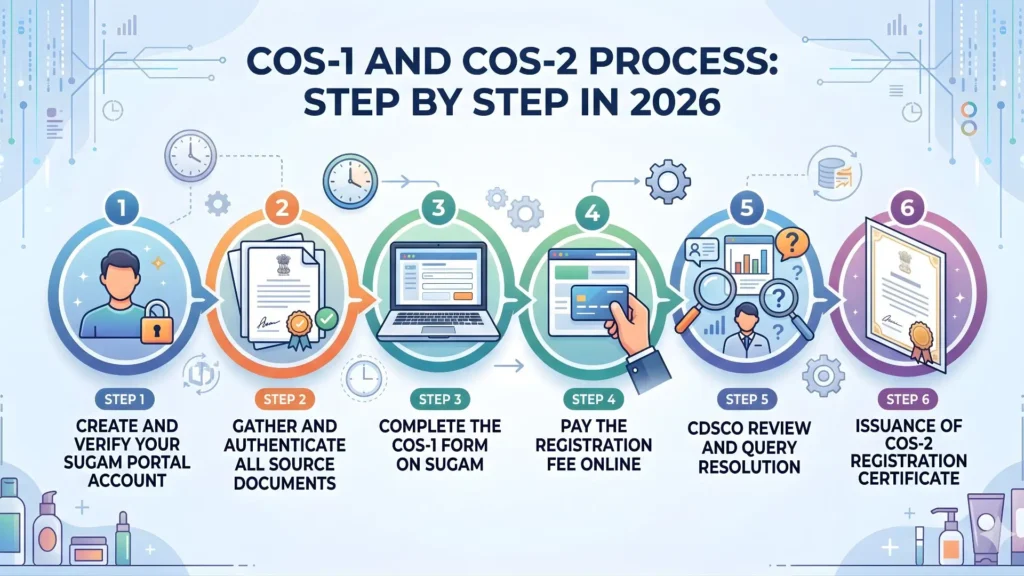
COS-1 And COS-2 Process: Step by Step in 2026
Understanding the flow from application to certificate helps you plan timelines, prepare resources, and avoid the delays that catch most first-time applicants off guard.
Step 1: Create and Verify Your SUGAM Portal Account
Before anything else, the Indian importer or authorized agent must register on the CDSCO SUGAM portal. If your company already has a SUGAM account for other drug or device registrations, you can use the same login for cosmetic filings — but ensure the user roles and product categories are correctly configured.
New applicants should allow three to five working days for SUGAM account verification before they can begin actual form filing.
Step 2: Gather and Authenticate All Source Documents
Every document in the COS-1 dossier that originates from outside India — GMP certificates, Free Sale Certificates, safety test reports from foreign laboratories — must be either apostilled or notarized and attested depending on whether the originating country is a Hague Convention signatory.
As of 2026, CDSCO has reinforced its document authentication requirements following a period of increased scrutiny on cosmetic import applications. Documents that were previously accepted with simple notarization from some jurisdictions may now require apostille. Verify current requirements with CDSCO or a qualified regulatory consultant for your specific country of origin before document collection begins.
Step 3: Complete the COS-1 Form on SUGAM
The COS-1 form is filled directly on the SUGAM portal. Key sections include product details, formulation summary, manufacturer information, importer information, and document upload fields. The portal has been upgraded in 2026 with improved file size limits and document format guidance — PDFs are the accepted format for most supporting documents.
Do not save and return to partially completed forms for more than the system's session limit. SUGAM has been known to time out and lose unsaved data. Complete each section in one sitting where possible, or use the draft-save function deliberately.
Step 4: Pay the Registration Fee Online
CDSCO charges the applicable fee at the time of COS-1 submission. Payment is made through the SUGAM integrated payment gateway. Keep the payment receipt — it is required for tracking and any correspondence with CDSCO post-submission.
Step 5: CDSCO Review and Query Resolution
After COS-1 submission, CDSCO's cosmetics division conducts a technical review of the dossier. Depending on the complexity of the product, completeness of documentation, and current CDSCO workload, this review takes anywhere from four weeks to six months in practice.
CDSCO may raise queries during this stage — requests for additional data, clarifications on ingredients, or additional labelling compliance evidence. These queries are communicated through the SUGAM portal. Prompt, complete responses to queries significantly reduce total processing time. Delayed or incomplete query responses are one of the most preventable causes of registration delay in 2026.
Step 6: Issuance of COS-2 Registration Certificate
Once CDSCO is satisfied with the application and all queries are resolved, the COS-2 Registration Certificate is generated and made available through the SUGAM portal. The certificate can be downloaded, printed, and used as the official authorisation for importing and selling the product in India.
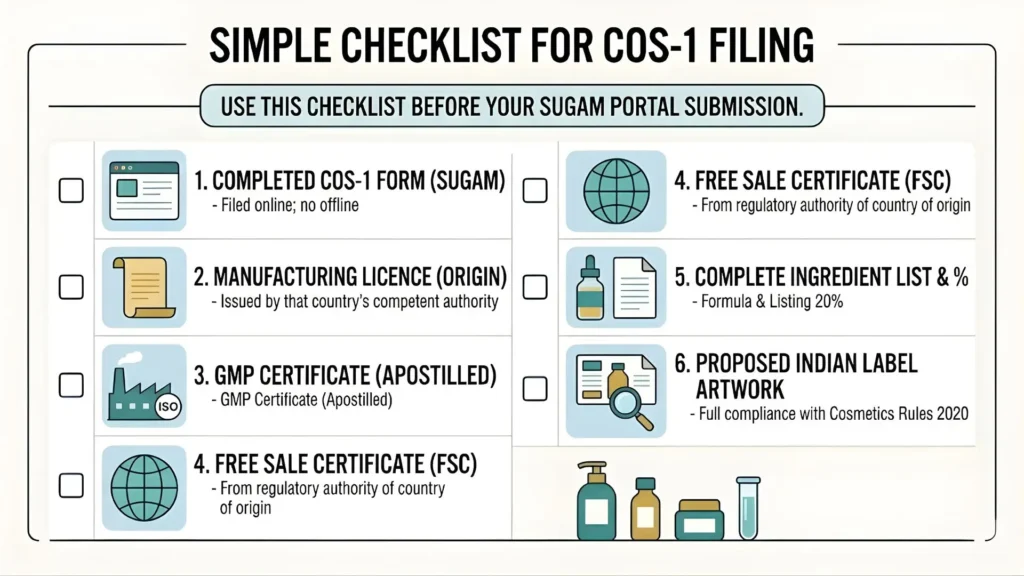
Complete Documentation Checklist for COS-1 Filing
Use this checklist before you begin your SUGAM portal submission. An incomplete filing is not just a delay — it resets your place in the CDSCO review queue.
| S.No. | Document | Requirement Notes |
| 1 | Completed COS-1 application form (SUGAM) | Filed online; no offline version accepted |
| 2 | Proof of Indian importer's business registration | Certificate of Incorporation or GST registration |
| 3 | Import Licence (if held) or importer authorisation | Issued by competent Indian authority |
| 4 | Power of Attorney / Authorisation Letter | If agent files on manufacturer's behalf |
| 5 | Manufacturing Licence from country of origin | Issued by that country's competent authority |
| 6 | GMP Certificate for manufacturing facility | ISO 22716 or equivalent; valid and apostilled |
| 7 | Free Sale Certificate (FSC) / Certificate of Pharmaceutical Product | From regulatory authority of country of origin |
| 8 | Complete ingredient list with INCI names and percentages | All ingredients, including preservatives and fragrance components |
| 9 | Ingredient compliance declaration | Against Cosmetics Rules, 2020 permitted/restricted lists |
| 10 | Product safety assessment report | From qualified toxicologist or safety assessor |
| 11 | Stability test data | Accelerated + real-time; for Indian climatic conditions |
| 12 | Microbiological test results | From ISO/IEC 17025-accredited laboratory |
| 13 | Proposed Indian market label artwork | Full compliance with Cosmetics Rules, 2020 labelling |
| 14 | Label compliance declaration | Signed by importer or authorised agent |
| 15 | Undertaking on product safety | Format as specified by CDSCO |
| 16 | Fee payment receipt | Via SUGAM portal gateway |
Realistic Timeline Expectations: COS-1 to COS-2 in 2026
Applicants frequently ask how long the process takes. Here is an honest assessment based on 2026 CDSCO processing patterns:
Document Preparation Phase: 4–10 Weeks Collecting authenticated documents from the country of manufacture, getting apostilles, preparing the formulation dossier, and drafting label artwork takes most of the calendar time. Businesses that underestimate this phase end up filing incomplete applications.
SUGAM Filing and Fee Payment: 1–3 Days The actual portal submission is fast once documents are ready.
CDSCO Technical Review: 4–24 Weeks This is the widest variable. Straightforward applications with complete, high-quality documentation from countries with well-recognised regulatory systems (EU, USA, Japan, South Korea) tend to move faster. Novel ingredients, missing authentications, or labelling non-compliance trigger queries that extend timelines significantly.
Total Realistic Timeline: 3 to 8 Months Plan for a minimum of three months from decision to COS-2 certificate if your documentation is already organised. Build in six to eight months if you are starting from scratch with overseas manufacturer coordination.
2026 Regulatory Updates Affecting COS-1 and COS-2 Applicants
Cosmetics Rules, 2020 Full Enforcement As of 2026, CDSCO is enforcing all provisions of Cosmetics Rules, 2020 comprehensively. Transitional tolerances that existed in earlier years are no longer applicable. Applications referencing older Schedule S labelling formats are being returned.
Digital-Only Submissions CDSCO confirmed in early 2026 that all cosmetic import registration filings must go through SUGAM. Physical file submissions to CDSCO offices are no longer entertained for new registrations.
Increased Scrutiny on Certain Ingredient Categories CDSCO has increased documentation requirements for applications involving products with specific active ingredients in skincare categories — particularly products making skin-brightening, anti-ageing, or scalp treatment-related claims in their labelling. Ensure your proposed Indian label does not carry therapeutic or drug-like claims that would reclassify your cosmetic as a drug under the Drugs and Cosmetics Act.
Stability Data for Indian Climatic Conditions CDSCO is increasingly requesting stability data conducted under Zone IVb conditions (40°C / 75% RH) — the climatic zone applicable to most of India. Stability data generated only for temperate market conditions may not be accepted without supplementary Indian-climate studies.
Renewal Enforcement CDSCO has tightened enforcement on expired COS-2 certificates. Products found in import pipelines against expired certificates are being held at customs. Build renewal timelines into your compliance calendar at least four to six months before your COS-2 expiry date.
Special Guidance for Foreign Manufacturers
If you are a cosmetic brand manufactured outside India looking to enter the Indian market in 2026, the registration process requires advance planning across multiple workstreams:
Appoint Your Indian Authorized Agent Early- Your Indian authorized agent is not just a filing intermediary — they carry legal responsibility for the product's compliance in India. Choose a company or individual with documented CDSCO cosmetic registration experience and verifiable references. This appointment should happen before document collection begins, not after.
Verify Your Free Sale Certificate Source- India accepts Free Sale Certificates issued by competent regulatory authorities — not trade associations, chambers of commerce, or self-certifying bodies. Know which authority in your home country issues FSCs and what the apostille process looks like for your jurisdiction.
Ingredient Compliance Is a Separate Step- Do not assume your global formulation passes Indian ingredient compliance automatically. Have an Indian regulatory consultant run a formal compliance check against Cosmetics Rules, 2020 Schedules before you begin the SUGAM application. Reformulation discovered mid-process costs significantly more time and money than a pre-filing audit.
Plan for Indian Labelling From the Start- Design your Indian market label in parallel with the registration process, not as an afterthought. Label artwork is part of the COS-1 dossier, and CDSCO will review it. Getting label approval built into your packaging design cycle saves significant revision time.
Working With a Regulatory Consultant for COS-1 and COS-2 in 2026
Given the documentation complexity, authentication requirements, and CDSCO query-response dynamics, most successful cosmetic importers — both Indian companies and international brands — work with a qualified Indian regulatory consultant.
A credible consultant for cosmetic import registration in India should offer:
- Ingredient compliance audit against Cosmetics Rules, 2020 before any filing begins
- Complete document checklist customised to your country of manufacture and product category
- Dossier preparation including FSC coordination, label compliance review, and safety documentation organization
- SUGAM portal filing and fee management
- CDSCO query response management — this is where experienced consultants add the most value
- Post-approval renewal tracking and variation filing for formulation or labelling changes
When evaluating consultants, ask specifically about their CDSCO cosmetic registration track record, not just their pharmaceutical or device experience. Cosmetic registration through SUGAM has its own process nuances that benefit from specialist familiarity.
Conclusion: Building a Compliant India Market Entry in 2026
India's cosmetics market is one of the most significant growth opportunities in global beauty — driven by a young, increasingly affluent, and highly brand-aware consumer base. But it is also a market where regulatory shortcuts create real legal exposure and business disruption.
The COS-1 to COS-2 pathway is not bureaucratic friction for its own sake. It is India's mechanism for ensuring that consumers receive products that are safe, accurately labelled, and manufactured to verifiable quality standards. Brands that approach this process with the same rigour they apply to product development consistently achieve faster approvals, cleaner import clearances, and stronger long-term market positions.
Start with a correct understanding of what COS-1 and COS-2 actually are. Build a complete, authenticated document set before you approach the SUGAM portal. Work with a consultant who has done this before. And treat your COS-2 certificate not as the finish line but as the foundation of your Indian market compliance programme.
That approach — methodical, well-documented, expert-supported — is what separates brands that enter India once and stay from those that struggle with repeated delays, held shipments, and costly remediation.
Frequently Asked Questions
Is COS-1 the license or the application?
COS-1 is the application — the form you file on the CDSCO SUGAM portal to request import registration for a cosmetic product. The COS-2 is the Registration Certificate (license) that CDSCO issues after approving your application.
Can I import cosmetics into India without a COS-2 certificate?
No. Under the Drugs and Cosmetics Act and Cosmetics Rules, 2020, cosmetic products from outside India cannot be legally imported for sale without a valid COS-2 Registration Certificate from CDSCO.
Does one COS-2 cover multiple products?
No. Each product requires its own COS-1 application and receives its own COS-2 certificate. Different shades, sizes, or formulations of the same product typically require separate registrations unless they qualify as variants under an amendment filing.
How long is a COS-2 Registration Certificate valid?
COS-2 certificates are valid for three years from the date of issue. Renewal must be applied for before expiry through the SUGAM portal.
What happens if I sell cosmetics in India without a COS-2 certificate?
This is a violation of the Drugs and Cosmetics Act. Consequences include seizure of goods at customs, product recall, import ban, financial penalties, and potential criminal liability for the importer and their agents.
Can a domestic Indian cosmetic brand use the COS-1/COS-2 framework?
COS-1 and COS-2 specifically relate to imported cosmetics. Domestic Indian cosmetic manufacturers operate under separate manufacturing license requirements — not the COS-1/COS-2 import registration framework.
Is GMP certification mandatory for COS-1 filing?
Yes. A valid GMP certificate for the manufacturing facility is a required document in the COS-1 dossier. CDSCO accepts ISO 22716 certificates and equivalent certifications from recognised regulatory authorities.