- Childcare cosmetics in India are regulated under the Drugs and Cosmetics Act 1940 and Cosmetics Rules 2020 — a separate and stricter compliance track than adult cosmetics.
- Importers need COS-1 (application) and COS-2 (grant of license) forms; manufacturers need COS-5 (application) and COS-8 (grant of license) — both issued by CDSCO.
- Every baby cosmetic product — from baby shampoo and lotion to baby powder and teething gel — must be individually registered with the Central Drugs Standard Control Organization (CDSCO).
- Non-compliance with baby cosmetic regulations in India can result in product seizure, import ban, license cancellation, and criminal prosecution under the Drugs and Cosmetics Act.
Introduction
CDSCO Registration For Childcare Products in India is governed by the Drugs and Cosmetics Act 1940 and Cosmetics Rules 2020, regulated by CDSCO (Central Drugs Standard Control Organization). All cosmetic products intended for use on infants and children — including baby shampoo, lotion, powder, wipes, oil, and rash cream — must be registered before they are manufactured or imported.
Importers file COS-1 and receive COS-2 (import license); manufacturers file COS-5 and receive COS-8 (manufacturing license). Both processes involve product-level registration, safety data submission, GMP/BIS compliance, and central government approval. The process typically takes 30 to 90 days depending on completeness of documentation.
What Is CDSCO Cosmetic Registration For Childcare Products in India and Why Is It Mandatory?
India regulates cosmetics through the Drugs and Cosmetics Act 1940 (as amended in 2008) and the Cosmetics Rules 2020, which replaced the old Cosmetics, Toiletry and Perfumery Goods Rules. The 2020 rules brought sweeping changes — including product-level registration, stricter labelling norms, and a specific compliance track for products used on infants and children.
Baby cosmetics are considered a high-sensitivity category because infant skin is 30% thinner than adult skin, more permeable, and significantly more reactive to chemical exposure. Because of this, any product marketed for use on babies — even a basic baby powder or baby wipe — is subject to heightened scrutiny by CDSCO before it enters the Indian market.
Registration is not optional. If your product is labelled, marketed, or intended for use on babies or young children and falls within the cosmetics definition, it must be registered with CDSCO before manufacturing begins (for domestic players) or before the first shipment arrives (for importers).
Which Baby Products Require Cosmetic Registration in India?
India does not have a separate statutory list exclusively for 'baby cosmetics', but CDSCO and the Cosmetics Rules 2020 treat any cosmetic product labelled or intended for infants and children as requiring individual product registration. The following table lists every major category of baby cosmetic products along with their specific product names and registration requirement status:
| Category | Specific Product Name | Form Required | Registration Mandatory? |
| Baby Skin Care | Baby lotion (body lotion for infants) | COS-1/COS-5 | Yes |
| Baby Skin Care | Baby moisturising cream | COS-1/COS-5 | Yes |
| Baby Skin Care | Baby body oil (coconut, almond, etc.) | COS-1/COS-5 | Yes |
| Baby Skin Care | Baby massage oil | COS-1/COS-5 | Yes |
| Baby Skin Care | Baby diaper rash cream / barrier cream | COS-1/COS-5 | Yes |
| Baby Skin Care | Baby sunscreen lotion (SPF-based) | COS-1/COS-5 | Yes |
| Baby Skin Care | Baby face cream | COS-1/COS-5 | Yes |
| Baby Hair Care | Baby shampoo (tear-free formula) | COS-1/COS-5 | Yes |
| Baby Hair Care | Baby hair oil | COS-1/COS-5 | Yes |
| Baby Hair Care | Baby conditioner | COS-1/COS-5 | Yes |
| Baby Bath & Cleansing | Baby soap / baby bar | COS-1/COS-5 | Yes |
| Baby Bath & Cleansing | Baby body wash / baby bath foam | COS-1/COS-5 | Yes |
| Baby Bath & Cleansing | Baby bubble bath | COS-1/COS-5 | Yes |
| Baby Hygiene | Baby powder / talc-free baby powder | COS-1/COS-5 | Yes |
| Baby Hygiene | Baby wipes (cosmetic category) | COS-1/COS-5 | Yes |
| Baby Hygiene | Baby hand sanitiser (cosmetic grade) | COS-1/COS-5 | Yes |
| Baby Oral Care | Baby/infant toothpaste (fluoride-free) | COS-1/COS-5 | Yes |
| Baby Oral Care | Baby gum gel / teething gel (non-medicated) | COS-1/COS-5 | Yes |
| Baby Lip Care | Baby lip balm | COS-1/COS-5 | Yes |
| Baby Speciality | Baby insect repellent lotion/cream (cosmetic grade) | COS-1/COS-5 | Yes |
| Baby Speciality | Baby eczema/sensitive skin cream (non-medicated) | COS-1/COS-5 | Yes |
| Baby Speciality | Baby milia/prickly heat powder | COS-1/COS-5 | Yes |
| Baby Colour Cosmetics | Baby nail polish (water-based, non-toxic) | COS-1/COS-5 | Yes |
| Baby Colour Cosmetics | Baby face paint (non-toxic, water-soluble) | COS-1/COS-5 | Yes |
Note: Products like medicated teething rings, medicated baby rash ointments, or infant fever patches are classified as drugs, not cosmetics, and require separate licensing under the Drugs Rules 1945. Always check the product's primary intended claim before applying under the cosmetics route.
Legal Framework Governing Baby Cosmetic Registration in India
| Law / Regulation | What It Covers for Baby Cosmetics |
| Drugs and Cosmetics Act 1940 (Amended 2008) | Primary legislation defining 'cosmetic', prohibiting manufacture/import without license |
| Cosmetics Rules 2020 | Registration process, application forms (COS-1 to COS-10), labelling, prohibited ingredients, GMP norms |
| BIS Standard IS 4011:2015 | Safety requirements for baby soaps and toiletries |
| BIS Standard IS 6608 | Baby powder (talc-free and talc-based) safety norms |
| Cosmetics (Amendment) Rules 2023 | Updated list of prohibited/restricted ingredients; aligns with EU Cosmetics Regulation for baby products |
| Schedule M (Part XV) — Cosmetics | GMP norms for cosmetic manufacturing facilities in India |
| Legal Metrology (Packaged Commodities) Rules 2011 | Mandatory labelling — MRP, net weight, batch number, manufacturing date, expiry |
| Consumer Protection Act 2019 | Liability for misleading claims on baby cosmetic products |
Understanding the Four Key CDSCO Forms: COS-1, COS-2, COS-5, and COS-8
Under the Cosmetics Rules 2020, there are 10 prescribed forms (COS-1 to COS-10) for different stages of cosmetic regulation in India. For baby product businesses, the four most critical forms are:
COS-1 — Application for Grant of License to Import Cosmetics
- Who files it: Any person, company, or LLP who wants to import cosmetic products (including baby cosmetics) into India.
- Filed with: State Licensing Authority (SLA) through CDSCO's Sugam portal.
- Key details required: Product name, formulation details, manufacturer name & address abroad, intended use, country of origin, batch/shelf life details, safety data.
- Fee: As per the Second Schedule of Cosmetics Rules 2020 — per product, per manufacturer.
- Outcome: On successful processing, COS-2 (Import License) is granted.
COS-2 — Grant of License to Import Cosmetics
- What it is: The actual import license granted by the State Licensing Authority after COS-1 application is verified and approved.
- Validity: 5 years from date of issue.
- Product-specific: Each COS-2 license is issued per product, per manufacturer. Importing a new baby product variant requires a fresh COS-1 filing.
- Renewal: COS-2 must be renewed before expiry using the prescribed renewal application. Lapsed licenses require fresh filing.
- Key Condition: Importer must be a registered Indian entity with a valid business address in India.
COS-5 — Application for Grant of License to Manufacture Cosmetics
- Who files it: Any company or individual who wants to manufacture cosmetic products (including baby cosmetics) in India.
- Filed with: State Licensing Authority of the state where the manufacturing facility is located.
- Key details required: Details of manufacturing facility, premises plan, list of products to be manufactured, equipment list, GMP compliance status, qualified technical staff details.
- Fee: As per Second Schedule, Cosmetics Rules 2020 — based on product category and scale.
- Outcome: On approval, COS-8 (Manufacturing License) is granted.
COS-8 — Grant of License to Manufacture Cosmetics
- What it is: The manufacturing license issued by the State Licensing Authority after inspection and COS-5 application approval.
- Validity: Typically 5 years, renewable.
- Facility-specific: COS-8 is issued for a specific manufacturing premises. If you move or set up a new plant, a fresh COS-5 must be filed.
- GMP Inspection: A government inspector from the State FDA will physically inspect the facility before COS-8 is granted.
- Key Condition: The facility must comply with Schedule M (Part XV) GMP norms for cosmetics.
COS-1, COS-2, COS-5, COS-8 — Side-by-Side Comparison
| Parameter | COS-1 (Import Application) | COS-2 (Import License) | COS-5 (Mfg. Application) | COS-8 (Mfg. License) |
| Purpose | Apply to import cosmetics | Approved import license | Apply to manufacture | Approved manufacturing license |
| Who Applies | Importer / authorised agent | N/A (issued by authority) | Manufacturer / company | N/A (issued by authority) |
| Filed With | State Licensing Authority | Issued by SLA | State Licensing Authority | Issued by SLA |
| Basis of Approval | Product safety data, docs | After COS-1 review | GMP facility inspection | After COS-5 review + inspection |
| Validity | Application stage | 5 years | Application stage | 5 years |
| Per Product? | Yes — per product | Yes — per product | No — covers all products at facility | No — covers all products at facility |
| Foreign Manufacturer? | Details required | Name appears on license | Not applicable | Not applicable |
| Inspection Required? | No | No | Yes (State FDA) | Pre-condition |
Eligibility Criteria for Baby Cosmetic Registration in India
For Importers (COS-1 / COS-2)
| Eligibility Factor | Requirement |
| Business Entity | Registered Indian company, LLP, proprietorship, or partnership firm |
| Import Export Code (IEC) | Valid IEC from DGFT — mandatory |
| Authorised Indian Agent | Foreign manufacturers must appoint a resident Indian agent/importer |
| GST Registration | Valid GST certificate in the state of business |
| Product Eligibility | Product must be a cosmetic as defined in D&C Act; no drug claims allowed |
| Foreign Manufacturer Certificate | Certificate of free sale / GMP certificate from country of origin |
| No Prohibited Ingredients | Product formulation must not contain ingredients banned under Cosmetics Rules 2020 Schedule 4 |
For Manufacturers (COS-5 / COS-8)
| Eligibility Factor | Requirement |
| Business Entity | Registered company, LLP, or proprietorship with Indian premises |
| Manufacturing Premises | Dedicated facility compliant with Schedule M (Part XV) GMP norms |
| Qualified Person | Minimum one qualified technical person (pharmacy/chemistry graduate or higher) |
| Equipment & Utilities | Appropriate manufacturing, filling, and quality control equipment |
| Water Quality | Purified water (BPW/WFI standard) system for baby cosmetics production |
| Product Testing Facility | In-house or contracted NABL-accredited testing laboratory |
| No Prior Cancellation | Manufacturing license should not have been previously cancelled/suspended |
Documents Required for Baby Cosmetic Registration
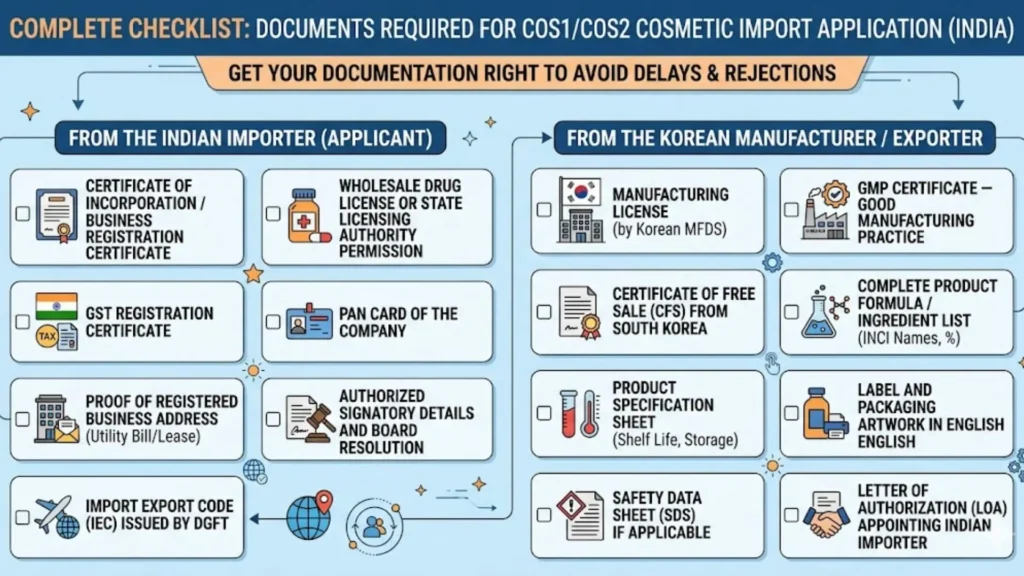
For Import Registration (COS-1 Application)
- Duly filled Form COS-1 (online via CDSCO Sugam portal)
- Certificate of Incorporation / Partnership Deed of the Indian importer
- Valid IEC (Import Export Code) from DGFT
- GST registration certificate
- Undertaking by the Indian authorized agent/importer
- Power of Attorney from foreign manufacturer to Indian importer
- Certificate of Free Sale (CFS) from country of origin — notarized and apostilled
- GMP Certificate of the foreign manufacturer — notarized and apostilled
- Full product formulation / ingredient list (with INCI names)
- Safety Assessment Report (SAS) for baby products — prepared by a certified toxicologist
- Product specification sheet and stability test data (12-month accelerated or 24-month real-time)
- Microbial challenge test report for baby cosmetics
- Dermatological test / patch test report (for baby skin care products)
- Paediatric safety data where available (especially for products for babies under 3 years)
- Packaging material specification and proposed label design
- Product MSDS (Material Safety Data Sheet)
- Registration fee payment proof (demand draft / online payment)
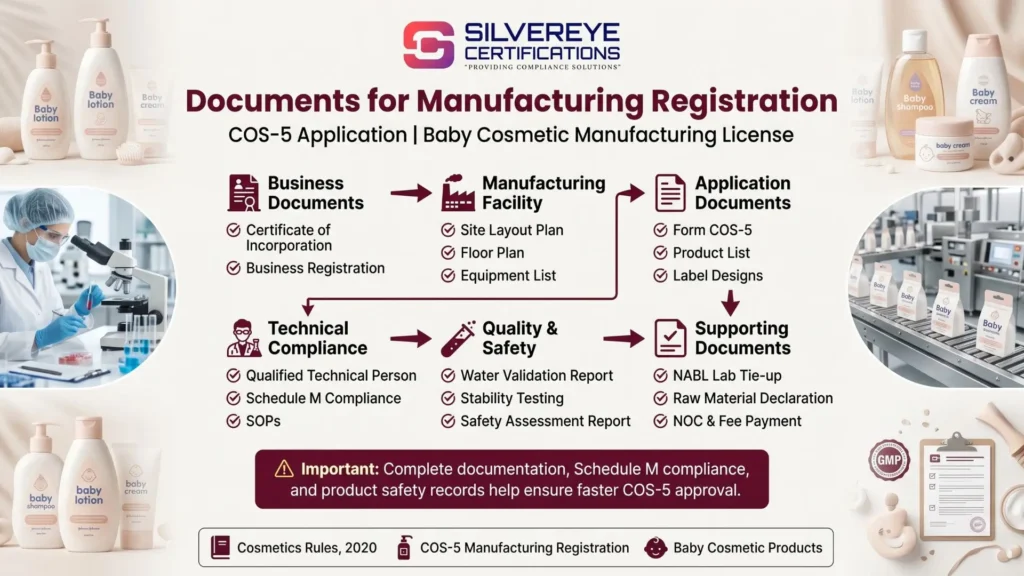
For Manufacturing Registration (COS-5 Application)
- Duly filled Form COS-5 (submitted to State Licensing Authority)
- Certificate of Incorporation / business registration of the manufacturing entity
- Site plan and floor plan of manufacturing premises
- List of products proposed to be manufactured with INCI formulations
- Equipment list with specifications
- Qualifications and appointment letter of the technical person / qualified person in charge
- Schedule M (Part XV) compliance undertaking / self-assessment checklist
- Source and quality of raw materials declaration
- Water system validation report (for baby cosmetics — purified water standard)
- In-house quality control procedure document / SOPs
- NABL-accredited lab tie-up letter (if no in-house lab)
- Stability testing protocol for baby cosmetic products
- Safety Assessment Report (SAS) — especially for baby category
- Proposed label designs for each product
- NOC from local municipal authority / pollution control board (where required)
- Manufacturing license fee payment proof
Step-by-Step Process: Baby Cosmetic Registration in India (2026)
Import Route (COS-1 → COS-2)
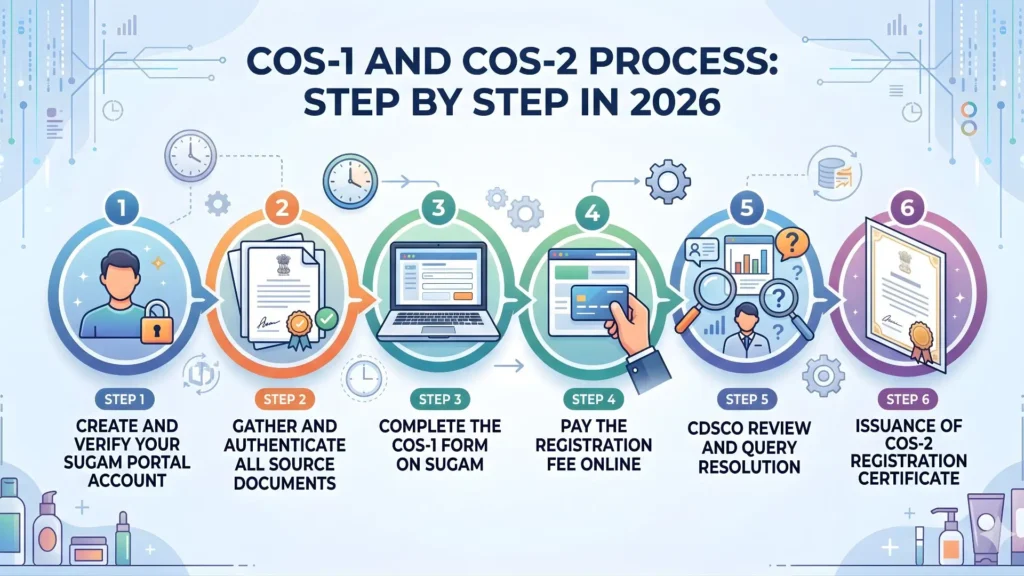
- Register on the CDSCO Sugam portal as an importer.
- Prepare all documents listed in Section 6 — Import Documents. This includes obtaining CFS and GMP certificates from the foreign manufacturer (apostilled).
- Complete the product Safety Assessment Report (SAS) through a qualified toxicologist. For baby cosmetics, the SAS must specifically address infant skin safety.
- Log in to the Sugam portal and fill Form COS-1 for each product individually. Upload all required documents.
- Pay the registration fee as per the Second Schedule of Cosmetics Rules 2020.
- The State Licensing Authority (SLA) reviews the application. For baby cosmetics, CDSCO may conduct additional scrutiny.
- If queries are raised, respond within the stipulated time (usually 30 days) or the application may be rejected.
- Upon approval, COS-2 (Import License) is issued in the name of the Indian importer for the specific product and manufacturer.
- The COS-2 license number must be declared on each import shipment's Bill of Entry for customs clearance.
Manufacturing Route (COS-5 → COS-8)
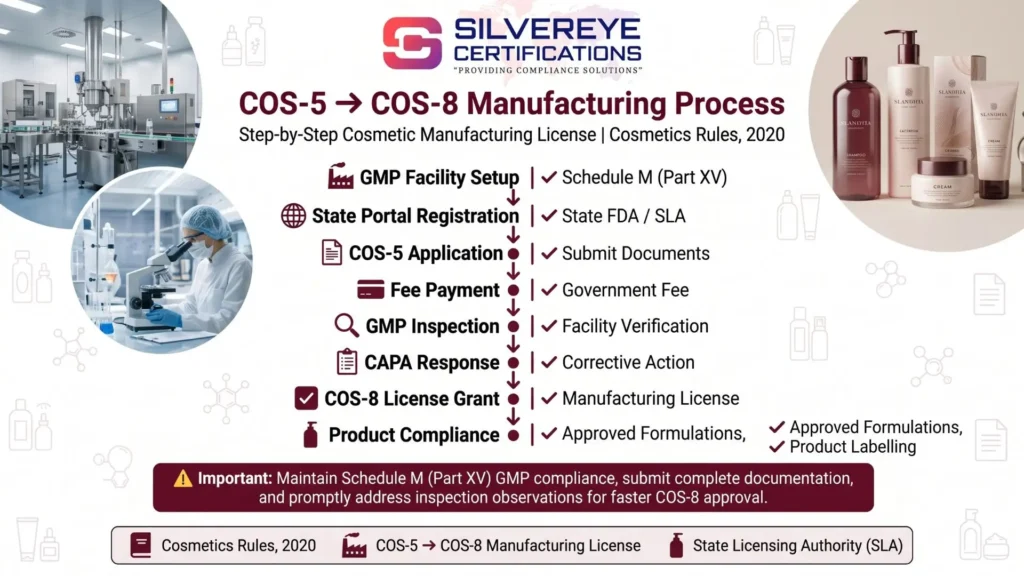
- Ensure your manufacturing facility is built and set up as per Schedule M (Part XV) GMP norms for cosmetics.
- Register on the State FDA / State Licensing Authority portal of your state (each state may have a slightly different portal).
- Fill Form COS-5 for the facility. Attach all documents listed in Section 6 — Manufacturing Documents.
- Pay the manufacturing license fee.
- A State FDA inspector will visit the manufacturing premises for a GMP inspection. Ensure the facility is ready.
- If the inspector raises observations, respond with a corrective action report (CAPA) within the given timeline.
- Upon satisfactory inspection and document review, the State Licensing Authority issues COS-8 (Manufacturing License).
- COS-8 is valid for 5 years. A product-specific SOA (Statement of Address) or product list is attached to the license.
- Every product manufactured must comply with the specifications, formulations, and labelling declared at the time of COS-5 filing.
Baby Cosmetic Registration Process
| Stage | Import Route | Manufacturing Route |
| Initial Step | Register on CDSCO Sugam portal | Set up GMP-compliant facility |
| Application Form | COS-1 (per product) | COS-5 (per facility) |
| Fee Payment | As per Second Schedule, Cosmetics Rules 2020 | As per Second Schedule, Cosmetics Rules 2020 |
| Key Document | CFS + GMP Cert from country of origin (apostilled) | Schedule M GMP compliance + Water system validation |
| Inspection Required? | No physical inspection | Yes — State FDA GMP inspection |
| Approval Authority | State Licensing Authority / CDSCO | State Licensing Authority (State FDA) |
| License Issued | COS-2 (Import License) | COS-8 (Manufacturing License) |
| Validity | 5 years | 5 years |
| Per Product? | Yes — individual COS-2 per product | No — COS-8 covers entire facility |
| Typical Timeline | 30 to 60 days (complete docs) | 60 to 90 days (with inspection) |
Fees for Baby Cosmetic Registration in India (2026)
Fees are prescribed in the Second Schedule of the Cosmetics Rules 2020 and are payable at the time of application. Fees may be revised by the government — always check the latest official schedule on the CDSCO website (cdsco.gov.in).
| Form / Service | Category | Indicative Fee (INR) |
| COS-1 (Import Application) | Per product, per manufacturer | Rs. 3,000 to Rs. 6,000 |
| COS-2 (Import License) | Included in COS-1 fee | No separate fee |
| COS-2 Renewal | Per product renewal | Rs. 1,500 to Rs. 3,000 |
| COS-5 (Manufacturing Application) | Per manufacturing premises | Rs. 5,000 to Rs. 15,000 |
| COS-8 (Manufacturing License) | Included in COS-5 fee | No separate fee |
| COS-8 Renewal | Per renewal | Rs. 2,500 to Rs. 7,500 |
| Amendment to License | Change in product/address etc. | Rs. 1,000 to Rs. 3,000 |
| Safety Assessment Report (SAS) | Third-party toxicologist cost (approx.) | Rs. 25,000 to Rs. 75,000 per product |
| Stability Testing (per product) | Accredited lab cost (approx.) | Rs. 20,000 to Rs. 60,000 per product |
Note: Fees above are indicative. Government fees are fixed and non-negotiable; testing and assessment costs depend on the service provider. Always factor in third-party testing costs when planning your registration budget.
Special Compliance Rules for Baby Cosmetics — What Makes Them Different
This is where baby cosmetic compliance diverges significantly from adult cosmetics in India. The following rules apply specifically — or with greater strictness — to products intended for infants and children:
Mandatory Safety Assessment Report (SAS) with Paediatric Focus
All baby cosmetic products require a Safety Assessment Report (SAS) as per Schedule 4A of the Cosmetics Rules 2020. For baby products, the SAS must explicitly address:
- Toxicological safety of all ingredients for infant use (0 to 36 months)
- Skin absorption and percutaneous penetration risk in infants
- Any ingredient that is safe for adults but restricted or contraindicated for babies
- Cumulative exposure assessment (especially for rinse-off vs. leave-on baby products)
Prohibited and Restricted Ingredients in Baby Cosmetics
The Cosmetics Rules 2020 (Schedule 4) list over 1,300 prohibited substances. For baby cosmetics, the following additional or enhanced restrictions apply:
| Ingredient | Status in Baby Cosmetics | Reason |
| Talc (cosmetic talc) | Restricted / under review | Inhalation risk in infants; some states require talc-free declaration |
| Parabens (butyl, propyl) | Restricted — max 0.19% for leave-on | Endocrine disruption concern in infants |
| Formaldehyde-releasing preservatives | Restricted — low limits | Carcinogenicity and infant skin sensitisation |
| Essential oils (high concentrations) | Restricted | Skin sensitisation risk in babies under 6 months |
| Salicylic acid | Prohibited in rinse-off baby cosmetics | Systemic absorption risk in infants |
| Resorcinol | Prohibited | Thyroid disruption risk |
| Aluminium salts (antiperspirant) | Restricted in baby products | Neurotoxicity risk in infants |
| Synthetic fragrances (some allergens) | Restricted — must declare if above threshold | ISCC 26 allergens must be declared on label |
Labelling Requirements Specific to Baby Cosmetics
- Must display: 'For external use only' and 'Keep away from eyes' in English and one regional language
- Age indication: Products for children under 3 years must state 'Not suitable for children under 3 years' if applicable, or 'Suitable for use from birth' with supporting safety data
- Fragrances: All 26 IFRA/ISCC allergen fragrances present above 0.001% (leave-on) or 0.01% (rinse-off) must be individually declared by name
- Batch Number, Manufacturing Date, Best Before / Expiry Date: mandatory on every unit and outer pack
- Full ingredient list in INCI nomenclature: mandatory in descending order of concentration
- Imported baby cosmetics must additionally state: country of origin, name and address of Indian importer, and COS-2 license number
Stability and Microbial Testing Requirements
| Test | Requirement for Baby Cosmetics |
| Stability Testing | Minimum 12 months accelerated or 24 months real-time before market launch |
| Microbial Challenge Test (PCT) | Mandatory — must meet Cosmetics Rules 2020 microbial limits |
| pH Testing | Baby rinse-off products must maintain pH 5.5 to 7.0 to match infant skin pH |
| Dermatological / Patch Test | Strongly recommended; some SLAs require it for leave-on baby products |
| Paediatric Dermatologist Endorsement | Recommended for 'dermatologist-tested' or 'clinically tested' claims |
| Skin Sensitisation Test | Required for all baby cosmetics containing fragrances or botanical extracts |
GMP Norms for Baby Cosmetic Manufacturing (Schedule M Part XV)
- Dedicated manufacturing areas for baby products — no cross-contamination with adult cosmetics
- HVAC systems with controlled temperature, humidity, and particulate count
- Purified water (BP standard) mandatory for water-based baby formulations
- Enhanced cleaning and sanitization protocols compared to regular cosmetic GMP
- All raw materials for baby cosmetics must meet higher purity standards — COA and TDS from approved suppliers mandatory
- Complete batch manufacturing records (BMR) and batch packaging records (BPR) for each production batch
Validity and Renewal of Baby Cosmetic Registration Licenses
| License | Validity Period | Renewal Timeline | What Happens If Not Renewed |
| COS-2 (Import License) | 5 years from date of issue | Apply 6 months before expiry | Import becomes illegal; customs will reject shipments |
| COS-8 (Manufacturing License) | 5 years from date of issue | Apply 3 months before expiry | Manufacturing becomes illegal; product cannot be sold |
| Amendment to COS-2 | As per original expiry | File whenever change occurs | Using incorrect license details can attract penalties |
| Amendment to COS-8 | As per original expiry | File whenever change occurs (new product, new area, new QP) | Operating with lapsed amendments can attract inspection penalties |
Key Renewal Reminders:
- Submit renewal applications well before the expiry date — CDSCO and SLAs do not automatically renew licenses
- Renewal applications require updated safety data if formulation has changed since original registration
- Any change in the foreign manufacturer's GMP certificate or CFS must be immediately updated with CDSCO
Benefits of Proper Baby Cosmetic Registration in India
| Benefit | What It Means for Your Business |
| Legal Market Access | Registered baby cosmetics can be legally sold across all Indian retail, e-commerce, and institutional channels |
| E-Commerce Compliance | Amazon, Flipkart, and other platforms require CDSCO registration details for all cosmetic listings — especially baby products |
| Brand Trust & Safety | CDSCO registration builds consumer and retailer confidence in your baby product's safety and quality |
| Avoided Penalties | Prevents seizure, fines, import bans, and reputational damage from non-compliant products in the market |
| Export Facilitation | Indian-manufactured registered baby cosmetics are easier to export to markets that require proof of origin country registration |
| Premium Positioning | Registered products can legitimately display safety claims like 'dermatologist tested' or 'clinically proven safe for babies' |
Common Mistakes That Lead to Baby Cosmetic Registration Rejection
- Submitting a generic SAS (Safety Assessment Report) not tailored for infant/baby use
- CFS and GMP certificates from foreign manufacturer not apostilled or incorrectly notarised
- Ingredient list using trade names instead of INCI nomenclature
- Stability data too short — accelerated data for less than 6 months submitted instead of 12 months minimum
- Product label design not compliant with Cosmetics Rules 2020 labelling schedule
- Filing COS-1 for a product that has drug claims — drug-cosmetic borderline products often rejected
- Foreign manufacturer not having an active GMP certificate at the time of filing
- No Power of Attorney from foreign manufacturer authorizing the Indian importer
Conclusion
India's baby cosmetics market is one of the fastest-growing segments in the personal care industry. But it comes with some of the most stringent regulatory requirements in the cosmetics space — and for good reason. When your customers are putting products on a newborn's skin, the safety bar has to be the highest.
Whether you are importing a baby shampoo from Europe or manufacturing a baby massage oil in Maharashtra, the CDSCO registration process — via COS-1/COS-2 for importers and COS-5/COS-8 for manufacturers — is your legal gateway to the Indian baby care market. Invest the time in getting your Safety Assessment Report right, your GMP compliance in order, and your documentation complete. It pays off in brand trust, uninterrupted business, and most importantly, in product safety for the little ones who use your products.
Frequently Asked Questions
Do all baby cosmetic products need separate registration in India?
Yes. Under the Cosmetics Rules 2020, every individual cosmetic product — including each variant of a baby product (e.g. baby lotion unscented vs. baby lotion with lavender) — requires its own COS-2 import license or must be covered under the COS-8 manufacturing license. There is no blanket registration for an entire product range.
Can a foreign baby cosmetic brand sell directly in India without a local entity?
No. A foreign manufacturer cannot hold an Indian cosmetic import license. They must appoint an authorised Indian importer or agent who holds the COS-2 license. The Indian importer is legally responsible for product compliance, safety, and recall in India.
What is the difference between COS-1 and COS-5 forms?
COS-1 is the application form for importing cosmetics into India — used by importers. COS-5 is the application form for manufacturing cosmetics in India — used by manufacturers. They are two separate tracks under the Cosmetics Rules 2020 with different requirements and approval processes.
How long does the baby cosmetic import license (COS-2) take to get?
If all documents are complete and correct, a COS-2 for baby cosmetics typically takes 30 to 60 working days. Baby products may take slightly longer due to additional scrutiny of the Safety Assessment Report by CDSCO. Incomplete applications significantly delay timelines.
Is baby powder (talc-based) still allowed to be registered in India?
Talc-based baby powder is under regulatory review in India due to international safety concerns. As of 2026, it can still be registered under COS-1 or COS-5 but the SAS must specifically address inhalation risk and the label must carry appropriate precautionary statements. Talc-free baby powders face fewer hurdles during registration.
What is a Safety Assessment Report (SAS) and is it mandatory for all baby cosmetics?
A Safety Assessment Report (SAS) is a technical document evaluating the safety of all cosmetic ingredients for the intended use on a specific age group. For baby cosmetics in India, SAS is mandatory and must be prepared or endorsed by a qualified toxicologist. The SAS for baby products must specifically address infant skin absorption and exposure safety.
Can the same COS-8 manufacturing license be used for both baby and adult cosmetics?
Yes, a single COS-8 can cover both adult and baby cosmetic products if the manufacturing premises meet GMP requirements for both. However, CDSCO and many state FDAs expect dedicated areas or at minimum dedicated equipment and procedures for baby cosmetic production to prevent cross-contamination.
What happens if I import baby cosmetics without a COS-2 license?
8. What happens if I import baby cosmetics without a COS-2 license?
Importing cosmetics without a valid license is a criminal offence under the Drugs and Cosmetics Act 1940. The shipment will be seized at customs, the importer can be prosecuted, fined, or imprisoned, and the DGFT may suspend the importer's IEC. Do not import baby cosmetics without a valid COS-2.
Do e-commerce platforms in India require CDSCO registration for baby cosmetics?
Yes. Major e-commerce platforms including Amazon India, Flipkart, Nykaa, and FirstCry require sellers to submit CDSCO cosmetic registration details (COS-2 license number for imports or COS-8 for domestic brands) for all cosmetic product listings, especially baby products. Non-registered products are removed from listings.
How often do I need to renew the baby cosmetic import license (COS-2)?
COS-2 import licenses are valid for 5 years. Renewal applications must be submitted well before the expiry date — ideally 6 months in advance. The renewal process is generally simpler than fresh registration but requires updated documents, especially if the foreign manufacturer's GMP or CFS has been renewed in the interim.