
- Mandatory nationwide from 1 October 2026 for medium and large manufacturers under the QCO 2026 mandate.
- Covers electric toothbrushes, water flossers, oral irrigators and other battery-operated or DC-supplied oral care devices.
- Certification is granted under Scheme-I of the BIS (Conformity Assessment) Regulations, 2018, against IS 302 (Part 1):2024 / IEC 60335-1:2020.
- Selling or importing without a valid ISI license can lead to fines, customs detention, product seizure and prosecution under the BIS Act, 2016.
Introduction
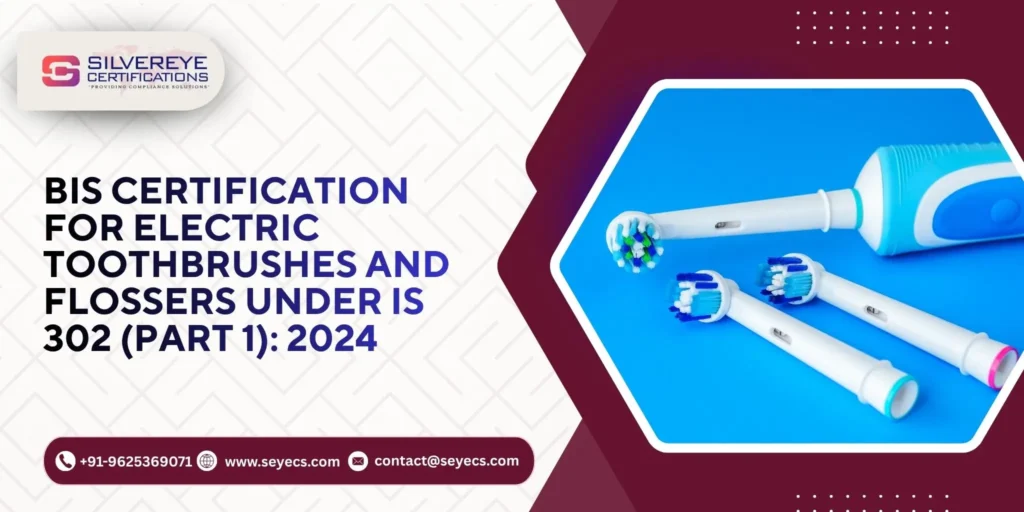
BIS Certification for electric toothbrushes and flossers is a mandatory safety approval issued by the Bureau of Indian Standards under IS 302 (Part 1):2024, which is identical to IEC 60335-1:2020. It applies to every battery-operated or DC-supplied oral hygiene appliance sold in India under the Safety of Household, Commercial and Similar Electrical Appliances Quality Control Order.
Manufacturers and importers apply through Scheme-I, get their factory inspected, have samples tested at a BIS-recognized laboratory, and then affix the ISI Mark on each unit. Under the latest QCO 2026 notification, general manufacturers must comply by 1 October 2026, small enterprises by 1 January 2027, and micro enterprises by 1 April 2027.
What Is BIS Certification for Electric Toothbrushes and Flossers?
Electric toothbrushes, water flossers, and oral irrigators sit in an unusual product category: they are electrical appliances that go directly inside the mouth. A battery pack, a motor, and a charging circuit are packed into a device that touches gums, teeth and soft tissue several times a day. Because of that close, repeated contact, the Government of India treats these products as safety-critical electrical appliances rather than ordinary personal-care gadgets.

BIS certification is the government's way of confirming, before a product reaches a consumer, that its electrical design, insulation, battery charging behaviour, heat management, and mechanical construction meet a defined national safety benchmark. Once a manufacturer or brand owner clears testing, factory inspection and document verification, the Bureau of Indian Standards (BIS) grants a license to use the ISI Mark, the well-known triangular certification mark that Indian consumers already associate with tested and approved products.
For electric toothbrushes and flossers specifically, this approval is issued under Scheme-I (Product Certification Scheme) of Schedule-II to the BIS (Conformity Assessment) Regulations, 2018, and it is assessed against a single governing standard: IS 302 (Part 1):2024.
Understanding IS 302 (Part 1):2024 — The Standard Behind the Certificate
IS 302 (Part 1):2024, titled the safety standard for household and similar electrical appliances (general requirements), is the seventh revision of a standard that has existed in earlier form since IS 302 (Part 1):2008. The 2024 revision is dual-numbered and technically identical to the international standard IEC 60335-1:2020, which means Indian manufacturers are now tested against the same baseline used across much of the world.
The standard sets out general requirements for electrical equipment used in households, shops and light-industrial or commercial settings, operating up to 250 V for single-phase appliances (and correspondingly higher limits for other configurations), including direct-current-supplied and battery-operated devices. It specifically brings oral hygiene appliances — electric toothbrushes, water flossers and similar devices — under its scope as a distinct appliance category, alongside vacuum cleaners, hair clippers, kitchen appliances and dozens of other everyday electrical products.
In practical terms, IS 302 (Part 1):2024 tests a product for: protection against electric shock, safe temperature rise during charging and use, resistance to moisture (since these devices are used near water and are often rinsed), mechanical strength and durability, safe behaviour of the battery and charging circuit, and clear, non-misleading markings and instructions for the end user.
Latest Update for 2026: The QCO Deadline Has Moved — What Every Brand Should Know Now
This is the part manufacturers most often get wrong, because the compliance date has changed more than once. Here is the accurate timeline, current as of this writing.
How the deadline evolved
- 17 September 2024 — DPIIT first notified the Safety of Household, Commercial and Similar Electrical Appliances (Quality Control) Order, 2024, built around IS 302 (Part 1):2008/2024.
- 19 May 2025 — DPIIT superseded that order with the Quality Control Order, 2025, resetting the compliance date to 19 March 2026 and confirming IS 302 (Part 1):2024 as the applicable standard.
- 6 April 2026 — DPIIT issued the Quality Control Order, 2026 (S.O. 1739(E)) under Section 16 of the BIS Act, 2016, which supersedes the 2025 order. The covered appliance list (90 categories, including oral hygiene appliances) and the applicable standard remain the same, but the compliance dates were pushed forward.
Under the current QCO 2026, the enforcement schedule by enterprise size is as follows.
| Category of Manufacturer / Importer | Mandatory Compliance Date |
|---|---|
| General / medium and large enterprises | 1 October 2026 |
| Small enterprises | 1 January 2027 |
| Micro enterprises | 1 April 2027 |
Two points matter here for anyone reading this close to the deadline. First, this timeline can move again if a further amendment is notified — always cross-check the live notification on bis.gov.in or the DPIIT portal before finalising a launch plan. Second, goods manufactured domestically purely for export remain exempt from the QCO, but anything sold within India — whether made locally or imported — needs a valid BIS licence once the applicable date arrives.
Why Is BIS Certification Mandatory for Oral Hygiene Appliances?
The requirement is not a formality; it is backed by law. The Quality Control Order is issued by DPIIT under Section 16 of the Bureau of Indian Standards Act, 2016, which empowers the government to make BIS certification compulsory for products where public safety, health or the prevention of unfair trade practices is at stake.
Electric toothbrushes and flossers carry real, if often overlooked, risks when built poorly: overheating battery packs, exposed conductive parts in a device used near water, brittle plastic housings that crack near the mouth, and chargers that do not isolate mains voltage safely. Mandatory certification is meant to filter out substandard imports and locally assembled units before they reach a bathroom counter, not after.
Who Needs This Certification?
- Indian manufacturers producing electric toothbrushes, water flossers or oral irrigators for sale in the domestic market — apply under Scheme-I for an ISI Mark license.
- Importers and brand owners who get these products manufactured overseas and sell them in India — the overseas factory itself must hold a valid BIS license, typically via the Foreign Manufacturers Certification Scheme (FMCS), routed through an Authorized Indian Representative (AIR).
- Foreign manufacturers who want to sell directly into India or through Indian distributors — apply through FMCS with an AIR based in India.
- E-commerce sellers and marketplaces listing these appliances — while the license itself sits with the manufacturer/brand owner, sellers are expected to verify and display valid BIS/ISI details before listing regulated appliances.
There is no size-based exemption from the certification requirement itself — the QCO only staggers the compliance date for micro and small enterprises; it does not exempt them from eventually getting certified.
Scope and Exemptions Under IS 302 (Part 1):2024
It helps to know what is and is not covered before starting the process.
Covered
- Electric (battery-operated and DC-supplied) toothbrushes
- Water flossers and oral irrigators
- Other similar oral hygiene appliances operating within the standard's voltage limits
Generally outside the scope of this standard
- Goods manufactured in India solely for export
- Medical devices regulated separately (for example, devices with a clinical/therapeutic claim regulated under drug or medical device law)
- Industrial appliances and portable electric hand tools, which fall under other standards
- Products already notified for mandatory certification under a different, more specific QCO
If there is any doubt about whether a specific SKU falls inside or outside scope — for instance, a hybrid device marketed with a therapeutic claim — it is worth getting a written scope opinion before investing in testing, since misclassification wastes both time and certification fees.
Key Benefits of BIS Certification for Electric Toothbrushes and Flosser Brands
- Legal market access — without it, the product simply cannot be lawfully sold in India once the QCO deadline for your enterprise category applies.
- Consumer trust — the ISI Mark is one of the most recognised quality symbols in India, and it visibly signals that a device has passed independent safety testing.
- Marketplace and retail eligibility — large e-commerce platforms and organised retail chains increasingly ask for BIS/ISI proof before onboarding regulated electrical products.
- Smoother customs clearance — imported consignments without valid BIS certification risk being held, tested on the spot, or rejected at the port once the product is under compulsory certification.
- Export credibility — because IS 302 (Part 1):2024 mirrors IEC 60335-1:2020, a BIS-tested product is already aligned with a standard recognized well beyond India.
Documents Required for BIS Certification For Electric Toothbrushes and Flosser
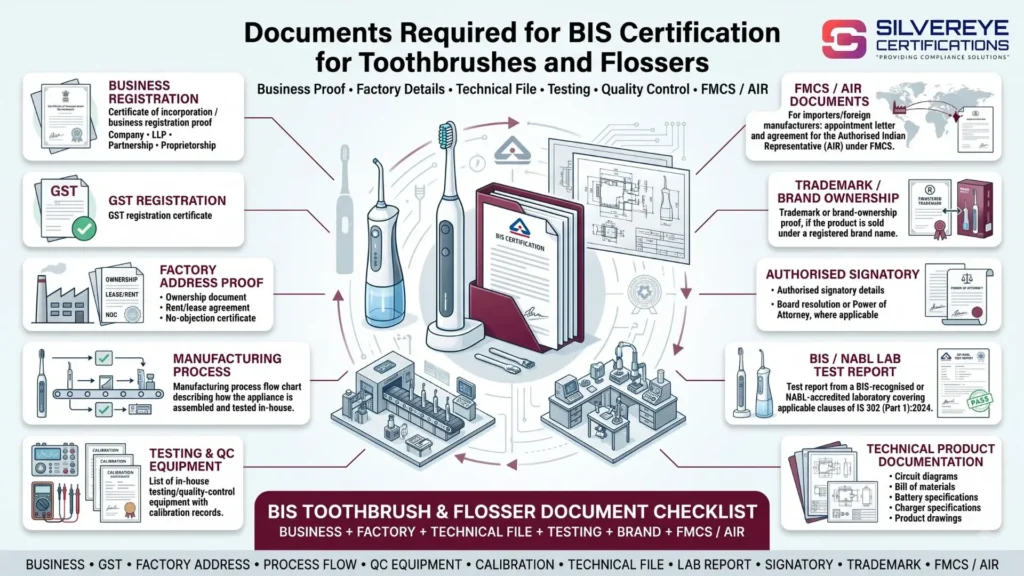
Requirements can vary slightly by application type (domestic Scheme-I versus FMCS for foreign manufacturers), but a typical file includes:
- Certificate of incorporation / business registration proof (company, LLP, partnership or proprietorship, as applicable)
- GST registration certificate
- Factory address proof — ownership document, rent/lease agreement, or a no-objection certificate for the manufacturing premises
- Manufacturing process flow chart describing how the appliance is assembled and tested in-house
- List of in-house testing/quality-control equipment, with calibration records
- Technical product documentation — circuit diagrams, bill of materials, battery and charger specifications, and product drawings
- Test report from a BIS-recognised or NABL-accredited laboratory covering the applicable clauses of IS 302 (Part 1):2024
- Authorized signatory details and a board resolution or power of attorney, where applicable
- Trademark or brand-ownership proof, if the product is sold under a registered brand name
- For importers/foreign manufacturers: appointment letter and agreement for the Authorised Indian Representative (AIR) under FMCS
Step-by-Step BIS Certification Process for Electric Toothbrush and Flosser
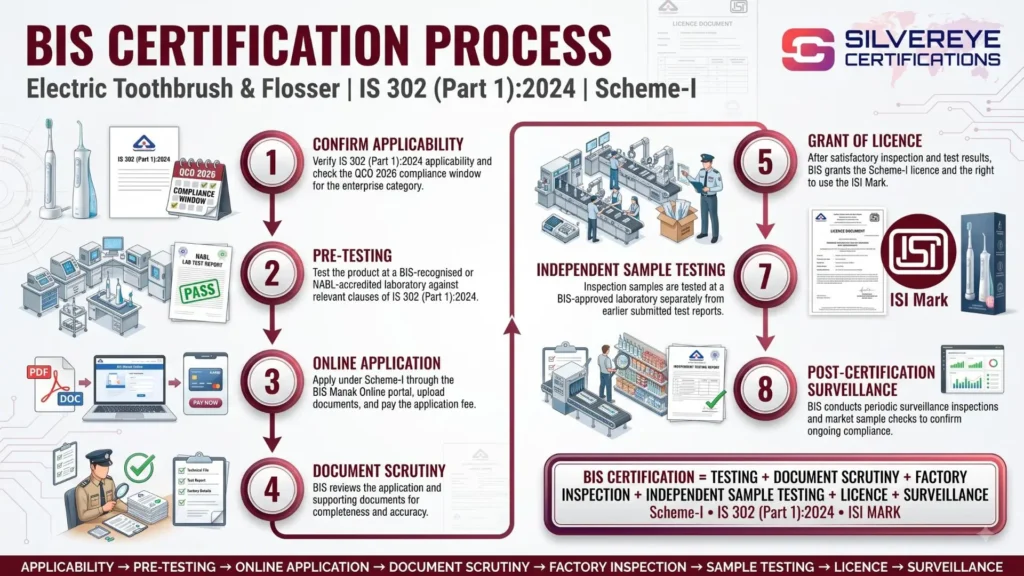
- Confirm applicability — verify that your product falls under IS 302 (Part 1):2024 and identify whether your enterprise category is already within its QCO 2026 compliance window.
- Pre-testing — get the product tested at a BIS-recognized or NABL-accredited laboratory against the relevant clauses of IS 302 (Part 1):2024 to catch design or component issues before the formal application.
- Online application — apply under Scheme-I through the BIS Manak Online portal, upload the required documents, and pay the application fee.
- Document scrutiny — BIS reviews the application and supporting documents for completeness and accuracy.
- Factory inspection — a BIS officer visits the manufacturing unit to verify production processes, in-house quality control, and testing capability, and draws samples directly from the production line.
- Independent sample testing — the samples drawn during inspection are sent for testing at a BIS-approved laboratory, separate from any test report submitted earlier.
- Grant of license — once the factory inspection report and test results are satisfactory, BIS grants the Scheme-I license and the right to use the ISI Mark on the certified product.
- Post-certification surveillance — after the license is granted, BIS conducts periodic surveillance inspections and market sample checks to confirm ongoing compliance.
BIS Certification Fees for Electric Toothbrushes and Flosser (2026)
BIS publishes and periodically revises its fee schedule directly on its official website (bis.gov.in, under Product Certification → Fee), including a downloadable marking-fee document covering every product under Scheme-I. The figures below reflect the standard Scheme-I fee structure applicable to this category; always check the current notification on the BIS website before budgeting, since marking fees in particular are revised from time to time and vary by product and turnover slab.
| Fee Head | Typical Amount / Basis |
|---|---|
| Application fee | Approx. Rs 1,000 per application (non-refundable) |
| Factory inspection fee | Approx. Rs 7,000 per man-day, plus actual travel and boarding expenses for the inspecting officer |
| Annual licence fee | Approx. Rs 1,000 per year, payable for as long as the licence is held |
| Marking fee | Product- and turnover-linked; charged on units produced/marked under the license, as per the latest BIS marking-fee notification |
| Testing charges | Payable to the testing laboratory, varying by the number of test parameters and lab tariffs — not a fixed government fee |
| MSME / DPIIT-recognised startup concession | Fee concessions (historically up to a significant percentage on marking fees) are available for eligible micro enterprises and recognised startups, subject to current BIS conditions |
For the exact, current numbers — including the latest marking-fee schedule and any fee concession notifications — refer directly to the official BIS fee page at bis.gov.in/product-certification/product-certification-fee, which lists the downloadable marking-fee PDF and every gazette amendment issued to date. Because BIS updates this schedule periodically, treat any third-party quote (including this one) as an estimate to confirm at application time, not a final invoice.
Validity, Renewal and Surveillance of the BIS License
- An ISI Mark license under Scheme-I is typically granted for an initial period and can subsequently be renewed for up to five years at a time, subject to satisfactory surveillance history.
- The annual license fee and applicable marking fees must be paid each year to keep the licence active — a lapsed licence effectively stops your legal right to use the ISI Mark.
- BIS conducts periodic, sometimes unannounced, surveillance visits and draws market samples to re-verify that certified products continue to meet IS 302 (Part 1):2024.
- Renewal applications should be filed well before expiry; certifying bodies and consultants generally recommend starting the renewal process at least 60–90 days ahead to avoid a compliance gap.
How Long Does BIS Certification Take?
Timelines depend heavily on how quickly documentation and pre-testing are completed, and on whether the simplified or normal procedure applies to your product category.
- Domestic manufacturers (simplified procedure, where the product qualifies): documentation, testing and inspection can often be completed in roughly 30–65 days if the product passes testing on the first attempt.
- Domestic manufacturers (normal procedure): expect a longer runway, since it can involve additional verification cycles.
- Foreign manufacturers under FMCS: generally takes considerably longer — often several months — because it involves appointing an Authorised Indian Representative, an overseas factory audit, and shipping samples for testing in India.
Products that fail testing on the first attempt need design or component changes and a retest, which is the single biggest cause of delay in practice — building in time for at least one round of corrective testing is a realistic way to plan a launch.
What Happens If You Sell Without BIS Certification?
Once a product category falls under a Quality Control Order and the applicable compliance date has passed, selling, storing for sale, or importing it without a valid BIS license is a punishable offence under Section 29 of the Bureau of Indian Standards Act, 2016.
Consequences commonly include monetary penalties (which can run from roughly Rs 2 lakh up to ten times the value of the goods for repeat or serious offences), imprisonment for up to two years in aggravated cases, seizure of non-compliant stock, detention of imported consignments at customs, delisting from e-commerce marketplaces, and cancellation or blacklisting of any existing BIS license the company holds for other products.
Common Mistakes Manufacturers Make For BIS Certification
- Waiting until close to the QCO deadline to start testing, leaving no buffer for a retest if the first sample fails.
- Assuming micro or small enterprise status means exemption from certification altogether, rather than just a later compliance date.
- Submitting incomplete technical documentation (missing circuit diagrams or battery specifications), which slows down document scrutiny.
- Treating the marking fee as a one-time cost instead of an ongoing, production-linked expense that needs to be budgeted for every year.
- Not confirming AIR arrangements early enough for FMCS applications, which delays the entire foreign-manufacturer timeline.
Why Choose Silvereye Certifications
Getting BIS certification right the first time comes down to two things: knowing exactly which clauses of IS 302 (Part 1):2024 your product needs to satisfy, and keeping the paperwork, testing and inspection stages moving without avoidable back-and-forth.
Silvereye Certifications works with electric toothbrush, water flosser and oral hygiene appliance manufacturers and importers to do exactly that — from an initial scope and gap assessment against IS 302 (Part 1):2024/IEC 60335-1:2020, through coordinating pre-testing at a recognized laboratory, preparing a complete and inspection-ready document file, to managing the Scheme-I or FMCS application end-to-end and staying engaged through renewal and surveillance cycles.
If your compliance date under QCO 2026 is approaching, the practical priority is to start testing now rather than at the deadline, since a failed first test and a required redesign is what typically pushes brands past their compliance window. Silvereye Certifications can review your current product file, flag likely gaps early, and lay out a realistic timeline to a licence — before the October 2026 date turns from a planning item into an enforcement risk.
Conclusion
BIS certification for electric toothbrushes and flossers under IS 302 (Part 1):2024 is no longer an optional quality badge — it is a legal requirement with a firm, government-notified deadline. QCO 2026 has confirmed 1 October 2026 for general manufacturers, with small and micro enterprises following through 2027, and the appliance list and standard are unlikely to soften from here.
Brands that treat this as a genuine safety exercise — pre-testing early, keeping documentation complete, and budgeting realistically for application, inspection, testing and annual marking fees — tend to clear the process smoothly and come out the other side with a product that carries real consumer trust in the Indian market. For anyone still uncertified, the most useful next step is simple: check where your product currently stands against IS 302 (Part 1):2024, and start the testing conversation now, well ahead of your compliance date.
Frequently Asked Questions
Is BIS certification mandatory for electric toothbrushes sold in India?
Yes. Under the Safety of Household, Commercial and Similar Electrical Appliances (Quality Control) Order, 2026, electric toothbrushes and similar oral hygiene appliances must carry a valid BIS ISI Mark once the compliance date applicable to your enterprise category arrives.
Which Indian Standard applies to electric toothbrushes and water flossers?
IS 302 (Part 1):2024, which is technically identical to IEC 60335-1:2020, is the governing safety standard for this category.
What is the current QCO deadline for oral hygiene appliances?
Under QCO 2026, general/medium and large manufacturers must comply by 1 October 2026, small enterprises by 1 January 2027, and micro enterprises by 1 April 2027. Always verify the live date on bis.gov.in, since these orders have been revised before.
Are water flossers and oral irrigators covered, or only toothbrushes?
Both are covered. IS 302 (Part 1):2024 applies to electric toothbrushes, water flossers, oral irrigators and comparable battery-operated or DC-supplied oral hygiene devices.
How much does BIS certification cost for an electric toothbrush?
Government fees typically include an application fee of around Rs 1,000, an inspection fee of around Rs 7,000 per man-day, an annual license fee of around Rs 1,000, plus a product-specific marking fee and separate lab testing charges. The exact, current figures are published on the official BIS fee.
How long is a BIS ISI Mark license valid, and does it need renewal?
The licence is typically granted for an initial period and can be renewed for up to five years at a time, provided the annual licence fee, marking fees and surveillance requirements are kept current.
Can importers sell electric toothbrushes made overseas without local BIS certification?
No. Once the product is under compulsory certification, the overseas factory needs its own valid BIS license, generally obtained through the Foreign Manufacturers Certification Scheme (FMCS) via an Authorized Indian Representative based in India.
Do micro and small enterprises get any relief under the QCO?
They get a later compliance date (1 January 2027 for small enterprises and 1 April 2027 for micro enterprises under QCO 2026) and, historically, fee concessions on certain BIS charges for eligible micro units and DPIIT-recognized startups — but they are not exempt from certification itself.
Are products made in India purely for export required to get BIS certification?
No. Goods manufactured domestically solely for export are explicitly exempt from the Quality Control Order. Anything sold within India, whether made locally or imported, still needs certification.
What is the difference between CRS and the ISI Mark (Scheme-I) for this category?
Electric toothbrushes and flossers are certified under Scheme-I (ISI Mark), not the Compulsory Registration Scheme (CRS), which mainly applies to electronics and IT hardware. Scheme-I involves factory inspection, ongoing surveillance and an annually renewable licence, unlike the registration-based CRS process.
What happens if my product fails BIS lab testing?
The application does not move forward until the product is redesigned or its components changed to meet the failed clause(s) of IS 302 (Part 1):2024, after which a retest is required. This is the most common cause of certification delays, so it helps to pre-test before formally applying.
Can I keep selling my existing, uncertified stock after the deadline passes?
This depends on the specific transitional provisions in force at the time and is a fact-sensitive question; in general, stock manufactured or imported before the applicable compliance date may be allowed limited continued sale under conditions set out in the order, but new production or import after the deadline requires certification.