
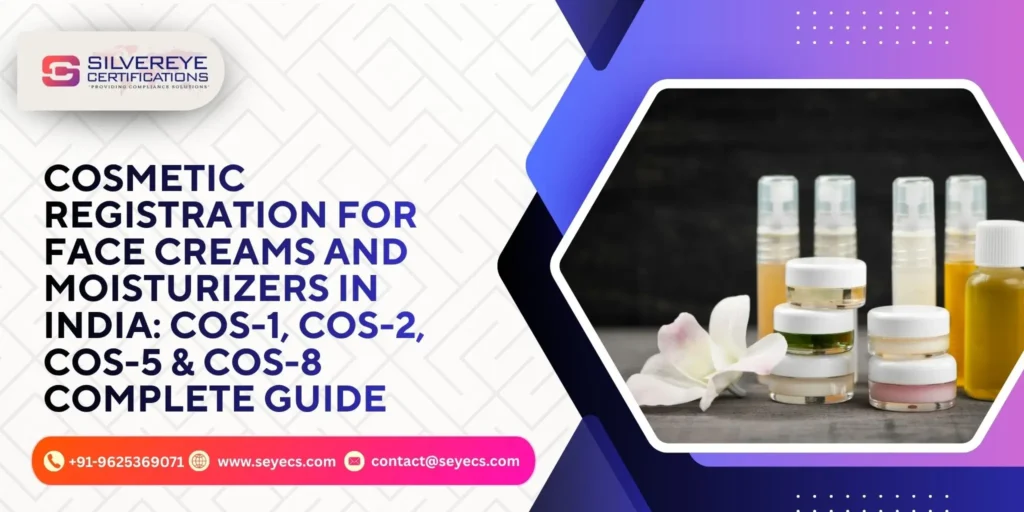
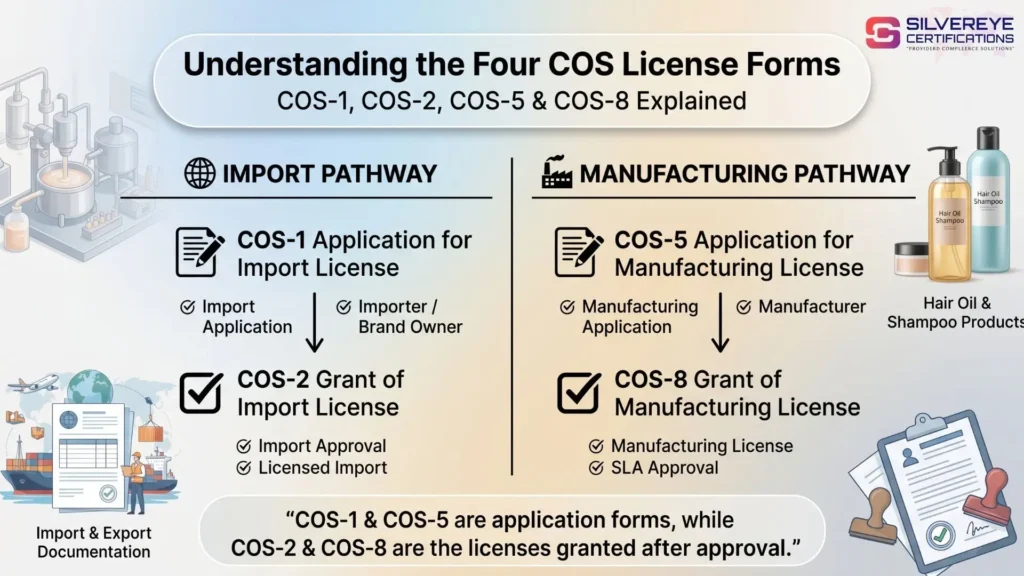
- Cosmetic registration for face creams and moisturizers in India requires COS-1 (import application) or COS-5 (manufacturing application) — followed by COS-2 or COS-8 as the final grant of license.
- Sunscreen products with SPF claims are regulated differently and need specific classification under the Drugs and Cosmetics Act — a dedicated table covers all sunscreen types and their registration route.
- Both importers and manufacturers must understand their respective licensing path: the forms, fees, documents, and timelines are different for each category.
Cosmetic Registration for Face Creams and Moisturizers in India
Cosmetic registration for face creams and moisturizers in India is governed by the Drugs and Cosmetics Act, 1940, and regulated by the Central Drugs Standard Control Organization (CDSCO). If you are importing, you need to file COS-1 (application) and receive COS-2 (import license). If you are manufacturing, you need COS-5 (application) and COS-8 (grant of manufacturing license).
Sunscreen products with active SPF ingredients follow a stricter registration route. The process requires specific documents, applicable fees, and a licensed premise — whether a factory or a licensed importer's facility.
Regulatory Framework: What Law Governs Cosmetic Registration in India?
All cosmetics sold, manufactured, or imported in India — including face creams, moisturizers, sunscreens, day creams, night creams, and anti-ageing formulations — are regulated under:
- The Drugs and Cosmetics Act, 1940 (D&C Act)
- The Drugs and Cosmetics Rules, 1945 (Schedule S for cosmetics)
- The New Drugs and Clinical Trials Rules, 2019 (for certain borderline cosmetic-drug products)
- CDSCO guidelines and circulars updated through 2026
The key regulatory authority for cosmetic imports is CDSCO (Central Drugs Standard Control Organisation) under the Ministry of Health and Family Welfare. For manufacturing licenses, the State Licensing Authority (SLA) in the respective state is the primary authority, with certain products requiring CDSCO central approval.
| Important 2026 Update: The Drugs, Medical Devices and Cosmetics Bill 2023 is progressively being implemented. While the 1940 Act still governs most cosmetic registrations as of 2026, keep track of any new compliance requirements under the updated bill through official CDSCO notifications. |
COS-1: Application for Import of Cosmetics (Face Creams & Moisturizers)
COS-1 is the application form used by importers to apply for a license to import cosmetics into India — including face creams, moisturizers, sunscreens, and all related skin-care formulations. It is the mandatory first step for any business that wants to legally import cosmetic products.
Who Files COS-1?
- Indian importers holding a valid import license
- Authorized agents or representatives of foreign cosmetic manufacturers
- Distributors registered as importers under CDSCO
What COS-1 Covers
- Face creams — all types including hydrating, brightening, anti-ageing, barrier creams
- Day creams and night creams with cosmetic-grade actives
- Moisturizers — lotion, gel, and cream formulations
- Sunscreen products (SPF creams, lotions, gels — see dedicated section below)
- Tinted moisturizers and BB/CC creams (cosmetic category)
- Serum-creams and hybrid formulations classified as cosmetics
| One COS-1 = One Product: As a general rule, a separate COS-1 application is required for each distinct cosmetic product. Variants with the same formulation but different pack sizes may be grouped — but only where explicitly permitted by CDSCO. Always verify before clubbing variants. |
COS-2: Grant of License for Import of Cosmetics
COS-2 is the actual import license issued by CDSCO after your COS-1 application is reviewed and approved. Without a valid COS-2, no importer can legally bring cosmetics into India. The COS-2 license is product-specific and tied to the approved COS-1 application.
Key Features of COS-2
- Issued by CDSCO after successful scrutiny of the COS-1 application
- Product-specific — tied to the exact formulation, brand, and manufacturer declared in COS-1
- Has a defined validity period (typically renewable)
- Must be produced at customs clearance and during regulatory inspections
- Any change in formulation, brand name, or manufacturer requires fresh application
COS-1 to COS-2: The Import Licensing Journey
| Stage | Form / License | Issued By |
| Application Stage | COS-1 (Application for Import License) | Filed by Importer with CDSCO |
| Grant Stage | COS-2 (Grant of Import License) | Issued by CDSCO after approval |
| Renewal | Renewal of COS-2 | CDSCO on fresh application before expiry |
| Amendment | Amendment to existing COS-2 | CDSCO — on material change in product/importer details |
COS-5: Application for Manufacturing License for Cosmetics
COS-5 is the application form filed by manufacturers who want to produce cosmetics in India — including face creams, moisturizers, sunscreens, and other skin-care products. It is the manufacturing equivalent of COS-1 and is submitted to the State Licensing Authority (SLA) of the state where the manufacturing facility is located.
Who Files COS-5?
- Registered cosmetic manufacturers operating in India
- Contract manufacturers producing cosmetics for a brand owner
- Companies expanding their existing cosmetic product range
- New entrants setting up cosmetic manufacturing facilities
What COS-5 Covers — Manufacturing Scope
- Face creams — day/night creams, anti-ageing creams, brightening creams
- Moisturizers — lotion, fluid, gel, and cream formulations
- Sunscreen creams, lotions, and gels (with or without SPF claims)
- Under-eye creams, neck creams, and body moisturizers
- Tinted moisturizers, foundation creams, and BB/CC creams
- Medicated cosmetics not crossing into drug classification
| Manufacturing vs. Import Route: If you manufacture in India, your path is COS-5 (application) → COS-8 (license). If you import from overseas, your path is COS-1 (application) → COS-2 (license). The documents and fees differ significantly. Choose the correct path before you begin. |
COS-8: Grant of License for Manufacturing Cosmetics
COS-8 is the final manufacturing license granted by the State Licensing Authority (SLA) after reviewing and approving the COS-5 application. It is the legal authorization to manufacture cosmetics at a specified facility. Without a valid COS-8, no cosmetic manufacturing operation is lawful in India.
Key Features of COS-8
- Issued by the State Drug Licensing Authority (not CDSCO centrally, unless specific products require central review)
- Tied to the manufacturing premises — any change of location requires fresh application
- Product category-specific — you can only manufacture what is listed on your COS-8
- Valid for a defined period — annual renewal or as per SLA norms
- Requires GMP (Good Manufacturing Practice) compliance at the facility
- Physical inspection of the manufacturing premises is mandatory before issuance
Cosmetic Import License vs Cosmetic Manufacturing License
| Parameter | Import Route (COS-1 & COS-2) | Manufacturing Route (COS-5 & COS-8) |
| Applicable Form | COS-1 (Application) | COS-5 (Application) |
| License Granted Via | COS-2 | COS-8 |
| Filed With | CDSCO (Central) | State Licensing Authority (SLA) |
| Inspection Required? | Product/document scrutiny | Physical factory inspection mandatory |
| Who Can Apply | Registered Indian importer / authorized agent | Registered cosmetic manufacturer |
| GMP Requirement | Foreign manufacturer needs GMP-compliant facility | Indian facility must comply with Schedule M-II / GMP norms |
| Fees (approx.) | As per CDSCO schedule | As per State SLA schedule |
| Validity | Typically 1–3 years (renewable) | Typically 1–5 years (renewable) |
Sunscreen Products: Registration Classification & COS Form Required
Sunscreen products are among the most closely regulated cosmetics in India because many contain active pharmaceutical ingredients (such as zinc oxide, titanium dioxide, avobenzone, octinoxate, and other UV filters). The regulatory classification of a sunscreen — whether it is a cosmetic or a drug — determines which licensing path you must follow.
The table below covers every major type of sunscreen product, its classification under Indian regulations, and the applicable COS form for both import and manufacturing:
| Sunscreen Product Name / Type | Key Active Ingredient(s) | Classification | Import Form | Mfg Form | Notes |
| SPF 15–30 Sunscreen Lotion | Avobenzone, Octinoxate | Cosmetic | COS-1 / COS-2 | COS-5 / COS-8 | Most common OTC category |
| SPF 50 / SPF 50+ Sunscreen Cream | Octisalate, Octocrylene, Avobenzone | Cosmetic | COS-1 / COS-2 | COS-5 / COS-8 | Label must state SPF value |
| PA+ / PA++++ Sunscreen (UVA Rating) | Tinosorb M, Tinosorb S | Cosmetic | COS-1 / COS-2 | COS-5 / COS-8 | PA rating system for UVA |
| Mineral Sunscreen (Zinc Oxide Cream) | Zinc Oxide | Cosmetic / Drug (concentration-dependent) | COS-1/2 or Drug import license | COS-5/8 or Drug mfg license | Check ZnO % threshold |
| Mineral Sunscreen (Titanium Dioxide) | Titanium Dioxide | Cosmetic | COS-1 / COS-2 | COS-5 / COS-8 | Generally cosmetic-classified |
| Tinted Sunscreen Cream / Fluid | Avobenzone + Iron Oxides | Cosmetic | COS-1 / COS-2 | COS-5 / COS-8 | Colour cosmetic + SPF |
| Sunscreen Face Gel (SPF 30+) | Avobenzone, Octocrylene | Cosmetic | COS-1 / COS-2 | COS-5 / COS-8 | Gel base — same COS route |
| Sunscreen Body Lotion (SPF 20–50) | Homosalate, Octisalate | Cosmetic | COS-1 / COS-2 | COS-5 / COS-8 | Body application cosmetic |
| Sunscreen Spray / Aerosol (SPF 30+) | Ethylhexyl Methoxycinnamate | Cosmetic | COS-1 / COS-2 | COS-5 / COS-8 | Aerosol compliance rules apply |
| Sunscreen Lip Balm / Lip Protector | Octinoxate, Octisalate | Cosmetic | COS-1 / COS-2 | COS-5 / COS-8 | Lip cosmetic category |
| Kids / Baby Sunscreen Cream (SPF 50+) | Zinc Oxide (low concentration) | Cosmetic | COS-1 / COS-2 | COS-5 / COS-8 | Gentle formulation claims |
| After-Sun Moisturizing Cream | Aloe Vera, Panthenol | Cosmetic | COS-1 / COS-2 | COS-5 / COS-8 | Not SPF-rated — after-sun only |
| Medicated Sunscreen (Rx / OTC Drug) | Zinc Oxide > drug threshold or therapeutic claim | Drug | Drug import license (Form 10) | Drug mfg license | NOT a cosmetic COS route |
| Sunscreen + Moisturizer Combo Cream | Avobenzone + Hyaluronic Acid | Cosmetic | COS-1 / COS-2 | COS-5 / COS-8 | Combo — cosmetic classification |
| Sunscreen + Antioxidant Serum-Cream | Octocrylene + Vitamin C / Niacinamide | Cosmetic | COS-1 / COS-2 | COS-5 / COS-8 | Cosmetic-grade actives only |
| Critical Note on Sunscreen Classification: If a sunscreen product carries a therapeutic claim (e.g., 'treats photodamage', 'prevents skin cancer', 'repairs UV-damaged skin'), it crosses into the drug category and requires a Drug License — not a COS-1/COS-2. Only cosmetic claims such as 'protects from UV rays', 'SPF 50 protection', or 'broad-spectrum coverage' keep it under COS licensing. |
Eligibility Criteria for Cosmetic Registration in India
For Importers (COS-1 / COS-2)
- Must be a registered business entity in India (Pvt. Ltd., LLP, Proprietorship, Partnership, etc.)
- Must hold or be in the process of obtaining a valid Import Export Code (IEC)
- The foreign manufacturer must be a licensed cosmetic manufacturing facility in their country of origin
- The foreign manufacturer must hold a valid GMP certificate or equivalent quality certification
- A registered premise in India for the importer is required
- The applicant must appoint a Responsible Person (RP) for regulatory compliance
For Manufacturers (COS-5 / COS-8)
- Must be a registered business entity in India
- The manufacturing facility must be located within India with a valid premises license
- Must comply with Good Manufacturing Practices (GMP) as per Schedule M-II of the D&C Rules
- Must employ or retain a qualified Technical Supervisor (Diploma/Degree in Pharmacy, Chemistry, or equivalent)
- Manufacturing facility must have adequate infrastructure: clean rooms, QC lab, storage, utilities
- All raw materials, finished product specifications, and stability data must be documented
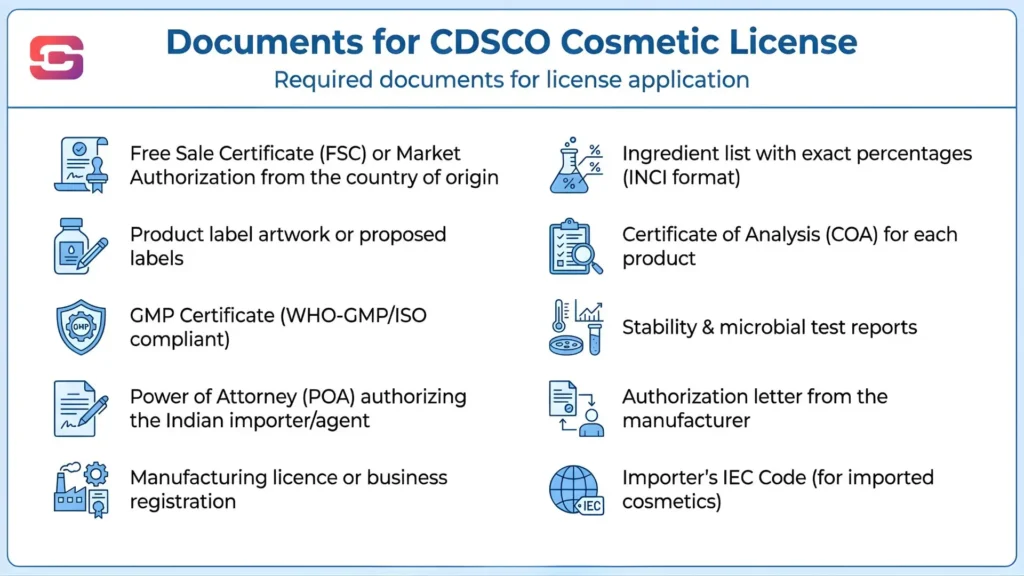
Documents Required for Cosmetic Registration (Import & Manufacturing)
| Document | Import (COS-1 / COS-2) | Manufacturing (COS-5 / COS-8) |
| Application Form (COS-1 or COS-5) | Required | Required |
| Business Registration Certificate / GST Certificate | Required | Required |
| Import Export Code (IEC) | Required | Not required |
| Manufacturing License / Permission to Manufacture | From country of origin (foreign mfg) | COS-8 is the license being applied for |
| GMP Certificate (foreign manufacturer) | Required | Facility GMP compliance certificate |
| Product Formula / Ingredient List (INCI) | Required — full formulation details | Required — with quantities |
| Certificate of Analysis (CoA) / Lab Test Reports | Required — recent (within 12 months) | Required — batch test reports |
| Product Label / Artwork (English + Hindi) | Required — CDSCO label standards | Required |
| Safety Data Sheet (SDS) / Safety Assessment | Required for regulated actives | Required |
| Stability Data / Shelf-Life Justification | Required | Required |
| Letter of Authorization (from foreign brand) | Required if filed via authorized agent | N/A |
| Site Master File (SMF) of manufacturing facility | Foreign manufacturer's SMF | Indian facility's SMF |
| Undertaking / Declaration by applicant | Required | Required |
| Power of Attorney (if applicable) | Required if applicant is agent | Required if filed through representative |
| Premises Proof (Indian importer's office/warehouse) | Required | Required — factory premises docs |
| Technical Supervisor Qualification Proof | N/A | Required — TC/Degree + Experience |
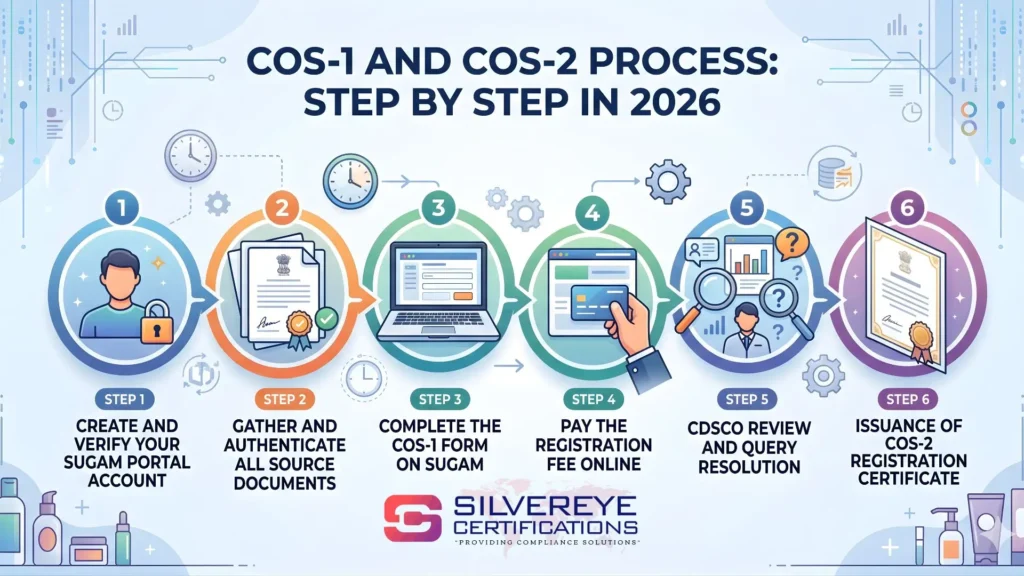
Step-by-Step Process: Cosmetic Registration in India (2026)
Import Route: COS-1 → COS-2
Step 1: Verify Product Classification
Confirm your face cream, moisturizer, or sunscreen is classified as a cosmetic (not a drug). Check if the product's claims and active ingredients stay within cosmetic boundaries.
Step 2: Gather All Required Documents
Compile the complete COS-1 document set — GMP certificate, product formula, CoA, safety data, label artwork, IEC, and authorization letter from the foreign brand.
Step 3: Complete COS-1 Application Form
Fill in the COS-1 form accurately. Include precise product name, INCI-based ingredient list, intended use, brand name, and country of origin.
Step 4: Pay the Applicable Fee
Pay the required fee to CDSCO as per the current schedule. Retain the fee receipt — it must accompany the application.
Step 5: Submit Application to CDSCO
File the complete application package — either via the SUGAM portal (online) or physical submission to the relevant CDSCO zonal office.
Step 6: Application Scrutiny & Queries
CDSCO reviews the application. They may raise deficiency letters or queries. Respond promptly and completely to avoid additional delays.
Step 7: Grant of COS-2 License
On approval, CDSCO issues the COS-2 import license. This is your authorization to import the specific cosmetic product.
Manufacturing Route: COS-5 → COS-8
Step 1: Establish Manufacturing Facility
Set up a GMP-compliant facility. Ensure adequate infrastructure — production area, QC lab, raw material storage, packaging area, and waste management.
Step 2: Appoint a Technical Supervisor
Hire or retain a qualified Technical Supervisor with a recognized qualification in pharmacy, chemistry, or a relevant discipline.
Step 3: Prepare the Product Dossier
Develop complete product documentation — master formula, batch manufacturing record template, specifications, CoA, stability studies, and safety assessment.
Step 4: Complete COS-5 Application Form
Fill in the COS-5 form. Include manufacturing premises details, list of products to be manufactured, technical supervisor details, and equipment list.
Step 5: Submit to State Licensing Authority (SLA)
File the COS-5 application with your state's drug licensing authority. Attach all documents and the prescribed fee.
Step 6: Factory Inspection by SLA Inspector
The SLA schedules a physical inspection of your manufacturing premises. Be ready to demonstrate GMP compliance, infrastructure, and documentation.
Step 7: Grant of COS-8 License
After successful inspection and document verification, the SLA issues the COS-8 manufacturing license.
Fee Structure for Cosmetic Registration in India (2026)
Fees for cosmetic registration are set by the respective authority — CDSCO for import licenses and the State Drug Licensing Authority for manufacturing licenses. The figures below represent the officially referenced benchmarks. Always verify current fees on the CDSCO Sugam portal or your State SLA portal before filing.
| License Type | Application / Form | Approx. Fee (INR) | Payable To |
| Import License Application | COS-1 | As per CDSCO schedule (typically ₹3,000–₹5,000 per product) | CDSCO (via DD / online payment) |
| Grant of Import License | COS-2 | Included in COS-1 fee or separate as per schedule | CDSCO |
| Manufacturing License Application | COS-5 | As per State SLA schedule (varies by state, typically ₹2,000–₹10,000) | State Licensing Authority |
| Grant of Manufacturing License | COS-8 | Included in COS-5 fee or separate state-specific fee | State Licensing Authority |
| Renewal — Import (COS-2) | Renewal Application | As per current CDSCO schedule | CDSCO |
| Renewal — Manufacturing (COS-8) | Renewal Application | As per State SLA schedule | State Licensing Authority |
| Amendment to License | Amendment Form | Partial fee — as per applicable schedule | Respective authority |
| Fee Disclaimer: Fee amounts are subject to periodic revision by CDSCO and State Licensing Authorities. Always check the official CDSCO Sugam portal (sugam.gov.in) and your respective State SLA website for the latest fee schedule before making any payment. |
Validity Period and Renewal Timeline For Cosmetic License
COS-2 Import License Validity
- COS-2 is typically valid for a period as specified at the time of grant — commonly 1 to 3 years or as specified by CDSCO
- Renewal must be filed before the expiry date to avoid lapse
- Operating with an expired COS-2 is a legal violation and can result in customs seizure of imported goods
COS-8 Manufacturing License Validity
- COS-8 is typically valid for 1 to 5 years depending on the State SLA and product category
- Some states issue licenses with annual renewal requirements; others provide longer validity
- Manufacturing must cease if COS-8 lapses and is not renewed
Renewal Timeline
| Timeline Before Expiry | Action Required |
| 90 days before expiry | Begin gathering renewal documents; check for any formulation or label changes that need amendment |
| 60 days before expiry | Submit renewal application with updated documents and fee payment |
| 30 days before expiry | Follow up with authority if no acknowledgement or query received |
| Expiry date | License lapses if renewal not granted — business must pause relevant activity immediately |
| Post-expiry (if lapsed) | Fresh COS-1 or COS-5 application required — treated as new application with full fees and processing time |
Benefits of Obtaining a Valid Cosmetic Registration in India
- Legal compliance — you can import or manufacture without risk of regulatory seizure, recall, or prosecution
- Market access — registered products can be listed on e-commerce platforms, pharmacy chains, and modern trade
- Brand credibility — CDSCO-licensed products carry greater trust with retailers, distributors, and consumers
- Tender and institutional eligibility — government and institutional buyers require licensed cosmetic suppliers
- Basis for downstream certifications — ISO, Halal, Cruelty-Free, and export approvals become easier with CDSCO registration in place
- Protects against counterfeiting — license-linked products are traceable and have regulatory standing in legal disputes
Conclusion: Getting Cosmetic Registration Right in 2026
Cosmetic registration for face creams, moisturizers, and sunscreen products in India is a well-defined process — but it requires choosing the right path from day one. Importers go through COS-1 and COS-2 with CDSCO. Manufacturers go through COS-5 and COS-8 with their State Licensing Authority. Sunscreen products sit in a particularly sensitive classification zone — one wrong label claim can push your product from the cosmetic track into the drug track.
Prepare your documents completely, classify your product correctly, pay the right fees, and submit to the right authority. A proactive compliance approach — especially for renewal timelines — keeps your product in the market and your business on the right side of regulation.
This guide is designed to give you a clear, honest, and actionable roadmap. If you are working with multiple products or complex formulations, consulting a CDSCO-registered regulatory consultant for your specific case is always the most reliable step.
Frequently Asked Questions
What is the difference between COS-1 and COS-5?
COS-1 is the application form for importing cosmetics into India. COS-5 is the application form for manufacturing cosmetics within India. Both lead to a license — COS-2 for importers and COS-8 for manufacturers. You file COS-1 if you are importing; you file COS-5 if you are manufacturing.
Do sunscreen products with SPF 50+ need a drug license in India?
Not automatically. SPF 50+ sunscreens are classified as cosmetics in India as long as they carry only cosmetic-type claims (UV protection, broad-spectrum coverage). If the product makes therapeutic claims — such as 'prevents skin cancer' or 'treats photodamage' — it is reclassified as a drug and requires a drug license instead of COS-1 or COS-5.
How long does it take to get a COS-2 import license?
Typically 30 to 90 days from the date of complete submission, depending on CDSCO workload and whether any queries are raised. If the application is complete and deficiency-free, some approvals come faster. Queries and deficiency letters extend the timeline.
Can one COS-1 cover multiple face cream products from the same brand?
No. As a general rule, one COS-1 application is required per product. Variants of the same product (e.g., same formula in 50g and 100g packs) may sometimes be grouped, but only where CDSCO explicitly permits it. Unrelated products always require separate applications.
Is a GMP certificate mandatory for importing face creams and moisturizers?
Yes. The foreign manufacturer must hold a valid GMP certificate or equivalent quality compliance document from their country of origin. CDSCO requires this as part of the COS-1 application package to ensure the manufacturing source meets international quality standards.
What happens if I import cosmetics without a valid COS-2?
Importing cosmetics without a valid COS-2 is a violation of the Drugs and Cosmetics Act. The consignment can be seized at customs, and the importer is liable for penalties, prosecution, and reputational damage. There is no grace period for unlicensed cosmetic imports.
Do tinted moisturizers and BB creams require cosmetic registration in India?
Yes. Tinted moisturizers, BB creams, and CC creams are classified as cosmetics in India when they carry standard cosmetic claims (moisturization, colour correction, SPF protection without therapeutic claims). They follow the standard COS-1/COS-2 or COS-5/COS-8 route.
Is there a separate process for organic or natural face creams?
No separate registration process exists in India specifically for organic or natural cosmetics as of 2026. Organic/natural face creams follow the same COS-1/COS-2 or COS-5/COS-8 route. However, you may need third-party certification (COSMOS, NATRUE, USDA Organic) for branding and marketing claims.
How do I renew my COS-8 manufacturing license?
Start the renewal process at least 60 to 90 days before the expiry date. Submit a renewal application to your State Licensing Authority with updated documents, any changes in product list or facility details, and the prescribed renewal fee. Late renewal may be treated as a fresh application.
Which authority should I contact for cosmetic import registration — central or state?
For import registration (COS-1 / COS-2), the authority is CDSCO (Central Drugs Standard Control Organization) — a central authority under the Ministry of Health and Family Welfare. For manufacturing registration (COS-5 / COS-8), the authority is the State Licensing Authority (SLA) in the state where your manufacturing facility is located.