
- Mandatory once an establishment has 20 or more employees; smaller businesses can still register voluntarily under Section 1(4).
- Fully online via the EPFO Unified Portal and Shram Suvidha Portal — zero government fee, PF code usually issued in 7-15 working days.
- The Employees' Provident Funds Scheme, 2026 replaced the 1952 scheme from 1 July 2026 under the new Code on Social Security.
- Three one-time 2026 windows — EEC, VISHWAS and AMNESTY — let employers fix past PF gaps and settle old disputes before their deadlines close.
Introduction
EPF registration is mandatory for any Indian establishment employing 20 or more people; smaller businesses may register voluntarily. Employers apply free of cost on the EPFO Unified Portal or Shram Suvidha Portal using their PAN, incorporation proof, address proof and Digital Signature Certificate. Registration typically takes 7-15 working days and generates a permanent Establishment (PF) Code.
Once registered, the employer deducts 12% of basic wages plus dearness allowance from each employee and matches it (split 3.67% to EPF and 8.33% to EPS, capped at the Rs 15,000 wage ceiling), adds 0.5% EDLI and 0.5% admin charges, and files the monthly Electronic Challan-cum-Return (ECR) by the 15th. From 1 July 2026, the Employees' Provident Funds Scheme, 2026 governs the process under the Code on Social Security, 2020.

If you have just crossed the 20-employee mark, or you want to offer your team a formal retirement benefit even earlier, EPF registration is the first compliance step you cannot skip.
This guide walks through every part of employer PF registration in India as it actually stands in 2026 — who must register, which documents EPFO checks, the exact online steps, what registration costs, how contributions are calculated, what happens if you miss the deadline, and the fresh regulatory changes (the new EPF Scheme 2026, and three time-bound 2026 relief windows) that every HR and finance team should know about right now.
What Is EPF Registration and Why Does It Matter for Employers?
The Employees' Provident Fund (EPF) is India's flagship retirement-savings and social-security scheme, run by the Employees' Provident Fund Organisation (EPFO) under the Ministry of Labour and Employment. A single EPF registration actually enrols your establishment into three linked schemes:
- Employees' Provident Fund Scheme - builds a lump-sum retirement corpus for each employee.
- Employees' Pension Scheme (EPS) - provides a monthly pension after age 58 for members with at least 10 years of contributory service.
- Employees' Deposit Linked Insurance Scheme (EDLI) - gives nominees a life-insurance payout, up to Rs 7 lakh, if an employee dies during active service.
For an employer, EPF registration is not optional paperwork — it is a statutory obligation once the headcount threshold is crossed, and it directly affects payroll, employee trust, and your legal exposure to interest, damages and prosecution under Indian labour law.
Who Needs EPF Registration? Eligibility & Applicability
Mandatory registration
EPF registration is compulsory for any factory or establishment employing 20 or more persons on any single day, counted across permanent, part-time, temporary and contract workers. The Central Government has separately notified 180-plus classes of establishments — shops, hotels, restaurants, cinemas, road transport, educational institutions, hospitals, IT/ITES firms and most service businesses — that fall under this rule. Once the 20-employee threshold is crossed, the law gives the employer 30 days to complete registration; the obligation begins from day one of crossing the threshold, not from the date of application.
Voluntary registration
Establishments with fewer than 20 employees can still register voluntarily under Section 1(4) of the EPF Act, with the consent of a majority of employees. This is common among startups and small businesses that want to offer a tax-advantaged retirement benefit to attract and retain talent, even though they are below the mandatory threshold.
Wage ceiling for mandatory coverage
The statutory wage ceiling for mandatory EPF coverage is Rs 15,000 per month in basic wages plus dearness allowance. This ceiling has been unchanged since 1 September 2014 and was not revised in the 2026 update. Employees drawing a higher basic salary who are joining EPF coverage for the first time may opt out at entry, but once enrolled, membership is permanent regardless of later salary increases; most employers choose to cover everyone as a default HR practice.
Benefits of EPF Registration for Employers
- Legal compliance: avoids interest, damages and prosecution under the EPF Act / Code on Social Security.
- Employee retention and trust: a registered PF account is one of the most-checked benefits by job seekers in India.
- Access to EPFO's digital ecosystem: UAN-based tracking, auto transfer of PF on job change, and simplified KYC.
- Eligibility for related statutory processes: many clients, government tenders and larger corporates require a valid PF code before onboarding vendors.
- Built-in life insurance (EDLI) and pension (EPS) cover for the workforce at a predictable payroll cost.
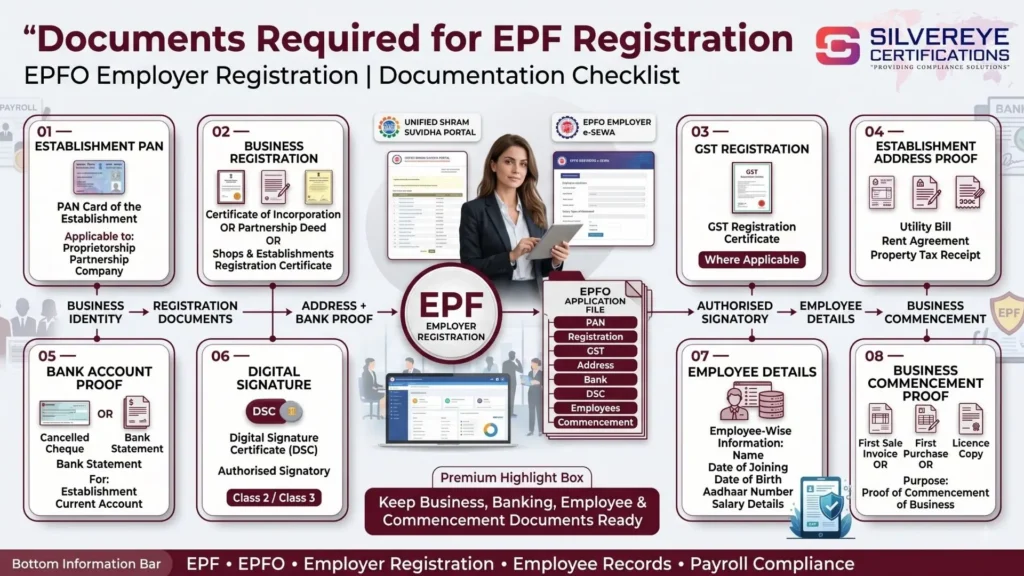
Documents Required for EPF Registration
Keep scanned PDF copies ready before you start the online application — EPFO's portal rejects mismatched names and expired proofs, which is the single biggest cause of delayed registrations.
Entity documents
- PAN card of the establishment (proprietorship, partnership, LLP, company, trust or society).
- Certificate of Incorporation / Partnership Deed / Registration Certificate, as applicable to the entity type.
- GST registration certificate or Shop & Establishment Certificate / trade licence issued by the local authority.
- Proof of business address (utility bill, lease agreement or rent deed).
- Cancelled cheque or bank statement of the establishment's current account.
Authorized signatory documents
- PAN and Aadhaar of the proprietor, all partners or all directors.
- A Class 3 Digital Signature Certificate (DSC) of the authorised signatory — Class 2 DSCs were discontinued from January 2021, so only Class 3 is accepted now.
- Specimen signature of the authorised representative.
Employee details (for staff already on payroll)
- Name, date of birth, gender, PAN and Aadhaar of each employee.
- Date of joining, designation, wages and bank account details for UAN generation.
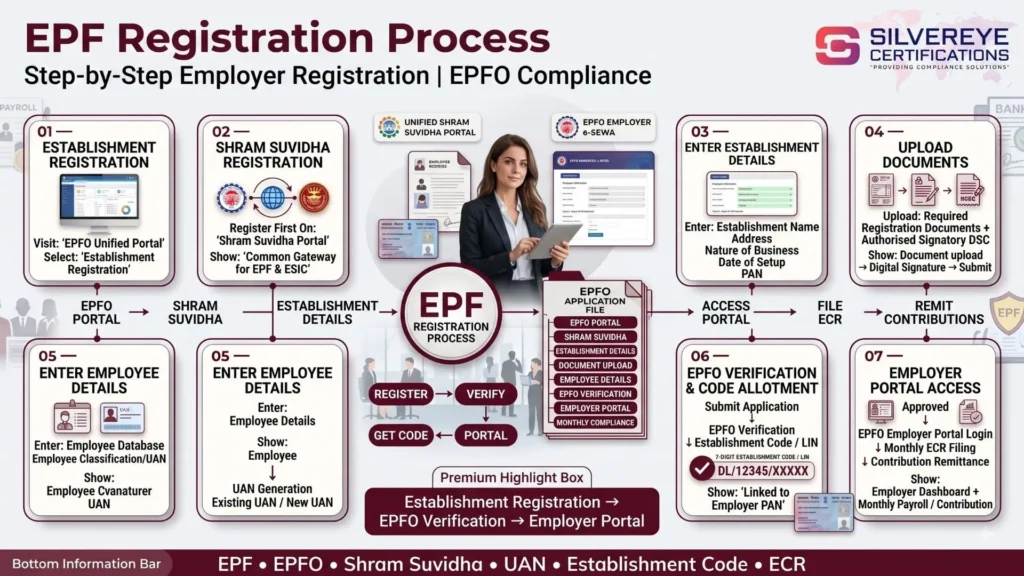
EPF Registration Process: Step-by-Step (2026)
Registration is conducted entirely online through the EPFO Unified Portal (unifiedportal-emp.epfindia.gov.in) or the Shram Suvidha Portal (registration.shramsuvidha.gov.in). There is no offline or physical-office route for new establishment registration.
Step 1: Create your employer profile
Go to the EPFO website and select "Establishment Registration" under the Employers section, or sign up directly on the Shram Suvidha Portal with your name, email and mobile number. Verify your email to activate the login.
Step 2: Enter establishment details
Select the entity type (company, partnership, proprietorship, LLP, society, trust, etc.) and fill in the establishment name, date of setup, PAN, registered address, NIC code (National Industrial Classification) and the nature of business.
Step 3: Add employment details
Enter total employee strength, gender-wise break-up, wage details and the number of employees above and below the statutory wage ceiling.
Step 4: Upload documents
Upload PDF copies of all entity, signatory and address-proof documents listed above in the format specified by the portal (usually under 1 MB per file).
Step 5: Verify PAN and complete Digital Signature registration
The portal performs a real-time PAN verification through an API link with the Income Tax Department. Once verified, attach and register the Class 3 DSC (or e-Sign) of the authorised signatory — this step legally authenticates the application.
Step 6: Submit and receive the Establishment (PF) Code
On successful submission you will get an on-screen confirmation and a confirmation email from the Unified Shram Suvidha Platform. EPFO typically allots the permanent Establishment Code Number within 7 to 15 working days for a clean application with no document mismatches.
Step 7: Generate employee UANs and start monthly compliance
Once the code is allotted, generate or link Universal Account Numbers (UAN) — a portable 12-digit identifier — for each covered employee, then begin filing the monthly Electronic Challan-cum-Return (ECR) and depositing contributions.
EPF Registration Fees and Timeline
Government fee: EPF registration itself is completely free of charge on the EPFO and Shram Suvidha portals. The only real cost is procuring the Class 3 Digital Signature Certificate (USB token), typically a one-time, modest cost from a licensed certifying authority, plus any professional fee if you engage a consultant to manage the filing.
Timeline: 7 to 15 working days from submission to Establishment Code allotment for applications with complete, matching documentation. Mismatched names across PAN, Aadhaar and incorporation documents are the most common reason applications get sent back for correction, which can push the effective date out by weeks.
Registration deadline: The law requires registration within 30 days of first employing 20 or more persons — the clock starts on the day the threshold is crossed, not on the day you notice it.
EPF Contribution Structure Employers Must Set Up
Registration is only the entry point — once registered, an employer must run monthly PF contributions correctly. Here is the standard contribution break-up on wages up to the Rs 15,000 ceiling:
| Component | Who Pays | Rate | Notes |
|---|---|---|---|
| EPF (Provident Fund) | Employee | 12% of basic + DA | Entire employee share goes to the EPF account |
| EPF (Provident Fund) | Employer | 3.67% of basic + DA | Balance of employer's 12% after EPS |
| EPS (Pension Scheme) | Employer | 8.33% of basic + DA | Capped at Rs 1,250/month on the Rs 15,000 ceiling |
| EDLI (Insurance) | Employer only | 0.5% of basic + DA | Capped at Rs 75 per employee per month |
| EPF Admin Charges | Employer only | 0.5% of basic + DA | Subject to a prescribed minimum per establishment |
Total statutory employer outgo works out to roughly 13% of the wage base once EDLI and admin charges are added on top of the 12% contribution. A reduced 10% contribution rate (both sides) applies to establishments with fewer than 20 employees that opt in, and to specific notified industries such as jute, beedi, brick, coir and guar-gum factories, and to financially distressed units meeting prescribed conditions.
The EPF interest rate declared for FY 2025-26 is 8.25% per annum, compounded monthly and credited to member accounts at year-end. Monthly ECR filing and contribution payment are due by the 15th of the following wage month — for example, June 2026 wages must be reported and paid by 15 July 2026.
Penalties for Late or Missed EPF Registration and Payment
Indian PF law treats delay seriously, and the new Code on Social Security has not softened this — if anything, digital tracking has made non-compliance easier for EPFO to detect.
| Provision | What It Covers | Rate / Consequence |
|---|---|---|
| Section 7Q (EPF Act) / Sec. 127 (Code on Social Security) | Interest on any delayed contribution | 12% per annum, from the due date until actual payment — no grace period |
| Section 14B (EPF Act) / Sec. 128 (Code on Social Security) | Damages for delayed deposit | 5% to 25% per annum depending on the length of default, generally capped at 100% of the arrears |
| Section 14, EPF Act | Deducting PF from wages but not depositing it, or wilful non-registration | Criminal prosecution, with fines and imprisonment for the employer/responsible officer |
Under the Code on Social Security framework, EPF officers have also been formally designated as Inspectors-cum-Facilitators and Recovery Officers with authority to inspect records, initiate proceedings and levy damages directly — so treating registration and monthly filing as a low-priority task carries real financial and legal risk.
Validity, Renewal and Cancellation of EPF Registration
EPF (Establishment) registration does not expire and does not need periodic renewal — the Establishment Code Number is permanent for the life of the business. What is ongoing, and non-negotiable, is monthly compliance: filing the ECR and depositing contributions by the 15th of every month, updating employee records, and processing UAN/KYC changes as staff join or leave.
Registration can only be cancelled or marked inactive if the establishment permanently closes and has zero employees, and this requires a formal application and EPFO's approval — an establishment cannot simply stop filing returns to "exit" the scheme.
What's New in 2026: Key EPFO and Labour Code Updates for Employers
2026 has brought the most significant regulatory reset to India's PF framework in over a decade. Here is what every employer should track:
1. The four new Labour Codes are now in force
The Code on Wages 2019, Industrial Relations Code 2020, Code on Social Security 2020, and Occupational Safety, Health and Working Conditions Code 2020 took effect on 21 November 2025, consolidating 29 older labour laws — including the EPF & Miscellaneous Provisions Act, 1952 — into a single modern framework. Final central rules were notified in stages through 2026 as the transition continues.
2. The Employees' Provident Funds Scheme, 2026 replaces the 1952 scheme
On 29 June 2026, the Ministry of Labour and Employment notified the Employees' Provident Funds Scheme, 2026, alongside the Employees' Pension Scheme, 2026 and the Employees' Deposit Linked Insurance Scheme, 2026, operationalising PF provisions under the Code on Social Security. These came into force on 1 July 2026. The core contribution structure (12% employee, 12% employer split 3.67%/8.33%, 0.5% EDLI) is unchanged, but the new scheme strengthens governance, digital administration and compliance tracking, and existing UANs, balances and service history carry forward without interruption for current members.
3. Employees' Enrolment Campaign (EEC), 2026
A one-time window, open from 1 July 2026 to 31 October 2026, lets employers voluntarily enrol eligible employees who were left out of EPF coverage between 1 April 2009 and 31 March 2026. The employee's share of contribution is waived where it was never deducted from wages, while the employer pays its own share, applicable interest and admin charges, plus a lump-sum damages amount of Rs 100 under the campaign — a major reduction versus standard Section 14B damages. Enrolment happens through the EPFO Employer Portal with Face Authentication-based UAN generation.
4. VISHWAS, 2026 — dispute settlement for old PF damages cases
Effective 29 June 2026 for six months, VISHWAS lets employers settle pending Section 14B damages disputes (for defaults before 14 June 2024) at reduced rates, covering cases pending in court, cases where recovery is pending, and cases where notices are yet to be issued. Employers must first pay the full Section 7Q interest and give an undertaking not to pursue further appeal; fraud or falsified-record cases are excluded.
5. AMNESTY, 2026 — regularising exempted PF trusts
Running on the same 29 June 2026 to six-month timeline, AMNESTY gives employers operating their own exempted PF trusts (or informal in-house arrangements) a structured route to regularise their status with formal EPFO approval.
6. Other procedural changes to note
- Face Authentication Technology (FAT) is now used for UAN generation and activation, tightening identity checks.
- PAN entered during registration undergoes real-time API verification with the Income Tax Department.
- The appeal deposit required to challenge an EPFO order has been reduced to 25% (down from the earlier 40-70% range).
- Inquiries into an establishment must now begin within 5 years and conclude within 2 years (extendable by one further year), giving employers more certainty on how long a compliance case can remain open.
Given the pace of change, employers who registered years ago — or who suspect gaps in past employee coverage — should treat 2026 as a checkpoint year: review headcount records, reconcile past contributions, and evaluate whether EEC, VISHWAS or AMNESTY apply before their windows close.
Common Mistakes Employers Make During EPF Registration
- Waiting past the 30-day deadline after crossing the 20-employee threshold, which triggers interest from day one of default.
- Mismatched names or dates of birth across PAN, Aadhaar and incorporation documents, causing portal rejections.
- Undercounting headcount by excluding contract, part-time or temporary workers, who legally count toward the 20-employee threshold.
- Submitting an expired Digital Signature Certificate or using a Class 2 DSC, which is no longer accepted.
- Not knowing that voluntary registration is available below 20 employees, and delaying an intended employee benefit unnecessarily.
- Missing the 15th-of-the-month ECR deadline even after registration is complete, which triggers Section 7Q interest and Section 14B damages independently of the registration process.
Getting EPF Registration Right, the First Time
EPF registration sits at the intersection of legal compliance, payroll accuracy and employee trust — get the documentation and timing right at the start, and monthly ECR filing becomes routine; get it wrong, and interest, damages and inspection risk compound quickly, especially now that EPFO's digital and Face Authentication systems flag mismatches faster than ever. With the Employees' Provident Funds Scheme, 2026 and the EEC, VISHWAS and AMNESTY windows all active this year, 2026 is a genuinely useful checkpoint to register correctly, close old gaps, or settle pending disputes before the deadlines pass.
Need help getting it right the first time? Silvereye Certifications assists employers end-to-end with EPF registration, documentation review, monthly ECR compliance, and evaluating eligibility under the 2026 EEC, VISHWAS and AMNESTY windows — so your business stays compliant without the back-and-forth of a rejected application.
Frequently Asked Questions
Is EPF registration mandatory for small businesses?
Only if the business employs 20 or more people on any single day. Below that, EPF registration is voluntary, and many small businesses register anyway to offer a competitive employee benefit.
What is the fee for EPF registration?
The EPFO and Shram Suvidha portals do not charge any government fee for registration. The employer's only real cost is the Digital Signature Certificate needed to authenticate the application.
How long does EPF registration take in 2026?
Typically 7 to 15 working days from submission to Establishment Code allotment, provided all documents match and no verification issues arise.
Can a company with fewer than 20 employees register for EPF?
Yes. Section 1(4) of the EPF Act allows voluntary registration for establishments below the mandatory threshold, subject to majority employee consent.
What documents are required for EPF registration?
PAN of the establishment, incorporation or partnership proof, GST or Shop & Establishment certificate, address proof, a cancelled cheque, the Digital Signature Certificate and PAN/Aadhaar of the authorised signatory, plus basic employee details for staff already on payroll.
What happens if an employer registers late or misses PF payments?
Late payment attracts 12% per annum interest under Section 7Q and additional damages of 5% to 25% per annum under Section 14B, with criminal prosecution possible under Section 14 for deducting PF from wages and not depositing it.
Does EPF registration need to be renewed every year?
No. The Establishment (PF) Code is permanent and does not expire. What must continue every month, without a break, is ECR filing and contribution payment.
What is the Employees' Provident Funds Scheme, 2026?
It is the scheme notified on 29 June 2026, effective 1 July 2026, that replaces the 1952 EPF Scheme under the new Code on Social Security. It keeps the same contribution rates but adds a stronger digital-compliance and governance framework.
What is the Employees' Enrolment Campaign (EEC) 2026?
A one-time window from 1 July 2026 to 31 October 2026 that lets employers voluntarily enrol employees who were left out of EPF coverage between April 2009 and March 2026, with the employee's share waived and reduced lump-sum damages of Rs 100.
How is the monthly EPF contribution calculated?
12% of basic wages plus dearness allowance from the employee, matched by the employer's 12% (split 3.67% EPF and 8.33% EPS, capped at the Rs 15,000 wage ceiling), plus 0.5% EDLI and 0.5% admin charges paid entirely by the employer.
Can EPF registration be cancelled?
Only if the establishment permanently closes with zero employees, and only after a formal application and EPFO approval — it cannot be exited simply by discontinuing monthly returns.
Where can employers apply for EPF registration online?
Through the EPFO Unified Portal (unifiedportal-emp.epfindia.gov.in) or the Shram Suvidha Portal (registration.shramsuvidha.gov.in) — both are the official, government-run channels; there is no valid offline route for new registration.