
- BIS CRS Registration Under IS/IEC 62368-1:2023 is India's mandatory electronics registration framework covering 63+ product categories — no factory inspection required; registration is based entirely on lab test reports and self-declaration.
- MeitY Notification S.O. 4997(E) dated 29 October 2025 has replaced IS 13252 (Part 1):2010 and IS 616:2017 with IS/IEC 62368-1:2023 as the new unified safety standard for AV, IT, and ICT equipment under the CRS.
- The concurrent running period for old and new standards ends 01 November 2028 — after this date, only IS/IEC 62368-1:2023 will be legally valid under the CRO for laptops, tablets, TVs, printers, CCTV cameras, and all other covered products.
- Start your migration in 2026 — BIS-recognized testing labs will face severe capacity constraints closer to November 2028, and each product registration can take 3 to 9 months end-to-end.
What Is BIS CRS Registration? Why Does It Matter in 2026?
BIS CRS Registration Scheme II — formally called the Compulsory Registration Scheme — is India's mandatory product compliance framework for electronics and IT goods. It was introduced in 2012 by the Bureau of Indian Standards (BIS) and the Ministry of Electronics and Information Technology (MeitY) to protect Indian consumers from unsafe, substandard, and counterfeit electronics entering the market.

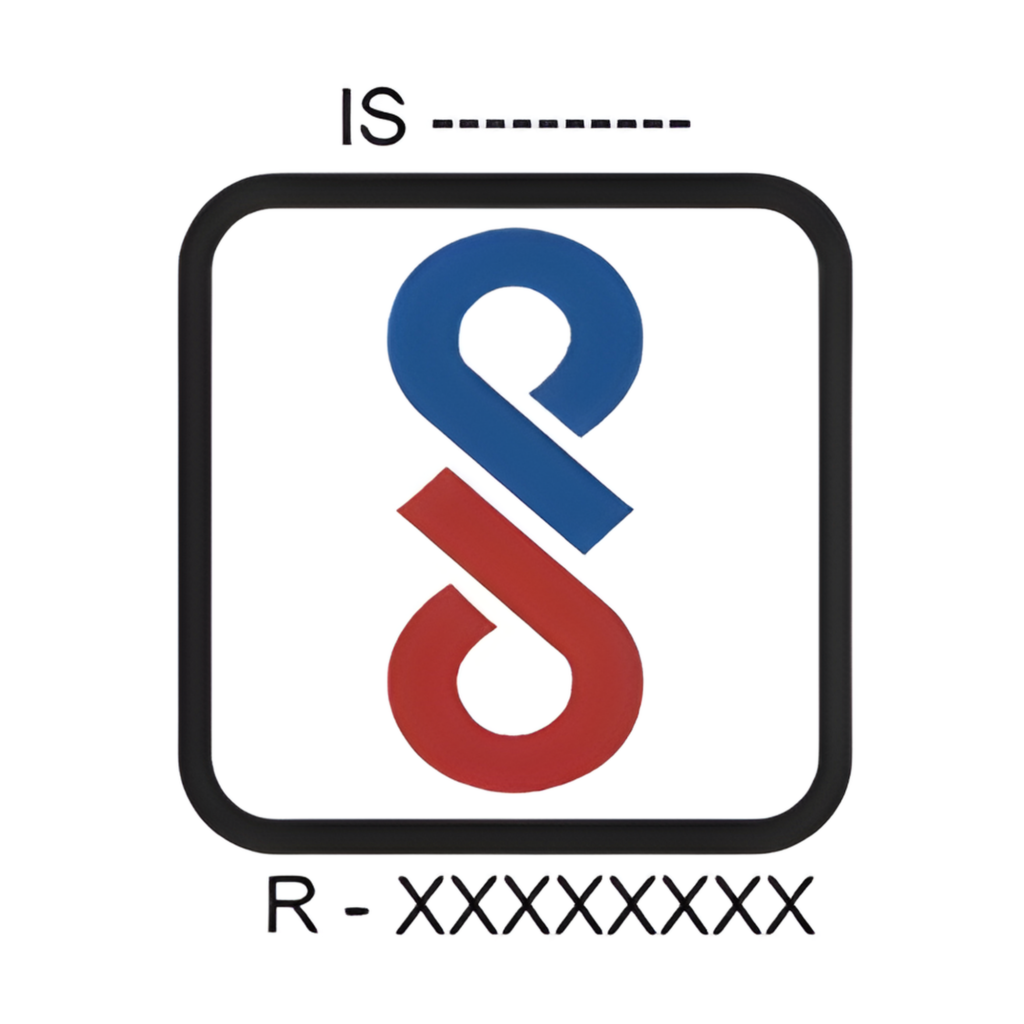
Since 2012, the scheme has expanded from 15 product categories to over 63 notified categories today, covering everything from laptops and smartphones to LED lamps, UPS inverters, rice cookers, and induction stoves. Every product on the notified list must carry a valid BIS CRS registration — identified by a unique R-number — before it can be manufactured, imported, stored for sale, or distributed in India.
There are no exemptions based on company size, order quantity, or sales channel. Whether you are a multinational OEM or a small importer, BIS CRS compliance is non-negotiable.
| What Makes Scheme II Different from ISI Mark (Scheme I)? BIS CRS Scheme II does NOT require factory inspection. No BIS officer visits your manufacturing site. Unlike Scheme I (ISI Mark) and the Foreign Manufacturers Certification Scheme (FMCS), Scheme II registration is based entirely on: (1) Product testing at a BIS-recognized laboratory, (2) Self-declaration of conformity, and (3) Document review by BIS. This makes Scheme II faster, more cost-effective, and far less operationally disruptive — especially for foreign manufacturers. |
MeitY Notification S.O. 4997(E) — The Standard Migration That Affects Everything
On 29 October 2025, MeitY issued Notification S.O. 4997(E), amending the Electronics and Information Technology Goods (Requirement of Compulsory Registration) Order, 2021. This notification formally replaced two long-standing Indian Standards with a single, globally harmonized standard.
| Notification Detail | Information |
| Notification Number | S.O. 4997(E) |
| Issued By | Ministry of Electronics and Information Technology (MeitY) |
| Date of Issue | 29 October 2025 |
| Standards Replaced | IS 13252 (Part 1):2010 and IS 616:2017 |
| New Standard | IS/IEC 62368-1:2023 — Audio/Video, IT & Communication Technology Equipment Part 1: Safety Requirements |
| Approach | Hazard-Based Safety Engineering (HBSE) — replaces prescriptive methodology |
| Concurrent Running Period | Both old and new standards valid simultaneously until 01 November 2028 |
| After 01 November 2028 | ONLY IS/IEC 62368-1:2023 valid — old standards formally withdrawn |
| Certification Scheme | BIS CRS Scheme II (Compulsory Registration Scheme) |
| Factory Inspection | NOT required under Scheme II |
| Critical: What IS/IEC 62368-1:2023 Replaces IS 13252 (Part 1):2010 was India's adaptation of IEC 60950-1 (IT equipment safety). IS 616:2017 was India's adaptation of IEC 60065 (audio/video equipment safety). IS/IEC 62368-1:2023 is India's adoption of IEC 62368-1:2023 Edition 4 — a converged standard that covers ALL IT, AV, and ICT equipment under a single, internationally harmonized framework. |
Old vs New Standard — What Has Changed for Your Product?
| Feature | IS 13252:2010 / IS 616:2017 | IS/IEC 62368-1:2023 |
| Based On | IEC 60950-1 / IEC 60065 | IEC 62368-1:2023 (Edition 4 — latest) |
| Approach | Prescriptive construction rules | Hazard-Based Safety Engineering (HBSE) |
| Scope | IT Equipment + AV Equipment (2 separate standards) | All AV + IT + ICT in one unified standard |
| Global Status | Being withdrawn globally | Already mandatory in EU, USA, Japan, Korea |
| India Status | Valid until 01 November 2028 only | Mandatory from October 2025 onwards |
| Risk Method | Component-level limits | Hazard pathway analysis with safeguard verification |
| Persons Covered | End users only | Ordinary, Instructed, and Skilled persons (3 levels) |
| For Exporters | Limited reuse of test data | IEC 62368-1:2023 data from EU/US may be leveraged |
Complete Official Product List: All 63 Categories Under BIS CRS Scheme II with IS Numbers & Focus Keywords
This is the master reference table for all products currently notified under BIS CRS Scheme II. For each product, the current IS number, the new IS/IEC 62368-1:2023 standard (where applicable), migration deadline, and the recommended focus keyword for product-specific SEO pages are shown.
Group A — IT Equipment (IS 13252 Part 1:2010 → IS/IEC 62368-1:2023)
| Sl. | Product Name | Current IS No. | New Standard | Focus Keyword (Product + IS Number) |
| 1 | Laptop / Notebook | IS 13252 (Pt.1):2010 | IS/IEC 62368-1:2023 | BIS CRS registration laptop IS/IEC 62368-1:2023 |
| 2 | Tablet PC | IS 13252 (Pt.1):2010 | IS/IEC 62368-1:2023 | BIS CRS registration tablet IS/IEC 62368-1:2023 |
| 3 | Automatic Data Processing Machine (Desktop PC / Server) | IS 13252 (Pt.1):2010 | IS/IEC 62368-1:2023 | BIS CRS ADP machine desktop PC IS/IEC 62368-1:2023 |
| 4 | Visual Display Unit / Video Monitor (32" and above) | IS 13252 (Pt.1):2010 | IS/IEC 62368-1:2023 | BIS CRS monitor registration IS/IEC 62368-1:2023 India |
| 5 | Visual Display Unit / Video Monitor (up to 32") | IS 13252 (Pt.1):2010 | IS/IEC 62368-1:2023 | BIS CRS small monitor video display IS 62368-1:2023 |
| 6 | Printer / Plotter | IS 13252 (Pt.1):2010 | IS/IEC 62368-1:2023 | BIS CRS printer registration IS/IEC 62368-1:2023 India |
| 7 | Scanner (all types) | IS 13252 (Pt.1):2010 | IS/IEC 62368-1:2023 | BIS CRS scanner registration IS/IEC 62368-1:2023 |
| 8 | Wireless Keyboard | IS 13252 (Pt.1):2010 | IS/IEC 62368-1:2023 | BIS CRS wireless keyboard IS/IEC 62368-1:2023 India |
| 9 | Keyboard (wired) | IS 13252 (Pt.1):2010 | IS/IEC 62368-1:2023 | BIS CRS keyboard registration IS 62368-1:2023 India |
| 10 | Set Top Box | IS 13252 (Pt.1):2010 | IS/IEC 62368-1:2023 | BIS CRS set top box IS/IEC 62368-1:2023 registration |
| 11 | Telephone Answering Machine | IS 13252 (Pt.1):2010 | IS/IEC 62368-1:2023 | BIS CRS telephone answering machine IS 62368-1:2023 |
| 12 | Mobile Phone | IS 13252 (Pt.1):2010 + IS 16333 (Pt.3) | IS/IEC 62368-1:2023 + IS 16333 | BIS CRS mobile phone IS/IEC 62368-1:2023 IS 16333 |
| 13 | Power Adaptor for IT Equipment | IS 13252 (Pt.1):2010 | IS/IEC 62368-1:2023 | BIS CRS power adaptor IT equipment IS 62368-1:2023 |
| 14 | Cash Register | IS 13252 (Pt.1):2010 | IS/IEC 62368-1:2023 | BIS CRS cash register IS/IEC 62368-1:2023 India |
| 15 | Point of Sale (POS) Terminal | IS 13252 (Pt.1):2010 | IS/IEC 62368-1:2023 | BIS CRS POS terminal IS/IEC 62368-1:2023 India |
| 16 | Copying Machine / Duplicator | IS 13252 (Pt.1):2010 | IS/IEC 62368-1:2023 | BIS CRS copying machine duplicator IS 62368-1:2023 |
| 17 | Smart Card Reader | IS 13252 (Pt.1):2010 | IS/IEC 62368-1:2023 | BIS CRS smart card reader IS/IEC 62368-1:2023 India |
| 18 | Mail Processing / Franking Machine | IS 13252 (Pt.1):2010 | IS/IEC 62368-1:2023 | BIS CRS franking machine IS 62368-1:2023 registration |
| 19 | Passport Reader | IS 13252 (Pt.1):2010 | IS/IEC 62368-1:2023 | BIS CRS passport reader IS/IEC 62368-1:2023 India |
| 20 | Power Bank (portable applications) | IS 13252 (Pt.1):2010 | IS/IEC 62368-1:2023 | BIS CRS power bank IS/IEC 62368-1:2023 registration |
| 21 | CCTV Camera / CCTV Recorder | IS 13252 (Pt.1):2010 | IS/IEC 62368-1:2023 | BIS CRS CCTV camera recorder IS/IEC 62368-1:2023 |
| 22 | USB Barcode / Iris / Fingerprint Scanner | IS 13252 (Pt.1):2010 | IS/IEC 62368-1:2023 | BIS CRS barcode iris fingerprint scanner IS 62368-1:2023 |
| 23 | Smartwatch / Wearable Device | IS 13252 (Pt.1):2010 | IS/IEC 62368-1:2023 | BIS CRS smartwatch wearable IS/IEC 62368-1:2023 India |
| 24 | ATM / Automatic Teller Cash Dispensing Machine | IS 13252 (Pt.1):2010 | IS/IEC 62368-1:2023 | BIS CRS ATM cash dispensing machine IS 62368-1:2023 |
| 25 | USB External Hard Disk Drive (HDD) | IS 13252 (Pt.1):2010 | IS/IEC 62368-1:2023 | BIS CRS external HDD USB IS/IEC 62368-1:2023 India |
| 26 | USB External SSD (above 256 GB) | IS 13252 (Pt.1):2010 | IS/IEC 62368-1:2023 | BIS CRS external SSD USB IS 62368-1:2023 registration |
| 27 | Standalone SMPS (output voltage max 48V) | IS 13252 (Pt.1):2010 | IS/IEC 62368-1:2023 | BIS CRS SMPS standalone IS/IEC 62368-1:2023 India |
| 28 | Digital Camera | IS 13252 (Pt.1):2010 | IS/IEC 62368-1:2023 | BIS CRS digital camera IS/IEC 62368-1:2023 registration |
Group B — Audio/Video Equipment (IS 616:2017 → IS/IEC 62368-1:2023)
| Sl. | Product Name | Current IS No. | New Standard | Focus Keyword (Product + IS Number) |
| 29 | LED/LCD/Plasma Television (32" and above) | IS 616:2017 | IS/IEC 62368-1:2023 + IS 18112:2025 | BIS CRS LED LCD TV 32 inch IS/IEC 62368-1:2023 India |
| 30 | LED/LCD/Plasma Television (up to 32") | IS 616:2017 | IS/IEC 62368-1:2023 + IS 18112:2025 | BIS CRS small LED TV television IS 62368-1:2023 |
| 31 | Television (other than Plasma/LCD/LED) | IS 616:2017 | IS/IEC 62368-1:2023 | BIS CRS television other types IS/IEC 62368-1:2023 |
| 32 | Optical Disc Player with Amplifier (200W+) | IS 616:2017 | IS/IEC 62368-1:2023 | BIS CRS optical disc player amplifier IS 62368-1:2023 |
| 33 | Amplifier (input power 2000W and above) | IS 616:2017 | IS/IEC 62368-1:2023 | BIS CRS amplifier 2000W IS/IEC 62368-1:2023 India |
| 34 | Electronic Musical System (200W and above) | IS 616:2017 | IS/IEC 62368-1:2023 | BIS CRS electronic music system 200W IS 62368-1:2023 |
| 35 | Electronic Musical System (below 200W) | IS 616:2017 | IS/IEC 62368-1:2023 | BIS CRS electronic music system below 200W IS 62368-1 |
| 36 | Electronic Game / Video Game Console | IS 616:2017 | IS/IEC 62368-1:2023 | BIS CRS video game console IS/IEC 62368-1:2023 India |
| 37 | Power Adaptor for AV Equipment | IS 616:2017 | IS/IEC 62368-1:2023 | BIS CRS power adaptor AV equipment IS 62368-1:2023 |
| 38 | Wireless Headphone and Earphone | IS 616:2017 | IS/IEC 62368-1:2023 | BIS CRS wireless headphone earphone IS 62368-1:2023 |
| 39 | Smart Speaker (with/without display) | IS 616:2017 | IS/IEC 62368-1:2023 | BIS CRS smart speaker IS/IEC 62368-1:2023 India 2026 |
| 40 | Bluetooth Speaker | IS 616:2017 | IS/IEC 62368-1:2023 | BIS CRS Bluetooth speaker IS/IEC 62368-1:2023 India |
| 41 | Wireless Microphone | IS 616:2017 | IS/IEC 62368-1:2023 | BIS CRS wireless microphone IS/IEC 62368-1:2023 India |
| 42 | Video Camera | IS 616:2017 | IS/IEC 62368-1:2023 | BIS CRS video camera registration IS 62368-1:2023 |
| 43 | Webcam (finished product) | IS 616:2017 | IS/IEC 62368-1:2023 | BIS CRS webcam registration IS/IEC 62368-1:2023 India |
Group C — Products Under Standalone IS Numbers (Not Migrating to IS/IEC 62368-1:2023)
| Sl. | Product Name | Current IS No. (Remains Valid) | Standard Title | Focus Keyword (Product + IS Number) |
| 44 | UPS / Inverter (rating up to 5 kVA) | IS 16242 (Pt.1):2025 | General & Safety Requirements for UPS | BIS CRS UPS inverter 5kVA IS 16242 Part 1 registration |
| 45 | UPS / Inverter (rating up to 10 kVA) | IS 16242 (Pt.1):2025 | General & Safety Requirements for UPS | BIS CRS UPS inverter 10kVA IS 16242 registration India |
| 46 | Secondary Battery — Nickel Systems (portable) | IS 16046 (Pt.1):2018 | Nickel Systems Cells & Batteries | BIS CRS nickel battery IS 16046 Part 1 registration India |
| 47 | Secondary Battery — Lithium Systems (portable) | IS 16046 (Pt.2):2018 | Lithium Systems Cells & Batteries | BIS CRS lithium battery IS 16046 Part 2 registration India |
| 48 | DC/AC Electronic Control Gear for LED Modules | IS 15885 (Pt.2/Sec13) | Safety of Lamp Controlgear for LED Modules | BIS CRS LED module control gear IS 15885 registration |
| 49 | Self-Ballasted LED Lamp (General Lighting) | IS 16102 (Pt.1) | Self-Ballasted LED Lamps Safety | BIS CRS LED lamp registration IS 16102 Part 1 India |
| 50 | Fixed General Purpose LED Luminaire | IS 10322 (Pt.5/Sec.1) | Luminaires — Fixed General Purpose | BIS CRS LED luminaire general IS 10322 Part 5 Sec 1 |
| 51 | Recessed LED Luminaire | IS 10322 (Pt.5/Sec.2) | Luminaires — Recessed | BIS CRS recessed LED luminaire IS 10322 Part 5 Sec 2 |
| 52 | LED Road & Street Lighting Luminaire | IS 10322 (Pt.5/Sec.3) | Luminaires — Road & Street Lighting | BIS CRS LED street road light IS 10322 Part 5 Sec 3 |
| 53 | LED Flood Light | IS 10322 (Pt.5/Sec.5) | Luminaires — Flood Lights | BIS CRS LED flood light IS 10322 Part 5 Sec 5 India |
| 54 | LED Hand Lamp | IS 10322 (Pt.5/Sec.6) | Luminaires — Hand Lamps | BIS CRS LED hand lamp IS 10322 Part 5 Sec 6 India |
| 55 | LED Lighting Chain | IS 10322 (Pt.5/Sec.7) | Luminaires — Lighting Chains | BIS CRS LED lighting chain IS 10322 Part 5 Sec 7 |
| 56 | LED Emergency Lighting Luminaire | IS 10322 (Pt.5/Sec.8) | Luminaires — Emergency Lighting | BIS CRS LED emergency light IS 10322 Part 5 Sec 8 |
| 57 | Rope Light / Lighting Chain | IS 10322 (Pt.5/Sec.9) | Luminaires — Rope Lights | BIS CRS rope light IS 10322 Part 5 Sec 9 India |
| 58 | Standalone LED Module (General Lighting) | IS 16103 (Pt.1) | LED Modules — Safety Requirements | BIS CRS standalone LED module IS 16103 Part 1 India |
| 59 | Microwave Oven | IS 302-2-25 | Household Appliances — Microwave Ovens | BIS CRS microwave oven IS 302-2-25 registration India |
| 60 | Electronic Clock (mains powered) | IS 302-2:26 | Household Appliances — Clocks | BIS CRS electronic clock mains IS 302-2-26 India |
| 61 | Adapter for Household Appliances | IS 302 (Pt.1) | Household Electrical Appliances — General | BIS CRS household adapter IS 302 Part 1 India |
| 62 | Induction Stove | IS 302 (Pt.2)/Sec.6 | Household Appliances — Cooking Ranges | BIS CRS induction stove IS 302 Part 2 Sec 6 India |
| 63 | Rice Cooker | IS 302 (Pt.2)/Sec.15 | Household Appliances — Heating Liquids | BIS CRS rice cooker registration IS 302 Part 2 Sec 15 |
| 64 | LED Dimmer (for LED products) | IS 60669-2-1:2008 | Electronic Switches for Fixed Installations | BIS CRS LED dimmer IS 60669-2-1 registration India |
Note on Group C: Products in Group C are not migrating to IS/IEC 62368-1:2023. They remain under their existing standalone IS numbers. Always verify the current applicable standard on www.crsbis.in before applying, as BIS updates standards periodically.
Note on Group A & B: Products migrating to IS/IEC 62368-1:2023 may also require compliance with supplementary standards — e.g., Mobile Phones require IS 16333 (Part 3), Televisions require IS 18112:2025, and IP-based CCTV cameras may require cybersecurity compliance. Verify all applicable standards for your product.
Who Needs BIS CRS Registration? — Eligibility
BIS CRS registration is mandatory for any person or entity whose product appears on the notified CRS list. Here is exactly who must comply:
Indian Manufacturers
Any Indian company that manufactures a notified electronics or IT product must obtain BIS CRS registration before manufacturing commences. One registration (R-number) is required per product model / series per manufacturing location. Multiple factories producing the same product each need a separate registration.
Foreign Manufacturers
Global OEMs and brand owners selling products in India — directly or through distributors — must obtain BIS CRS registration. They must appoint an Authorised Indian Representative (AIR) to apply on their behalf. The R-number is issued in the manufacturer's name; the AIR holds legal compliance responsibility within India.
Brand Owners / Private Label Companies
If you sell products under your own brand but have them manufactured by a third-party OEM, the brand must be registered alongside the manufacturer. Both the manufacturer and brand name must appear on the BIS registration.
Importers
Importers cannot obtain BIS CRS registration independently. They must either be appointed as AIR of the foreign manufacturer or ensure the manufacturer holds a valid CRS registration before importing.
| No Exemptions Apply: There are no size-based, turnover-based, or volume-based exemptions under BIS CRS Scheme II. A first-time importer bringing in 50 units of a laptop is as legally required to have CRS compliance as a global brand shipping millions. Non-compliance is a criminal offence under the BIS Act, 2016 — carrying penalties including product seizure, fines up to Rs. 5 lakhs, and prosecution. |
Technical Requirements Under IS/IEC 62368-1:2023
IS/IEC 62368-1:2023 uses Hazard-Based Safety Engineering (HBSE) to evaluate whether a product is safe for its intended users. Instead of specifying exact construction methods, it asks: what hazards does this product pose — and are the safeguards in place proportionate to those hazards?
Three categories of persons are considered in the risk evaluation:
- Ordinary Persons (OP) — End consumers with no technical background or safety training
- Instructed Persons (IP) — Users who have received basic safety instruction
- Skilled Persons (SP) — Engineers, technicians, and trained maintenance professionals
Key Technical Domains Evaluated:
| Technical Area | What Is Evaluated Under IS/IEC 62368-1:2023 |
| Electrical Safety | Insulation class, creepage and clearance distances, protective earthing, protection from electric shock at all three person levels |
| Thermal Safety | Maximum surface temperatures at accessible points, thermal cutoff devices, battery thermal management, overload protection |
| Mechanical Safety | Structural integrity under load, stability, protection from sharp edges, guarding of moving parts |
| Radiation Safety | Laser emission classification and controls, optical radiation limits, acoustic output exposure limits |
| Chemical Safety | Flame retardancy of materials per UL 94 equivalent, hazardous substance restrictions, RoHS-related requirements |
| Battery / Energy Safety | Lithium-ion battery cell and pack safety, overcurrent protection, inrush current limits, power supply safeguards |
| Fire Enclosure | Flame spread prevention requirements, material flammability classifications, enclosure construction |
| EMC (if applicable) | Some products require separate EMC testing under applicable Indian standards in addition to IS/IEC 62368-1:2023 |
Documents Required for BIS CRS Scheme II Registration
Documents differ slightly between Indian and foreign manufacturers. The complete checklist is below:
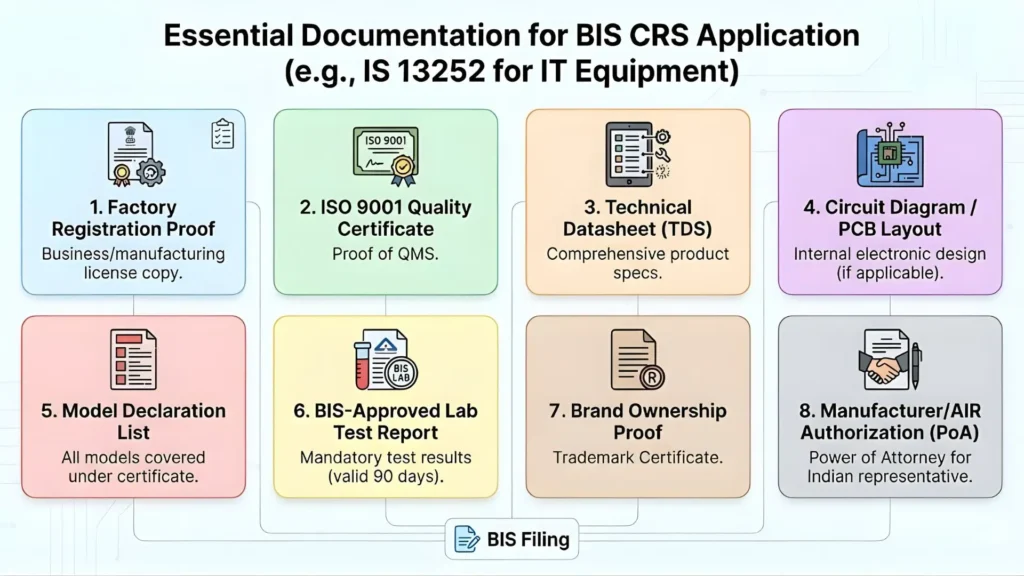
| Document / Requirement | Indian Manufacturer | Foreign Manufacturer (via AIR) |
| Test report against applicable IS (IS/IEC 62368-1:2023 or standalone IS) | Required | Required |
| BIS CRS online application — Form I on www.crsbis.in | Required | Required (filed by AIR) |
| Company incorporation / factory registration certificate | Required | Required (overseas address) |
| GST registration certificate | Required | Not applicable |
| PAN card of the company | Required | Not applicable |
| Importer Exporter Code (IEC), if importing | Required | Not required for manufacturer |
| AIR appointment letter (original, notarised) | Not required | Required |
| AIR business registration proof (India) | Not required | Required |
| Product technical datasheet (model number, specs, components) | Required | Required |
| User manual in English | Required | Required |
| Product photographs showing BIS mark placement | Required | Required |
| Labelling / marking details (R-number placement) | Required | Required |
| Circuit diagram / Bill of Materials (BOM) if requested | If asked by BIS | If asked by BIS |
| Declaration of Conformity (DoC) | Required | Required |
| Foreign lab accreditation proof (if overseas lab used) | N/A | Required |
Step-by-Step BIS CRS Registration Process — No Factory Inspection
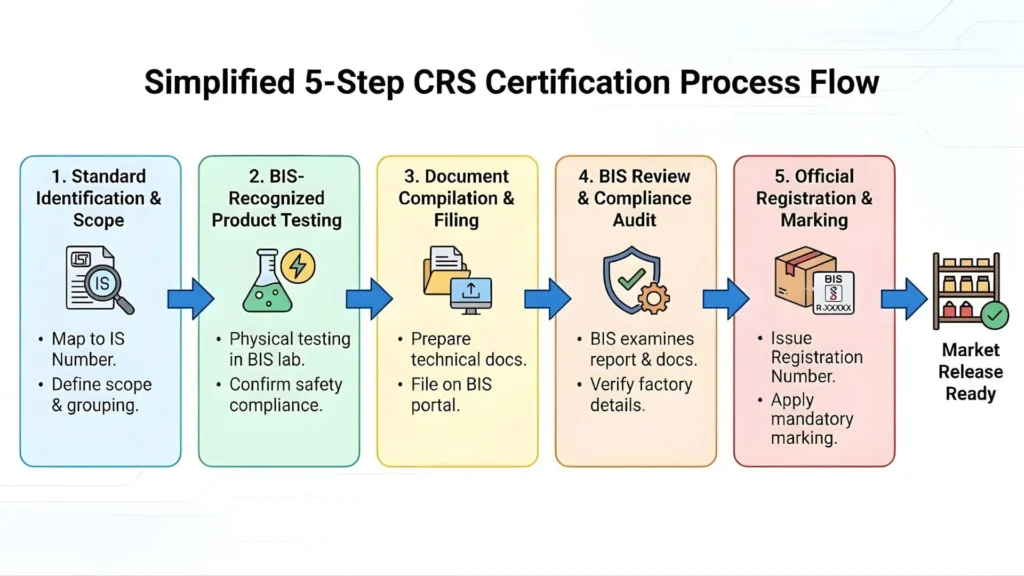
Here is the complete, practical process to obtain BIS CRS Scheme II registration. Crucially — no BIS official visits your factory at any stage.
- Confirm Product Applicability: Verify your specific product falls under a CRS-notified category. Identify the applicable Indian Standard — IS/IEC 62368-1:2023 for IT/AV/ICT products, or the standalone IS number for LED, battery, UPS, and appliance products. Check for supplementary standards.
- Appoint an AIR (Foreign Manufacturers Only): If you are a foreign manufacturer, appoint a legally registered Indian entity as Authorized Indian Representative through a notarised agreement. The AIR will manage your BIS application, communicate with BIS, and hold legal compliance responsibility in India.
- Select and Engage a BIS-Recognized Test Laboratory: Choose an NABL-accredited or BIS-empanelled Indian lab, or a BIS-recognized foreign lab. Get a formal quotation and testing timeline. Ensure the lab is currently recognized — accreditations are subject to renewal.
- Prepare Product Samples and Documentation: Compile production-representative samples (not modified prototypes), the technical datasheet, circuit diagrams, Bill of Materials, component specifications, and user manual in English.
- Submit Samples and Conduct Testing: Deliver samples to the lab. Testing under IS/IEC 62368-1:2023 is comprehensive. Allow 4 to 12 weeks for testing depending on product complexity. Simpler products under standalone IS numbers (LED lamps, batteries) may test faster.
- Receive and Review the Test Report: The lab issues a formal test report upon completion. Ensure it explicitly references the applicable IS number (IS/IEC 62368-1:2023 or the standalone IS), is from a BIS-recognized laboratory, and is not older than 90 days at the time of BIS submission.
- Apply on the BIS CRS Portal: Register on www.crsbis.in. Complete Form I, upload all required documents including the test report, and pay applicable BIS fees. The AIR files this on behalf of foreign manufacturers.
- BIS Document Evaluation: BIS officials review the application and documents. Queries may be raised. Respond promptly with additional documentation or clarification. No factory visit occurs under Scheme II.
- Registration Certificate and R-Number Issuance: Upon satisfactory review, BIS issues the CRS Registration Certificate and allots a unique R-number to the product.
- Update Product Labelling: Display the BIS Standard Mark and R-number on the product and/or packaging — visibly, legibly, indelibly, and non-removably — before the product enters the Indian market.
Cost of BIS CRS Scheme II Registration — 2026 Budget Guide
Costs vary based on product complexity, lab rates, number of models, and whether supplementary standards apply. Use these figures for budget planning only — always get formal quotations.
| Cost Head | Approximate Range (INR) |
| Product testing (per model) — Indian NABL/BIS lab | Rs. 80,000 – Rs. 3,50,000+ |
| Additional testing for supplementary standards (if needed) | Rs. 30,000 – Rs. 1,50,000 extra per standard |
| BIS CRS registration fee (per product per factory) | Rs. 1,000 – Rs. 10,000 (per BIS fee schedule) |
| AIR annual retainer fee (foreign manufacturers) | Rs. 50,000 – Rs. 2,00,000+ per year |
| Compliance consultancy (optional) | Rs. 50,000 – Rs. 5,00,000 per engagement |
| Retesting due to design changes | Rs. 40,000 – Rs. 1,50,000 per change |
| Sample courier and logistics | Rs. 10,000 – Rs. 50,000 per submission |
| Total estimate — single model, no AIR | Rs. 1,00,000 – Rs. 4,00,000+ |
| Total estimate — single model, with AIR (Year 1) | Rs. 1,50,000 – Rs. 6,00,000+ |
These are indicative estimates only. BIS fee schedules are subject to revision. Lab testing rates vary significantly. Always obtain written quotations before committing.
Timeline for BIS CRS Registration — Realistic Expectations in 2026
| Stage | Typical Duration |
| Product applicability check and lab selection | 1 – 2 weeks |
| AIR appointment and documentation preparation | 2 – 4 weeks |
| Sample preparation and dispatch to lab | 1 – 2 weeks |
| Laboratory testing (IS/IEC 62368-1:2023 — complex products) | 6 – 12 weeks |
| Laboratory testing (standalone IS — LED, batteries, appliances) | 3 – 6 weeks |
| Test report issuance by laboratory | 1 – 2 weeks post-testing |
| BIS portal application and document submission | 1 week |
| BIS evaluation and query resolution | 2 – 6 weeks |
| R-number and certificate issuance | 1 – 2 weeks post-approval |
| Total realistic timeline (IT/AV products) | 3 – 6 months per product |
| Total realistic timeline (complex IT products) | Up to 9 – 12 months |
| 2026 Warning: Start Now All 63 product categories under BIS CRS Scheme II — including those migrating to IS/IEC 62368-1:2023 — will converge on the November 2028 deadline simultaneously. BIS-recognized testing labs will face severe capacity constraints 12 to 18 months before November 2028. Companies with 5 or more products to migrate must begin in Q1-Q2 2026. Waiting until 2027 introduces serious risk of delayed registrations, supply chain disruptions, and missed market windows. |
Validity, Renewal & Market Surveillance
BIS CRS registration under Scheme II is valid for 2 years from the date of issuance, after which it must be renewed.
Renewal Checklist
- Apply for renewal through www.crsbis.in before the expiry date — lapsed registrations require fresh applications
- Provide an updated test report if the product or its key components have undergone significant changes
- Ensure continued compliance with the applicable IS number at the time of renewal
- Keep AIR authorization valid (foreign manufacturers) — an expired AIR agreement invalidates the renewal
- Pay renewal fees per the current BIS fee schedule
| Aspect | Detail |
| Registration Validity | 2 years from date of issuance |
| Renewal Application | Must be submitted before expiry |
| Test Report on Renewal | Required if significant product/component changes occurred |
| What Happens on Lapse | Product becomes illegal to manufacture, import, or sell in India — fresh application required |
| Market Surveillance | BIS conducts market surveillance at least once per 2-year registration period |
| Standard Migration Note | IS 13252:2010 / IS 616:2017 registrations do NOT transfer to IS/IEC 62368-1:2023 — fresh registration required |
BIS Labelling Requirements After BIS CRS Registration
Once your R-number is issued, comply with the following labelling obligations before any product enters the Indian market:
- Display the BIS Standard Mark (ISI mark format for CRS) on the product and/or its packaging
- Include the Registration Number (R-number) in the format approved by BIS — minimum Arial font size 6 or equivalent
- Mark the applicable Indian Standard number (now IS/IEC 62368-1:2023, or the standalone IS number) on the product label
- Manufacturer name, country of manufacture, and model number must appear on the label
- Labels must be visible, legible, indelible, and non-removable — not under the battery cover or in an inaccessible location
- E-labelling (on-screen label) is permitted only for devices with integrated displays where physical labelling is impractical
- Update IS number on labels to IS/IEC 62368-1:2023 ONLY after receiving the formal Standard Revision letter from BIS — do not update labels prematurely
Benefits of BIS CRS Scheme II for Manufacturers & Importers
| Benefit | Business Value |
| No Factory Inspection | Reduces compliance cost and operational disruption. No BIS officials visit the manufacturing site. |
| Lab-Based Process | Entirely documentation and test-report driven — faster, predictable, manageable remotely |
| Global Harmonisation (IS/IEC 62368-1:2023) | Aligned with EU CE, US NRTL, and Japanese standards — existing IEC 62368-1 test data may be leveraged to reduce India testing costs |
| Single Standard for Converged Products | One IS/IEC 62368-1:2023 registration covers devices that previously required two separate certifications (IT + AV) |
| Legal Market Access to India | Rs. 14+ lakh crore electronics market — no BIS CRS registration means no legal market entry |
| Consumer Trust via BIS Mark | BIS Standard Mark is widely recognised by Indian consumers as a signal of safety and quality |
| Customs Clearance | A valid CRS R-number prevents customs clearance holds — products without BIS registration are routinely detained at ports |
| Government & Enterprise Procurement | Many government tenders and enterprise procurement policies require valid BIS CRS certification |
| Marketplace Compliance | Amazon India, Flipkart, and major e-commerce platforms require BIS CRS for listed electronics |
Migration Roadmap: Your Action Timeline 2026 – 2028
| Milestone | Date / Period |
| MeitY Notification S.O. 4997(E) issued | 29 October 2025 |
| IS/IEC 62368-1:2023 in force under CRO | November 2025 |
| BIS Implementation Guidelines issued | 09 March 2026 |
| AR/VR/XR device accelerated deadline | 01 May 2026 |
| ACTION: Audit all existing CRS registrations NOW | Q1 2026 (Immediate) |
| ACTION: Engage BIS labs for testing quotations | Q1 – Q2 2026 |
| ACTION: Complete testing for high-volume products | Q2 – Q3 2026 |
| ACTION: Submit BIS portal applications — first batch | Q3 2026 |
| TARGET: Complete all portfolio migrations | By 31 December 2027 |
| Buffer period for any delays or re-tests | January – October 2028 |
| Concurrent running period ENDS — old standards invalid | 01 November 2028 |
Frequently Asked Questions
Does BIS CRS Scheme II require a factory inspection?
No. BIS CRS Scheme II (Compulsory Registration Scheme) does not require any factory inspection by BIS officials at any stage. This is the key distinction from Scheme I (ISI Mark) and the Foreign Manufacturers Certification Scheme (FMCS). Registration is based entirely on product test reports from a BIS-recognized laboratory and document review. No BIS officer visits your manufacturing facility.
What products are now required to register under IS/IEC 62368-1:2023 instead of IS 13252 (Part 1):2010?
All products previously covered under IS 13252 (Part 1):2010 and IS 616:2017 must migrate to IS/IEC 62368-1:2023. This includes 43 product categories — laptops, tablets, desktop computers, monitors, printers, scanners, set top boxes, mobile phones, power banks, CCTV cameras, TVs, amplifiers, wireless headphones, smart speakers, smartwatches, routers, digital cameras, webcams, and more.
Can I still apply for BIS CRS registration under IS 13252 (Part 1):2010 in 2026?
Yes, during the concurrent running period (until 01 November 2028), applications under IS 13252 (Part 1):2010 are still accepted if product testing has already been completed. However, BIS may require a commitment to migrate to IS/IEC 62368-1:2023 within the deadline. Applying directly under IS/IEC 62368-1:2023 today avoids a second migration cycle and is strongly recommended.
How long does it take to get BIS CRS registration under IS/IEC 62368-1:2023?
The complete end-to-end process — from sample submission to R-number issuance — typically takes 3 to 6 months per product. Complex IT products or those requiring supplementary standard testing can take 9 to 12 months. Start in 2026 to avoid the lab capacity crunch that will worsen significantly closer to the November 2028 deadline.
What is an Authorized Indian Representative (AIR) and do foreign manufacturers need one?
Yes. Foreign manufacturers must appoint an Authorised Indian Representative — a legally registered Indian entity — to apply for BIS CRS registration on their behalf. The R-number is issued in the foreign manufacturer's name, but the AIR files the application, communicates with BIS, and bears legal compliance responsibility within India. Importers cannot act as AIR unless specifically appointed and authorised by the manufacturer in writing.
Can multiple models be covered under one BIS CRS registration?
Yes. Multiple models may be grouped under one registration (and one R-number) if they qualify as a product series under BIS series-based testing guidelines. BIS defines series grouping criteria — typically products with the same basic safety-relevant design, construction, and power supply characteristics.
What does BIS CRS registration cost for IS/IEC 62368-1:2023 in India?
BIS registration fees range from Rs. 1,000 to Rs. 10,000 per product per factory location (subject to BIS fee schedule updates). Laboratory testing costs are separate and typically range from Rs. 80,000 to Rs. 3,50,000 or more per model depending on complexity. For foreign manufacturers, AIR fees add Rs. 50,000 to Rs. 2,00,000 per year.
Does IS/IEC 62368-1:2023 certification from another country (EU CE, US NRTL) reduce testing requirements for India?
If your product already has a valid IEC 62368-1:2023 test report (Edition 4) from a BIS-recognised foreign laboratory, you may be able to use that report for BIS CRS registration, potentially reducing or eliminating the need for fresh India-specific testing. The report must explicitly reference IEC 62368-1:2023 (Edition 4) and be issued by a laboratory currently recognised by BIS.
What happens if a product's BIS CRS registration expires or lapses?
If your BIS CRS registration expires and is not renewed — or if you fail to migrate from IS 13252:2010 to IS/IEC 62368-1:2023 before November 2028 — the product cannot legally be manufactured, imported, or sold in India. BIS and customs authorities can seize products, and companies face fines up to Rs. 5 lakhs under the BIS Act, 2016.
How can I verify if a product is registered under BIS CRS?
You can verify any product's BIS CRS registration status on the official BIS CRS portal at www.crsbis.in by searching with the R-number, manufacturer name, or product category. For your own account, log in to view your registered products, expiry dates, and registration history. Marketplaces, customs authorities, and enterprise procurement teams use this same portal to verify compliance.