
- IS 6356:2021 fixes the safety, composition, and labelling requirements for every toothpaste sold in India.
- Toothpaste is not under a BIS Quality Control Order (QCO) yet — the certificate remains voluntary in 2026.
- The ISI mark builds instant trust with pharmacists, supermarkets, e-commerce platforms, and export buyers.
- You apply on BIS's manakonline.in portal under Scheme-I, with lab testing, a factory audit, and an annual license fee.
Introduction
BIS Certificate for Toothpaste under IS 6356:2021 is currently voluntary in India — toothpaste has not been brought under a mandatory Quality Control Order (QCO), so you are not legally required to hold it to manufacture or sell domestically. Even so, most modern retail chains, quick-commerce platforms, and export buyers ask for the ISI mark because it proves your formulation has cleared BIS-approved lab testing for fluoride content, pH, abrasivity, and microbial safety.

You apply under BIS Scheme-I on the manakonline portal, submit test reports and factory details, go through a factory audit, and receive a license that is typically valid for one year and renewable annually.
What Is a BIS Certificate for Toothpaste?
BIS Certificate for Toothpaste is a license issued by the Bureau of Indian Standards (BIS), India's national standards body under the Ministry of Consumer Affairs, Food & Public Distribution, confirming that a toothpaste formulation and the factory that makes it comply with IS 6356:2021 — Tooth Paste: Specification. Once you hold this license, you are permitted to print the ISI mark, along with your BIS license number and the standard number IS 6356, on your cartons and tubes.

If you have searched for this topic, you have probably landed on conflicting information — some blogs claim the certificate is compulsory, others say it is optional. Here is the straightforward, current position: toothpaste has not been notified under a Quality Control Order (QCO) by the Government of India, so, as of 2026, BIS certification for toothpaste is a voluntary scheme. You can legally manufacture and sell toothpaste in India without it. What has changed the game is market pressure, not law — large retail chains, modern trade, quick-commerce apps, government tenders, and several state procurement lists now prefer or require BIS-certified oral care products before they list them.
Is BIS Certification Mandatory or Voluntary for Toothpaste?
BIS runs two very different tracks for the same product:
- Mandatory certification – Applies only when the government issues a QCO for a product category (examples: cement, LPG cylinders, electrical appliances, and helmets). Selling a QCO-listed product without the mark is a legal offence.
- Voluntary certification – Applies to products like toothpaste that are not under a QCO. Manufacturers choose to certify to demonstrate quality, safety, and regulatory maturity, and to unlock distribution channels that ask for it.
BIS periodically reviews which product categories move under QCOs based on public-health risk assessments. Toothpaste manufacturers should keep an eye on official BIS and Department for Promotion of Industry and Internal Trade (DPIIT) notifications, since a category that is voluntary today can be notified as mandatory later — as has happened with several consumer-goods categories in recent years.
Understanding IS 6356:2021 — What the Standard Actually Covers
IS 6356:2021 is published by BIS's Cosmetics Sectional Committee (PCD 19) and lays down the requirements and test methods for toothpaste (also called dentifrice) intended for daily use with a toothbrush. It applies to both fluoridated and non-fluoridated toothpaste, including gel, paste, and striped formats. The standard was last reaffirmed in November 2021, with Amendment 1 issued in 2023, so the version currently in force is IS 6356:2021 (with Amendment 1:2023).
In broad terms, the standard governs four areas:
- Composition & ingredient safety — Permissible abrasives, humectants, binders, preservatives, sweeteners, and active ingredients; limits on substances that could be harmful if swallowed or used long-term.
- Fluoride content limits — Maximum and minimum fluoride levels for fluoridated toothpaste, to balance cavity protection against the risk of dental fluorosis, especially relevant for children's formulations.
- Physical & chemical parameters — pH range, relative dentine abrasivity (RDA), foaming ability, stability under storage, and freedom from grit or coarse particles.
- Packaging, marking & labelling — Net content declaration, batch number, manufacturing and expiry details, directions for use, and cautionary statements (such as fluoride warnings for children's toothpaste).
Typical Test Parameters Under IS 6356:2021
| Test Category | What It Checks | Why It Matters |
| pH value | Acidity/alkalinity of the paste | Prevents enamel erosion and gum irritation |
| Fluoride content | Free and total fluoride (for fluoridated variants) | Ensures effective cavity protection within safe limits |
| Relative Dentine Abrasivity (RDA) | Abrasiveness of the cleaning agents | Protects enamel and dentine from excessive wear |
| Heavy metals | Lead, arsenic and other restricted elements | Protects against toxic contamination |
| Microbial limits | Total viable count, absence of pathogenic organisms | Confirms the product is hygienically manufactured |
| Foaming power & consistency | Extrudability, spreadability, foam generation | Confirms usability and consumer experience match label claims |
| Stability / shelf-life | Behaviour under accelerated storage conditions | Confirms the formulation stays stable through its shelf life |
| Packaging & labelling | Declared net content, batch coding, warnings | Confirms compliance with Legal Metrology and BIS marking rules |
Benefits of Getting BIS Certification for Toothpaste (Even Though It's Voluntary)
Manufacturers who invest in the ISI mark for toothpaste generally do it for practical commercial reasons, not just goodwill. Here's what it actually unlocks:
- Retail & e-commerce access: Many organised retail chains, pharmacy chains, and marketplaces prefer or explicitly ask for BIS-certified oral care products before onboarding a new SKU.
- Consumer trust: The ISI mark is one of the most recognised quality symbols in India. In a category like toothpaste, where people are naturally cautious about what goes in their mouths, that recognition translates into buying confidence.
- Tender & institutional eligibility: Government hospitals, defence canteens, railway stores, and large institutional buyers frequently shortlist only BIS-certified suppliers in their procurement criteria.
- Export credibility: A BIS license backed by lab-tested compliance with a formal Indian Standard strengthens your documentation when entering other regulated or semi-regulated export markets.
- Internal quality discipline: Preparing for BIS testing and factory audit usually forces a brand to tighten batch records, raw-material traceability, and quality-control documentation — improvements that pay off well beyond the certificate itself.
- Reduced regulatory risk: If toothpaste is ever brought under a QCO in the future, an existing BIS license means you are already compliant instead of racing to catch up under a deadline.
Who Can Apply for BIS Certification for Toothpaste?
BIS certification for toothpaste under IS 6356:2021 can be obtained by:
- Domestic manufacturers with their own production facility in India (applying under Scheme-I of the BIS Conformity Assessment Regulations, 2018).
- Foreign manufacturers exporting toothpaste into India, who apply under the Foreign Manufacturers Certification Scheme (FMCS) through an Authorized Indian Representative (AIR).
- Contract/third-party manufacturers, provided the factory being certified is the actual site of production and meets BIS's infrastructure and quality-control requirements.
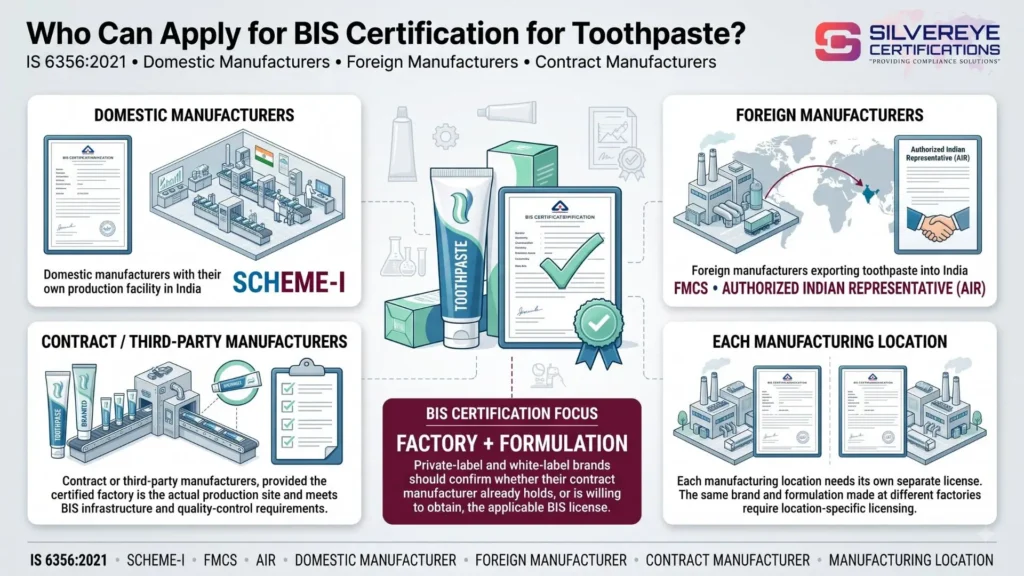
Each manufacturing location needs its own separate license, even if the same brand and formulation are made at more than one factory. Private-label and white-label brands should confirm with their contract manufacturer whether the factory already holds (or is willing to obtain) the license, since BIS certifies the factory + formulation combination, not just the brand name on the packaging.
What Documents Are Required for BIS Toothpaste Certification?
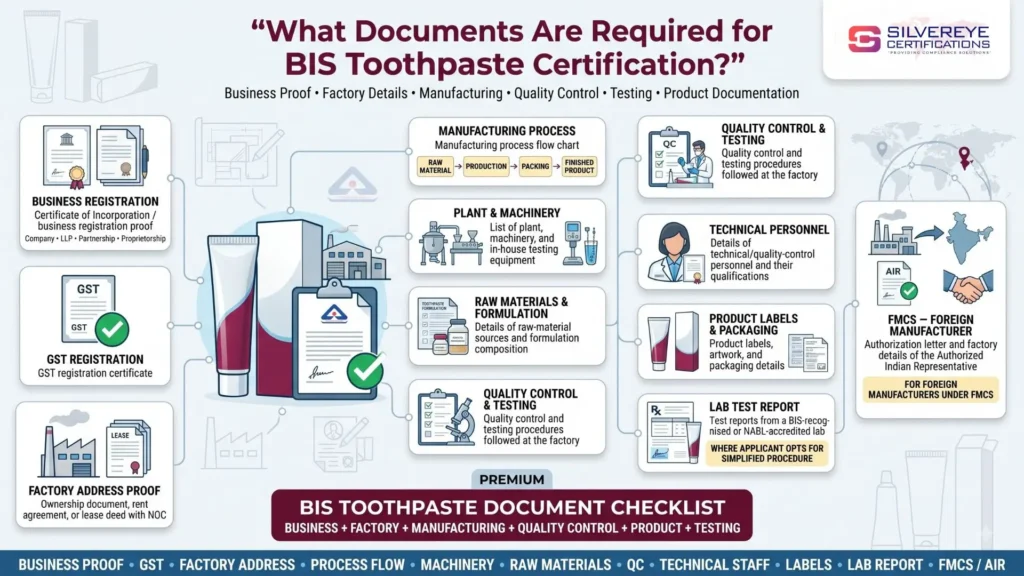
While the exact checklist can vary slightly by application type, applicants are typically asked to prepare:
- Certificate of Incorporation / business registration proof (Company, LLP, Partnership, or Proprietorship documents)
- GST registration certificate
- Factory address proof (ownership document, rent agreement, or lease deed with NOC)
- Manufacturing process flow chart, from raw-material intake to finished, packed product
- List of plant, machinery, and in-house testing equipment
- Details of raw-material sources and formulation composition
- Quality control and testing procedures followed at the factory
- Details of technical/quality-control personnel and their qualifications
- Product labels, artwork, and packaging details
- Test reports from a BIS-recognised or NABL-accredited lab (where the applicant opts for the Simplified Procedure)
- Authorization letter and factory details of the Authorized Indian Representative (for foreign manufacturers under FMCS)
Incomplete or inconsistent documentation is the single biggest reason applications get delayed at the scrutiny stage. Cross-check that your GST address, factory address proof, and application details all match exactly before submission.
Step-by-Step BIS Certification Process for Toothpaste
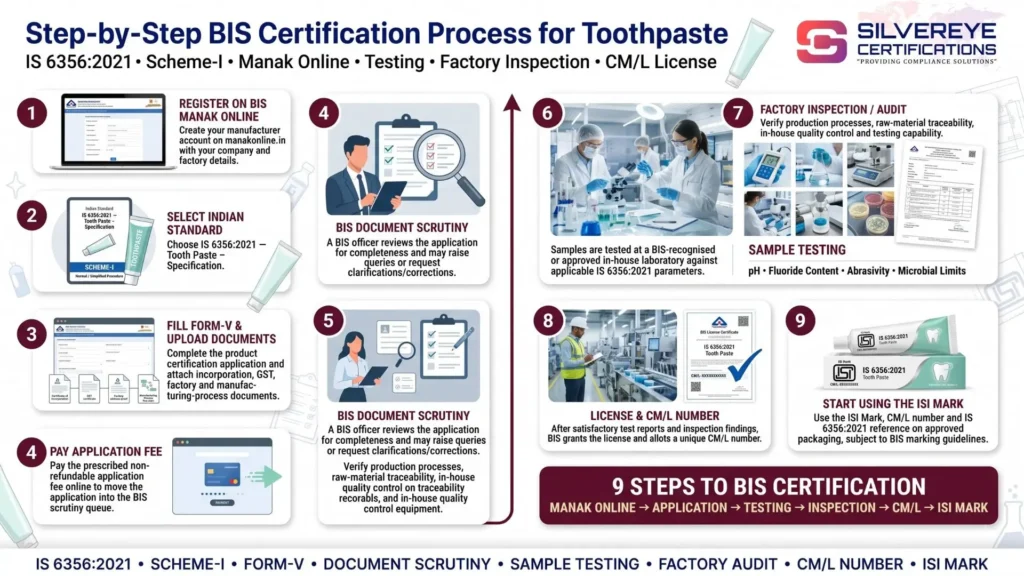
Applications for the ISI mark are filed online through BIS's official portal, manakonline.in, under Scheme-I of the BIS (Conformity Assessment) Regulations, 2018. Here is how the journey typically unfolds:
- Register on the BIS Manak Online portal. Create your manufacturer account on manakonline.in with your company and factory details.
- Select the applicable Indian Standard. Choose IS 6356:2021 (Tooth Paste – Specification) and the relevant application type (normal or Simplified Procedure, if you already hold valid test reports).
- Fill Form-V and upload documents. Complete the product certification application form and attach the incorporation, GST, factory, and process documents listed above.
- Pay the application fee. Pay the prescribed non-refundable application fee online to move your file into BIS's scrutiny queue.
- Document scrutiny by BIS. A BIS officer reviews your application for completeness and may raise queries or ask for clarifications/corrections.
- Sample testing. Samples are tested at a BIS-recognized or in-house lab (once approved) against IS 6356:2021 parameters — pH, fluoride content, abrasivity, microbial limits, and more.
- Factory inspection/audit. A BIS officer visits your manufacturing unit to verify production processes, raw-material traceability, in-house quality control, and testing capability.
- Grant of license and CM/L number allotment. Once the test reports and inspection findings are satisfactory, BIS grants the license and allots a unique CM/L (Certification Marks License) number for your product — this is the official license number you'll use on packaging and for verification.
- Start using the ISI mark. You can now print the ISI mark, your CM/L number, and the IS 6356:2021 reference on your approved packaging, subject to BIS marking guidelines.
What Is a CM/L Number, and When Does BIS Issue It?
Once your application is submitted on manakonline, BIS first allots it a temporary application/file reference number so you can track its status on the portal through scrutiny, testing, and inspection. The CM/L number itself — short for Certification Marks License number — is the official BIS license number, and BIS issues it only at the end of the process, when the license is actually granted, i.e., after your formulation has cleared testing and your factory has passed inspection. It is not generated at the moment you merely submit the application.
A few practical points about the CM/L number:
- Format – it typically appears as "CM/L-" followed by a 7–10 digit number (for example, CM/L-1234567), and must be printed on your toothpaste packaging alongside the ISI mark and the IS 6356:2021 reference.
- Purpose – it uniquely identifies your specific license, tying it to your company, factory, and certified product, so retailers, distributors, and consumers can verify authenticity.
- Verification – anyone can check whether a CM/L number is genuine and currently active using the free BIS Care app or the license-verification tool on the BIS website, by entering the CM/L number exactly as printed on the pack.
- Ongoing use – the same CM/L number stays valid through renewals, as long as the license is renewed on time and not suspended or cancelled; it does not change every year.
BIS Certification vs. Cosmetic Manufacturing License — These Are Not the Same Thing
This is where a lot of the confusion in this space comes from. People read that "BIS is voluntary for toothpaste" and assume that means toothpaste is loosely regulated in India. It isn't. BIS certification and the cosmetic manufacturing license are two completely separate approvals, from two different authorities, and only one of them is optional.
Legally, toothpaste is classified as a cosmetic under the Drugs and Cosmetics Act, 1940, and the Cosmetics Rules, 2020 — the same framework that covers skin creams, shampoos, and hair oils. And under this framework, a manufacturing license is mandatory to legally manufacture and sell cosmetic products in India. So before you even get to the question of whether to pursue the ISI mark, you need this license just to switch on your production line.
How the Cosmetic License Actually Works
The application for a manufacturing license is filed in Form COS-5, and once approved, the license itself is granted in Form COS-8. This license is issued by the State Licensing Authority — commonly referred to as the State Drug Controller — not by BIS, so it's a state-level approval rather than a central one.
A few things worth knowing about how it plays out on the ground:
- Timeline: Once the application is reviewed and documents are verified without any pending query, the State Licensing Authority is expected to grant the license within 45 days of that verification.
- Inspection comes after, not before: Unlike BIS, where the factory audit happens before the license is granted, the cosmetic license process works the other way. Within 30 days of the license being issued, the State Licensing Authority may inspect the manufacturing premises to check that what was declared in the self-certified GMP document (Form COS-7) actually matches reality. If that self-certificate turns out to contain false information, the license can be cancelled.
- Validity: This is one of the more manufacturer-friendly parts of the framework. Under Rule 30 of the Cosmetics Rules, 2020, a license or loan license issued in Form COS-8 or COS-9 stays valid in perpetuity, as long as the license retention fee is paid before five years elapse from the date of issue — unless it's suspended or cancelled along the way. So there's no annual renewal treadmill here the way there is with BIS; it's a five-year fee cycle instead.
- Fees: The government charges ₹10,000 for grant of a COS-8 license covering up to ten items within a cosmetic category, with an additional ₹500 per extra item in that category.
- New formulations: If your toothpaste uses an ingredient or claim that counts as a "new cosmetic," you don't skip straight to the state authority. Prior permission from the Central Licensing Authority — the Drugs Controller General (India) — is required before you can manufacture a new cosmetic in India.
Importers follow a parallel track, applying through Form COS-1 to receive an import registration/license, rather than going through COS-5/COS-8, since that pair is specifically for domestic manufacturing.
Manufacturer & Importer— Who Actually Needs This License?
This is the part that trips up a lot of people, because the answer isn't "everyone in the supply chain needs a cosmetic license." The Cosmetics Rules, 2020 place the licensing obligation squarely on two roles — the manufacturer and the importer — and are largely silent on wholesalers, distributors, and retailers as a separately licensed category. That's a real and deliberate difference from how drugs are regulated in India, and it's worth spelling out clearly since so much online content blurs the two.
- Manufacturer — license mandatory. Anyone manufacturing toothpaste in India for sale or distribution, including contract and third-party manufacturers, must hold a license (Form COS-8) or loan license (Form COS-9) from the State Licensing Authority, obtained by filing Form COS-5 or COS-6. There is no exemption for small-batch, private-label, or herbal manufacturers making cosmetic-only claims — if you're producing the paste, you need this license before you sell a single tube.
- Importer — license mandatory. Anyone bringing toothpaste into India for sale — the overseas manufacturer's authorised agent, an Indian subsidiary, or any other importer — must hold an Import Registration Certificate (Form COS-2) from the Central Licensing Authority (CDSCO), obtained by filing Form COS-1. This is a central-government approval, separate from the state-level manufacturing license, and it's tied to the specific product category and manufacturing site abroad, not just the importing company.
BIS Certification Fees for Toothpaste
BIS fees for Scheme-I product certification follow a common structure across most product categories, including toothpaste. Based on BIS's published fee framework, the broad components are:
| Fee Component | Approx. Amount (₹) | When It's Paid |
| Application fee | ₹1,000 (non-refundable) | At the time of filing the application |
| Inspection/audit fee | Approx. ₹7,000 per man-day + officer's actual travel & incidental expenses | Before or after the factory inspection, as intimated by BIS |
| Annual license fee | Approx. ₹1,000 per year | On grant of license, and every year at renewal |
| Marking fee | Product- and turnover/volume-based; calculated as per BIS's marking fee schedule for the relevant product code | Ongoing, based on actual production/sales under the mark |
| Lab testing charges | Varies by lab and number of parameters tested (commonly a few thousand to ~₹25,000+ for a full IS 6356 panel) | At the time of sample testing |
| Concessions | Reduced application/marking fees may be available for eligible MSMEs, startups, and women entrepreneurs on producing valid certificates | At the time of application, subject to BIS approval |
How Long Does BIS Certification for Toothpaste Take?
Timelines depend heavily on how complete your documentation is and whether you're on the normal route or the Simplified Procedure. As a general guide based on BIS's typical Scheme-I processing pattern:
| Stage | Typical Duration |
| Document scrutiny | 1–2 weeks |
| Sample testing | 2–4 weeks, depending on lab load and parameters |
| Factory inspection & report | 2–3 weeks after scheduling |
| Final review & license grant | 1–3 weeks after satisfactory testing and inspection |
| Overall (Simplified Procedure) | Approximately 35–40 days, if test reports are already in hand |
| Overall (Normal Procedure) | Roughly 2–4 months, depending on query resolution and audit scheduling |
Validity, Renewal & Ongoing Compliance
License Validity
A BIS license under Scheme-I for toothpaste is typically granted for an initial period of one year, and can be renewed annually (or for a longer period, at BIS's discretion, based on the manufacturer's compliance track record) thereafter.
Renewal Process
- Log in to your dashboard on the manakonline.in portal before your license's expiry date.
- Submit the renewal application along with actual production data for the period, which BIS uses to calculate the marking fee due.
- Pay the applicable renewal and marking fees online.
- BIS may conduct a renewal-linked inspection or rely on your surveillance-audit history, depending on your compliance record.
If a renewal application and fee are not submitted before the validity expires, the license can go into deferment, governed by Regulation 8 of the BIS (Conformity Assessment) Regulations, 2018 — meaning the license effectively lapses until renewal formalities are completed.
Why Choose Silvereye Certifications for Your BIS Toothpaste License
Getting a BIS certificate for toothpaste is straightforward on paper, but in practice it involves formulation review against a technical standard, precise documentation, lab coordination, and a factory audit — all of which get easier with the right guidance. This is where Silvereye Certifications adds real value:
- End-to-end handling: From your first document checklist to the day your license is granted, our team manages the manakonline.in application, BIS correspondence, and query resolution on your behalf, so you stay focused on production.
- Pre-compliance review: We assess your formulation and documentation against IS 6356:2021 parameters before filing, so surprises during official testing are minimised.
- Lab & audit coordination: We help schedule sample testing at recognised labs and prepare your factory for the BIS inspection, including QC documentation and process-flow records.
- Transparent, realistic costing: We give you an itemised, honest fee estimate upfront — application, inspection, testing, and marking fees — instead of vague, one-line quotes.
- Renewal & compliance tracking: We track your license validity and production-based marking fee obligations, so renewals happen on time and your license never lapses into deferment.
- Support for foreign manufacturers: For overseas brands, we can help coordinate the FMCS route through an Authorized Indian Representative.
If you want a smooth, well-documented path from application to ISI mark on your toothpaste cartons, Silvereye Certifications is built to make that process predictable rather than stressful.
Conclusion
A BIS Certificate for Toothpaste under IS 6356:2021 is not a legal requirement in India today — but it has quietly become a commercial one. As retail chains, e-commerce platforms, institutional buyers, and increasingly aware consumers gravitate toward BIS-certified oral-care products, the ISI mark has shifted from a nice-to-have to a genuine growth lever for toothpaste brands. The process — registering on manakonline.in, preparing your documents, clearing lab testing, and passing a factory audit — is well-defined, and the cost is modest compared to the market access and trust it unlocks.
Whether you are a new D2C oral-care brand preparing for your first retail listing, or an established manufacturer looking to future-proof your compliance ahead of a possible QCO, the right time to start the BIS certification journey for your toothpaste is before a retailer, distributor, or regulation forces your hand. If you'd like this process handled accurately and on schedule, Silvereye Certifications can guide you from formulation review through to your final ISI-mark licence.
Frequently Asked Questions
Is BIS certification mandatory for toothpaste in India?
No. As of 2026, toothpaste is not covered under a BIS Quality Control Order (QCO), so BIS certification under IS 6356:2021 remains voluntary. You can legally manufacture and sell toothpaste without it, though many large retailers and marketplaces prefer certified products.
What does IS 6356:2021 actually specify?
It specifies composition, safety, and quality requirements for fluoridated and non-fluoridated toothpaste, along with test methods and rules for packaging, marking, and labelling.
Who can apply for a BIS certificate for toothpaste?
Domestic manufacturers with their own factory can apply under Scheme-I. Foreign manufacturers can apply under the Foreign Manufacturers Certification Scheme (FMCS) through an Authorized Indian Representative.
Where do I apply for the BIS toothpaste license?
Applications are filed online on BIS's official portal, under Scheme-I of the BIS (Conformity Assessment) Regulations, 2018.
How much does BIS certification for toothpaste cost?
Costs typically include an application fee (around ₹1,000), inspection/audit fees, an annual license fee, product testing charges, and an ongoing marking fee linked to production volume.
How long does the BIS certification process take?
Under the Simplified Procedure (with existing valid test reports), it can take roughly 35–40 days. Under the normal procedure, it usually takes about 2–4 months, depending on documentation, testing, and audit scheduling.
What is the validity period of a BIS toothpaste license?
Licenses are typically granted for one year and are renewable annually through the manakonline portal, subject to payment of renewal and marking fees.
What documents are required for BIS toothpaste certification?
Common requirements include incorporation and GST documents, factory address proof, manufacturing process flow charts, raw-material and formulation details, quality-control procedures, and lab test reports.
Can herbal or ayurvedic toothpaste get BIS certification under IS 6356:2021?
Yes, as long as the formulation is marketed and functions as a toothpaste/dentifrice and meets the parameters of IS 6356:2021. Products claiming specific Ayurvedic/medicinal effects may also need to comply with separate applicable regulations.
What happens if my product fails a test parameter under IS 6356:2021?
BIS will typically ask for corrective action and reformulation, followed by re-testing of the corrected sample before the application can move forward to inspection and license grant.
Can I sell toothpaste on e-commerce platforms without BIS certification?
Legally, yes, since it is a voluntary certification. In practice, though, several e-commerce platforms and retail chains now prefer or require the ISI mark before listing or stocking oral-care products, so certification can directly affect your distribution reach.
Do I need a cosmetic manufacturing license even if I get BIS certification for my toothpaste?
Yes. BIS certification does not replace the cosmetic manufacturing license — they cover different things. The COS-8 license under the Cosmetics Rules, 2020 is your legal permission to manufacture and sell the toothpaste at all; BIS certification under IS 6356:2021 is a voluntary, additional quality mark. Most manufacturers end up holding both.
Is the cosmetic license mandatory for a toothpaste manufacturer in India?
Yes, without exception. Any business manufacturing toothpaste for sale or distribution in India — including contract and third-party manufacturers — must hold a manufacturing license (Form COS-8) or loan license (Form COS-9) from the State Licensing Authority before producing and selling the product.
Is the cosmetic license mandatory for a toothpaste importer?
Yes. Anyone importing toothpaste into India for sale — whether the overseas manufacturer's authorised agent, an Indian subsidiary, or an independent importer — must hold an Import Registration Certificate (Form COS-2) from the Central Licensing Authority (CDSCO), obtained by filing Form COS-1. This is a mandatory central-government approval, distinct from the manufacturing license.