
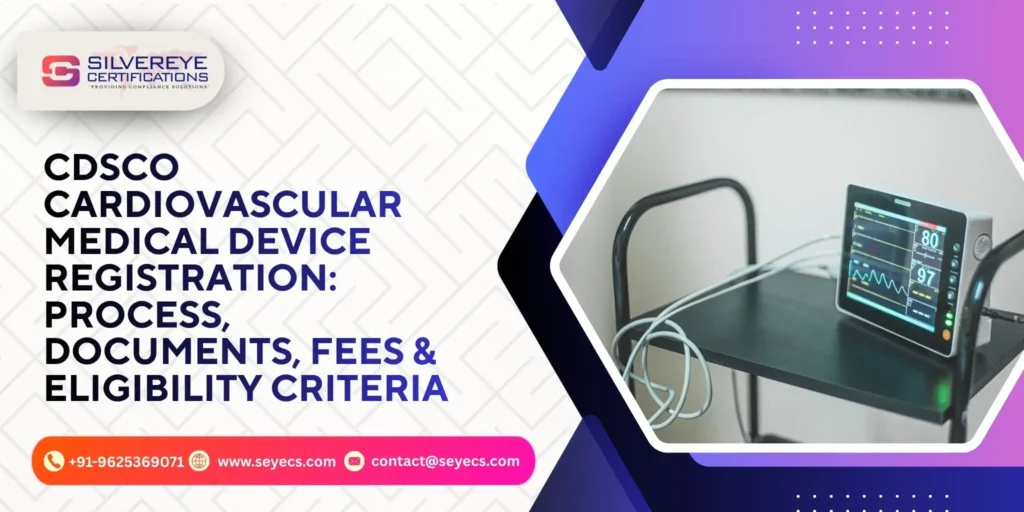
- CDSCO Cardiovascular medical device Registration in India range from low-risk blood pressure monitors (Class A/B) to high-risk implantable pacemakers and heart valves (Class D) — each requiring a specific CDSCO registration or license under MDR 2017.
- CDSCO is the sole authority for registering Class C and Class D cardiovascular devices in India; manufacturers file Form MD-7 and importers file Form MD-14 to obtain the corresponding licenses.
- With India's cardiac device market projected to grow significantly through 2026 and beyond, obtaining valid CDSCO registration is both a legal requirement and a strategic market-entry gateway.
Introduction
If you manufacture, import, or distribute cardiovascular medical devices in India, CDSCO registration is not optional — it is the law. The Central Drugs Standard Control Organization (CDSCO), under the Ministry of Health and Family Welfare, governs every cardiovascular device sold, used, or manufactured in India under the Medical Devices Rules, 2017 (MDR 2017).
Cardiovascular devices span an enormous range — from simple disposable items like IV cannulas to complex life-sustaining implants like artificial heart valves and cardiac resynchronization therapy (CRT) devices. Each category carries its own risk level, its own classification, and its own regulatory pathway. Getting this right from the start saves months of delay and avoids costly rejections.
This guide is written for manufacturers, importers, regulatory affairs professionals, and healthcare entrepreneurs who want a clear, accurate, and current picture of the CDSCO cardiovascular device registration process for 2026.
What Is CDSCO Cardiovascular Medical Device Registration?
CDSCO cardiovascular medical device registration is the formal process through which a medical device used in the diagnosis, treatment, monitoring, or support of cardiovascular conditions is reviewed and approved by CDSCO before it can be manufactured, imported, or marketed in India.
Under the Medical Devices Rules, 2017, all cardiovascular devices that fall under the notified category must be registered. CDSCO evaluates the device's safety, performance, and quality before granting a license or registration certificate. This process protects patients from substandard or unsafe cardiac devices entering the Indian market.
| Regulatory Framework at a Glance Governing Law: Medical Devices Rules, 2017 (MDR 2017) under the Drugs and Cosmetics Act, 1940 | Regulatory Body: CDSCO (Central Drugs Standard Control Organization) | Application Portal: SUGAM (sugamapplication.gov.in) | Manufacturing License Form: MD-7 | Import License Form: MD-14 | License Grant Forms: MD-9 (manufacturing), MD-15 (import) | Classification: Class A, B, C, D (risk-based) |
Risk-Based Classification of Cardiovascular Medical Devices in India
MDR 2017 classifies all medical devices into four risk-based categories — Class A (lowest risk) to Class D (highest risk). Cardiovascular devices appear across all four classes. The classification determines who issues the license, what documents are needed, and how long the process takes.
Below is the classification framework with real examples of cardiovascular devices in each class:
| Class | Risk Level | Licensing Authority | Key Regulatory Requirement |
| Class A | Low Risk | State Licensing Authority (SLA) | Registration; basic quality documentation |
| Class B | Low-to-Moderate Risk | State Licensing Authority (SLA) | Registration; technical file required |
| Class C | Moderate-to-High Risk | CDSCO (Central) | Manufacturing/import license; GMP + technical dossier |
| Class D | Highest Risk | CDSCO (Central) | Manufacturing/import license; full clinical data + GMP |
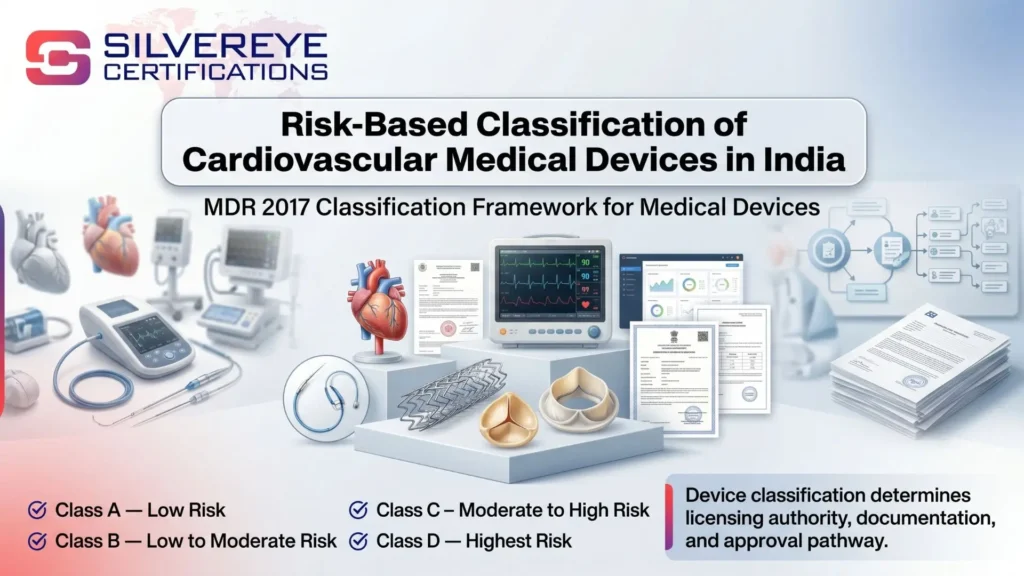
Complete Classification of Cardiovascular Medical Devices by Risk Class
The following table lists cardiovascular and cardiac-related medical devices classified under MDR 2017, organised by risk class. This is one of the most searched and referenced sections for regulatory professionals, manufacturers, and importers planning their CDSCO registration strategy.
Class A — Low Risk Cardiovascular Devices
| Device Name | Description / Use | Class |
| Non-invasive blood pressure (NIBP) cuffs | Fabric/rubber cuffs used with sphygmomanometers for blood pressure measurement | A |
| Aneroid sphygmomanometer (manual) | Manual BP measuring device with gauge; non-electronic | A |
| Stethoscope | Acoustic device for auscultation of heart and lung sounds | A |
| Disposable ECG electrodes | Single-use adhesive electrodes for ECG signal pickup | A |
| ECG paper / recording paper | Thermal or plain paper used in ECG machines for waveform printing | A |
| Blood pressure monitoring accessories | Non-electronic accessories such as tubing, connectors for manual BP monitors | A |
| Non-sterile cardiac procedure drapes | Sterile field establishment accessories used during cardiac procedures | A |
| Compression bandages (non-sterile) | Support bandages used post-cardiac catheterisation or vascular procedures | A |
Class B — Low-to-Moderate Risk Cardiovascular Devices
| Device Name | Description / Use | Class |
| Digital blood pressure monitor (wrist/arm) | Electronic NIBP device for home or clinical use; battery or mains powered | B |
| 12-lead ECG machine | Standard resting ECG recorder for cardiac rhythm and conduction assessment | B |
| Holter monitor | Ambulatory ECG recorder worn by patients for 24–48 hours to detect arrhythmias | B |
| Exercise stress testing system (treadmill ECG) | ECG monitoring combined with treadmill exercise to diagnose ischaemic heart disease | B |
| Pulse oximeter (non-implantable) | Finger/wrist probe device measuring SpO2 and pulse rate non-invasively | B |
| Cardiac event monitor | Patient-activated ECG recorder for intermittent arrhythmia documentation | B |
| External defibrillator (AED — automated) | Automated device for public access defibrillation; delivers shock for VF/VT | B |
| Vascular Doppler (handheld) | Ultrasound probe to detect peripheral vascular blood flow signals | B |
| Blood coagulation monitor (INR — point of care) | Handheld device for patient self-testing of anticoagulation (INR) levels | B |
| Cardiac telemetry transmitter | Wireless device transmitting ECG data from patient to monitoring station | B |
Class C — Moderate-to-High Risk Cardiovascular Devices
| Device Name | Description / Use | Class |
| Cardiac catheterization catheters | Flexible tubes inserted into heart chambers/vessels for diagnosis and intervention | C |
| Coronary angiography catheters | Catheters used to visualise coronary arteries via X-ray contrast injection | C |
| Percutaneous transluminal coronary catheters | Balloon-tipped catheters for PTCA procedures to open blocked coronary arteries | C |
| Vascular access sheaths | Introducer sheaths for arterial/venous access during cardiac catheterisation | C |
| Peripheral vascular stents | Metallic mesh stents deployed in peripheral arteries to maintain vessel patency | C |
| Inferior vena cava (IVC) filter | Implantable filter placed in IVC to prevent pulmonary embolism from DVT | C |
| Cardiac ablation catheter | Catheter delivering RF or cryo energy to ablate arrhythmogenic cardiac tissue | C |
| Electrophysiology (EP) diagnostic catheter | Multi-electrode catheter for recording intracardiac electrograms during EP study | C |
| Intra-aortic balloon pump (IABP) catheter | Balloon catheter placed in aorta to provide haemodynamic support in cardiogenic shock | C |
| Cardiovascular guide wires | Flexible metallic wires used to guide catheters and devices to target cardiac sites | C |
| Cardiac monitoring electrodes (implantable loop) | Subcutaneously implanted ECG monitor for long-term arrhythmia surveillance | C |
| External cardiac pacemaker (temporary) | Transcutaneous or transvenous temporary pacemaker for acute bradycardia management | C |
| Haemodialysis blood tubing sets | Extracorporeal tubing used in haemodialysis circuits supporting cardiac patients | C |
| Left ventricular assist device (LVAD) — non-permanent | Short-term mechanical circulatory support pump for bridge-to-transplant or recovery | C |
| Cardiac output monitoring systems | Invasive/minimally invasive systems (e.g., PiCCO, Swan-Ganz) measuring cardiac output | C |
| Drug-eluting balloon (DEB) catheter | Balloon catheter coated with antiproliferative drug to prevent restenosis post-PTCA | C |
Class D — Highest Risk Cardiovascular Devices
| Device Name | Description / Use | Class |
| Drug-eluting coronary stent (DES) | Coronary stent with drug coating to prevent in-stent restenosis after PCI | D |
| Bare-metal coronary stent (BMS) | Metallic mesh stent permanently implanted in coronary arteries to treat stenosis | D |
| Bioresorbable vascular scaffold (BVS) | Fully dissolving coronary scaffold providing temporary scaffolding and drug delivery | D |
| Mechanical heart valve (prosthetic) | Implantable mechanical valve replacing diseased aortic, mitral, or tricuspid valves | D |
| Bioprosthetic heart valve (tissue valve) | Valve made from bovine/porcine tissue or human donor tissue implanted surgically | D |
| Transcatheter aortic valve (TAVI/TAVR device) | Catheter-delivered bioprosthetic valve for minimally invasive aortic valve replacement | D |
| Implantable cardioverter-defibrillator (ICD) | Permanently implanted device detecting and terminating life-threatening ventricular arrhythmias | D |
| Permanent cardiac pacemaker | Implantable pulse generator maintaining heart rate in patients with bradycardia/heart block | D |
| Cardiac resynchronization therapy device (CRT-P / CRT-D) | Biventricular pacemaker/ICD improving cardiac synchrony in heart failure patients | D |
| Subcutaneous ICD (S-ICD) | ICD implanted subcutaneously without transvenous leads; treats VF/VT without pacing | D |
| Left ventricular assist device (LVAD — permanent) | Long-term implantable pump supporting left ventricle in advanced heart failure | D |
| Total artificial heart (TAH) | Device replacing both ventricles as destination therapy in end-stage biventricular failure | D |
| Coronary artery bypass graft (CABG) conduit — synthetic | Synthetic vascular graft used as bypass conduit in CABG surgery | D |
| Ventricular septal defect (VSD) closure device | Transcatheter occluder device for closing ventricular septal defects | D |
| Atrial septal defect (ASD) closure device | Transcatheter occluder device for closing atrial septal defects | D |
| Patent foramen ovale (PFO) closure device | Catheter-delivered occluder for closing PFO to reduce stroke recurrence risk | D |
| Left atrial appendage (LAA) occluder | Implantable device occluding LAA to reduce stroke risk in non-valvular AF patients | D |
| Cardiac patch / myocardial support device | Epicardial support device or patch used in left ventricular reconstruction | D |
| Thoracic aortic endovascular graft (TEVAR) | Endovascular stent-graft placed in thoracic aorta to exclude aortic aneurysm/dissection | D |
| Percutaneous mitral valve repair device (MitraClip) | Transcatheter device for edge-to-edge mitral valve leaflet repair | D |
| Important Classification Note for 2026 The above classification is based on the Medical Devices Rules, 2017 and CDSCO's notified device lists. For devices that are not yet explicitly listed in the notification, the manufacturer or importer must approach CDSCO for classification guidance before filing. Misclassification leads to rejection and wasted time. When in doubt, seek a pre-submission consultation with a qualified regulatory affairs professional. |
Who Needs CDSCO Cardiovascular Device Registration? — Eligibility
The following entities are required to obtain CDSCO registration or a license before dealing in cardiovascular medical devices in India:
| Entity Type | Applicable Form | Issued License Form |
| Indian Manufacturer (Class A/B) | Application via SLA | SLA License |
| Indian Manufacturer (Class C/D) | Form MD-7 (CDSCO) | Form MD-9 |
| Importer (Class C/D devices) | Form MD-14 (CDSCO) | Form MD-15 |
| Foreign Manufacturer (for import) | Via Indian Authorised Agent; Form MD-14 | Form MD-15 |
| Loan License Manufacturer | Form MD-7 (mention loan license) | Form MD-9 |
| Contract Manufacturer | Form MD-7 | Form MD-9 |
To be eligible, the applicant must meet these baseline conditions:
- The entity must be legally registered in India (as a company, LLP, partnership, or proprietorship).
- For manufacturing licenses: a physical manufacturing facility in India compliant with Schedule M-III GMP is mandatory.
- A qualified responsible person with the technical background prescribed under MDR 2017 must be appointed.
- For import licenses: a valid Indian Authorized Agent (IAA) agreement with the foreign manufacturer is required.
- All Class C and D cardiovascular devices require a performance test report from a CDSCO-recognized or NABL-accredited laboratory.
Documents Required for CDSCO Cardiovascular Device Registration
The document requirements differ for manufacturers and importers. Below are comprehensive checklists for both pathways:
A. Documents for Indian Manufacturer (Form MD-7 — Class C/D)
- Certificate of Incorporation / Business registration proof
- PAN Card and GST Registration Certificate
- Board resolution or authorization letter for the authorized signatory
- Memorandum and Articles of Association
- Site Master File (SMF) detailing the manufacturing premises layout, equipment, and processes
- Ownership or lease/rent agreement for the manufacturing premises
- Floor plan and facility layout diagrams
- ISO 13485 Quality Management System certificate (strongly recommended for Class C/D)
- Device Master File including technical specifications, design history, and intended use
- Risk management file compliant with ISO 14971
- Labelling samples and draft Instructions for Use (IFU)
- Performance and safety test reports from NABL-accredited or CDSCO-recognized laboratory
- Biocompatibility data (ISO 10993 series) for all patient-contact components
- Electrical safety test reports (IEC 60601-1 and relevant particular standards)
- Clinical evaluation report (for Class D devices — clinical data or literature-based evaluation)
- Sterilization validation records (if device is supplied sterile)
- Shelf life / packaging validation data
- Qualification and experience certificates of the Responsible Person / Technical Staff
- Declaration of Conformity signed by the manufacturer
B. Documents for Importer (Form MD-14 — Class C/D)
- Certificate of Incorporation of the Indian importing entity
- PAN Card and GST Registration Certificate
- Free Sale Certificate (FSC) from the country of origin, issued by the competent authority
- Certificate of Conformity or Marketing Authorization from the country where the device is approved
- CE Certificate or US FDA 510(k) / PMA clearance letter (international approvals strengthen the application)
- Indian Authorized Agent (IAA) agreement — a notarized and apostilled agreement between the Indian importer and the foreign manufacturer
- Undertaking by the foreign manufacturer for post-market surveillance and adverse event reporting in India
- Device Master File / technical dossier for the specific device model being imported
- Risk management summary as per ISO 14971
- Labelling samples adapted to Indian requirements (with Indian importer details)
- IFU in English or local language as required
- Test reports from CDSCO-recognized or NABL-accredited laboratory for the Indian market
- Performance and safety data or published clinical literature for Class D devices
- Declaration of Conformity from the foreign manufacturer
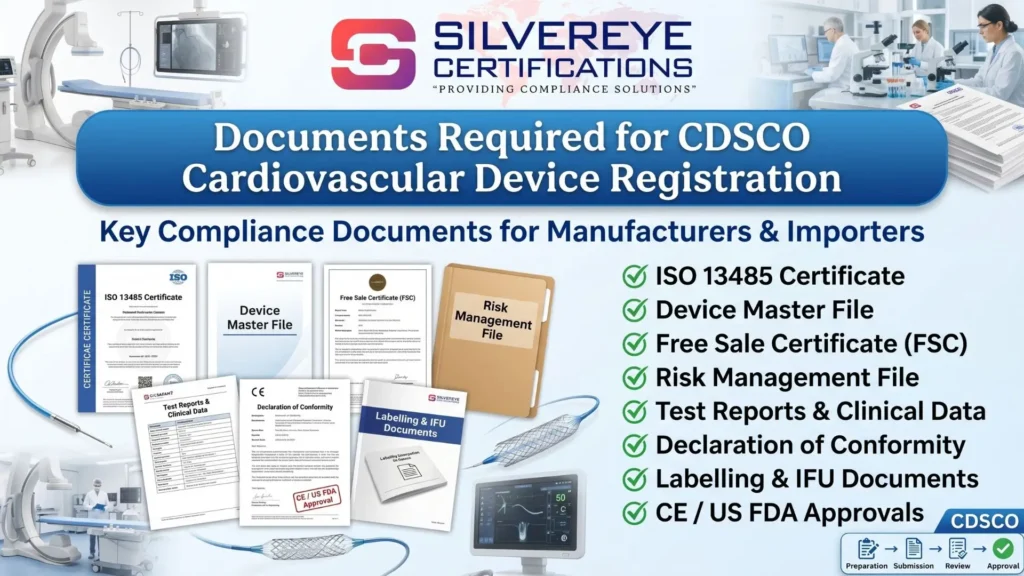
| Free Sale Certificate (FSC) The Free Sale Certificate is one of the most critical documents for import applications. It must be issued by the national regulatory authority of the country where the device is manufactured — not just a chamber of commerce certificate. For US-manufactured devices, this is typically an FDA Export Certificate. For EU devices, it is a certificate from the relevant national competent authority. An incorrect FSC is one of the top reasons for application rejection at CDSCO. |
Step-by-Step CDSCO Cardiovascular Device Registration Process
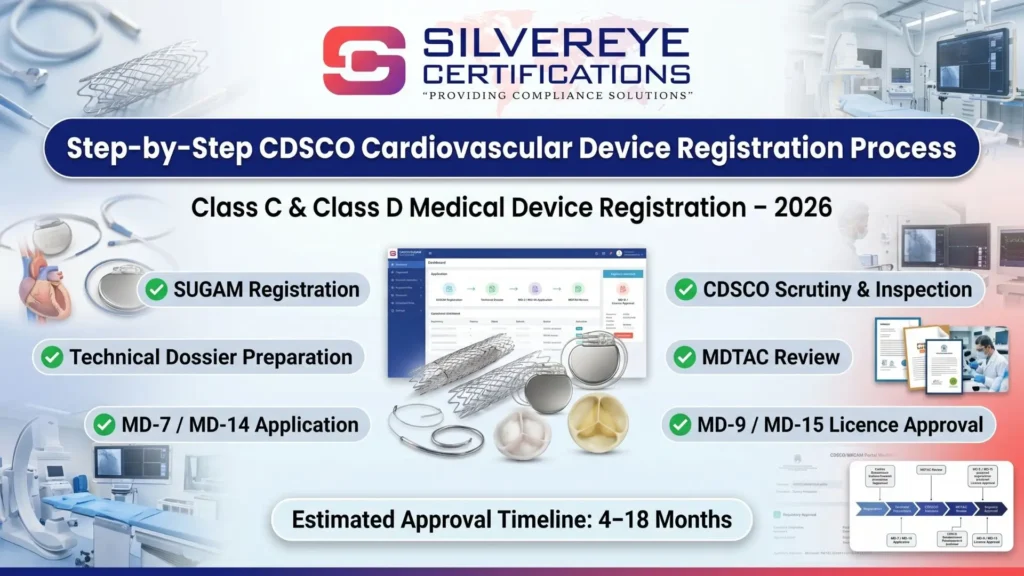
Here is the complete, sequential process for registering a cardiovascular medical device with CDSCO in 2026. This applies to both Class C and Class D devices via the SUGAM online portal.
| Step | Action Required | Who Does It | Timeline |
| Step 1 | Register your entity on the SUGAM portal (sugamapplication.gov.in). Create an applicant profile with company and contact details. | Applicant | 1–2 Days |
| Step 2 | Gather and prepare all required documents. Prepare the technical dossier, Device Master File, risk management file, and test reports. This is the most time-intensive step. | Applicant / Regulatory Consultant | 4–12 Weeks |
| Step 3 | For manufacturing applicants: ensure your facility is GMP-ready and compliant with Schedule M-III before applying. An unprepared facility at inspection stage causes major delays. | Manufacturer | Concurrent with Step 2 |
| Step 4 | File the application on SUGAM — MD-7 (manufacturing) or MD-14 (import). Fill in all sections, upload documents in required format, and pay the prescribed government fee online. | Applicant | 1–2 Days |
| Step 5 | CDSCO scrutinises the application for completeness. If any documents are missing or deficient, a deficiency letter is sent. Respond accurately and completely within the given time. | CDSCO + Applicant | 30–60 Days |
| Step 6 | For Class D devices (highest risk), CDSCO may refer the application to the Medical Device Technical Advisory Committee (MDTAC) for expert review. Prepare for possible queries. | CDSCO / MDTAC | Varies — 30–90 Days |
| Step 7 | CDSCO schedules and conducts a manufacturing premises inspection (for MD-7 applicants). The inspection team verifies GMP compliance, equipment, and quality system on-site. | CDSCO Inspector + Manufacturer | Depends on CDSCO schedule |
| Step 8 | Respond to any post-inspection observations or additional technical queries in writing, with supporting evidence. | Applicant | 15–30 Days |
| Step 9 | After satisfactory review, CDSCO grants the manufacturing license (Form MD-9) or import license (Form MD-15). The license specifies the device, manufacturer, and validity period. | CDSCO | 30–60 Days |
| Total Est. | End-to-end timeline from document preparation to license grant for Class C: typically 4–9 months. For Class D: typically 6–18 months due to MDTAC review and clinical data requirements. | — | 4–18 Months |
CDSCO Registration Fees for Cardiovascular Medical Devices
Government fees for CDSCO cardiovascular device registration are prescribed under the Second Schedule of the Medical Devices Rules, 2017. The fees vary based on the device class and whether the application is for manufacturing or import. Below is a framework guide — always verify the current fee on the SUGAM portal at the time of application, as these figures are subject to government revision.
| Application Type | Device Class | Fee Category (MDR 2017 Second Schedule) |
| Manufacturing License Application (MD-7) | Class A / B | Fees as per Second Schedule — lower tier |
| Manufacturing License Application (MD-7) | Class C | Fees as per Second Schedule — moderate tier |
| Manufacturing License Application (MD-7) | Class D | Fees as per Second Schedule — higher tier |
| Import License Application (MD-14) | Class C | Fees as per Second Schedule — moderate tier |
| Import License Application (MD-14) | Class D | Fees as per Second Schedule — higher tier |
| License Renewal | All Classes | Renewal fee as per Second Schedule |
| Amendment to License | All Classes | Amendment fee as applicable |
Validity of CDSCO Cardiovascular Device License
The validity period of a CDSCO cardiovascular device license depends on the type of license granted:
| License Type | Form Issued | Validity Period |
| Manufacturing License (Class C/D) | Form MD-9 | 3 years from date of grant |
| Import License (Class C/D) | Form MD-15 | 3 years from date of grant |
| State License (Class A/B) | SLA Form | As per State Licensing Authority rules — typically 5 years |
| Loan License | Form MD-9 | Co-terminus with the lending manufacturer's license |
During the validity period, the licensee can manufacture, import, or sell the registered cardiovascular device in India. Any change to the device design, manufacturing site, responsible person, label, or intended use during the validity period must be intimated to or approved by CDSCO before implementation — failure to do so is a regulatory violation.
License Renewal: Timeline and Process
Renewing your CDSCO cardiovascular device license on time is critical. Letting a license lapse means you legally cannot manufacture or sell the device until the renewal is granted. Here is what you need to know for 2026:
When to Apply for Renewal
- Initiate the renewal process at least 60 to 90 days before the license expiry date.
- If renewal is filed before expiry and is pending with CDSCO, manufacturing or sale can typically continue — but always confirm this with current CDSCO guidance or a regulatory consultant, as interpretations can vary.
- Filing after expiry may attract a late renewal penalty and will require CDSCO's discretionary approval to resume activities.
Renewal Process Steps
- Log in to the SUGAM portal and select the renewal application option against your existing license.
- Review and update your technical dossier if there have been any device changes, labelling updates, or new adverse event data during the previous license period.
- Confirm that your manufacturing premises or import arrangements are still GMP compliant and operational.
- Upload any new test reports, updated FSC (for importers), or revised QMS documents if required.
- Pay the renewal fee as per the current Second Schedule of MDR 2017.
- Respond promptly to any deficiency notices or queries raised by CDSCO during renewal scrutiny.
- Upon successful review, CDSCO issues the renewed license with a new 3-year validity period.
Key Benefits of CDSCO Cardiovascular Device Registration
Getting your cardiovascular device registered with CDSCO is more than a compliance checkbox. It delivers real business and clinical value:
| Benefit | What It Means for You |
| Legal Market Access | Only CDSCO-registered devices can be sold in Indian hospitals, clinics, and through distributors. |
| Government Tender Eligibility | All central and state government tender requirements specify valid CDSCO registration as mandatory eligibility. |
| Hospital Procurement | Top-tier hospitals in India require CDSCO registration as a prerequisite for device vendor empanelment. |
| Patient Safety Assurance | Registration confirms the device has passed safety and performance review, building clinician confidence. |
| Export Credibility | A CDSCO-registered device demonstrates regulatory compliance to international buyers and distributors. |
| Brand Protection | Registered devices are traceable; registration deters counterfeit products from using your brand. |
| Insurance & Reimbursement | CGHS and other insurance schemes increasingly link reimbursement eligibility to CDSCO-registered devices. |
| Investor Confidence | Regulatory clearance from CDSCO is a key milestone that investors and partners look for in medtech startups. |
CDSCO vs. CE Marking vs. US FDA: How They Align for Cardiovascular Devices
Many cardiovascular device manufacturers already have CE marking or US FDA clearance. Here is how these international approvals interact with the CDSCO registration process:
| Regulatory Approval | Accepted by CDSCO? | How It Helps |
| CE Marking (EU MDR) | Yes, as supportive evidence | CE technical file, notified body certificate, and clinical evaluation are accepted as part of the CDSCO dossier for import applications. |
| US FDA 510(k) Clearance | Yes, as supportive evidence | FDA clearance letter and substantial equivalence data strengthen the application, particularly for Class C/D devices. |
| US FDA PMA Approval | Yes, as strong supportive data | PMA clinical data is highly relevant for Class D cardiovascular device applications at CDSCO. |
| ISO 13485 Certification | Yes, supports QMS compliance | ISO 13485 from an accredited certification body supports GMP compliance demonstration and is looked at favourably by CDSCO. |
| CDSCO Registration | Primary requirement | None of the above replaces CDSCO registration. All international approvals are supportive — a dedicated Indian CDSCO application is mandatory. |
Conclusion
Cardiovascular device registration with CDSCO is a structured process — and one that rewards preparation. The manufacturers and importers who invest time in getting their technical dossier right, ensuring their quality system is genuinely compliant, and understanding the classification of their specific device consistently achieve faster approvals and fewer rejections.
India's cardiac care market is growing. Hospitals are upgrading, catheterization labs are expanding, and the demand for both high-end implantables and reliable diagnostic devices is increasing year on year. CDSCO registration is your entry ticket to this market — and with the right regulatory strategy, the process is entirely manageable.
If you are starting your registration journey in 2026, begin with these three actions: confirm your device classification, prepare your technical dossier with ISO-standard documentation, and register on the SUGAM portal. The rest follows from there.
Frequently Asked Questions
Is CDSCO registration mandatory for all cardiovascular devices sold in India?
Yes, for all cardiovascular devices that fall under CDSCO's notified device list. Class A and B devices are regulated by State Licensing Authorities, while Class C and D cardiovascular devices are mandatorily registered with CDSCO.
How do I determine the correct classification of my cardiovascular device?
Classification is based on the risk rules in the First Schedule of MDR 2017. You assess factors like whether the device is invasive, whether it is implantable, whether it directly contacts the heart or vasculature, and its duration of use.
How long does it take to register a coronary stent (Class D) with CDSCO?
Coronary stents are Class D devices and typically take 12 to 18 months for full registration due to MDTAC technical committee review, clinical data requirements, and the overall volume of scrutiny involved. Having a complete dossier — including clinical data, risk management file, and performance test reports — at the time of filing significantly reduces delays.
Can a foreign manufacturer register a cardiovascular device directly with CDSCO?
A foreign manufacturer cannot directly file with CDSCO. They must appoint an Indian Authorized Agent (IAA) — an Indian entity registered in India — who files the import license application (Form MD-14) on their behalf. The IAA is legally responsible for the device in the Indian market and must be named on the license.
Is clinical data always required for CDSCO cardiovascular device registration?
Clinical data is mandatory for Class D cardiovascular devices — devices like pacemakers, ICDs, heart valves, and coronary stents. For Class C devices, clinical evaluation through literature review may suffice in many cases. For Class A and B devices, clinical performance is typically demonstrated through bench testing and published evidence rather than new clinical trials.
What is the role of MDTAC in cardiovascular device registration?
MDTAC — the Medical Device Technical Advisory Committee — is a CDSCO expert committee that reviews applications for high-risk devices, primarily Class D. MDTAC evaluates clinical data, safety evidence, and technical specifications and provides recommendations to CDSCO.
Does CDSCO accept CE Marking as a substitute for Indian registration for cardiovascular devices?
No. CE marking does not substitute for CDSCO registration. India has its own regulatory pathway, and all cardiovascular devices — even those with CE, FDA, or other international approvals — must obtain a separate CDSCO license or registration before being marketed in India.
What happens if I sell a cardiovascular device in India without CDSCO registration?
Selling a notified cardiovascular device without valid CDSCO registration is an offence under the Drugs and Cosmetics Act, 1940 and MDR 2017. Penalties can include seizure of the device, cancellation of existing licenses, substantial fines, and criminal prosecution of the responsible persons.
How do I handle device amendments — for example, if I change the labelling of a registered cardiovascular device?
Any change to a registered cardiovascular device — including labelling, design, intended use, manufacturing site, or responsible person — must be reported to or approved by CDSCO before implementation. Minor changes may require an amendment application through the SUGAM portal.
Is ISO 13485 certification mandatory for CDSCO cardiovascular device registration?
ISO 13485 is not listed as a hard mandatory requirement for every application under MDR 2017, but it is strongly expected for Class C and Class D cardiovascular device manufacturers.