
- CDSCO approves all cardiac pacemaker types in India under MDR 2017 — single chamber, dual chamber, CRT, CRT-D, ICD, and leadless pacemakers all require prior central registration before use.
- CRT device registration in India is mandatory under Form MD-14 (import) or Form MD-7 (manufacturing) via the SUGAM portal — no CRT or CRT-D device can be sold or implanted without it.
- Biventricular pacemakers and CRT-D devices are classified as Class D by CDSCO — the highest-risk category — requiring rigorous documentation including dual IEC test reports and full clinical evaluation.
- The cardiac resynchronization therapy license process in India covers device dossier submission, IEC performance testing, ISO 10993 biocompatibility, and clinical evidence reviewed by CDSCO's central licensing authority.
Introduction
India's regulatory framework for medical devices has advanced significantly under the Medical Devices Rules (MDR), 2017. If you are a manufacturer, importer, distributor, or hospital procurement team asking about the types of pacemakers approved in India by CDSCO, this pillar guide covers everything — from device classification and regulatory pathways to CRT device registration in India, CRT-D CDSCO approval, and the biventricular pacemaker India licensing process.
Cardiac pacemakers are life-sustaining implantable devices, and CDSCO treats them with the highest level of regulatory scrutiny under the Drugs Controller General of India (DCGI). Whether you are planning to import a CRT-D system from a global OEM or set up domestic manufacturing of biventricular pacemakers in India, understanding which type of device you have and what CDSCO approval pathway applies is your most important first step.
This guide covers the cardiac resynchronisation therapy license requirements, applicable CDSCO forms, government fees, timelines, eligibility, document requirements, and common pitfalls — all based on real regulatory references under MDR 2017 and CDSCO guidelines.
How CDSCO Classifies Pacemakers in India Under MDR 2017
Under Schedule III of the Medical Devices Rules, 2017, pacemakers and related cardiac implantable electronic devices (CIEDs) are classified based on intended use, duration of body contact, and degree of invasiveness. CDSCO follows a four-tier risk classification — Class A (lowest risk) to Class D (highest risk).
All types of pacemakers approved in India by CDSCO fall under Class C or Class D because they are long-term implantable devices that directly regulate cardiac function. This classification determines the licensing authority, documentation requirements, inspection regime, and applicable fees.
| Risk Class | Category | Examples | Licensing Authority |
| Class A | Non-implantable, low risk | External pulse generators (short-term) | State Licensing Authority |
| Class B | Low-medium risk | Non-implantable external defibrillation electrodes | State Licensing Authority |
| Class C | High risk / Implantable | Single chamber pacemaker, dual chamber pacemaker, standard ICD | CDSCO – Central Licensing Authority |
| Class D | Highest risk / Implantable | CRT-P, CRT-D, biventricular pacemaker, leadless pacemaker, S-ICD | CDSCO – Central Licensing Authority |
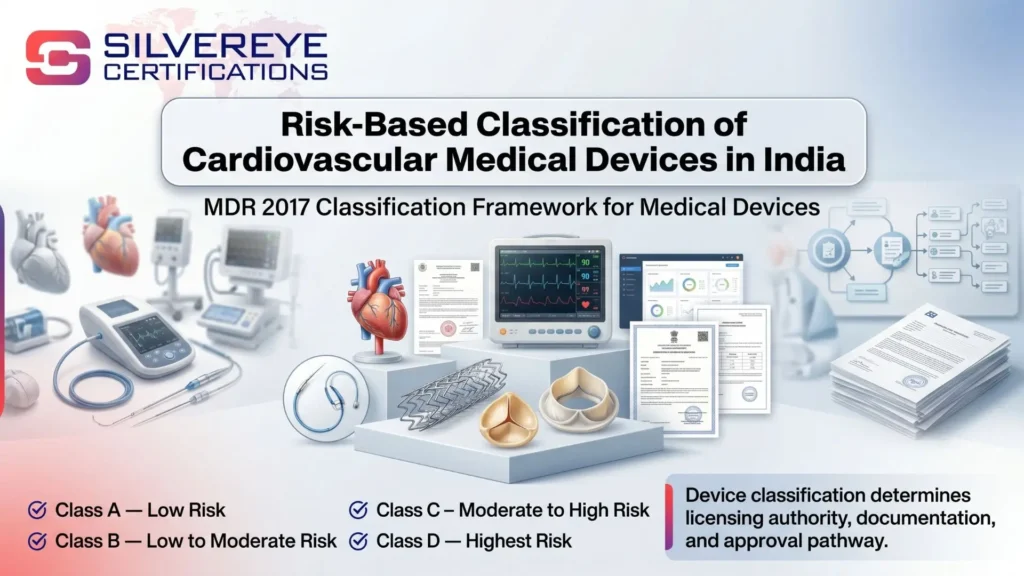
This classification is critical. CRT device registration in India and CRT-D CDSCO approval both fall under Class D — the most stringently regulated category under Indian medical device law, handled exclusively by CDSCO's Central Licensing Authority.
All Types of Pacemakers Approved in India by CDSCO
Here is a comprehensive breakdown of every pacemaker category that CDSCO reviews and approves in India, along with clinical purpose, risk class, and registration requirements.
| 1. Single Chamber Pacemaker |
| Device Type: Implantable cardiac pacemaker — one pacing lead (RA or RV) CDSCO Risk Class: Class C – Central Licensing Authority (CDSCO) Clinical Indication: Symptomatic bradycardia, sick sinus syndrome, AV block (single site pacing) Registration Form: Form MD-7 (Manufacturing) / Form MD-14 (Import) – SUGAM portal Key Note: Most widely used pacemaker type in India. Requires IEC 60601-2-31 test report. Estimated 40,000+ implants annually in India across public and private cardiac centres. |
| 2. Dual Chamber Pacemaker |
| Device Type: Implantable pacemaker with two pacing leads (RA + RV) CDSCO Risk Class: Class C – Central Licensing Authority (CDSCO) Clinical Indication: AV node dysfunction, sick sinus syndrome, chronotropic incompetence requiring AV synchrony Registration Form: Form MD-7 (Manufacturing) / Form MD-14 (Import) – SUGAM portal Key Note: Provides physiological pacing by synchronizing atrial and ventricular contractions. Most commonly implanted pacemaker type in Indian tertiary cardiac centres. |
| 3. Rate-Responsive Pacemaker |
| Device Type: Single or dual chamber device with rate modulation (AAIR, VVIR, DDDR) CDSCO Risk Class: Class C – Central Licensing Authority (CDSCO) Clinical Indication: Patients with chronotropic incompetence who cannot naturally increase heart rate during activity Registration Form: Form MD-7 (Manufacturing) / Form MD-14 (Import) – SUGAM portal Key Note: Rate-responsive (R-mode) is usually a feature within single or dual chamber pacemakers. The DMF must specifically validate the R-mode sensor algorithm. |
| 4. CRT-P Device (Cardiac Resynchronisation Therapy – Pacemaker / Biventricular Pacemaker) |
| Device Type: Biventricular pacemaker — 3 leads: right atrium (RA), right ventricle (RV), left ventricle (LV) via coronary sinus CDSCO Risk Class: Class D – Central Licensing Authority (CDSCO) Clinical Indication: Heart failure with reduced ejection fraction (HFrEF), LBBB pattern, QRS duration ≥ 130ms, NYHA Class II–IV Registration Form: Form MD-7 (Manufacturing) / Form MD-14 (Import) – Class D requirements — SUGAM portal Key Note: CRT device registration in India requires the most detailed clinical evidence package, including published RCT data mapped to the specific device model. IEC 60601-2-31 is the key performance standard. |
| 5. CRT-D Device (Cardiac Resynchronisation Therapy – Defibrillator) |
| Device Type: Biventricular pacemaker with integrated ICD — combines CRT pacing and high-voltage shock therapy CDSCO Risk Class: Class D – Central Licensing Authority (CDSCO) Clinical Indication: Heart failure patients with HFrEF who also have a risk of sudden cardiac death — combines resynchronization and defibrillation in a single implantable device Registration Form: Form MD-7 (Manufacturing) / Form MD-14 (Import) – Class D requirements — SUGAM portal Key Note: CRT-D CDSCO registration is the most complex cardiac device approval in India. Requires dual compliance with IEC 60601-2-31 (pacemaker) AND IEC 60601-2-4 (defibrillator). Clinical evidence must address both therapeutic functions. |
| 6. Implantable Cardioverter Defibrillator (ICD) |
| Device Type: Single or dual chamber device with high-voltage defibrillation capability CDSCO Risk Class: Class D – Central Licensing Authority (CDSCO) Clinical Indication: Ventricular tachycardia, ventricular fibrillation, sudden cardiac death prevention in high-risk patients Registration Form: Form MD-7 (Manufacturing) / Form MD-14 (Import) – Class D requirements — SUGAM portal Key Note: ICD devices are tested under IEC 60601-2-4. CDSCO requires charge time data, defibrillation threshold methodology, and validated battery longevity information in the technical dossier. |
| 7. Subcutaneous ICD (S-ICD) |
| Device Type: Extravascular defibrillator — no transvenous leads, implanted under the skin CDSCO Risk Class: Class D – Central Licensing Authority (CDSCO) Clinical Indication: Patients needing defibrillation backup without pacing requirement; younger patients to avoid lead complications Registration Form: Form MD-14 (Import) — no domestic S-ICD manufacturer in India as of 2026 Key Note: Newer device category in India. CDSCO registration requires full technical documentation, clinical evidence from pivotal trials, and comparative safety evaluation versus transvenous ICD. |
| 8. Leadless Pacemaker |
| Device Type: Miniaturisized capsule-style intracardiac pacemaker — no leads, no subcutaneous pocket CDSCO Risk Class: Class D – Central Licensing Authority (CDSCO) Clinical Indication: VVIR pacing in patients with limited venous access, high infection risk, or those with prior lead complications Registration Form: Form MD-14 (Import) — no domestic leadless pacemaker manufacturer in India as of 2026 Key Note: Leadless pacemakers represent an emerging technology in India. CDSCO approval requires detailed device performance data, delivery system validation, and clinical evidence supporting non-inferiority to conventional transvenous pacemakers. |
| 9. Temporary / External Pacemaker (Non-Implantable) |
| Device Type: External pulse generator — emergency or short-term pacing via temporary transcutaneous or transvenous leads CDSCO Risk Class: Class A / B (Non-Implantable) – State Licensing Authority Clinical Indication: Acute bradycardia, post-cardiac surgery pacing, bridging to permanent pacemaker implant Registration Form: Form MD-5 / Form MD-7 via State Drug Authority (not CDSCO central) Key Note: Non-implantable devices fall under State Licensing Authorities. This is an important distinction for distributors and hospital procurement teams — these do NOT require CDSCO central approval. |
CDSCO-Approved Pacemaker Types – Master Comparison Table
| Device Type | CDSCO Class | Key Indication | Form | Key Test Standard |
| Single Chamber Pacemaker | Class C | Bradycardia, Sick Sinus Syndrome | MD-7 / MD-14 | IEC 60601-2-31 |
| Dual Chamber Pacemaker | Class C | AV Block, Chronotropic Incompetence | MD-7 / MD-14 | IEC 60601-2-31 |
| Rate-Responsive Pacemaker | Class C | Chronotropic Incompetence | MD-7 / MD-14 | IEC 60601-2-31 |
| CRT-P (Biventricular PM) | Class D | Heart Failure with LBBB, HFrEF | MD-7 / MD-14 | IEC 60601-2-31 |
| CRT-D (CRT + Defibrillator) | Class D | Heart Failure + Sudden Cardiac Death | MD-7 / MD-14 | IEC 60601-2-31 + IEC 60601-2-4 |
| ICD (Single/Dual Chamber) | Class D | VT/VF, SCD Prevention | MD-7 / MD-14 | IEC 60601-2-4 |
| Subcutaneous ICD (S-ICD) | Class D | Defibrillation Without Pacing | MD-14 Import | IEC 60601-2-4 |
| Leadless Pacemaker | Class D | VVIR Pacing, Limited Venous Access | MD-14 Import | IEC 60601-2-31 |
| Temporary External Pacemaker | Class A/B | Acute/Post-Op Bradycardia | State / MD-5 | IEC 60601-2-31 |
CRT Device Registration in India – Complete Process Guide
CRT device registration in India is the most documentation-intensive process in CDSCO's medical device approval framework. Both CRT-P (pacemaker only) and CRT-D (pacemaker plus defibrillator) are classified as Class D devices — making them subject to the most rigorous regulatory scrutiny applied to any medical device category in India.
CRT-P vs CRT-D: Key Differences for CDSCO Approval
| Parameter | CRT-P (Biventricular PM) | CRT-D (CRT + Defibrillator) |
| Full Form | Cardiac Resynchronisation Therapy – Pacemaker | Cardiac Resynchronisation Therapy – Defibrillator |
| CDSCO Class | Class D | Class D |
| Primary Function | Biventricular pacing (3 leads: RA, RV, LV via CS) | Biventricular pacing + high-voltage shock therapy |
| Key Indication | HFrEF with LBBB, NYHA Class II–IV | HFrEF + risk of sudden cardiac death |
| Test Standard – Pacing | IEC 60601-2-31 | IEC 60601-2-31 |
| Test Standard – Defib | Not Applicable | IEC 60601-2-4 (mandatory) |
| Clinical Evidence | RCT data for CRT (e.g., CARE-HF, COMPANION) | Dual evidence: RCT for CRT + defibrillation clinical data |
| Typical CDSCO Timeline | 6 – 12 months (complete application) | 9 – 15 months (complete application) |
| Approx. Device Cost | Rs. 3 – 7 Lakh (imported) | Rs. 6 – 15 Lakh (imported) |
Who Approves CRT Device Registration in India?
CRT device registration in India is approved exclusively by the Central Licensing Authority (CLA) — which is DCGI under CDSCO, Ministry of Health and Family Welfare. No state authority has jurisdiction over Class D devices. All CRT CDSCO registration applications are filed and processed through the SUGAM portal (sugam.gov.in).
Eligibility: Who Can Apply for CRT Device CDSCO Registration in India?
For Import License (Form MD-14)
- Indian Importers / Authorized Indian Representatives (AIR) – Any Indian company with a valid wholesale medical device dealer license can apply. For Class D CRT devices, CDSCO increasingly expects the AIR to have dedicated regulatory affairs capability — not just a trading function.
- Indian Subsidiaries of Foreign Manufacturers – Wholly owned subsidiaries of global cardiac device companies operating in India can hold the registration in their own name.
- Distributors Appointed as AIR – A foreign manufacturer can appoint a single AIR in India who holds the CDSCO import registration on their behalf — the AIR must be a registered legal entity with medical device wholesale license.
For Manufacturing License (Form MD-7)
- Companies under Companies Act 2013 – Private limited, public limited entities with manufacturing objectives covering medical device production.
- LLPs and Partnership Firms – Eligible with a qualified Technical Head meeting CDSCO's prescribed qualifications for Class D device manufacturing.
- Technical Head Qualification – Degree in Biomedical / Electrical / Electronics Engineering or equivalent with minimum 5 years of Class C/D medical device manufacturing experience.
Documents Required for CDSCO Pacemaker Registration (MDR 2017)
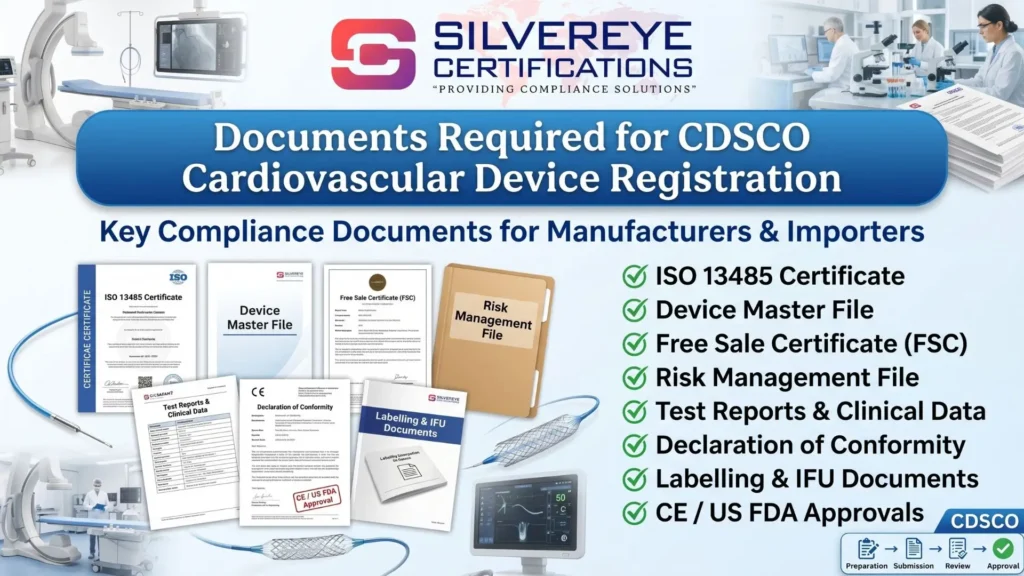
A complete, well-organised technical dossier is the single most important factor in getting your pacemaker registration approved without unnecessary delays. Here is the full document checklist for 2026 submissions.
A. Administrative and Legal Documents
- Duly completed Application Form MD-14 — signed by the Authorized Indian Representative
- AIR Appointment Letter — issued by the foreign manufacturer, notarized and apostilled
- Certificate of Incorporation or Business Registration of the foreign manufacturer
- Valid ISO 13485:2016 Quality Management System Certificate — scope must explicitly include the pacemaker model being registered
- Free Sale Certificate (FSC) or Certificate of Marketability from the country of origin — notarized and apostilled
- List of countries where the pacemaker is currently approved and marketed
- Undertaking from the AIR on regulatory compliance and adverse event reporting responsibilities
B. Technical and Design Documentation
- Detailed Device Description — covering design, materials, dimensions, energy source, pacing modes, and accessories
- Intended Use and Indications for Use statement
- Summary of Design and Development (D&D) documentation
- Specifications for pulse generator, leads, and programmer — including connector standard (IS-1, DF-1, DF4, IS4)
- Electromagnetic compatibility (EMC) test reports as per IEC 60601-1-2
- Electrical safety test reports as per IEC 60601-1
C. Performance, Safety, and Clinical Data
- Biocompatibility evaluation report per ISO 10993-1:2018 for all patient-contacting materials
- Preclinical performance testing — bench testing, accelerated wear/fatigue testing, impedance stability
- Sterility and packaging validation data
- Software documentation (if applicable) — IEC 62304 compliance summary
- Clinical Evaluation Report (CER) per Schedule VII of MDR 2017 — systematic literature review or clinical investigation data
- Post-market clinical follow-up (PMCF) plan or real-world data summary
- CE Technical File summary or FDA PMA/510(k) approval documentation (if device is approved in other jurisdictions)
D. MRI-Conditional Pacemaker — Additional Requirements
- In-vitro MRI testing data (RF heating, force, torque tests per ISO/TS 10974)
- In-vivo MRI testing data or clinical study data under defined MRI conditions
- Detailed MRI labelling including: field strength, bore diameter, SAR limits, scan duration, temperature rise data
- Documentation that ALL components of the system (generator + leads) are MRI-conditional
- Compatibility chart for the full MRI-conditional system
E. Labelling and IFU
- Device label compliant with Schedule II of MDR 2017 — batch number, manufacturing date, expiry, sterility statement, CDSCO license number
- Instructions for Use (IFU) in English — comprehensive with implant procedure, follow-up, contraindications, warnings
- Patient ID Card template — to be provided to every implanted patient
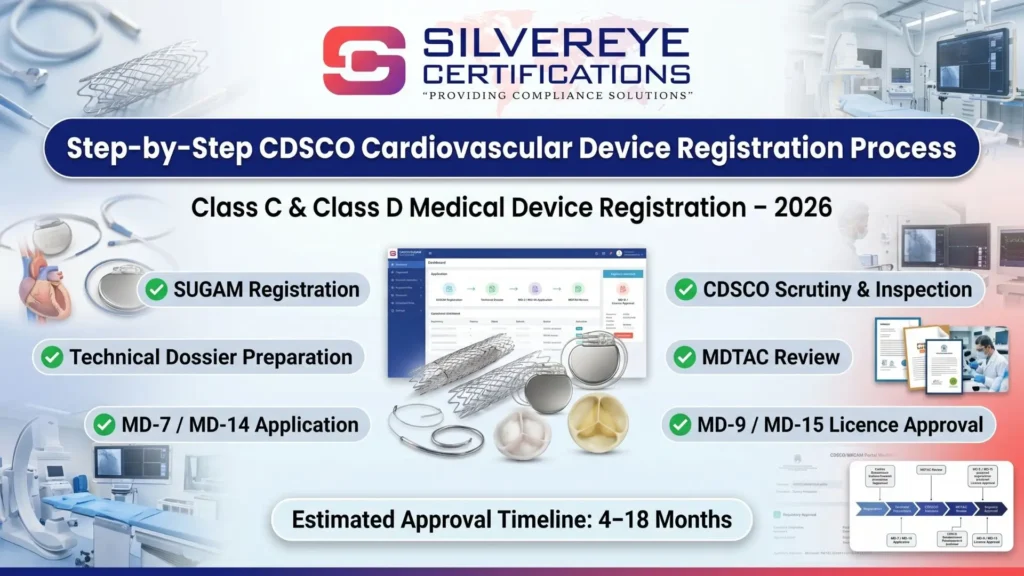
Step-by-Step CDSCO Pacemaker Registration Process
| Step | Action | Who Does It | Timeframe |
| 1 | Foreign manufacturer appoints AIR via formal appointment letter (notarised + apostilled) | Manufacturer | Before submission |
| 2 | Prepare complete technical dossier per MDR 2017 and CDSCO guidance | Manufacturer + AIR / Regulatory Consultant | 6–10 weeks |
| 3 | AIR creates account on SUGAM Portal and registers as an applicant | AIR | 2–3 days |
| 4 | Submit online Form MD-14 application with dossier upload via SUGAM | AIR | 1–3 days |
| 5 | Pay prescribed CDSCO application fee online through SUGAM portal | AIR | Same day |
| 6 | CDSCO screening review — checks completeness of documents | CDSCO | 15–30 days |
| 7 | Deficiency query issued (if documents are incomplete) — AIR must respond within 30 days | AIR | Up to 30 days per round |
| 8 | Technical review by Medical Device Technical Advisory Committee (MDTAC) | CDSCO/MDTAC | 1–3 months |
| 9 | Site inspection / GMP audit (for Indian manufacturers or if specifically requested) | CDSCO | Scheduled separately |
| 10 | CDSCO issues Import Licence in Form MD-15 (or Manufacturing Licence MD-9) | CDSCO | Final step |
Government Fee Structure for CDSCO Pacemaker and CRT Device Registration India
Government fees for CRT device CDSCO registration and all pacemaker types are prescribed under the First Schedule of Medical Devices Rules 2017, payable through the SUGAM portal at the time of application filing.
| Application Type | Device Class | Govt. Fee (INR) | Form |
| Import Registration – New | Class C | Rs. 50,000 per device | Form MD-14 |
| Import Registration – New | Class D | Rs. 50,000 per device | Form MD-14 |
| Manufacturing License – New | Class C | Rs. 50,000 per site | Form MD-7 |
| Manufacturing License – New | Class D | Rs. 50,000 per site | Form MD-7 |
| Import Registration – Renewal | Class C/D | Rs. 25,000 per device | Form MD-14 |
| Manufacturing License – Renewal | Class C/D | Rs. 25,000 per site | Form MD-7 |
| Amendment to Existing License | Class C/D | Rs. 25,000 | Amendment Form |
| Duplicate Registration | All | Rs. 1,000 | Application to CLA |
Note: The above are government fees only. Total costs for CRT device registration in India will also include IEC 60601-2-31 and IEC 60601-2-4 testing fees (Rs. 5 – 20 Lakhs depending on scope), ISO 10993 biocompatibility testing, regulatory consultancy charges, apostille / notarization costs for foreign documents, and translation expenses. CRT-D registration costs are typically higher due to dual test standard requirements.
Validity and Renewal of CDSCO Pacemaker Registration in India
Import Registration (Form MD-14)
A CDSCO import registration certificate for a CRT device, CRT-D, biventricular pacemaker, or any other pacemaker type is valid for 3 years from the date of grant under MDR 2017. The registration is device-specific and manufacturer-specific — it cannot be transferred to another importer or applied to a different model without filing an amendment.
Manufacturing License (Form MD-9 via Form MD-7)
A manufacturing license for Class C or Class D pacemakers issued by CDSCO in Form MD-9 is also valid for 3 years. The renewal application must be submitted at least 30 days before expiry. If filed before expiry, the license remains valid during the processing period, provided no adverse compliance finding exists.
| License Type | Validity | Renewal Deadline | Renewal Fee | Form |
| Import Registration (Class C) | 3 Years | 30 days before expiry | Rs. 25,000 | Form MD-14 |
| Import Registration (Class D) | 3 Years | 30 days before expiry | Rs. 25,000 | Form MD-14 |
| Manufacturing License (Class C/D) | 3 Years | 30 days before expiry | Rs. 25,000 | Form MD-7 |
| Amendment (any class) | Co-terminus with base license | With base renewal | Rs. 25,000 | Amendment to base form |
| Renewal Warning Importing or selling CRT devices, CRT-D systems, or biventricular pacemakers in India with an expired CDSCO registration — even by a single day — is a serious MDR 2017 violation. CDSCO's enforcement at ports of import checks device registration validity in real time. Set renewal reminders at least 90 days before expiry to allow adequate time for document preparation and SUGAM portal filing. |
Biventricular Pacemaker India – Market, Demand & Regulatory Landscape
Biventricular pacemakers — the implantable hardware at the heart of CRT therapy — represent one of the fastest-growing yet most underserved segments of India's cardiac device market. Despite global establishment since the early 2000s, biventricular pacemaker penetration in India remains far below global rates, primarily due to high device cost, import dependence, and limited diagnosis of eligible heart failure patients.
| Market Indicator | Estimated Status (India, 2026) |
| Annual CRT Device Implants | Approx. 8,000 – 12,000 per year (growing ~15% annually) |
| CRT-D vs CRT-P Split | Approx. 40% CRT-D, 60% CRT-P (cost sensitivity drives CRT-P preference) |
| Domestic Manufacturing | Limited — virtually all biventricular pacemakers in India are currently imported |
| Major Import Sources | USA, Germany, Ireland, Netherlands |
| CRT-P Price Range (Imported) | Rs. 3 – 7 Lakh per device |
| CRT-D Price Range (Imported) | Rs. 6 – 15 Lakh per device |
| NPPA / DPCO Price Control | CDSCO & NPPA monitor cardiac implant pricing under DPCO notifications |
| Government Tailwinds | Make in India, PLI for Medical Devices, National Medical Devices Policy 2023, import substitution policy |
Any company planning to enter the biventricular pacemaker India market — whether through import or domestic manufacturing — must complete CRT device registration in India with CDSCO as the mandatory first step. The regulatory pathway is clear, and with the government's Make in India push and PLI scheme incentives, the opportunity for domestic CRT device manufacturing is significant in 2026.
Conclusion: Navigate CDSCO Pacemaker and CRT Device Approvals the Right Way
Understanding the types of pacemakers approved in India by CDSCO is not just an academic exercise — it carries direct commercial, clinical, and legal implications for every stakeholder in India's cardiac device supply chain. From single chamber pacemakers regulated as Class C devices to CRT-D systems carrying the highest Class D designation, each device type has a specific CDSCO approval pathway that must be followed correctly and completely.
CRT device registration in India is one of the most documentation-intensive approval processes CDSCO manages. Entering this space — whether as a CRT importer, biventricular pacemaker distributor, or cardiac device manufacturer — requires investing in proper regulatory preparation from the very start. Getting the documentation right the first time saves enormous time, cost, and reputational risk downstream.
The Indian cardiac device market in 2026 is at a genuine inflection point. Growing heart failure burden, improving diagnosis rates, expanding cardiac care infrastructure across Tier 2 and Tier 3 cities, and government policies supporting domestic production all point to strong sustained demand for CRT devices and all CDSCO-approved pacemaker types in India. The regulatory pathway is clearly defined — the opportunity is very real.
Frequently Asked Questions
What types of pacemakers are approved by CDSCO in India?
CDSCO approves all major cardiac pacemaker types in India under MDR 2017 — including single chamber pacemakers (Class C), dual chamber pacemakers (Class C), rate-responsive pacemakers (Class C), CRT-P biventricular pacemakers (Class D), CRT-D devices (Class D), ICDs (Class D), subcutaneous ICDs (Class D), and leadless pacemakers (Class D). External or temporary pacemakers fall under State Licensing Authorities as Class A/B devices.
What is the difference between CRT-P and CRT-D for CDSCO registration in India?
CRT-P (Cardiac Resynchronization Therapy – Pacemaker) provides biventricular pacing only and is used to improve cardiac synchrony in heart failure patients. CRT-D (Cardiac Resynchronization Therapy – Defibrillator) combines biventricular pacing with a high-voltage defibrillation capability for patients with an additional risk of sudden cardiac death.
How long does CRT device registration in India take with CDSCO?
CRT device registration in India typically takes 9 to 18 months from a complete application submission on the SUGAM portal for Class D devices. This assumes no major documentation deficiencies. If CDSCO raises a deficiency notice, the review clock pauses until the applicant responds adequately.
Which form is used for CRT device registration in India — Form MD-7 or Form MD-14?
The applicable form depends on whether you are importing or manufacturing the CRT device in India. If importing a CRT-P or CRT-D made outside India, the form is Form MD-14 (Import Registration). If manufacturing the CRT device domestically, the form is Form MD-7 (Manufacturing License Application), which is submitted to the Central Licensing Authority (CDSCO/DCGI).
Is CDSCO approval required for biventricular pacemakers implanted in Indian hospitals?
Yes, absolutely. Any biventricular pacemaker (CRT device) implanted in a patient in India must carry a valid CDSCO import registration certificate or manufacturing license. Hospitals are required under MDR 2017 to procure cardiac implants only from CDSCO-registered importers or licensed domestic manufacturers.
What is the government fee for CRT device CDSCO registration in India?
The government fee for CRT device CDSCO import registration (Form MD-14) for a Class D device is Rs. 50,000 per device model as prescribed under the First Schedule of Medical Devices Rules 2017. Renewal is Rs. 25,000. For manufacturing licenses (Form MD-7), the new license fee is Rs. 50,000 per site and renewal is Rs. 25,000
Is a Free Sale Certificate mandatory for CRT device registration in India?
Yes. For import registration of CRT devices (Class D) in India, CDSCO requires a Free Sale Certificate or Certificate to Foreign Government issued by the regulatory authority of the country of manufacture.
Can the same CDSCO registration cover multiple CRT device models?
No. Under MDR 2017, CDSCO issues device registration on a per-model basis. Each distinct CRT-P or CRT-D device model — even from the same manufacturer — requires its own separate registration application with a device-specific Device Master File, test reports, and clinical evaluation report.
Does CDSCO accept CE or US FDA approval for faster CRT device registration in India?
CDSCO takes CE marking (EU MDR 2017) and US FDA PMA or 510(k) clearance into account as reference approvals during technical review of Class D cardiac devices. These approvals strengthen the dossier and can support more efficient technical evaluation.
What happens if a CRT device is imported into India without CDSCO registration?
Importing CRT devices, CRT-D systems, or any other pacemaker type into India without a valid CDSCO registration is a serious violation of the Drugs and Cosmetics Act, 1940 and MDR 2017. Consequences include seizure and confiscation of devices at the port of import, heavy financial penalties on the importer, cancellation of existing medical device licenses, and criminal prosecution of responsible persons including directors.
Are leadless pacemakers and subcutaneous ICDs approved by CDSCO in India?
Yes, both leadless pacemakers and subcutaneous ICDs (S-ICDs) are recognized device categories under MDR 2017 and can be registered with CDSCO as Class D devices via Form MD-14 for import. As of 2026, there is no domestic Indian manufacturer of either device type — all currently implanted units are imported.