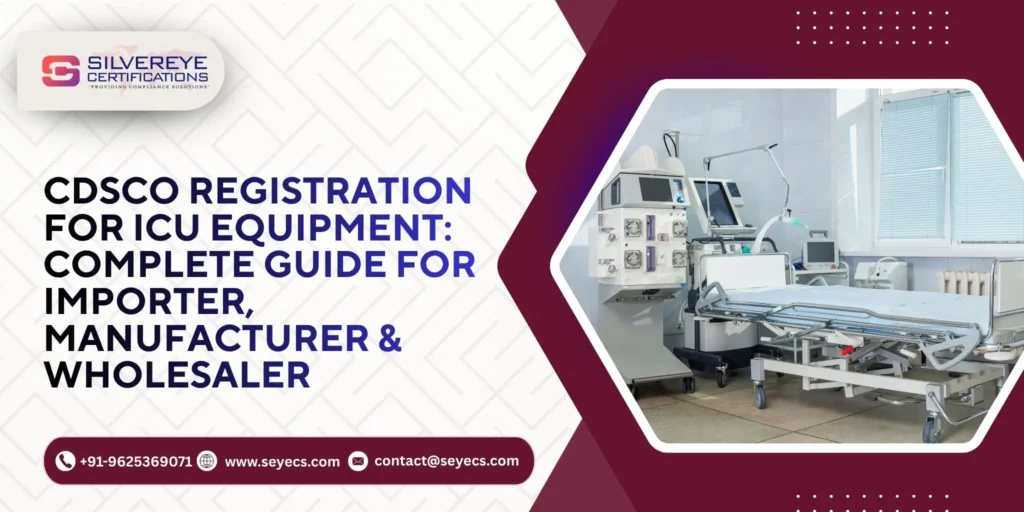
- ICU equipment spans all four classes: Basic vitals tools are Class A/B, most core critical-care equipment (ventilators, infusion pumps, dialysis machines) is Class C, and implantable life-support devices are Class D.
- The manufacturing route changes with class: Class A/B equipment uses Form MD-3 (granted as MD-5) via the State Licensing Authority; Class C/D equipment uses Form MD-7 (granted as MD-9) via CDSCO's Central Licensing Authority.
- Importers always use MD-14/MD-15: Regardless of class, an authorized Indian agent files Form MD-14 and receives the import licence on Form MD-15 from CDSCO.
- Wholesalers always use MD-41/MD-42: Any business stocking, supplying, or distributing ICU equipment needs the registration certificate granted on Form MD-42, applied for via Form MD-41.
Introduction
CDSCO registration for ICU equipment is mandatory under the Medical Devices Rules, 2017, and the process depends entirely on the specific device's risk class. ICU equipment spans all four CDSCO classes — from basic vitals-monitoring tools (Class A) to critical-care devices like ventilators, infusion pumps, and dialysis machines (Class C) to implantable life-support devices like intra-aortic balloon pumps and ventricular assist devices (Class D).
Class A/B manufacturers apply on Form MD-3 and receive the license on Form MD-5 from the State Licensing Authority. Class C/D manufacturers apply on Form MD-7 and receive the license on Form MD-9 directly from CDSCO's Central Licensing Authority — the route that applies to most core ICU equipment. Importers use Form MD-14 (granted as MD-15), and wholesalers/distributors use Form MD-41 (granted as MD-42), regardless of class.
What Is CDSCO Registration for ICU Equipment?
CDSCO registration for ICU equipment is the regulatory approval issued by the Central Drugs Standard Control Organization (CDSCO), under India's Ministry of Health and Family Welfare, that authorizes a business to manufacture, import, or distribute devices used in intensive care settings. This spans a wide range of equipment — from vitals-monitoring tools and infusion pumps to ventilators, dialysis machines, and life-support devices — all regulated under the Medical Devices Rules, 2017 (MDR 2017), notified under the Drugs and Cosmetics Act, 1940.
ICU equipment is unusually diverse from a regulatory standpoint. A basic clinical thermometer used at the bedside carries minimal risk and sits in Class A. A ventilator or dialysis machine that directly sustains a critically ill patient's breathing or kidney function sits in Class C. And a device like an intra-aortic balloon pump, which is inserted into the aorta during a life-threatening cardiac emergency, sits in Class D — CDSCO's highest-risk category. Because the regulatory pathway, documentation, and licensing authority change completely between these classes, correctly identifying your specific device's classification is the essential first step.
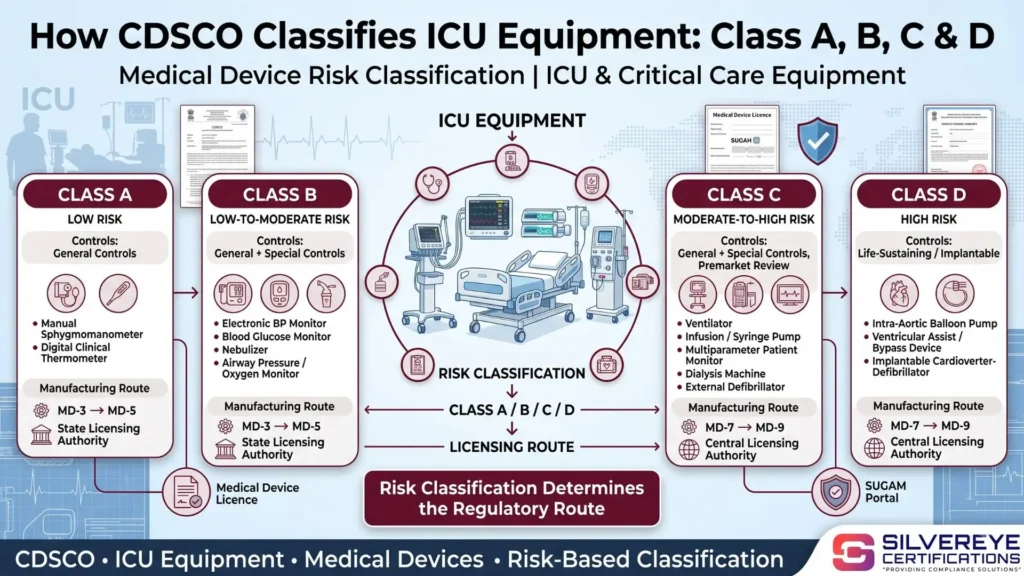
How CDSCO Classifies ICU Equipment: Class A, B, C & D
CDSCO's risk-based classification system sorts ICU-relevant devices across all four categories based on invasiveness, whether the device sustains or supports a critical life function, and the consequence of device failure. Devices used in the ICU, in surgery, or for life support are frequently classified as Class C or D.
| Class | Risk Level | ICU Equipment Examples | Manufacturing Route |
| Class A | Low risk | Manual sphygmomanometer, digital clinical thermometer | Form MD-3 → MD-5 (State Licensing Authority) |
| Class B | Low-to-moderate risk | Electronic blood pressure monitor, blood glucose monitoring device, nebulizer, airway pressure/oxygen monitor | Form MD-3 → MD-5 (State Licensing Authority) |
| Class C | Moderate-to-high risk | Ventilator, infusion/syringe pump, multiparameter patient monitor, dialysis machine, external defibrillator | Form MD-7 → MD-9 (Central Licensing Authority) |
| Class D | High risk — life-sustaining/implantable | Intra-aortic balloon pump and control system, ventricular assist (bypass) device, implantable cardioverter-defibrillator | Form MD-7 → MD-9 (Central Licensing Authority) |
Who Needs CDSCO Registration for ICU Equipment?
CDSCO registration applies separately to each role in the ICU equipment supply chain, and the manufacturing form depends on class:
| Entity | Class A/B Route | Class C/D Route | Issuing Authority |
| Manufacturer | Form MD-3 → MD-5 | Form MD-7 → MD-9 | State Licensing Authority (A/B); CDSCO Central Licensing Authority (C/D) |
| Importer | Form MD-14 → MD-15 | Form MD-14 → MD-15 | CDSCO – Central Licensing Authority (all classes) |
| Wholesaler / Distributor | Form MD-41 → MD-42 | Form MD-41 → MD-42 | State Licensing Authority (all classes) |
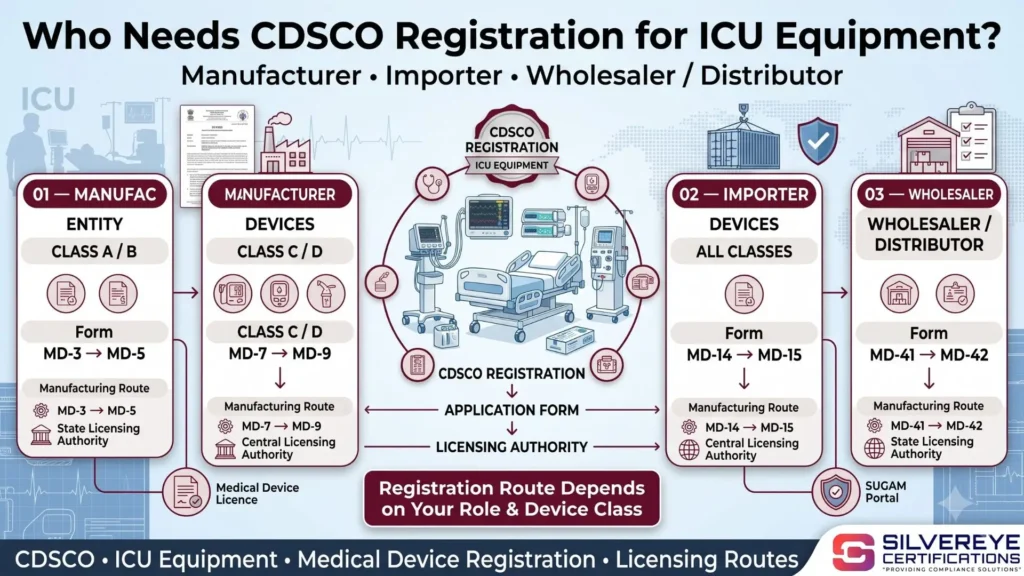
If your business plays more than one role — for example, manufacturing infusion pumps and also importing ventilators from an overseas partner — you will need separate licences matched to each activity and each product's class.
CDSCO Manufacturing License: MD-3/MD-5 (Class A/B) vs. MD-7/MD-9 (Class C/D)
Class A/B ICU-Adjacent Equipment — Form MD-3 & MD-5
- Applicant must be a registered business entity with a defined manufacturing premise in India.
- Quality Management System aligned with ISO 13485:2016, proportionate to the specific device.
- Application filed on Form MD-3 via the CDSCO SUGAM portal, with a Site Master File and Device Master File.
- Reviewed and granted by the State Licensing Authority (SLA) on Form MD-5.
- Typical processing time: approximately 3–6 months.
Class C/D Core ICU Equipment — Form MD-7 & MD-9
- Applicant must meet the same business-entity and premise requirements, with a substantially more rigorous Quality Management System given the life-supporting or life-sustaining nature of the equipment.
- Application filed on Form MD-7 via the SUGAM portal, with a comprehensive Device Master File, electrical safety testing (for active/powered devices), performance testing, and — for Class D — clinical evaluation data.
- Reviewed and granted directly by CDSCO's Central Licensing Authority on Form MD-9.
- A facility inspection by CDSCO's Medical Device Officers is typically scheduled within 60 days of a complete application.
- Typical processing time: approximately 6–9 months for Class C; Class D devices, given clinical evaluation requirements, can take longer.
Documents Required for ICU Equipment Registration
Common Documents (All Classes)
- Covering letter and duly filled application form (MD-3 for Class A/B, MD-7 for Class C/D).
- Proof of constitution of the firm (incorporation certificate, partnership deed, GST registration).
- Site Master File describing the manufacturing premises and layout.
- Device Master File covering technical specifications, intended use, and labelling.
- Details of manufacturing plant, machinery, and quality-control equipment.
- Undertaking of compliance with Essential Principles of safety and performance under MDR 2017.
Additional Documents for Class C/D (Critical Care / Life-Support Equipment)
- Electrical safety testing data (per IEC 60601 series) for powered ICU devices such as ventilators, monitors, and infusion pumps.
- Performance testing data demonstrating the device functions accurately and reliably under intended critical-care conditions.
- Biocompatibility data (per ISO 10993) for devices with patient blood or tissue contact, such as dialysis circuits or balloon pump catheters.
- Risk management documentation aligned with ISO 14971 principles.
- Clinical evaluation data or literature-based clinical evidence, particularly for Class D life-sustaining devices.
CDSCO Import License for ICU Equipment (MD-14 & MD-15)
Foreign manufacturers cannot sell ICU equipment directly in India, regardless of class. They must appoint an Authorized Indian Agent who holds a valid wholesale license (Form MD-42) or manufacturing licence, and who files the import application on Form MD-14. CDSCO's Central Licensing Authority reviews the application — with depth proportionate to the equipment's class — and grants the import licence on Form MD-15.
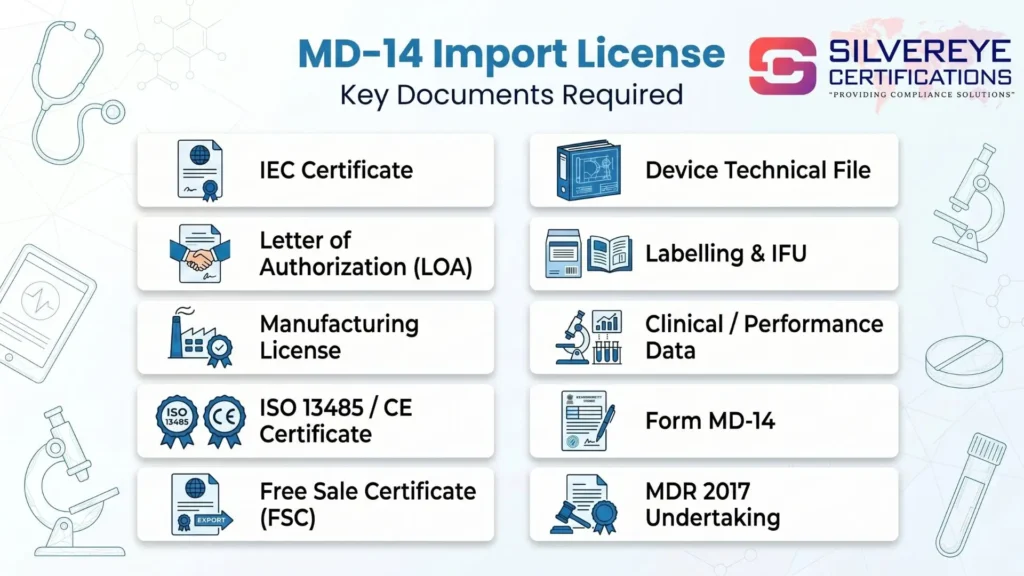
Documents Required for MD-14 Application
- Covering letter and duly filled Form MD-14.
- Government fee payment challan.
- Notarized and apostilled Power of Attorney from the foreign manufacturer authorizing the Indian agent.
- Copy of the agent's Wholesale License (MD-42) or Manufacturing License.
- Free Sale Certificate or Marketing Authorization from the regulatory authority of the country of origin.
- Device Master File and Plant Master File of the foreign manufacturing site, including electrical safety and performance data appropriate to the equipment's class.
- ISO 13485 certificate and any applicable CE marking or equivalent international approval.
CDSCO Wholesale / Distributor License for ICU Equipment (MD-41 & MD-42)
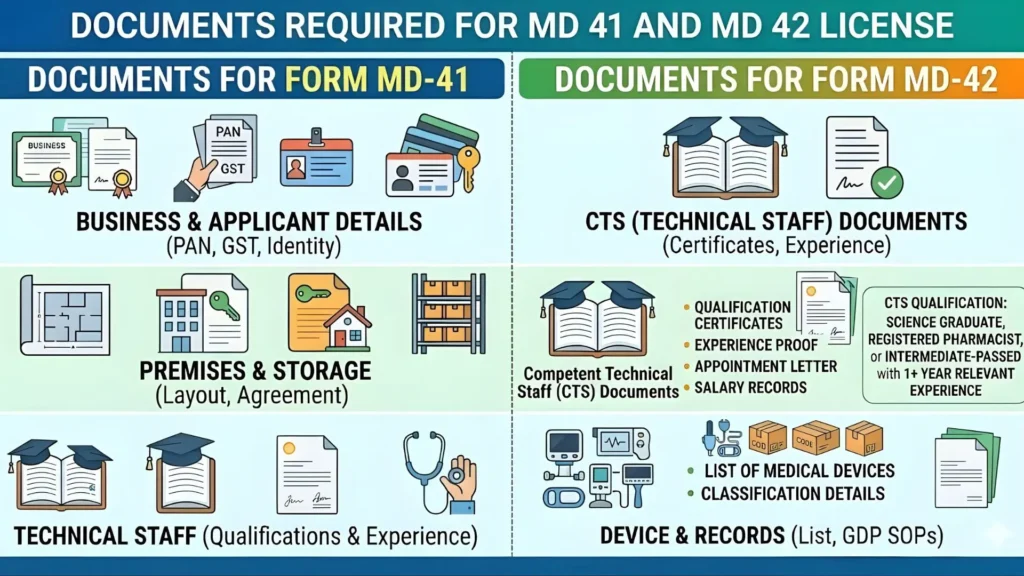
Any business that stocks, exhibits, sells, or distributes ICU equipment in bulk — including hospital equipment distributors, biomedical equipment suppliers, and critical-care device stockists — needs a wholesale registration, regardless of the equipment's class. The application is made on Form MD-41, and the State Licensing Authority grants the registration certificate on Form MD-42.
Eligibility and Documents for MD-41/MD-42
- A dedicated storage premise of adequate size with proper shelving, cleanliness, and record-keeping arrangements, including appropriate handling for sensitive electronic equipment.
- A technically competent person overseeing storage and distribution, ideally with biomedical or clinical engineering familiarity for complex ICU equipment.
- Duly filled Form MD-41, business constitution proof, premises address proof and layout plan, technical competence proof, and the fee payment receipt.
- A Drug Inspector conducts a physical inspection of the storage premises before the State Licensing Authority issues the registration certificate on Form MD-42.
Fees for ICU Equipment Registration
Government fees differ by license type and risk class, prescribed under the First Schedule of MDR 2017. Class C/D fees are meaningfully higher than Class A/B, reflecting the deeper technical review involved. Fees are revised from time to time, so always verify the current amount on the SUGAM portal before submitting payment.
| Licence Type | Applicable Fee | Notes |
| Class A/B Manufacturing (MD-3/MD-5) | As per MDR 2017 Schedule I | Lower than Class C/D; confirm current amount on SUGAM |
| Class C/D Manufacturing (MD-7/MD-9) | As per MDR 2017 Schedule I | Higher fee reflecting Central Licensing Authority review; applies to most core ICU equipment |
| Import Licence (MD-14/MD-15) | As per MDR 2017 Schedule I | Applies per manufacturing site and per product/product group |
| Wholesale Licence (MD-41/MD-42) | ₹3,000 per premise (government fee) | Non-refundable; same across all device classes |
Processing Timeline & Validity
| Licence Type | Typical Processing Time | Validity | Renewal |
| MD-5 (Class A/B) | Approx. 3–6 months | 5 years from date of issue | Apply before expiry with retention/renewal fee |
| MD-9 (Class C) | Approx. 6–9 months, including facility inspection | 5 years from date of issue | Apply before expiry with retention/renewal fee |
| MD-9 (Class D) | Can extend beyond 9 months given clinical evaluation requirements | 5 years from date of issue | Apply before expiry with retention/renewal fee |
| MD-15 (Import, any class) | Approx. 3–9+ months depending on class | Generally continues indefinitely subject to a 5-year retention fee cycle | Pay retention fee every 5 years |
| MD-42 (Wholesale) | Approx. 30–60 days | 5 years from date of issue | Renew before expiry |
As a best practice, begin renewal filing at least 90 days before expiry for Class C/D ICU equipment licences, since Central Licensing Authority review depth for life-supporting devices can extend the timeline if performance or clinical data needs updating.
Benefits of CDSCO Registration for ICU Equipment
- Legal market access: A valid CDSCO authorization, matched to the correct class, is what allows ICU equipment to be manufactured, imported, or sold in India.
- Hospital and critical-care procurement eligibility: Government hospitals, private hospital ICUs, and procurement tenders require CDSCO documentation before empanelling an ICU equipment supplier.
- Protection from penalties: Registered businesses avoid the seizure, fines, and legal action that come with selling unregistered medical devices.
- Export credibility: A CDSCO license strengthens your regulatory profile when ICU equipment is later exported to markets that recognize Indian approvals.
Common Mistakes to Avoid
- Assuming ICU equipment automatically qualifies for the lighter Class A/B pathway — most core critical-care devices (ventilators, infusion pumps, dialysis machines) are Class C or D.
- Applying under the wrong form — filing MD-3 for a Class C/D device (which needs MD-7), or MD-7 for a Class A/B device (which only needs MD-3).
- Submitting an incomplete Device Master File without electrical safety, performance, or (for Class D) clinical evaluation data.
- Underestimating the Class D review timeline, which can extend well beyond the typical Class C window given clinical data requirements.
- Assuming a single licence covers manufacturing, import, and wholesale activity — each role needs its own authorisation.
- Delaying renewal filing until close to expiry, especially for Class C/D licences where review depth can extend the timeline.
Conclusion
ICU equipment spans CDSCO's entire risk spectrum, which makes classification the make-or-break first step in this registration process. A clinical thermometer and a ventilator are both used at the ICU bedside in the everyday sense, but they follow completely different licensing routes — one through the lightweight MD-3/MD-5 state pathway, the other through the far more rigorous MD-7/MD-9 Central Licensing Authority route. Getting that classification right, and building complete electrical safety, performance, and (where needed) clinical documentation from the outset, is what determines how smoothly your registration proceeds.
The team at Silvereye Certifications specialises in end-to-end CDSCO medical device registration support — from device classification and technical dossier preparation to SUGAM portal submissions and post-approval compliance management for ICU equipment manufacturers, importers, and distributors across India.
Frequently Asked Questions
Is CDSCO registration mandatory for all ICU equipment?
Yes. Every notified device used in ICU settings — whether a basic vitals-monitoring tool (Class A/B) or critical-care/life-support equipment (Class C/D) — requires the applicable CDSCO licence or registration before manufacture, import, or distribution in India.
What class do most core ICU devices fall under?
Most core critical-care equipment — ventilators, infusion and syringe pumps, multiparameter patient monitors, and dialysis machines — is classified as Class C. Implantable or directly life-sustaining devices, such as intra-aortic balloon pumps and ventricular assist devices, are Class D.
What is the difference between the MD-3/MD-5 and MD-7/MD-9 manufacturing routes?
MD-3/MD-5 is the manufacturing licence route for Class A/B ICU-adjacent equipment, reviewed and granted by the State Licensing Authority. MD-7/MD-9 is the route for Class C/D critical-care and life-support equipment, reviewed and granted directly by CDSCO's Central Licensing Authority.
Is a ventilator Class C or Class D under CDSCO?
Ventilators used in critical-care and neonatal/paediatric intensive-care settings are generally classified as Class C. Devices that are permanently implanted or directly sustain circulation, such as ventricular assist devices, are Class D.
Is a dialysis machine Class C or Class D?
Class C. CDSCO's classification notices confirm dialysis machines — used for acute or chronic kidney failure to filter blood — as Class C.
Do importers use different forms depending on the equipment's class?
No. Importers use Form MD-14 (application) and receive Form MD-15 (licence) from CDSCO's Central Licensing Authority regardless of class, though the depth of technical review scales with the equipment's risk.
How long does CDSCO registration take for ICU equipment?
Class A/B manufacturing licences (MD-5) typically take 3–6 months. Class C manufacturing licenses (MD-9) typically take 6–9 months. Class D licenses can take longer given clinical evaluation requirements. Wholesale registrations (MD-42) typically take 30–60 days.
What is the validity of a CDSCO ICU equipment license?
MD-5, MD-9, and MD-42 are generally valid for 5 years from the date of issue. MD-15 import licenses generally continue indefinitely, subject to a 5-year retention fee cycle.
What documents are required for Class C/D ICU equipment applications?
Beyond the standard Device Master File, Class C/D applications typically require electrical safety testing data (per IEC 60601), performance testing data, biocompatibility data where relevant, risk management documentation, and — for Class D — clinical evaluation data or literature-based clinical evidence.
Can one business hold manufacturing, import, and wholesale licenses for ICU equipment?
Yes, if the business genuinely performs all three activities. Each activity still requires its own separate CDSCO authorisation, matched to the equipment's class — holding one licence does not automatically cover the others.
What happens if I sell ICU equipment without CDSCO registration?
You risk stock seizure, financial penalties, cancellation of any existing licenses, and prosecution under the Drugs and Cosmetics Act, 1940, which can include imprisonment in serious cases.
How do I renew a CDSCO ICU equipment license?
Renewal applications should be filed at least 60 days before expiry for Class A/B licenses, and at least 90 days before expiry for Class C/D licenses, using the previous license details, updated technical/clinical documentation, and the prescribed renewal or retention fee, submitted through the SUGAM portal to the relevant State or Central Licensing Authority.