- CDSCO Registration For Class D Medical Devices classified under 83 devices — India's highest-risk category covering implantable, life-sustaining, and infection-controlling devices.
- Class D demands clinical investigation data, mandatory Notified Body assessment, and CDSCO's most stringent pre-market scrutiny.
- Covers 14 speciality categories — neurology, radiotherapy, oncology, cardiovascular, paediatrics and more.
- 2026: All Class D license applications processed via CDSCO Sugam portal — fully digital, with mandatory post-market vigilance obligation.
What is CDSCO Registration For Class D Medical Devices?
Class D medical devices are India's highest-risk, most strictly regulated medical device category under the Medical Devices Rules (MDR) 2017. If your product is classified as Class D, it is either implantable in the human body, life-sustaining, or directly involved in infection control — and a failure or defect in such a device can cause serious harm or death.
The Central Drugs Standard Control Organization (CDSCO), India's apex medical device regulator under the Ministry of Health and Family Welfare, applies its most rigorous pre-market licensing framework to Class D devices. Unlike lower-risk classes, Class D licensing under Chapter IV of MDR 2017 mandates clinical investigation data, mandatory Notified Body assessment, comprehensive technical documentation, and GMP inspection — before a single device can be legally sold in India.
This is not a process to approach casually. Class D devices include deep brain stimulators, implantable pacemakers, replacement heart valves, brachytherapy systems, neurovascular stents, and other devices where patient safety is directly and immediately at stake. CDSCO's Class D framework is designed to ensure that every such device reaching Indian patients has been rigorously validated for safety and performance.
| Official Source: All 83 Class D devices in this guide are sourced directly from Annexure II of CDSCO's official Medical Device Classification document. Every device name and category is taken verbatim from the official CDSCO source. No third-party interpretation. This guide is maintained for accuracy and regulatory freshness as of 2026. |
India's Medical Device Risk Classification — Class D at the Top
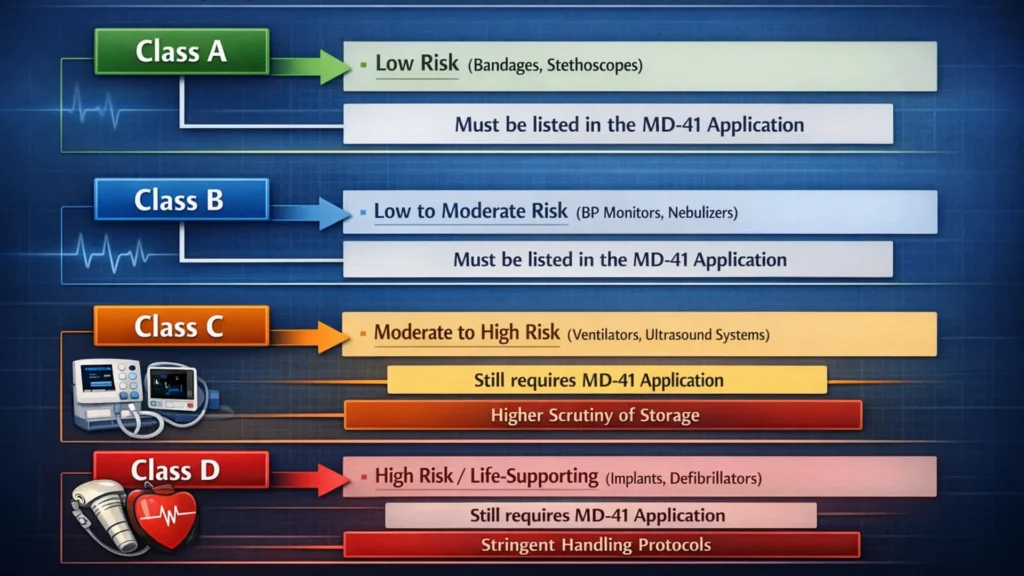
MDR 2017 classifies all medical devices into four risk-based tiers. Class D occupies the highest tier — with correspondingly strict regulatory obligations:
| Device Class | Risk Level & Regulatory Requirement |
| Class A (Non-Sterile, Non-Measuring) | Lowest risk. Registration only under Chapter IIIB. No manufacturing license needed. |
| Class A (Sterile/Measuring) & Class B | Low to moderate risk. Full license under Chapter IV. GMP and ISO 13485 required. |
| Class C | Moderate-to-high risk. Full license + clinical performance evaluation + often Notified Body involvement. |
| Class D ← Highest Risk | Life-sustaining, implantable, or infection-controlling devices. Clinical investigation, Notified Body certification, CDSCO's most rigorous pre-market review. No compromise on safety evidence. |
Why Class D is different from everything else: Class D devices are in a category where failure is not just a quality issue — it is a patient safety emergency. An implantable pacemaker that malfunctions, a neurovascular stent that fractures, or a brachytherapy system that miscalibrates can cause immediate, irreversible harm. That is why CDSCO demands the highest standard of clinical evidence, manufacturing control, and post-market vigilance for this class.
Who Needs a CDSCO Class D Medical Device License?
A CDSCO Class D license is legally mandatory for every entity that makes Class D devices available in the Indian market:
- Indian manufacturers producing Class D devices for sale anywhere in India — regardless of company size, turnover, or business stage
- Importers bringing Class D devices from foreign countries into India — the Indian Authorized Agent (IAA) holds the import license on behalf of the foreign manufacturer
- Foreign manufacturers selling Class D devices in India through a registered IAA — the IAA is the legal responsible party in India
- Contract manufacturers producing Class D devices on behalf of brand owners — the license must cover the actual manufacturing site and device scope
- Relabellers or repackagers of imported Class D devices — treated as importers and must hold a valid import license
- Companies whose devices have been upgraded to Class D following CDSCO notification revisions or reclassification decisions
| Absolute Prohibition Without License: There are no grace periods, informal exemptions, or transitional provisions for Class D devices. Selling, distributing, importing, or manufacturing a Class D device in India without a valid CDSCO license is a serious criminal offence under MDR 2017. Penalties include immediate product seizure, fines, factory closure orders, and imprisonment for repeat or willful violations. CDSCO and state drug controllers actively enforce Class D compliance. |
Eligibility Criteria for CDSCO Class D Device License
Class D eligibility requirements are the most demanding in India's medical device regulatory framework. Every criterion below must be met before a license application is filed:
| Eligibility Criterion | Requirement for Class D |
| Device Classification Confirmation | Device must appear in the official CDSCO Class D list (Annexure II). Using an incorrect classification leads to rejection and significant delay. |
| Legal Entity Registration in India | Applicant must be a registered Indian legal entity — private limited company, LLP, or proprietorship with valid GSTIN and PAN. |
| GMP Compliance — Schedule M | Manufacturing premises must fully comply with Schedule M of MDR 2017. For Class D, GMP standards are enforced at the highest level — cleanroom requirements, validated processes, documented quality controls. |
| ISO 13485 Certification — Mandatory | ISO 13485 certification is mandatory for Class D. Certificate must be issued by a NABCB-accredited (India) or ILAC-MRA recognized (global) certification body and must cover the Class D device scope. |
| Clinical Investigation Data | For most Class D devices, prospective clinical investigation data is required — not just a literature review. Clinical investigation must be conducted as per MDR 2017 Chapter VI and Schedule II-A requirements. |
| Notified Body Assessment — Mandatory | Class D devices require a formal Notified Body assessment. The Notified Body must be recognized by CDSCO or a competent authority equivalent (e.g., EU Notified Body under MDR 2017/745). |
| Full Technical Documentation | Complete technical file including design dossier, design validation reports, software documentation (IEC 62304 if applicable), risk management file (ISO 14971), biocompatibility reports (ISO 10993 for implantable devices), labelling. |
| Performance & Safety Test Reports | Test reports from NABL-accredited labs (India) or ILAC-MRA recognized labs (global) confirming conformity with all applicable IS/IEC/ISO safety and performance standards. |
| For Implantable Devices: Biocompatibility Testing | Complete ISO 10993 biocompatibility testing mandatory for all implantable Class D devices — cytotoxicity, sensitization, implantation, genotoxicity, and systemic toxicity at minimum. |
| For Importers: Stringent Home Country Approval | CE Certificate (Class III under EU MDR 2017/745) or equivalent highest-tier approval from USFDA (PMA), TGA, PMDA, or CDSCO-recognized authority. Apostilled FSC required. |
| Post-Market Clinical Follow-Up Plan | Mandatory post-market clinical follow-up (PMCF) plan demonstrating ongoing clinical evidence collection after market introduction. |
| Technically Qualified Personnel | Senior technical and clinical personnel with relevant qualifications as per MDR 2017 requirements. For implantable devices, clinical expertise in the relevant specialty is expected. |
Complete List of CDSCO Class D Medical Devices — All 83 Devices
The table below contains the complete official CDSCO Class D medical device list sourced directly from Annexure II of CDSCO's classification document. All 83 Class D devices across 14 medical speciality categories are listed here. This is your definitive reference for confirming whether your device falls under India's most stringent regulatory pathway.
| S.No. | Medical Device Name | Medical Speciality | CDSCO Class |
| 1 | Electronic epidural space locator control unit | Anesthesiology | Class D |
| 2 | Epidural anaesthesia kit | Anesthesiology | Class D |
| 3 | Spinal needle bioimpedance navigation unit | Anesthesiology | Class D |
| 4 | Implantable intrathecal infusion pump | Pain Management | Class D |
| 5 | Implantable lumbar neuromuscular electrical stimulation system | Pain Management | Class D |
| 6 | Ventricular bypass (assist) device. | Cardiovascular | Class D |
| 7 | Implantable pacemaker pulse generator. | Cardiovascular | Class D |
| 8 | Pacemaker programmers. | Cardiovascular | Class D |
| 9 | Pacemaker repair or replacement material. | Cardiovascular | Class D |
| 10 | Carotid sinus nerve stimulator | Cardiovascular | Class D |
| 11 | Replacement heart valve. | Cardiovascular | Class D |
| 12 | Cardiopulmonary bypass pulsatile flow generator. | Cardiovascular | Class D |
| 13 | Tympanic membrane contact hearing aid | ENT (Ear, Nose & Throat) | Class D |
| 14 | Fistula-repair biomatrix implant | Gastroenterology | Class D |
| 15 | Gastrointestinal anastomosis coupler, bioabsorbable | Gastroenterology | Class D |
| 16 | Implantable sleep apnoea treatment system | Respiratory | Class D |
| 17 | Analgesic spinal cord electrical stimulation system | Neurological | Class D |
| 18 | Aneurysm clip. | Neurological | Class D |
| 19 | Antiseizure/psychiatric-therapy vagus nerve electrical stimulation system | Neurological | Class D |
| 20 | Atrial cerebrospinal fluid catheter | Neurological | Class D |
| 21 | Bare-metal intracranial vascular stent | Neurological | Class D |
| 22 | Bladder/bowel-evacuation implantable electrical stimulation system | Neurological | Class D |
| 23 | Brain-responsive electrical stimulation system | Neurological | Class D |
| 24 | Cardiac-therapy vagus nerve electrical stimulation system | Neurological | Class D |
| 25 | Cerebral perfusion catheter | Neurological | Class D |
| 26 | Coma-arousal vagus nerve electrical stimulation system | Neurological | Class D |
| 27 | Cortical electrode. | Neurological | Class D |
| 28 | Cranial electrotherapy stimulator. | Neurological | Class D |
| 29 | Cryogenic surgical device. | Neurological | Class D |
| 30 | Deep brain electrical stimulation system | Neurological | Class D |
| 31 | Diskectomy system, percutaneous, automatic | Neurological | Class D |
| 32 | Extramuscular diaphragm/phrenic nerve electrical stimulation system | Neurological | Class D |
| 33 | Gait-enhancement electrical stimulation system, implantable | Neurological | Class D |
| 34 | Human dura mater. | Neurological | Class D |
| 35 | Implantable intrathecal infusion pump, programmable | Neurological | Class D |
| 36 | Implantable lumbar neuromuscular electrical stimulation system pulse generator | Neurological | Class D |
| 37 | Implantable pulse generator mesh bag, bioabsorbable | Neurological | Class D |
| 38 | Implantable sleep apnoea treatment system | Neurological | Class D |
| 39 | Implantable sleep apnoea treatment system, respiration- sensing | Neurological | Class D |
| 40 | Implanted cerebellar stimulator. | Neurological | Class D |
| 41 | Implanted diaphragmatic/phrenic nerve stimulator. | Neurological | Class D |
| 42 | Implanted intracerebral/subcortical stimulator for pain relief. | Neurological | Class D |
| 43 | Implanted neuromuscular stimulator. | Neurological | Class D |
| 44 | Implanted spinal cord stimulator for bladder evacuation. | Neurological | Class D |
| 45 | Intracranial pressure monitor device | Neurological | Class D |
| 46 | Intramuscular diaphragm/phrenic nerve electrical stimulation system | Neurological | Class D |
| 47 | Meningeal prosthesis | Neurological | Class D |
| 48 | Nerve guide, bioabsorbable, animal-derived | Neurological | Class D |
| 49 | Nerve guide, bioabsorbable, synthetic | Neurological | Class D |
| 50 | Nerve guide, non- bioabsorbable | Neurological | Class D |
| 51 | Rheoencephalograph. | Neurological | Class D |
| 52 | Scoliosis-treatment electrical stimulation system | Neurological | Class D |
| 53 | Stereotactic radiosurgical system | Neurological | Class D |
| 54 | Tibial nerve percutaneous incontinence-control electrical stimulation system | Neurological | Class D |
| 55 | Transvenous phrenic nerve electrical stimulation control unit | Neurological | Class D |
| 56 | Fallopian tube occlusion insert | Obstetrical and Gynaecological (OG) | Class D |
| 57 | Aqueous/vitreous humour replacement medium kit | Ophthalmic | Class D |
| 58 | Transilluminator for breast evaluation | Interventional and Radiology | Class D |
| 59 | Foetal cardiac monitor | Interventional and Radiology | Class D |
| 60 | Craniofacial bone screw, bioabsorbable | Pediatrics and Neonatology | Class D |
| 61 | Polyglyconate suture | Pediatrics and Neonatology | Class D |
| 62 | Alternating electric field antimitotic cancer treatment system | Oncology | Class D |
| 63 | Brain brachytherapy system applicator, manual | Oncology | Class D |
| 64 | Brain brachytherapy system applicator, remote-afterloading | Oncology | Class D |
| 65 | Breast transilluminator | Oncology | Class D |
| 66 | Coronary artery brachytherapy system applicator, manual- afterloading | Oncology | Class D |
| 67 | Extravascular-circulation hyperthermia system | Oncology | Class D |
| 68 | Extravascular-circulation hyperthermia system applicator, intracorporeal | Oncology | Class D |
| 69 | Flexible ultrasound bronchoscope | Oncology | Class D |
| 70 | Absorbable tissue spacer for radiotherapy | Radiotherapy | Class D |
| 71 | Blood vessel manual brachytherapy applicator | Radiotherapy | Class D |
| 72 | Blood vessel remote afterloading brachytherapy applicator | Radiotherapy | Class D |
| 73 | Brain manual brachytherapy applicator | Radiotherapy | Class D |
| 74 | Brain remote afterloading brachytherapy applicator | Radiotherapy | Class D |
| 75 | Central circulatory general-purpose manual brachytherapy applicator | Radiotherapy | Class D |
| 76 | Central circulatory general-purpose remote afterloading brachytherapy applicator | Radiotherapy | Class D |
| 77 | Central circulatory manual brachytherapy therapeutic radionuclide system | Radiotherapy | Class D |
| 78 | Central circulatory permanent implant manual brachytherapy therapeutic radionuclide source | Radiotherapy | Class D |
| 79 | Central circulatory remote afterloading brachytherapy therapeutic radionuclide source | Radiotherapy | Class D |
| 80 | Central circulatory remote afterloading brachytherapy therapeutic radionuclide system | Radiotherapy | Class D |
| 81 | Central circulatory temporary placement manual brachytherapy therapeutic radionuclide source | Radiotherapy | Class D |
| 82 | Absorbable peritoneum catheter cuff | Nephrology and Renal Care | Class D |
| 83 | Collagen-containing peritoneum absorbable catheter cuff | Nephrology and Renal Care | Class D |
Class D Medical Devices by Medical Speciality Category
All 83 Class D devices span 14 medical speciality categories. Here is the complete breakdown:
| Medical Speciality Category | Number of Class D Devices |
| Neurological | 39 |
| Radiotherapy | 12 |
| Oncology | 8 |
| Cardiovascular | 7 |
| Anesthesiology | 3 |
| Pain Management | 2 |
| Gastroenterology | 2 |
| Interventional and Radiology | 2 |
| Pediatrics and Neonatology | 2 |
| Nephrology and Renal Care | 2 |
| ENT (Ear, Nose & Throat) | 1 |
| Respiratory | 1 |
| Obstetrical and Gynaecological (OG) | 1 |
| Ophthalmic | 1 |
Documents Required for CDSCO Class D Medical Device License
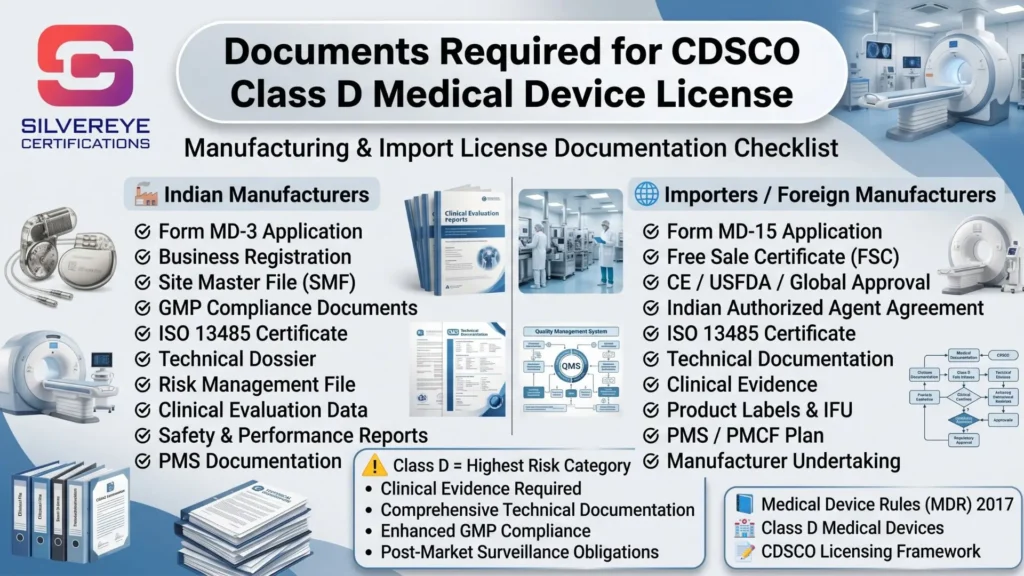
Class D requires the most comprehensive documentation package in India's entire medical device regulatory framework. Every document below must be complete, current, and from recognized sources before submission:
Documents for Indian Manufacturers — Class D Manufacturing License
| Document | Details / Requirements |
| Application Form MD-3 | Completed online manufacturing license application on the CDSCO Sugam portal (sugamya.cdsco.gov.in) — Class D designation must be clearly stated |
| Proof of Business Registration | Certificate of Incorporation / Partnership Deed / Proprietorship documents; current GST Certificate and PAN of the manufacturing entity |
| Site Master File (SMF) — Enhanced | Detailed SMF covering: manufacturing facility layout with cleanroom classifications (ISO 14644 compliance for implantable devices), equipment validation records, environmental monitoring program, utilities qualification, and full personnel structure |
| Schedule M GMP Compliance Documentation | Documented GMP compliance at the highest level — validated manufacturing processes, sterility assurance (SAL 10⁻⁶ for sterile implantables), environmental monitoring records, batch records, change control, deviation management, CAPA, and internal audit reports |
| ISO 13485 Certificate — Mandatory, Current | Valid ISO 13485 certificate from a NABCB-accredited or ILAC-MRA recognized body; must explicitly cover the Class D device type(s) in scope |
| Full Technical Documentation / Design Dossier | Complete technical file: device description and specifications, intended use statement, design history file with design inputs/outputs/reviews/verification/validation, manufacturing process description with process validation, materials specification (biocompatibility-tested), sterility validation (for sterile devices), shelf-life and packaging validation |
| Risk Management File — ISO 14971 (Full) | Complete risk management documentation per ISO 14971:2019 — hazard identification, probability and severity estimation, risk control implementation, residual risk evaluation, benefit-risk analysis, and post-production information feedback loop |
| Clinical Investigation Data | For Class D, prospective clinical investigation data is typically required. Clinical investigation must comply with MDR 2017 Chapter VI requirements, including ethics committee approval, informed consent, monitoring, and data integrity protocols |
| Clinical Evaluation Report — Full Schedule II-A | Comprehensive clinical evaluation report structured per MDR 2017 Schedule II-A — covering the clinical development plan, appraisal of clinical data, clinical evaluation of safety and performance, post-market clinical follow-up plan |
| Biocompatibility Test Reports — ISO 10993 | Full ISO 10993 series biocompatibility testing for all patient-contacting materials — cytotoxicity, sensitization, implantation, systemic toxicity, genotoxicity, pyrogenicity, hemocompatibility (for cardiovascular/blood-contacting devices) |
| Performance & Safety Test Reports | NABL-accredited lab reports confirming conformity with all applicable IS/IEC/ISO standards — IEC 60601-1 (electrical safety), IEC 60601-1-2 (EMC), applicable ISO standards for device type |
| Software Documentation (if applicable) | IEC 62304 Software Development Lifecycle documentation for software-based or software-integrated Class D devices; software V&V reports; cybersecurity assessment for networked/connected devices |
| Notified Body Assessment Report | Formal Notified Body assessment report from a CDSCO-accepted Notified Body — technical documentation assessment, clinical evaluation assessment, and QMS assessment |
| Post-Market Surveillance Plan | Comprehensive PMS plan including complaint handling procedure, adverse event reporting procedure (MvPI compliance), trend analysis, post-market clinical follow-up (PMCF) plan, and periodic safety update report (PSUR) schedule |
| Declaration of Conformity | Signed declaration by the most senior authorized signatory confirming conformity with all applicable standards, MDR 2017 requirements, and device-specific regulations |
| Implant Card / Patient Card (for implantable devices) | Implant card compliant with MDR 2017 requirements for implantable Class D devices — device identification details for the patient's medical records |
Additional Documents for Importers — Class D Import License
| Document | Details / Requirements |
| Application Form MD-15 | Completed import license application on Sugam portal; filed by the registered Indian Authorized Agent (IAA) |
| Free Sale Certificate (FSC) — Apostilled | Valid FSC from the national competent authority of the country of manufacture; apostilled as required by CDSCO; must cover the specific device models being imported |
| Highest-Tier Regulatory Approval from Country of Origin | CE Certificate under EU MDR 2017/745 (Class III equivalent) / USFDA PMA Approval / TGA Class AIMD or Class III / PMDA certification, or equivalent highest-tier approval |
| Notified Body Certificate (EU-regulated devices) | Full Notified Body certificate including certificate number, scope, expiry date; must be from a Notified Body listed under EU MDR 2017/745 |
| Clinical Evaluation Report Summary | Summary of clinical evidence for the device's safety and performance; full clinical evaluation report will typically be requested by CDSCO for Class D |
| Indian Authorized Agent (IAA) Agreement | Original signed agreement between the foreign manufacturer and the India-registered IAA; must explicitly cover all Class D devices being applied for; notarized |
| IAA CDSCO Registration Certificate | Current, valid CDSCO registration of the IAA — must not be expired at time of application or during review |
| ISO 13485 Certificate of Foreign Manufacturer | Current, valid certificate from an ILAC-recognized certification body; scope must explicitly cover the Class D device types being imported |
| Product Labels in English — MDR 2017 Compliant | Labels compliant with MDR 2017 Schedule III requirements — product name, model number, manufacturer details, expiry/shelf-life, batch/lot number, sterility indicator, IFU reference, regulatory identifiers |
| Instructions for Use (IFU) in English | Complete, MDR 2017-compliant IFU document; must address Indian clinical context; for implantable devices must include implant card reference and MRI safety information |
| Post-Market Surveillance Documentation | PMS plan, PMCF plan, and PSUR template for the Indian market — CDSCO expects evidence of ongoing safety monitoring |
| Undertaking from Foreign Manufacturer | Notarized undertaking accepting full product quality and compliance responsibility; authorizing the IAA to act on their behalf in all matters before CDSCO |
| Performance and Safety Test Reports | ILAC-MRA recognized lab reports; NABL-accredited lab required for India-based testing; must be from a lab with specific competence for the device type |
Step-by-Step Process: How to Get a CDSCO Class D License in 2026
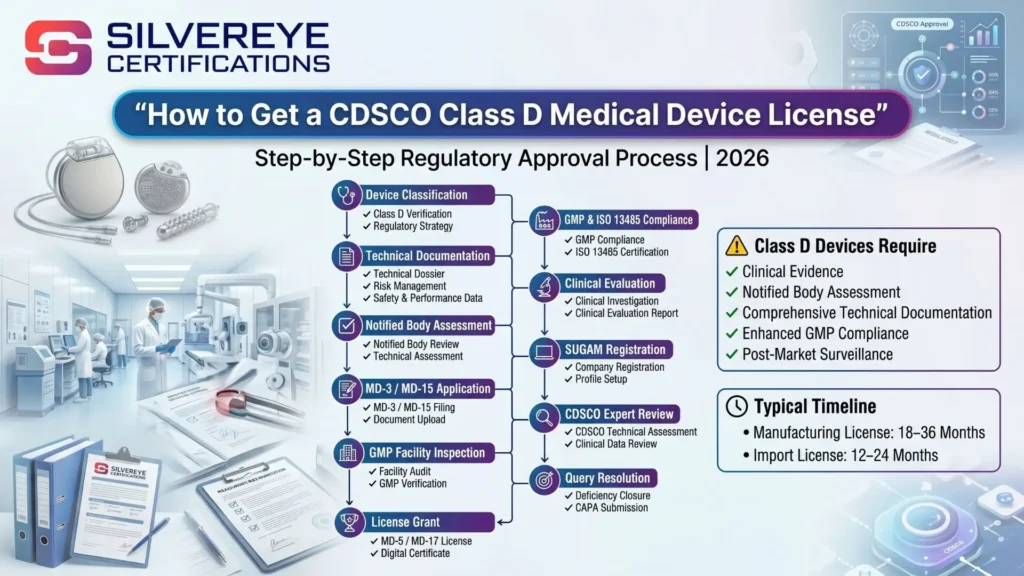
The Class D licensing process is India's most rigorous medical device regulatory pathway. Here is the complete, accurate step-by-step guide for 2026:
Step 1: Confirm Your Device is Class D and Plan Your Regulatory Strategy
- Cross-reference your product name against the official CDSCO Class D list (Annexure II — in this guide)
- Verify the intended use matches the CDSCO classification description exactly — slight differences in intended use can place a device in Class C
- For novel or borderline devices, raise a formal classification query with CDSCO's medical device division before investing in clinical investigation or documentation
- Engage a senior CDSCO-experienced Regulatory Affairs professional immediately — Class D is not an application type to attempt without specialist guidance
- Develop a full regulatory strategy: clinical investigation plan, Notified Body selection, ISO 13485 certification timeline, and application submission milestones
Step 2: Design and Manufacturing GMP Compliance
- Implement a fully functioning ISO 13485 QMS — for Class D, design controls (Clause 7.3), risk management, and post-market surveillance are the most intensively reviewed sections
- Ensure manufacturing facility compliance with Schedule M of MDR 2017 at Class D standards — validated cleanrooms, validated sterilization processes (for sterile implantables), documented process controls
- Obtain ISO 13485 certification from a NABCB-accredited certification body (Indian manufacturer) or ILAC-recognized certification body (foreign manufacturer) with explicit Class D device scope
- For sterile implantable devices: validate all sterility assurance processes to SAL 10⁻⁶ and obtain sterilization validation reports
Step 3: Complete Full Technical Documentation
- Compile the complete design dossier — design history file, all design verification and validation test reports, design review records
- Complete the full ISO 14971:2019 risk management file — hazard identification through residual risk evaluation with benefit-risk analysis
- Complete ISO 10993 biocompatibility testing for all patient-contacting and implanting materials — commission a NABL-accredited or ILAC-recognized test laboratory
- For software-containing Class D devices: complete IEC 62304 software lifecycle documentation and cybersecurity assessment
- Prepare device labelling and IFU in compliance with MDR 2017 Schedule III, including implant card content for implantable devices
- Commission all applicable performance and safety tests from NABL-accredited labs
Step 4: Clinical Investigation (Where Required by CDSCO)
- For most Class D devices, CDSCO requires prospective clinical investigation data — not just literature evidence
- Design the clinical investigation protocol in compliance with MDR 2017 Chapter VI, ISO 14155 (clinical investigation of medical devices), and applicable GCP guidelines
- Obtain Ethics Committee approval from a CDSCO-registered / ICMR-recognized Ethics Committee before initiating investigation
- File a Clinical Investigation Application with CDSCO if the investigation involves Indian subjects — separate approval required before investigation commencement
- Conduct the investigation, collect data, and prepare the clinical investigation report to the standard required for MDR 2017 Schedule II-A compliance
- Note: clinical investigation is a multi-year process for complex Class D devices — plan regulatory timelines accordingly
Step 5: Notified Body Assessment
- Select a Notified Body recognized under EU MDR 2017/745 or equivalent, accepted by CDSCO for Class D device assessment
- Submit the full technical documentation and clinical evaluation report for Notified Body review
- Address all Notified Body questions and requests for additional information — this process can take 6–18 months for complex Class D devices
- Obtain the Notified Body certificate and assessment report — these are mandatory documents in your CDSCO license application
Step 6: Register on CDSCO Sugam Portal and Prepare Application
- Create or update your company profile on sugamya.cdsco.gov.in with all current details — GSTIN, PAN, manufacturing site address, authorized signatory
- For importers: ensure IAA profile is fully established, linked to the foreign manufacturer account, and all IAA documents are current
- Organize all documentation in PDF format, clearly labeled, within portal file size limits
Step 7: File Application (Form MD-3 / MD-15) and Pay Fee
- Select 'Apply for Class D Manufacturing License' or 'Apply for Class D Import License' on the Sugam portal
- Complete Form MD-3 (manufacturers) or MD-15 (importers) — all device names must exactly match the official CDSCO Class D classification list
- Upload all required documents in the correct format to each designated document section
- Pay the prescribed Class D licensing fee online through the Sugam portal payment gateway
- Save and note your application reference number — this is your primary tracking identifier for all future correspondence
Step 8: CDSCO Expert Review, Queries, and Clinical Data Assessment
- CDSCO assigns a senior medical device reviewer with relevant clinical expertise for Class D applications
- The review is the most detailed of any device class — clinical evidence quality, Notified Body report conclusions, biocompatibility data, and risk management completeness are all deeply assessed
- Technical queries will be raised on the Sugam portal — respond promptly and completely through the portal only
- CDSCO may request additional clinical evidence, specific test reports, or expert consultation meetings for complex Class D devices
- All queries must be answered within the stipulated deadline — unanswered queries lead to automatic application closure
Step 9: Manufacturing Facility Inspection (Most Rigorous in MDR 2017)
- CDSCO conducts the most thorough facility inspection of any device class for Class D manufacturing licenses
- Inspectors verify Schedule M GMP compliance at the highest standard — cleanroom qualification, sterility assurance validation, equipment calibration, process validation, and complete QMS implementation
- All inspection Non-Conformances must be resolved with documented CAPA before license issuance
- Critical Non-Conformances may require a re-inspection, adding months to the timeline
- Import license applications require full review of the foreign manufacturer's GMP documentation — an on-site inspection of the foreign facility may be requested
Step 10: License Issuance — Manufacturing License (Form MD-5) or Import License (Form MD-15)
- After successful document review, clinical evidence acceptance, Notified Body assessment validation, and inspection clearance — CDSCO issues the license
- Download the digital license certificate from the Sugam portal — it is legally valid
- The license number must be printed on all device labels and referenced in all regulatory submissions
- Typical total timeline: 18–36 months from complete application submission for manufacturing licenses (including clinical investigation time); 12–24 months for import licenses with fully complete documentation
- Implant the license review date in your compliance calendar — renewal preparation must begin at least 6 months before expiry
| 2026 Update: CDSCO is actively strengthening Class D enforcement. In 2025–2026, CDSCO issued several show-cause notices and enforcement actions against importers selling Class D equivalent devices (particularly implantable neurostimulators and cardiovascular devices) without valid Indian licenses. If you are currently in this situation, engage a regulatory specialist immediately — voluntary compliance is always treated more favourably than enforcement discovery. |
CDSCO Fees for Class D Medical Device License
The Class D licensing fee structure under MDR 2017's Second Schedule reflects the highest fee tier, consistent with the intensity of the review process:
| License Type / Applicant Category | Fee (INR) — Indicative |
| Manufacturing License — Small Manufacturer (Turnover ≤ ₹10 crore, per device) | ₹5,000 per device |
| Manufacturing License — Medium Manufacturer (Turnover ₹10–250 crore, per device) | ₹10,000 per device |
| Manufacturing License — Large Manufacturer (Turnover > ₹250 crore, per device) | ₹25,000 per device |
| Import License — All Importers (per device) | ₹15,000 per device |
| Amendment to Existing Manufacturing License | ₹10,000 – ₹25,000 (depending on amendment scope) |
| Amendment to Existing Import License | ₹10,000 per new device added |
| License Renewal (per device) | Same as initial licensing fee for the entity's applicable size tier |
| State Inspection Fee (Class D manufacturing) | Varies by state — typically ₹25,000 – ₹1,00,000 per inspection for Class D |
| Clinical Investigation Application Fee (if applicable) | Separate fee schedule — verify current amount directly on cdsco.gov.in |
| True Cost of Class D Compliance: The CDSCO application fee is a small fraction of the total cost of Class D compliance. Clinical investigation costs (₹50 lakh to ₹5 crore+ depending on device and study design), Notified Body assessment fees (₹15–50 lakh+), ISO 10993 biocompatibility testing (₹10–30 lakh), and ISO 13485 certification together represent the true regulatory investment for a Class D device. Budget and plan accordingly. |
Validity and Renewal of CDSCO Class D Device License
Managing Class D license validity is a mission-critical compliance obligation. An expired Class D license is the same as no license — with immediate legal consequences:
| Aspect | Key Details |
| License Validity Period | Manufacturing License: 3 years from date of issue. Import License: 3 years from date of issue. |
| Renewal Application Window | Apply for renewal a minimum of 30 days before expiry — for Class D manufacturing licenses, begin renewal preparation 6–12 months in advance. Re-inspection is required and clinical evidence must be updated. |
| Renewal Documentation | Updated technical file, current ISO 13485 certificate, updated Notified Body certificate, current FSC (importers), updated post-market surveillance summary, PMCF data, and any adverse event reports filed since original license issuance. |
| Consequence of Lapsed License | Manufacturing or importing Class D devices with an expired license is an immediate MDR 2017 violation. Product seizure, court proceedings, and director-level liability are real consequences. |
| Adding New Class D Devices | Amendment application required — full documentation, clinical evidence, and Notified Body assessment for each new device. May require re-inspection for manufacturing scope expansion. |
| Modification to Existing Device | Any significant change to a licensed Class D device (design, materials, manufacturing process, intended use) requires a change notification and amendment — may trigger new clinical data requirements. |
| Post-Market Clinical Follow-Up (PMCF) | Ongoing PMCF data collection is mandatory for Class D. PMCF reports must be submitted to CDSCO as part of the periodic safety update report (PSUR) process. |
| Materiovigilance — Adverse Event Reporting | Class D licensees must report all serious adverse device effects to CDSCO through the national Materiovigilance Programme of India (MvPI) within stipulated timelines — immediate for life-threatening events. |
| Voluntary Surrender / Discontinuation | If permanently discontinuing a Class D device, file a surrender application. All known device recipients (via implant cards) should be informed per applicable clinical protocols. |
Key Benefits of Obtaining a CDSCO Class D Medical Device License
The Class D licensing process is the most demanding in India's device framework — but the business and ethical benefits of getting it right are profound:
1. The Only Legitimate Gateway to India's Premium Device Market
A valid CDSCO Class D license is the only legal pathway to manufacturing, importing, or selling Class D devices in India. There is no alternative route, no informal market access, and no grace period. For companies with genuinely Class D products, the license is not optional — it is the foundation of every sales conversation, every hospital contract, and every distribution agreement.
2. Access to Cardiology, Neurology, and Oncology Speciality Markets
Class D devices serve the highest-value clinical specialties in Indian healthcare — implantable cardiac devices, neurostimulators, deep brain stimulators, brachytherapy systems. These specialties are served by India's largest and best-funded hospitals, which require valid CDSCO licenses as a non-negotiable procurement prerequisite.
3. Government Procurement — High-Value, Long-Term Contracts
National health programs, AIIMS, state government hospitals, and defence healthcare (ECHS, CGHS) procure Class D devices through large, multi-year contracts. The GeM portal and central/state procurement committees all mandate valid CDSCO Class D licenses. The regulatory investment unlocks contract values that dwarf the compliance cost.
4. Clinical Credibility — The Highest Standard of Device Validation
A CDSCO Class D license, backed by clinical investigation data and Notified Body assessment, is the strongest possible clinical credibility signal in the Indian market. Cardiologists, neurosurgeons, and oncologists who implant or apply these devices need to trust them with their patients' lives. A CDSCO Class D license tells them that trust is earned and verified.
5. Global Regulatory Alignment — Easier Export Pathway
The documentation and clinical evidence generated for CDSCO Class D licensing — ISO 13485, ISO 14971, ISO 10993, IEC 62304, clinical evaluation per Schedule II-A — is aligned with the highest global regulatory standards (EU MDR, USFDA PMA, TGA Class III). This means the investment in Indian Class D compliance simultaneously advances your global regulatory portfolio.
6. Free Sale Certificate (FSC) for Export
CDSCO issues Free Sale Certificates only to licensed manufacturers. Your Class D manufacturing license is the prerequisite for getting an FSC — required by virtually every international importing market. Your Indian compliance directly supports your export access.
7. Foundation for India's Most Valuable Device Market Segment
Implantable devices, neurostimulators, and brachytherapy systems represent some of the highest per-unit revenue and margin medical products globally. India's growing cardiac, neurological, and oncology treatment market represents a multi-thousand-crore opportunity. Class D licensing is the investment that unlocks this market.
Class A vs B vs C vs D — Complete Regulatory Comparison
A side-by-side comparison of all four device classes to help you understand exactly what Class D demands:
| Regulatory Aspect | Class A | Class B | Class C |
| Regulatory Type | Registration only | Full license | Full license + clinical eval |
| Facility Inspection | Not required | Mandatory | Mandatory |
| ISO 13485 | Optional | Expected | Required |
| Biocompatibility (ISO 10993) | Not required | As applicable | As applicable |
| Clinical Evidence | Not required | Sometimes required | Always required |
| Notified Body | Not required | Not required | Sometimes required |
| License Fee (Large Mfr) | ₹5,000/device | ₹10,000/device | ₹20,000/device |
| Processing Time | 30–45 days | 90–180 days | 180–365 days |
| License Validity | 5 years | 3 years | 3 years |
| Post-Market Surveillance | Minimal | Required | Mandatory + vigilance |
| Adverse Event Reporting | Not required | Required for serious events | Required (MvPI) |
Critical Mistakes That Derail CDSCO Class D License Applications
Class D applications have the longest review timelines and highest deficiency rates in CDSCO's licensing system. Here are the most consequential mistakes to avoid:
- Submitting a clinical evaluation report based only on literature review when CDSCO determines prospective clinical investigation data is required for that specific device type
- Biocompatibility test reports that cover only cytotoxicity and sensitization — for implantable Class D devices, the full ISO 10993 series (including implantation, genotoxicity, systemic toxicity, hemocompatibility) is mandatory
- ISO 13485 certificate with a scope that does not explicitly cover the Class D device type being applied for — scope must match precisely
- Notified Body certificate from a body not recognized by CDSCO or not listed under EU MDR 2017/745 — always verify Notified Body recognition status before commissioning assessment
- Site Master File and actual facility conditions that are inconsistent — Class D inspections are the most thorough, and inconsistencies are treated as critical non-conformances
- Software-integrated Class D devices without IEC 62304 documentation and cybersecurity risk assessment
- Device names in the application that do not exactly match the CDSCO Class D classification — even minor word variations trigger classification queries and delays
- FSC, CE certificates, or Notified Body certificates that expire during the review period — all certificates must remain valid through the entire CDSCO review cycle
- Failing to respond to Sugam portal queries within the stipulated deadline — Class D queries often require specialist input; build response capacity before filing
- Not establishing a Materiovigilance system before receiving the license — CDSCO auditors check this during post-license inspections
- Filing a Class D application without a complete post-market clinical follow-up (PMCF) plan — this is mandatory for all Class D devices
Conclusion — CDSCO Class D Licensing Is a Patient Safety Commitment
CDSCO Class D medical device registration is not just India's most demanding regulatory process — it is a patient safety commitment. Every clinical investigation data point, every biocompatibility test, every Notified Body assessment, and every GMP inspection report in a Class D license application represents the evidence base that says: this device is safe to implant in a patient, safe to sustain a life with, safe to use in cancer treatment. That weight is why the process is demanding, and it is why the process is right.
Companies that approach Class D licensing with that mindset — investing in robust clinical evidence, genuinely compliant manufacturing, and a culture of patient safety — find the regulatory process rigorous but navigable. Companies that try to shortcut clinical evidence, use non-recognized testing labs, or misrepresent facility capabilities face delays, rejections, enforcement actions, and ultimately, damage to the patients they set out to serve.
The 83 Class D devices listed in this guide come directly from CDSCO's official Annexure II classification. Use this list to confirm your device, develop your regulatory strategy early, invest in the right clinical and technical evidence, and pursue India's Class D license as the credential of trust it represents.
Frequently Asked Questions
What is a Class D medical device in India under MDR 2017?
Class D is India's highest-risk medical device category under MDR 2017. These are devices that are implantable in the human body, life-sustaining, or intended to directly prevent or control infection — where device failure can cause immediate, severe, or irreversible harm to patients.
Is clinical investigation always mandatory for Class D devices?
For most Class D devices, clinical investigation data is required — not just clinical evaluation based on literature. CDSCO's Schedule II-A requires a level of clinical evidence proportionate to the device's risk. For novel Class D devices with no equivalent predicate on the Indian market, prospective clinical investigation is typically mandatory.
How long does CDSCO Class D licensing take in 2026?
The realistic timeline depends heavily on whether clinical investigation is required. If existing clinical data is accepted: import licenses may be processed in 12–24 months; manufacturing licenses in 18–36 months from complete submission
Which Notified Body does CDSCO accept for Class D devices?
CDSCO has not published a definitive list of accepted Notified Bodies as of 2026, but in practice accepts Notified Bodies listed under EU MDR 2017/745 (EU Medical Device Regulation), as these are among the world's most rigorously assessed conformity assessment bodies
Can a startup or new company get a CDSCO Class D license?
Yes — CDSCO does not have a minimum company age or revenue threshold for Class D licensing. However, the regulatory, clinical, and manufacturing requirements are so demanding that in practice, Class D licensing is typically pursued by established medical device companies with significant resources.
Is ISO 13485 mandatory for Class D, and can ISO 9001 substitute?
ISO 13485 is mandatory for Class D devices — ISO 9001 cannot substitute. ISO 13485 is specifically designed for medical device quality management systems, covering design controls, risk management, sterility management, traceability, and post-market surveillance that ISO 9001 does not address.
What is the Materiovigilance Programme of India (MvPI) and how does it apply to Class D?
The Materiovigilance Programme of India (MvPI) is CDSCO's national medical device adverse event surveillance system, coordinated through the Indian Pharmacopoeia Commission (IPC). For Class D licensees, MvPI compliance means: (1) establishing an internal adverse event reporting and complaint handling system; (2) reporting serious adverse device effects to CDSCO within stipulated timelines (immediately for life-threatening events, within 10 days for serious events, 30 days for non-serious events); and (3) conducting Field Safety Corrective Actions (FSCAs) when safety issues are identified. MvPI compliance is monitored and non-compliance can result in license suspension.
What if my Class D device is already CE-marked or FDA-approved — is CDSCO licensing still needed?
Yes — absolutely and without exception. CE marking (EU) or FDA PMA (USA) does not grant any right to sell a device in India. India's CDSCO licensing under MDR 2017 is a fully independent regulatory requirement.
How are Class D devices monitored after the license is issued?
Class D post-market obligations are the most extensive in India's device framework: (1) ongoing post-market surveillance per your approved PMS plan; (2) post-market clinical follow-up (PMCF) data collection and reporting; (3) periodic safety update reports (PSUR) submitted to CDSCO; (4) adverse event reporting through MvPI within statutory timelines; (5) field safety corrective actions when device safety issues are identified; (6) cooperation with CDSCO inspections and audits; and (7) maintaining traceability records — particularly for implantable Class D devices, implant cards must be issued and device traceability maintained to the patient level.
What is the penalty for selling an unlicensed Class D device in India?
Selling, importing, or manufacturing a Class D device without a valid CDSCO license is one of the most serious violations under MDR 2017. Under the Drugs and Cosmetics Act (as applicable to medical devices), penalties include: product seizure and destruction, fines of ₹5 lakh or more per violation, factory/import suspension, and imprisonment of up to 5 years for willful or repeat violations.