
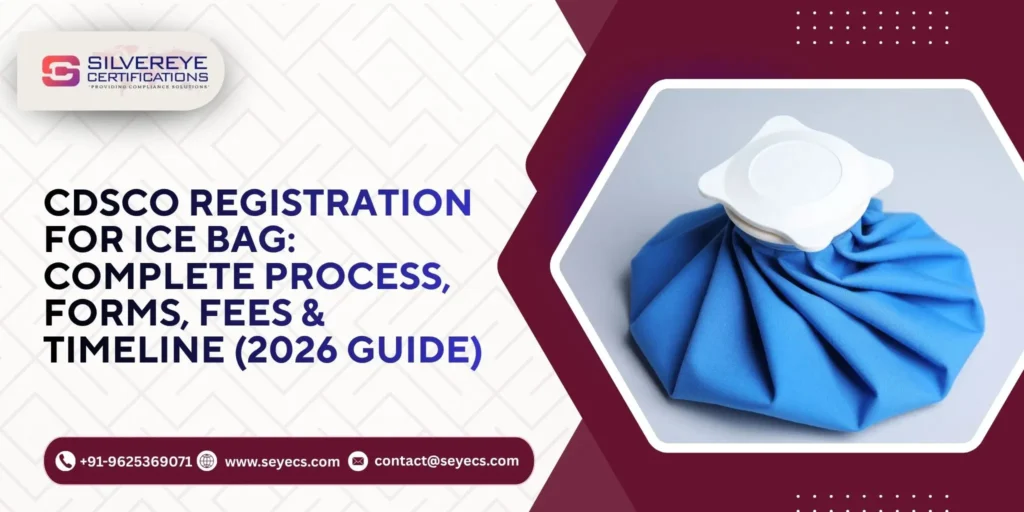
- Ice bags are regulated as Class A or Class B medical devices under MDR 2017, depending on classification and intended clinical use.
- Manufacturers need Form MD-4 (application) and Form MD-6 (license) from the State Licensing Authority.
- Importers need Form MD-14 (application) and Form MD-15 (license) issued by CDSCO through an Authorised Indian Agent.
- Wholesalers and distributors need Form MD-41 (application) and Form MD-42 (license) from the State Licensing Authority.
Introduction
CDSCO registration for ice bag is mandatory under the Medical Device Rules, 2017, because an ice bag is classified as a Class A or Class B non-invasive medical device depending on its intended use. Domestic manufacturers apply through Form MD-4 and receive their manufacturing license on Form MD-6 from the State Licensing Authority. Importers apply on Form MD-14 and get the import license on Form MD-15 from CDSCO.
Wholesalers, stockists, and distributors apply on Form MD-41 and receive Form MD-42. Every applicant needs a Sugam portal account, a valid quality management certificate, and product-specific technical documentation before submission.
What Is CDSCO Registration for Ice Bag?
An ice bag (also called a cold pack, ice cap, or cold therapy bag) is used to apply localized cold therapy for pain relief, swelling reduction, and post-injury or post-surgical care. Because it comes into contact with the human body for a therapeutic purpose, it falls within the definition of a "medical device" under the Medical Devices Rules, 2017 (MDR 2017), administered by the Central Drugs Standard Control Organization (CDSCO), the national regulator under the Ministry of Health and Family Welfare.
CDSCO registration for ice bag simply means obtaining the legal authorization — as a manufacturer, importer, or wholesaler — before the product can be manufactured, imported, stocked, or sold in the Indian market. Selling or distributing an ice bag without valid CDSCO registration can attract penalties under the Drugs and Cosmetics Act, 1940, and MDR 2017, including seizure of stock and cancellation of business operations at the concerned premises.
Why Ice Bag Falls Under CDSCO Class A and Class B
MDR 2017 classifies every medical device into Class A (low risk), Class B (low-to-moderate risk), Class C (moderate-to-high risk), or Class D (high risk) based on intended use, duration of body contact, degree of invasiveness, and dependence on an energy source. A plain, non-electric, surface-contact ice bag used for general cold compression typically sits in Class A, alongside comparable non-invasive comfort devices such as hot water bags and elastic bandages.
However, some ice bag variants — for example, gel-filled reusable cold packs marketed for clinical or post-operative use, or products bundled with pressure/compression claims — may be evaluated as Class B, similar to how digital thermometers or BP monitoring accessories are treated. This is precisely why applicants must first confirm classification against CDSCO's dynamic device classification list on the Sugam portal, or seek a classification opinion from the Central Licensing Authority (CLA) before filing Form MD-4, MD-14, or MD-41 — filing under the wrong class is one of the most common reasons applications get delayed or returned.
| Class | Risk Level | Basis of Classification | Example Devices |
| A | Low risk | Simple, non-invasive, surface-contact use | Ice bag (general use), hot water bag, elastic bandage |
| B | Low-to-moderate risk | Non-invasive but with added functional/clinical claims | Ice bag (clinical/gel-pack variant), digital thermometer |
CDSCO Forms Required for Ice Bag Registration
The form you need depends entirely on your role in the supply chain — manufacturer, importer, or wholesaler/distributor. Here is the complete form-to-role mapping for CDSCO registration for ice bag:
| Applicant Type | Application Form | License Form | Issuing Authority |
| Manufacturer (India) | MD-4 | MD-6 | State Licensing Authority (SLA) |
| Importer (foreign brand into India) | MD-14 | MD-15 | CDSCO / Central Licensing Authority (CLA) |
| Wholesaler / Distributor / Stockist | MD-41 | MD-42 | State Licensing Authority (SLA) |
A quick note on manufacturing routes: businesses that own and operate their own production unit generally apply through Form MD-3/MD-5, while those manufacturing through a contracted or loan-licensed facility (a very common model for small ice bag units) use Form MD-4 for the application and receive Form MD-6 as the license. Confirm your exact manufacturing arrangement with your regulatory consultant before filing, since the correct form depends on who legally owns the production site.
Eligibility Criteria for CDSCO Ice Bag Registration
Manufacturers
- A registered business entity (proprietorship, partnership, LLP, or company) with a documented manufacturing or loan-license premises.
- A functioning quality management system aligned with ISO 13485 (recommended even where not strictly mandatory for Class A).
- Technical competence to prepare a Device Master File and Plant Master File as prescribed under the Fourth Schedule of MDR 2017.
Importers
- An Authorised Indian Agent holding a valid wholesale license (Form 20B/21B or MD-42) to represent the foreign manufacturer before CDSCO.
- A Free Sale Certificate or Marketing Authorisation from the regulatory authority of the country of origin.
- A valid ISO 13485 certificate for the manufacturing site abroad.
Wholesalers / Distributors
- Adequate storage premises with documented ownership or a tenancy/lease agreement.
- A technically qualified person or pharmacist-equivalent competent person, as required under the applicable state rules.
- Purchase records/invoices establishing the source of the ice bags being distributed.
Documents Required for CDSCO Registration for Ice Bag
For Manufacturers (Form MD-4 / MD-6)
- Covering letter and duly filled Form MD-4
- Constitution details of the manufacturing/loan-license unit
- Site ownership or tenancy/lease agreement
- Plant Master File (Appendix I, Fourth Schedule)
- Device Master File (Appendix II) — not mandatory for straightforward Class A ice bags, but recommended
- ISO 13485 quality certificate, if available
- Labelling and instructions-for-use draft
- Fee payment challan / online payment receipt
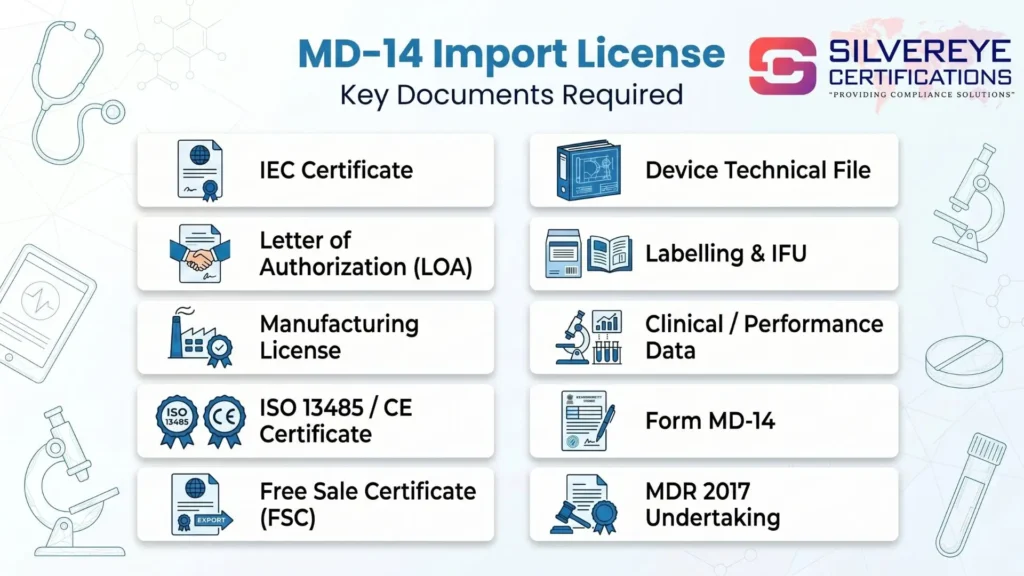
For Importers (Form MD-14 / MD-15)
- Covering letter and duly filled Form MD-14
- Power of Attorney in favour of the Authorised Indian Agent, notarised/apostilled
- Free Sale Certificate from the country of origin's regulator
- ISO 13485 certificate of the foreign manufacturing site
- Device Master File and Plant Master File of the foreign manufacturer
- Wholesale license (Form 20B/21B or MD-42) of the Authorised Indian Agent
- Fee challan in the prescribed foreign-currency or INR equivalent
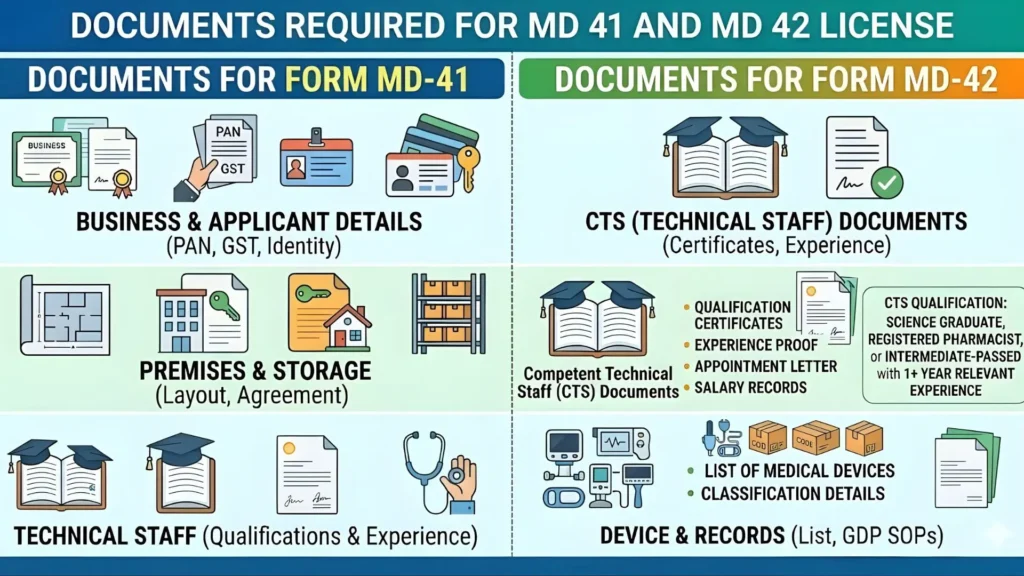
For Wholesalers (Form MD-41 / MD-42)
- Covering letter and duly filled Form MD-41
- Proof of premises (ownership deed or rent agreement)
- Site plan/layout of the storage area
- Details and qualification proof of the competent technical staff
- Constitution of the business (partnership deed, certificate of incorporation, etc.)
- Fee payment challan
Step-by-Step CDSCO Registration Process for Ice Bag
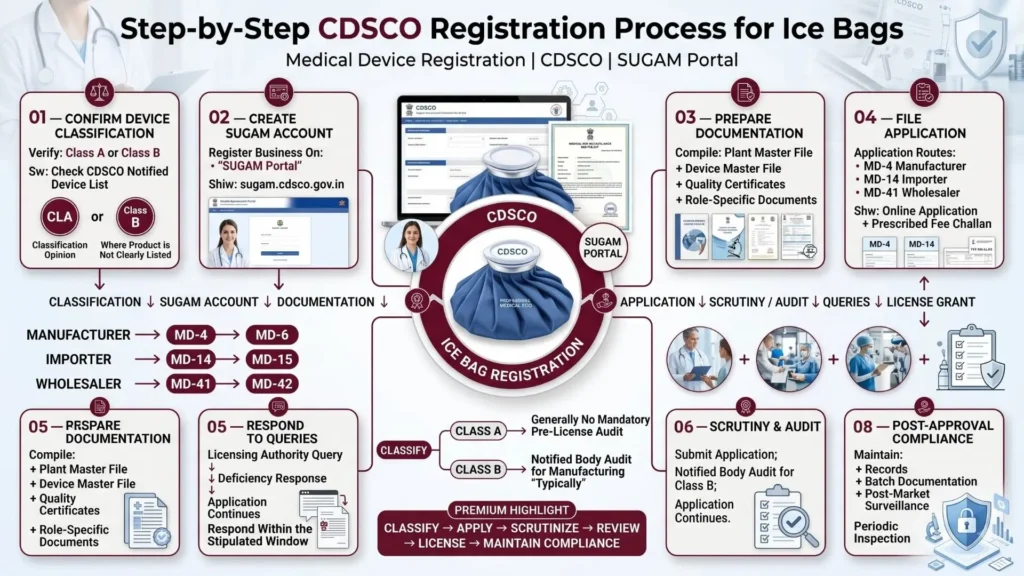
- Confirm device classification: Verify whether your specific ice bag qualifies as Class A or Class B against CDSCO's notified device list; obtain a classification opinion from the CLA if the product isn't clearly listed.
- Create a Sugam portal account: Register your business on the CDSCO online portal (sugam.cdsco.gov.in) — every application, from MD-4 to MD-42, is filed digitally.
- Compile role-specific documentation: Prepare the Plant Master File, Device Master File, quality certificates, and other documents listed above for your applicant category.
- File the application form: Submit Form MD-4 (manufacturer), MD-14 (importer), or MD-41 (wholesaler) online along with the prescribed fee challan.
- Undergo scrutiny and audit, where applicable: Class A applications generally proceed without a mandatory pre-license audit, while Class B manufacturing applications are typically audited by a Notified Body before the license is granted.
- Respond to queries: If the licensing authority raises a deficiency or query, respond within the stipulated window to avoid the application being treated as withdrawn.
- Receive the grant of license: On satisfactory review (and audit, if applicable), the authority issues Form MD-6 (manufacturer), MD-15 (importer), or MD-42 (wholesaler).
- Maintain post-approval compliance: Keep records, batch documentation, and post-market surveillance data current, since the license remains subject to periodic inspection.
CDSCO Fees for Ice Bag Registration
Government fees for Class A and Class B devices under MDR 2017 are charged per manufacturing site and per product/device, in addition to any consultancy or professional service charges you may incur. Indicative government fee heads are summarised below; always verify the current fee schedule on the Sugam portal before payment, as government fees are revised periodically.
| Fee Head | Indicative Government Fee |
| Manufacturing site registration (Class A & B) | ₹5,000 per site (indicative, per MDR 2017 fee schedule) |
| Per-product/device fee (Class A & B manufacturing) | ₹500 per device (indicative) |
| Import license application (MD-14/MD-15) | Fee payable in the prescribed currency per site/product as notified by CDSCO |
| Wholesale license (MD-41/MD-42) | State-specific fee as prescribed by the respective State Licensing Authority |
Approval Timeline
| License Type | Typical Timeline |
| Class A manufacturing license (MD-6) | Around 45 days from complete application; no mandatory pre-grant audit for most Class A devices |
| Class B manufacturing license (MD-6) | Notified Body audit typically scheduled within 90 days; audit report submitted within 30 days, followed by SLA decision |
| Import license (MD-15) | Timeline depends on document completeness and any CLA queries; incomplete Power of Attorney or FSC documentation is the most common cause of delay |
| Wholesale license (MD-42) | Generally faster, since it is primarily a premises and documentation-based verification by the SLA |
These timelines are indicative and can vary by state and by how quickly deficiency queries are resolved. Keeping your Plant Master File, Device Master File, and quality certificates audit-ready from day one is the single biggest factor in avoiding delays.
Validity and Renewal of CDSCO Ice Bag License
Under MDR 2017, manufacturing, import, and wholesale licenses for medical devices generally do not carry a fixed multi-year expiry like the older Drugs and Cosmetics Rules regime. Instead, a license granted on Form MD-6, MD-15, or MD-42 remains valid indefinitely unless it is suspended, cancelled by the licensing authority, or voluntarily surrendered by the license holder.
That said, the license holder must continue to comply with retention requirements — including timely payment of any prescribed retention fee, maintenance of quality records, and cooperation with periodic inspections. Any material change (new manufacturing site, change in device design, change in business constitution, or addition of a new product) requires an endorsement or fresh application rather than a routine "renewal." Always cross-check the latest retention and compliance circulars on the CDSCO/Sugam portal, since state-level practices can vary.
Benefits of CDSCO Registration for Ice Bag
- Legal market access: Only CDSCO-registered ice bags can be legally manufactured, imported, stocked, or sold in India.
- Buyer and hospital confidence: Institutional buyers, hospitals, pharmacy chains, and e-commerce platforms increasingly ask for CDSCO license proof before onboarding a supplier.
- Export credibility: A valid CDSCO license strengthens your product's regulatory profile when seeking approvals or buyer confidence in other markets.
- Reduced regulatory risk: Registration protects the business from raids, product seizure, and penal action under the Drugs and Cosmetics Act, 1940.
- Tender and government-supply eligibility: Government hospital and institutional tenders typically mandate valid CDSCO documentation as a bid qualification.
Common Mistakes Applicants Make
- Filing under the wrong class (assuming every ice bag is automatically Class A without checking the specific product's intended-use claims).
- Submitting an incomplete Plant Master File or Device Master File, which is the leading cause of deficiency queries.
- Importers appointing an Authorised Indian Agent who does not hold a valid, current wholesale license.
- Ignoring labelling requirements under Rule 96 of MDR 2017 (batch number, manufacturing details, intended use, storage instructions).
- Treating the license as a one-time task and failing to update it after a change in manufacturing site, product design, or business constitution.
Why Choose Silvereye Certifications
Navigating CDSCO registration for ice bag — from classification and form selection to documentation, audits, and post-approval compliance — takes regulatory experience that most first-time applicants don't have in-house. SilverYE Certifications works with manufacturers, importers, and wholesalers to take that burden off your plate:
- Accurate classification support so your ice bag is filed under the correct class (A or B) the first time, avoiding rejection or resubmission.
- End-to-end documentation, including Plant Master File, Device Master File, and quality system paperwork, prepared to CDSCO's exact format requirements.
- Dedicated handling of Sugam portal filing, deficiency responses, and coordination with the Notified Body for Class B audits.
- Support across all three applicant categories — manufacturer (MD-4/MD-6), importer (MD-14/MD-15), and wholesaler (MD-41/MD-42) — under one roof.
- Transparent timelines and fee guidance, so you know exactly what to expect at every stage of the process.
- Post-license compliance support, including guidance on endorsements, retention requirements, and labelling audits.
If you manufacture, import, or distribute ice bags and want a compliance partner who understands both the regulatory paperwork and the practical realities of running a medical device business in India, SilverYE Certifications can guide your application from classification through to license grant.
Conclusion
CDSCO registration for ice bag is a mandatory, non-negotiable step for anyone manufacturing, importing, or distributing ice bags in India, since the product is regulated as a Class A or Class B medical device under MDR 2017. The exact form you file — MD-4/MD-6 for manufacturers, MD-14/MD-15 for importers, or MD-41/MD-42 for wholesalers — depends entirely on your role in the supply chain, and getting the classification and documentation right the first time saves significant time and cost. With accurate preparation, realistic timeline expectations, and the right regulatory support, businesses of any size can secure their CDSCO license and build a compliant, credible ice bag business in the Indian healthcare market.
Frequently Asked Questions
Is CDSCO registration mandatory for ice bags in India?
Yes. Since an ice bag is classified as a Class A or Class B medical device under MDR 2017, manufacturing, importing, or wholesale distribution without a valid CDSCO license is not permitted.
Which CDSCO class does an ice bag fall under — Class A or Class B?
It depends on the specific product's design and intended-use claims. A basic, non-electric cold compression ice bag is usually Class A, while gel-filled or clinically positioned variants may be classified as Class B. Always verify against the current CDSCO classification list.
Which form does a manufacturer need to apply for an ice bag license?
Manufacturers apply using Form MD-4 and receive the manufacturing license on Form MD-6 from the State Licensing Authority.
What form does an importer need for CDSCO ice bag registration?
Importers file Form MD-14 through an Authorised Indian Agent and receive the import license on Form MD-15 from CDSCO.
What license does a wholesaler or distributor of ice bags need?
Wholesalers, stockists, and distributors apply on Form MD-41 and receive the wholesale license on Form MD-42 from the State Licensing Authority.
How long does it take to get a CDSCO license for an ice bag?
Class A manufacturing licenses are typically processed within around 45 days with no mandatory pre-grant audit, while Class B applications involve a Notified Body audit that can extend the timeline to roughly 90–120 days, depending on document readiness.
What documents are required for CDSCO ice bag registration?
Core documents include the covering letter, constitution details, site ownership proof, Plant Master File, Device Master File (where applicable), quality certificates such as ISO 13485, and the prescribed fee challan — the exact list varies by applicant category.
Is ISO 13485 certification compulsory for ice bag manufacturers?
It is not always strictly mandatory for a simple Class A ice bag, but having an ISO 13485-certified quality management system significantly strengthens the application and is generally recommended for smoother processing.
Does a CDSCO ice bag license expire and need renewal?
Under MDR 2017, most manufacturing, import, and wholesale licenses do not carry a fixed expiry date and remain valid until suspended, cancelled, or surrendered, subject to ongoing compliance and any prescribed retention requirements.
Can one CDSCO license cover both manufacturing and wholesale of ice bags?
No. Manufacturing (MD-4/MD-6), import (MD-14/MD-15), and wholesale (MD-41/MD-42) are distinct license categories tied to distinct business activities, and a business performing more than one activity needs the corresponding license for each.
What happens if an ice bag is sold in India without CDSCO registration?
Selling an unregistered medical device can lead to enforcement action under the Drugs and Cosmetics Act, 1940, including seizure of stock, penalties, and business disruption at the concerned premises.
Who is the licensing authority for ice bag registration — central or state?
Manufacturing and wholesale licenses for Class A and B devices like ice bags are issued by the State Licensing Authority (SLA), while import licenses are issued by CDSCO's Central Licensing Authority (CLA).