
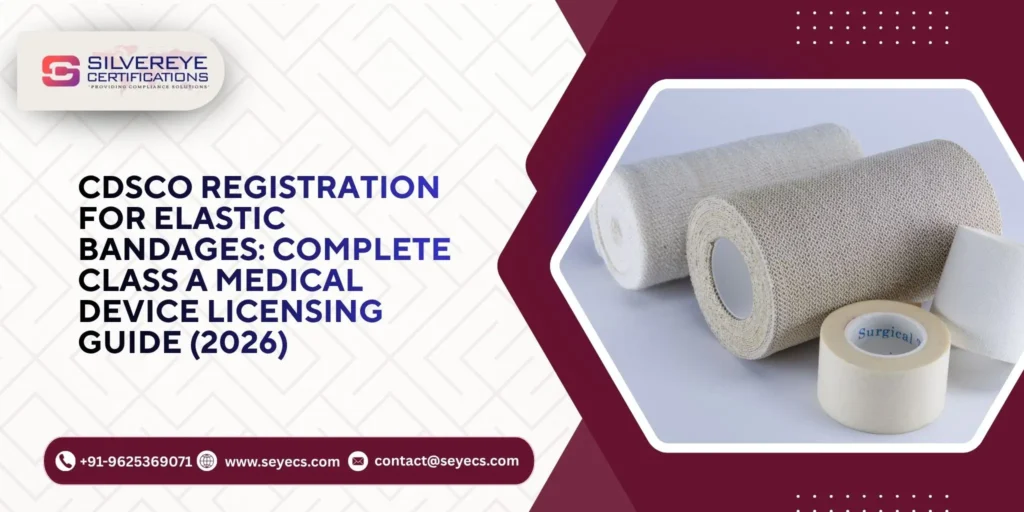
- Class A classification: Elastic bandages — elastic adhesive bandages and cotton crepe bandages used for sprains, strains, and painful joints — are Class A (low-risk) medical devices under CDSCO's official notification.
- Manufacturers need MD-3/MD-5: Indian manufacturers of elastic bandages apply through Form MD-3 and receive the manufacturing license on Form MD-5 from their State Licensing Authority.
- Importers need MD-14/MD-15: Foreign brands must appoint an authorized Indian agent who files Form MD-14 and secures the import license on Form MD-15 from CDSCO's Central Licensing Authority.
- Wholesalers/distributors need MD-41/MD-42: Any business stocking, supplying, or distributing elastic bandages commercially must hold the registration certificate granted on Form MD-42, applied for via Form MD-41.
Introduction
CDSCO registration for elastic bandages is mandatory because elastic bandages — including elastic adhesive bandages and cotton crepe bandages — are classified as Class A (low-risk) medical devices under CDSCO's Medical Devices Rules, 2017, per official notification 29/Misc./03/2020-DC(193)-Part-3 dated 16 March 2022.
Manufacturers apply on Form MD-3 and receive the manufacturing license on Form MD-5 from the State Licensing Authority. Importers appoint an authorized Indian agent, file Form MD-14, and receive the import license on Form MD-15 from CDSCO. Wholesalers and distributors apply on Form MD-41 and receive the registration certificate on Form MD-42. All applications route through the SUGAM portal, and most CDSCO elastic bandage licenses carry a 5-year validity cycle.
What Is CDSCO Registration for Elastic Bandages?
CDSCO registration for elastic bandages is the regulatory approval issued by the Central Drugs Standard Control Organization (CDSCO), under India's Ministry of Health and Family Welfare, that authorizes a business to manufacture, import, or distribute elastic bandages as a notified medical device.
Elastic bandages — including elastic adhesive bandages and cotton/rubber crepe bandages — are elasticated devices worn on the limbs to manage sprains, strains, and painful joints on intact skin, or used to secure dressings and provide strapping. They are classified under CDSCO's General Hospital or Orthopaedic Instruments category and are regulated under the Medical Devices Rules, 2017 (MDR 2017), notified under the Drugs and Cosmetics Act, 1940.
CDSCO officially classified elastic adhesive bandages and cotton/rubber elastic bandages as Class A devices through notification 29/Misc./03/2020-DC(193)-Part-3, dated 16 March 2022. Even though these are simple, everyday clinical products, they still make direct, often prolonged contact with intact skin, so CDSCO requires manufacturers and importers to meet baseline standards for material safety and hygiene before the product can be sold legally in India.
Every entity in the supply chain — the manufacturer producing the bandage, the importer bringing a foreign-made bandage into India, and the wholesaler or distributor supplying it to hospitals, pharmacies, and retailers — needs its own CDSCO authorisation.
Why Elastic Bandages Are Classified as Class A
CDSCO's risk-based classification system groups medical devices into four categories — Class A, B, C, and D — as specified in the First Schedule of MDR 2017. Elastic bandages fall under Class A because they are non-invasive, contact only intact skin, and do not measure any physiological parameter. This places them alongside other basic, low-risk orthopaedic and general hospital devices.
| Product | CDSCO Classification | Intended Use |
| Elastic adhesive bandage | Class A | Secures dressings and provides strapping on intact skin |
| Cotton/rubber elastic bandage | Class A | Worn on limbs to manage sprains, strains, and painful joints on intact skin |
| Cotton crepe bandage | Class A | Worn on limbs to manage sprains, strains, and painful joints on intact skin |
| Simplified registration route for non-sterile, non-measuring elastic bandages Because elastic bandages are non-sterile and non-measuring, they generally qualify for CDSCO's simplified Class A registration route under GSR 777(E), which can exempt the product from the full MD-5/MD-15 licensing cycle in favour of portal-based registration. This guide covers the complete MD-3/MD-5 manufacturing process for businesses that need or choose the formal licensing route. Confirm your specific product's exact pathway on the CDSCO SUGAM portal before applying, since requirements can be updated. |
Who Needs CDSCO Registration for Elastic Bandages?
CDSCO registration applies separately to each role in the elastic bandage supply chain:
| Entity | Application Form | Licence/Certificate | Issuing Authority |
| Manufacturer (Class A) | Form MD-3 | Form MD-5 (Manufacturing Licence) | State Licensing Authority |
| Importer | Form MD-14 | Form MD-15 (Import Licence) | CDSCO – Central Licensing Authority |
| Wholesaler / Distributor | Form MD-41 | Form MD-42 (Registration Certificate) | State Licensing Authority |
If your business performs more than one role — for example, importing elastic bandages and also wholesaling them directly to hospitals and pharmacies — you will typically need more than one licence, since each authorisation covers a distinct commercial activity.
CDSCO Manufacturing License for Elastic Bandages (MD-3 & MD-5)
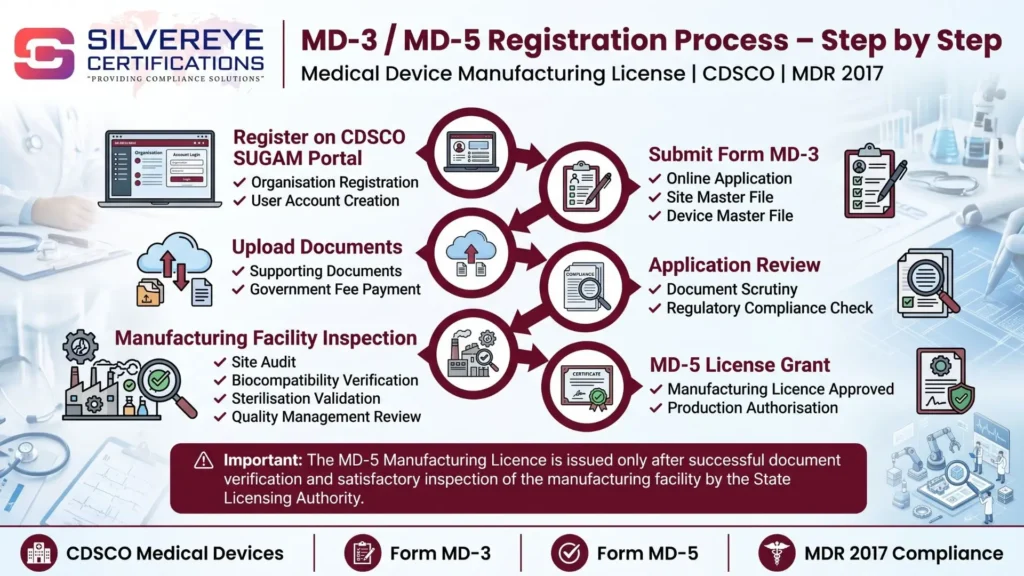
Indian manufacturers producing elastic bandages on their own premises must obtain a Class A manufacturing licence. The application is filed on Form MD-3, and once approved, the State Licensing Authority (SLA) grants the licence on Form MD-5.
Eligibility for MD-3/MD-5
- The applicant must be a registered business entity (proprietorship, partnership, LLP, or company) with a defined manufacturing premise in India.
- The manufacturing site must maintain a Quality Management System aligned with ISO 13485:2016 principles appropriate for Class A devices, including material safety and hygiene controls for the elasticated fabric and adhesive components.
- A qualified technical person responsible for production and quality must be designated at the facility.
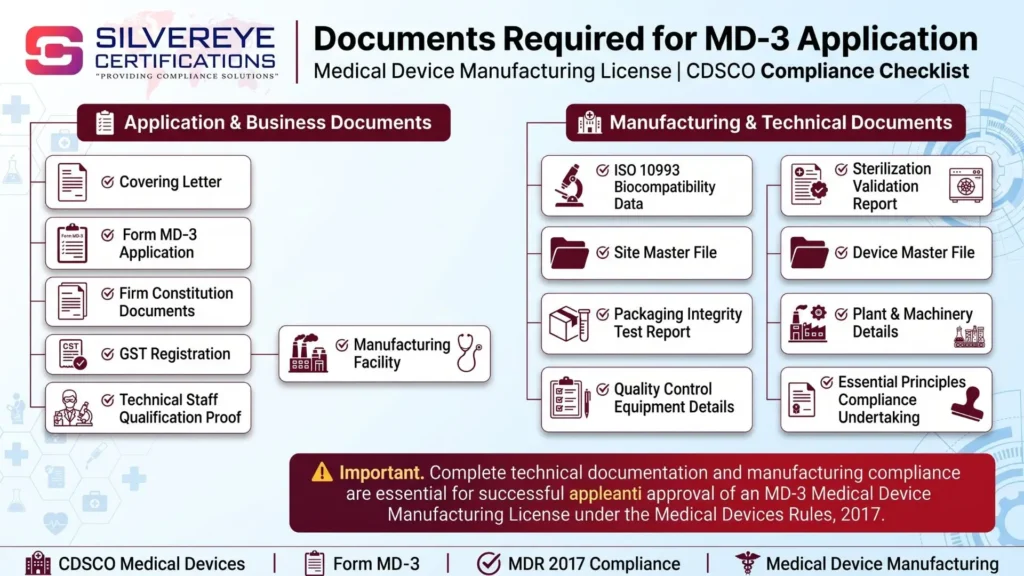
Documents Required for MD-3 Application
- Covering letter and duly filled Form MD-3.
- Proof of constitution of the firm (incorporation certificate, partnership deed, GST registration).
- Site Master File describing the manufacturing premises and layout.
- Device Master File covering fabric composition, elasticity/stretch specifications, adhesive formulation (where applicable), size range, intended use, and labelling.
- Details of manufacturing plant, machinery, and quality-control equipment.
- Undertaking of compliance with Essential Principles of safety and performance under MDR 2017.
- Details of technical staff along with qualification proof.
MD-3/MD-5 Process — Step by Step
- Register the organization on the CDSCO SUGAM portal.
- Obtain a Test License (Form MD-13) and complete product testing at a CDSCO-approved laboratory, where required before the full manufacturing application.
- Fill and submit Form MD-3 online along with the Site Master File and Device Master File.
- Upload supporting documents and pay the applicable government fee.
- The State Licensing Authority scrutinises the application for completeness and regulatory compliance.
- Where required, the manufacturing premises undergo an inspection or audit to verify quality-system compliance.
- On satisfactory review, the SLA grants the manufacturing licence on Form MD-5.
CDSCO Import License for Elastic Bandages (MD-14 & MD-15)
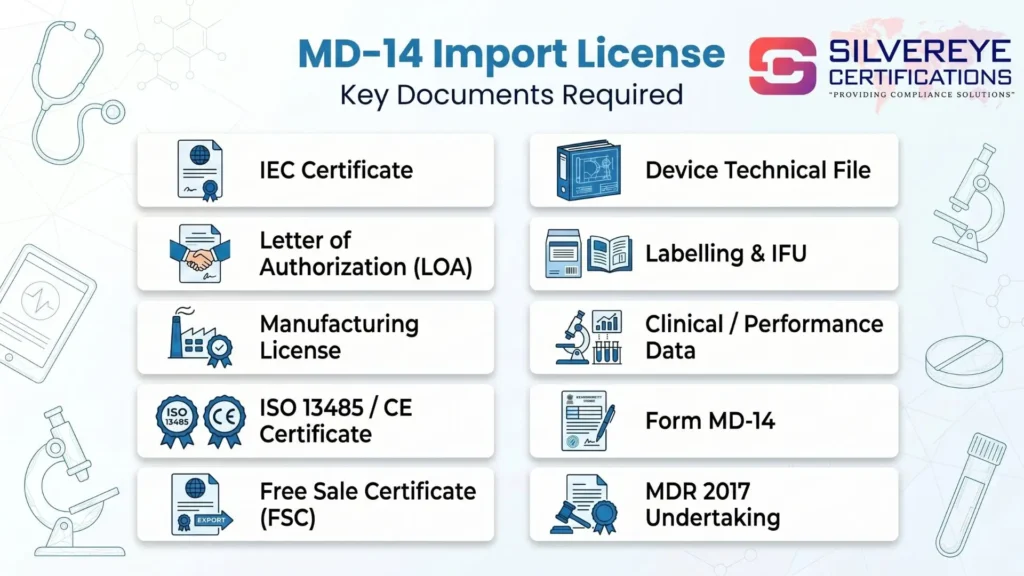
Foreign manufacturers cannot sell elastic bandages directly in India. They must appoint an Authorized Indian Agent who holds a valid wholesale license (Form MD-42) or manufacturing license, and who then files the import application on Form MD-14. Once CDSCO's Central Licensing Authority approves the application, the import license is granted on Form MD-15.
Documents Required for MD-14 Application
- Covering letter and duly filled Form MD-14.
- Government fee payment challan.
- Notarised and apostilled Power of Attorney from the foreign manufacturer authorising the Indian agent.
- Copy of the agent's Wholesale License (MD-42) or Manufacturing License.
- Free Sale Certificate or Marketing Authorisation from the regulatory authority of the country of origin.
- Device Master File and Plant Master File of the foreign manufacturing site.
- ISO 13485 certificate and any applicable CE marking or equivalent international approval.
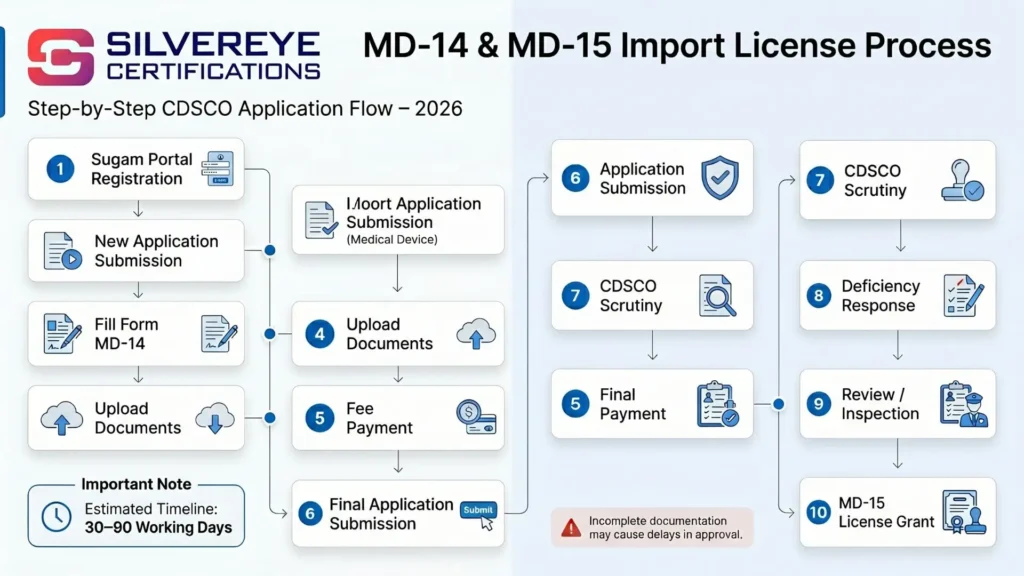
MD-14/MD-15 Process — Step by Step
- The Authorized Agent registers on the CDSCO SUGAM portal.
- Form MD-14 is filled online with device, manufacturer, and agent details.
- Supporting documents are uploaded and the applicable government fee is paid.
- CDSCO reviews the application and may raise queries requiring clarification or additional documents.
- On satisfactory review, CDSCO grants the import license on Form MD-15, permitting legal import of the listed elastic bandage product(s).
| Most standard elastic bandages qualify for the lighter registration route Since elastic bandages are non-sterile and non-measuring, they typically qualify for CDSCO's simplified Class A registration route rather than the full MD-14/MD-15 licensing cycle. This guide covers the complete MD-14/MD-15 process for cases where a formal import license is otherwise required. Confirm your specific product's pathway on the SUGAM portal before applying. |
CDSCO Wholesale / Distributor License for Elastic Bandages (MD-41 & MD-42)
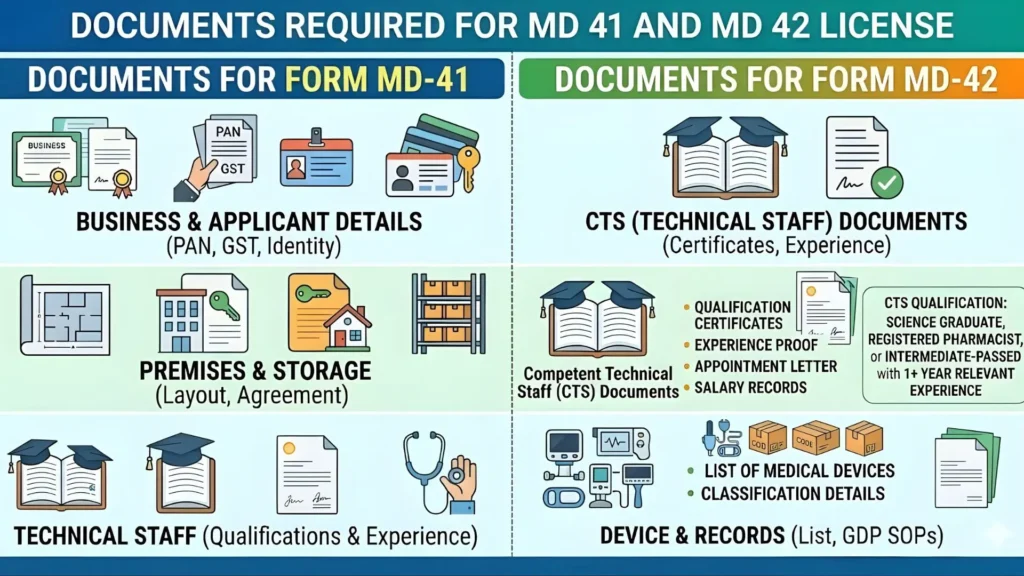
Any business that stocks, exhibits, sells, or distributes elastic bandages in bulk — including distributors, stockists, C&F agents, and e-commerce sellers of regulated medical devices — needs a wholesale registration. The application is made on Form MD-41, and the State Licensing Authority grants the registration certificate on Form MD-42.
Eligibility and Documents for MD-41/MD-42
- A dedicated storage premise of adequate size with proper shelving, cleanliness, and record-keeping arrangements.
- A technically competent person overseeing storage and distribution.
- Duly filled Form MD-41, business constitution proof, premises address proof and layout plan, technical competence proof, and the fee payment receipt.
- A Drug Inspector conducts a physical inspection of the storage premises before the State Licensing Authority issues the registration certificate on Form MD-42.
CDSCO Fees for Elastic Bandage Registration
Government fees differ by license type and are prescribed under the First Schedule of MDR 2017. Fees are revised from time to time, so always verify the current amount on the SUGAM portal before submitting payment.
| Licence Type | Applicable Fee | Notes |
| Manufacturing Licence (MD-3/MD-5) | As per MDR 2017 Schedule I | Fee for Class A manufacturing is lower than higher classes; confirm current amount on SUGAM |
| Import Licence (MD-14/MD-15) | As per MDR 2017 Schedule I, or nil for simplified registration | Non-sterile, non-measuring elastic bandages often qualify for the lighter registration route with no formal import fee |
| Wholesale Licence (MD-41/MD-42) | ₹3,000 per premise (government fee) | Non-refundable; paid at the time of application submission |
Processing Timeline & Validity of CDSCO Elastic Bandage Licenses
| Licence Type | Typical Processing Time | Validity | Renewal |
| MD-5 (Manufacturing) | Approx. 3–6 months, including a test licence stage and product testing at a CDSCO-approved laboratory where applicable | 5 years from date of issue | Apply before expiry with retention/renewal fee |
| MD-15 (Import) | Ranges from a few weeks (simplified registration) up to several months for a formal licence | Generally continues indefinitely subject to a 5-year retention fee cycle | Pay retention fee every 5 years to keep the licence active |
| MD-42 (Wholesale) | Approx. 30–60 days | 5 years from date of issue | Renew before expiry to avoid disruption in distribution |
As a best practice, begin your renewal filing at least 60–90 days before expiry across all three licence types, since re-inspection, document verification, or portal queries can extend the review timeline.
Benefits of CDSCO Registration for Elastic Bandages
- Legal market access: A valid CDSCO authorization is what allows an elastic bandage to be manufactured, imported, or sold in India in the first place.
- Buyer and marketplace trust: Hospitals, pharmacies, and procurement bodies increasingly ask for CDSCO documentation before onboarding an elastic bandage supplier.
- Protection from penalties: Registered businesses avoid the seizure, fines, and legal action that come with selling unregistered medical devices.
- Export credibility: A CDSCO licence strengthens your regulatory profile when elastic bandages are later exported to markets that recognise Indian approvals.
Penalties for Selling Elastic Bandages Without CDSCO Registration
Manufacturing, importing, or distributing elastic bandages without the applicable CDSCO authorization is a violation of the Medical Devices Rules, 2017 and the Drugs and Cosmetics Act, 1940. Consequences can include seizure of stock, suspension or cancellation of any related licenses, financial penalties, and prosecution under the Act, which in serious or repeat cases can extend to imprisonment. Businesses found sourcing from unregistered manufacturers or importers can also face action for non-compliance with supply-chain obligations.
Common Mistakes to Avoid During CDSCO Elastic Bandage Registration
- Applying under the wrong form — for example, filing MD-7 (meant for Class C/D) instead of MD-3 for a Class A elastic bandage.
- Submitting an incomplete Device Master File or Site Master File, which is one of the most common reasons for CDSCO deficiency queries.
- Assuming a single license covers manufacturing, import, and wholesale activity — each role needs its own authorization.
- Skipping or underestimating the Test License (MD-13) and product testing stage before the full MD-3 application, where required.
- Delaying renewal filing until close to the expiry date, risking a business disruption if inspection or documentation queries arise.
- Not verifying whether a specific elastic bandage variant (e.g., medicated, sterile, or bundled with other regulated components) shifts it out of the simplified Class A pathway.
Conclusion
Whether you manufacture elastic bandages in India, import them from an overseas supplier, or distribute them to hospitals and pharmacies, CDSCO registration for elastic bandages is the foundation of legal, credible operations in this Class A medical device category. Getting the classification right, filing the correct form — MD-3, MD-14, or MD-41 — and preparing complete documentation are the biggest factors that determine how quickly your licence comes through.
The team at Silvereye Certifications specialises in end-to-end CDSCO medical device registration support — from device classification and technical dossier preparation to SUGAM portal submissions and post-approval compliance management for elastic bandage manufacturers, importers, and distributors across India.
Frequently Asked Questions
Is CDSCO registration mandatory for elastic bandages in India?
Yes. Elastic bandages are notified medical devices under MDR 2017, so manufacturing, importing, or distributing them in India requires the applicable CDSCO authorisation.
What class of medical device is an elastic bandage under CDSCO?
Elastic bandages are classified as Class A, the lowest-risk category under CDSCO's four-tier (A–D) classification system, per official notification 29/Misc./03/2020-DC(193)-Part-3 dated 16 March 2022.
What is the difference between Form MD-3, MD-14, and MD-41?
MD-3 is the manufacturing license application (granted as MD-5), MD-14 is the import license application (granted as MD-15), and MD-41 is the wholesale/distribution registration application (granted as MD-42). Each serves a different role in the supply chain.
Who can apply for the CDSCO elastic bandage manufacturing license?
Any registered business entity manufacturing elastic bandages on its own premises in India, with a designated technical person and a documented quality system, can apply on Form MD-3 to the State Licensing Authority.
Do all elastic bandages need a full MD-15 import license?
Not always. Because elastic bandages are non-sterile and non-measuring, many qualify for a simplified CDSCO registration route rather than the full MD-14/MD-15 licence. Confirm the correct pathway before filing.
How long does CDSCO registration for elastic bandages take?
Manufacturing licences (MD-5) typically take about 3–6 months, including test licence and product testing where required. Wholesale registrations (MD-42) take about 30–60 days, and import approvals range from a few weeks under the simplified route to several months for a formal MD-15 license.
What is the validity of a CDSCO elastic bandage licence?
MD-5 and MD-42 are generally valid for 5 years from the date of issue. MD-15 import licences generally continue indefinitely, subject to payment of a retention fee every 5 years.
What documents are required for CDSCO elastic bandage registration?
Core documents include the relevant application form (MD-3, MD-14, or MD-41), business constitution proof, site or premises details, a Device Master File covering fabric and elasticity specifications, technical staff qualifications, and the applicable fee payment receipt. Importers additionally need a Power of Attorney and a Free Sale Certificate from the country of origin.
Can one business hold manufacturing, import, and wholesale licenses together?
Yes, if the business genuinely performs all three activities. Each activity still requires its own separate CDSCO authorization — holding one license does not automatically cover the others.
What happens if I sell elastic bandages without CDSCO registration?
You risk stock seizure, financial penalties, cancellation of any existing licenses, and prosecution under the Drugs and Cosmetics Act, 1940, which can include imprisonment in serious cases.
Is BIS certification also required for elastic bandages?
BIS and CDSCO are separate regulatory frameworks. CDSCO governs elastic bandages as medical devices under MDR 2017. Whether a specific BIS textile standard also applies depends on the product's material composition, and should be checked independently of CDSCO compliance
How do I renew my CDSCO elastic bandage license?
Renewal applications should be filed 60–90 days before expiry, using the previous licence details, updated documents where applicable, and the prescribed renewal or retention fee, submitted through the SUGAM portal or your State Licensing Authority.