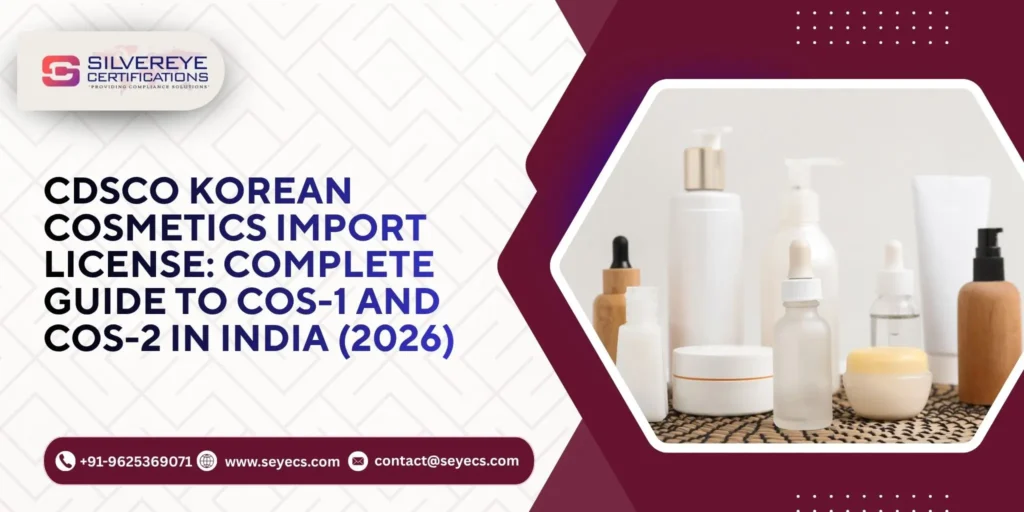
- CDSCO Korean cosmetics import license requires COS-1 application and COS-2 grant under the Drugs and Cosmetics Act, 1940.
- Korean beauty brands need a licensed Indian importer with a valid CDSCO cosmetics import license before shipping any product.
- The process involves submitting product dossiers, safety data, and manufacturing proof to CDSCO's online portal.
- A CDSCO cosmetics import license is valid for 3 years and can be renewed before expiry to avoid penalties.
Introduction
To import Korean cosmetics into India, you must obtain a CDSCO import license by submitting a COS-1 application form along with product details, safety data, GMP certificate, and a free sale certificate. Once reviewed and approved, CDSCO issues the COS-2 grant of license. The license is valid for 3 years, costs approximately INR 3,000 to INR 10,000 per product depending on category, and is mandatory under the Drugs and Cosmetics Act, 1940, and the Cosmetics Rules, 2020.
What Is a CDSCO Korean Cosmetics Import License?
The CDSCO Korean cosmetics import license is an official regulatory permit issued by the Central Drugs Standard Control Organization (CDSCO), which operates under the Ministry of Health and Family Welfare, Government of India. This license is mandatory for any business that wants to import Korean beauty, skincare, haircare, or cosmetic products into India for commercial sale.
India is one of the fastest-growing markets for Korean beauty (K-beauty) products. From sheet masks and serums to BB creams and sunscreens, Korean cosmetics have become extremely popular among Indian consumers. However, every Korean cosmetic brand or Indian importer must comply with the CDSCO import licensing rules before bringing these products into the country.
The regulatory framework is governed by the Drugs and Cosmetics Act, 1940, and the Cosmetics Rules, 2020 (which replaced the old Schedule S provisions). Under this framework, CDSCO processes two key forms for cosmetics import:
- COS-1 — Application Form for Import of Cosmetics
- COS-2 — Grant of License to Import Cosmetics
Why Is the CDSCO Cosmetics Import License Mandatory for Korean Products?
India treats cosmetics as a regulated category under the Drugs and Cosmetics Act, 1940. Any cosmetic product manufactured outside India and sold within India must be licensed by CDSCO before it enters the Indian market. This applies 100% to Korean cosmetics.
Without a valid CDSCO import license for Korean cosmetics, the importer can face:
- Seizure of goods at Indian customs ports
- Fines and penalties under the Drugs and Cosmetics Act
- Rejection of consignments by Port Health Officers or Drug Inspectors
- Legal action against the Indian importer of record
For Korean cosmetic brands wanting to enter India, working with a licensed Indian importer or establishing their own Indian entity with the correct CDSCO license is the only legal pathway.
Who Needs a CDSCO Korean Cosmetics Import License?
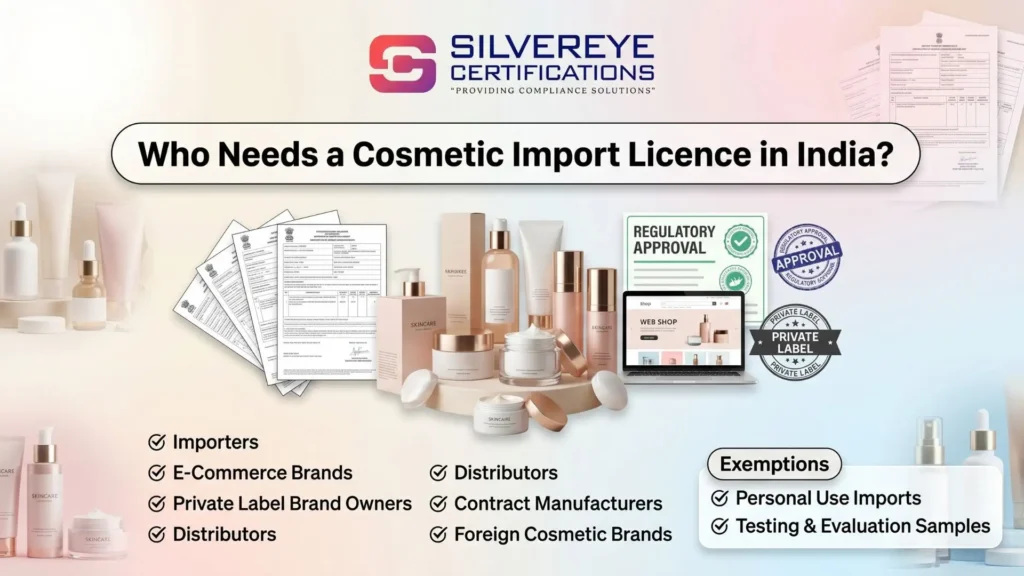
The following entities require a CDSCO cosmetics import license to legally bring Korean beauty products into India:
- Indian importers or distributors representing Korean cosmetic brands
- Indian subsidiaries of Korean cosmetic companies
- E-commerce businesses importing Korean beauty products for online resale in India
- Retail companies sourcing Korean skincare and haircare products for offline distribution
- Manufacturers or contract manufacturers importing Korean cosmetic raw materials (in some cases)
COS-1: Application for Import of Korean Cosmetics — Everything You Need to Know
The COS-1 form is the starting point for obtaining a CDSCO import license for Korean cosmetics. It is the formal application that an Indian importer submits to CDSCO to seek permission to import cosmetic products from Korea.
What Is the COS-1 Form?
COS-1 is the prescribed application form under the Cosmetics Rules, 2020 (Form COS-1), which an applicant fills out online through the CDSCO Sugam Portal. It captures product information, applicant details, and the supporting technical documentation.
Who Submits the COS-1 Application?
The COS-1 application is submitted by the Indian importer or their authorized representative on behalf of the Korean manufacturer. The Indian party must hold a valid Drug License (Form 20B or equivalent) or a cosmetics business registration, depending on the state-specific requirement.
Key Information Required in the COS-1 Application
| Field | Details Required |
| Applicant Name | Name of the Indian importer or company |
| Korean Manufacturer Name | Legal name of the Korean cosmetic manufacturer |
| Product Name(s) | Brand name and generic/common name of each cosmetic |
| Product Category | Skincare, haircare, oral care, colour cosmetics, etc. |
| Ingredients List | Complete INCI (International Nomenclature of Cosmetic Ingredients) list |
| Country of Origin | Republic of Korea (South Korea) |
| Intended Use | How the product is used — rinse-off, leave-on, etc. |
| Shelf Life | Product shelf life as stated by manufacturer |
| Pack Sizes | All pack sizes being imported |
| Label Copy | Draft or existing label in English for Indian market |
Step-by-Step Process for COS-1 Application
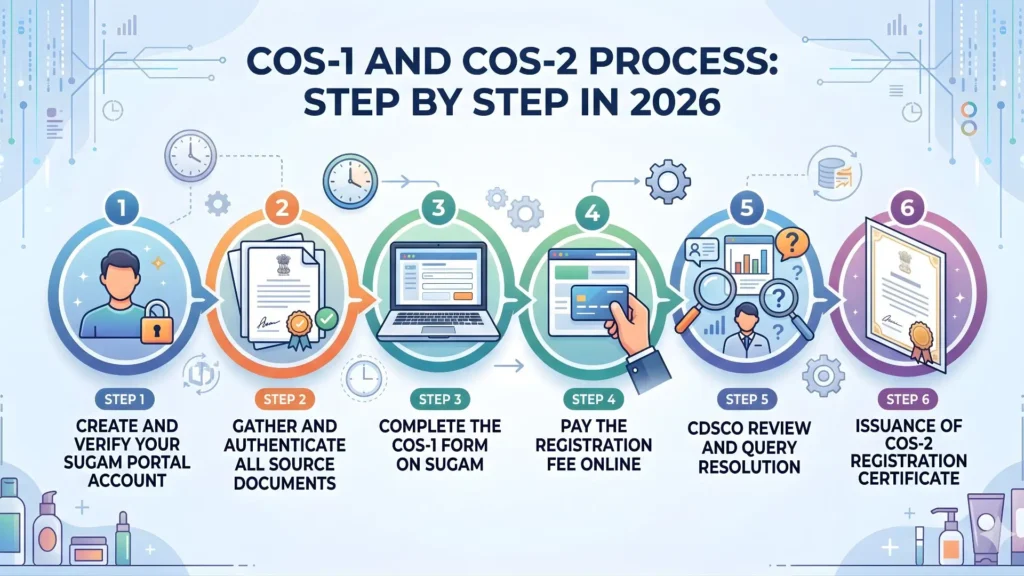
- Register on the CDSCO Sugam Portal as an importer
- Select 'New Application' under the Cosmetics Import License module
- Fill in the COS-1 form with all required product and company information
- Upload all mandatory supporting documents (detailed in the documents section below)
- Pay the prescribed application fee online through the portal
- Submit the application and note the Application Reference Number
- Track the status of your application on the portal
- Respond to any queries raised by the CDSCO reviewer (Deficiency Letters)
- Await the COS-2 Grant of License upon approval
COS-2: Grant of License to Import Korean Cosmetics — What It Means
After the COS-1 application is reviewed and approved by the licensing authority at CDSCO, the applicant receives the COS-2 — which is the actual Grant of Import License for cosmetics. This is the document that legally allows the Indian importer to import the specified Korean cosmetic products into India.
What Does COS-2 Contain?
The COS-2 Grant of License document typically includes:
- Name and address of the licensed importer in India
- License number issued by CDSCO
- Product name(s) covered under the license
- Name of the Korean manufacturer
- Date of grant
- Validity period (generally 3 years from date of grant)
- Conditions attached to the license, if any
How COS-2 Differs from COS-1
| Aspect | COS-1 (Application) | COS-2 (Grant of License) |
| Nature | Application submitted by importer | License granted by CDSCO |
| Stage | Beginning of the process | End result / approval |
| Purpose | Request for permission to import | Proof of legal permission to import |
| Who Holds It | Submitted to CDSCO | Held by the Indian importer |
| Validity | N/A (it's just an application) | 3 years from date of issue |
Eligibility Criteria for CDSCO Korean Cosmetics Import License
Before applying for the CDSCO cosmetics import license (COS-1/COS-2), the applicant must meet the following eligibility conditions:
- Must be an Indian entity — an individual, company, LLP, or firm registered in India
- Must possess a valid Drug License or Business License as required by the state licensing authority
- The Korean manufacturer must hold a valid GMP (Good Manufacturing Practice) Certificate
- Products must comply with the Cosmetics Rules, 2020 — no prohibited ingredients
- Products must carry a label in English (for Indian market compliance) with all mandatory label declarations
- The Indian importer must have a valid PAN and GST registration
- A Free Sale Certificate (FSC) from the Korean regulatory authority (MFDS — Ministry of Food and Drug Safety, Korea) is required
Documents Required for CDSCO Korean Cosmetics Import License (COS-1 Application)
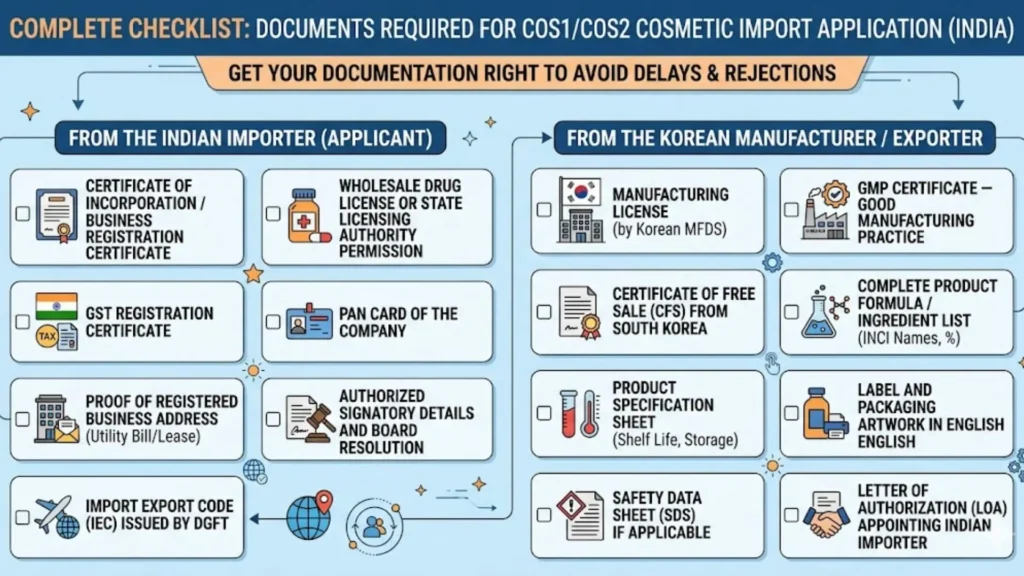
The document checklist for CDSCO Korean cosmetics import license is detailed and must be accurately prepared. Incomplete documentation is the most common reason for application delays.
Documents from the Indian Importer
- Copy of Drug License / Cosmetics Business License (state-issued)
- PAN Card of the company or individual
- GST Registration Certificate
- Certificate of Incorporation (if company) or Partnership Deed (if firm)
- Power of Attorney, if application is filed through an authorized representative
- Undertaking letter as per CDSCO format
Documents from the Korean Manufacturer
- Certificate of GMP (Good Manufacturing Practice) — issued by MFDS Korea or an accredited body
- Free Sale Certificate (FSC) — confirming the product is freely sold in Korea
- Manufacturing License of the Korean factory
- Authorization Letter — from the Korean manufacturer authorizing the Indian importer to apply for the license
- Complete ingredient list in INCI nomenclature
- Safety data / Safety Assessment Report of the product
- Certificate of Analysis (COA) of the product
- Product specification sheet
- Technical dossier or Product Information File (PIF)
Product-Related Documents
- Draft label as per Indian labelling requirements (as per Rule 135 of Cosmetics Rules, 2020)
- Pack size and packaging details
- Shelf life data and stability study summary
- Claims substantiation documents (if any special claims are made)
CDSCO Korean Cosmetics Import License: Step-by-Step Process (2026)
| Step | Activity | Who Does It | Timeline |
| 1 | Gather all documents from Korean manufacturer and Indian entity | Importer + Korean brand | 2-4 weeks |
| 2 | Register on CDSCO Sugam Portal and create applicant profile | Indian Importer | 1-2 days |
| 3 | Fill COS-1 form online with all product and company details | Indian Importer | 2-5 days |
| 4 | Upload all mandatory documents on the portal | Indian Importer | 1-2 days |
| 5 | Pay online application fee | Indian Importer | Same day |
| 6 | CDSCO scrutiny and review of application | CDSCO Officials | 30-90 days |
| 7 | Respond to Deficiency Letter (if raised by CDSCO) | Indian Importer | Within 30 days of query |
| 8 | Product testing (if directed by CDSCO) | Lab / Importer | Varies |
| 9 | CDSCO issues COS-2 Grant of License | CDSCO | After approval |
| 10 | Import product consignments under COS-2 license number | Indian Importer | Ongoing |
CDSCO Korean Cosmetics Import License Fees (2026)
The government fees for CDSCO cosmetics import license are prescribed under the Cosmetics Rules, 2020. These fees are subject to periodic revision by the Ministry of Health and Family Welfare.
| Fee Type | Amount (Approx.) | Remarks |
| COS-1 Application Fee (per product) | INR 3,000 – INR 10,000 | Varies by product category and number of variants |
| Additional Variant Fee | Lower than base fee | For additional SKUs under the same product |
| License Renewal Fee | Similar to original application fee | Paid at renewal stage |
| Late Renewal Penalty | Additional surcharge | If renewal is submitted after expiry |
Note: Fees may vary based on the number of products, product category, and any revisions made by CDSCO. Always verify current fee schedules on the official CDSCO Sugam Portal before submitting your application.
Validity and Renewal of CDSCO Korean Cosmetics Import License
Validity Period
A CDSCO cosmetics import license (COS-2) is typically valid for 3 years from the date of grant. During this period, the licensee can import the approved Korean cosmetic products into India without needing a fresh license.
License Renewal Process
The renewal of a CDSCO Korean cosmetics import license must be initiated before the existing license expires. Key points:
- Apply for renewal at least 3 to 6 months before the expiry date to avoid a lapse in import operations
- Submit a renewal application through the CDSCO Sugam Portal
- Upload updated documents — especially updated GMP certificate, FSC, and COA from the Korean manufacturer
- Pay the renewal fee as prescribed
- If there are changes in the product formulation, label, or manufacturer, these must be declared and may require fresh approval
What Happens If You Miss the Renewal Deadline?
If the CDSCO cosmetics import license expires without renewal:
- The importer cannot legally import the Korean cosmetic products
- Existing stock may need to be cleared before expiry or a fresh license may be needed
- A late renewal application may attract penalty fees
- Customs clearance may be blocked for incoming shipments
CDSCO Cosmetics Rules 2020: Key Provisions Affecting Korean Cosmetics Import
The Cosmetics Rules, 2020 form the backbone of cosmetics regulation in India. Here are the most important provisions that affect Korean cosmetics importers:
| Rule / Provision | What It Means for Korean Importers |
| Rule 10 — Import License Required | No Korean cosmetic can enter India without a valid COS-2 import license |
| Rule 135 — Labelling Requirements | All imported Korean cosmetics must carry a label in English with product name, ingredients, MRP, importer details, and batch number |
| Rule 137 — Prohibited Ingredients | Products containing any of the prohibited substances listed in Schedule 4 of the Rules cannot be imported |
| Rule 143 — GMP Compliance | Korean manufacturer must be GMP-certified as per Indian or internationally accepted standards |
| Schedule 4 — Prohibited Substances | Over 1,000+ substances are prohibited in cosmetics in India — Korean formulas must be checked against this list |
| Rule 12 — Port of Entry Inspection | Drug Inspectors at ports have authority to inspect, sample, and reject imported consignments |
Common Reasons for COS-1 Application Rejection or Delays
Understanding why CDSCO applications get rejected or delayed helps importers avoid costly mistakes:
- Incomplete or incorrect COS-1 form — missing fields or wrong product category
- Documents not apostilled or notarized as required
- GMP certificate of Korean manufacturer not valid or from an unacceptable certifying body
- Products contain ingredients that are prohibited under Schedule 4 of the Cosmetics Rules, 2020
- Free Sale Certificate not covering the specific product being applied for
- Label does not comply with Indian labelling regulations (Rule 135)
- Mismatch between product name on documents and label
- Failure to respond to CDSCO Deficiency Letters within the stipulated time
- Application submitted without proper authorization letter from Korean manufacturer
Benefits of Getting a CDSCO Korean Cosmetics Import License
- Legal compliance — import Korean beauty products without risk of seizure or penalty
- Market access — sell Korean cosmetics across all Indian retail and e-commerce channels
- Brand credibility — licensed imports build trust with Indian retailers and consumers
- Customs clearance ease — valid COS-2 license ensures faster, smoother customs processing
- Business scalability — once licensed, you can add more Korean products through amendments
- Protection from competition — only licensed importers can legally sell these products
CDSCO Korean Cosmetics Import License vs. Other Countries' Cosmetics License
| Aspect | Korean Cosmetics | European / US Cosmetics | Chinese Cosmetics |
| Regulatory Authority Abroad | MFDS (Korea) | EU SCCS / US FDA | NMPA (China) |
| FSC Issuing Body | MFDS Korea | EU Competent Authority / FDA | NMPA China |
| GMP Certification | Korean CGMP (accepted by CDSCO) | ISO 22716 or equivalent | Chinese GMP |
| CDSCO Form Required | COS-1 and COS-2 | Same | Same |
| K-Beauty Demand in India | Very High (fastest growing) | Moderate to High | Growing |
| Documentation Complexity | Moderate | Moderate to High | High |
How Long Does It Take to Get a CDSCO Korean Cosmetics Import License?
The typical timeline for getting a CDSCO Korean cosmetics import license from the date of application submission is:
| Stage | Estimated Time |
| Document preparation and COS-1 form filling | 2–4 weeks |
| CDSCO initial scrutiny after submission | 2–4 weeks |
| Deficiency Letter response (if any) | 2–4 weeks (depends on importer) |
| CDSCO review and evaluation post-query | 4–8 weeks |
| COS-2 Grant of License issuance | 1–2 weeks after final approval |
| Total Typical Timeline | 3 to 6 months (can vary) |
Pro Tip: Applications with complete, correctly formatted documentation and no deficiencies are processed much faster. Working with a regulatory consultant experienced in CDSCO cosmetics licensing can significantly reduce the timeline.
Indian Labelling Requirements for Imported Korean Cosmetics
One of the most important compliance areas for Korean cosmetics importers is labelling. Under Rule 135 of the Cosmetics Rules, 2020, every imported cosmetic sold in India must carry the following on the label:
- Name of the cosmetic product
- Name and address of the Indian importer
- Name and country of the manufacturer (Republic of Korea)
- Net content (by weight or volume)
- List of ingredients in INCI nomenclature (in descending order of concentration)
- Directions for use
- Precautions, if any
- Batch number or Lot number
- Month and year of manufacture
- Best before date (expiry / shelf life)
- Maximum Retail Price (MRP) including all taxes
- CDSCO import license number (COS-2 number)
Labels can be in the form of a sticker in English affixed over or alongside the original Korean label, provided it does not obscure mandatory Korean label information.
MFDS Korea and Its Role in CDSCO Korean Cosmetics Import License
The Ministry of Food and Drug Safety (MFDS) is South Korea's regulatory authority for cosmetics. For the purpose of importing Korean cosmetics into India, MFDS plays a critical role because:
- MFDS issues the Free Sale Certificate (FSC) — confirming a product is legally sold in Korea
- MFDS oversees Korean CGMP certification — which CDSCO accepts as proof of manufacturing quality
- MFDS registration of the Korean product and manufacturer gives credibility to the CDSCO application
Korean cosmetic manufacturers must ensure their MFDS-issued documents are current, apostilled, and accurate before the Indian importer files the COS-1 application.
Prohibited Ingredients in Korean Cosmetics — CDSCO Schedule 4 Compliance
India's Cosmetics Rules, 2020 Schedule 4 lists over 1,300 substances prohibited in cosmetics. Korean cosmetic formulations, while generally compliant with EU and Korean safety standards, must be specifically checked against India's prohibited list before applying for the import license.
- Common categories of prohibited substances to watch out for:
- Mercury compounds (sometimes found in skin-whitening products)
- Certain hydroquinone concentrations (regulated in skin-lightening creams)
- Retinol at concentrations above the permitted Indian limit
- Certain preservatives that are permitted in Korea or the EU but prohibited in India
- Lead compounds and certain heavy metals
It is strongly advisable to conduct an ingredient screening audit against Schedule 4 before filing the COS-1 application. This prevents rejection and avoids reformulation costs later.
Frequently Asked Questions
Is a CDSCO import license mandatory for every Korean cosmetic product?
Yes. Every Korean cosmetic product imported into India for commercial sale requires a separate CDSCO import license (COS-2). You cannot sell even a single category of product without it. However, samples imported for testing or trials may have different rules — consult CDSCO directly for such cases.
Can a Korean brand directly apply for a CDSCO cosmetics import license?
No. The CDSCO cosmetics import license is issued to an Indian entity (importer, company, or distributor) registered in India. The Korean manufacturer cannot directly hold this license. The Indian entity files the COS-1 application and receives the COS-2 license.
How many products can be covered under one COS-1 application?
Typically, each product or product variant (different SKU, different shade, different formulation) requires a separate COS-1 application and separate COS-2 license. However, products that are essentially the same with only minor variations (such as fragrance or color) may sometimes be grouped — CDSCO's guidelines on this should be verified at the time of filing.
What is the validity of the CDSCO Korean cosmetics import license?
The COS-2 Grant of License is valid for 3 years from the date of issuance. The importer must apply for renewal before the expiry to continue importing the product legally.
Can the CDSCO cosmetics import license be transferred from one importer to another?
No. The COS-2 license is specific to the licensed Indian importer and cannot be transferred. If the Korean brand changes its Indian distributor or importer, a fresh COS-1 application must be filed by the new Indian entity.
What happens if my Korean cosmetics contain an ingredient not listed in INCI?
CDSCO requires all ingredients to be listed using their INCI (International Nomenclature of Cosmetic Ingredients) names. If a Korean product uses non-standard ingredient names on the label, the Indian importer must get the INCI equivalent names from the Korean manufacturer and use those in the application and label.
Does CDSCO physically test Korean cosmetics before granting the COS-2 license?
CDSCO may direct the applicant to submit product samples for testing at a government-approved laboratory in some cases, especially for new or unusual products. However, not all applications require product testing. The decision is at the discretion of the reviewing officer.
What is a Deficiency Letter from CDSCO, and how should I respond?
A Deficiency Letter is an official communication from CDSCO listing missing, incorrect, or unclear information in your COS-1 application. You must respond within the stipulated deadline (usually 30 days) with the corrected or additional information. Failure to respond on time can result in your application being closed or rejected.
Can I import Korean cosmetics for personal use without a CDSCO license?
Personal use imports in very small quantities (for personal consumption, not commercial sale) may not require a formal CDSCO import license. However, commercial importation of any quantity for resale always requires a valid COS-2 license. Consult a customs broker or regulatory consultant for the specific rules on personal use imports.
How do I check the status of my CDSCO COS-1 application online?
You can track your COS-1 application status by logging into the CDSCO Sugam Portal at sugam.gov.in using your registered credentials. The portal provides real-time status updates on whether your application is under review, has a deficiency letter, or has been approved with COS-2 issuance.