
- CDSCO regulates all cosmetic imports via the Drugs & Cosmetics Act 1940 — Korean brands need COS-1 (import license application) and COS-2 (grant of license) before any product enters India.
- The registration process requires a valid Indian Responsible Person (IRP), product safety data, and CDSCO-compliant labelling — missing any one document leads to rejection.
- Manufacture or third-party production inside India needs COS-5 (application) and COS-8 (grant of license), while outsourced/loan manufacturing is separately covered under COS-9.
- Government fees start from INR 3,000 per product for import licenses and INR 10,000 for manufacturing licenses — validity is typically 3 years with a renewal window of 6 months before expiry.
CDSCO Korean Cosmetics Registration In India
CDSCO (Central Drugs Standard Control Organization) governs the import and manufacture of cosmetics in India, including Korean beauty (K-beauty) products, under the Drugs & Cosmetics Act 1940 and Cosmetics Rules 2020. Any Korean brand or Indian importer must obtain a Cosmetic Import License by submitting Form COS-1 and receiving Form COS-2 from CDSCO.
For manufacturing in India, Form COS-5 (application) leads to Form COS-8 (license grant). Third-party or loan manufacturing requires Form COS-9. Each license category carries specific documents, fees, and timelines.
What is CDSCO Registration and Why Does It Matter for Korean Cosmetics?
The Central Drugs Standard Control Organization (CDSCO) operates under India's Ministry of Health and Family Welfare. It is the national regulatory authority for drugs, cosmetics, diagnostics, and medical devices. Every cosmetic product imported into or manufactured in India — including Korean skincare, hair care, and makeup products — must comply with CDSCO's guidelines.
Since the K-beauty (Korean beauty) wave hit India in a big way, demand for products like sheet masks, BB creams, glass-skin serums, ampoules, toners, and sunscreens from South Korea has increased sharply. But importing or manufacturing these products without CDSCO registration is a punishable offence under the Drugs & Cosmetics Act 1940.
Key regulations governing Korean cosmetic registration in India:
- Drugs and Cosmetics Act, 1940 — the primary law
- Cosmetics Rules, 2020 (replaced earlier Schedule S rules)
- CDSCO Cosmetics Import License Notifications
- IS/ISO standards for cosmetic safety and testing
Korean Cosmetic Products Covered Under CDSCO Registration
Not every product from Korea is classified as a "cosmetic" under Indian law. CDSCO defines cosmetics specifically, and some K-beauty products may fall under the drug or OTC drug category — which requires a different registration pathway.
Below is a category-wise table of common Korean cosmetic products that require CDSCO cosmetic import licence registration:
| Category | Product Examples | CDSCO Classification | Licence Required |
| Skincare | Serums, moisturisers, toners, essences, ampoules, face oils | Cosmetic | COS-1 / COS-2 |
| Sun Protection | SPF sunscreens, UV protection creams (SPF ≤ 50) | Cosmetic | COS-1 / COS-2 |
| Face Masks | Sheet masks, sleeping masks, clay masks, peel-off masks | Cosmetic | COS-1 / COS-2 |
| Colour Cosmetics | BB cream, CC cream, foundation, blush, eyeshadow, lipstick | Cosmetic | COS-1 / COS-2 |
| Hair Care | Shampoo, conditioner, hair serum, scalp treatments, hair masks | Cosmetic | COS-1 / COS-2 |
| Body Care | Body lotion, body wash, exfoliators, hand creams | Cosmetic | COS-1 / COS-2 |
| Nail Care | Nail polish, nail serums, cuticle oil | Cosmetic | COS-1 / COS-2 |
| Men's Grooming | Face wash, toner, moisturiser, shaving foam for men | Cosmetic | COS-1 / COS-2 |
| Oral Care | Toothpaste, mouthwash, teeth whitening strips | Cosmetic (with conditions) | COS-1 / COS-2 |
| Perfumes & Deodorants | Perfumes, body sprays, roll-ons, deodorants | Cosmetic | COS-1 / COS-2 |
| Medicated / Therapeutic Claims | Anti-acne with prescription actives, depigmentation agents | May be classified as Drug | Drug Licence (not COS) |
| Sunscreen SPF > 50 | High SPF products with therapeutic claims | Drug | Drug Licence (not COS) |
Note: Products making therapeutic or medical claims — even partially — may be reclassified as drugs by CDSCO, requiring a drug manufacturing or import licence. Always verify the classification before applying.
Cosmetic Import License Registration — COS-1 (Application) and COS-2 (Grant of License)
If you are a Korean cosmetics brand, Indian distributor, or importer looking to bring Korean beauty products into India, you need a Cosmetic Import License from CDSCO. This is a two-stage process — COS-1 is the application form you submit, and COS-2 is the licence CDSCO grants after approval.
What is Form COS-1?
Form COS-1 is the official application form for obtaining a Cosmetic Import License in India. It is prescribed under the Cosmetics Rules 2020. The applicant (typically the Indian importer or authorized representative) files this form with the Central Licensing Authority (CLA) — which is the office of the CDSCO — along with supporting documents, fees, and product details.
What is Form COS-2?
Form COS-2 is the Cosmetic Import Licence document issued by CDSCO upon successful review of the COS-1 application. This licence allows the holder to import specific cosmetic products into India from a named foreign manufacturer (Korean brand). The licence is product-specific and manufacturer-specific.
Who Can Apply for COS-1?
- An Indian company registered under the Companies Act or Firms Act
- LLP, partnership firm, or sole proprietorship with a valid trade license
- The Indian importer must have a designated Responsible Person
- Korean brands can apply through their authorized Indian agent or distributor
Eligibility for Cosmetic Import License
- The applicant must be based in India with a registered office address
- The Korean manufacturer must be licensed in South Korea under MFDS (Ministry of Food and Drug Safety)
- Products must comply with prohibited/restricted ingredient lists under Cosmetics Rules 2020
- The product labelling must be compliant with Indian labelling requirements
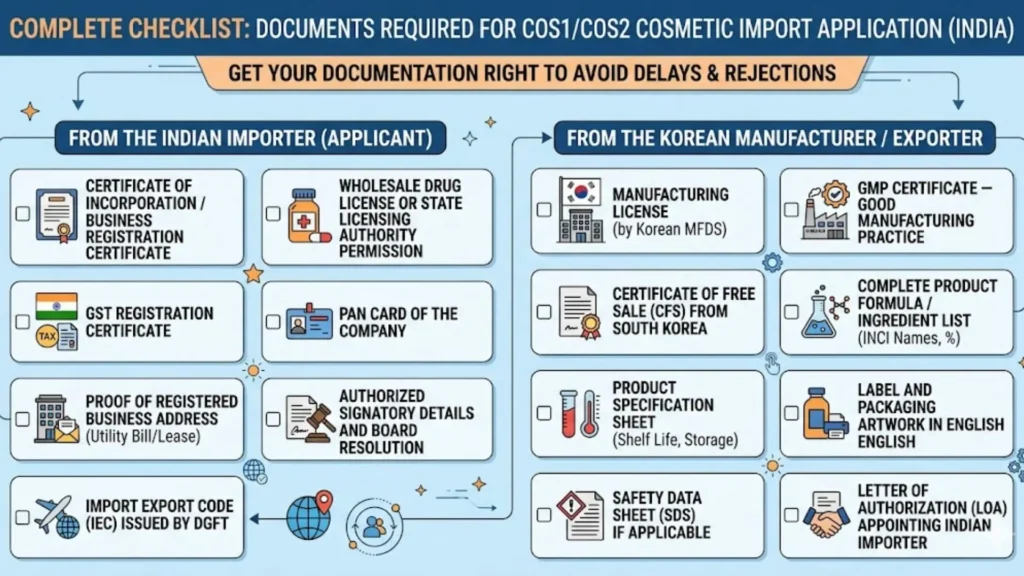
Documents Required for COS-1 Application
| S.No. | Document | Who Provides It |
| 1 | Duly filled Form COS-1 (online via SUGAM portal) | Indian Applicant |
| 2 | Certificate of Incorporation / Business Registration | Indian Applicant |
| 3 | Authorisation Letter from Korean Manufacturer | Korean Brand / Manufacturer |
| 4 | Manufacturing Licence of Korean Brand (MFDS Certificate) | Korean Manufacturer |
| 5 | Certificate of Free Sale (CFS) from Korean authority | Korean Manufacturer / MFDS |
| 6 | Product formulation / complete list of ingredients (INCI names) | Korean Manufacturer |
| 7 | Certificate of Analysis (COA) for each product | Korean Manufacturer |
| 8 | Safety Data Sheet (SDS) or Cosmetic Product Safety Report (CPSR) | Korean Manufacturer |
| 9 | Label artwork (proposed Indian label complying with Cosmetics Rules 2020) | Indian Applicant |
| 10 | Undertaking for compliance with Indian cosmetic laws | Indian Applicant |
| 11 | Challan / proof of payment of CDSCO fee | Indian Applicant |
| 12 | Site Master File (for manufacturing site of Korean brand) | Korean Manufacturer |
| 13 | GMP certificate (ISO 22716 or equivalent) | Korean Manufacturer |
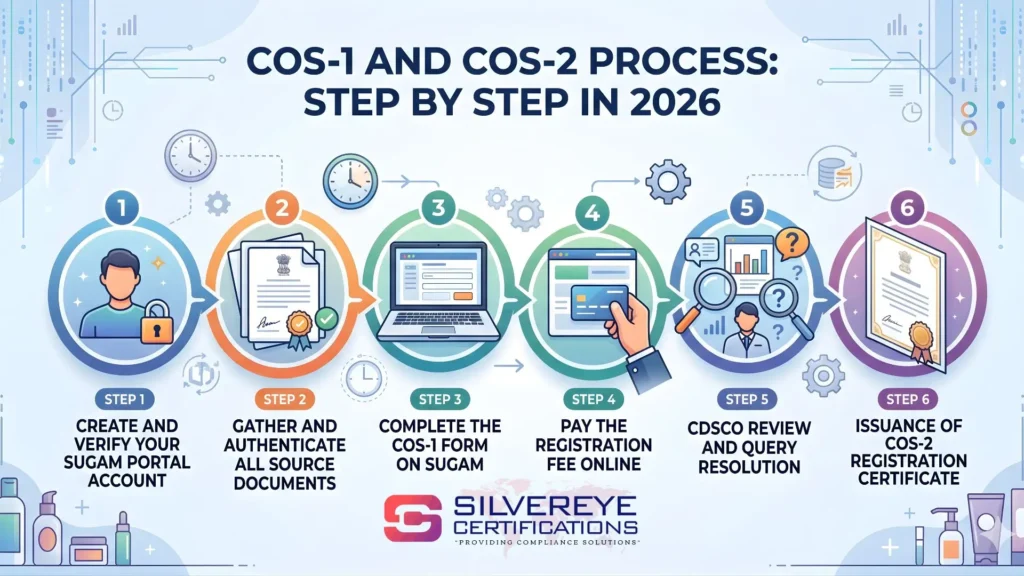
Step-by-Step COS-1 Application Process
- Register on the CDSCO SUGAM portal (sugam.gov.in) and create an applicant account.
- Select 'Cosmetic Import License' and fill in Form COS-1 online with all product details.
- Upload all required documents in PDF format. Each document must be clear and self-attested.
- Pay the government fee online via NEFT/RTGS/net banking through the portal.
- Submit the application. CDSCO assigns a unique application reference number.
- CDSCO scrutinizes the application — may raise queries within 30 working days.
- Respond to any CDSCO queries with additional documents or clarifications within the stipulated time.
- Upon satisfactory review, CDSCO issues Form COS-2 (Cosmetic Import License) digitally.
- Download the COS-2 license from the SUGAM portal. This authorizes import of listed products.
COS-1 / COS-2 Government Fee Structure
| Application Type | Number of Products | Government Fee (INR) |
| New Cosmetic Import Licence | Up to 5 products | INR 3,000 per product |
| New Cosmetic Import Licence | 6 to 20 products | INR 2,500 per product |
| New Cosmetic Import Licence | 21 products and above | INR 2,000 per product |
| Addition of New Products to existing licence | Per product | INR 2,000 per product |
| Renewal of Cosmetic Import Licence | Per licence | 50% of original fee |
| Amendment (name/address change) | Per application | INR 2,000 |
Note: Fees indicated above are approximate government fees based on available CDSCO schedules. Professional service/consultation fees are separate and vary by service provider. Always confirm the latest fee structure on the official CDSCO SUGAM portal before applying.
COS-2 License Validity and Renewal
- Validity: 3 years from the date of issue
- Renewal must be applied 6 months before the expiry date to avoid lapse
- A lapsed license requires fresh application and fees as a new application
- Renewal is processed through the SUGAM portal using Form COS-1 (renewal option)
Cosmetic Manufacturing License Registration — COS-5 (Application) and COS-8 (Grant of License)
If a Korean brand or an Indian company wants to manufacture cosmetic products in India — whether at their own facility or at a third-party contract manufacturing unit — they need a Cosmetic Manufacturing Licence. This applies to:
- Korean brands setting up manufacturing operations in India
- Indian companies manufacturing Korean-formulation cosmetics for domestic sale or export
- Contract manufacturers producing cosmetics for Korean brands in India
What is Form COS-5?
Form COS-5 is the application form for a Cosmetic Manufacturing License in India. It is submitted to the State Licensing Authority (SLA) — typically the State Drug Controller or State FDA — where the manufacturing facility is located. Unlike import licences, manufacturing licences are granted by state authorities, not CDSCO centrally.
What is Form COS-8?
Form COS-8 is the Cosmetic Manufacturing Licence issued by the State Licensing Authority upon approval of Form COS-5. This document legally authorises the holder to manufacture specific categories of cosmetics at the registered facility.
COS-5 Eligibility — Who Can Apply?
- Indian companies or LLPs with a registered manufacturing premises in India
- The facility must comply with GMP standards as per Schedule M-III of Cosmetics Rules 2020
- Qualified Technical Staff (Diploma or Degree in Pharmacy, Chemistry, or related sciences) must be present
- The premises must have adequate manufacturing, testing, and storage infrastructure
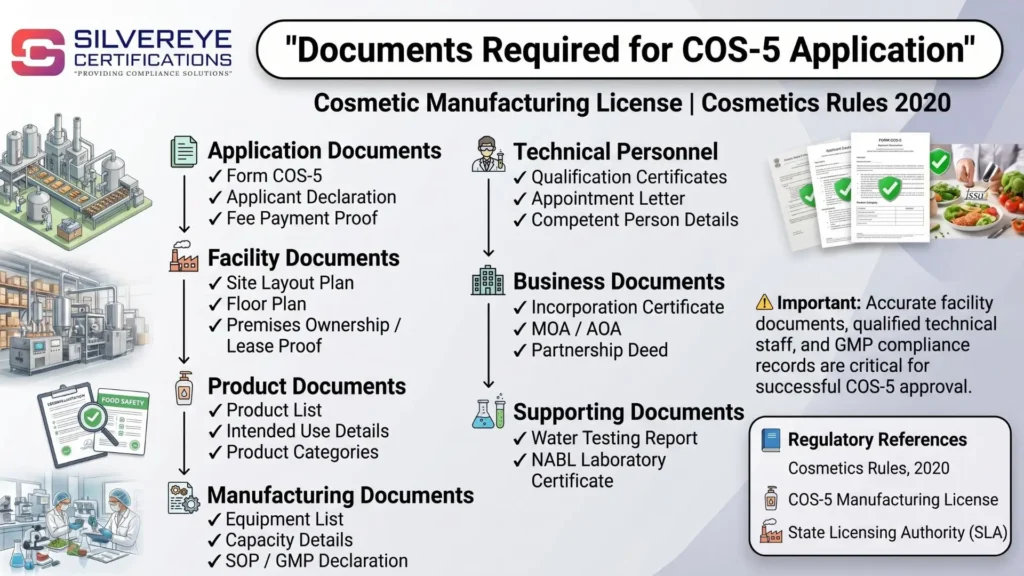
Documents Required for COS-5 Application
| S.No. | Document | Details |
| 1 | Duly filled Form COS-5 | Application form as per Cosmetics Rules 2020 |
| 2 | Site Layout Plan and Floor Plan | Showing manufacturing areas, testing labs, stores |
| 3 | Ownership / Tenancy documents for premises | Lease deed, ownership proof of manufacturing site |
| 4 | List of cosmetic products to be manufactured | With product category and intended use |
| 5 | List of manufacturing equipment | With make, model, and capacity details |
| 6 | Qualification certificate of Technical Staff | B.Pharm, M.Pharm, B.Sc Chemistry, or equivalent |
| 7 | Appointment letter of Technical Staff / Competent Person | Employment proof |
| 8 | GMP compliance declaration / SOP list | Standard Operating Procedures summary |
| 9 | Water testing report (if purified water used) | From NABL-accredited lab |
| 10 | Treasury Challan / Fee payment proof | State government fee as applicable |
| 11 | Declaration / Undertaking by applicant | Compliance with Cosmetics Rules 2020 |
| 12 | Partnership deed / MOA / AOA / Incorporation certificate | Company constitution documents |
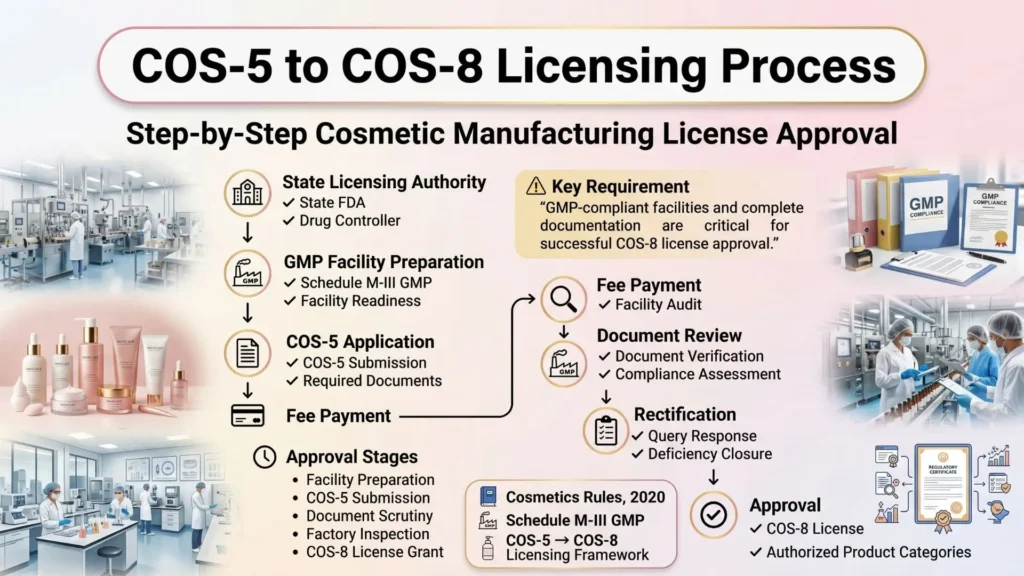
Step-by-Step COS-5 to COS-8 Process
- Identify the State Licensing Authority (State FDA / Drug Controller) where your factory is located.
- Prepare the manufacturing facility to comply with GMP norms under Schedule M-III of Cosmetics Rules 2020.
- Submit Form COS-5 along with all required documents and state government fee at the SLA office or via the state drug licensing portal.
- The SLA will inspect the manufacturing premises — ensure GMP compliance before inspection.
- Address any deficiencies raised during inspection or in the scrutiny letter.
- Upon successful inspection and document verification, SLA issues Form COS-8 (Manufacturing License).
- The COS-8 license lists the specific product categories and forms (cream, lotion, shampoo, etc.) authorized for manufacture.
COS-8 Manufacturing License Fee and Validity
| Licence Type | Approx. Government Fee (INR) | Validity |
| New Cosmetic Manufacturing Licence (small scale) | INR 10,000 – 25,000 (state-specific) | 3 years |
| New Cosmetic Manufacturing Licence (large scale) | INR 25,000 – 50,000 (state-specific) | 3 years |
| Renewal of Manufacturing Licence | 50% of original fee (approx.) | 3 years |
| Amendment (product addition, area expansion) | State-specific fee | As applicable |
Note: Manufacturing license fees are state-specific and vary across Maharashtra, Delhi, Haryana, Tamil Nadu, and other states. Confirm the latest fees with your State FDA before applying.
Cosmetic Loan License — Form COS-9
A Loan License (also called Contract Manufacturing License or Third-Party Manufacturing License) allows a brand owner to have their cosmetic products manufactured at another company's licensed manufacturing facility. The brand owner does not need to own a factory but uses the infrastructure, equipment, and GMP compliance of the contract manufacturer (the lender).
This is one of the most common models used by Korean beauty brands entering India — they tie up with an FSSAI/CDSCO-compliant Indian contract manufacturer without investing in a plant.
What is Form COS-9?
Form COS-9 is the application form for a Cosmetic Loan Manufacturing License. It is submitted to the State Licensing Authority (SLA). A loan licence holder (the brand/borrower) is authorised to manufacture or get manufactured specific cosmetic products under their own brand name at the licensed manufacturer's (lender's) facility.
Who Needs a COS-9 Loan License?
- Korean brands wanting Indian-manufactured products without owning a factory
- Indian brand owners outsourcing manufacturing to a contract manufacturing unit (CMU)
- Startups and SMEs in K-beauty, private label cosmetics, or white-label cosmetics
- D2C cosmetic brands that manufacture on a contract basis
Key Differences: COS-5/COS-8 vs COS-9
| Aspect | COS-5 / COS-8 (Own Manufacturing) | COS-9 (Loan / Contract Manufacturing) |
| Factory Required? | Yes — own facility mandatory | No — uses lender's facility |
| Who applies? | Facility owner (manufacturer) | Brand owner (borrower) |
| Technical Staff | Must have own qualified staff | Lender's staff used |
| GMP Compliance | Own GMP premises needed | Lender's GMP compliance suffices |
| Ideal For | Large-scale manufacturers | Startups, small brands, Korean brands entering India |
| Licence Authority | State Licensing Authority (SLA) | State Licensing Authority (SLA) |
Documents Required for COS-9 Application
| S.No. | Document | Who Provides It |
| 1 | Duly filled Form COS-9 (Loan Licence application) | Brand owner (borrower) |
| 2 | Copy of Lender's COS-8 Licence (Manufacturing Licence) | Lender / Contract Manufacturer |
| 3 | Loan Licence Agreement between lender and borrower | Both parties (notarised) |
| 4 | List of products to be manufactured under loan licence | Brand owner |
| 5 | Proposed label artwork for each product | Brand owner |
| 6 | Incorporation certificate / business registration of borrower | Brand owner |
| 7 | Undertaking / Declaration by both parties | Both parties |
| 8 | Fee payment proof (state government fee) | Brand owner |
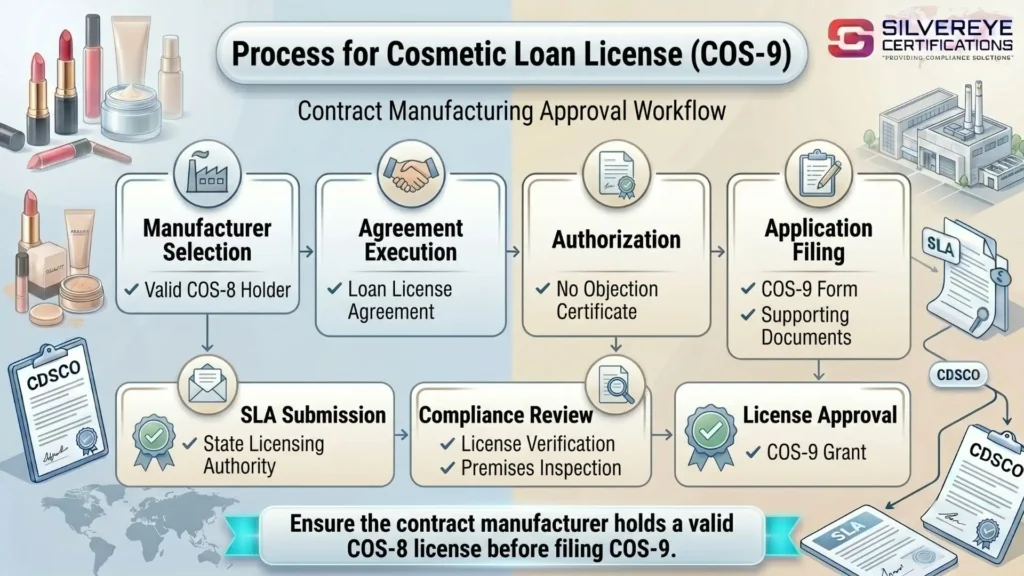
COS-9 License Validity, Fee, and Renewal
- Validity: 3 years from date of issue (co-terminus with lender's COS-8 license in many states)
- Approx. Government Fee: INR 5,000 – 15,000 (state-specific)
- Renewal: Must be applied 6 months before expiry with a fresh loan agreement
- If the lender's COS-8 license lapses or is cancelled, the COS-9 license automatically becomes invalid
CDSCO Korean Cosmetics Registration: Complete Process at a Glance
| Step | Activity | Form Used | Authority | Timeline |
| 1 | Identify product category and verify cosmetic classification | — | Applicant | 1–3 days |
| 2 | Obtain authorisation from Korean manufacturer / MFDS documents | — | Korean brand | 2–4 weeks |
| 3 | Register on CDSCO SUGAM portal (sugam.gov.in) | — | CDSCO online | 1 day |
| 4 | Prepare and upload documents for import licence | COS-1 | CDSCO SUGAM | 1–2 weeks |
| 5 | Pay CDSCO government fee | COS-1 | CDSCO SUGAM | 1 day |
| 6 | CDSCO scrutiny and query resolution | — | CDSCO | 30–60 working days |
| 7 | Receipt of Cosmetic Import Licence | COS-2 | CDSCO (Central) | After scrutiny |
| 8 | Custom clearance with COS-2 licence at port of entry | — | Customs | 1–5 days per shipment |
| 9 | If manufacturing in India: State GMP inspection | COS-5 | State FDA / SLA | 1–3 months |
| 10 | Grant of Manufacturing Licence | COS-8 | State SLA | After inspection |
| 11 | If loan manufacturing: apply for Loan Licence | COS-9 | State SLA | 30–60 days |
Indian Labelling Requirements for Korean Cosmetics
One of the most common reasons CDSCO rejects or queries Korean cosmetic import license applications is non-compliant labelling. Korean product labels need to be adapted for the Indian market before import.
As per Rule 14 of the Cosmetics Rules 2020, every cosmetic sold in India must display the following on its label:
- Product name and generic name of the cosmetic
- Name and address of the manufacturer (Korean brand) and Indian importer
- Country of origin (Made in Korea / Republic of Korea)
- Batch number, manufacturing date, and expiry date (in DD/MM/YYYY or similar format)
- Net weight or volume in metric units (grams or millilitres)
- Complete list of ingredients in INCI (International Nomenclature of Cosmetic Ingredients) order — descending by weight
- Directions for use and precautions / warnings
- MRP (Maximum Retail Price) inclusive of all taxes — mandatory for India
- Customer care contact number or address
- CDSCO license number (COS-2 number) of the importer
Important: Korean-language-only labels are not permitted. The label must either be in English or have an English sticker / additional label affixed with all mandatory information.
Prohibited and Restricted Ingredients in Korean Cosmetics for India
India follows its own list of prohibited and restricted cosmetic ingredients as specified in the Cosmetics Rules 2020 (Second Schedule). Korean cosmetic formulations must be checked against this list before registration. Some ingredients commonly used in K-beauty products may be restricted or prohibited in India.
| Category | Examples of Concern for K-Beauty | India Status |
| Hydroquinone (skin lightening) | Used in depigmentation creams | Restricted (requires prescription) |
| Mercury compounds | Found in some older brightening creams | Prohibited |
| Formaldehyde (high concentrations) | Preservative in some formulas | Restricted to trace levels |
| Certain hair dye intermediates | PPD and other oxidative dyes | Restricted — concentration limits apply |
| Retinoids (Retinol > certain %) | Anti-aging serums | Restricted above certain concentrations |
| Certain UV filters | Oxybenzone, etc. | Only approved UV filters permitted |
| Stem cell extracts (animal-derived) | Some premium K-beauty serums | May require additional clearance |
Always verify the full ingredient list against India's Cosmetics Rules 2020 Second Schedule prohibited/restricted list before filing the COS-1 application. Formulations with prohibited ingredients will be rejected.
Common Reasons for CDSCO Cosmetic License Rejection
- Incomplete or incorrectly filled Form COS-1 or COS-5
- Missing or invalid Certificate of Free Sale (CFS) from Korea
- MFDS manufacturing license of the Korean brand not matching the product scope
- Non-compliant Indian label — missing MRP, INCI ingredients, or CDSCO importer number
- Prohibited or restricted ingredients found in the product formulation
- Authorization letter from Korean brand not notarized or apostilled as required
- Mismatch between declared manufacturing site and CFS issuing authority
- Fee payment mismatch or use of incorrect challan
- Failure to respond to CDSCO queries within the stipulated 30-day window
- Safety data sheet (CPSR) not meeting EU Cosmetic Regulation or equivalent international standards
Benefits of CDSCO Korean Cosmetics Registration
- Legal authorization to import, distribute, and sell Korean cosmetic products in India
- Access to one of the fastest-growing beauty markets in the world — India's cosmetics market is projected to exceed USD 35 billion by 2030
- Ability to sell on major Indian e-commerce platforms (Amazon India, Flipkart, Nykaa, Myntra) — all require CDSCO compliance
- Protects the brand from regulatory action, product seizure, or market ban
- Builds consumer trust — CDSCO-registered Korean cosmetics signal safety and authenticity
- Enables participation in Indian retail, pharmacy chains, and hotel amenity supply chains
- Mandatory for participating in Indian government or institutional tenders for cosmetics
- Reduces customs clearance delays — CDSCO license is required at India's ports of entry
CDSCO SUGAM Portal — How to Apply Online
CDSCO's SUGAM portal is the official online platform for all cosmetic license applications. As of 2026, the majority of CDSCO cosmetic import license applications must be submitted online. Here is how to navigate it:
- Go to sugam and portal register as a new applicant using your company PAN, CIN, or GSTIN.
- Under 'Cosmetics', choose 'Import License' and select the appropriate application type (new license, renewal, amendment, or product addition).
- Fill in Form COS-1 online — product details, Korean manufacturer details, Indian importer details.
- Upload supporting documents. File size limits apply — keep each document under 5 MB.
- Generate and pay the fee online. Download the payment receipt (challan).
- Submit the application and download the acknowledgment with application number.
- Track application status on the SUGAM dashboard. Respond to queries via the portal.
- Download your COS-2 license from the SUGAM portal once issued.
Renewal, Amendment, and Transfer of CDSCO Cosmetic Licenses
Renewal of COS-2 (Import License)
- Apply at least 6 months before expiry via the SUGAM portal
- Submit updated documents if any have changed (new authorization letter, updated CFS, etc.)
- Fee: approximately 50% of the original application fee per product
- CDSCO typically processes renewals within 30–45 working days
Renewal of COS-8 (Manufacturing License)
- Apply to State Licensing Authority 6 months before expiry
- Premises re-inspection may be conducted at the SLA's discretion
- Updated GMP compliance report and staff qualifications to be submitted
Amendment of Licenses
- Change of Indian importer's name or address — Amendment Form via SUGAM (fee applies)
- Change of Korean manufacturer's address — Amendment with updated CFS and authorization
- Addition of new products — treated as a product addition, fee per product applies
- Change of Korean manufacturer (new brand tie-up) — fresh application or amendment per CDSCO guidelines
Transfer of License
- Import licenses (COS-2) are generally non-transferable
- Change of importing entity requires fresh COS-1 application
- Manufacturing licence (COS-8) transfer requires prior SLA approval with complete fresh documentation
CDSCO vs BIS — Do Korean Cosmetics Need BIS Registration?
This is a common question for Korean brands entering India. BIS (Bureau of Indian Standards) and CDSCO have separate but sometimes overlapping mandates for cosmetics.
| Parameter | CDSCO | BIS (Bureau of Indian Standards) |
| Primary Role | Safety, efficacy, and regulatory approval of cosmetics | Standards and quality certification |
| Mandatory for Cosmetics? | Yes — for import and manufacture in India | Not currently mandatory for most cosmetics (as of 2026) |
| Application Form | COS-1 (import) / COS-5 (manufacture) | BIS CRS / ISI Mark scheme |
| Products Covered | All cosmetics imported or manufactured in India | Specific product categories under mandatory BIS (if notified) |
| Authority | Central — CDSCO, Ministry of Health | Central — BIS, Ministry of Consumer Affairs |
As of 2026, BIS certification is not mandatorily required for most Korean cosmetic categories in India. However, monitor BIS notifications as India is gradually expanding mandatory certification to more product categories.
Conclusion: Your 2026 Roadmap for CDSCO Korean Cosmetics Registration
Registering Korean cosmetics under CDSCO is not a single-step process. It is a structured regulatory journey — from verifying product classification, gathering Korean manufacturer documents, applying for COS-1 on the SUGAM portal, getting your COS-2 import license, and then managing renewals, amendments, and additions over time.
If you are manufacturing in India — whether through your own plant (COS-5 / COS-8) or through a contract manufacturer (COS-9) — the requirements differ and the timelines are longer due to GMP inspections.
The key to a smooth CDSCO Korean cosmetics registration is:
- Get all documents from your Korean manufacturer early — especially CFS, MFDS license, and GMP certificate
- Ensure your Indian label design is compliant with Cosmetics Rules 2020 before submitting
- Verify your product formulation against India's prohibited/restricted ingredient list
- Respond to all CDSCO queries within the stipulated window — delays extend timelines
- Renew your license 6 months in advance to avoid a lapse that forces fresh application
K-beauty is a high-growth segment in India and the regulatory pathway is well-defined. With the right preparation and professional guidance, CDSCO Korean cosmetics registration is entirely achievable within a reasonable timeframe.
Frequently Asked Questions
Is CDSCO registration mandatory for all Korean cosmetics sold in India?
Yes. Any cosmetic product imported into India, including all Korean skincare, makeup, and hair care, must have a valid CDSCO Cosmetic Import License (Form COS-2). Selling without this license is a violation of the Drugs and Cosmetics Act 1940 and can result in product seizure and penalties.
Can a Korean brand apply for CDSCO registration directly, or does it need an Indian partner?
A Korean brand cannot apply directly to CDSCO for an import license. The application must be filed by an Indian entity — an Indian importer, distributor, or authorized Indian agent. The Korean brand provides the authorization, MFDS license, and product documents.
How long does it take to get a CDSCO Cosmetic Import License (COS-2)?
Typically, CDSCO takes 60 to 120 working days from the date of a complete application. If queries are raised, the timeline extends. Having all documents correct and complete before submission significantly reduces the time.
How many products can be covered in one COS-1 application?
There is no strict limit on the number of products per application. However, each product requires individual product details, safety data, and formulation information. The government fee is charged per product.
What is the difference between COS-5 and COS-9?
COS-5 is the application for a manufacturing licence for a company with its own factory. COS-9 is for loan/contract manufacturing, where a brand owner gets products made at another company's licensed facility without owning a factory.
Can Korean cosmetics with SPF be imported under a regular cosmetic license?
Yes, sunscreen products with SPF up to 50 are generally classified as cosmetics and can be imported under COS-2. However, products with SPF above 50 or those making therapeutic or dermatological claims may be classified as drugs, requiring a separate drug import licence.
What is a Certificate of Free Sale (CFS) and why is it needed?
A Certificate of Free Sale (CFS) is an official document issued by the Korean regulatory authority (MFDS or KITA) certifying that the product is freely sold in South Korea without restriction. CDSCO requires this to ensure the product meets safety standards in its country of origin.
What happens if a Korean cosmetic is imported without a CDSCO licence?
Importing cosmetics without a valid CDSCO COS-2 license is illegal under the Drugs and Cosmetics Act 1940. Consequences include product seizure at the port of entry, penalties on the importer, legal prosecution, and a ban on future imports. Always obtain the license before shipping.
Is the COS-9 Loan Licence valid across all Indian states?
The COS-9 Loan License is issued by the State Licensing Authority of the state where the lender's (contract manufacturer's) factory is located. Its validity and scope are governed by that state's regulations. If you sell across India, the products manufactured under COS-9 can be sold nationally, but the license itself is state-specific.
How do I renew a lapsed CDSCO cosmetic import license?
If your COS-2 license has already lapsed (expired), renewal is typically not possible. You must file a fresh COS-1 application as a new license request with full documentation and fee. This is why renewing at least 6 months before expiry is strongly recommended.