
- BIS offices in Delhi: The Central Regional Office and Delhi Branch Offices I and II are located at Konnectus Tower, Bhavbhuti Marg, near New Delhi Railway Station.
- Two application procedures: Manufacturers can apply through the Normal Procedure (Option 1) or the Simplified Procedure (Option 2), where the product is eligible. BIS guidelines specify expected processing periods of 90 days and 30 days, respectively, subject to satisfactory documentation, assessment and product conformity. Applications are submitted online through the Manak Online portal.
- BIS certification fees: The standard charges include a ₹1,000 application fee, ₹7,000 per man-day inspection fee and ₹1,000 annual license fee, along with the applicable product-specific minimum marking fee. Eligible micro and small enterprises and startups may receive concessions on the minimum marking fee, subject to BIS conditions.
- License validity and annual compliance: Since the 2026 amendments, an initial BIS license can be granted for up to five years. However, applicable annual fees and production statements must still be submitted as required by BIS.
Introduction
A BIS ISI Mark Certification consultant in Delhi helps manufacturers understand the requirements for obtaining and maintaining a BIS license under Scheme-I of the BIS (Conformity Assessment) Regulations, 2018. The support may include checking the applicable Quality Control Order (QCO), identifying the relevant Indian Standard, preparing the application and documents, and helping the manufacturer get its factory and testing arrangements ready for BIS assessment.

A consultant can assist with the following:
- QCO and product applicability check: Review whether the product is covered by a mandatory Quality Control Order and identify the applicable Indian Standard, product scope and compliance requirements.
- Procedure selection: Explain the two application routes: Normal Procedure (Option 1) and Simplified Procedure (Option 2). Option 2 is available only for products listed as eligible under the current BIS guidelines and subject to the prescribed conditions. A recent test report from a BIS-recognized laboratory does not, by itself, make every product eligible.
- Documentation and online filing: Help prepare the required documents, complete the applicable application details and submit the application through the official Manak Online portal.
- Factory readiness support: Review manufacturing facilities, machinery, in-house testing arrangements, quality-control procedures and records against the applicable product requirements before the BIS visit.
- Testing coordination: Guide the manufacturer on sample testing, laboratory requirements and follow-up on test reports, as applicable to the selected procedure.
- BIS assessment and query support: Help the manufacturer understand observations, prepare responses and coordinate the required corrective actions. The actual factory assessment and certification decision remain with BIS.
- Post-license assistance: Provide guidance on production records, marking-fee payments, annual compliance requirements, scope changes and license renewal.
Why Delhi and NCR Manufacturers Prefer Local BIS ISI Certification Support
BIS ISI Mark applications are submitted online through the Manak Online portal, so a consultant does not necessarily need to be based in Delhi. However, manufacturers in Delhi and the National Capital Region (NCR) may prefer local consultancy support because factory assessment, sample collection and manufacturing-readiness checks involve practical coordination at the production unit.

Local support can be useful for manufacturers operating in industrial areas such as Okhla, Wazirpur, Bawana, Narela and Mayapuri, as well as nearby locations in Noida, Ghaziabad, Faridabad and Gurugram.
Here are some practical reasons to consider local assistance:
- Factory-readiness review: A consultant can visit your manufacturing unit, review the available machinery, testing equipment, quality-control arrangements and records, and identify gaps before the BIS assessment. This is a preparatory review, not an official BIS inspection.
- Laboratory coordination: Product samples may need to be sent to a laboratory for testing. A consultant can help identify a laboratory recognized by BIS for the relevant Indian Standard and coordinate sample dispatch and test-report requirements.
- Manufacturing-premises documentation: Applicants should ensure that the factory address and supporting premises documents are consistent with the application. Depending on the arrangement, supporting records may include an ownership document, lease or rent agreement, allotment letter and utility bill, as applicable.
- Application and query support: Local assistance can make it easier to review documents, discuss factory-level requirements and coordinate responses to BIS observations. Official communication and application tracking still take place through the applicable BIS channels and portal.
- Preparation for the BIS visit: A pre-assessment review can help the manufacturer organize production records, testing facilities, calibration documents, quality-control procedures and other applicable records before the BIS officer visits.
BIS Offices in Delhi: Addresses and Contact Details
The Bureau of Indian Standards (BIS) has its Central Regional Office and two Delhi Branch Offices at Konnectus Tower, Bhavbhuti Marg, near New Delhi Railway Station. The Central Laboratory is located in Sahibabad, Ghaziabad.
The following details are listed in the BIS online directory:
| BIS office or facility | Official address | Purpose |
|---|---|---|
| Central Regional Office (CRO) | 601/A, Konnectus Tower-1, 6th Floor, DMRC Building, Bhavbhuti Marg, New Delhi | Regional administrative office |
| Delhi Branch Office-I (DLBO-I) | Unit 601-A, 6th Floor, Tower-1, Konnectus Tower, DMRC Building, Bhavbhuti Marg, near New Delhi Railway Station Gate No. 2, New Delhi | BIS branch office handling its assigned functions and applications |
| Delhi Branch Office-II (DLBO-II) | 601-A, Konnectus Tower-1, 6th Floor, DMRC Building, Bhavbhuti Marg, New Delhi | BIS branch office handling its assigned functions and applications |
| BIS Central Laboratory | Plot No. 20/9, Site IV, Sahibabad Industrial Area, Sahibabad, Uttar Pradesh – 201010 | BIS laboratory facility; product testing depends on the applicable testing scope and requirements |
Which BIS office should you contact?
The appropriate branch office depends on the factory's location and the jurisdiction applicable to the application. Do not assume that every Delhi or NCR manufacturer must approach the same branch. Check the relevant BIS directory or contact the branch office before planning a visit.
Also, the BIS Central Laboratory in Sahibabad is not automatically the testing laboratory for every product. Laboratory selection depends on whether the facility is recognized for the relevant Indian Standard and the applicable testing requirements.
Do You Need a BIS ISI Mark Certification Consultant in Delhi?
Manufacturers can apply for BIS certification directly through the Manak Online portal. Hiring a consultant is not compulsory. However, professional assistance may be useful when the manufacturer is unfamiliar with BIS procedures, product standards, factory documentation or testing requirements.
| Your situation | Can you apply independently? | When consultancy support may help |
|---|---|---|
| Product requirements are clear and your team understands BIS procedures | Yes | A document review can help identify gaps before submission |
| First BIS application for a Delhi or NCR factory | Yes | Guidance can help with product classification, documentation and factory preparation |
| Unsure about the applicable Indian Standard or QCO | Possible, after checking official requirements | Assistance with product and regulatory applicability checks |
| Unsure about laboratory recognition or testing requirements | Possible, if you can verify the applicable laboratory and procedure | Help with laboratory selection and sample-testing coordination |
| Multiple products or manufacturing locations | Yes, with separate applicable requirements | Support with application planning, product-wise documentation and coordination |
| Annual fees, production statements and renewal requirements need tracking | Yes | A compliance calendar can help organise due dates and records |
Important: A consultant is not mandatory for BIS certification and cannot influence the independent certification decision. The manufacturer remains responsible for product conformity and compliance with the applicable BIS requirements.
What Should a BIS ISI Mark Certification Consultant in Delhi Actually Do?
A reliable BIS consultant should provide practical guidance on the certification process rather than promise guaranteed approval or a fixed grant date. Before engaging a consultant, ask for a clear scope of work covering the following activities:
| Consultancy service | What the support should include | Why it matters |
|---|---|---|
| QCO and Indian Standard verification | Check the product's applicable Quality Control Order, Indian Standard and product manual | Helps establish whether certification is mandatory and which requirements apply |
| Certification route guidance | Assess whether the product is eligible for Option 1 or Option 2 under the current BIS guidelines | Helps identify the applicable procedure and testing requirements |
| Factory-readiness review | Review manufacturing machinery, testing equipment, calibration records, quality-control staff and production arrangements | Helps identify gaps before the official BIS factory assessment |
| Laboratory coordination | Identify a BIS-recognised laboratory for the relevant Indian Standard and coordinate testing requirements | Helps avoid relying on an unsuitable laboratory or test report |
| Document preparation | Assist with Form-V, the Self-Evaluation-cum-Verification Report and other applicable declarations and supporting records | Helps maintain consistency between the application and factory records |
| Manak Online application support | Guide the applicant through online registration, application submission, document uploads and applicable payments | Helps ensure that the application information is complete and accurate |
| BIS query and assessment preparation | Help organise responses to observations and prepare the manufacturer for the official factory visit | Supports timely and accurate communication |
| Post-licence compliance guidance | Help track annual fees, production statements, surveillance requirements, scope changes and renewal dates | Helps the manufacturer maintain compliance after receiving the licence |
Important Points About BIS Timelines and Annual Compliance
- Processing time: BIS guidelines dated 25 February 2026 specify expected processing periods of 90 days under Option 1 and 30 days under Option 2, subject to the prescribed conditions, satisfactory factory assessment and product conformity at the first instance. These are not guaranteed approval dates.
- Option 2 test reports: The Simplified Procedure is available only for eligible products under the current BIS guidelines. The latest test report must generally be no more than 90 days old when the application is received; where multiple reports are submitted, the oldest report is generally subject to a 180-day limit.
- Annual payment and production statement: Applicable annual fees and production statements must be submitted by the prescribed due date. Under the amended BIS provisions, non-receipt can result in suspension of the licence for 90 days. Payment within that period, together with the prescribed ₹5,000 late fee, may revoke the suspension, subject to the applicable conditions. Failure to comply within the suspension period can lead to cancellation.
How to Choose a BIS ISI Mark Certification Consultant in Delhi
Selecting a BIS ISI Mark certification consultant in Delhi requires more than comparing professional fees. The consultant should understand Scheme-I requirements, the applicable Indian Standard, product-specific testing procedures and factory assessment requirements. Before appointing one, verify their technical knowledge, service scope, payment practices and post-licence support.
Use the following checklist to evaluate a consultant:
| Criterion | What to ask or verify | Good sign | Warning sign |
|---|---|---|---|
| Knowledge of Scheme-I | Can they explain Option 1 and Option 2, test-report validity and applicable marking-fee payments? | Answers supported by current BIS guidelines | Confuses Scheme-I with CRS or gives outdated information |
| Product-specific experience | Have they worked with your Indian Standard or a similar product category? | Understands the relevant product manual and testing requirements | Claims expertise in every product without explaining the requirements |
| Realistic timelines | What processing time do they expect, and what could cause delays? | Explains the 90-day and 30-day expected timelines and relevant conditions | Guarantees a fixed licence-grant date |
| Itemised professional fees | Are BIS fees, laboratory charges and consultancy fees listed separately? | Written quotation with a clear cost breakdown | One unexplained lump-sum amount |
| BIS fee payments | How will official BIS fees be paid? | Payments made through the official Manak Online portal | Requests to transfer government fees to a personal account |
| Factory involvement | Will they review your manufacturing and testing arrangements? | Offers a defined factory-readiness review where required | Provides paperwork support without understanding factory requirements |
| Post-licence assistance | Do they help track annual fees, production statements and renewal requirements? | Clear post-licence service scope and compliance reminders | No support after the licence is granted |
| Verifiable references | Can they share client-approved examples of relevant work? | References or case examples shared with permission | Unverifiable client logos or unsupported claims |
| Named accountability | Who will manage your application and communicate updates? | A designated contact person and defined responsibilities | No clear point of contact |
Red Flags to Watch for When Hiring a BIS Consultant in Delhi
A consultant's office near Manak Bhavan or Bhavbhuti Marg, photographs outside a BIS building, or claims of personal connections with BIS officers do not establish official authorisation or certification expertise.
BIS independently processes applications and grants licences. Do not assume that a private consultant is officially appointed, approved or recommended by BIS unless this is independently confirmed through an official BIS source.
Be cautious if someone:
- Promises a guaranteed BIS licence or a special fast-track approval.
- Claims they can influence a BIS inspection or change a failed test report.
- Requests government fees in a personal bank account or through an unofficial payment channel.
- Pressures you to pay immediately to resolve an alleged BIS objection.
- Uses an official-looking email, letterhead or identity without verifiable confirmation.
For application status, payment requirements and official communications, use the Manak Online portal and verify doubtful requests directly with the relevant BIS Regional or Branch Office.
BIS Normal vs Simplified Procedure for a Delhi Factory
Under Scheme-I, BIS provides two routes for grant of an ISI Mark license: Normal Procedure (Option 1) and Simplified Procedure (Option 2). The applicable route depends on the product category and current BIS guidelines. Manufacturers cannot freely select Option 2 for every product simply because they have a laboratory test report.
| Point | Normal Procedure (Option 1) | Simplified Procedure (Option 2) |
|---|---|---|
| Test report before application | A complete product test report is not generally required as a prerequisite in the same way as Option 2; applicable raw-material evidence may still be required | Conforming product test report from an accepted laboratory is required |
| Product eligibility | Available for products covered under Option 1 and other cases processed through this route | Only products listed under Annexure II(C) of the applicable BIS guidelines; not available to foreign manufacturers |
| Test-report age | Not subject to the Option 2 pre-application report-age rule in the same way | Latest report generally not more than 90 days old; where multiple reports are submitted, the oldest generally must not exceed 180 days |
| Factory assessment | BIS assesses manufacturing infrastructure, production processes, quality control and testing arrangements | BIS also conducts a factory assessment |
| Sample drawal | Samples are drawn for testing in a third-party laboratory, unless the case is processed on a permitted factory-testing basis | BIS draws a verification sample during the factory visit; a counter sample is also drawn |
| Expected processing period | 90 days, subject to satisfactory documentation, assessment and product conformity at the first instance | 30 days, subject to satisfactory factory assessment and conformity at the first instance |
| Product testing charges | Testing charges for the applicable samples are borne by the applicant | Testing charges for the BIS verification sample are included within the applicable minimum marking fee |
| If the verification sample fails | An application may be processed for rejection under the applicable rules, including the provisions for repeated sample failure | Licence suspension is imposed immediately; corrective action and fresh conforming samples are required |
| Typical consideration | Relevant where Option 1 applies, including products not eligible for Option 2 | Relevant for eligible domestic manufacturers who meet the prescribed testing and documentation conditions |
What about a new product with no previous BIS license?
BIS treats a product for which no licence has previously been granted as an All India First Licence case. Such applications are generally processed under Option 1, although the 2026 guidelines permit consideration under Option 2 in specified circumstances where information about an available third-party laboratory exists. BIS aims to process an All India First Licence case within 45 days of application submission, unless the minimum testing time required for the product makes this impracticable.
These are BIS processing expectations, not guaranteed approval dates. The actual duration depends on product testing, factory readiness, documentation and conformity with the applicable Indian Standard.
Documents Delhi Manufacturers Should Keep Ready for BIS ISI Certification
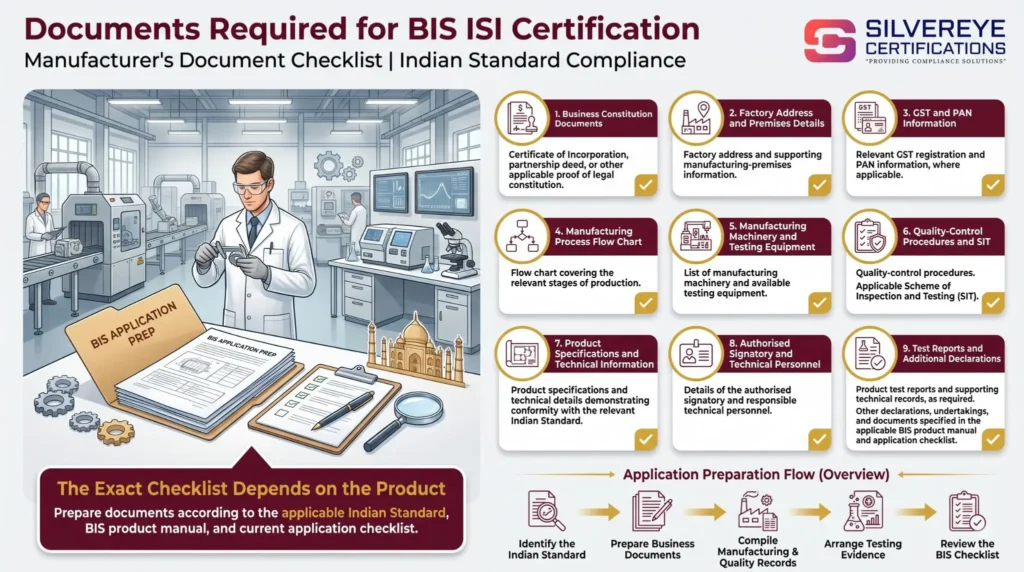
The documents required for a BIS ISI Mark application depend on the product, applicable Indian Standard, certification route and manufacturing arrangements. The following checklist covers common documents and records that manufacturers may need to prepare.
| Document or record | What to check |
|---|---|
| Form-V application and applicable declarations | Provide accurate manufacturer, factory, product and authorised-signatory details |
| Business constitution and identity documents | Keep company, LLP, partnership or proprietorship records, as applicable |
| Factory address and premises documents | Keep relevant ownership, lease, rent or allotment documents and supporting address records |
| Factory location plan and plant layout | Clearly identify manufacturing, storage and testing areas |
| Manufacturing process flow chart | Explain the production stages and relevant process controls |
| Machinery and testing equipment details | Prepare equipment lists and confirm that required testing facilities or arrangements are available |
| Calibration certificates | Keep valid calibration records for applicable testing equipment |
| Quality-control personnel details | Maintain names, qualifications and responsibilities of the relevant personnel |
| Self-Evaluation-cum-Verification Report | Prepare the report in the applicable BIS format |
| Raw-material test certificates or reports | Provide evidence where required by the applicable product standard |
| Product test report | Required before filing under Option 2, subject to the applicable laboratory and report-validity conditions |
| Udyam Registration certificate | Keep it ready if you are claiming an applicable MSME concession |
| Additional declarations and undertakings | Provide long-duration test or Option 2 undertakings where applicable |
Do GST registration and local factory permissions need to be submitted in every BIS application?
Not necessarily. GST registration and local factory permissions should not be described as universal requirements for every Scheme-I application. The exact supporting documents depend on the application, the applicant's legal structure, the product-specific requirements and the live Manak Online checklist. Manufacturers should nevertheless maintain applicable factory permissions and premises records under the laws relevant to their business.
For a more detailed document-by-document checklist, read our guide on Documents Required for BIS ISI Mark Certification.
BIS ISI Mark Certification Fees in Delhi: Government Charges and Other Costs
BIS ISI Mark certification fees are prescribed centrally and are not different for Delhi manufacturers. However, the total cost varies according to the product, applicable Indian Standard, certification procedure, testing requirements and minimum marking fee.
The following table summarizes the main Scheme-I fee components:
| Fee component | Amount or calculation | When it applies |
|---|---|---|
| Application fee | ₹1,000 | At the time of application; non-refundable |
| Minimum marking fee | Product-specific; 50% at application and the balance at grant under the 2026 guidelines | At application and before licence grant; annual advance payment also applies |
| Inspection fee | ₹7,000 per man-day | Payable before the BIS inspection |
| Annual licence fee | ₹1,000 | At licence grant and for subsequent annual continuation |
| Sample testing | Option 1: applicant generally pays applicable third-party testing charges. Option 2: BIS verification-sample testing is included in the applicable minimum marking fee | Depends on the selected procedure and testing arrangement |
| Renewal application fee | ₹1,000 | When applying for licence renewal; non-refundable |
| Late fee for overdue annual dues | ₹5,000 | Applicable when the annual fee and production statement are submitted within the prescribed 90-day suspension period |
| Late fee for renewal after expiry | ₹5,000 | Applicable where the renewal application is submitted after the licence validity expires, as prescribed under the regulations |
| Change in scope | Depends on the applicable BIS processing-fee schedule | When adding varieties or making changes to the existing licence scope |
Important: Do not assume that every variety addition attracts a universal ₹5,000 charge. Check the current BIS change-of-scope fee schedule for the applicable product and application.
BIS Fee Concessions for MSMEs and Startups
Eligible enterprises may receive concessions on the minimum marking fee under the applicable BIS provisions. The current concession notification provides:
- Micro enterprises: 80% concession.
- Small enterprises: 50% concession.
- Eligible startups: 80% concession.
- Women entrepreneur enterprises: Additional 10% concession, subject to the applicable conditions.
These concessions are available until 31 May 2029, subject to eligibility and the relevant BIS notification. They apply to the minimum marking fee, not automatically to every BIS charge.
The product-specific minimum marking fee is one of the largest variables in the overall certification cost. Check the latest applicable tariff before preparing your budget.
For a detailed breakdown of application charges, marking fees and concessions, see our guide on BIS ISI Mark Certification Fees and Cost.
Consultancy and other expenses: A Delhi-based consultant may charge separate professional fees for documentation, factory-readiness reviews and application support. Laboratory testing, travel or other applicable expenses may also be additional. Ask for an itemised quotation and distinguish professional charges from official BIS payments.
BIS ISI Certification Timeline: From Delhi Factory Preparation to License Grant
The time required to obtain an ISI Mark license depends on the certification procedure, product testing, factory readiness, documentation and BIS assessment. The processing periods published in the BIS guidelines are expected timelines, not guaranteed approval dates.
The following is a practical preparation schedule for a Delhi or NCR manufacturer. The preparation stages are planning estimates, not mandatory BIS deadlines.
| Stage | Suggested activity | What to prepare |
|---|---|---|
| Weeks 1–2: Product and QCO assessment | Identify the applicable Indian Standard, product manual and QCO status | Product specifications, models, manufacturing details and applicable standard |
| Weeks 2–4: Factory-readiness review | Review machinery, testing equipment, calibration and quality-control arrangements | Factory layout, equipment records, process flow and quality-control documents |
| Weeks 3–6: Option 2 testing, where applicable | Arrange product testing before filing the application | Test samples and a report from a laboratory accepted under the applicable BIS guidelines |
| Application submission | Submit the application through Manak Online | Form-V, Self-Evaluation-cum-Verification Report, supporting documents and applicable fees |
| BIS assessment stage | Respond to queries, pay applicable inspection charges and prepare for the factory visit | Complete factory records, testing arrangements and required supporting evidence |
| Decision and licence grant | BIS evaluates the application, assessment report and product test results | Balance minimum marking fee and other applicable dues before grant |
Expected BIS Processing Periods
Under the BIS Guidelines for Grant of Licence dated 25 February 2026, the expected processing periods are:
| Application category | Expected processing period |
|---|---|
| Normal Procedure (Option 1) | 90 days |
| Simplified Procedure (Option 2) | 30 days |
| All India First Licence case | 45 days, subject to the applicable conditions and minimum testing time |
The expected periods are subject to satisfactory documentation, factory assessment and product conformity at the first instance. The 45-day period is specific to applicable All India First License cases; it should not be treated as a general alternative timeline for every new applicant.
Planning tip: Complete factory preparations and document checks before submitting the application. Delays in testing, responding to BIS queries, arranging inspections or meeting compliance requirements can affect the actual completion time.
Validity of a BIS ISI Mark License
The validity of a BIS license depends on the applicable provisions and the period granted by BIS. Under the 2026 changes, an initial Scheme-I license may be granted for up to five years. The actual validity period should always be checked in the license document.
| Aspect | Applicable position |
|---|---|
| Initial licence validity | Up to five years under the 2026 framework; check the period specified in the grant letter |
| Renewal period | Minimum one year and up to five years at a time, subject to BIS requirements |
| Annual obligations | Pay applicable annual dues in advance and submit the required production statement |
| Missed annual dues | Licence operation is suspended for 90 days from the due date, subject to the applicable provisions |
| Reinstatement after missed annual dues | Payment of the annual fee and production statement, along with the prescribed ₹5,000 late fee within the suspension period, may revoke the suspension |
| Continued non-payment | The licence is liable to cancellation if the required dues and statement are not received within the prescribed suspension period |
| Product and factory scope | The licence covers only the approved varieties and the manufacturing premises specified in the licence |
Factory relocation: A BIS license is linked to the approved manufacturing premises. If you plan to shift your factory within Delhi or elsewhere in the NCR, inform BIS and follow the prescribed relocation and assessment procedure. Do not assume that the existing license automatically covers the new premises.
BIS ISI License Renewal: Process, Fees and When to Apply
A manufacturer must apply for renewal through the Manak Online portal before the license expires. Renewal involves submitting the application, applicable fees and production information required for calculating the marking fee.
| Renewal requirement | Details |
|---|---|
| Where to apply | Manak Online, through the licence holder's dashboard |
| Renewal application fee | ₹1,000, subject to the applicable fee schedule |
| Renewal period | Minimum one year and up to five years |
| Supporting production details | Production statement for the relevant period, authenticated by a Chartered Accountant or Cost Accountant as required |
| Other payments | Applicable annual licence fee, advance minimum marking fee and outstanding dues |
| Late renewal | A ₹5,000 late fee applies when the renewal application is submitted after the licence validity expires |
| Deferment | BIS may defer renewal under Regulation 8 where the application and fee are not received by the expiry date or the licence is under suspension |
When Should You Apply for BIS License Renewal?
BIS recommends applying for renewal preferably two months before the license expiry date. Do not treat three months as a compulsory statutory deadline unless a specific product or scheme requirement says otherwise.
The following is a suggested planning calendar for Delhi manufacturers:
| Suggested period | Action to take |
|---|---|
| 5–4 months before expiry | Collect production data, test records and calibration documents; review the applicable Indian Standard and QCO status |
| 4–3 months before expiry | Check outstanding dues, address surveillance observations and review the licence scope |
| At least 2 months before expiry | Prepare and submit the renewal application through Manak Online, with the applicable documents and fees |
| Every year before the due date | Pay annual dues in advance and submit the required production statement |
Marking fee adjustment: The actual marking fee is calculated using the relevant production details. If the applicable fee based on actual production exceeds the minimum marking fee already paid, the difference must be settled as required by BIS.
BIS Surveillance and Compliance Requirements After License Grant
Obtaining a BIS ISI Mark license is not the end of the certification process. Manufacturers must continue to meet the applicable Indian Standard, Scheme of Inspection and Testing (SIT), license conditions and marking requirements throughout the license period.
BIS carries out surveillance to check whether certified products continue to conform to the applicable standards.
1. Factory Surveillance
BIS officers or authorised personnel may visit the licensed manufacturing premises to:
- Review the manufacturing process and quality-control arrangements.
- Verify compliance with the accepted Scheme of Inspection and Testing.
- Check production, testing and dispatch records.
- Conduct applicable factory tests.
- Draw product samples for independent testing.
2. Market Surveillance
BIS may collect ISI-marked products from the market and arrange testing to verify continued conformity with the relevant Indian Standard. Market surveillance helps BIS monitor the quality of products available to consumers.
3. Handling Product Non-Conformity
If a sample or factory assessment identifies non-conformity, BIS may communicate the observations and require corrective action. Depending on the nature and seriousness of the issue, the licence may be subjected to suspension, further assessment or cancellation under the applicable regulations.
Manufacturers should maintain test records, calibration documents, production information and corrective-action records to demonstrate continued compliance.
4. Correct Use of the ISI Mark
A manufacturer must use the ISI Standard Mark only in accordance with the approved licence scope and applicable marking requirements. This includes:
- Marking only approved products and varieties.
- Using the prescribed Standard Mark and CM/L number.
- Following the marking requirements in the relevant Indian Standard and accepted SIT.
- Maintaining traceability of marked production.
- Avoiding use of the mark during periods when the licence is suspended, expired or otherwise not operative.
The licence and its scope should be displayed or made available as required by BIS. Any use of the ISI Mark in product packaging, labels or commercial advertising must follow the applicable BIS conditions and marking rules.
BIS ISI Mark Certification: Benefits and Eligibility at a Glance
BIS ISI Mark certification demonstrates that a product conforms to the applicable Indian Standard and has been assessed under the relevant BIS certification scheme. For manufacturers, it can support regulatory compliance, market access and customer confidence.
Key Benefits of BIS ISI Certification
- Regulatory compliance: Helps manufacturers meet mandatory certification requirements where an applicable Quality Control Order (QCO) requires the ISI Mark.
- Market access: Enables the sale of products covered by mandatory QCOs when the manufacturer holds the required valid BIS licence and meets the applicable conditions.
- Buyer confidence: Demonstrates that the certified product has undergone conformity assessment against the relevant Indian Standard.
- Government procurement opportunities: A valid BIS licence can help manufacturers meet product certification requirements in tenders where the relevant standard or QCO applies. Other tender eligibility conditions still need to be fulfilled.
- Quality-control improvement: Encourages manufacturers to maintain testing facilities, production controls, calibration records and consistent product quality.
- Brand credibility: Use of the authorised ISI Standard Mark can strengthen product credibility, provided it is used only within the approved licence scope.
Who Is Eligible for BIS ISI Mark Certification?
A manufacturer can apply for a BIS ISI Mark license if the product falls under an applicable certification standard and the manufacturing unit can meet the relevant technical and quality requirements.
The main eligibility considerations include:
- Manufacturing capability: The applicant must have a manufacturing unit capable of producing the product covered by the relevant Indian Standard.
- Product conformity: The product must meet the applicable requirements of the Indian Standard.
- Factory infrastructure: The unit must have the necessary manufacturing machinery, testing facilities or permitted testing arrangements.
- Quality-control arrangements: The manufacturer must maintain appropriate quality-control personnel, production records and testing procedures.
- Application and documentation: The applicant must provide the required business, factory, product and technical information.
- Factory-specific licence: The licence applies to the approved manufacturing premises and the products and varieties included in its scope.
Generally, a separate application is required for each product, applicable Indian Standard and manufacturing location, subject to the provisions for including permitted varieties within one licence scope.
Latest BIS Certification Updates in 2026: What Delhi Manufacturers Should Know
Several important regulatory and procedural changes have been introduced in 2026. Manufacturers planning to obtain or maintain an ISI Mark license should review these updates before applying.
| 2026 update | What it means for manufacturers in Delhi and NCR |
|---|---|
| BIS (Conformity Assessment) Amendment Regulations, 2026 | The amended framework provides for licence validity of up to five years, annual advance fee payments and production statements, and provisions relating to suspension and late payment. |
| Revised Guidelines for Grant of Licence – 25 February 2026 | Updated guidance covers Option 1 and Option 2 eligibility, laboratory reports, sample drawal, factory assessment, application fees and expected processing periods. |
| Guidelines for Dealing with Product Non-Conformity – 25 February 2026 | BIS has specified procedures for handling non-conforming test reports, corrective actions, risk assessment, product recalls, suspension and cancellation. |
| MSME and startup marking-fee concessions until 31 May 2029 | Eligible micro enterprises and startups receive an 80% concession, while small enterprises receive a 50% concession on the applicable annual minimum marking fee. Eligible women entrepreneur enterprises may receive an additional 10% concession, subject to conditions. |
| Transition Facilitation (Quality Control) Order, 2026 | Introduces a conditional alternative sourcing mechanism involving manufacturers holding BIS Scheme-II licences for specified QCO-covered goods. It is not a general replacement for Scheme-I certification. |
| Changes to Quality Control Orders | Manufacturers should check the latest QCO notifications, amendments, implementation dates, exemptions, withdrawals and suspensions before starting certification. |
| BIS product verification and enforcement | Manufacturers should ensure that their products carry the Standard Mark only when authorised and maintain conformity with the licence conditions. Consumers can also use the BIS Care app to verify relevant product and licence information. |
What Is the Transition Facilitation (Quality Control) Order, 2026?
The Department for Promotion of Industry and Internal Trade (DPIIT) notified the Transition Facilitation (Quality Control) Order, 2026, on 25 June 2026.
The Order introduces an alternative compliance mechanism for specified goods covered by the QCOs listed in its Schedule. Subject to permission and the applicable conditions, eligible domestic companies can procure covered goods from manufacturers holding BIS licences under Scheme-II of Schedule-II, instead of relying exclusively on the Scheme-I ISI Mark route.
The mechanism considers factors such as technical capability, compliance history, technology advancement, research and development and domestic supply-chain capabilities.
Important: This is a limited, conditional mechanism for specified goods. It does not automatically exempt all manufacturers from Scheme-I certification, nor does DPIIT recognition alone make a business eligible. Manufacturers should check the Order's product coverage and permission requirements before relying on this route.
BIS ISI Mark Certification Support in Delhi: Working with Silvereye Certifications
Silvereye Certifications provides BIS certification consultancy and application-support services to manufacturers in Delhi, the NCR and other parts of India. Our support is focused on helping businesses understand the applicable certification requirements, prepare their documentation and coordinate the application process.
For manufacturers planning to obtain an ISI Mark license under Scheme-I, our assistance can include:
| Service | How Silvereye Certifications can assist |
|---|---|
| Product and QCO assessment | Help identify the applicable Indian Standard, product manual and QCO requirements |
| Certification route guidance | Explain the Normal Procedure (Option 1) and Simplified Procedure (Option 2), including product eligibility |
| Factory-readiness review | Review manufacturing machinery, testing equipment, calibration records and quality-control arrangements against applicable requirements |
| Documentation and application support | Assist with Form-V, the Self-Evaluation-cum-Verification Report and other applicable documents |
| Laboratory coordination | Guide manufacturers on laboratory requirements, sample testing and test-report documentation |
| BIS visit preparation | Help organise factory records and prepare for the official BIS assessment |
| Post-licence compliance guidance | Help track annual fee requirements, production statements, surveillance preparation and renewal dates |
Start Your BIS ISI Mark Certification Application
If you are a manufacturer in Delhi, Noida, Ghaziabad, Faridabad or Gurugram, you can contact Silvereye Certifications to discuss your product certification requirements.
For an initial assessment, keep the following information ready:
- Product name and description.
- Applicable Indian Standard number, if known.
- Manufacturing unit location.
- Business and factory details.
- Existing test reports, if available.
- Any existing BIS licence or application details, if applicable.
Our team can review the information, explain the applicable certification route and provide an itemised quotation separating BIS government fees, laboratory charges and professional consultancy fees.
Important: Silvereye Certifications is an independent consultancy and application-support provider. BIS is the authority responsible for assessing applications, conducting official inspections and granting, renewing, suspending or cancelling licences. Silvereye does not issue BIS licences or guarantee certification outcomes.
Conclusion
Getting a BIS ISI Mark Certification in Delhi involves more than submitting an online application. Manufacturers must first confirm whether their product falls under a mandatory Quality Control Order (QCO), identify the applicable Indian Standard, prepare the required documents, arrange product testing and ensure that their factory meets BIS quality and inspection requirements.
The applicable certification procedure, fees and timeline depend on the product, factory location and current BIS guidelines. Since requirements can change, manufacturers should verify the latest BIS notifications and product-specific requirements before applying.
Silvereye Certifications (SEYECS) provides consultancy support to manufacturers through product and QCO assessment, documentation, application filing, testing coordination and factory-readiness guidance. BIS alone evaluates applications and grants the license. With the right preparation and a clear understanding of the process, manufacturers can approach their ISI Mark application with greater confidence and avoid common compliance delays.
Frequently Asked Questions
Who is the best BIS ISI mark certification consultant in Delhi?
BIS does not rank consultants. The best choice is one that knows your Indian Standard, explains Option 1 and Option 2 clearly, audits your factory, quotes honestly and supports you after the license.
Do I need a Delhi-based consultant for an ISI license?
No. Applications are filed online on Manak Online. A local consultant helps with the factory audit, lab logistics and visit preparation at your Delhi or NCR unit.
Which BIS office handles ISI applications from Delhi?
BIS has Delhi Branch Offices I and II under its Central Regional Office at Konnectus Tower, Bhavbhuti Marg. Your file goes to the office that covers your factory location, so confirm if you are near the Delhi boundary.
How long does ISI mark certification take for a Delhi factory?
BIS targets about 30 days for the simplified procedure and about 90 days for the normal procedure from a complete application, and about 45 days for a first-ever license of a product. Your own preparation time comes on top.
What is the difference between the normal and simplified procedure?
In Option 1 BIS inspects and samples first. In Option 2 you bring a conforming test report from a recognised lab, BIS visits and draws a verification sample, and the license is granted sooner.
How much does ISI mark certification cost in Delhi?
BIS fees are the same across India: ₹1,000 application fee, ₹7,000 per man-day for inspection, ₹1,000 annual licence fee and a product-specific minimum marking fee. Lab fees, consultant fees and GST are extra.
Is there a fee concession for Delhi MSMEs?
Yes. Until 31 May 2029, micro enterprises and start-ups get an 80% concession on the minimum marking fee, and small enterprises get 50%.
Where can I test my product near Delhi?
Use the BIS search for recognized and empanelled labs by Indian Standard. BIS has a Central Laboratory at Sahibabad, and other recognized labs exist, but only labs recognized for your standard are accepted for the simplified procedure.
Can a consultant guarantee an ISI license?
No. Only BIS decides. Be careful with anyone who promises a license without a factory visit or testing.
How long is an ISI license valid?
Up to five years on initial grant under the amendment notified on 25 February 2026, renewable for up to five years at a time. Annual fees are still due every year.
What happens if I miss the annual fee?
The license is suspended for 90 days from the due date. Paying the dues with a ₹5,000 late fee within that period lifts the suspension. If the dues stay unpaid, the license is cancelled.
How do I verify an ISI license or a claim a consultant makes?
Enter the CM/L license number in the BIS Care app or check it on the BIS website, and confirm important details through Manak Online or the BIS branch office.