

Before applying for an ISI Mark license, manufacturers should prepare the prescribed application details and supporting documents. The exact checklist depends on the product, applicable Indian Standard, manufacturing arrangements and application procedure.
- Core application documents: Form-V, the self-evaluation cum verification report, details of manufacturing machinery and testing equipment, proof of business constitution, and proof of the manufacturing premises.
- Additional requirement under Option 2: A product test report from a laboratory recognized or accepted by BIS for the relevant Indian Standard. The latest report must generally be no more than 90 days old when the application is received. Where multiple reports are submitted, the oldest must generally be no more than 180 days old.
- Manak Online submission: Complete all mandatory fields and upload the documents required by the portal for the selected product and application route. Incomplete submissions may not proceed through the application process.
- Document consistency: Ensure that the manufacturer's name, factory address, product description and other details match across the application and supporting documents. Differences or missing information can lead to BIS queries and delay assessment.
Introduction
Documents Required for BIS ISI Mark Certification include business registration proof, factory address documents, manufacturing and testing equipment details, a factory layout, quality-control information and the prescribed BIS application forms. Manufacturers must prepare these documents before applying to demonstrate that their factory has the necessary infrastructure and quality-control arrangements to meet the applicable Indian Standard.

The exact checklist depends on the product and application procedure selected. Below is a detailed list of commonly required documents, including the additional test report required under the Simplified Procedure (Option 2).
What Are the Documents Required for BIS ISI Certification?
Documents Required for BIS ISI Mark Certification are the official application forms, business records, factory details, manufacturing information and quality-control documents that a manufacturer must submit to the Bureau of Indian Standards (BIS) to obtain a licence to use the ISI Mark. These documents help BIS verify whether the manufacturer has the necessary infrastructure, production controls and testing arrangements to manufacture products according to the applicable Indian Standard.

The application generally starts with Form-V (Application for Grant of License to Use the Standard Mark) and a Self-Evaluation cum Verification Report, along with the supporting documents prescribed by BIS. Depending on the product and application procedure, additional information or test reports may also be required.
Manufacturers submit their applications online through the Manak Online portal. BIS subsequently assesses the manufacturing premises and verifies the submitted information before deciding whether to grant the license. Therefore, preparing the correct documents is an important part of the certification process.
Why Documents Matter for BIS ISI Mark Certification
The documents required for BIS ISI Mark Certification play an important role in determining whether your application is complete and ready for assessment. BIS evaluates three key areas before granting an ISI license: manufacturing infrastructure, quality-control and testing capabilities, and product conformity. Your application documents provide the initial information BIS needs to assess these areas before its officials visit the factory.
Inconsistent factory addresses, incomplete machinery details, missing calibration records or incorrect product information can lead to queries and additional verification. This may extend the time required to process your application.
Keep these two points in mind:
- Complete online submission: BIS accepts Scheme-I product certification applications through the Manak Online portal. Applicants must provide the required information and upload the applicable documents before submitting the application.
- Factory-level verification: During the factory visit, BIS officials verify the submitted information against the actual manufacturing facilities, machinery, testing arrangements, calibration records and other relevant documents. Any inadequacy identified during the visit may be communicated through a Discrepancy-cum-Advisory Report (Form-VII).
Submitting accurate and consistent information from the beginning helps reduce avoidable queries and prepares your factory for BIS assessment.
BIS Scheme-I Forms: What Each Form Means
Under Scheme-I of the BIS (Conformity Assessment) Regulations, 2018, different forms are used for manufacturing details, testing, licence applications, factory assessment and licence-related activities. You do not need to submit every form with your initial application. Some are prepared by the manufacturer, while others are issued by BIS or used later by existing licence holders.
| Form | Purpose | Who prepares or uses it? |
|---|---|---|
| Form-I | Declaration regarding manufacturing machinery available at the factory, including relevant machinery details and production capacity, where applicable. | Manufacturer |
| Form-II | Declaration and list of testing equipment required for testing as per the applicable Indian Standard and inspection and testing requirements. | Manufacturer |
| Form-III | Declaration of the proposed levels of control that the manufacturer intends to follow during production to maintain product conformity. | Manufacturer, where applicable |
| Form-IV | Format for preparing the product test report covering the applicable requirements of the Indian Standard. | Manufacturer |
| Form-V | Application for a licence to use the BIS Standard Mark, containing the applicant's business, factory, product and other prescribed details. | Every applicant |
| Form-VI | Nomination of an Authorised Indian Representative (AIR) for a foreign manufacturer. | Foreign manufacturer |
| Form-VII | Discrepancy-cum-Advisory Report communicating inadequacies identified during a factory visit or relevant surveillance activity. | Issued by BIS |
| Form-VIII | Licence granted by BIS, specifying details such as the licence number, product scope, manufacturing address and validity. | Issued by BIS |
| Form-IX | Agreement for grant of BIS licence. | Applicable to foreign manufacturers |
| Form-X | Indemnity bond submitted in connection with the foreign manufacturer's BIS licence. | Applicable to foreign manufacturers |
| Form-XI | Format for the Performance Bank Guarantee (PBG) of USD 10,000 required for foreign manufacturers. | Applicable to foreign manufacturers |
| Form-XII | Application for renewal of an existing BIS licence. | Existing licence holder |
| Form-XIII | Format in which BIS renews the licence. | Issued by BIS |
| Form-XIV | Application for a change in the scope of an existing licence, such as adding product varieties. | Existing licence holder |
| Form-XV | Format used by BIS to approve a change in the licence scope. | Issued by BIS |
How Are These Forms Used During the Application?
For a new Indian manufacturer's application, the main application form is Form-V. The manufacturer also needs to prepare the relevant manufacturing machinery and testing equipment details, along with the applicable declarations and supporting documents.
The other forms are used at different stages:
- Before and during factory assessment: BIS verifies the manufacturer's documents, production arrangements, testing facilities and quality-control systems.
- If BIS identifies inadequacies: The officer communicates the observations through Form-VII, and the manufacturer must address the identified gaps.
- After successful assessment: BIS grants the licence in Form-VIII.
- For foreign manufacturers: Additional requirements include AIR nomination, the prescribed agreement, indemnity bond and Performance Bank Guarantee.
- After licence grant: Existing licence holders may use Form-XII for renewal or Form-XIV to request a change in the licence scope.
Important: The forms and supporting documents applicable to an application depend on the product, the manufacturing arrangement and the relevant BIS requirements. Always refer to the latest Scheme-I guidelines and product-specific manual before filing.
Online Submission Through Manak Online
For Indian manufacturers, the Scheme-I application and applicable payments are submitted online through the Manak Online portal. The portal captures much of the information covered by the prescribed forms, so applicants should ensure that the details entered online match their supporting records.
BIS may subsequently verify these details during the factory visit. Therefore, keep the original business records, machinery details, calibration certificates, test records and other relevant documents available for inspection.
Complete Document Checklist for BIS ISI Mark Certification
The documents required for BIS ISI Certification vary depending on the product, applicable Indian Standard, manufacturing arrangements and application procedure. Some documents are submitted with the application, while others are checked by BIS during the factory visit. The following checklist covers the main categories manufacturers should prepare before applying through Manak Online.
1. Applicant and Business Documents
These documents establish the identity of the applicant and the legal entity responsible for manufacturing the product.
| Document | What it establishes | Important notes |
|---|---|---|
| Form-V application | Applicant details, product, applicable Indian Standard and proposed licence scope | Complete the prescribed application details and declarations |
| Business constitution proof | Legal identity of the applicant | May include a certificate of incorporation, partnership deed or applicable proprietorship/business registration document |
| GST registration certificate | GST registration details of the business | Provide where applicable or requested for the application; do not assume it is a universal requirement |
| Udyam or DIC registration | MSME status of the business | Relevant when claiming an applicable MSME concession or where specifically required |
| Authorisation letter | Authority of the person representing the manufacturer before BIS | Provide where the application is filed or handled by an authorised representative |
| Top management and quality-control personnel details | Responsible persons for manufacturing and quality control | Ensure names and designations are consistent with the application and factory records |
2. Factory and Premises Documents
BIS needs to establish the location of the manufacturing unit and understand how the factory is organised.
| Document | What it establishes | Important notes |
|---|---|---|
| Factory address proof | The actual manufacturing premises covered by the application | May include ownership documents, a lease or rent agreement, or other acceptable premises evidence |
| Factory location plan | The geographical location of the manufacturing unit | Keep the location details accurate for the BIS factory visit |
| Plant layout | Arrangement of manufacturing, storage and testing areas | Clearly identify the production area, raw-material storage, finished-goods storage and testing laboratory, where available |
| Manufacturing premises details | Where the manufacturing activities are carried out | Disclose other premises or subcontracted manufacturing activities where applicable |
Important: The factory address declared in the application must match the supporting records and the actual manufacturing location. This is particularly important because the manufacturing premises are assessed before BIS grants the licence.
3. Manufacturing and Testing Documents
These documents help BIS assess whether the manufacturer has the machinery, equipment, personnel and testing arrangements required to maintain product conformity.
| Document | What it establishes | Important notes |
|---|---|---|
| Form-I – Manufacturing machinery details | Availability of machinery required for manufacturing the product | The declared machinery should be available at the manufacturing premises |
| Form-II – Testing equipment details | Availability of equipment required for product testing | Compare the equipment requirements with the applicable product manual and testing requirements |
| Calibration certificates | Accuracy and reliability of testing instruments | Keep applicable calibration records available for verification during the factory visit |
| Manufacturing process flow chart | Different production stages and process controls | Show the sequence of manufacturing activities clearly |
| Quality-control personnel details | Availability of personnel responsible for quality control and testing | Keep relevant names, designations and qualification details ready |
| Subcontracted testing declaration | Testing arrangements for requirements not covered by the manufacturer's own facilities | Declare the outside laboratory or testing party, as applicable |
| Quality Assurance Plan (QAP) | Quality-control arrangements proposed by the manufacturer | Submit the manufacturer's proposed QAP where it differs from the BIS-recommended Scheme of Inspection and Testing (SIT) |
Note: An in-house laboratory is not automatically compulsory for every product. BIS guidelines recognise certain alternative testing arrangements, including shared facilities, cluster-based facilities and subcontracting, subject to applicable conditions and approval.
4. Product and Conformity Documents
These documents establish that the product and, where required, its raw materials meet the relevant Indian Standard.
| Document | What it establishes | Important notes |
|---|---|---|
| Product test reports (Option 2) | Conformity of the product with the applicable Indian Standard | Required under Option 2. Reports must be issued by a laboratory accepted under the current BIS guidelines |
| Raw-material test reports or certificates | Conformity of raw materials where the product standard makes it mandatory | Evidence may include BIS-marked raw material, an accepted laboratory report, a manufacturer's test certificate, an NABL-accredited laboratory report or, where permitted, an in-house factory test report |
| Product or component drawings | Product design, dimensions and component specifications | Provide where relevant to the applicable Indian Standard or product requirements |
| Laboratory sample-submission receipt (Option 2) | Proof that product samples have been submitted for testing using the unique code generated through the BIS system | Upload the receipt through the prescribed online process after submitting the samples to the laboratory |
| Hygienic condition report | Hygiene and cleanliness of the manufacturing premises | Required only where applicable to the product |
Option 2 test-report requirements: The 2026 BIS guidelines specify that product test reports must generally be no more than 90 days old when the application is received by the concerned BIS Branch Office. If multiple reports are submitted for one product, the latest report must not be more than 90 days old and the oldest must not be more than 180 days old.
BIS accepts reports from laboratories established, maintained or recognised by BIS for the product, government laboratories empanelled by BIS, and other laboratories accepted under the guidelines.
5. Brand, Marking and Declaration Documents
These documents provide information about the proposed product identification, marking arrangements and the manufacturer's declarations.
| Document | What it establishes | Important notes |
|---|---|---|
| Self-Evaluation cum Verification Report (Annexure-I) | The manufacturer's assessment of its readiness for BIS certification | A prescribed part of the application process; covers relevant details such as raw materials, packing, marking and factory arrangements |
| Brand and trademark details | The brand or trade name proposed for use on the product | If the brand belongs to another party, keep the relevant authorisation or agreement available where applicable |
| Product label or marking details | How the product and its packaging will display the required information | Prepare sample labels or marking details where applicable to the product and its standard |
| Long-duration test undertaking | Commitment to provide pending long-duration test results | Required where the applicable testing requirements and BIS guidelines call for it |
| Option 2 undertaking | Manufacturer's acceptance of the consequences if the verification sample fails to conform | Required under the applicable Option 2 procedure |
| Previous BIS licence details | History of an earlier licence for the same product and premises | Provide the licence number and relevant cancellation, expiry, surrender or corrective-action details where applicable |
Brand clarification: BIS assesses the product and its conformity with the applicable Indian Standard. Manufacturers are responsible for ensuring that the brand names and marking information used on their products are properly authorised. Do not assume that BIS approval of a brand name is part of the certification process.
Important Points Before Uploading Your Documents
Before submitting your application through Manak Online, check the following:
- The applicant's legal name and factory address are consistent across the application and supporting records.
- The machinery and testing equipment declared are actually available or supported by acceptable testing arrangements.
- Applicable calibration certificates and quality-control records are available for inspection.
- Product descriptions, models, grades and varieties match the proposed licence scope.
- Option 2 test reports meet the applicable laboratory and report-age requirements.
- Raw-material conformity evidence is included wherever the relevant product standard makes it mandatory.
- Any applicable undertakings and declarations are completed in the prescribed format.
Remember: This is a general checklist for Scheme-I certification, not a fixed list applicable to every product. The latest BIS Grant of Licence Guidelines, relevant product manual and requirements displayed on Manak Online should be treated as the final reference for your application.
Normal vs Simplified Procedure: How the Document Requirements Differ
BIS offers two application procedures under Scheme-I: Normal Procedure (Option 1) and Simplified Procedure (Option 2). The basic documentation is broadly similar under both options. However, the main difference is when the product test report is submitted and how sample testing is carried out.
Under Option 1, the manufacturer generally applies without submitting a product test report with the initial application. Under Option 2, an eligible manufacturer must arrange the prescribed product test report before submitting the application.
| Requirement | Normal Procedure (Option 1) | Simplified Procedure (Option 2) |
|---|---|---|
| Product test report with application | Generally not required at the initial application stage | Mandatory from a laboratory accepted under the applicable BIS guidelines |
| Test report age | Not applicable at the initial application stage | Latest report generally must not be more than 90 days old when BIS receives the application. Where multiple reports are submitted, the oldest must generally not be more than 180 days old |
| Laboratory sample code and receipt | Not required as a pre-application step under this procedure | Manufacturer obtains the prescribed unique sample code through the BIS online system, submits the sample to the laboratory and uploads the required receipt |
| Raw-material conformity documents | Required where specified by the applicable product standard; BIS may also verify raw materials during assessment | Required where specified by the applicable product standard |
| Additional undertakings | Long-duration test undertaking, where applicable | Long-duration test undertaking, where applicable, and the prescribed undertaking concerning suspension if the verification sample fails |
| Sample testing expenses | Testing and applicable sample-related charges are generally borne by the applicant | Verification sample testing charges are covered within the applicable annual minimum marking fee |
| Indicative BIS processing period | 90 days under the prescribed guidelines, subject to satisfactory assessment | 30 days under the prescribed guidelines, subject to satisfactory assessment |
| Eligibility | Available to eligible domestic manufacturers and the applicable route for foreign manufacturers | Available only to eligible domestic manufacturers for products listed under the Simplified Procedure |
Which Procedure Should You Choose?
Your choice depends on the product, factory readiness and eligibility under the current BIS guidelines.
- Choose Option 1 (Normal Procedure) if you are a foreign manufacturer or your product is not eligible for the Simplified Procedure. It allows the application to proceed without a product test report at the initial filing stage, but BIS will assess the factory and arrange the required testing.
- Choose Option 2 (Simplified Procedure) if you are an eligible domestic manufacturer and your product appears in the applicable BIS list. You must arrange a conforming test report from an accepted laboratory before filing the application.
Important: Option 2 is not available for every product simply because a manufacturer has access to a laboratory. Check the applicable BIS guidelines and eligible-product list before selecting the procedure. The indicative 30-day and 90-day periods are not guaranteed end-to-end completion times; queries, testing, factory readiness and other assessment requirements can affect the actual timeline.
Documents BIS Verifies During the Factory Inspection
Uploading documents through Manak Online does not complete the entire certification assessment. BIS officials also verify the manufacturing premises, testing arrangements, quality-control system and supporting records during the factory visit.
Keep the following documents and records organised and available:
- Self-Evaluation cum Verification Report: Keep the submitted report and supporting evidence available for verification.
- Form-I and Form-II details: Ensure the declared manufacturing machinery and testing equipment are available or supported by the permitted testing arrangements.
- Calibration certificates: Keep current calibration records for the applicable testing instruments.
- Raw-material test certificates: Maintain relevant certificates and conformity records wherever required by the product standard.
- Quality-control staff details: Keep the names, designations and relevant qualification records of personnel responsible for quality control and testing.
- Factory layout and location plan: Ensure the documents reflect the actual factory arrangement and location.
- Manufacturing process flow chart: Keep the documented production sequence and process-control details ready.
- Subcontracted laboratory details: Provide the details and supporting records of external laboratories used for testing, where applicable.
- In-house test records: Maintain the relevant testing records in the prescribed format, including Form-IV where applicable.
- Previous licence and corrective-action records: If you previously held a BIS licence for the same product, keep relevant licence history and corrective-action records available.
BIS may also verify the actual machinery, production process, testing facilities, raw materials, product samples and quality-control arrangements against the information submitted in the application.
Prepare Your Factory Before the BIS Visit
Before the inspection, conduct an internal review with your production and quality-control teams. Compare the documents submitted to BIS with the actual factory setup.
For example, if Form-I lists a particular machine, make sure that the machine is available and operational as declared. If Form-II includes a testing instrument, verify its availability and applicable calibration records. Also check that the factory layout, process flow chart and staff details reflect the current arrangements.
The duration of a factory visit depends on the product, manufacturing setup and scope of assessment. Do not assume that every inspection will be completed in one day.
Common Document Mistakes That Can Delay BIS ISI Mark Certification
Incomplete, inconsistent or incorrect documents can lead to clarification requests, additional verification or an unsuccessful application. Review these common mistakes before submitting your documents.
| Common problem | Why it creates an issue | How to avoid it |
|---|---|---|
| Different business names or addresses across documents | BIS may need clarification about the applicant's legal identity or manufacturing premises | Match the details with the relevant registration and factory records |
| Machinery or testing equipment listed but unavailable | The declared manufacturing or testing capability cannot be verified | List only the equipment available or supported by an acceptable arrangement |
| Missing or outdated calibration records | The reliability of test results may be questioned | Maintain applicable calibration certificates and records |
| Option 2 test report older than the permitted period | The report may not satisfy the current application requirements | Schedule testing close enough to the intended application date |
| Test report from an unaccepted laboratory | BIS may not accept the report for the relevant Indian Standard | Check the latest BIS-recognised, empanelled or otherwise accepted laboratory list |
| Incomplete top management or quality-control details | BIS may seek clarification about the persons responsible for manufacturing and quality control | Complete the prescribed application fields and declarations accurately |
| Incorrect or tampered documents | False or misleading information can result in rejection or other action, including cancellation of a licence where applicable | Submit authentic, accurate and verifiable documents |
| Product details do not match the proposed licence scope | BIS may need clarification about the models, varieties or product specifications covered | Cross-check the product description against the applicable Indian Standard and product manual |
What Should You Do If BIS Raises a Document Discrepancy?
If BIS identifies an inconsistency or missing document, read the communication carefully and check the specific requirement mentioned by the concerned BIS office.
Follow these steps:
- Identify the discrepancy: Understand whether it concerns business details, factory premises, machinery, testing arrangements, product specifications or supporting records.
- Check the original information: Compare the submitted document with the relevant business, factory or technical records.
- Correct the issue: Prepare the revised document, missing evidence or clarification required.
- Submit a clear response: Explain the correction and upload the supporting documents through the prescribed channel within the deadline communicated by BIS.
- Keep the response record: Retain the submitted clarification and supporting documents for future reference.
Do not assume that every discrepancy has a fixed 21–30-day response period. Follow the deadline and instructions stated in the actual BIS communication. If the issue relates to the factory setup rather than paperwork, correct the underlying problem instead of merely changing the document.
Practical tip: Review your application, supporting documents and factory arrangements together before filing. Consistent paperwork and a factory that matches the declared information can help prevent avoidable queries during BIS assessment.
Documents Required for Foreign Manufacturers Under BIS FMCS
Foreign manufacturers whose factories are located outside India must generally apply for BIS certification under the Foreign Manufacturers Certification Scheme (FMCS). Under this scheme, BIS grants a licence to eligible overseas manufacturers to use the Standard Mark on products that conform to the applicable Indian Standard.
Foreign manufacturers follow the applicable Normal Procedure (Option 1) and must nominate an Authorized Indian Representative (AIR) to represent them before BIS. In addition to the core manufacturing, testing and business documents, they must prepare the following prescribed forms and supporting documents:
| Form | Purpose | Requirement |
|---|---|---|
| Form-VI | Nomination of an Authorized Indian Representative (AIR) | Foreign manufacturer must nominate an eligible Indian resident |
| Form-IX | Agreement with BIS | Covers the manufacturer's obligations under the applicable BIS certification requirements |
| Form-X | Indemnity bond | Submitted as prescribed under the FMCS requirements |
| Form-XI | Performance Bank Guarantee (PBG) | USD 10,000, as prescribed for the foreign manufacturer |
Role of the Authorized Indian Representative (AIR)
The AIR acts as the authorised representative of the foreign manufacturer in India and handles relevant communication and compliance responsibilities with BIS. The nominated person must meet BIS eligibility conditions and provide the prescribed consent and undertaking.
Important update for 2026: BIS has moved FMCS applications to the online filing system. Offline applications in hard copy were accepted only up to 31 May 2026. From 1 June 2026, applicants must submit FMCS applications through the Manak Online portal. Although the filing is online, FMCS continues to be administered through BIS's Foreign Manufacturers Certification Department (FMCD).
Foreign manufacturers should check the latest FMCS application checklist, prescribed forms, fee requirements and product-specific conditions before filing.
Documents and Records to Maintain After Getting the BIS ISI License
Obtaining the BIS licence is not the end of the compliance process. Manufacturers must continue to maintain product conformity, testing records and manufacturing controls throughout the licence period. BIS may examine these records during factory surveillance or other verification activities.
Keep the following records updated and available:
- Scheme of Inspection and Testing (SIT) records: Maintain records of the inspections and tests required under the applicable product-specific SIT.
- Calibration certificates: Keep calibration records for the testing instruments and ensure that applicable calibration requirements are met.
- Production and marking records: Maintain accurate details of production and the quantities of products marked with the ISI Mark.
- Consignee and dispatch records: Maintain relevant customer, consignee and dispatch details wherever required under the applicable scheme and reporting requirements.
- Testing and quality-control records: Preserve in-house test results, inspection reports, non-conformity records and corrective actions.
- Changes in manufacturing arrangements: Inform BIS about changes to the factory premises, machinery, testing equipment, manufacturing process or other particulars wherever the applicable guidelines require prior approval or intimation.
- Surveillance cooperation: Provide access to relevant records, factory facilities and product samples when BIS conducts surveillance or verification.
The licence holder must also follow the conditions of the licence, including the prescribed product marking requirements. Do not use the Standard Mark outside the approved licence scope or continue marking when the licence is under suspension.
Documents Required for Change in License Scope, Renewal and Factory Relocation
A BIS licence may need to be updated when a manufacturer adds product varieties, renews the licence or relocates the factory. Each situation has its own application and verification requirements.
| Situation | Form or documents involved | Important requirements |
|---|---|---|
| Adding a new variety or product to the licence | Form-XIV application for change in scope, applicable test reports and supporting technical documents | BIS examines the proposed addition against the relevant Indian Standard, product manual and grouping guidelines. Additional testing or facility details may be required |
| Renewing the licence | Form-XII renewal application, production statement and applicable fees | Submit through the licence holder's Manak Online dashboard. Production details are used to calculate the applicable marking fee |
| Shifting the factory | Factory relocation intimation, new premises details, supporting documents and conformity evidence required by BIS | The manufacturer must follow the prescribed relocation process, including suspension and BIS verification before marking resumes |
What Happens When You Shift Your Factory?
A BIS licence is linked to the manufacturing premises mentioned in the licence. Therefore, shifting production to another location is not simply an address update.
Under the BIS factory-shifting guidelines dated 25 February 2026, the manufacturer must follow the prescribed procedure, which includes:
- Inform BIS about the proposed relocation and provide the new factory address, premises authentication, location map, expected shifting date and other required information.
- Suspend the use of the Standard Mark during the shifting process as required under the guidelines. The manufacturer must also inform BIS about the suspension.
- Complete the relocation and submit the required conformity evidence, including the specified test report covering tests that can be completed within one day.
- Allow BIS verification of the old and new manufacturing premises as required.
- Resume marking only after the applicable BIS requirements have been met and the suspension has been dealt with by BIS.
Do not manufacture or mark products under the existing licence at the new premises as though the factory address has automatically changed. Follow the BIS relocation procedure and wait for the necessary clearance.
BIS ISI Mark Certification Fees: What You Pay During the Application
The cost of BIS ISI Mark Certification includes application and inspection charges, the annual licence fee, product-specific minimum marking fees and applicable testing expenses. The actual amount depends on the product, application procedure and other applicable requirements.
The following table summarises the main Scheme-I charges under the current fee framework:
| Fee | Amount or basis | When it is paid |
|---|---|---|
| Application fee | ₹1,000 | At the time of application |
| Advance minimum marking fee | 50% of the applicable product-specific annual minimum marking fee | At application submission; the balance is payable when the licence is granted |
| Inspection fee | ₹7,000 per man-day | As prescribed before the factory inspection |
| Annual licence fee | ₹1,000 | At the applicable licence-grant stage |
| Product sample testing | Depends on the product and testing laboratory | Under Option 1, generally borne by the applicant |
| Option 2 verification sample testing | Covered within the applicable annual minimum marking fee | As prescribed under the Simplified Procedure |
| Option 2 pre-application test report | Charged separately by the accepted laboratory | Before submitting the application |
| Renewal application fee | ₹1,000 | With the renewal application |
MSME Fee Concessions
BIS has provided concessions on minimum marking fees for eligible enterprises under Scheme-I. The applicable concessions include:
- Micro enterprises: 80% concession.
- Small enterprises: 50% concession.
- Eligible start-ups: 80% concession.
- Eligible women entrepreneur enterprises: Additional 10% concession, subject to the prescribed conditions.
These concessions apply to the relevant marking-fee component, not automatically to every charge involved in certification. Check the latest BIS fee notification and eligibility conditions before calculating the total cost.
Additional point: Applicable taxes, including GST, are charged as prescribed. The product-specific minimum marking fee can vary significantly, so check the latest fee details on the official BIS website rather than relying on a general estimate.
Validity of the BIS ISI Mark License
A BIS ISI Mark licence under Scheme-I is granted for a specified period and covers only the manufacturing premises and product varieties mentioned in the licence. Manufacturers should check the validity dates and approved scope before using the ISI Mark.
| Licence aspect | BIS requirement |
|---|---|
| Initial validity | Up to two years |
| Renewal period | Minimum one year and up to five years, as applicable |
| Product coverage | Only the varieties and products included in the approved licence scope |
| Factory coverage | The manufacturing premises specified in the licence |
| Use of the ISI Mark | Permitted only while the licence is valid and subject to its conditions |
A licence does not automatically cover every product manufactured by the company or every factory operated by the same business. Additional products, varieties or manufacturing locations require the applicable BIS application and approval.
BIS ISI Mark License Renewal: Timeline and Documents
Manufacturers must apply for renewal before their BIS licence expires to maintain continuity of certification. The renewal application is submitted online through the Manak Online portal, using the licence holder's dashboard.
The main renewal requirements include:
- Form-XII renewal application: Complete the prescribed renewal details.
- Production statement: Submit production details for the relevant period to calculate the actual marking fee.
- Applicable fees: Pay the renewal application fee, annual licence fee, advance minimum marking fee for the requested renewal period and any outstanding dues.
- Production statement authentication: Submit the production statement authenticated by a Chartered Accountant or Cost Accountant, as required by BIS.
- Additional records for foreign manufacturers: FMCS licence holders must also meet the applicable requirements, including production details with consignee information and extension of the Performance Bank Guarantee.
Renewal Deadlines and Late Applications
Under Regulation 8 of the BIS (Conformity Assessment) Regulations, 2018, a renewal application with the prescribed fee should be submitted before the licence expires.
If the renewal application and requisite fees are not received before expiry, BIS may defer the renewal decision for up to 90 days from the licence validity date, subject to the applicable conditions. A renewal application submitted after the validity date attracts a late fee of ₹5,000.
If the licence is under suspension, it cannot be renewed until the suspension is revoked. The applicable provisions also provide for a longer deferment period in certain suspended-licence cases.
Do not treat the deferment period as an automatic extension of permission to use the ISI Mark. Follow the licence status and directions communicated by BIS.
Suggested BIS License Renewal Calendar
The following is a practical planning schedule to help manufacturers prepare their renewal documents. It is a recommendation, not a statutory BIS filing schedule.
| Suggested period | Action to take |
|---|---|
| 5–4 months before expiry | Collect production data, calibration certificates and SIT records. Check for changes to the applicable Indian Standard or Quality Control Order |
| 4–3 months before expiry | Review the licence scope, resolve outstanding surveillance observations and update machinery and testing-equipment records |
| Around 2 months before expiry | Prepare the renewal application, verify the production statement and arrange the applicable fees |
| Before the last date of validity | Submit the renewal application and requisite fees through Manak Online and confirm that the submission has been recorded |
Practical advice: Start preparing renewal documents well before the expiry date. This gives you time to reconcile production figures, obtain the required professional authentication, clear outstanding dues and address any issues identified by BIS.
Latest BIS ISI Mark Certification Updates for 2026
BIS certification requirements can change through revised guidelines, Quality Control Orders (QCOs), laboratory updates and amendments to certification procedures. Manufacturers planning to apply for BIS ISI Mark Certification in 2026 should verify the latest requirements before arranging product testing or submitting documents.
The following updates are particularly relevant:
| 2026 update | What it means for manufacturers and their documents |
|---|---|
| Revised Guidelines for Grant of Licence – 25 February 2026 | The revised Scheme-I guidelines explain the application requirements, including Form-V and the Self-Evaluation cum Verification Report under Annexure-I. They also specify the requirements for Option 1 and Option 2 applications, including test-report age limits. |
| Transition Facilitation (Quality Control) Order, 2026 – 25 June 2026 | DPIIT introduced a specific alternative compliance mechanism for goods covered by the QCOs listed in the Order. It concerns the permitted use of the BIS Scheme-II route under prescribed conditions. It is not a general exemption from BIS certification or an automatic alternative for every manufacturer. |
| QCO amendments, withdrawals and implementation changes | Manufacturers should check whether the relevant QCO is currently in force, whether its implementation date has changed and whether any exemption or amendment applies to their product. |
| Updated BIS-recognised and empanelled laboratory lists | Option 2 applicants should check the latest applicable laboratory list before submitting samples. The laboratory must be accepted for the relevant product and Indian Standard. |
| Online application and payment requirements | BIS accepts Scheme-I product certification applications and applicable payments through the Manak Online portal. Applicants must complete the required information and upload the prescribed documents. |
What should manufacturers do? Before starting the application, identify the applicable Indian Standard, check the current QCO status, review the latest BIS product manual and confirm the accepted laboratory requirements. This helps prevent expenditure on outdated test requirements or reports that may not be accepted.
Benefits and Eligibility for BIS ISI Mark Certification
Before preparing the documents, manufacturers should understand who can apply and why accurate documentation matters.
Benefits of Preparing the Documents Correctly
A complete and consistent document set can help manufacturers:
- Reduce application queries: Accurate business, factory and product details help avoid preventable discrepancies.
- Improve factory inspection readiness: Organised machinery lists, calibration records and quality-control documents make verification easier.
- Avoid unnecessary rework: Checking the applicable Indian Standard and product requirements before filing can reduce errors.
- Support ongoing compliance: Maintaining testing, production and marking records helps with licence renewal and BIS surveillance.
- Improve application preparation: Completing the required documentation before filing helps the manufacturer move through the prescribed assessment stages more systematically.
Who Is Eligible to Apply?
Generally, a manufacturer can apply for a BIS licence under Scheme-I when:
- The product is covered by an applicable Indian Standard for which BIS certification is available.
- The manufacturing unit has the required infrastructure, production controls and testing capabilities or acceptable testing arrangements.
- The product can demonstrate conformity with the applicable Indian Standard.
- The applicant can meet the documentation, factory assessment and other requirements prescribed by BIS.
Application-specific requirement: A separate application is generally required for each product and Indian Standard combination and for each manufacturing factory location. A licence granted for one factory does not automatically cover another factory or every product manufactured by the company.
BIS ISI Mark Certification Process in Brief
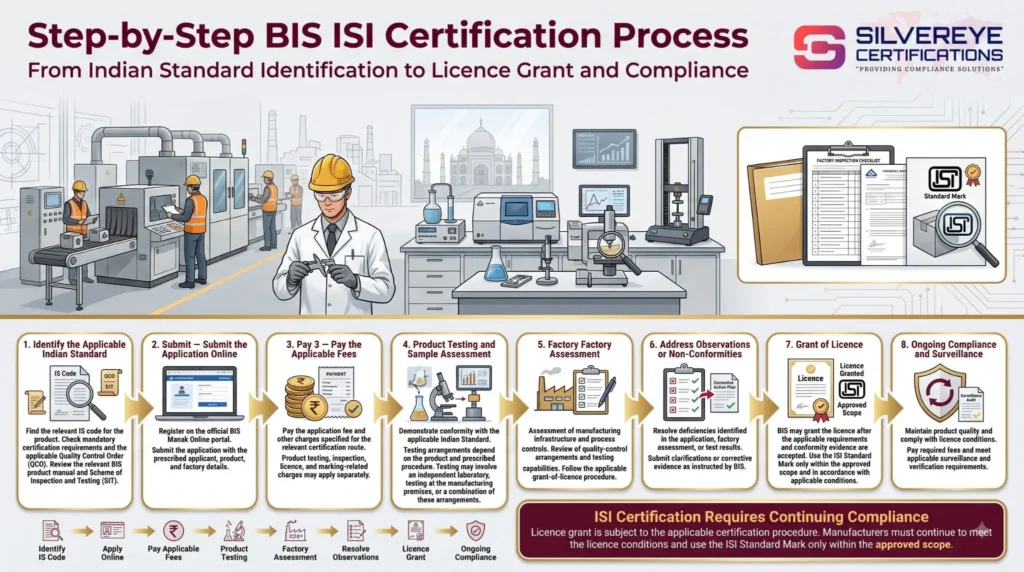
The general application journey can be understood in five steps:
- Identify the product and Indian Standard: Check the applicable standard and whether a QCO makes certification mandatory.
- Prepare the documents: Arrange Form-V, the Self-Evaluation cum Verification Report and the applicable supporting records.
- Select the application procedure: Check eligibility for Option 1 (Normal Procedure) or Option 2 (Simplified Procedure).
- Submit the application: Complete the online filing and applicable payments through Manak Online.
- Complete BIS assessment: Facilitate the factory visit and required product testing. BIS grants the licence after the prescribed requirements are satisfactorily fulfilled.
Why Choose Silvereye Certifications for BIS ISI Mark Certification?
Preparing documents for BIS ISI Mark Certification involves more than completing an application form. Manufacturers must identify the correct Indian Standard, understand the applicable certification procedure, arrange product testing where required and ensure that their factory is ready for BIS assessment.
Silvereye Certifications (SEYECS) provides professional guidance and application support to manufacturers seeking BIS certification in India. Our team helps simplify the documentation and application process through practical assistance at different stages.
Here is how Silvereye Certifications can support your certification journey:
- Product and Indian Standard identification: Guidance to identify the applicable Indian Standard and understand the relevant certification requirements for your product.
- Document preparation: Assistance in organising application forms, business records, factory details, machinery lists and other supporting documents.
- Application procedure guidance: Help in understanding the Normal Procedure (Option 1) and Simplified Procedure (Option 2), including the applicable eligibility requirements.
- Laboratory coordination: Assistance in understanding product testing requirements and identifying suitable laboratories from the applicable BIS-recognised or accepted lists.
- Manak Online application support: Guidance with application information, document uploads, fee payments and submission requirements.
- Factory inspection preparation: Support in reviewing manufacturing records, testing arrangements, quality-control documents and factory readiness before the BIS visit.
- Query and clarification support: Assistance in preparing responses and supporting documents when BIS raises queries or identifies discrepancies.
Important: Silvereye Certifications is a consultancy and does not issue BIS licences or government approvals. The Bureau of Indian Standards (BIS) evaluates applications and grants licences after the prescribed assessment and conformity requirements are fulfilled. Our role is to guide manufacturers through the documentation and application process.
Conclusion
Obtaining BIS ISI Mark Certification requires accurate documentation, appropriate manufacturing facilities, suitable testing arrangements and conformity with the applicable Indian Standard. Whether you apply through the Normal Procedure (Option 1) or Simplified Procedure (Option 2), preparing the correct documents from the beginning can help avoid unnecessary queries and application delays.
Before applying, verify whether your product is covered by a mandatory Quality Control Order (QCO), check the latest BIS guidelines, confirm the applicable procedure and prepare the documents required for your manufacturing unit. Also remember that a BIS licence is specific to the approved product scope and manufacturing premises.
If you need assistance with BIS ISI Mark Certification, document preparation, laboratory coordination or the Manak Online application, Silvereye Certifications (SEYECS) can guide you through the process and help you prepare for the required BIS assessment.
Frequently Asked Questions
What documents are required for BIS ISI certification?
Form-V, a self-evaluation cum verification report, lists of machinery and test equipment, proof of business and factory address, factory layout and process flow chart, quality control staff details and brand details. Option 2 also needs conforming test reports from a BIS-recognised lab.
What is Form-V?
It is the application for a license to use the Standard Mark under Scheme-I. It records the office and factory address, top management and quality control personnel, and the varieties to be covered.
What is the self-evaluation cum verification report?
It is your own report on the plant, raw materials, packing and marking, quality control staff, brand names and any earlier BIS license. BIS Guidelines for Grant of License give the format as Annexure-I, and it is a mandatory step on Manak Online.
Do I need a test report to apply?
Only under the simplified procedure (Option 2). Under the normal procedure (Option 1) you can apply without one, and BIS draws samples at the visit.
How old can the test report be?
Generally not more than 90 days at the time BIS receives the application. With multiple reports, the latest must be within 90 days and the oldest within 180 days.
Which labs are accepted for Option 2?
BIS-recognised labs, including Group-2 labs, government labs empanelled by BIS, and others approved by the BIS Executive Committee.
What happens if my documents do not match?
BIS raises a discrepancy query. You usually get a few weeks to reply with an explanation and corrected documents. Serious or false discrepancies can lead to rejection.
What documents does BIS check at the factory visit?
The self-evaluation report, calibration certificates, raw material test certificates, quality control staff details, plant layout, location plan, process flow chart, subcontracting declarations and undertakings.
Do MSMEs need extra documents?
Only if they claim MSME benefits. A DIC or Udyam registration is typically used to support concessions for micro, small and medium units.
What documents are needed to renew an ISI licence?
A renewal application on Manak Online, production details for the period and the renewal fee. Keep your SIT test records and calibration certificates ready for the next surveillance.
What do I need to add a new product variety to my licence?
An application for change in scope with original test reports from BIS-recognised labs, details of any added manufacturing or testing facilities and any declaration the product manual asks for.
What extra documents do foreign manufacturers need?
An Authorised Indian Representative nomination, an agreement with BIS, an indemnity bond and a performance bank guarantee of USD 10,000, along with the core forms.