
- Indian manufacturers whose products are covered by a BIS Quality Control Order (QCO) or who voluntarily seek the ISI Mark, where the relevant certification scheme is available.
- Application routes: BIS offers two routes under Scheme-I: Option 1 (Normal Procedure), generally around 4 months, and Option 2 (Simplified Procedure), generally around 1 month. Actual timelines depend on complete documentation, inspection, testing and BIS processing.
- Official fees: The published BIS fee schedule lists a ₹1,000 application fee, ₹7,000 per man-day inspection fee and ₹1,000 annual license fee, plus the applicable product-specific minimum marking fee. Testing charges and applicable taxes may be additional.
- License validity: A license may initially be granted for up to 2 years and renewed for a period of up to 5 years, subject to BIS requirements and payment of applicable fees.
Introduction
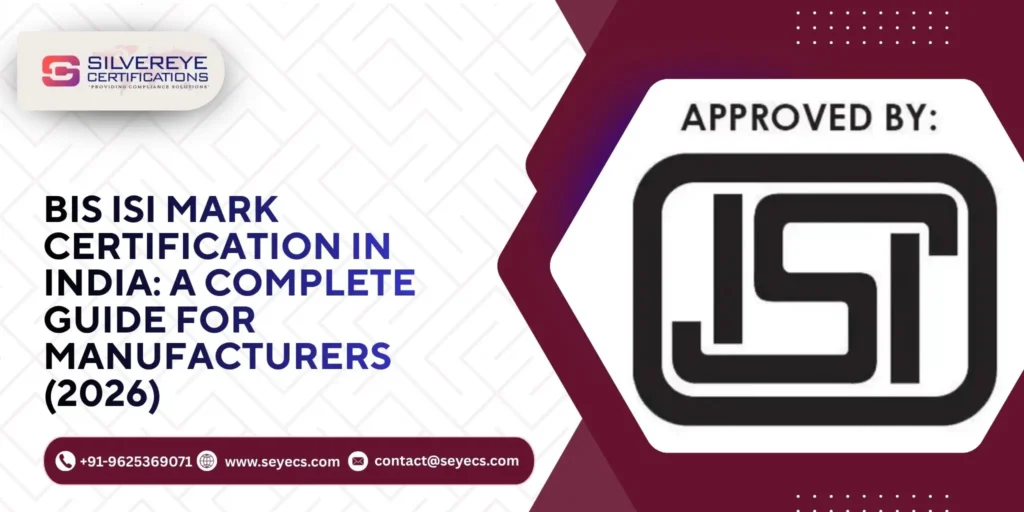
BIS ISI Mark Certification is a product license granted by the Bureau of Indian Standards (BIS) under Scheme-I of the BIS (Conformity Assessment) Regulations, 2018. It allows manufacturers to use the ISI Mark on products that conform to the applicable Indian Standard. Applications are submitted online through the Manak Online portal.

Manufacturers can apply through two procedures:
- Normal Procedure (Option 1): The average processing time is around four months from receipt and recording of a complete application.
- Simplified Procedure (Option 2): The average processing time is around one month. It requires a product test report, generally not more than 90 days old, issued by a BIS or BIS-recognised/empanelled laboratory for the relevant product.
The official fees include a ₹1,000 application fee, ₹7,000 per man-day inspection fee, and ₹1,000 annual licence fee, along with the applicable product-specific minimum marking fee. Testing charges may also apply.
A BIS license is initially granted for up to two years and may be renewed for a period of up to five years, subject to BIS requirements and payment of applicable fees.
What Is BIS ISI Mark Certification?
The ISI Mark, commonly known as the Standard Mark, is a conformity mark associated with the Bureau of Indian Standards (BIS). It indicates that a product is covered by a valid BIS license and conforms to the applicable Indian Standard (IS) within the approved license scope.

Under Section 13 of the BIS Act, 2016, BIS may grant a license to use a specified Standard Mark on goods that conform to the relevant standard, subject to applicable conditions and fees.
For manufacturers planning to apply, two licensing requirements are particularly important:
- Product and Indian Standard: A separate application is generally required for each product/Indian Standard combination. The approved license scope may include multiple varieties, grades, sizes or models, where permitted by the applicable standard and BIS requirements.
- Factory location: A separate application is required for each manufacturing location, even when the same product is manufactured at multiple factories. Each factory must meet the applicable BIS assessment requirements.
This guide focuses on ISI Mark certification under Scheme-I for manufacturers in India. BIS also operates other conformity-assessment routes, including the Compulsory Registration Scheme (CRS), the Foreign Manufacturers Certification Scheme (FMCS) and Scheme-X. Hallmarking is a separate certification framework for notified precious-metal articles. The applicable scheme, application process and fees depend on the product and the manufacturer's circumstances.
Is BIS ISI Mark Certification Mandatory for Your Product?
BIS certification is generally voluntary unless the Central Government makes it compulsory for a particular product through a Quality Control Order (QCO) or another applicable legal notification.
If your product is covered by a QCO that has come into force, you must meet the applicable BIS certification requirements before manufacturing, importing, selling or distributing the product in the regulated market, subject to the specific order's scope, exemptions and implementation dates.
If no compulsory certification requirement applies, a manufacturer may still seek a BIS license voluntarily where the relevant certification scheme is available. A valid ISI Mark license can help demonstrate conformity with the applicable Indian Standard and may be relevant when dealing with buyers, distributors or procurement requirements.
Check the Latest QCO Status Before Applying
The QCO position can change through new notifications, amendments, implementation-date extensions, suspensions and withdrawals. Therefore, do not rely only on an old product list or an earlier implementation date.
Before arranging product testing or submitting your application:
- Visit the official BIS Products Under Compulsory Certification page.
- Check whether your product falls under Scheme-I (Mark Scheme) or another certification route.
- Open the relevant QCO and verify its product scope, applicable Indian Standard, implementation date and exemptions.
- Check subsequent amendments, withdrawal or suspension notifications issued by the concerned Ministry or Department.
- Confirm the applicable Indian Standard and certification requirements with BIS before proceeding.
Important: A product appearing in a QCO list does not, by itself, establish that the requirement is already effective. Always verify the latest notification and its implementation date.
Products Covered Under BIS ISI Mark Certification
The Bureau of Indian Standards (BIS) maintains a product-wise list of goods covered under compulsory certification through Scheme-I (ISI Mark Scheme). These products are brought under mandatory certification through applicable Quality Control Orders (QCOs) and other government notifications.
The following table highlights selected product categories and examples listed under the BIS Scheme-I framework. It is an illustrative guide, not a complete list of products or a confirmation that every listed product has an active compulsory-certification requirement on every date.
| Product category | Examples of products |
|---|---|
| Cement | Ordinary Portland Cement, Portland Pozzolana Cement, Portland Slag Cement, White Cement and Rapid Hardening Cement |
| Household electrical goods | RCCBs, RCBOs, self-ballasted lamps and specified household electrical appliances |
| Electricity meters | AC watt-hour meters and static watt-hour meters |
| Batteries | Multi-purpose dry batteries |
| Automotive tyres and tubes | Pneumatic tyres and tubes for specified automotive vehicles |
| Steel and steel products | TMT bars, galvanised steel sheets, structural steel and electrical steel products |
| Electrical motors and capacitors | Three-phase induction motors, AC motor capacitors and power capacitors |
| Electrical appliances | Toasters, grills, cooking appliances, electric call bells and buzzers for indoor use, and other notified household and commercial appliances |
| Chemicals and polymers | Caustic soda, boric acid, specified polymers and other notified chemical products |
| Medical and healthcare-related products | Specified products such as clinical thermometers and other products covered by applicable certification requirements |
Important: The applicable Indian Standard, QCO, implementation date and certification scheme differ by product. Some products may also fall under separate regulatory requirements. Check the individual product entry and its governing notification before treating certification as mandatory.
Products De-notified or Removed from Compulsory BIS Certification
The BIS Scheme-I list also identifies products that have been de-notified from compulsory BIS certification. Examples include:
- Packaged drinking water (IS 14543)
- Packaged natural mineral water (IS 13428)
- Milk powder (IS 1165)
- Infant milk substitutes (IS 14433)
- Certain other food and food-related products listed by BIS
BIS also records withdrawn QCOs for certain chemicals and metals. For example, the 2025 orders for acetic acid, aniline and methanol, and for pyridine, beta picoline and sodium tripolyphosphate, were withdrawn through subsequent notifications.
Do not assume that an old QCO remains enforceable simply because an earlier website or supplier refers to it. Always check the latest BIS listing and the relevant government notification.
Does Every Product Require an ISI Mark?
No. ISI Mark certification is compulsory only when the product is covered by an applicable mandatory certification notification or QCO that is in force, subject to its scope and exemptions.
Some products are covered under other BIS certification schemes. For example, specified electronics and IT products, including notified mobile phones and laptops, fall under the Compulsory Registration Scheme (CRS) rather than the ISI Mark Scheme-I route.
How to Check Whether Your Product Requires BIS Certification
Before applying or arranging product testing, follow these steps:
- Visit the official BIS Products Under Compulsory Certification page.
- Open the Scheme-I (ISI Mark Scheme) list and search for your product.
- Identify the applicable Indian Standard (IS) number and product description.
- Open the relevant QCO or government notification to check its scope, implementation date and exemptions.
- Check whether the product falls under the normal or simplified application procedure and review the applicable BIS product manual.
Note: The simplified procedure is available only where BIS has specified it for the relevant product. Do not assume that every product is eligible for Option 2.
Benefits of ISI Mark Certification
For manufacturers, obtaining a valid BIS ISI Mark license can provide regulatory and commercial benefits, depending on the product and applicable market requirements.
- Regulatory compliance: For products covered by an effective QCO, a valid BIS license is necessary to meet the applicable compulsory certification requirement, subject to the notification's conditions and exemptions.
- Buyer confidence: The ISI Mark helps buyers identify products certified against the relevant Indian Standard within the scope of a valid BIS license.
- Tender and procurement opportunities: Government departments and institutional buyers may specify BIS certification as an eligibility or technical requirement in their tenders.
- Market acceptance: Distributors, retailers and business customers may prefer or require BIS-certified products, particularly in regulated product categories.
- Manufacturing quality controls: BIS certification involves applicable factory assessment and a Scheme of Inspection and Testing (SIT), helping manufacturers establish documented quality-control and product-testing practices.
- Product credibility: A valid license provides evidence that the licensed product has undergone the applicable BIS conformity-assessment process.
Latest BIS ISI Mark Updates for 2026
BIS certification requirements continue to evolve through revised guidelines, Quality Control Orders (QCOs) and government notifications. The following updates are particularly relevant to manufacturers applying for BIS ISI Mark Certification in 2026.
| 2026 update | What manufacturers should know |
|---|---|
| Revised Guidelines for Grant of License – 25 February 2026 | BIS issued updated Scheme-I guidelines covering application requirements, factory assessment, testing, Option 1 and Option 2 procedures. Applicants should follow the latest guidelines rather than relying on older application instructions. |
| Transition Facilitation (Quality Control) Order, 2026 – 25 June 2026 | DPIIT introduced an alternative compliance mechanism for specified QCOs. Eligible companies may receive permission to procure covered goods from manufacturers holding BIS licenses under Scheme-II instead of Scheme-I, subject to the Order's conditions. It is not a general exemption from BIS certification or a replacement for the normal ISI licensing route. |
| QCO withdrawals, amendments and extensions | Several QCOs have been withdrawn, amended or had their implementation dates changed. For example, the Machinery and Electrical Equipment Safety (Omnibus Technical Regulation) Order, 2024 was rescinded on 14 January 2026. Manufacturers should verify the latest notification applicable to their products. |
| Changes to Indian Standards | BIS periodically revises, replaces and withdraws Indian Standards. Check the current edition of the applicable standard before arranging product testing or submitting an application. |
| Online-only applications | BIS accepts product certification applications and payments through the Manak Online portal. Applicants should use the official portal and follow its current application instructions. |
Marking Fee Concessions for MSMEs
BIS has extended concessions on the annual minimum marking fee up to 31 May 2029, subject to eligibility:
- Micro enterprises: 80% concession.
- Small enterprises: 50% concession.
- Start-ups: 80% concession.
- Women entrepreneur enterprises: An additional 10% concession, subject to the applicable conditions.
These concessions apply to the specified minimum marking fee, not automatically to every BIS application, inspection or testing charge. Check the latest BIS fee notification to confirm your eligibility.
Practical advice: Before applying, verify your product's QCO status, the current Indian Standard, applicable testing requirements and the latest fee schedule. A previous QCO deadline or fee quotation may no longer be applicable.
Normal vs Simplified Procedure: Which One Applies to You?
Under BIS Scheme-I, manufacturers can obtain an ISI Mark license through two procedures: Option 1 (Normal Procedure) and Option 2 (Simplified Procedure).
Both routes lead to a BIS license under Scheme-I. The main difference is the timing of the applicant's test reports and how BIS verifies product conformity.
| Comparison | Normal Procedure (Option 1) | Simplified Procedure (Option 2) |
|---|---|---|
| Test report at application | A product test report is generally not required with the initial application. | Conforming product test reports must be submitted with the application. |
| Testing before application | Not normally required. BIS arranges product sampling and testing during the application process. | Required before filing, using an eligible laboratory under the BIS guidelines. |
| Factory assessment | BIS visits the factory to assess manufacturing infrastructure, production processes, quality control and testing arrangements. | BIS also conducts a factory verification visit and draws samples for verification testing. |
| Sample testing | Samples drawn during the factory visit are sent to an eligible third-party laboratory, subject to applicable factory-testing provisions. | The applicant's earlier test reports are reviewed, and the verification sample drawn during the factory visit is tested. |
| Age of test report | No pre-submitted product test report is generally required. | Product test reports must generally be no more than 90 days old when the application is received by BIS. |
| Product eligibility | Available for products processed under Option 1, including products not listed for Option 2. | Available only for products listed in Annexure II(C) of the current BIS guidelines, subject to the prescribed conditions. |
| Foreign manufacturers | Applications from foreign manufacturers are processed under Option 1. | Not available to foreign manufacturers. |
| Average processing time | Approximately 4 months. | Approximately 1 month. |
The timelines are indicative averages stated in BIS guidance. Actual processing may take longer depending on factory readiness, testing results, document completeness and other requirements.
Which Procedure Should You Choose?
Use the following approach before submitting your application:
- Choose Option 1 if your product is not listed for Option 2, you do not have the required pre-application test reports, or your application must be processed under the normal route.
- Consider Option 2 if your product is listed in Annexure II(C), you have conforming test reports from an eligible laboratory and your factory is ready for BIS verification.
- Foreign manufacturers must follow Option 1 under the current Scheme-I guidelines.
Check the product-specific eligibility in the latest BIS guidelines. The availability of a recognised laboratory alone does not automatically make a product eligible for Option 2.
For a new product being brought under BIS certification, BIS may process it under the applicable provisions for new products, including factory-testing arrangements where permitted. Do not assume that every new product automatically qualifies for the simplified procedure.
Eligibility and Requirements for BIS ISI Mark Certification
BIS primarily evaluates whether the manufacturer can consistently produce goods that conform to the relevant Indian Standard. Before applying, check the following requirements:
- Manufacturing facility: You must have a manufacturing unit with suitable infrastructure and production facilities for the product.
- Quality-control arrangements: Your factory must have appropriate process controls and quality-control systems to maintain product conformity.
- Testing facilities: You must have the testing equipment and arrangements required under the applicable Indian Standard and Scheme of Inspection and Testing. Permitted external or subcontracted testing arrangements may be considered where applicable.
- Product conformity: The product must meet the requirements of the relevant Indian Standard, including applicable testing and performance criteria.
- Application documents: Submit the prescribed application, supporting documents and self-evaluation cum verification report under the current BIS guidelines.
- Factory-specific application: Apply for the relevant product and Indian Standard at the manufacturing premises concerned. Separate factory locations require separate applications.
Do You Need GST or Udyam Registration?
GST registration and Udyam registration should not be treated as universal eligibility conditions for every BIS ISI Mark application. BIS requires the prescribed applicant and manufacturing-unit details and supporting documents. The exact documents depend on the applicant's legal constitution and the applicable application requirements.
If you are unsure which Indian Standard applies to your product, search the product on the official BIS website or contact the concerned BIS Branch Office before arranging testing.
Documents Required for BIS ISI Mark Certification
The documents required for BIS ISI Mark Certification depend on the product, applicable Indian Standard and manufacturing facility. BIS requires applicants to submit the prescribed Form-V application and self-evaluation cum verification report under the current Scheme-I guidelines.
The following is a practical preparation checklist. It is not a universal mandatory-document list; check the applicable product manual and Manak Online requirements before submitting your application.
| Document or information | Why it is required |
|---|---|
| Form-V application and prescribed declarations | Provides applicant, product, Indian Standard and factory details. |
| Legal identity and business constitution documents | Establishes the identity and legal constitution of the applicant, such as a company, partnership or proprietorship. |
| Factory address and location proof | Helps verify the manufacturing premises covered by the application. |
| Factory layout and manufacturing process flow chart | Shows production stages, storage areas and testing facilities. |
| Machinery and testing equipment details | Demonstrates the manufacturing and testing arrangements available at the factory. |
| Calibration certificates for testing equipment | Provides evidence of calibration of applicable testing instruments. |
| Quality-control personnel details | Identifies the personnel responsible for quality control and product testing. |
| Raw-material test certificates, where applicable | Helps establish conformity of raw materials when required by the relevant Indian Standard. |
| Product test reports | Required before applying under Option 2; the applicable reports must meet BIS laboratory and validity requirements. |
| Quality Assurance Plan or applicable Scheme of Inspection and Testing | Explains how the manufacturer will maintain product conformity. |
| Authorisation letter, where applicable | Establishes the authority of the person representing the applicant or signing documents. |
| Udyam or other eligibility proof, where applicable | May be required when claiming an applicable MSME or other fee concession. |
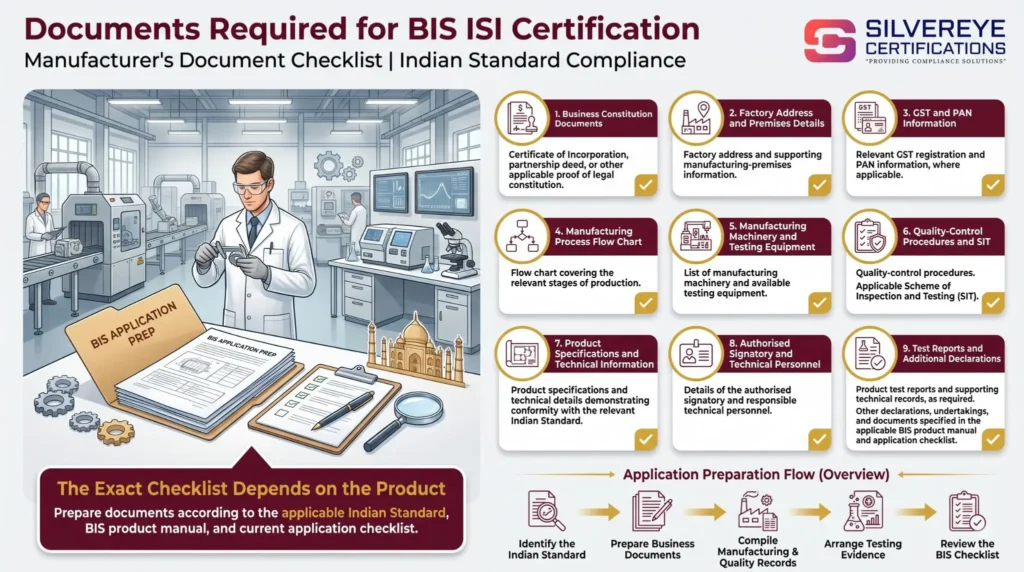
Important: GST registration should not be treated as a universal BIS eligibility requirement. The prescribed legal and business documents depend on the applicant's constitution and the current application requirements. BIS may also request additional product-specific documents.
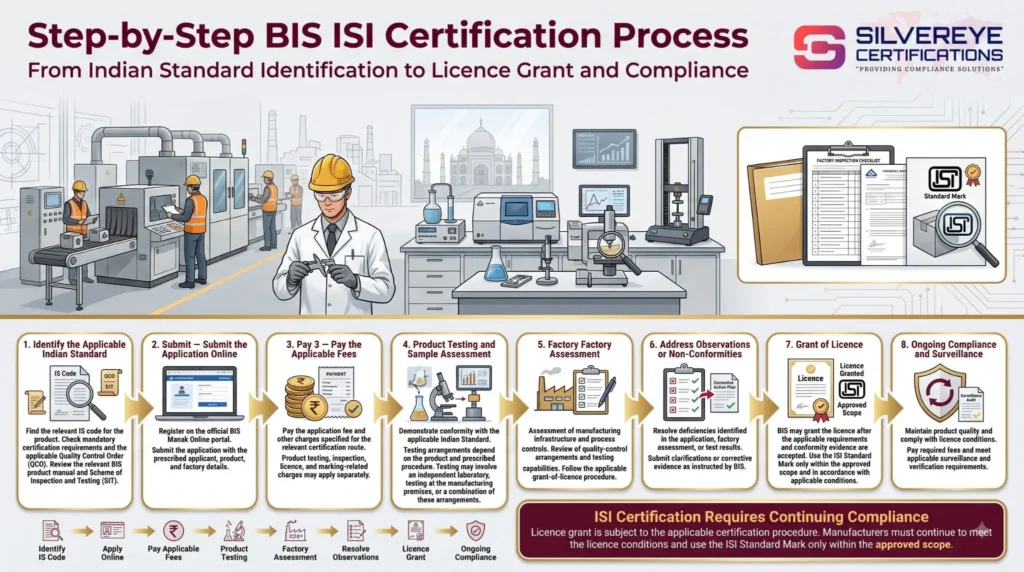
BIS ISI Mark Certification Process: Step by Step
Manufacturers apply for an ISI Mark license online through the Manak Online portal. The process differs slightly depending on whether the application follows Option 1 or Option 2.
1. Identify the applicable Indian Standard
Find the Indian Standard (IS) applicable to your product. Review the corresponding BIS product manual for testing requirements, grouping guidelines, machinery and equipment requirements, and the Scheme of Inspection and Testing (SIT).
2. Check the applicable application procedure
Check whether your product is listed under Option 2 (Simplified Procedure) in the current BIS guidelines. If it is not eligible, the application generally follows Option 1 (Normal Procedure).
3. Prepare your manufacturing and quality-control facilities
Ensure that your factory has the required manufacturing infrastructure, production controls, testing arrangements and quality-control personnel. Prepare the prescribed self-evaluation cum verification report and supporting documents.
4. Arrange product testing, if applying under Option 2
For Option 2, obtain conforming product test reports from laboratories accepted under the BIS guidelines. The latest report must generally be no more than 90 days old when BIS receives the application. The oldest report, where multiple reports are submitted for one product, must generally not be more than 180 days old.
5. Submit the application through Manak Online
Complete the Form-V application, select the applicable procedure, upload the prescribed documents and submit the application online. Pay the applicable application fee, inspection fee and 50% of the annual minimum marking fee as required under the current guidelines.
6. Respond to BIS observations or document queries
BIS examines the application and supporting documents. If clarification or additional information is required, respond through the prescribed online communication process within the specified time.
7. Attend the BIS factory inspection
BIS visits the manufacturing premises to assess production infrastructure, process controls, quality-control arrangements and testing capabilities. The inspection also involves verification of relevant records and product sampling.
- Under Option 1, samples are generally drawn during the factory visit and sent for third-party laboratory testing, subject to applicable factory-testing provisions.
- Under Option 2, BIS draws a verification sample during the factory visit. Its test result is reviewed after the licence is granted under the prescribed procedure.
The inspection fee is payable in advance. Additional inspection days, where required, may involve additional charges.
8. Complete the applicable fee payments
If BIS decides to grant the licence, pay the ₹1,000 annual licence fee and the remaining applicable minimum marking fee, along with any other outstanding dues. The total marking fee depends on the product and the period of licence requested.
9. Receive your BIS license
After the required assessment, testing and payments are completed, BIS issues the licence with a CM/L number through the prescribed process.
10. Start production with the ISI Mark
Use the ISI Standard Mark and licence number only after the licence has been granted and in accordance with its approved scope, applicable Indian Standard and BIS marking requirements. Maintain the required quality controls and production records throughout the licence period.
How Long Does BIS ISI Mark Certification Take?
BIS publishes average processing timelines for the two Scheme-I procedures. The period is counted from receipt and recording of a complete application.
| Application procedure | Average processing time | Factors that may cause delays |
|---|---|---|
| Simplified Procedure (Option 2) | Approximately 1 month | Incomplete test reports, factory inspection delays, non-conforming verification samples or outstanding fees. |
| Normal Procedure (Option 1) | Approximately 4 months | Document queries, factory readiness, sample dispatch, laboratory testing and retesting. |
These are average timelines, not guaranteed approval periods. Under the February 2026 guidelines, BIS also specifies expected processing periods of 30 days for Option 2 and 90 days for Option 1, subject to satisfactory assessment and conformity being established at the first instance.
Preparing the factory, testing equipment, records and application documents before filing can help avoid preventable delays.
BIS ISI Mark Certification Fees in 2026
The total cost of BIS certification includes government fees, product-specific marking fees and, where applicable, laboratory testing charges. The following table summarises the principal charges under Scheme-I.
| Fee component | Amount or calculation | When payable |
|---|---|---|
| Application fee | ₹1,000 | At application submission. |
| Inspection fee | ₹7,000 per man-day | In advance, before the factory inspection. |
| Annual licence fee | ₹1,000 | When BIS decides to grant the licence. |
| Minimum marking fee | Product-specific, as notified by BIS | 50% at application submission; balance at licence grant. |
| Actual marking fee | Calculated using the applicable product-wise marking rate and marked production | Adjusted against the minimum marking fee as per BIS rules. |
| Renewal application fee | Applicable prescribed fee | With the renewal application. |
| Laboratory testing charges | Product- and test-specific | Under Option 1, borne by the applicant. Under Option 2, verification-sample testing is included in the applicable annual minimum marking fee. |
What Determines the Total Certification Cost?
The final amount depends on several factors:
- The Indian Standard and product-specific minimum marking fee.
- The number of inspection man-days required.
- Laboratory testing and retesting costs, where applicable.
- The licence period requested.
- Applicable MSME or other notified fee concessions.
- Any additional testing equipment or quality-control arrangements required at the factory.
Cost-planning tip: Do not rely on a generic BIS certification package price. Check the product-specific marking fee, testing requirements and current fee notifications for your Indian Standard before estimating the total cost.
Validity of the BIS ISI Mark License
A BIS ISI Mark licence is initially granted for up to two years under Scheme-I. Manufacturers must apply for renewal before expiry to continue using the Standard Mark.
| Aspect | BIS requirement |
|---|---|
| Initial validity | Up to 2 years. |
| Renewal period | Renewable for a minimum of 1 year and up to 5 years, depending on the period requested and applicable fee payments. |
| Product coverage | Valid only for the product varieties included in the approved licence scope. Additional varieties require an application for change in scope. |
| Manufacturing premises | The licence applies to the manufacturing premises identified in the licence. Relocation requires compliance with BIS's factory-shifting procedure, including suspension and verification. |
Important: A BIS license does not automatically cover every product manufactured by the same company. Its validity is linked to the approved product scope and manufacturing premises.
BIS ISI Mark License Renewal: Process and Timeline
Manufacturers can apply for renewal through the Manak Online portal, using the licence holder's dashboard. BIS requires the renewal application, relevant production details and applicable fees.
| Renewal requirement | What you need to do |
|---|---|
| Where to apply | Submit the renewal application through the licence holder's Manak Online dashboard. |
| Application form | Submit the prescribed renewal application, Form XII, with the required documents. |
| Production statement | Provide the production details required to calculate the actual marking fee. BIS requires the production statement to be authenticated by a Chartered Accountant or Cost Accountant. |
| Renewal period | Request renewal for a period of 1 to 5 years. |
| Applicable fees | Pay the renewal application fee, annual licence fee, advance minimum marking fee for the requested period and outstanding dues, if any. |
| Late application | BIS may defer the renewal decision for up to 90 days after expiry under the applicable provisions. A late fee of ₹5,000 applies where the renewal application is submitted after the licence validity date. |
| Licence under suspension | BIS will not renew the licence until the suspension has been revoked. |
When Should You Apply for Renewal?
BIS recommends submitting the renewal application preferably two months before the licence expiry date. The following is a practical preparation schedule, not a separate statutory deadline.
| Suggested timing | Action to take |
|---|---|
| 3 months before expiry | Review production records, marking-fee calculations and the current Indian Standard. |
| 2 months before expiry | Prepare the renewal application, authenticated production statement and applicable fee payments. |
| Before the expiry date | Submit the renewal application and ensure BIS has received the required documents and payments. |
| After submission | Monitor the Manak Online dashboard and respond to any BIS observations or additional requirements. |
Do not wait until the final few days. If your application or required payment is incomplete when the licence expires, the renewal decision may be deferred under the applicable rules.
After Getting the BIS License: Surveillance and Compliance
Receiving the ISI Mark licence is not the end of the certification process. Manufacturers must continue complying with the applicable Indian Standard, licence conditions and Scheme of Inspection and Testing.
BIS carries out factory and market surveillance to verify whether licensed products continue to meet the required standards.
- Factory surveillance: BIS officers may inspect the manufacturing premises, with or without prior notice, to examine production infrastructure, quality-control arrangements, testing facilities and compliance with the accepted quality assurance plan or Scheme of Inspection and Testing.
- Product sampling and testing: BIS may draw samples from the factory and arrange independent testing at a BIS or BIS-recognised laboratory, wherever applicable.
- Market surveillance: BIS may collect ISI-marked products from the market and arrange testing to verify conformity with the relevant Indian Standard.
- Production and quality records: Manufacturers must maintain relevant production, testing, inspection and marking records and provide them to BIS when required.
- Changes to manufacturing facilities: Changes to the manufacturing premises, production infrastructure or other relevant details must be reported and handled according to applicable BIS procedures.
- Suspension or cancellation: Failure to meet licence conditions, product conformity requirements or other regulatory obligations can result in suspension or cancellation under the BIS Act and applicable conformity-assessment regulations.
Important: Using the ISI Mark without a valid licence, or applying it to products outside the approved licence scope, can attract action under the BIS Act, 2016. Always ensure that your product marking matches your current licence.
Common Mistakes That Can Delay BIS ISI Mark Certification
Even when a manufacturer has a suitable product, errors in documentation, testing or factory preparation can delay the licensing process. Avoid these common mistakes:
- Selecting the wrong Indian Standard: Applying under an incorrect or outdated standard can result in application queries or rejection.
- Using an ineligible testing laboratory: For Option 2, ensure the laboratory and test report meet the current BIS requirements for the relevant product and Indian Standard.
- Submitting an outdated test report: Check the applicable 90-day and 180-day report-age requirements before filing an Option 2 application.
- Providing inconsistent factory details: The factory address and applicant information should match the supporting documents and actual manufacturing premises.
- Ignoring calibration requirements: Ensure applicable testing equipment is available, functional and supported by valid calibration records.
- Incomplete machinery and equipment details: Compare your factory's equipment with the requirements in the product manual and applicable testing scheme.
- Delaying responses to BIS queries: Monitor the application dashboard and respond to observations within the specified period.
- Ignoring inspection and fee requirements: Pay applicable inspection charges and other fees on time to avoid unnecessary delays.
- Overlooking QCO amendments: Verify the latest QCO status, implementation dates and exemptions before applying.
- Using the ISI Mark before licence grant: Do not manufacture, sell or advertise products as BIS-certified before obtaining the applicable licence and complying with its marking conditions.
- Failing to follow the factory relocation procedure: Inform BIS and follow the prescribed suspension and verification process before shifting manufacturing operations.
Choosing Professional Assistance for BIS ISI Mark Certification
Manufacturers can apply for BIS certification directly through Manak Online. However, professional consultancy may be useful if you are applying for the first time, have complex testing requirements or need help preparing your factory for inspection.
Before choosing a consultant, consider these questions:
- Product and standard identification: Can the consultant identify the correct Indian Standard and applicable certification procedure for your product?
- Testing coordination: Can they help identify an eligible BIS-recognised or empanelled laboratory where required?
- Application support: Do their services include document preparation, Manak Online filing and assistance with BIS queries?
- Factory preparation: Can they help review your manufacturing infrastructure, testing equipment and quality-control records against the applicable product manual?
- Transparent pricing: Are government fees, laboratory charges and professional consultancy fees clearly separated?
- Realistic timelines: Are the estimated timelines based on BIS's published averages rather than guaranteed licence-grant dates?
Why Choose Silvereye Certifications?
Silvereye Certifications (SEYECS) provides consultancy and application support to manufacturers seeking BIS certification and other regulatory approvals in India.
The team can assist with:
- Indian Standard identification: Guidance on identifying the applicable standard and certification route.
- Document preparation: Assistance in organising the prescribed application documents and factory details.
- Application support: Help with Manak Online filing and understanding application requirements.
- Testing coordination: Guidance on applicable product testing and laboratory documentation.
- Factory inspection preparation: Support in reviewing quality-control arrangements, testing equipment and relevant records.
- Compliance guidance: Assistance with understanding licence conditions, renewal requirements and applicable modifications.
Silvereye Certifications provides consultancy and documentation support; BIS alone evaluates applications and grants, renews, suspends or cancels ISI Mark licences. The final decision rests with the competent authority, and certification cannot be guaranteed.
Conclusion
Obtaining a BIS ISI Mark licence involves more than submitting an online application. Manufacturers must identify the correct Indian Standard, prepare their production and testing facilities, submit the required documents and successfully complete the applicable BIS assessment and testing process.
After receiving the licence, businesses must also maintain product conformity, follow marking requirements, submit renewal applications on time and cooperate with BIS surveillance.
Before starting your application, review the latest BIS guidelines and product-specific manual. If you need assistance with the application, documentation, testing coordination or factory preparation, Silvereye Certifications can help you understand the applicable requirements and navigate the process.
Frequently Asked Questions
What is BIS ISI Mark Certification?
It is a licence from the Bureau of Indian Standards under Scheme-I that allows a manufacturer to apply the ISI mark on a product that meets the relevant Indian Standard.
Which products need ISI mark certification?
Products covered by a Quality Control Order, such as cement, steel bars and structural steel, switches, PVC cables, electric irons, immersion water heaters, tyres and tubes, LPG cylinders and clinical thermometers. Some products, including packaged drinking water, were de-notified from compulsory certification in 2024, so always check the BIS list for the current position.
Is the ISI mark mandatory?
Only for products covered by a Quality Control Order that is in force. For other products it is voluntary. Check the BIS list of products under compulsory certification for the current status.
What is the difference between the normal and simplified procedure?
In the normal procedure (Option 1) you can apply without a test report, and BIS inspects and samples first. In the simplified procedure (Option 2) you test at a BIS-recognised lab first and apply with the report. Option 2 is faster, at about one month on average against about four months for Option 1.
How long does ISI mark certification take?
BIS states average times of about one month under Option 2 and about four months under Option 1, counted from a complete application. Delays in replies, visits, sample deposit or fees extend this.
How much does ISI mark certification cost?
BIS charges ₹1,000 as application fee, ₹7,000 per man-day for inspection and ₹1,000 as annual licence fee, plus a product-specific minimum marking fee. Testing charges are extra, and GST applies.
Can one application cover several products or factories?
No. BIS requires a separate application for each product and Indian Standard, and for each factory location.
Can I get ISI mark without a factory visit?
No. BIS grants the licence after assessing the factory through a visit. Under Option 2 the visit is a verification visit, but a visit still takes place.
How long is an ISI licence valid?
Initially up to two years. It can be renewed, with renewal allowed up to five years from the last date of validity.
How do I renew my ISI licence?
Apply on Manak Online from the license holder’s dashboard, with production details for the period and the renewal fee. File before the last date of validity to avoid deferment.
Which laboratories are accepted for the test report?
Reports from BIS laboratories or BIS-recognised or empanelled laboratories are accepted for Option 2. You can search the right lab for your Indian Standard on the BIS testing facilities page.
Can foreign manufacturers get the ISI mark through this route?
No. Overseas factories apply under the Foreign Manufacturers Certification Scheme (FMCS). The simplified procedure is also not available to foreign manufacturers.
What happens if BIS finds non-compliance after the licence is granted?
BIS can suspend or cancel the licence under the BIS (Conformity Assessment) Regulations, 2018. Corrective action and re-inspection are needed before a suspension is revoked.
Does the Transition QCO 2026 replace the ISI mark
No. It offers a Scheme-II route for DPIIT-approved manufacturers in notified sectors. Compliance with the Indian Standard is still required, and most applicants continue under Scheme-I.