

- Factory audit requirements: BIS ISI Certification under Scheme I generally involves a factory assessment of manufacturing and quality-control capabilities. BIS CRS Registration under Scheme II generally does not require a routine pre-registration factory visit.
- Core documentation: Applications commonly require business and manufacturing details, product test reports where applicable, and scheme-specific technical and quality-control documents. Exact requirements vary by product and certification route.
- Foreign manufacturers: FMCS applications require an eligible Authorized Indian Representative (AIR). A Performance Bank Guarantee (PBG) is also required under the applicable FMCS conditions, at the stage specified by BIS. These are not standard requirements for domestic manufacturers applying through the usual ISI route.
- Avoiding documentation delays: Missing documents, inconsistent product details, incomplete test reports, and failure to respond to BIS queries can delay processing. Check the latest scheme-specific checklist and portal instructions before submission.
Introduction
BIS Certification documents vary depending on the certification scheme and product category. For ISI Certification (Scheme I), applicants commonly need factory registration documents, a manufacturing process flow chart, a quality-control plan or Scheme of Inspection and Testing (SIT), machinery and testing-equipment lists, and applicable product test reports. BIS assesses the manufacturing and quality-control capabilities through the procedure applicable to the product, which generally includes a factory inspection before license grant.
For BIS CRS Registration (Scheme II), the documents generally include company and manufacturing details, a test report from a BIS-recognized laboratory, product specifications, and prescribed declarations. A routine pre-registration factory visit is generally not required under CRS.

For BIS FMCS, foreign manufacturers submit relevant business, manufacturing, technical, and quality-control documents, along with an Authorized Indian Representative (AIR) nomination and other prescribed undertakings. A Performance Bank Guarantee (PBG) is required under applicable FMCS conditions at the stage specified by BIS. The scheme includes an overseas factory inspection to assess manufacturing facilities and quality-control arrangements.
Important: The final document checklist depends on the product, applicable Indian Standard, and current BIS requirements. Always verify the latest scheme-specific guidance before applying.
What Are BIS Certification Documents and Why Do They Matter?
BIS Certification documents are the business, technical, testing, and quality-control records that the Bureau of Indian Standards (BIS) uses to assess an applicant’s eligibility and a product’s conformity with the applicable Indian Standard (IS).
Incomplete documents, inconsistent product details, or an unsuitable test report can lead to queries and delay the application process. Preparing the correct documents before filing helps applicants avoid preventable issues.
The documentation requirements depend on the applicable certification scheme:
- ISI Certification (Scheme I): Manufacturers submit business, factory, manufacturing-process, testing, and quality-control documents. BIS assesses manufacturing capabilities according to the applicable certification procedure, which generally involves a factory visit.
- CRS Registration (Scheme II): Manufacturers of notified electronics and IT products submit the prescribed application documents, laboratory test reports, and declarations. A routine pre-registration factory inspection is generally not required.
- FMCS Certification: Foreign manufacturers provide relevant manufacturing, technical, and quality-control documents, along with an Authorised Indian Representative (AIR) nomination and other prescribed documents. Overseas factory inspection is an important part of the process.
The following sections explain the common document requirements, application process, fees, and validity considerations for each scheme.
BIS ISI Certification Documents — Complete Checklist
Scheme I certification generally involves assessment of the manufacturing facility and quality-control capabilities. However, the applicable process and assessment requirements depend on the product, its product manual, and the selected application option. Check the latest BIS guidelines before assuming that the same procedure applies to every product.
Who Needs to Prepare These Documents?
- Indian manufacturers applying for a BIS licence under the applicable Scheme I procedure.
- Manufacturers producing goods covered by a relevant Indian Standard.
- Businesses manufacturing products for which BIS certification is mandatory under an applicable Quality Control Order (QCO).
- Manufacturers seeking voluntary certification where the applicable BIS scheme permits it.
Products such as cement, helmets, LPG cylinders, steel bars, and electrical wires may be subject to mandatory BIS requirements, depending on the applicable product standard and notification. Check the latest official list rather than relying on a fixed number of product categories.
Document Checklist for BIS ISI Certification
| Document | Why BIS Needs It |
|---|---|
| Company incorporation or business registration documents | Establishes the applicant’s legal identity |
| Factory address and applicable registration documents | Identifies the manufacturing premises |
| GST and PAN details, where applicable | Supports business and applicant verification |
| Manufacturing process flow chart | Shows the process from raw materials to finished products |
| Plant and machinery list | Helps assess manufacturing capability |
| In-house testing equipment list | Documents the available testing facilities |
| Quality-control procedures and applicable Scheme of Inspection and Testing (SIT) | Explains how the manufacturer will maintain product conformity |
| Product specifications and applicable IS details | Establishes the technical requirements for the product |
| Relevant test reports | Supports assessment of conformity with the applicable Indian Standard |
| Authorised signatory details | Identifies the person responsible for the application |
| Additional product-specific documents | Meets the requirements of the relevant BIS product manual |
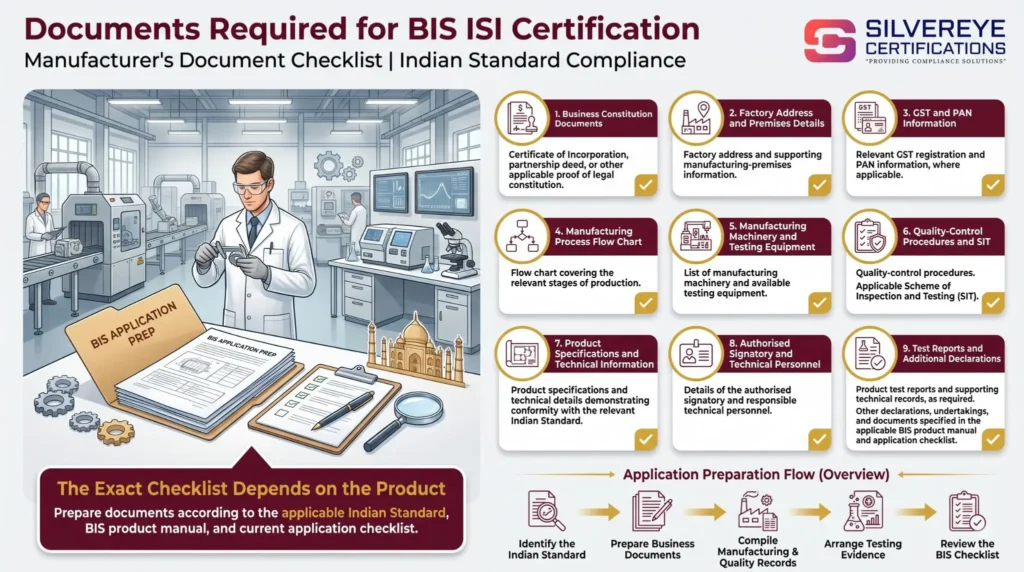
The exact checklist may include further records, such as calibration certificates, raw-material test certificates, factory layout plans, or details of technical personnel, depending on the product and applicable procedure.
BIS ISI Certification Process, Fees and Validity
After identifying the applicable Indian Standard, the manufacturer submits the online application through Manak Online and provides the prescribed documents and fees. The application then proceeds through the applicable scrutiny, assessment, testing, and compliance steps.
Depending on the application route, product conformity may be established through third-party laboratory testing, testing at the manufacturing premises, or a combination of testing methods. BIS assesses the manufacturing and quality-control arrangements according to the applicable procedure before deciding whether to grant the licence.
BIS ISI Certification Fees
| Fee Component | Details |
|---|---|
| Application fee | Payable according to the current BIS fee schedule |
| Inspection fee | Depends on the applicable inspection requirements and prescribed fee |
| Laboratory testing | Charged separately where testing is required; varies by product and tests |
| Annual licence fee | Payable according to the applicable BIS provisions |
| Minimum marking fee | Product-specific and subject to the current fee schedule |
| Other expenses | May include sample transportation, retesting, or other applicable costs |
BIS’s published general FAQ lists an application fee of ₹1,000 and an inspection fee of ₹7,000 per man-day. However, applicants should verify the current fee schedule and product-specific marking fees before budgeting. Avoid treating an estimated laboratory-testing range or a processing fee as universal for every product.
BIS ISI Certification Validity
Under the revised BIS conformity assessment provisions, a Scheme I licence may be granted initially for up to five years, subject to applicable requirements. Five years is the maximum period, not a guarantee that every licence will receive that term.
The actual validity, annual fee obligations, renewal conditions, and ongoing compliance requirements should be confirmed against the current regulations, relevant product guidelines, and licence terms. Apply for renewal within the prescribed period to avoid a lapse in certification.
BIS CRS Registration Documents — Complete Checklist
BIS CRS Registration generally does not require a routine pre-registration factory inspection. The process is based on the prescribed application documents, laboratory testing, and declarations of conformity. BIS may still conduct applicable compliance checks or market surveillance after registration.
Who Needs to Prepare These Documents?
- Indian and foreign manufacturers of products notified under the Compulsory Registration Scheme.
- Manufacturers of covered electronics and IT products, such as specified laptops, mobile phones, televisions, power adapters, LED products, and other notified goods.
- Manufacturers seeking registration before marketing a product for which CRS registration is mandatory.
CRS applies only to products covered by the relevant notifications and Indian Standards. Not every electronic appliance automatically falls under the scheme.
Document Checklist for BIS CRS Registration
| Document | Why BIS Needs It |
|---|---|
| Company registration or legal identity documents | Establishes the applicant’s identity |
| Manufacturing-facility details | Identifies the product’s manufacturing source |
| Product test report from a BIS-recognised laboratory | Provides evidence of conformity with the applicable Indian Standard |
| Product datasheet and technical specifications | Identifies the product and its relevant technical details |
| Brand or trademark documentation, where applicable | Supports verification of the brand used on the product |
| Prescribed declarations and undertakings | Records the applicant’s commitments under CRS |
| Authorised Indian Representative documentation, where required | Provides the required representation for eligible foreign applicants |
| Other prescribed application documents | Meets current portal and scheme requirements |
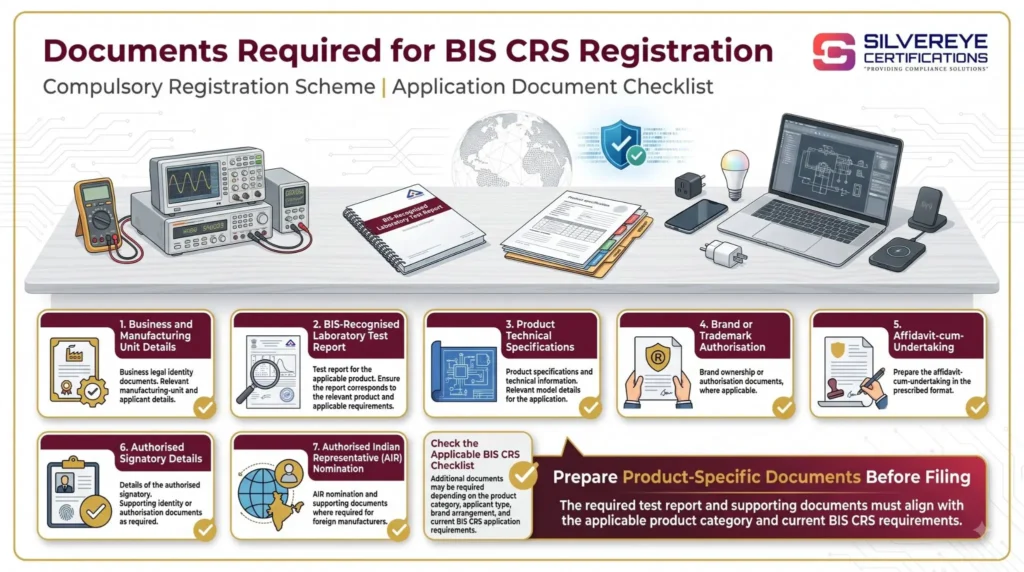
The final checklist depends on the product, manufacturer, brand, application type, and current BIS CRS instructions.
BIS CRS Registration Process, Fees and Validity
The manufacturer first identifies the applicable Indian Standard and arranges product testing at a BIS-recognised laboratory. The applicant then files the registration application through the official BIS CRS portal, uploads the required documents, and pays the applicable fees.
BIS verifies the application, supporting documents, and test report. If the requirements are satisfied, BIS grants registration with a unique registration number. The registration holder must comply with the applicable marking requirements and ongoing regulatory conditions.
BIS CRS Registration Fees and Processing Time
| Item | Details |
|---|---|
| Application and registration fees | Confirm the applicable fees on the official CRS portal |
| Laboratory testing | Charged separately by the laboratory |
| Additional model inclusion | Subject to applicable eligibility, testing, and fees |
| Foreign applicant requirements | May involve additional representation and documentation requirements |
| Processing time | Depends on complete documentation, acceptable test reports, and resolution of any BIS queries |
Avoid publishing a fixed 20% MSME discount or a guaranteed processing timeline unless the current BIS fee schedule and applicable guidance explicitly support the claim.
BIS CRS Registration Validity and Renewal
The CRS validity and renewal provisions were revised in 2026. Under the revised provisions, registration may be granted initially for up to five years, subject to the applicable conditions. The older statement that every CRS registration is valid for exactly two years should not be used as a universal rule.
Applicants should verify the latest BIS CRS circular, registration certificate, annual fee requirements, and renewal procedure before applying. Renewal timing should follow the current instructions rather than an assumed three-month deadline.
For the latest requirements, consult the official BIS CRS circulars and notices before submitting an application or renewal request.
BIS FMCS Certification Documents — Complete Checklist
The Foreign Manufacturers Certification Scheme (FMCS) enables manufacturers with factories outside India to obtain a BIS license to use the ISI Mark on products that conform to the applicable Indian Standard. The documentation includes business, manufacturing, testing, and quality-control records, along with specific requirements for foreign applicants, including an Authorized Indian Representative (AIR) and a Performance Bank Guarantee (PBG) under the applicable conditions.
Who Needs to Prepare These Documents (Eligibility)
- Manufacturers whose factories are located outside India and who produce products covered by relevant Indian Standards.
- Manufacturers applying for mandatory certification under a QCO or voluntary certification where permitted.
- Foreign manufacturers able to meet BIS requirements for manufacturing facilities, in-house testing arrangements, competent testing personnel, and ongoing quality control.
- Applicants who agree to the applicable Scheme of Testing and Inspection (SIT), marking-fee requirements, and licence conditions.
A separate application is generally required for each applicable product/Indian Standard and manufacturing location.
Document Checklist for BIS FMCS Certification
| Document | Why BIS Needs It |
|---|---|
| Factory registration, business licence, and company incorporation documents | Establishes the foreign manufacturer’s legal identity and manufacturing details |
| AIR nomination and acceptance documents | Establishes the authorised Indian representative responsible for applicable compliance obligations |
| Manufacturing process flow chart | Describes the production process from raw materials to finished goods |
| List of plant, machinery, and testing equipment | Helps BIS assess manufacturing and testing capabilities |
| Quality-control procedures and applicable SIT documentation | Demonstrates how product conformity will be maintained |
| Product specifications and applicable Indian Standard details | Identifies the requirements against which the product will be assessed |
| Laboratory test reports, where applicable | Provides supporting evidence of product conformity |
| Prescribed agreements, undertakings, and indemnity documents | Records acceptance of the applicable licence conditions |
| Performance Bank Guarantee (PBG) | Provides financial security under the applicable FMCS requirements |
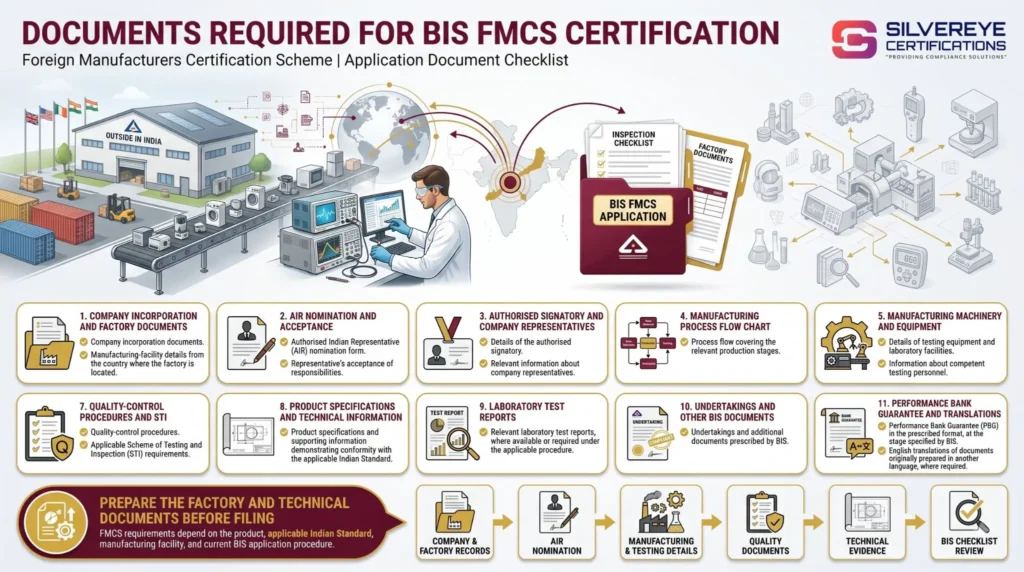
Important: The PBG should not automatically be treated as a document that must accompany the initial application. BIS’s published guidance specifies its submission after the licence is granted. Confirm the latest checklist and applicable instructions for the product before filing.
Authorized Indian Representative (AIR) — Why This Document Is Essential
Foreign manufacturers applying under FMCS must nominate an Authorised Indian Representative (AIR) who meets BIS eligibility requirements. The AIR must be an Indian resident and formally accept the responsibilities associated with the licence.
The AIR supports the manufacturer with:
- Filing the application and prescribed declarations.
- Responding to BIS queries and coordinating required documentation.
- Coordinating arrangements for overseas factory inspection.
- Supporting ongoing compliance with the BIS Act, rules, regulations, and licence conditions.
BIS also specifies requirements relating to qualifications and potential conflicts of interest. If the manufacturer has a branch or office in India, an eligible employee of that office may preferably be nominated.
Online application update: BIS states that offline FMCS applications were accepted up to 31 May 2026. From 1 June 2026, applications must be submitted through the Manakonline portal.
BIS FMCS Process, Fees and Validity
FMCS costs can be higher than those for domestic certification because overseas applications may involve international payment requirements, factory inspection expenses, travel and accommodation arrangements, laboratory testing, and a Performance Bank Guarantee.
The overall cost depends on the product, applicable Indian Standard, inspection requirements, and testing needs. Applicants should obtain the current fee details directly from BIS rather than relying on a single estimated total.
Processing time: The process includes application scrutiny, overseas factory inspection, product sampling, laboratory testing, and resolution of any deficiencies. The time required varies by product and application readiness; a fixed approval period should not be assumed.
Validity and renewal: BIS’s published FMCS guidance states that an initial license may be granted for one to two years, while renewal may be considered for one to five years, subject to applicable requirements and fee payments. Renewal also requires the prescribed documentation and extension of the PBG as specified by BIS. Always check the license’s actual expiry date and current renewal instructions.
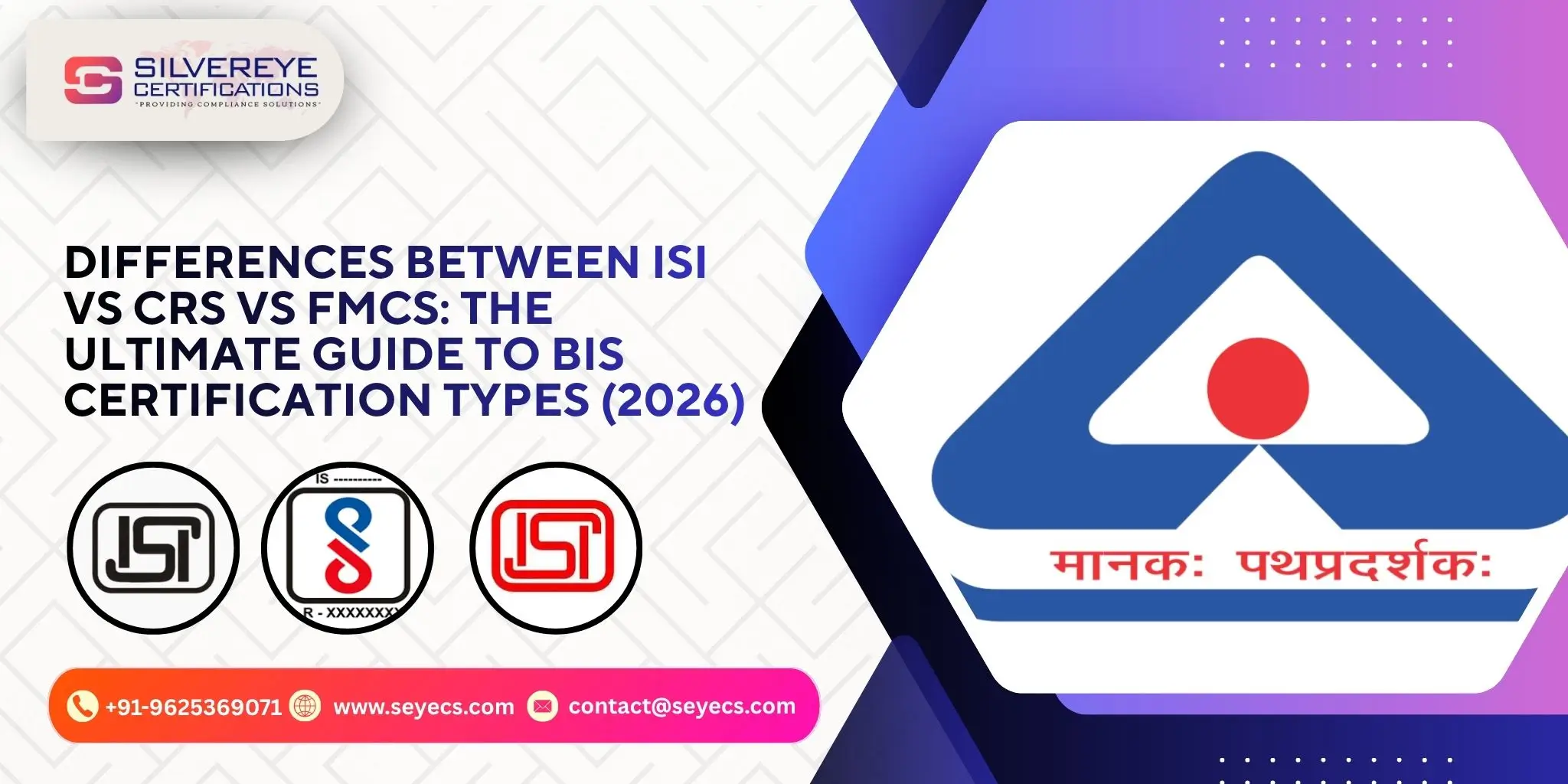
BIS Document Requirements: ISI vs CRS vs FMCS at a Glance
| Parameter | ISI Certification (Scheme I) | CRS Registration (Scheme II) | FMCS Certification |
|---|---|---|---|
| Factory inspection | Manufacturing-premises assessment under the applicable procedure | Generally no routine pre-registration factory visit | Overseas factory inspection is a central part of the process |
| Is an inspection report submitted by the applicant? | BIS conducts the assessment; the applicant should prepare the required factory and quality-control records | A factory inspection report is generally not part of the routine CRS application | BIS conducts the overseas assessment; the applicant provides supporting factory documentation |
| Core proof of conformity | Applicable testing plus assessment of manufacturing and quality-control capabilities | Prescribed laboratory test report, application documents, and declarations | Overseas factory assessment, product sampling/testing, and compliance with FMCS requirements |
| Scheme-specific documentation | Manufacturing, testing, and quality-control records | Product test report and prescribed declarations | AIR nomination, prescribed agreements/undertakings, and PBG under applicable conditions |
| Where applications are filed | Manakonline | BIS CRS portal | Manakonline |
| Validity | Initial licence may be granted for up to five years under revised provisions, subject to applicable conditions | Registration may be granted for up to five years under revised provisions, subject to applicable conditions | Initial licence generally one to two years; renewal may be one to five years under published FMCS guidance |
Note: A factory inspection and a factory inspection report are not the same thing. BIS may conduct an inspection as part of its assessment, but that does not mean the applicant must obtain and upload a completed BIS inspection report as a standard application document.
Latest BIS Certification Documentation Updates (2026)
- Scheme I Grant of License guidelines — 25 February 2026: BIS published revised guidelines for granting licenses under Scheme I. Applicants should use the current guidance and applicable product manual when preparing documentation.
- Revised Scheme I validity provisions: The 2026 amendments updated license-validity provisions. An initial license may be granted for up to five years, subject to the applicable requirements; this is a maximum rather than an automatic validity period.
- FMCS applications fully online — effective 1 June 2026: BIS requires FMCS applications to be submitted through Manakonline from this date. Applicants should follow the portal’s current document and submission instructions.
- CRS validity and renewal update — 27 May 2026: BIS published revised provisions covering CRS license validity, renewal, and annual fee payment. The previous blanket statement that all CRS registrations are valid for exactly two years should therefore be avoided. Check the current circular and certificate terms.
- Changes to product standards and QCOs: Product-specific standards, implementation dates, exemptions, and compulsory-certification requirements may change. Manufacturers should verify the current notification and applicable standard before preparing technical documents.
Because BIS requirements can change during the year, confirm the latest checklist for the relevant product through the official BIS website or applicable portal before filing.
Benefits of Getting Your BIS Documents Right the First Time
- Faster application processing: Complete and correctly formatted documents can help reduce avoidable queries and processing delays.
- Regulatory compliance: Valid BIS certification helps businesses meet applicable requirements for manufacturing, importing, or selling regulated products in India.
- E-commerce compliance: Products covered by mandatory BIS requirements must meet the applicable certification rules before being marketed through relevant sales channels.
- Smoother renewals: Well-organised records make it easier to prepare renewal applications and provide updated information when required.
- Better audit readiness: Updated quality-control procedures, manufacturing process flow charts, and testing records help manufacturers prepare for applicable ISI and FMCS factory assessments.
Common Document Mistakes That Delay BIS Approval
- Outdated quality-control manual: Ensure that quality-control procedures and the Scheme of Inspection and Testing (SIT) reflect current manufacturing processes and equipment.
- Incomplete CRS test reports: Verify that laboratory reports cover the applicable Indian Standard and meet current BIS requirements.
- Missing AIR documentation for FMCS: Foreign manufacturers must complete the prescribed Authorised Indian Representative (AIR) nomination and acceptance requirements.
- Mismatched technical specifications: Ensure product datasheets, model details, and test reports correspond to the applicable Indian Standard.
- Delayed renewal applications: Check the current scheme-specific renewal procedure and deadline rather than relying on a general pre-expiry period.
- Incorrect authorised signatory details: Confirm that applications and declarations are completed by an appropriately authorised person and that the supporting records are consistent.
Why Work With Silvereye Certifications for BIS Certification?
Preparing documents for ISI Certification, CRS Registration, or FMCS Certification can be challenging because each scheme has different requirements. Silvereye Certifications supports manufacturers, importers, and foreign businesses with documentation preparation and application coordination for BIS certification.
How Silvereye Certifications Helps
- Document checklist review: Helps identify the documents applicable to the product and certification scheme.
- Technical file preparation: Assists with preparing and reviewing quality manuals, process flow charts, and SIT-related documentation, where applicable.
- Laboratory and test-report coordination: Helps applicants understand testing requirements and coordinate with suitable laboratories.
- Factory-audit readiness: Supports ISI and FMCS applicants in organising manufacturing, testing, and quality-control records before the applicable factory assessment.
- AIR documentation support: Helps foreign manufacturers prepare the required documentation for an Authorised Indian Representative under FMCS.
- Renewal tracking: Helps clients monitor relevant licence and registration expiry dates and prepare renewal documentation in advance.
If you are preparing BIS ISI, CRS, or FMCS documents in 2026, confirming the correct scheme and organising the required paperwork can help reduce avoidable delays. Silvereye Certifications can assist with documentation and application coordination, while final approval remains subject to BIS assessment and applicable regulatory requirements.
Conclusion
Getting your BIS Certification documents right from the beginning can help simplify the application process, reduce documentation-related queries, and support ongoing compliance. Whether you need ISI Certification, CRS Registration, or FMCS Certification, ensure that your documents, test reports, and technical details meet the requirements of the applicable scheme. As BIS standards, fees, validity periods, and renewal procedures may change, always verify the latest official guidance before applying.
Silvereye Certifications can support your business with document preparation, laboratory coordination, factory-assessment readiness, AIR documentation, and renewal assistance throughout the certification process.
Frequently Asked Questions
What documents are required for BIS Certification?
The exact list depends on the scheme. ISI needs factory, quality, and process documents plus a factory audit report; CRS needs company and lab-test documents without a factory audit; FMCS needs the ISI document set plus AIR nomination and a Performance Bank Guarantee.
Is a factory audit document mandatory for BIS ISI certification?
Yes. A physical factory audit by BIS officials is compulsory for every ISI Certification application under Scheme I — there is no document-only waiver.
Is a factory audit document required for BIS CRS registration?
No. BIS CRS Registration is based on a laboratory test report and self-declaration of conformity; a factory audit document is not part of the checklist.
What is the most important document for BIS CRS registration?
The product test report from a BIS-recognised laboratory, since it is the primary proof of conformity in the absence of a factory audit.
What documents does a foreign manufacturer need for BIS FMCS?
The same technical and quality documents required for ISI, plus an Authorised Indian Representative (AIR) nomination letter and a Performance Bank Guarantee.
Can I apply for BIS ISI certification without a quality control manual?
No. The Scheme of Inspection and Testing (SIT) / quality control manual is a mandatory document, and its implementation is verified during the compulsory factory audit.
How long does BIS take to verify CRS documents?
Typically around 20 to 30 working days from a complete, correctly documented application, though incomplete submissions take longer due to query cycles.
What happens if a BIS document is missing or incorrect?
BIS raises a query on the applicant's portal account; the application timeline pauses until the correct or missing document is submitted and reviewed.
Do I need to renew my BIS documents periodically?
Yes. CRS registration documents must be renewed via Form IX at least three months before the two-year validity expires; ISI and FMCS also require timely renewal filings before their licence expiry.
Can one document set cover multiple product models?
For CRS, multiple models under the same brand and standard can be added to an existing registration by submitting model-specific test reports and paying an inclusion fee.
What is a Performance Bank Guarantee (PBG) in FMCS documents?
It is a financial guarantee document foreign manufacturers submit to BIS as assurance of continued compliance during the FMCS licence period.
Where do I submit BIS certification documents?
ISI documents go through the BIS Manak Online portal (Scheme I), CRS documents through the BIS CRS portal, and FMCS documents through Manakonline, which became fully online from 1 June 2026.