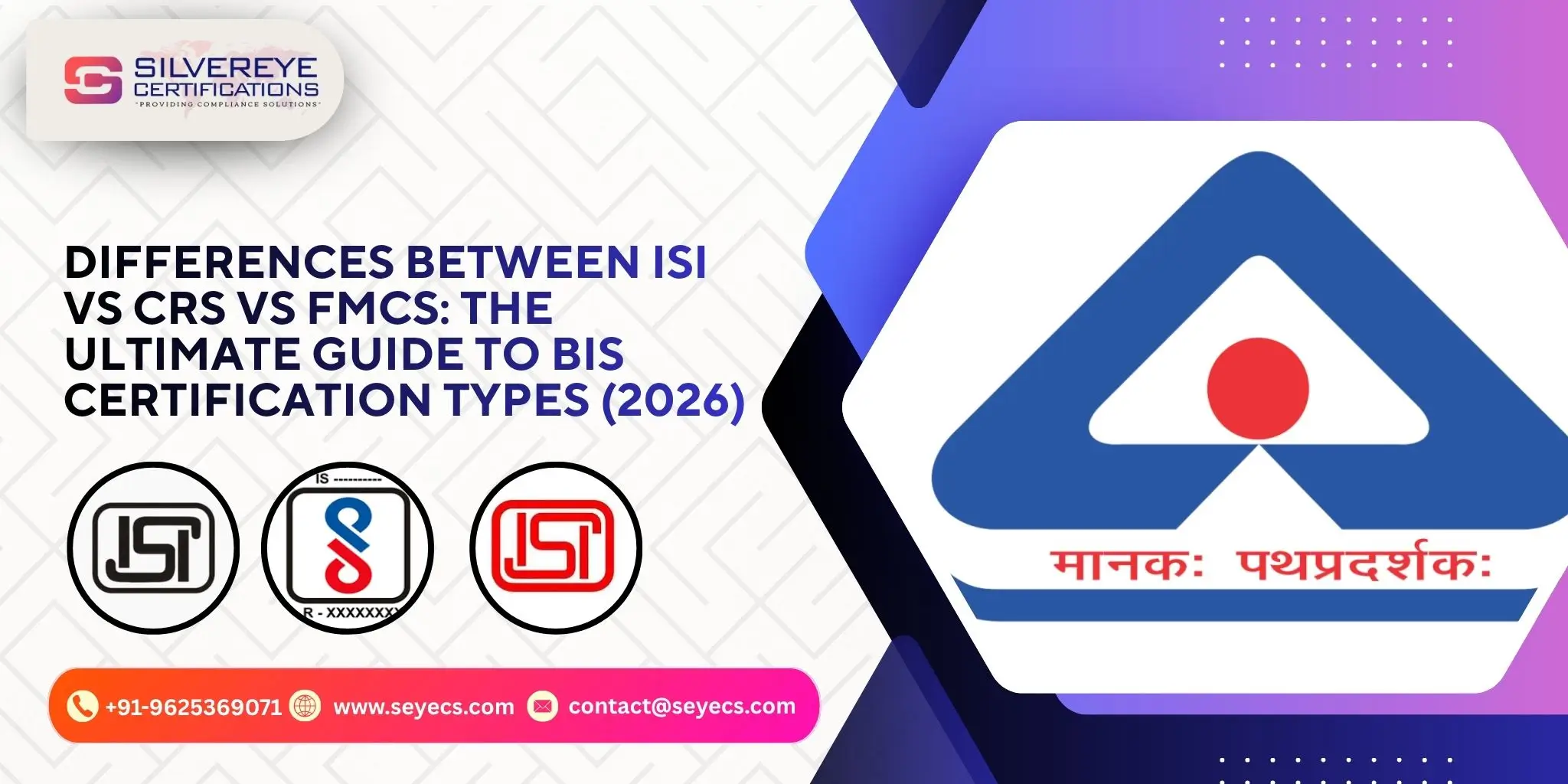


- Factory Audit: BIS ISI certification generally involves factory assessment and product testing under the applicable certification scheme. In contrast, BIS CRS registration is based on testing at a BIS-recognized laboratory and an application supported by the required declarations and documents. CRS should not be described as exempt from all verification or surveillance.
- Product Coverage: BIS certification is mandatory for products notified by the Government through applicable Quality Control Orders (QCOs) and other compulsory certification requirements. The number of covered products changes as notifications are added, amended, or withdrawn, so check the current BIS list rather than relying on a fixed total.
- License Validity: Under the 2026 amendments, BIS CRS (Scheme II) licenses are initially granted for five years, with renewal for a further five-year period and fees payable annually in advance. Under Scheme I, the initial license period can be up to five years, subject to the applicable regulations. Always confirm the scheme-specific conditions before applying.
- Foreign Manufacturers: Under the Foreign Manufacturers Certification Scheme (FMCS), overseas manufacturers must nominate an Authorised Indian Representative (AIR). BIS assesses the manufacturing facility and product conformity as part of the licensing process, including factory inspection and testing under the applicable requirements.
Introduction
BIS Certification is India's product quality and conformity assessment system administered by the Bureau of Indian Standards (BIS) under the BIS Act, 2016. The applicable certification route depends on the product, the manufacturer's location, and the relevant government notification.
There are three important routes to understand:
- ISI Certification (Scheme I): Applies to products covered by the relevant BIS certification requirements, including certain cement, helmets, and electrical cables. The process generally involves product testing and factory assessment before a licence is granted.
- BIS CRS Registration (Scheme II): Covers notified electronics and IT products, including specified mobile phones, LED products, and power adapters. Registration generally relies on testing at a BIS-recognised laboratory and the required application documents and declarations. A routine factory audit is not a standard requirement for every CRS application.
- BIS FMCS Certification: Enables eligible foreign manufacturers to obtain BIS certification for products covered by the applicable requirements. The manufacturer must appoint an Authorized Indian Representative (AIR) and undergo the prescribed factory inspection and product testing at the overseas manufacturing facility.
Choosing the correct BIS certification scheme and preparing complete, accurate documentation can help avoid unnecessary delays. Before applying, verify the product's applicable Quality Control Order (QCO), testing requirements, factory assessment procedure, and current BIS guidelines.
What Is BIS Certification Process and Why Does It Matter?
The Bureau of Indian Standards (BIS) is India's national standards body, established under the BIS Act, 2016, under the Ministry of Consumer Affairs, Food and Public Distribution. BIS develops Indian Standards and operates conformity assessment schemes to help ensure that products meet applicable safety, quality, and performance requirements.

For many products, BIS certification is mandatory under Quality Control Orders (QCOs) issued by the Government of India. Depending on the product, manufacturers may need a BIS license or registration before manufacturing, importing, or selling it in India. Non-compliance can result in enforcement action, penalties, or other consequences under the applicable law.
Three important BIS certification routes are:
- ISI Certification (Scheme I): Generally applies to products such as cement, steel products, helmets, and electrical cables covered by the relevant Indian Standards and certification requirements. The process involves assessment of manufacturing and testing capabilities and verification of product conformity.
- BIS CRS Registration (Scheme II): Covers notified electronics and IT products, including specified mobile phones, LED products, and power adapters. Registration follows the applicable testing and self-declaration requirements.
- BIS FMCS Certification: Enables eligible foreign manufacturers of products covered by the scheme to obtain BIS certification and use the ISI mark. The process includes an overseas factory visit, product sampling, and testing under the applicable requirements.
Choosing the correct BIS certification scheme is essential because the application process, documentation, testing, inspection, fees, and validity conditions differ by product and scheme. This guide explains the BIS ISI certification process, required documents, fees, factory assessment, and licence validity.
BIS ISI Certification Process (Scheme I): Step by Step
The ISI mark indicates that a product conforms to the applicable Indian Standard under a BIS license. Under Scheme I, BIS assesses the manufacturer's production and testing capabilities and establishes whether the product meets the relevant standard.
Who Needs BIS ISI Certification?
BIS ISI certification may be required for:
- Indian manufacturers producing products covered by the applicable Scheme I requirements.
- Manufacturers whose products are subject to a mandatory Quality Control Order (QCO).
- Businesses manufacturing products for which voluntary BIS certification is available and commercially beneficial.
- Manufacturers of products such as cement, helmets, steel bars, and electrical wires, where the relevant product and standard are covered by applicable certification requirements.
Foreign manufacturers seeking certification for eligible products generally use the Foreign Manufacturers Certification Scheme (FMCS) rather than applying as domestic manufacturers.

Important: Not every product with an Indian Standard requires mandatory certification. Check the latest BIS compulsory-certification list and the applicable QCO to confirm whether your product requires a licence.
Documents Required for BIS ISI Certification
The exact document checklist depends on the product and the applicable Indian Standard. Commonly required documents and information include:
- Business constitution documents, such as a Certificate of Incorporation or partnership deed, as applicable.
- Factory address and manufacturing-premises details.
- GST and PAN information, where applicable to the applicant.
- Manufacturing process flow chart covering the relevant production stages.
- List of manufacturing machinery and testing equipment.
- Quality-control procedures and the applicable Scheme of Inspection and Testing (SIT).
- Product specifications and technical information demonstrating conformity with the relevant Indian Standard.
- Details of the authorised signatory and responsible technical personnel.
- Product test reports and supporting technical records, as required by the applicable procedure.
- Other declarations, undertakings, and documents specified in the relevant BIS product manual and application checklist.
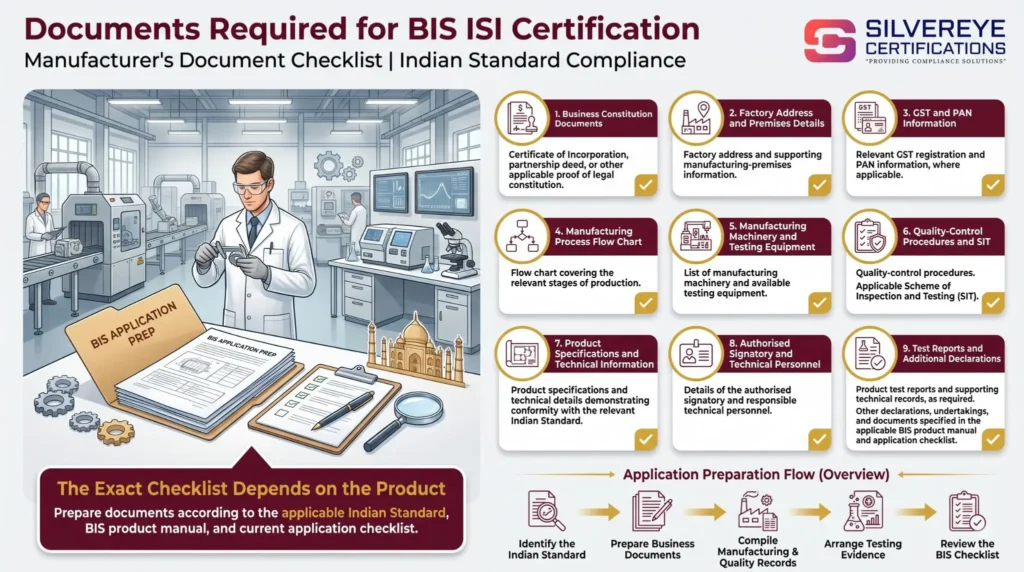
Prepare the documents against the specific product manual, rather than relying on a generic checklist alone.
Step-by-Step BIS ISI Certification Process
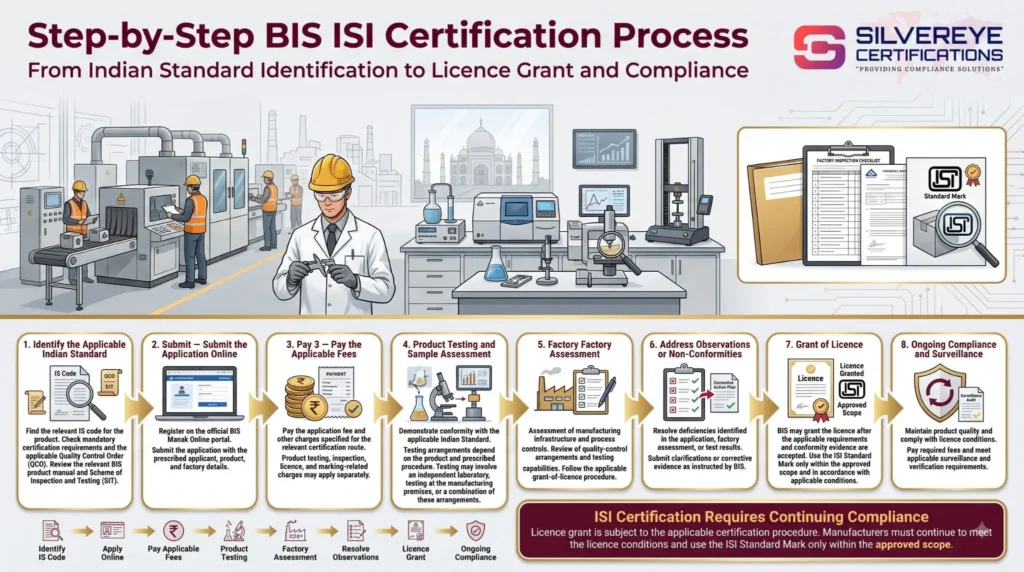
1. Identify the applicable Indian Standard
Find the relevant IS code and check whether the product falls under mandatory certification. Review the applicable QCO, product manual, and Scheme of Inspection and Testing.
2. Submit the application online
Register on the official BIS Manak Online portal and submit the application with the prescribed applicant, product, and factory information.
3. Pay the applicable fees
Pay the application fee and other charges specified for the relevant certification route. Product testing, inspection, licence, and marking-related fees may be charged separately.
4. Product testing and sample assessment
BIS establishes conformity with the applicable Indian Standard through the testing route prescribed for the product. Depending on the scheme and product-specific requirements, testing may involve an independent laboratory, testing at the manufacturing premises, or a combination of these arrangements.
5. Factory assessment
BIS assesses the manufacturing infrastructure, process controls, quality-control arrangements, and testing capabilities. The applicable grant-of-licence procedure determines the assessment requirements and how the manufacturing facility is evaluated.
6. Address observations or non-conformities
If BIS identifies deficiencies in the application, factory assessment, or test results, the applicant must address them in accordance with the instructions provided.
7. Grant of license
Once the application and required conformity evidence meet the applicable requirements, BIS may grant the licence and authorise use of the ISI Standard Mark within the approved scope.
8. Ongoing compliance and surveillance
After the licence is granted, the manufacturer must continue to meet the applicable licence conditions, maintain product quality, pay required fees, and comply with relevant surveillance and verification requirements.
BIS ISI Certification Fees
The cost of BIS ISI certification depends on the product, testing requirements, inspection arrangements, and applicable fee schedule.
| Fee Component | What to Know |
|---|---|
| Application fee | Pay the amount prescribed under the current BIS fee schedule. |
| Inspection fee | Applicable charges depend on the inspection requirements and current fee rules. |
| Laboratory testing | Varies by product, Indian Standard, number of samples, and tests required. |
| Licence and marking fees | Pay the applicable licence fee and product-specific marking fee, as required. |
| Additional expenses | Sample transportation, travel-related expenses where applicable, and professional consultancy charges may be separate. |
Do not rely on a single estimated total for every product. Confirm the latest charges on the official BIS website and the relevant product manual before applying.
ISI License Validity and Renewal
Under the BIS (Conformity Assessment) Regulations, 2018, as amended in 2026, the applicable Scheme I licence provisions allow an initial licence period of up to five years, with renewal for a further period of up to five years, subject to the applicable requirements.
The licence period granted to a particular manufacturer depends on the relevant scheme provisions and approval. Manufacturers should not assume that every licence automatically receives the maximum five-year period.
Licence holders must also comply with applicable annual fee-payment and production-reporting requirements. Review the licence conditions and current BIS instructions well before the due date to avoid disruption.
BIS CRS Registration Process (Scheme II) — Step by Step
BIS CRS Registration is a mandatory conformity assessment requirement for notified electronic and IT products in India. It operates under Scheme II of Schedule II of the BIS (Conformity Assessment) Regulations, 2018, as amended.
Under the Compulsory Registration Scheme (CRS), manufacturers demonstrate product conformity through testing by a BIS-recognised laboratory and submission of the required documents and declarations.
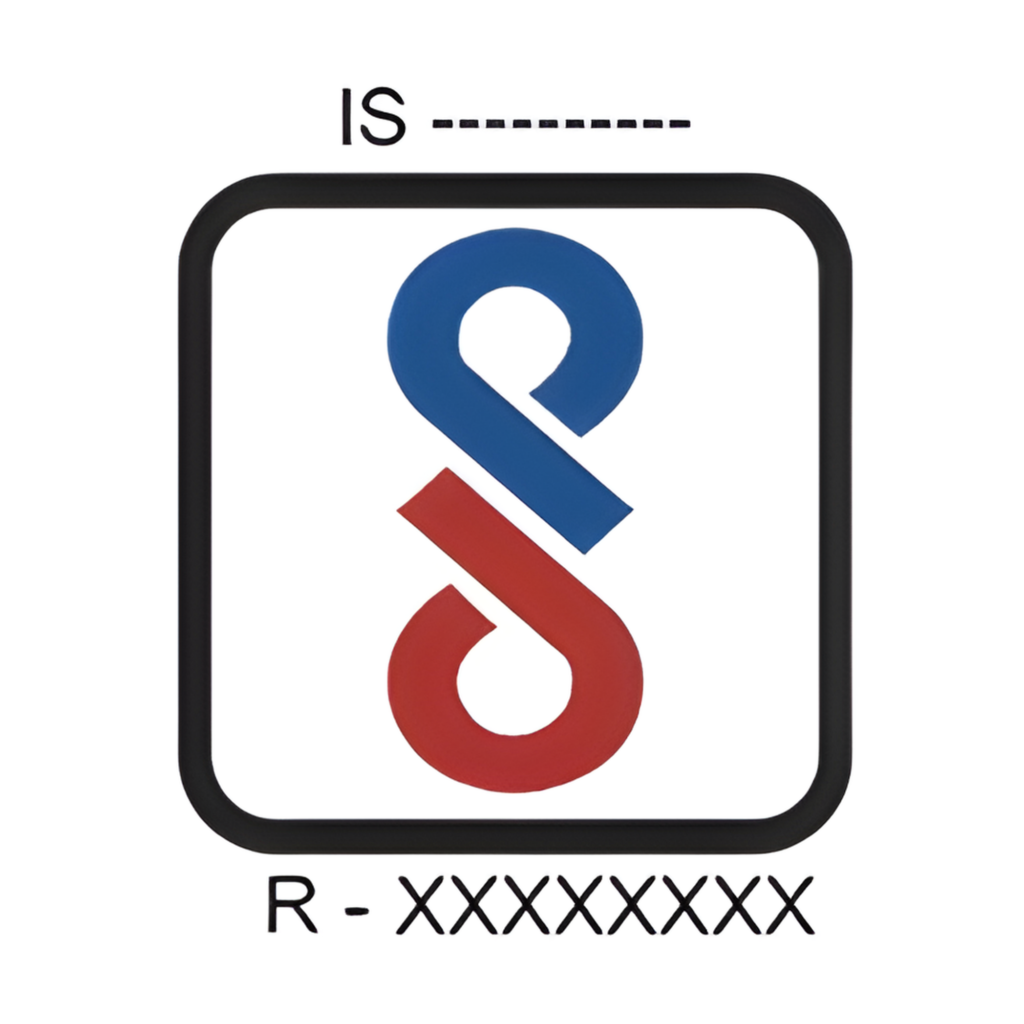
Key Difference Between BIS CRS and ISI Certification: BIS CRS Registration generally follows a laboratory testing and self-declaration route, without a routine pre-registration factory audit. In comparison, BIS ISI Certification under Scheme I involves assessment of manufacturing and quality-control capabilities according to the applicable certification procedure.
Who Needs BIS CRS Registration (Eligibility)?
BIS CRS Registration applies to manufacturers of products notified under the relevant compulsory registration orders.
- Indian manufacturers producing notified electronic and IT products.
- Foreign manufacturers supplying covered products to the Indian market.
- Manufacturers of notified products such as mobile phones, laptops, televisions, power adapters, LED lighting products, batteries, and other specified electronic goods.
- Manufacturers seeking to introduce additional models covered by the same applicable Indian Standard.
Important: CRS requirements depend on the exact product category, applicable Indian Standard, and current government notification. Not every electronic appliance automatically falls under CRS.
Documents Required for BIS CRS Registration
The following documents are commonly required:
- Business and manufacturing unit details, including proof of legal identity.
- BIS-recognised laboratory test report for the applicable product.
- Product technical specifications and model details.
- Brand or trademark authorisation, where applicable.
- Affidavit-cum-undertaking in the prescribed format.
- Authorised signatory details and supporting documents.
- Authorised Indian Representative (AIR) nomination, where required for foreign manufacturers.
- Other documents specified in the BIS CRS application checklist.
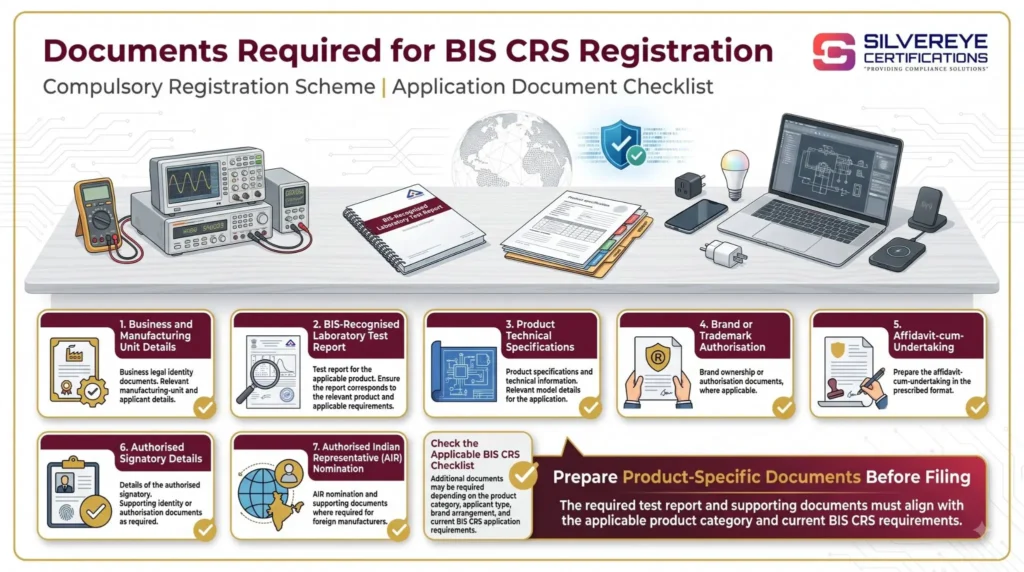
The precise documentation may vary according to the product, manufacturer location, and application type.
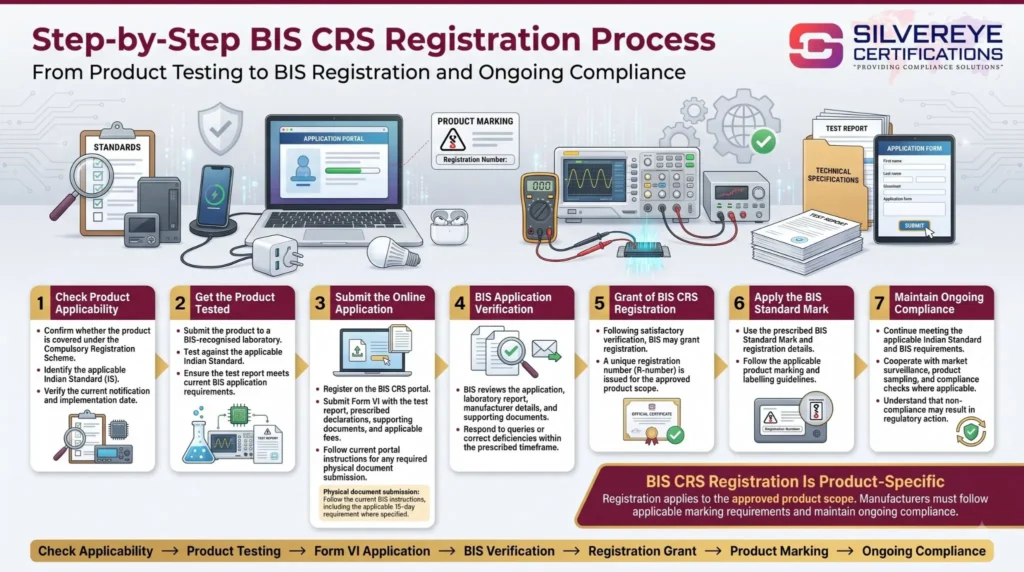
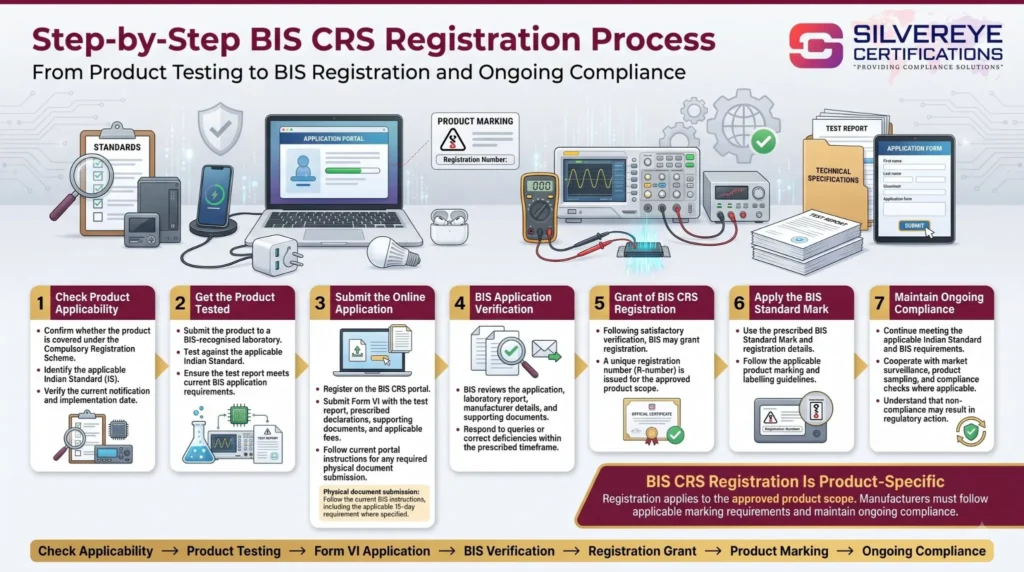
Step-by-Step BIS CRS Registration Process
Step 1: Check Product Applicability
Confirm whether the product is covered under the Compulsory Registration Scheme. Identify the relevant Indian Standard (IS) and verify the current notification and applicable implementation date.
Step 2: Get the Product Tested
Submit the product to a BIS-recognised laboratory for testing against the applicable Indian Standard. Ensure the test report meets BIS requirements and is valid for application submission.
Step 3: Submit the Online Application
Register on the BIS CRS portal and submit Form VI, along with the laboratory test report, prescribed declarations, supporting documents, and applicable fees.
Submit physical documents where required under the current BIS portal instructions. The published application guidance specifies submission of hard copies within 15 days of online filing.
Step 4: BIS Application Verification
BIS reviews the application, laboratory test report, manufacturer details, and supporting documents. If BIS identifies missing or incorrect information, the applicant must respond to the query within the prescribed timeframe.
Step 5: Grant of BIS CRS Registration
After satisfactory verification, BIS grants registration and issues a unique registration number (R-number) for the approved product scope.
Step 6: Apply the BIS Standard Mark
The manufacturer must use the prescribed BIS Standard Mark and registration details according to the applicable marking and labelling guidelines.
Step 7: Maintain Ongoing Compliance
After registration, manufacturers must continue to comply with the relevant Indian Standard and BIS requirements. Market surveillance, product sampling, and compliance checks may be conducted. Non-compliance can result in regulatory action.
BIS CRS Registration Fees and Processing Time
| Fee / Timeline Component | Details |
|---|---|
| Application and processing fees | As specified in the applicable BIS CRS fee schedule |
| Laboratory testing fees | Charged separately by the BIS-recognised laboratory |
| Model inclusion fees | Applicable when adding eligible models to an existing registration |
| Foreign manufacturer expenses | May include AIR-related and documentation expenses |
| MSME concessions | Subject to current BIS fee provisions and eligibility |
| Processing time | BIS guidance indicates a normal processing period of approximately 20 working days, subject to complete documentation and satisfactory scrutiny |
Note: The overall registration timeline may be longer because of laboratory testing, document preparation, clarification requests, or additional compliance requirements.
BIS CRS Registration Validity and Renewal
Under the 2026 revised CRS provisions, registration validity and renewal arrangements have been updated.
- Initial validity: Registration may be granted for a period of up to five years, subject to applicable BIS requirements.
- Annual fee compliance: Applicable annual fees and required information must be submitted according to the revised provisions.
- Renewal: Manufacturers must follow the prevailing BIS renewal procedure and submit the required application, documents, and fees within the prescribed period.
- Model inclusion: Additional models of the same product category and brand may be included under an existing registration, subject to applicable testing and approval requirements.
- Continued compliance: Registration holders must maintain conformity with the applicable Indian Standard throughout the registration period.
Manufacturers should check their registration certificate, BIS CRS portal instructions, and latest renewal circulars before applying for renewal.
BIS FMCS Certification Process (Foreign Manufacturers) — Step by Step
The Foreign Manufacturers Certification Scheme (FMCS) is a BIS certification route that allows manufacturers with factories outside India to obtain a license to use the BIS Standard Mark (ISI Mark) on products conforming to the applicable Indian Standards.
FMCS operates under the BIS Act, 2016 and the BIS (Conformity Assessment) Regulations, 2018. It applies to products covered by relevant Indian Standards, whether certification is mandatory or voluntary. However, electronic and IT products notified under MeitY’s Compulsory Registration Scheme (CRS) are handled under the applicable CRS requirements rather than FMCS.

A foreign manufacturer must apply for certification for its manufacturing premises and the relevant product standard. An importer cannot apply for an FMCS licence on behalf of the foreign manufacturer.
Who Needs BIS FMCS Certification (Eligibility)?
FMCS may apply to manufacturers whose production facilities are located outside India and who seek BIS certification for products covered by the relevant Indian Standards.
Applicants must:
- Manufacture the product at an overseas factory with the required production facilities and machinery.
- Meet the requirements of the applicable Indian Standard (IS).
- Maintain suitable in-house testing facilities and competent testing personnel, as required by the relevant standard and certification requirements.
- Accept the applicable Scheme of Testing and Inspection (STI) and marking-fee requirements.
- Agree to comply with the terms and conditions of the BIS licence.
- Nominate an eligible Authorised Indian Representative (AIR).
A separate application is generally required for each applicable product/Indian Standard and each manufacturing location.
Authorized Indian Representative (AIR) — Mandatory Requirement
A foreign manufacturer must nominate an Authorized Indian Representative (AIR) to support its BIS certification application and ongoing license obligations.
The AIR must be an Indian resident and formally accept the responsibilities associated with the licence. The representative may be an eligible individual or a person associated with an Indian branch or office, subject to BIS requirements.
The AIR’s responsibilities include:
- Supporting the application and communicating with BIS.
- Responding to queries and helping maintain the required documentation.
- Accepting the responsibilities prescribed under the BIS Act, rules, regulations, and licence conditions.
- Coordinating relevant arrangements for factory inspections and sample handling.
- Supporting compliance and market-surveillance activities during the licence period.
The AIR must satisfy BIS eligibility requirements, including applicable qualification and conflict-of-interest conditions. The manufacturer must inform BIS of changes to the AIR or the representative’s address as required.
Documents Required for BIS FMCS Certification
The exact document checklist depends on the product, applicable Indian Standard, and the current BIS application requirements. Commonly required documents include:
- Company incorporation and manufacturing-facility documents from the country where the factory is located.
- AIR nomination form and the representative’s acceptance of responsibilities.
- Details of the authorised signatory and relevant company representatives.
- Manufacturing process flow chart covering the production stages.
- List of manufacturing machinery, plant, and equipment.
- Details of in-house testing equipment, laboratory facilities, and competent testing personnel.
- Quality-control procedures and the applicable Scheme of Testing and Inspection (STI) requirements.
- Product specifications and information demonstrating conformity with the applicable Indian Standard.
- Relevant laboratory test reports, where available or required under the applicable procedure.
- Undertakings and other documents prescribed by BIS.
- Performance Bank Guarantee (PBG) in the prescribed format, at the stage specified by BIS.
- English translations of documents originally prepared in another language, where required.
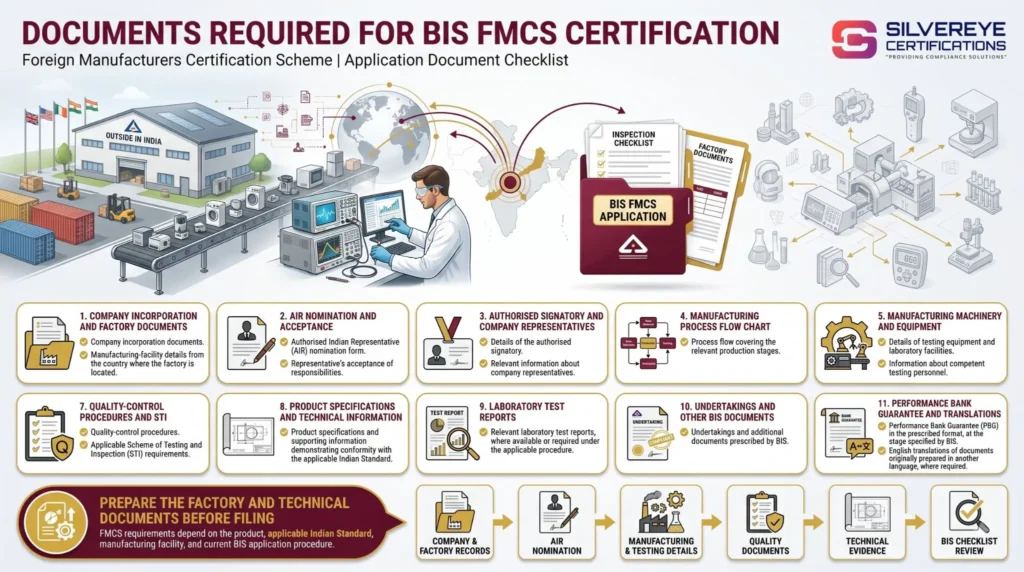
The applicant must also make the necessary arrangements for factory inspection, including applicable travel, accommodation, visa, insurance, and local transport expenses for BIS officials.
Step-by-Step BIS FMCS Certification Process
Step 1: Identify the Applicable Indian Standard
Identify the relevant Indian Standard (IS) for the product and check whether FMCS is the appropriate certification route. Review the applicable product manual, testing requirements, and Scheme of Testing and Inspection.
Step 2: Appoint an Authorised Indian Representative
Nominate an eligible AIR before filing the application. Complete the prescribed nomination and acceptance documents and confirm that the representative meets BIS requirements.
Step 3: Submit the Online Application
Submit the FMCS application through the official Manakonline portal with the required forms, supporting documents, and applicable fees.
From 1 June 2026, BIS accepts FMCS applications through the online portal only; the published transition notice states that offline applications were accepted up to 31 May 2026.
Step 4: BIS Scrutiny and Document Verification
BIS examines the application and supporting records. If deficiencies or queries arise, the applicant must provide the requested clarification or documents within the specified timeframe.
Step 5: Overseas Factory Inspection
BIS arranges a visit to the overseas manufacturing facility to assess its production infrastructure, process controls, quality-control systems, and testing capabilities.
The manufacturer must coordinate the required arrangements for the visit. Factory assessment is a central part of FMCS certification.
Step 6: Product Sampling and Laboratory Testing
Samples are drawn or handled according to the applicable certification procedure and tested against the relevant Indian Standard at the designated BIS or BIS-recognised laboratory. The applicant is responsible for applicable sample-handling arrangements and testing charges.
Step 7: Resolve Inspection and Testing Observations
The manufacturer must address any deficiencies identified during the factory assessment or product testing. BIS can proceed with the application when the required inspection and test results are satisfactory and other conditions have been met.
Step 8: License Grant and Performance Bank Guarantee
After satisfactory assessment and testing, and completion of the applicable formalities and payments, BIS may grant the licence.
BIS’s published grant-of-licence guidance specifies that the manufacturer must furnish the prescribed Performance Bank Guarantee of USD 10,000 immediately after the grant of licence, in the required format and from a bank with an RBI-approved branch in India. Confirm the current instructions and applicable conditions with BIS before submission.
The licence specifies the approved product scope and permits the manufacturer to use the BIS Standard Mark in accordance with the licence conditions.
Step 9: Ongoing Compliance and Surveillance
After the licence is granted, the manufacturer must continue to meet BIS requirements. Surveillance may include factory visits, checks of testing and quality-control arrangements, review of production and dispatch records, and independent product sampling.
BIS may also collect samples from the market for testing. Non-compliance can result in regulatory action, including suspension or cancellation of the licence.
BIS FMCS Certification Validity and Renewal
According to BIS’s published FMCS guidance:
- Initial licence period: Generally granted for a period of at least one year and up to two years.
- Renewal: May be considered for a period of one to five years, depending on the applicable requirements and payment of the annual licence fee and advance minimum marking fee.
- Performance Bank Guarantee: Renewal requires the prescribed extension of the PBG, generally covering six months beyond the renewed licence’s validity.
- Renewal documentation: Includes the prescribed renewal application, production details, and applicable fee payments.
- Late renewal: BIS’s published guidance specifies a late fee for applications submitted after licence expiry.
Manufacturers should verify the current renewal instructions, fee schedule, and required forms on the official BIS FMCS website before applying.
BIS FMCS Fees, Timeline and Validity
The cost of BIS FMCS Certification depends on the product, applicable Indian Standard, laboratory testing requirements, overseas factory inspection, and other scheme-specific charges.
The total budget may include:
- BIS application and certification fees, as applicable.
- Laboratory testing charges and any required retesting.
- Overseas inspection expenses, including applicable travel and accommodation costs.
- Performance Bank Guarantee (PBG) requirements.
- Minimum marking fees and other applicable licence charges.
The PBG is a financial security requirement, not a routine certification fee. Its value and applicable terms should be confirmed against the current BIS instructions.
Processing time: FMCS applications can take several months because they involve document scrutiny, overseas factory inspection, product testing, and closure of observations. The actual timeline depends on the product and the applicant’s readiness. Obtain a product-specific estimate rather than relying on a fixed approval deadline.
Validity and renewal: Validity depends on the applicable certification provisions and the terms of the licence. BIS’s published FMCS guidance has described initial licences of up to two years and renewals for periods of one to five years, subject to applicable requirements. Applicants should confirm the current conditions directly with BIS and follow the expiry date and renewal instructions stated for their licence.
ISI vs CRS vs FMCS: Quick Comparison Table
| Parameter | ISI Certification (Scheme I) | CRS Registration (Scheme II) | FMCS |
|---|---|---|---|
| Applies to | Manufacturers applying under the applicable Scheme I route | Manufacturers of notified electronics and IT products, including foreign manufacturers | Manufacturers with factories outside India seeking BIS certification under FMCS |
| Factory assessment | Manufacturing and quality-control assessment under the applicable procedure | Generally no routine pre-registration factory audit | Overseas factory inspection is a central part of the scheme |
| Typical products | Products such as cement, steel, helmets and cables, where covered by the applicable standard or QCO | Notified products such as specified laptops, televisions, mobile phones and other electronics | Products covered by the applicable Indian Standards and FMCS requirements, excluding products governed by a different scheme such as CRS |
| Approval basis | Product conformity, manufacturing capability, quality control and applicable testing | Required laboratory test report, application documents and conformity declarations | Overseas factory assessment, product testing and compliance with FMCS requirements |
| Indian representative required? | Not generally for an Indian manufacturer applying under the domestic route | Required where applicable for foreign manufacturers | Yes, an eligible Authorised Indian Representative (AIR) is required |
| Validity | Under the revised provisions, an initial licence may be granted for up to five years, subject to applicable requirements | Under the revised provisions, registration may be granted for up to five years, subject to applicable requirements | Confirm the current FMCS provisions and the period stated in the licence |
| Governing framework | BIS (Conformity Assessment) Regulations, 2018, Scheme I | BIS (Conformity Assessment) Regulations, 2018, Scheme II | BIS Act, 2016, applicable conformity assessment regulations and FMCS requirements |
Important: BIS certification is not automatically mandatory for every product. The requirement depends on the applicable government notification, product category, Indian Standard, and implementation date. Check the latest BIS compulsory-certification lists before choosing a scheme.
Latest BIS Certification Updates (2026)
- Revised Scheme I procedures — 25 February 2026: BIS updated its product-certification guidance and published revised procedural documents. Applicants should consult the current grant-of-licence, inspection, and renewal guidelines for their product.
- Updated validity provisions: The 2026 amendments revised validity provisions for Scheme I and Scheme II. The initial period may be up to five years, subject to the applicable scheme and conditions. This is a maximum, not a guarantee that every licence or registration will receive five years. Annual fee and reporting requirements may also apply.
- FMCS online applications — effective 1 June 2026: BIS’s published guidance states that offline FMCS applications were accepted only up to 31 May 2026. From 1 June 2026, applications must be submitted through the online portal.
- Migration to IS/IEC 62368-1:2023: The older safety standards IS 13252 (Part 1):2010 and IS 616:2017 are being replaced for relevant product categories. The applicable transition dates must be checked against the product-specific notification; the general concurrent-running period for the relevant goods extends to 1 November 2028.
- Scheme X and machinery requirements: Machinery and electrical equipment requirements have been subject to changes and rescission of earlier orders. Do not rely on older implementation dates without checking the latest applicable notification and product coverage.
- Expanding and changing QCO coverage: Product coverage and implementation dates can change through new notifications, amendments, exemptions, and rescissions. Check the current compulsory-certification list and the relevant QCO before manufacturing, importing, or selling a product.
Because requirements can change during the year, manufacturers and importers should verify the applicable standard, QCO, effective date, and certification route before filing an application.
Benefits of BIS Certification for Manufacturers and Importers
- Regulatory compliance: Helps businesses meet applicable BIS requirements for products covered by mandatory certification orders.
- Consumer confidence: The authorised BIS Standard Mark or applicable registration marking helps consumers identify products covered by the relevant conformity assessment scheme.
- Market access: Certification supports the lawful sale of products for which BIS approval is mandatory, subject to all other applicable legal requirements.
- Retail and e-commerce readiness: Businesses selling regulated product categories may need valid BIS certification to meet applicable marketplace and legal requirements.
- Procurement eligibility: Some government and institutional tenders specify BIS certification as a condition of participation.
- Quality-control discipline: The applicable certification process can help manufacturers maintain product testing, process controls, and records.
Note: BIS certification does not automatically guarantee customs clearance, marketplace listing, tender eligibility, or freedom from enforcement action. Businesses must meet all other applicable requirements as well.
Common Mistakes to Avoid During BIS Certification
- Choosing the wrong scheme: Confirm whether the product falls under Scheme I, CRS, FMCS, or another applicable conformity assessment route before applying.
- Assuming CRS rules apply to all electronics: CRS covers notified products. Check the exact product category and Indian Standard.
- Delaying AIR appointment for FMCS: Foreign manufacturers should appoint an eligible Authorised Indian Representative and complete the required documentation before filing.
- Incomplete quality-control documentation: For Scheme I and FMCS, ensure that manufacturing, testing, and quality-control arrangements meet the applicable product manual and Scheme of Inspection and Testing (SIT) requirements.
- Using outdated renewal information: Check the latest scheme-specific validity, renewal procedure, annual fees, and reporting obligations instead of relying on a generic renewal deadline.
- Incorrect product marking: Use the applicable Standard Mark, registration number, CM/L number or R-number, and other prescribed details exactly as required for the scheme.
- Ignoring standard revisions and QCO deadlines: Check whether the applicable standard has been revised and whether a transition period or exemption applies.
- Assuming certification covers every model: Ensure that the licence or registration covers the relevant product, model, brand, and manufacturing premises.
Why Work With Silvereye Certifications for BIS Certification?
Selecting the correct BIS scheme and preparing the required documents can be challenging, particularly when the process involves product testing, factory inspections, overseas coordination, or standard revisions.
Silvereye Certifications supports manufacturers, importers, and foreign businesses with BIS certification-related documentation and application coordination.
How Silvereye Certifications Helps
- Scheme selection guidance: Helps identify the potentially applicable certification route based on the product, Indian Standard, and relevant notification.
- Documentation support: Assists with compiling technical files, product details, quality manuals, and SIT-related documents as applicable.
- Laboratory coordination: Helps businesses understand testing requirements and coordinate with suitable laboratories.
- CRS application support: Assists with portal filing, model documentation, and applicable registration or renewal requirements.
- Factory-audit preparation: Helps Scheme I and FMCS applicants organise manufacturing and quality-control documentation ahead of inspection.
- AIR coordination: Supports foreign manufacturers with the documentation and coordination required for an Authorised Indian Representative.
- Renewal reminders: Helps clients track relevant licence and registration dates and prepare for renewal requirements.
If you are planning a BIS ISI, CRS, or FMCS application in 2026, start by confirming the applicable standard, scheme, current QCO requirements, and document checklist. Silvereye Certifications can assist with preparation and coordination throughout the process. Final approval remains subject to BIS assessment and the applicable regulatory requirements.
Conclusion
BIS Certification plays an important role in helping manufacturers and importers meet India’s product safety and quality requirements. Whether you need ISI Certification under Scheme I, CRS Registration under Scheme II, or FMCS Certification for a foreign manufacturing facility, choosing the correct scheme and preparing the required documents are essential first steps. Since BIS standards, QCO requirements, fees, and validity provisions can change, always verify the latest official guidelines before applying. Silvereye Certifications can assist with scheme selection, documentation, laboratory coordination, factory-audit preparation, and renewal support to help businesses navigate the BIS certification process more efficiently.
Frequently Asked Questions
What is the BIS certification process in India?
It is the process by which the Bureau of Indian Standards verifies that a product and its manufacturing process meet the applicable Indian Standard. Depending on the product, it runs through one of three routes — ISI Certification, CRS Registration, or FMCS Certification.
Is a factory audit mandatory for BIS ISI certification?
Yes. A physical factory audit by BIS officials is compulsory for every ISI Certification application under Scheme I — there is no exemption.
Is a factory audit required for BIS CRS registration?
No. BIS CRS Registration is based on laboratory test reports and self-declaration of conformity; a factory audit is not mandatory.
What is the main difference between ISI, CRS, and FMCS?
ISI applies to domestic manufacturers and always includes a factory audit. CRS applies to electronics/IT products and skips the factory audit in favour of lab testing. FMCS is for foreign manufacturers and includes a mandatory overseas factory audit plus an Authorised Indian Representative requirement.
How long does BIS ISI certification take?
Timelines vary by product category, but the process generally includes document review, lab testing, and a scheduled factory audit, which together can take a few months depending on how quickly observations are closed.
What is the validity of BIS CRS registration?
BIS CRS Registration Certificate is valid for 5 years from the date of issue and must be renewed at least three months before expiry using Form IX.
Who needs BIS FMCS certification?
Any manufacturer whose factory is located outside India and whose product falls under a notified Indian Standard needs FMCS certification to use the ISI mark on exports to India.
What is an Authorised Indian Representative (AIR) under FMCS?
The AIR is a resident Indian individual or entity nominated by the foreign manufacturer to file the FMCS application, coordinate with BIS, and take legal responsibility for compliance communication in India.
What are the approximate BIS ISI certification fees?
Typical fees include a ₹1,000 application fee, ₹2,000 processing fee, ₹7,000 factory inspection fee, plus variable lab testing charges and an annual marking fee based on production volume.
Can BIS cancel a certification or registration?
Yes. BIS can cancel an ISI licence or CRS registration if products fail compliance testing, false information is submitted, or verified customer complaints are upheld.
How do I renew BIS CRS registration?
File the renewal application through the BIS CRS portal using Form IX at least three months before the current certificate expires, along with updated test reports if required.
What happens if I sell a product in India without BIS certification?
For QCO-notified products, selling without valid BIS certification can lead to seizure of stock, financial penalties, e-commerce delisting, and potential legal action under the BIS Act, 2016.