
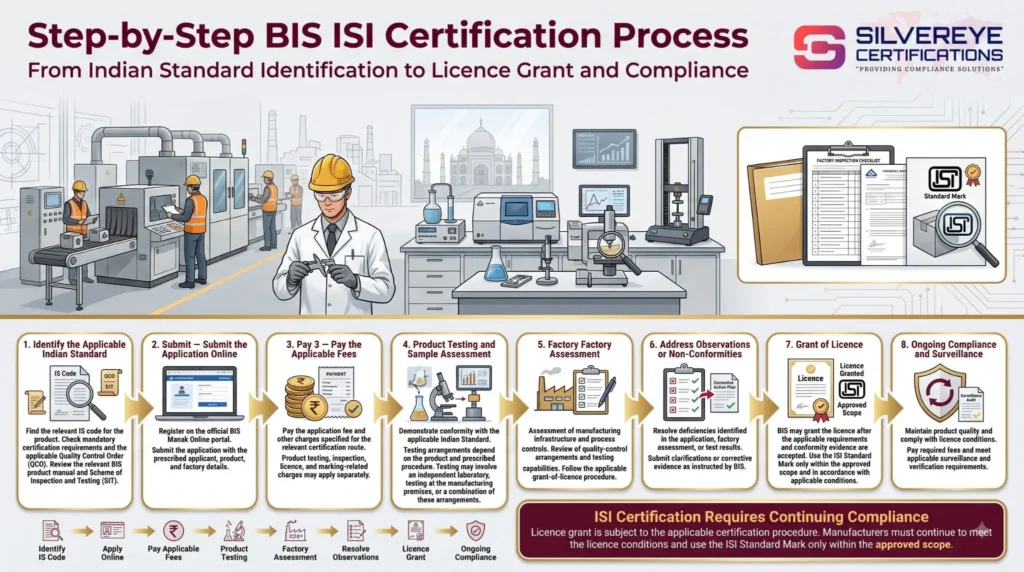
- The certification journey covers product and Indian Standard identification, document preparation, application filing, fee payment, factory assessment, product testing, license grant, marking, surveillance and renewal.
- Option 1 (Normal Procedure) has an indicative processing period of around 90 days, while Option 2 (Simplified Procedure) has an indicative period of around 30 days, subject to eligibility and satisfactory assessment.
- BIS may conduct factory and market surveillance to verify continued conformity. Non-compliance with applicable requirements can lead to suspension or cancellation of the license.
- The application fee is ₹1,000, the advance payment towards the annual minimum marking fee is generally 50% at the application stage, and the inspection fee is ₹7,000 per man-day. Other applicable charges, including testing and the balance marking fee, may also apply.
Introduction
The BIS ISI Certification Process involves ten key stages, starting with identifying the applicable Indian Standard and preparing the application documents, followed by factory assessment, product testing and license grant. After receiving the license, manufacturers must follow BIS marking requirements, maintain product conformity and complete periodic surveillance and renewal requirements.

Manufacturers can apply through two procedures under Scheme-I: Normal Procedure (Option 1) and Simplified Procedure (Option 2). The indicative processing period is around 90 days for Option 1 and 30 days for Option 2, subject to eligibility, satisfactory assessment and fulfilment of BIS requirements.

The initial license is generally granted for up to two years and can subsequently be renewed for a period ranging from one to five years, subject to BIS conditions. Here are the ten stages of the certification process.
The BIS ISI Certification Process
The BIS ISI Certification Process involves application filing, document scrutiny, factory assessment, product testing and license grant. After receiving the license, manufacturers must follow the applicable marking requirements and maintain conformity through BIS surveillance.
The following table explains the ten stages, the responsibilities of the manufacturer and BIS, and the indicative timelines under Scheme-I.
| Stage | What happens | Who is responsible? | Timeline or requirement |
|---|---|---|---|
| 1. Product and Indian Standard check | Identify the applicable Indian Standard, check QCO coverage, review the product manual and confirm eligibility for Option 1 or Option 2. | Manufacturer | Before submitting the application |
| 2. Application through Manak Online | Submit Form-V, the Self-Evaluation cum Verification Report and prescribed supporting documents. Pay the application fee and 50% of the applicable annual minimum marking fee. | Manufacturer | At the application stage |
| 3. Application scrutiny and clarification | BIS examines the submitted documents and may raise queries or request additional information. The manufacturer must respond with the required clarification. | BIS and manufacturer | Samples must be offered for testing within 30 days of recording the application, where applicable |
| 4. Inspection fee and factory visit scheduling | The manufacturer pays the applicable inspection fee in advance, and BIS arranges the factory assessment. | Manufacturer and BIS | Before the factory visit |
| 5. Factory inspection | BIS assesses manufacturing infrastructure, production processes, quality-control arrangements and testing facilities. Officials verify documents, witness applicable tests and draw product samples. | BIS officials and manufacturer | Normally one day for an Indian manufacturing unit |
| 6. Product sample testing | Under Option 1, samples drawn during the factory visit are generally sent to a third-party laboratory. Under Option 2, BIS draws a verification sample and a counter sample during the visit. | BIS and testing laboratory | Depends on the product and applicable testing requirements |
| 7. Assessment and decision | BIS reviews the factory inspection findings, applicable test reports, submitted documents and other conformity evidence. | BIS | Expected within 90 days under Option 1 or 30 days under Option 2, subject to the applicable conditions |
| 8. Grant of licence | After the requirements are satisfactorily fulfilled, the manufacturer pays the remaining applicable minimum marking fee and licence fee, and BIS grants the licence. | Manufacturer and BIS | After successful assessment and fulfilment of payment requirements |
| 9. ISI-marked production and surveillance | The manufacturer starts marking products in accordance with the licence scope and maintains conformity. BIS may conduct factory and market surveillance. | Manufacturer and BIS | Throughout the licence period |
| 10. Licence renewal or scope change | The manufacturer applies for renewal before expiry or submits a separate application to add eligible product varieties to the licence scope. | Manufacturer | As required, preferably well before licence expiry |
Important timeline clarification: BIS's 90-day and 30-day periods are expected processing periods, not guaranteed completion dates. They depend on satisfactory documentation, factory assessment and product conformity at the first instance. Under Option 2, BIS checks the proof of dispatch of the factory-drawn verification sample and the applicable advance marking fee before granting the license. The verification sample is subsequently reviewed, and non-conformity can lead to immediate suspension.
Normal vs Simplified Procedure: BIS Certification Process Compared
BIS provides two routes for granting a license under Scheme-I: Option 1 (Normal Procedure) and Option 2 (Simplified Procedure). Both involve factory assessment, but the timing of product testing and the requirements before application are different.
| Process stage | Normal Procedure (Option 1) | Simplified Procedure (Option 2) |
|---|---|---|
| Before application | Prepare the prescribed documents and factory details. A product test report is generally not required with the initial application. | Register on the BIS online system to obtain a unique sample code, submit product samples to an accepted laboratory and obtain the required test reports and sample-submission receipt. |
| Application submission | Submit Form-V, the Self-Evaluation cum Verification Report and applicable supporting documents. | Submit the same core documents along with conforming product test reports meeting the applicable age requirements. |
| Test report age | Not applicable as a general initial application requirement. | Latest report generally must not be more than 90 days old and, where multiple reports are submitted, the oldest must not be more than 180 days old. |
| Factory assessment | BIS assesses the factory and draws product samples for third-party laboratory testing, unless factory testing is permitted for the product. | BIS assesses the factory and draws one verification sample from the product variety proposed for certification, along with a counter sample. |
| Purpose of factory-drawn sample | Establishes product conformity through the prescribed testing process. | Used for verification and review of product conformity after the licence grant. |
| Testing charges for factory-drawn sample | Generally borne by the applicant. | Verification sample testing charges are included in the applicable annual minimum marking fee. |
| Licence grant requirements | BIS must be satisfied with the factory assessment and applicable product test results. | BIS checks the factory assessment, proof of dispatch of the verification sample to the laboratory and advance annual minimum marking fee before granting the licence. |
| After license grant | The manufacturer starts production under the licence and follows applicable marking and surveillance requirements. | BIS reviews the verification sample report. If the sample does not conform, the licence is suspended immediately, subject to the prescribed corrective-action process. |
| Expected processing period | Around 90 days from receipt of the application, subject to satisfactory assessment and conformity. | Around 30 days from receipt of the application, subject to satisfactory factory assessment and the applicable conformity requirements. |
| Who can apply? | Domestic manufacturers and foreign manufacturers. Foreign manufacturer applications are processed under Option 1. | Eligible domestic manufacturers only, for products listed under Annexure-II(C) of the current BIS guidelines. |
Which Procedure Should You Follow?
- Option 1 – Normal Procedure: Suitable for applications processed under the normal route, including all foreign manufacturer applications. BIS generally draws samples during the factory visit and arranges the required third-party testing.
- Option 2 – Simplified Procedure: Available only to eligible domestic manufacturers applying for products listed under the applicable BIS guidelines. The manufacturer must arrange conforming product test reports before filing the application.
Remember: The manufacturer cannot freely select either procedure for every product. Check the applicable product category under the latest BIS guidelines before starting the application. Some products are specifically assigned to one procedure, and eligibility restrictions may also apply to manufacturers with certain previous license histories.
Stage-by-Stage Breakdown of the BIS ISI Certification Process
Stage 1: Product and Indian Standard Check
Start by confirming whether your product is covered by a mandatory Quality Control Order (QCO) or whether BIS certification is voluntary for that product. Identify the applicable Indian Standard (IS) and review its product manual, including the Scheme of Inspection and Testing (SIT).
Next, check the current BIS Guidelines for Grant of License to identify the applicable application route:
- Option 1 – Normal Procedure
- Option 2 – Simplified Procedure
The available option depends on the product's listing in the current BIS guidelines. Products categorically assigned to a particular option generally cannot be shifted to the other option. However, the Head of the BIS Branch Office may permit a change in specified circumstances, such as an inadvertent selection error, after recording the reasons.
Stage 2: Application Through Manak Online
BIS accepts applications and payments for Scheme-I certification through its Manak Online portal. The application is submitted in Form-V, along with the prescribed documents and the Self-Evaluation-cum-Verification Report.
Before submitting, check that the information and supporting documents match the product, factory and applicable Indian Standard.
Under the current guidelines, the applicant must pay:
- Application fee: ₹1,000
- Advance annual minimum marking fee: 50% of the applicable amount
The remaining marking fee is payable when the license is granted. The applicable fee may be higher where the applicant requests a license for more than one year.
Stage 3: Application Scrutiny and Clarifications
After submission, BIS examines the application and supporting documents. If information is incomplete or clarification is required, the Branch Office may communicate the discrepancy through the portal.
Respond to each query with the relevant explanation and supporting documents. If a clarification is unclear, contact the concerned BIS Branch Office for guidance rather than making assumptions.
An important deadline applies to sample submission: samples must be offered for testing within 30 days of the application being recorded, wherever testing is required. Failure to meet this requirement is a listed ground for processing the application for rejection.
Stage 4: Inspection Fee and Factory Visit Notice
Once the application proceeds to factory assessment, BIS arranges the inspection. The applicable inspection fee must be paid in advance.
The prescribed inspection fee is ₹7,000 per man-day, subject to applicable charges and requirements.
The factory visit normally takes:
- Indian manufacturer: One day
- Foreign manufacturer: Two days
Additional inspection days may be required depending on the product and the testing activities involved.
Stage 5: Factory Inspection and Assessment
During the factory visit, the BIS officer assesses whether the manufacturer has the infrastructure and arrangements needed to produce goods consistently in accordance with the applicable Indian Standard.
The assessment generally covers:
- Manufacturing machinery and production processes
- Quality control personnel and their responsibilities
- Testing equipment and calibration records
- Raw material inspection and test records, where applicable
- Factory layout and location plan
- Self-Evaluation-cum-Verification Report
- Quality Assurance Plan (QAP) or applicable Scheme of Inspection and Testing (SIT)
The officer may witness tests that can be performed at the factory, examine product characteristics such as workmanship, and draw samples for independent laboratory testing.
If a product fails during factory testing, BIS may require corrective action and further verification. Where factory testing is the basis for the application, repeated non-conformity during a subsequent visit can be a ground for rejection. The exact action depends on the applicable procedure and the nature of the failure.
Stage 6: Product Sample Testing
The sample-testing procedure depends on the selected application route.
Under Option 1 – Normal Procedure
BIS generally draws product samples during the factory visit and sends them to a BIS-recognized or otherwise eligible third-party laboratory for testing. The applicant bears the applicable testing charges.
For products where factory testing is permitted, BIS may assess conformity through testing at the manufacturing premises instead of drawing samples for third-party testing.
Under Option 2 – Simplified Procedure
BIS draws one sample from the product variety proposed for inclusion in the license scope, along with a counter sample. Testing is focused on requirements whose testing frequency under the SIT is more than once in six months. If no requirement falls into that category, BIS follows the alternative selection criteria in the guidelines.
For tests requiring 30 days or more, prescribed test reports and an undertaking may be accepted so that the application does not have to wait for the entire testing period. However, the applicant must provide the pending report within the stipulated period. If the result is non-conforming or the report is not submitted as required, the license may be processed for cancellation.
Stage 7: BIS Review and Grant Decision
BIS reviews the factory assessment report, test results and other application records before deciding whether the licence can be granted.
The expected processing periods under the current guidelines are:
| Application category | Expected processing period |
|---|---|
| Option 1 – Normal Procedure | 90 days |
| Option 2 – Simplified Procedure | 30 days |
| All India First application | 45 days |
These are expected processing periods, not guaranteed approval timelines. They depend on satisfactory documentation, factory assessment and product conformity at the first instance. The All India First period may also be affected by the minimum testing time required for the product.
If BIS proposes to reject an application, it must issue a rejection notice giving the applicant at least 21 days to respond and provide a reasonable opportunity of being heard. The competent authority must record the reasons in a speaking order.
Stage 8: Grant of BIS ISI License
Once BIS is satisfied with the assessment and product conformity, it grants the license to use the BIS Standard Mark for the approved product and scope.
Before grant, the applicant must pay the applicable annual license fee of ₹1,000 and the balance of the annual minimum marking fee.
For Option 2 applications, BIS also checks the proof that the factory-visit sample has been dispatched to the designated laboratory and that the applicable advance annual minimum marking fee has been paid. The proof of delivery to the laboratory is reviewed through the portal within 15 working days after the grant of license.
The licence carries important conditions. The manufacturer must:
- Apply the Standard Mark to the entire production covered by the license scope and maintain conformity with the relevant Indian Standard.
- Display the BIS product certification licence prominently at the manufacturing premises.
- Mention the BIS product certification license in its commercial advertisements.
Stage 9: Marked Production and BIS Surveillance
After receiving the license, the manufacturer can apply the ISI Mark to products covered by the approved license scope, in accordance with the applicable Indian Standard and marking requirements.
The product marking must include the details prescribed for that product, such as the Indian Standard number and CM/L number. Additional labelling or digital marking, such as a QR code, should be used only where the applicable product-specific requirements permit it.
BIS continues to monitor the license after grant through different surveillance activities:
- Factory surveillance: BIS assesses manufacturing processes, quality control, testing arrangements and product conformity at the factory.
- Pre-despatch inspection: Where applicable, BIS may inspect products before dispatch.
- Market surveillance: BIS may purchase ISI-marked products from the market and send them for testing.
- Complaint-based surveillance: BIS may investigate complaints or other information indicating possible non-compliance.
Factory and pre-despatch inspections are pre-market activities, while purchasing products from the market is a post-market surveillance activity.
Stage 10: License Renewal and Change in Scope
A BIS license must be renewed before its validity expires if the manufacturer wants to continue using the Standard Mark.
The renewal application is submitted through Manak Online, along with the applicable fees, production details and other prescribed information.
If the manufacturer wants to include an additional product variety or make another change to the approved license scope, it must apply for a change in scope through the prescribed BIS procedure. Supporting documents, testing evidence and details of additional manufacturing or testing facilities may be required, depending on the proposed change.
Do not assume that a new model, size or variety is automatically covered by an existing license. Check the approved scope and obtain BIS approval for any required change before applying the Standard Mark to additional products.
What Happens After the BIS ISI License? Surveillance and Product Non-Conformity
Obtaining a BIS license is not the end of the compliance process. Manufacturers must continue to follow the applicable Indian Standard, maintain their declared quality-control arrangements and ensure that products bearing the ISI Mark remain conforming.
BIS issued revised Guidelines for Dealing with Product Non-Conformity on 25 February 2026. These guidelines explain how BIS handles failed factory or market surveillance samples, corrective actions, enhanced surveillance, product recall, suspension and cancellation.
The following table summarises the main stages.
| Step | What happens | Indicative timeline under the guidelines |
|---|---|---|
| Test report examination | BIS records the sample as conforming or non-conforming on its portal and records the failed requirements and relevant clauses. | Normally within 5 working days of receiving the report |
| Performance review | BIS examines the non-conformity, assesses product risk and reviews the manufacturer's surveillance performance over the preceding two years. | Normally within 5 working days of recording the non-conformity |
| Corrective-action communication | BIS informs the manufacturer through the portal and may send a copy of the test report through email or post. | Normally within 15 working days of receiving the test report |
| Manufacturer's response | The manufacturer submits corrective actions, root-cause analysis and supporting test evidence. | 30 days in general; 15 days where a product recall notice is included |
| Supporting test report | The manufacturer submits evidence demonstrating that corrective actions have addressed the failure. | If the complete report cannot be submitted within the prescribed response period, evidence that the sample is under testing must be provided; the full report is generally required within 45 days |
| Verification surveillance | BIS arranges market sampling or a factory surveillance visit, depending on the product and its suitability for market sampling. | Normally within the next 60 days |
| Enhanced surveillance | BIS increases surveillance frequency for manufacturers with non-conforming samples. | Market surveillance once every three months until the required consecutive conforming results are obtained |
| Product recall, where necessary | BIS assesses the risk and may issue a product recall notice or directions to the manufacturer. | Based on the risk assessment and decision of the competent BIS authority |
Important: The 15-day and 30-day response periods are not interchangeable in every case. The 15-day period applies where a product recall notice is included in the communication; otherwise, the usual response period is 30 days. The 45-day period relates to submission of the complete test report in specified circumstances where testing cannot be completed within the initial response period.
How Enhanced Surveillance Works
BIS may place a manufacturer under enhanced surveillance after a product non-conformity is identified.
- First or non-consecutive non-conformity: Market surveillance is generally conducted once every three months until two consecutive surveillance samples conform in independent testing.
- Where a suspension notice is issued or suspension is imposed: Market surveillance is generally conducted once every three months until three consecutive surveillance samples conform in independent testing.
The purpose is to verify whether the manufacturer's corrective actions have worked and whether subsequent production consistently meets the relevant Indian Standard.
Suspension, Cancellation and Appeal of a BIS License
A product failure does not automatically mean that every BIS license will be cancelled. BIS considers the nature and seriousness of the non-conformity, the manufacturer's previous performance, corrective actions and the applicable provisions of the BIS Act and Regulations.
The following table explains the main stages under the product non-conformity guidelines.
| Stage | What BIS may do | Manufacturer's response or obligation |
|---|---|---|
| Notice before suspension | BIS issues a notice with the relevant test reports and reasons for proposed suspension. | The manufacturer normally gets 10 days from the date of issue to submit an explanation. |
| Suspension | BIS may suspend the licence where the applicable grounds are established. | Stop applying the Standard Mark and stop dispatching the affected product with the mark, including stock in hand. |
| Corrective action and verification | BIS may arrange an inspection and testing to verify the corrective actions. | Submit supporting evidence, make improved products available and cooperate with the inspection. |
| Revocation of suspension | BIS may revoke suspension or allow normal operation if corrective actions and conformity are satisfactorily established. | Follow BIS instructions and provide any further information or product recall records required. |
| Notice before cancellation | BIS issues a cancellation notice where the applicable grounds are established. | The notice must provide at least 21 days to respond. The manufacturer may also be given an opportunity for a personal hearing. |
| Cancellation order | BIS passes a speaking order explaining the reasons for its decision. | Stop using the Standard Mark and stop claiming to hold the licence from the effective date of cancellation. |
| Appeal | An aggrieved manufacturer may appeal to the Director General of BIS. | An appeal may be filed within 90 days from the date of the order, with the prescribed fee of ₹2,000, under Section 34 of the BIS Act, 2016 and Rule 37 of the BIS Rules, 2018. |
| Fresh application after cancellation | A manufacturer whose license was cancelled, expired or surrendered due to product non-conformity cannot use Option 2 for a fresh application for the same product. | Apply under Option 1, subject to the applicable BIS requirements. |
What happens to the marking fee during suspension?
Suspension does not automatically remove the manufacturer's financial obligations. Under the BIS guidelines, the minimum marking fee remains payable even during the period when the license is not in operation due to suspension.
A suspension also means that the manufacturer cannot continue applying the ISI Mark or dispatching the affected product with the Standard Mark, including stock already marked.
Can Buyers Check a BIS License's Status?
Yes. Buyers, importers and other interested parties can verify BIS license details through official BIS channels, including the BIS Care app. License status may also be available through BIS online records.
This makes it important for manufacturers to maintain their license in good standing. A suspended, cancelled or expired license can affect a buyer's ability to verify the manufacturer's authority to use the Standard Mark.
Practical takeaway: BIS compliance continues after the license is granted. Manufacturers should maintain production records, conduct regular quality checks, keep testing equipment and calibration records updated, and address non-conformities promptly. These steps help demonstrate continued conformity and reduce the risk of suspension or cancellation.
Special Cases in the BIS ISI Certification Process
Some products and applicants require additional consideration under the BIS Scheme-I certification process. The following situations are worth understanding before submitting an application.
- All India First License: This applies when a product is being considered for BIS certification for the first time and product-specific certification details, such as the product manual or marking fee, have not yet been established. BIS works with the applicant to develop the necessary product-specific requirements. These applications are generally processed under Option 1, with an expected grant period of 45 days, subject to the applicable testing time and satisfactory assessment.
- Factory Testing Basis: For certain products, such as bulky goods that are difficult to transport or products without an available third-party laboratory, BIS may consider granting a license based on tests witnessed at the factory. The applicable guidelines and product category determine whether this route is available.
- Foreign Manufacturers: Applications from overseas manufacturers under the Foreign Manufacturers Certification Scheme (FMCS) are processed under Option 1. The factory inspection normally takes two days. Foreign applicants must also meet additional requirements, including nomination of an Authorized Indian Representative (AIR), prescribed agreements and indemnity documents, and a Performance Bank Guarantee where applicable. Check the latest FMCS requirements before applying.
- In-house Laboratory: A manufacturer that establishes its own testing laboratory may request consideration for factory-testing-based certification. The BIS Branch Office Head may consider this arrangement in situations such as an existing BIS license for similar products or the approaching implementation date of a Quality Control Order. Approval is not automatic; the adequacy of the testing facilities and applicable guidelines will be assessed.
BIS ISI Certification Fees: Cost at Each Stage
The total cost of BIS ISI Mark Certification depends on the product, applicable Indian Standard, testing requirements, factory inspection and license period. The following table summarizes the main Scheme-I fees.
| Fee | Amount or basis | When it is paid |
|---|---|---|
| Application fee | ₹1,000 | At application submission |
| Advance annual minimum marking fee | 50% of the applicable product-specific amount under the current grant guidelines | At application submission |
| Inspection fee | ₹7,000 per man-day | In advance of the factory inspection |
| Annual licence fee | ₹1,000 | At the time of licence grant |
| Balance minimum marking fee | Remaining amount payable for the applicable licence period | At licence grant |
| Product testing fee | Option 1: generally paid by the applicant. Option 2: verification-sample testing cost is covered within the applicable annual minimum marking fee | As applicable to the selected procedure |
| Additional inspection fee | Based on the inspection requirements and applicable charges | Before the additional inspection |
| Renewal application fee | Applicable renewal application fee under the current BIS fee schedule | At renewal |
Important fee points:
- The minimum marking fee is product-specific. It depends on the applicable Indian Standard and the relevant BIS fee notification.
- Actual marking fee liability may be higher than the minimum amount, depending on production and the applicable marking-fee rate.
- Applicable taxes, including GST where chargeable, are added to the payment.
- BIS provides concessions on the annual minimum marking fee for eligible enterprises. Current concessions include 80% for micro enterprises, 50% for small enterprises and 80% for start-ups, subject to the applicable conditions. Eligible women entrepreneur enterprises may receive an additional 10% concession.
- The current concession extension runs up to 31 May 2029, subject to the notification's conditions.
- Do not assume that all payments are refundable if an application is rejected or closed. Refund treatment depends on the applicable fee rules and the nature of the payment. Confirm the position with BIS before making a financial commitment.
Validity of a BIS ISI Mark License
A BIS license is granted for a defined period and applies only to the approved product scope and manufacturing premises. The following table summarizes the main validity conditions under Scheme-I.
| Aspect | BIS requirement |
|---|---|
| Initial license validity | Up to two years |
| Renewal period | Minimum one year and up to five years |
| Product scope | Limited to the varieties and products included in the approved licence scope |
| Manufacturing premises | Valid for the factory address specified in the licence |
A license does not automatically cover additional models, varieties or factory locations. The manufacturer must obtain the required BIS approval before applying the Standard Mark to products outside the approved scope.
BIS ISI License Renewal Process and Timeline
A manufacturer must apply for renewal through Manak Online if it wants to continue using the ISI Mark after the current license expires.
The renewal application is submitted through the license holder's dashboard, along with the applicable fees, production details and other prescribed documents.
| Renewal requirement | What the manufacturer needs to do |
|---|---|
| Where to apply | Submit the application through Manak Online using the licence holder's dashboard |
| Documents and details | Provide the renewal application, production details and other documents required by BIS |
| Fees | Pay the applicable renewal application fee, annual license fee, advance minimum marking fee for the requested period and any outstanding dues |
| Renewal period | Request renewal for a minimum of one year and up to five years |
| Production statement | Submit production details authenticated by a Chartered Accountant or Cost Accountant, as required for marking-fee calculation |
| Marking-fee reconciliation | Pay any applicable difference between the actual marking fee and the minimum marking fee |
| Late application | A renewal application submitted after the licence validity date attracts the applicable late fee of ₹5,000, subject to BIS rules |
| Licence under suspension | A licence under suspension at the time of expiry cannot be renewed until the suspension is revoked |
When should you apply for renewal?
BIS advises manufacturers to apply for renewal preferably two months before the license expires. Applying early gives the manufacturer time to arrange production statements, clear outstanding dues and respond to any requirements raised by BIS.
If the renewal application and prescribed fees are not received by the last date of validity, BIS may defer its decision on renewal for up to 90 days from the expiry date, subject to the applicable provisions. Do not treat this period as an automatic extension of the license.
Suggested BIS License Renewal Calendar
The following is a practical planning schedule, not a statutory BIS deadline.
| Suggested time before expiry | Action to take |
|---|---|
| 5–4 months | Collect production records, calibration certificates and SIT test records. Check for changes to the Indian Standard or applicable QCO. |
| 4–3 months | Review surveillance observations, close pending corrective actions and update machinery and testing-equipment records. |
| Around 2 months | Submit the renewal application through Manak Online and pay the applicable fees. |
| Before expiry | Check the portal for application status, payment confirmation and any pending BIS requirements. |
Documents Required BIS ISI Certification
The exact documents depend on the product, Indian Standard and application route. However, a typical Scheme-I application may require:
- Form-V and the prescribed declarations
- Self-Evaluation-cum-Verification Report
- Manufacturing machinery and testing-equipment details
- Business constitution and factory-address documents
- Factory layout and manufacturing process flow chart
- Quality control personnel details
- Product, brand and proposed marking details
- Calibration records and other applicable quality-control documents
- Conforming product test reports for eligible Option 2 applications
- Raw material test reports, wherever required by the applicable product manual
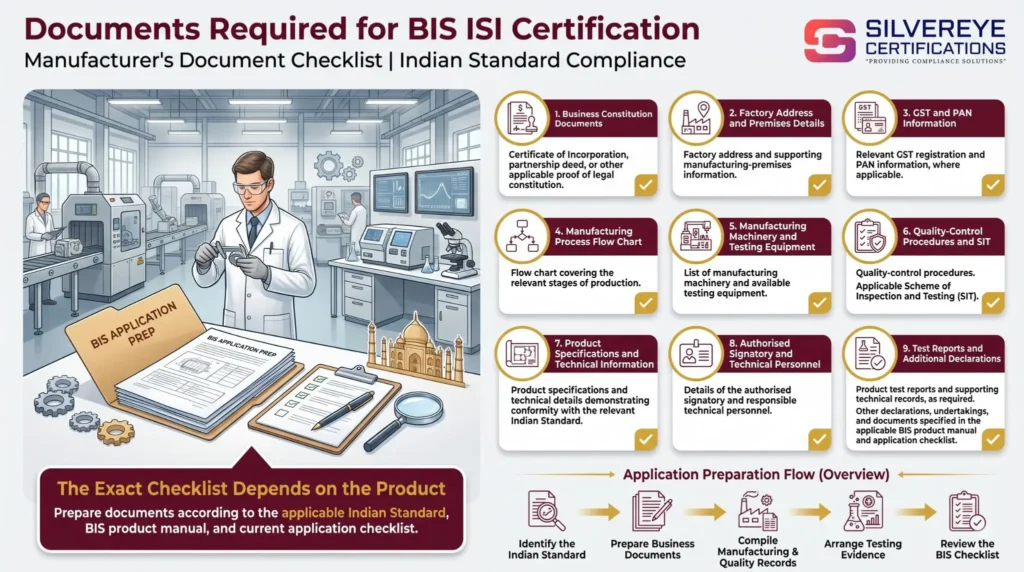
The requirements are not identical for every product. Check the relevant BIS product manual and application checklist before filing.
For a detailed explanation, see our guide on Documents Required for BIS ISI Certification.
BIS ISI Mark Certification: Benefits and Eligibility
- Regulatory compliance: Helps manufacturers meet mandatory BIS certification requirements where a QCO applies.
- Buyer confidence: Demonstrates that the product has been assessed against the applicable Indian Standard.
- Market access: Supports lawful sale of products covered by mandatory certification requirements.
- Tender participation: May help meet BIS-related technical eligibility conditions in government and institutional procurement.
- Quality control: Encourages manufacturers to maintain documented production checks, testing arrangements and process controls.
Who Can Apply for BIS ISI Mark Certification?
A manufacturer can apply for BIS ISI Mark Certification when:
- The product falls under an applicable BIS certification standard.
- The manufacturing unit can meet the infrastructure, process-control and testing requirements of that standard.
- The product meets the applicable Indian Standard.
- The applicant can provide the prescribed documents and cooperate with factory assessment and sample testing.
The license is linked to the product, applicable Indian Standard and manufacturing premises. A separate application is generally required for each product and Indian Standard combination at each factory location.
Latest BIS ISI Certification Updates for 2026
BIS certification requirements can change through revised guidelines, fee notifications, product manuals and government Quality Control Orders. Manufacturers should check the latest official notifications before applying.
| 2026 update | What it means for manufacturers |
|---|---|
| Revised Guidelines for Grant of Licence – 25 February 2026 | Updated the procedures for Option 1 and Option 2, including eligibility, test-report requirements, sampling, fee collection, rejection grounds and expected processing periods. |
| Guidelines for Dealing with Product Non-Conformity – 25 February 2026 | Set out the process for corrective action, enhanced surveillance, suspension, revocation, cancellation and product recall following non-conformity. |
| Transition Facilitation (Quality Control) Order, 2026 – 25 June 2026 | Introduced a conditional facilitation mechanism for specified QCO-covered goods. Eligible entities may procure covered goods from manufacturers holding BIS licences under Scheme-II, subject to the Order's conditions. It is not a general self-declaration route or a blanket exemption from Scheme-I. |
| Changes to QCOs during 2025–2026 | Some QCOs may be amended, withdrawn, suspended or given revised implementation dates. Manufacturers should verify the current status of the QCO applicable to their product. |
| Updated BIS laboratory information | Applicants should check the latest BIS-recognised laboratory list and confirm that the selected laboratory has the required testing scope for the product and variety. |
| Revised marking-fee notifications and concessions | Manufacturers should calculate costs using the latest product-specific marking-fee notification and check whether they qualify for an applicable MSME or start-up concession. |
The BIS product list and official notifications should be checked at the time of application because a product's QCO status, applicable Indian Standard or implementation date may change.
How to Make the BIS ISI Certification Process Smoother
Good preparation can reduce avoidable delays during document scrutiny, factory inspection and product testing. Consider these practical steps:
- Prepare the factory before applying. Match your machinery and testing-equipment arrangements with the applicable product manual. Keep calibration records current.
- Check Option 2 eligibility early. If the product is listed under Option 2, identify an eligible laboratory and plan testing so that the report meets the applicable age requirements when the application is received.
- Keep documents consistent. Use matching business names, factory addresses, product descriptions and brand details across the application and supporting records.
- Respond promptly to BIS queries. Provide clear answers and supporting evidence. Contact the concerned Branch Office if a clarification needs explanation.
- Conduct an internal factory-readiness check. Ask your quality team to review the production process, testing equipment, records and applicable SIT before the BIS inspection.
- Meet the sample-submission deadline. Offer samples for testing within 30 days of the application being recorded, wherever the procedure requires it.
- Track the application on Manak Online. Check payment status, inspection updates, pending documents and communications regularly.
Before appointing a consultant, ask for a stage-by-stage work plan and a clear breakdown of BIS government fees, laboratory testing charges and professional service fees. A consultant can help with preparation and application coordination, but cannot guarantee a BIS inspection date or license grant.
How Silvereye Certifications Can Help with BIS ISI Certification
Silvereye Certifications provides consultancy and application-support services for manufacturers seeking BIS and other regulatory approvals in India. Its team can assist with understanding the applicable certification route, preparing documentation, coordinating testing requirements and getting the factory ready for the BIS assessment.
Support may include:
- Identifying the applicable Indian Standard and certification route
- Reviewing the product-specific document checklist
- Assisting with the Manak Online application
- Coordinating with eligible testing laboratories
- Preparing the manufacturer for the factory inspection
- Helping organise responses to BIS queries and documentation requirements
- Providing guidance on licence renewal and changes in scope
Silvereye Certifications and SEYECS are the same brand. The consultancy supports manufacturers through the certification process; the BIS license itself is granted by the Bureau of Indian Standards after its assessment and approval.
If you are planning to apply for BIS ISI Mark Certification, discuss your product, manufacturing location and applicable Indian Standard with Silvereye Certifications to understand the requirements before starting the application.
Conclusion
BIS ISI Mark Certification is an important requirement for manufacturers whose products fall under mandatory Quality Control Orders. It confirms that the product has been assessed against the applicable Indian Standard and meets the prescribed quality and safety requirements. However, obtaining the license involves more than submitting an application. Manufacturers must select the correct certification route, prepare the required documents, maintain suitable manufacturing and testing facilities, complete factory assessment and ensure product conformity.
The process does not end with the grant of the license. Manufacturers must continue to follow BIS marking requirements, maintain quality-control records, cooperate with surveillance activities and apply for renewal within the prescribed period. Checking the latest QCO notifications, product manuals and BIS guidelines is equally important because certification requirements can change.
If you need assistance with product-standard identification, documentation, Manak Online filing, laboratory coordination or factory inspection preparation, Silvereye Certifications (SEYECS) can guide you through the application process. Silvereye Certifications provides consultancy and compliance support, while the final assessment and license approval remain with the Bureau of Indian Standards (BIS).
Frequently Asked Questions
What is the BIS ISI certification process?
It is the sequence of steps from filing a Scheme-I application on Manak Online to the grant of a license to use the ISI mark, followed by surveillance and renewal. It includes a factory visit and sample testing.
How many stages are there?
This guide breaks it into ten: product check, filing, scrutiny, fee and inspection notice, factory visit, sample testing, decision, grant, marked production with surveillance, and renewal or change in scope.
How long does the process take?
BIS aims to finish within about 90 days for the normal procedure, about 30 days for the simplified procedure and about 45 days for an All India First application, when everything is satisfactory at the first attempt.
What is the difference between the normal and simplified procedure?
In Option 1 BIS inspects and samples first. In Option 2 you bring a conforming test report from a recognized lab, BIS visits and draws a verification sample, and the license is granted sooner.
What happens at the BIS factory visit?
The officer checks your infrastructure, process, quality control and testing set-up, verifies documents such as calibration certificates, witnesses tests and draws samples. It normally takes one day.
What if a sample fails during the grant process?
Under Option 1 the application can be rejected if a sample fails independent testing for the second time. Under Option 2, a failed verification sample leads to immediate suspension, then corrective action and fresh samples within 30 days.
What happens after I get the license?
BIS runs factory surveillance visits and buys market samples to check conformity. You must keep testing as per the SIT and mark your products as required.
Can BIS suspend or cancel my license?
Yes. After repeated or serious non-conformity BIS issues a 10-day suspension notice, and for cancellation it gives at least 21 days’ notice and a chance to be heard.
How do I appeal against a cancellation?
You can appeal to the Director General of BIS within 90 days of the order, with a fee of ₹2,000, under Section 34 of the BIS Act, 2016.
How much does the process cost?
BIS charges ₹1,000 as application fee, ₹7,000 per man-day for inspection and ₹1,000 as annual license fee, plus a product-specific minimum marking fee, half of which is paid at filing. Lab fees and GST are extra.
How do I renew an ISI license?
Apply on Manak Online before the last date of validity, with the renewal fee, license fee and advance minimum marking fee for the period you request. Late renewal can be deferred under Regulation 8.
Can I check the status of an ISI license?
Yes. Buyers can check the validity of a license on the BIS website or the BIS Care app, which also shows suspended, cancelled and expired licenses.