

- Renewal timelines differ sharply by stream: Plastic and e-waste renewals must be filed 4 months (120 days) before expiry, battery renewals 60 days before, and tyre/used oil renewals should start well ahead of their 2-year expiry.
- Renewed validity often runs longer than a fresh registration: A first-time plastic packaging registration lasts only 1 year, but a successfully renewed one is valid for 3 years.
- An expired registration is treated as no registration at all: You cannot legally sell, import, or trade EPR credits once your CPCB registration lapses — reinstating it can take as long as, or longer than, applying fresh.
- Filed returns are a renewal prerequisite: CPCB checks that your quarterly/annual returns and recycling targets for prior years are up to date before it approves a renewal in any stream.
Introduction
EPR Registration Renewal is the mandatory process of extending a business's CPCB Extended Producer Responsibility registration before it expires, so the business can keep manufacturing, importing, selling, or recycling plastic, e-waste, batteries, tyres, or used oil in India.
Renewal timelines vary by waste stream: plastic packaging and e-waste renewals must be filed at least 120 days before expiry, battery renewals at least 60 days before expiry, and tyre and used oil renewals should be filed well before their two-year validity ends. Renewal requires updated sales/waste data, proof that prior-year recycling targets and returns were met, and payment of a renewal fee. An expired registration blocks all legal trading and EPR credit transactions until it is renewed.
What Is EPR Registration Renewal?
EPR registration in India isn't a one-time approval — it comes with an expiry date, and every producer, importer, brand owner, recycler, or processor has to renew it before that date passes. Renewal essentially asks CPCB to re-verify your business details, confirm you've met your recycling obligations for the period just gone, and extend your legal permission to keep operating under that waste stream's EPR rule.
This applies across all five active EPR regimes in India — plastic packaging, e-waste, battery waste, tyre waste, and used oil — but each one runs on its own clock. Miss the window and you're not just filing late; you risk a genuine compliance gap where your business technically cannot sell, import, or trade EPR credits until CPCB reinstates your registration.
If you're searching for "EPR registration renewal," you're probably trying to nail down one of these: how far ahead do I need to apply, what documents does CPCB actually want for a renewal (versus a fresh registration), and what happens if I miss the deadline. This guide answers all three for every waste stream.
Why EPR Renewal Deadlines Matter More Than People Expect
- Registered entities can only deal with other registered entities: Every EPR rule in India prohibits transactions with unregistered businesses — so a lapsed registration doesn't just affect you, it can strand your recyclers and buyers too.
- EPR credit purchases stop working: You cannot buy or use EPR Certificates to meet your recycling target while your registration is expired, even if you have funds ready and a willing recycler.
- Customs and marketplace checks are tightening: Import clearance for several product categories now checks live EPR registration status, and major e-commerce marketplaces increasingly ask sellers to demonstrate current EPR compliance.
- Reinstating a lapsed registration isn't instant: Depending on the stream, a lapsed application can be processed similarly to, or slower than, a fresh application — the "just renew later" approach usually costs more time than starting early would have.
EPR Renewal Timelines & Validity by Waste Stream
This is the single most important table on this page — renewal timing is genuinely different for each waste stream, and using the wrong number is the most common mistake businesses make:
| Waste Stream | New Registration Validity | Renewed Registration Validity | File Renewal Before Expiry |
| Plastic packaging | 1 year | 3 years | 4 months (120 days) |
| E-waste | 5 years | 5 years (per CPCB renewal terms) | 120 days |
| Battery waste | 5 years | 5 years (per CPCB renewal terms) | 60 days |
| Tyre waste | 2 years | 2 years | Well ahead of expiry (no grace period) |
| Used oil | 2 years | 2 years | Well ahead of expiry (no grace period) |
Notice that plastic packaging is the outlier — a fresh registration only lasts a year, but if you renew successfully (and keep your compliance record clean), the renewed registration is valid for three years, which is a real incentive to get that first renewal right. Tyre waste and used oil don't currently publish a fixed "days before expiry" rule the way plastic, e-waste and battery do, so the safest approach for those two streams is to start the renewal well before your two-year certificate lapses rather than waiting for a specific countdown.
Renewal Requirements by Waste Stream
1. Plastic Packaging EPR Renewal
Producers, Importers, Brand Owners (PIBOs) and Plastic Waste Processors renew through the Common EPR Portal (which absorbed the standalone Plastic Waste EPR Portal in mid-2026). Renewal needs updated packaging-category data (rigid, flexible, multilayered, compostable), proof of your recycling and recycled-content targets for the previous year, and the renewal fee — which typically mirrors the original registration fee slab based on your annual plastic quantity.
- Apply: At least 4 months before your current registration expires.
- If approved: Your renewed registration is valid for 3 years, versus 1 year for a first-time registration.
2. E-Waste EPR Renewal
E-waste producer registrations run on a longer 5-year cycle, but CPCB still wants renewal applications filed early — 120 days before expiry — because it reviews your Schedule I product categories, RoHS compliance declarations, and historical sales/generation data before extending your registration and recalculating your forward recycling target.
- Apply: At least 120 days before expiry.
- Also required: Confirmation that your quarterly returns and Form-3 annual return for the prior year were filed on time.
3. Battery Waste EPR Renewal
Producers renew using the same Form 1(A) used for original registration, along with their most recent annual EPR Plan (Form 1(C)). CPCB's stated process is to grant or reject a renewal within 15 working days of a complete submission, similar to the timeline for a fresh application.
- Apply: At least 60 days before expiry.
- Also required: Annual Returns filed by 30 June of the following year, and evidence your collection/recycling targets under Schedule II were met.
4. Tyre Waste EPR Renewal
Producers, Recyclers and Retreaders renew separately, each under their own category, through the CPCB Waste Tyre EPR Portal. The renewal fee is lower than the fresh-registration fee in every category, but it's still calculated per-tonne for producers, recyclers and retreaders based on the relevant transaction quantity from the preceding two years.
| Entity Type | Renewal Fee |
| Producer | ₹12,500 + ₹0.625/MT on quantity manufactured/imported in preceding 2 years |
| Recycler | ₹7,500 + ₹0.625/MT on EPR certificate transaction quantity in preceding 2 years |
| Retreader | ₹5,000 + ₹0.625/MT on retreading certificate transaction quantity in preceding 2 years |
Renewed tyre waste registration is valid for another 2 years, same as a fresh registration.
5. Used Oil EPR Renewal
Producers, Used Oil Importers, Collection Agents and Recyclers renew separately on the CPCB Used Oil EPR Portal. Because this portal only became fully operational through 2024-2025 with modules added in phases, many businesses are approaching their first-ever renewal cycle now — so it's worth confirming which modules currently support online renewal versus needing manual follow-up.
- Producers: Renewal requires updated sales/import data for the preceding 2 years, plus the annual processing fee (25% of the registration fee) kept current.
- Recyclers & Collection Agents: Renewal is tied to facility capacity slab, same structure as fresh registration but at the renewal fee rate.
Renewed used oil registration is valid for another 2 years, same as a fresh registration.
Latest Renewal-Related Notifications & Updates (2025–2026)
| Date | Notification / Update |
| Feb 2026 | CPCB launches the Common EPR (CEPR) Portal with Single Sign-On — existing registrations across plastic, e-waste, battery, tyre and used oil must be linked to a CEPR ID, affecting how renewals are filed going forward |
| 28.06.2026 | Standalone Plastic Waste EPR Portal discontinued; plastic renewal applications now processed through the Common EPR Portal |
| FY 2025-26 | Annual Return deadline for Battery and Plastic Waste EPR set for 30 June — a prerequisite CPCB checks before approving renewal |
| 25.02.2026 | CPCB issues the Guidance Document for Submission of Annual Return by Registered Producers on the Used Oil EPR Portal, relevant to producers approaching their first renewal cycle |
| Ongoing 2025-26 | CPCB conducting regular video-conference sessions to resolve registration, renewal and EPR credit/certificate issues across the tyre and used oil portals |
Because CPCB has been actively migrating portals and updating annual return deadlines through 2026, always cross-check your specific renewal window on the live Common EPR Portal, or with a compliance consultant such as Silvereye Certifications, rather than relying on a fixed date from a previous cycle.
Why Timely Renewal Matters (Benefits)
- Zero compliance gap: Filing early means your registration number stays continuously valid — no window where you're technically operating without authorization.
- Uninterrupted EPR credit access: You keep the ability to buy and sell EPR certificates without a lapse that could derail your annual target.
- Avoids Environmental Compensation exposure: A registration gap is treated the same as never having registered, which opens the door to EC penalties even for an otherwise-compliant business.
- Longer validity as a reward for compliance: In plastic packaging specifically, a clean renewal extends your registration from 1 year to 3 years — timely renewal literally reduces your future admin burden.
- Smoother customs and marketplace checks: A continuously valid registration avoids delays at import clearance or e-commerce onboarding that a lapsed certificate can trigger.
Documents Required for EPR Registration Renewal
Renewal documentation is lighter than a fresh application in most streams, since your core company details are already on file — but CPCB still wants current, updated information:
- Your existing EPR registration number and login credentials
- Updated PAN, GST, CIN and IEC details, if anything has changed since original registration
- Sales, import, or waste-processing data for the most recent 1–2 financial years
- Proof that previous-year quarterly and annual returns were filed
- Evidence that the prior year's recycling/collection target was met — typically your EPR Certificate purchase or generation record
- Stream-specific updates — e.g., a fresh EPR Plan (Form 1(C)) for batteries, updated tyre composition/plant data for tyre waste, or updated facility capacity for recyclers
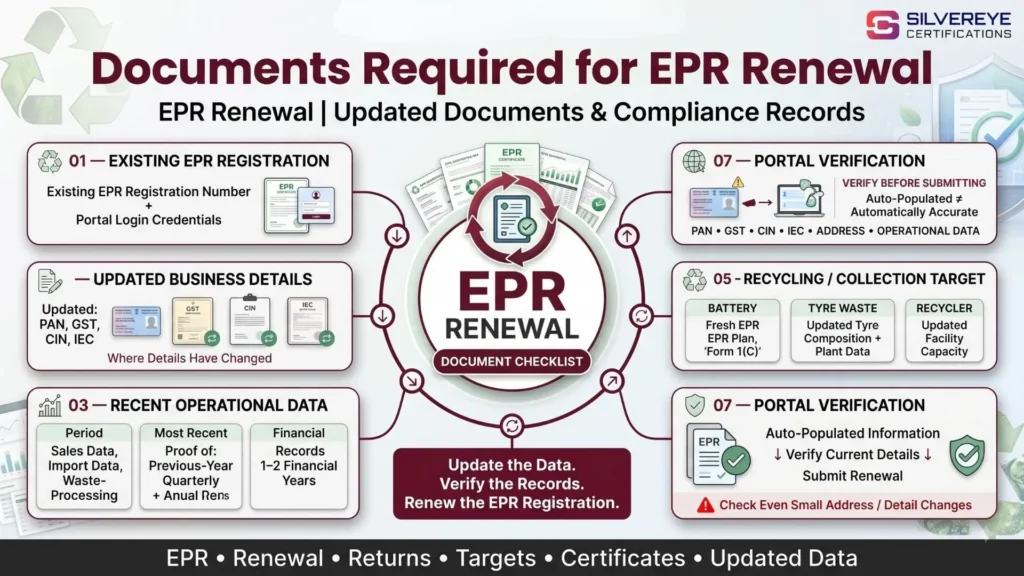
If your business details haven't changed since your last registration, most information auto-populates on the portal — but always verify it rather than assuming it's still accurate, since even small mismatches (like an updated registered address) can trigger a query and delay approval.
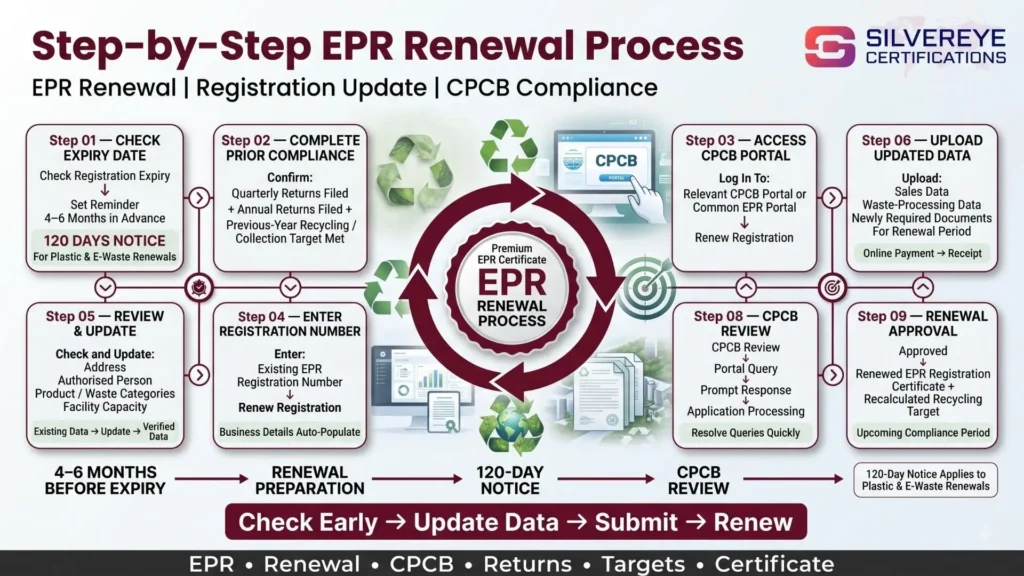
Step-by-Step EPR Registration Renewal Process
Check your registration's expiry date well ahead of time — set a reminder at least 4-6 months out, since plastic and e-waste renewals need 120 days' notice.
- Confirm all prior-period quarterly and annual returns are filed and your recycling/collection target for the last completed year was met — CPCB checks this before approving renewal.
- Log in to the relevant CPCB portal (or the Common EPR Portal, if your legacy registration has migrated) and locate the "Renew Registration" option.
- Enter your existing registration number; most business details should auto-populate from your original application.
- Review and update anything that's changed — address, authorized person, product/waste categories, or facility capacity.
- Upload updated sales/waste-processing data and any newly required documents for the renewal period.
- Pay the applicable renewal fee for your entity type and stream.
- CPCB reviews the renewal application; respond promptly to any queries raised through the portal to avoid delay.
- Once approved, your renewed registration certificate is issued, along with your recalculated recycling target for the upcoming compliance period.
What Happens If You Miss the Renewal Deadline?
If your EPR registration lapses before renewal is approved, CPCB treats your business the same as an unregistered entity for that period — meaning you legally cannot manufacture, import, sell, or trade EPR credits under that waste stream until the registration is reinstated. Depending on the stream and how long the lapse runs, reinstatement can involve the same level of document review as a fresh application, sometimes with an added late fee or additional scrutiny of the compliance gap.
For importers, an expired registration can also trigger customs holds, since EPR registration status is increasingly checked at the point of clearance. The practical lesson across every stream is the same: renewal is far cheaper and faster when it's filed on time than when it's filed as a recovery exercise after expiry.
How Silvereye Certifications Can Help
Tracking renewal windows across five different EPR streams — each with its own portal, its own "days before expiry" rule, and its own document checklist — is exactly the kind of recurring compliance task that's easy to let slip, especially for a business managing multiple waste categories at once.
Silvereye Certifications is a regulatory compliance consultancy supporting manufacturers, importers and brand owners across BIS, CDSCO, WPC-ETA, TEC-MTCTE, and EPR authorizations — including plastic, e-waste, battery, tyre waste, and used oil. For EPR registration renewal specifically, Silvereye Certifications typically helps with:
- Tracking every registration's expiry date and the correct renewal window for that specific stream
- Verifying prior-year return filings and target fulfilment before submission, so the renewal isn't held up by an overlooked gap
- Preparing and updating documentation — sales data, EPR Plans, facility details — in the exact format CPCB expects for renewal
- Managing the Common EPR Portal migration for businesses still linking legacy registrations to their CEPR ID
- Handling CPCB queries during the renewal review so approval isn't delayed by preventable back-and-forth
If you're approaching a renewal deadline in any EPR stream — or aren't sure exactly when yours falls — a consultant like Silvereye Certifications can confirm your timeline and help you file well within the window CPCB expects.
Conclusion
EPR registration renewal isn't a formality you can leave for the last week — every waste stream in India runs its own clock, and missing that window turns a routine filing into a genuine compliance gap that blocks your ability to trade, import, or buy EPR credits. The safest habit, across plastic, e-waste, battery, tyre waste and used oil alike, is to mark your expiry date the moment your registration is approved, and start the renewal process at least a few months out.
If you'd rather not track five different countdowns yourself, a consultancy such as Silvereye Certifications can monitor your renewal timelines and handle the documentation, so your registration stays continuously valid without last-minute pressure.
Frequently Asked Questions
How far in advance should I apply for EPR registration renewal?
It depends on the waste stream: plastic packaging and e-waste renewals should be filed at least 120 days (4 months) before expiry, battery renewals at least 60 days before expiry, and tyre waste or used oil renewals should be started well ahead of the 2-year expiry date since there's no published grace period for those two streams.
Is the EPR renewal process the same as applying fresh?
It's similar but generally lighter — your core business details usually auto-populate from your original registration, so renewal mainly involves updating sales/waste data, confirming prior returns were filed, and paying the renewal fee, rather than resubmitting every document from scratch.
What happens if my EPR registration expires before I renew it?
An expired registration is treated the same as having no registration at all. You cannot legally manufacture, import, sell, or trade EPR credits under that waste stream until CPCB approves your renewal or fresh reinstatement, which can also mean added scrutiny of the compliance gap.
Does a renewed plastic EPR registration last longer than a fresh one?
Yes. A first-time plastic packaging EPR registration is valid for 1 year, but a successfully renewed registration is valid for 3 years — a genuine incentive to keep your compliance record clean going into that first renewal.
Do I need to file pending returns before I can renew?
Yes, in practice. CPCB checks that your quarterly and annual returns for prior periods are filed, and that you met your recycling/collection target, before approving a renewal — outstanding returns are one of the most common reasons a renewal gets held up.
Can I renew my EPR registration if my business details have changed?
Yes, but you'll need to update the changed details — registered address, authorised person, product categories, or facility capacity — as part of the renewal filing, rather than relying on auto-populated data that no longer matches your current business.
Is the renewal fee the same as the original registration fee?
Not usually. Most streams charge a lower renewal fee than the fresh-registration fee — for example, tyre waste renewal fees run roughly half the new-registration fee across producer, recycler and retreader categories, plus a per-tonne component.
What is the Common EPR Portal, and does it affect renewal?
It's CPCB's unified Single Sign-On system, rolled out through 2026, giving registered entities one login (a CEPR ID) across plastic, e-waste, battery, tyre and used oil EPR. If you hold an existing registration on a legacy portal, you generally need to link it to your CEPR ID, and renewal applications for plastic packaging specifically are now processed through this unified portal.
How long does CPCB take to process a renewal application?
Timelines vary by stream — battery renewals are typically processed within 15 working days of a complete submission, similar to fresh applications. Other streams can take longer if CPCB raises queries, which is why filing well ahead of the deadline matters.
Can a consultant handle my EPR renewal on my behalf?
CPCB corresponds with the authorised person named on your registration, not with a consultant directly — but a compliance consultant like Silvereye Certifications can prepare your documentation, verify your compliance record, and guide the authorised person through every step of the portal filing.
What if I only just realised my EPR registration already expired?
Reach out to CPCB (or a compliance consultant) as soon as possible — the sooner you address a lapsed registration, the smaller the compliance gap and the less likely you are to face extended scrutiny or a customs/marketplace disruption in the meantime.
Do e-waste and battery registrations really last 5 years?
granted for 5 years, which is notably longer than plastic (1 year new / 3 years renewed) or tyre and used oil (2 years each). Even with a 5-year cycle, renewal applications still need to be filed well ahead of expiry — 120 days for e-waste and 60 days for battery.