- Who must register: Every producer, recycler and retreader of tyres in India must register separately on CPCB's centralised Waste Tyre EPR Portal — no entity can legally operate without it.
- Current recycling target: From FY 2024-25 onward, producers must fulfil 100% of their EPR obligation based on tyres manufactured or imported two years prior (the Y-2 formula).
- Registration fee range: ₹10,000 for a new retreader up to ₹25,000 plus a per-tonne charge for a new producer, with lower renewal fees every cycle.
- Certificate validity: Both the EPR registration and the EPR Certificate generated under it remain valid for two years, so timely renewal is essential to stay compliant.
Introduction
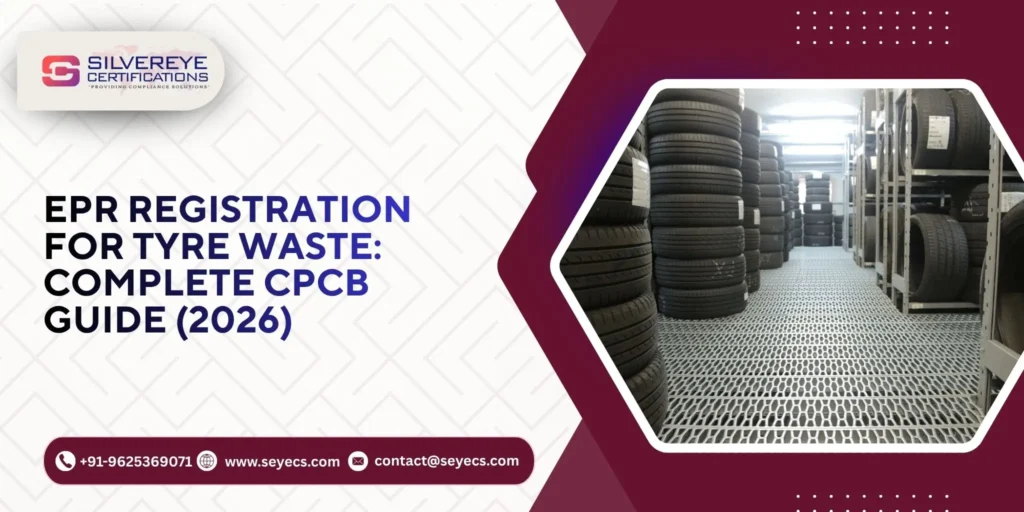
EPR Registration for Tyre Waste is the mandatory CPCB approval that producers, recyclers and retreaders of tyres in India must obtain under the Hazardous and Other Wastes (Management and Transboundary Movement) Amendment Rules, 2022 (Schedule IX). It requires businesses to register on CPCB's centralised Waste Tyre EPR Portal, meet annual waste-tyre recycling targets (100% of manufactured/imported quantity from FY 2024-25), and buy EPR Certificates from registered recyclers to prove compliance. Registration costs ₹10,000–₹25,000+ depending on entity type, stays valid for two years, and non-registration means a business legally cannot manufacture, import, sell or recycle tyres in India.
What Is EPR Registration for Tyre Waste?
Extended Producer Responsibility (EPR) for tyre waste is a regulatory principle that makes the company selling a tyre — not just the person who eventually throws it away — accountable for what happens to that tyre at the end of its life. In simple words, if you manufacture, import, or brand tyres in India, the law now holds you responsible for making sure a corresponding quantity of waste tyres actually gets recycled.
India generates a huge volume of scrap tyres every year, and for decades a large share of this waste was either dumped in open land, burned illegally (releasing toxic smoke), or processed in unscientific backyard pyrolysis units. Acting on directions from the National Green Tribunal (NGT), the Ministry of Environment, Forest and Climate Change (MoEFCC) asked CPCB to build a formal, traceable system for waste tyre management — and EPR registration is the entry point to that system.
So, when people search for "EPR registration for tyre waste," what they usually want to know is simple: do I need it, what will it cost, and how do I actually get it done without CPCB rejecting my application. This guide answers all of that in one place.
Legal Framework Governing Tyre Waste EPR
Tyre waste EPR in India is governed by a single, specific notification:
- Rule: Hazardous and Other Wastes (Management and Transboundary Movement) Amendment Rules, 2022
- Notification number: G.S.R. 593(E), dated 21 July 2022 (also referred to as the Eighth Amendment Rules, 2022)
- Governing schedule: Schedule IX, which lays down the entire EPR framework for waste tyres — obligations, targets, certificates, fees and penalties
- Regulator: Central Pollution Control Board (CPCB), under the Ministry of Environment, Forest and Climate Change
These rules apply to "every producer, recycler and retreader involved in manufacture, sale, transfer, purchase, collection, storage and processing of tyre or waste tyre" — which is a very wide net, covering everyone from large OEM tyre manufacturers to small regional retreading units.
Who Needs EPR Registration for Tyre Waste?
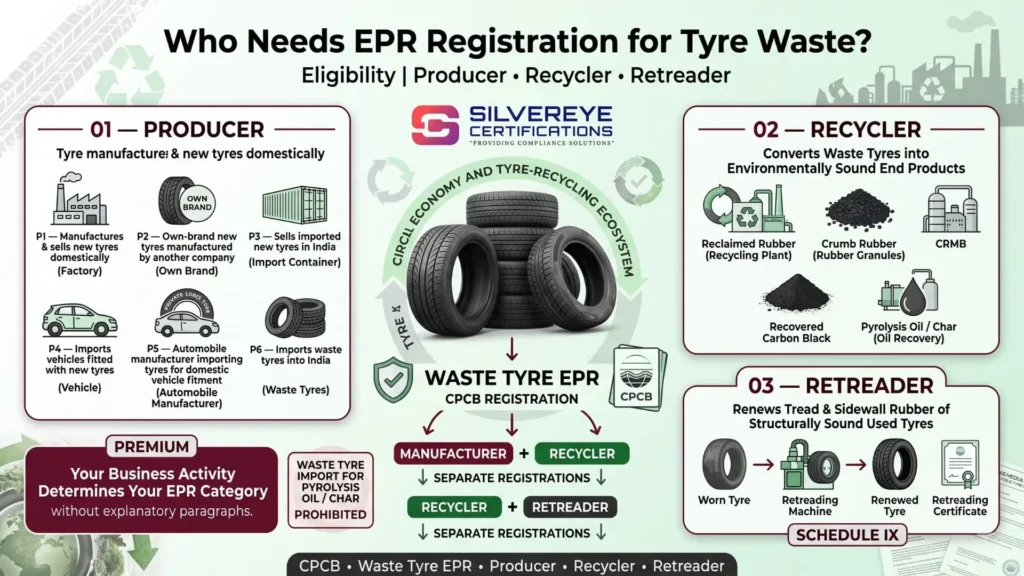
Three categories of stakeholders are required to register separately on the CPCB Waste Tyre EPR Portal. If a single company falls into more than one category — for example, a business that both manufactures tyres and recycles waste tyres — it must register under each category individually; CPCB does not allow a combined, single registration.
1. Producer
A "Producer" is any person or entity that:
- Manufactures and sells new tyres domestically (Category P1)
- Sells new tyres domestically under its own brand, manufactured by another company (Category P2)
- Sells imported new tyres in India (Category P3)
- Imports vehicles that come fitted with new tyres (Category P4)
- Is an automobile manufacturer importing new tyres for fitment in vehicles sold domestically (Category P5)
- Imports waste tyres into India (Category P6)
2. Recycler
A Recycler is any entity that converts waste tyres into environmentally sound end products, including reclaimed rubber, crumb rubber, crumb rubber modified bitumen (CRMB), recovered carbon black (RCB), or pyrolysis oil/char — and holds the facilities specified under the Rules.
3. Retreader
Retreading is the process of renewing the tread and sidewall rubber of a worn-out tyre that still has good structural quality. Retreaders must register on the portal to legally issue retreading certificates, which are recognised as part of the compliance chain.
A special case: waste tyre importers (Category P6) must register as both a Producer and a Recycler, since importing waste tyres is treated as bringing recycling feedstock into the country. Note also that the import of waste tyres purely for producing pyrolysis oil or char is prohibited under these Rules.
Latest CPCB Notifications & Updates on Tyre Waste EPR (2025–2026)
CPCB updates the Waste Tyre EPR Portal fairly often with return-filing extensions, SOP revisions and compliance reminders. Here are the notifications every producer, recycler and retreader should be tracking right now:
| Date | Notification / Update |
| 21.07.2022 | Hazardous and Other Wastes (M&TM) Eighth Amendment Rules, 2022 notified — Schedule IX introduces EPR for waste tyres |
| 03.2023 | Instruction sheets released for Producer and Recycler registration on the EPR Portal |
| 07.2023 | Standard Operating Procedures (SOPs) issued for registration of all stakeholders on the EPR Portal |
| 14.07.2025 | Annual Return filing for FY 2024-25 extended to 15.08.2025 |
| Ongoing (2025-26) | CPCB conducting daily video-conference sessions (4 PM–5 PM, Monday–Saturday) to resolve registration and EPR credit/certificate issues |
| FY 2025-26 | Recyclers permitted to generate denominated EPR certificates for FY 2025-26 sales up to the date of filing the Annual Return, or 30.04.2026, whichever is earlier |
Because the compliance calendar shifts almost every year — return deadlines get extended, new SOPs are issued — it's worth checking the CPCB Waste Tyre EPR Portal directly, or working with a compliance consultant such as Silvereye Certifications, before you assume last year's timeline still applies.
Benefits of EPR Registration for Tyre Waste
- Legal continuity: Without registration, a producer, recycler or retreader cannot legally manufacture, import, sell, or process tyres in India — registration is what keeps the business operating.
- Avoids penalties and disruption: Registered entities stay outside the reach of environmental compensation, certificate suspension, and enforcement action for non-compliance.
- Access to genuine business partners: Producers can only buy valid EPR Certificates from registered recyclers, and recyclers can only sell to registered producers — so registration is what allows a business to trade in the formal EPR ecosystem at all.
- Supports formal recycling: Every certificate generated is tied to verified, environmentally sound processing — directly reducing illegal dumping and unscientific pyrolysis.
- Builds brand and investor trust: A clean EPR compliance record increasingly matters for tenders, marketplace approvals, export documentation, and ESG reporting.
Documents Required for Tyre Waste EPR Registration
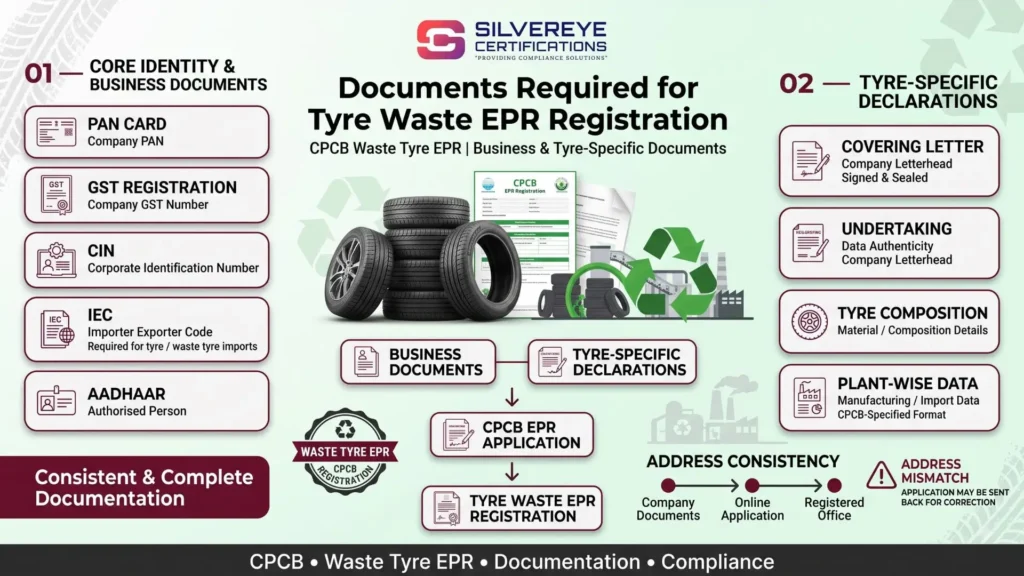
CPCB asks for a fairly standard identity and business document set, plus a few tyre-specific declarations:
Core Identity & Business Documents
- PAN card of the company
- GST registration number of the company
- CIN (Corporate Identification Number) of the company
- IEC (Importer Exporter Code) number — required only if the business imports tyres or waste tyres
- Aadhaar card of the authorised person handling the application
Tyre-Specific Declarations
- Covering letter on company letterhead, signed and sealed by the authorised person
- Undertaking on company letterhead confirming the authenticity of submitted data
- Tyre composition details
- Plant-wise manufacturing/import data, in the format specified by CPCB
All uploaded documents must show a consistent, matching address, and the registered office address must align exactly with what's entered on the online form — mismatches are one of the most common reasons applications get sent back for correction.
Step-by-Step EPR Registration Process for Tyre Waste
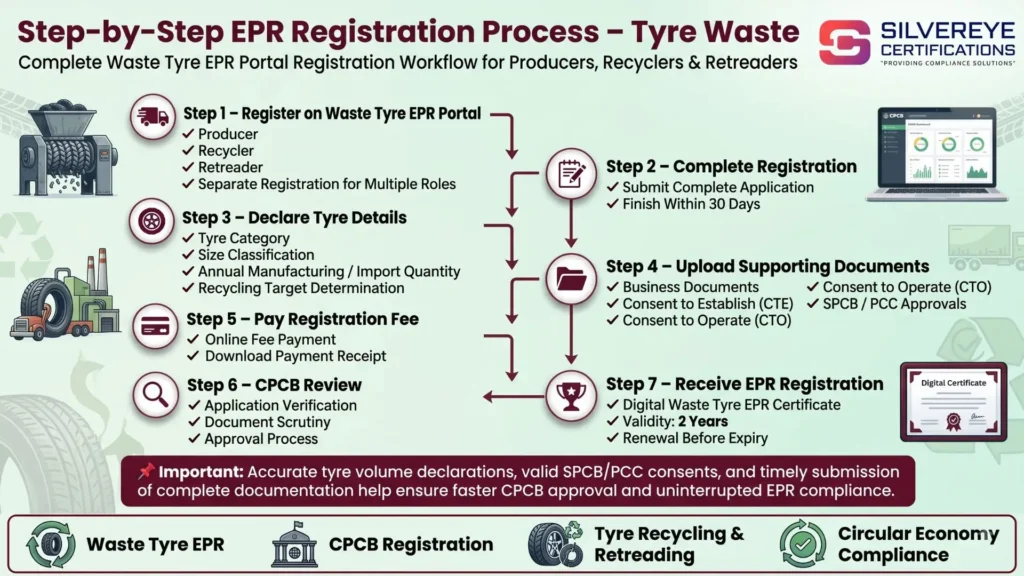
- Sign up on the CPCB Waste Tyre EPR Portal using the authorised person's email ID and mobile number.
- Receive login credentials (login ID and password) at the registered email address.
- Log in and complete the online registration form for the correct category — Producer, Recycler, or Retreader (register separately for each that applies).
- Upload all required documents: PAN, GST, CIN, IEC (if applicable), Aadhaar, covering letter, undertaking, tyre composition and manufacturing/plant data.
- Submit the completed application within 30 days of signing up — accounts left incomplete beyond 30 days are automatically deactivated.
- CPCB examines the submitted documents. If anything is incomplete or incorrect, CPCB communicates the shortcoming through the portal and by email to the authorised person.
- Once the application is complete and accurate, CPCB issues the registration number, typically within 15 days of receiving the full, correct submission.
- Begin compliance: producers track their EPR obligation, recyclers generate EPR Certificates against verified sales, and retreaders issue retreading certificates — all through the same portal.
A useful thing to know upfront: CPCB's own portal instructions state that it does not entertain consultants directly on an applicant's behalf during correspondence — but a consultant like Silvereye Certifications can still prepare, structure, and quality-check your documentation before submission, and guide the authorised person through every portal step, which is where most delays actually happen.
Registration for Businesses with Multiple Units
- Producers (Categories P1–P5) with manufacturing or business units across several states need only one registration, filed at the corporate office or principal place of business.
- Waste tyre importers (Category P6) with recycling units in different locations must register each recycling unit separately.
Waste Tyre Recycling Targets (EPR Obligation Schedule)
A producer's EPR obligation isn't a flat annual number — it's calculated as a percentage of the tyres they manufactured or imported two financial years earlier. Here's the full schedule as notified under Schedule IX:
| Financial Year | EPR Obligation (Recycling Target) |
| 2022-23 | 35% of new tyres manufactured/imported in 2020-21 |
| 2023-24 | 70% of new tyres manufactured/imported in 2021-22 |
| 2024-25 | 100% of new tyres manufactured/imported in 2022-23 |
| 2025-26 onward | 100% of new tyres manufactured/imported in year (Y-2) |
| New units (est. after 01.04.2022) | Obligation begins after a 2-year exemption, then 100% of tyres from year (Y-2) |
| Waste tyre importers | 100% of the quantity of waste tyres imported in year (Y-1) |
A retreading certificate offers some flexibility: if a producer's tyres are retreaded instead of scrapped, the corresponding EPR obligation is deferred by one year. However, the obligation is only fully extinguished once the tyre is eventually recycled through a registered recycler at true end-of-life — retreading buys time, it doesn't cancel the responsibility.
One relief worth noting: EPR obligations do not apply to tyres a producer exports out of India.
How EPR Certificates Are Calculated (Conversion Factor & Weightage)
Recyclers don't get EPR Certificates simply for processing tyres — CPCB applies a formula based on the end product actually produced and sold:
Eligible Quantity (QEPR) = Quantity of End Product (QP) × Conversion Factor (CF) × Weightage (WP)
| End Product | Weightage (WP) | Conversion Factor (CF) |
| Crumb rubber | 1.0 | 1.333 |
| Reclaimed rubber | 1.3 | 1.298 |
| Crumb rubber modified bitumen (CRMB) | 1.1 | 0.2 |
| Recovered carbon black (RCB) | 1.25 | 3.676 |
| Pyrolysis oil/char — continuous process | 0.8 | 1.49 |
| Pyrolysis oil/char — batch process | 0.5 | 1.49 |
Example: A recycler sells 10 MT of crumb rubber. QEPR = 10 × 1.333 × 1.0 = 13.33 MT of EPR credit, which is then reflected in the recycler's EPR wallet and can be transferred to a registered producer as an EPR Certificate.
Note: for imported waste tyres, the weightage (WP) is treated as 1 across all end-product categories.
EPR Registration Fees for Tyre Waste (2026)
| Entity Type | Fee Type | Amount |
| Producer | New registration (valid 2 years) | ₹25,000 + ₹0.625/MT on quantity manufactured/imported in preceding 2 years |
| Producer | Renewal | ₹12,500 + ₹0.625/MT on quantity manufactured/imported in preceding 2 years |
| Producer | Any amendment/addendum | ₹7,500 |
| Recycler | New registration (valid 2 years) | ₹15,000 |
| Recycler | Renewal | ₹7,500 + ₹0.625/MT on EPR certificate transaction quantity in preceding 2 years |
| Recycler | Any amendment/addendum | ₹5,000 |
| Retreader | New registration (valid 2 years) | ₹10,000 |
| Retreader | Renewal | ₹5,000 + ₹0.625/MT on retreading certificate transaction quantity in preceding 2 years |
| Retreader | Any amendment/addendum | ₹3,000 |
These are the CPCB-notified fee slabs applicable to fresh registration, renewal, and any correction/addition made to an existing registration. Government fee schedules can be revised, so it's worth reconfirming the exact figure on the portal — or with a consultant like Silvereye Certifications — at the time of filing.
Validity, Renewal & Compliance Timeline
- Registration validity: Every fresh registration (Producer, Recycler or Retreader) is valid for two years from the date of issue.
- EPR Certificate validity: An EPR Certificate remains valid for two years from the end of the financial year in which it was generated — and a producer can use a certificate generated in an earlier valid year to meet a later year's obligation.
- Renewal timeline: Applicants should apply for renewal before their two-year registration lapses, since operating on an expired registration is treated the same as operating without one.
- Returns filing: Producers and recyclers must file both quarterly and annual returns on the portal, due by the end of the month following the relevant quarter or financial year.
- Monthly data submission: Recyclers must additionally report, on a monthly basis, the quantity of waste tyres procured, end products produced, and EPR Certificates sold.
Practically, this means EPR compliance isn't a one-time filing — it's an ongoing cycle of monthly, quarterly and annual reporting layered on top of the two-year registration/renewal cycle. Many businesses that treat it as a "file once and forget" task end up missing a return deadline and risking their registration status.
What Happens If You Don't Register or Comply?
The Rules are explicit that no producer, recycler or retreader may carry out business with an unregistered entity, and that registered stakeholders cannot transact with unregistered ones either. Non-compliance — whether that's operating without registration, missing recycling targets, or failing to file returns — exposes a business to environmental compensation, suspension or cancellation of the EPR registration, and enforcement action under the Environment (Protection) Act, 1986.
For an importer, it can also mean customs holds on consignments. In short, EPR registration isn't optional paperwork; it's a precondition for legally trading in tyres in India.
How Silvereye Certifications Can Help
Because CPCB does not correspond with consultants directly on an applicant's behalf, the authorised person named in the application has to handle the actual portal filing and communication. That's exactly where a compliance partner adds the most value — behind the scenes.
Silvereye Certifications is a regulatory compliance consultancy that supports manufacturers, importers and brand owners across BIS, CDSCO, WPC-ETA, TEC-MTCTE, and EPR authorisations — including EPR for tyre waste, e-waste, plastic waste, and battery waste. For tyre waste EPR specifically, Silvereye Certifications typically assists with:
- Assessing whether your business qualifies as a Producer, Recycler, or Retreader (and under which producer category, P1–P6)
- Preparing and reviewing the covering letter, undertaking, tyre composition, and plant-wise data before upload, to reduce rejection risk
- Structuring documentation so PAN, GST, CIN and address details are consistent across every file — a common cause of CPCB queries
- Guiding the authorised person through the online form, obligation calculations, and EPR Certificate/credit workflow
- Tracking renewal timelines, quarterly/annual return deadlines, and portal notifications so nothing is missed
If your business is applying for the first time, renewing an existing registration, or trying to make sense of the recycling-target math, working with an experienced consultant like Silvereye Certifications can meaningfully cut down the back-and-forth with CPCB.
Conclusion
EPR registration for tyre waste is no longer a compliance formality tucked away in an environmental notification — it directly decides whether a tyre business can legally manufacture, import, sell, recycle, or retread in India. The rules are detailed, the recycling-target math takes some getting used to, and the fee-and-renewal cycle needs tracking every year. But once the registration is in place and the return-filing rhythm is set up, staying compliant becomes routine. If you'd rather not navigate CPCB's portal, document formats, and target calculations alone, a consultancy such as Silvereye Certifications can walk you through the entire process, from first registration to renewal.
Frequently Asked Questions
Is EPR registration mandatory for all tyre businesses in India?
Yes. Under Schedule IX of the Hazardous and Other Wastes (Management and Transboundary Movement) Amendment Rules, 2022, every producer, recycler and retreader dealing in tyres or waste tyres must register on CPCB's Waste Tyre EPR Portal. No entity is permitted to operate without it.
How long does it take to get EPR registration for tyre waste?
Once a complete, accurate application is submitted, CPCB typically issues the registration number within 15 days. Delays usually happen when documents or address details don't match, so accuracy at submission matters more than speed.
What is the fee for tyre waste EPR registration?
It depends on the category: ₹10,000 for a new Retreader, ₹15,000 for a new Recycler, and ₹25,000 plus ₹0.625 per MT of tyres manufactured/imported for a new Producer. Renewal fees are lower.
How long is the EPR registration valid?
Registration is valid for two years from the date of issue. EPR Certificates generated under it are also valid for two years from the end of the financial year in which they were generated.
Can one company register as both a Producer and a Recycler?
Yes, and in some cases it's mandatory — waste tyre importers (Category P6) must register as both a Producer and a Recycler, using separate contact details for each category.
What is an EPR Certificate and why does a producer need it?
It's the certificate a producer buys from a registered recycler to prove they've met their annual recycling obligation. Producers cannot fulfil their EPR obligation by recycling tyres themselves — they must purchase certificates from CPCB-registered recyclers.
Does retreading reduce a producer's EPR obligation?
Retreading defers the obligation by one year for that quantity of tyres, but doesn't cancel it — the obligation is only fully extinguished once the tyre is eventually recycled through a registered recycler at end-of-life.
Are exported tyres counted in the EPR obligation?
No. EPR obligations apply only to tyres sold or used domestically; tyres exported out of India by a producer are excluded from the calculation.
What documents are required to register as a producer or recycler?
PAN, GST number, CIN, Aadhaar of the authorised person, IEC (only if importing), a signed covering letter and undertaking on company letterhead, tyre composition details, and plant-wise manufacturing/import data.
What returns does a registered entity need to file after registration?
Producers and recyclers must file quarterly and annual returns on the CPCB portal, due by the end of the month following the relevant quarter or financial year. Recyclers also submit monthly data on tyres procured and certificates generated.
Can a business with manufacturing units in multiple states register once?
Yes, for Producer categories P1 to P5, a single registration at the corporate office or principal place of business covers all units. Waste tyre importers (P6) with multiple recycling units must register each unit separately.
What happens if a business doesn't renew its EPR registration on time?
An expired registration is treated the same as no registration at all — the business cannot legally continue producing, recycling, or trading tyres until it renews, and it risks environmental compensation and enforcement action.