
- EPR Registration for Electronic Products is legally mandatory in India under the E-Waste (Management) Rules, 2022 — non-compliance carries financial penalties of up to Rs. 1 lakh per day.
- The revised rules now cover 21 product categories under Schedule I, including solar PV modules, lithium-ion batteries, wearables, and chargers added in 2025-26.
- Every Producer, Importer, and Brand Owner (PIBO) must register on the CPCB EPR portal and display a WEEE crossed-bin symbol plus their EPR registration number on every covered product.
- In FY 2025-26, the mandatory e-waste collection target stands at 80% of total product weight placed in the market — the highest it has ever been.
Introduction
If you have ever asked yourself — do I need EPR Registration for my electronic product? — the answer, in almost every case, is yes. India's revised E-Waste (Management) Rules, 2022 cast a wide net. They cover everything from a smartphone to a solar panel, from a refrigerator to a fitness tracker. And in 2026, with CPCB tightening enforcement and linking EPR data to customs and GST systems, ignorance of the product list is no longer an acceptable defense.
EPR — Extended Producer Responsibility — shifts the burden of managing electronic waste from municipalities and informal scrap dealers onto the businesses that profit from selling these products. When you apply for EPR Registration for Electronic Products, you are not just ticking a compliance box. You are accepting legal accountability for what happens to your product after a consumer no longer needs it.
This guide covers every product category, the exact coverage criteria, labelling obligations, target calculations, and the 2026 updates you must act on — all in plain, direct language that helps you take real action.
How Does CPCB Decide Which Products Need EPR Registration?
The E-Waste (Management) Rules, 2022 define covered products through Schedule I — a notified list of electrical and electronic equipment (EEE) categories. If your product falls under any of these 21 categories, EPR Registration for Electronic Products is mandatory for you before you can legally manufacture, import, or sell in India.
The three core criteria CPCB uses to determine coverage are:
1. The product depends on electric currents or electromagnetic fields to function — it is not a purely mechanical device.
2. The product is designed for use with a voltage rating not exceeding 1,000 V AC or 1,500 V DC.
3. The product is listed under one of the notified categories in Schedule I of the E-Waste (Management) Rules, 2022.
If your product ticks all three boxes, you need EPR Registration. No exceptions for company size, turnover, or business model — the rules apply equally to a startup importing 500 units and a multinational shipping 5 million units.
Complete List of Products Requiring EPR Registration — Schedule I (2026)
The following table lists all 21 product categories under Schedule I of the E-Waste (Management) Rules, 2022 as they stand in 2026, including the categories expanded or newly added in 2025-26:
| S.No. | Category | Key Products Covered | Applicable To |
| 1 | Centralised Data Processing | Mainframes, Minicomputers | PIBOs |
| 2 | Personal Computing Devices | Desktops, Laptops, Notebooks, Tablets, Printers, Toner Cartridges, Scanners | PIBOs |
| 3 | Printing Consumables | Inkjet cartridges, Toner cartridges, Drum kits | PIBOs |
| 4 | Telecommunications Equipment | Mobile phones, Cordless phones, Satellite phones, Feature phones, Landlines | PIBOs |
| 5 | User Equipment | Television sets, LCD/LED/OLED panels, Computer monitors, Electronic notebooks | PIBOs |
| 6 | Lighting Equipment | Fluorescent lamps, High-intensity discharge lamps, CFLs, LED bulbs & tubes | PIBOs |
| 7 | Electrical & Electronic Tools | Power drills, saws, screwdrivers, sewing machines, electric motors | PIBOs |
| 8 | Toys, Leisure & Sports Equip. | Electric train sets, handheld video game consoles, electronic toys | PIBOs |
| 9 | Medical Devices | Radiotherapy, cardiology, dialysis, ventilators, nuclear medicine equipment | PIBOs (select) |
| 10 | Monitoring & Control Inst. | Smoke detectors, thermostats, heating regulators, measuring instruments | PIBOs |
| 11 | Automatic Dispensers | ATMs, vending machines, automated teller terminals, POS machines | PIBOs |
| 12 | Household Appliances (Large) | Washing machines, dryers, refrigerators, freezers, dishwashers, ACs, heat pumps | PIBOs |
| 13 | Household Appliances (Small) | Vacuum cleaners, irons, toasters, microwaves, electric fans, hair dryers | PIBOs |
| 14 | Consumer Electronics (Audio) | Radios, stereos, hi-fi equipment, amplifiers, musical instruments | PIBOs |
| 15 | Solar Photovoltaic Panels | Crystalline silicon PV modules, thin-film PV modules (added 2022) | PIBOs |
| 16 | Lithium-Ion Batteries | EV batteries, portable Li-ion batteries, energy storage system batteries | PIBOs |
| 17 | IT Networking Equipment | Routers, switches, modems, network hubs, wireless access points | PIBOs |
| 18 | Server & Storage Devices | Data servers, NAS, SAN, RAID arrays, data centre equipment | PIBOs |
| 19 | Display & Signage Equipment | Digital signage, information displays, electronic boards, scoreboards | PIBOs |
| 20 | Wearable Electronics | Smartwatches, fitness bands, hearing aids, smart glasses (2025–26 added) | PIBOs |
| 21 | Chargers & Adapters | Mobile chargers, laptop adapters, power banks (brought under EPR in 2025) | PIBOs |
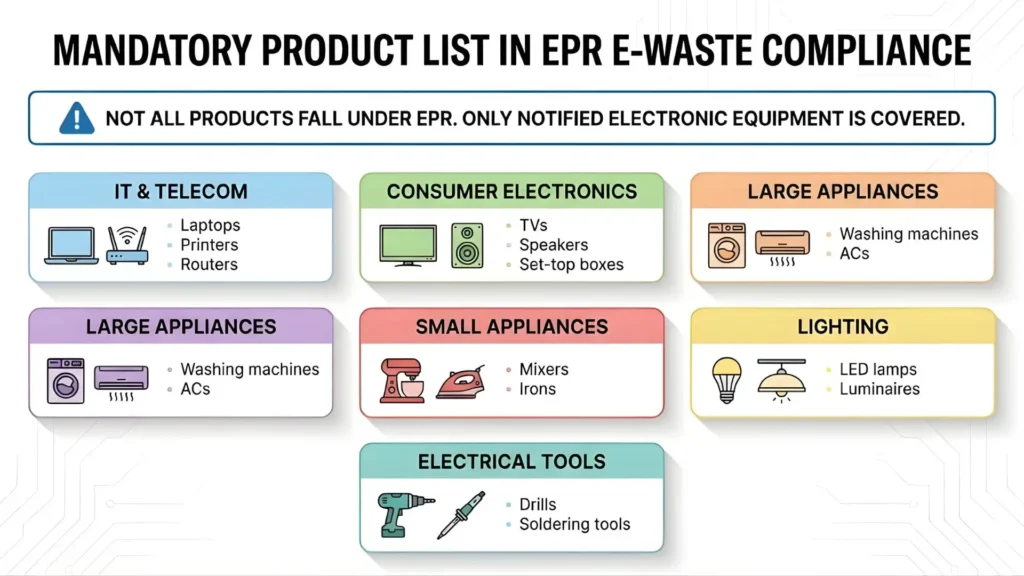
This is the most comprehensive product list India has ever had under its e-waste framework. If your product falls anywhere in these 21 categories, EPR Registration for Electronic Products is not optional — it is a legal obligation.
New and Expanded Product Categories Under EPR in 2025-2026
One of the most important developments in recent years is the expansion of EPR scope to cover newer technology categories. Many businesses in the wearables, D2C electronics, and clean energy sectors are caught off-guard when they discover that their products now fall under the EPR Registration for Electronic Products mandate. Here is what changed:
| New / Updated Product | Examples | 2026 Status / CPCB Update |
| Solar PV Modules | Rooftop solar, utility solar panels | Fully notified under E-Waste Rules (Amendment) 2022 |
| Lithium-Ion Batteries | EV battery packs, portable Li-ion packs | Covered; EV batteries linked to Battery Waste Rules 2022 |
| Wearable Technology | Smartwatches, fitness trackers, health monitors | Inclusion confirmed by CPCB circular 2025 |
| Chargers & Power Adapters | Mobile chargers, laptop adapters, power banks | Brought under EPR scope from FY 2025-26 |
| IoT & Smart Home Devices | Smart speakers, connected cameras, smart meters | Under review; CPCB advisory issued — register proactively |
| Digital Health Devices | Smart BP monitors, glucose meters, pulse oximeters | Classified under Medical Devices category — EPR applicable |
| Electric Vehicle Chargers | EV charging stations, home EV chargers, fast chargers | EPR applicability under examination; watch for CPCB notification |
The addition of solar PV modules and lithium-ion batteries is particularly significant for India's clean energy sector. Companies in the solar EPC, EV charging, and energy storage space must now build end-of-life management into their business model — not just as a sustainability goal but as a legal requirement.
How EPR Targets Are Calculated for Different Products
Once you obtain EPR Registration for Electronic Products, your next obligation is to meet annual collection and channelization targets. These targets are not one-size-fits-all — CPCB calculates them based on the weight and type of product you place in the market. Understanding the target calculation methodology is critical to planning your compliance strategy.
| Product Weight Band | Example Products | Target Calculation Method (2026) |
| Below 1 kg | Mobile phones, earbuds, small accessories | Quantity-based (units sold) |
| 1 kg – 10 kg | Laptops, monitors, printers, power tools | Weight-based (kg of EEE placed) |
| 10 kg – 50 kg | Washing machines, TVs (large), refrigerators (sm) | Weight-based (kg of EEE placed) |
| Above 50 kg | Industrial refrigerators, servers, large ACs | Weight-based (kg of EEE placed) |
| Solar PV Modules | Rooftop and utility-scale panels | Watt-peak capacity installed |
| Li-ion Batteries | EV and portable batteries | kWh capacity placed in market |
Current EPR Target for FY 2025-26
For the financial year 2025-26, CPCB has set the mandatory e-waste collection target at 80% of the total weight (or quantity) of covered electronic products placed in the Indian market in the preceding years. This progressive target structure means the more products you sell, the more e-waste you must collect and channel for safe recycling.
PIBOs that cannot meet their targets independently have two options: partner with a CPCB-registered Producer Responsibility Organization (PRO), or purchase EPR certificates (credits) from registered recyclers on the CPCB EPR exchange platform.
EPR Labelling and Marking Requirements for Electronic Products (2026)
Obtaining EPR Registration for Electronic Products is only the first step. The rules also impose specific labelling obligations on every covered product you place in the Indian market. Non-compliant labelling is increasingly being flagged during CPCB inspections and e-commerce audits.
| Label / Marking Requirement | Applicable Products | Status |
| WEEE Crossed-Bin Symbol | All EEE products covered under Schedule I | Mandatory on product and packaging |
| EPR Registration Number | All EEE placed in market by registered PIBOs | Mandatory — print or label on product |
| Manufacturer / Importer Name | All covered EEE | Mandatory on packaging |
| Collection Point Information | All PIBOs and their products | Must be on website + product manual |
| Hazardous Material Warning | Products containing Pb, Hg, Cd, Cr-VI, PBB, PBDE | Mandatory on product datasheet / label |
| QR Code to EPR Portal | Encouraged by CPCB from 2025 onwards | Strongly recommended — not yet mandatory |
The WEEE crossed-bin symbol must be clearly visible on the product or its immediate packaging. For products too small to carry a visible label (earbuds, USB dongles, small IoT sensors), CPCB permits the symbol and EPR registration number to appear on the retail packaging box rather than the product itself.
From 2025-26, CPCB has been encouraging PIBOs to include a QR code on the product packaging that links directly to their collection point information on the CPCB EPR portal. While not yet mandatory, early adoption of this practice positions your brand ahead of the regulatory curve and signals genuine commitment to responsible e-waste management.
Which Products Are Exempt from EPR Registration for E-Waste?
Not every electrical or electronic device triggers an EPR Registration obligation. There are specific exemptions under the E-Waste (Management) Rules, 2022 — though these are narrower than many businesses assume:
| Product / Category | Reason for Exemption |
| Defence & Military Equipment | Equipment notified exclusively for defence/military use is outside Schedule I |
| Space & Aerospace Equipment | Satellites, rockets, and specialised space technology are not covered |
| Large-Scale Fixed Industrial Tools | Machinery fixed at industrial sites (not EEE as defined in Schedule I) |
| Non-Electronic Electrical Equipment | Pure electrical items without electronic circuits, e.g. plain copper wiring |
| Incandescent Bulbs | Traditional filament bulbs are not listed under Schedule I categories |
| Personal Care Non-Electronic Devices | Non-electrically powered personal care items |
| Replacement Parts for Repair | Spare parts supplied for repair purposes are not covered as new EEE placed in market |
A common misconception is that low-value products or accessories are exempt. They are not. A Rs. 99 USB cable that falls under a notified category requires EPR Registration just as much as a Rs. 1 lakh television. What matters is the product category, not the price.
Handling Multi-Category Products and Bundle EPR Compliance
Many electronics businesses sell products that span multiple Schedule I categories — for example, a laptop sold with an original charger, or a smart home hub bundled with LED bulbs. How does EPR Registration apply to bundled products?
- Each product component is registered under its applicable Schedule I category individually. A laptop and its charger are separate EPR obligations from 2025-26 onwards.
- If a product serves multiple functions (e.g., a smartphone that also functions as a health monitor), it is classified under the primary function category for EPR purposes.
- For bundles sold as a single SKU, each component must be individually tracked in EPR returns, reporting weight by category.
- Replacement accessories sold separately (spare chargers, extra remote controls) must also carry EPR markings and be accounted for in returns.
This is an area where many businesses inadvertently fall short during CPCB audits. Maintaining SKU-level EPR category mapping in your ERP or inventory system is the most practical way to stay compliant.
EPR Registration for Imported Electronic Products — What Importers Must Know
If you import electronic products into India — whether as a brand owner, distributor, or OEM contract importer — EPR Registration for Electronic Products applies to you directly. In 2026, CPCB has established interoperability between its EPR portal and Customs systems, which means import clearances are being cross-checked against EPR registration status.
- Register Before You Import: Your EPR Registration Certificate must be in place before your first consignment is cleared through Indian Customs. Customs officials at key ports are increasingly checking EPR status for Schedule I products.
- Declare Quantities Accurately: EPR targets for importers are based on the quantity and weight of products imported. Bill of Entry data is accessible to CPCB, making under-reporting of imported quantities a high-risk strategy.
- Country-of-Origin Products Still Need India EPR: Even if your product has EPR compliance in Europe (WEEE Directive) or the USA, that compliance does not satisfy India's EPR requirement. A separate India-specific EPR Registration for Electronic Products is mandatory.
- Grey Market Imports and EPR: Parallel imports and grey market channels are not exempt from EPR. CPCB can hold the importer of record responsible for EPR compliance on any EEE entering India through commercial channels.
EPR Registration for D2C and E-Commerce Electronics Brands (2026)
India's D2C electronics ecosystem has exploded in recent years. Brands that sell directly to consumers through their own websites or through platforms like Flipkart, Amazon India, or Meesho are classified as either Producers or Importers under the EPR framework — and they carry full EPR obligations.
| Entity | Traditional OEM / Manufacturer | D2C Brand (Imported Products) |
| EPR Entity Type | Producer | Importer + Brand Owner |
| Registration Required? | Yes — before first sale | Yes — before first import / listing |
| EPR Target Basis | Qty/weight of products manufactured | Qty/weight of products imported |
| Labelling Obligation | Apply WEEE + EPR no. at manufacturing | Apply WEEE + EPR no. before listing |
| E-commerce Marketplace | OEM handles own EPR | Brand owner responsible; marketplace may co-verify |
| Key Risk | Missing product categories in returns | Customs linkage — shipments may be flagged without EPR Reg. |
Major e-commerce marketplaces in India have begun requiring sellers of EEE products to submit their EPR Registration number during seller onboarding or product listing. From 2026, several platforms have moved toward mandatory EPR verification as part of their own regulatory compliance. If you are a D2C or e-commerce electronics seller without EPR registration, you risk listing removals and account suspension in addition to CPCB penalties.
EPR for Refurbished and Second-Hand Electronic Products
The refurbished electronics market in India is growing rapidly, driven by cost-conscious consumers and sustainability awareness. But does EPR Registration for Electronic Products apply to refurbished goods? The answer requires some nuance.
- Registered Refurbishers: Entities that collect, repair, test, and resell used electronics are classified as Refurbishers under the E-Waste (Management) Rules, 2022. They must register separately with CPCB as a Refurbisher, not as a PIBO.
- Second-Hand Platforms: Online platforms facilitating C2B or C2C sale of used electronics (like OLX or Cashify) are not directly classified as PIBOs for existing products already in the market. However, they are expected to integrate with the EPR framework by providing collection channels.
- Imported Refurbished Goods:- Importing refurbished electronic products into India is subject to separate import policy under DGFT. If the import is permitted, EPR obligations as an importer apply in the same manner as for new products.
- Key Caution for Refurbishers: Refurbishers who receive defective or non-repairable units must channel them to CPCB-registered dismantlers or recyclers. Selling non-repairable e-waste to unregistered scrap dealers is a violation that can result in cancellation of the refurbisher'
Product-Level EPR Compliance Checklist for 2026
Whether you are registering for the first time or reviewing your existing EPR setup, use this checklist to verify that your product-level compliance is complete:
| Compliance Action | What You Need to Do |
| Confirm product falls under Schedule I | Check CPCB's notified product list and category descriptions |
| Identify your entity type (PIBO/RD/PRO) | Determine whether you are a Producer, Importer, Brand Owner, or other entity |
| Calculate product weight / quantity placed | Maintain year-wise data of product quantities / weight placed in India |
| Obtain CPCB EPR Registration Certificate | Complete online registration before placing products in the market |
| Apply WEEE symbol and EPR Reg. No. on product | Ensure all products carry the crossed-bin symbol and your registration number |
| Set up or join a take-back / collection scheme | Partner with registered dismantlers, recyclers, or enroll with a PRO |
| File quarterly EPR returns on CPCB portal | Report quarterly collection data; non-filing attracts penalties |
| Meet annual e-waste collection target | Achieve 80% collection target for FY 2025-26 per CPCB norms |
| Generate / purchase EPR credits if needed | Buy credits from CPCB exchange if target shortfall; sell surplus credits |
| File annual return and maintain records | File annual return by June 30 each year; keep records for 5 years |
Conclusion: Know Your Product's EPR Obligation and Act in 2026
The question is no longer whether EPR Registration for Electronic Products applies to your business — for most electronics companies operating in India, it does. The real question is whether you have the right documentation, the right registrations, and the right processes in place to stay compliant as the framework tightens through 2026 and beyond.
India's e-waste regulatory environment is maturing fast. CPCB is no longer issuing only warnings — penalties, show-cause notices, and marketplace delisting are now real consequences. And with the addition of solar panels, batteries, wearables, and chargers to the product list, the scope of EPR has never been wider.
Frequently Asked Questions
Do I need EPR Registration if I sell only a few hundred units of my product per year?
Yes. The E-Waste (Management) Rules, 2022 do not contain any minimum quantity or turnover threshold for EPR Registration. Even if you sell 50 units of a laptop or 200 LED bulbs, you are legally required to register as a Producer or Importer and meet your proportionate EPR targets. The targets scale with the quantity placed in market, but the registration obligation does not.
My product is manufactured in China and I only put my brand label on it before selling. Do I still need EPR Registration?
Absolutely yes. Under the E-Waste (Management) Rules, 2022, a Brand Owner — defined as any company that sells EEE in India under its own brand name regardless of where the product was manufactured — is explicitly required to obtain EPR Registration for Electronic Products. This is one of the most common misconceptions among D2C hardware startups and private-label electronics brands.
Are mobile phone accessories like cables, headphones, and cases covered under EPR?
It depends on the accessory. Cables and chargers are now explicitly covered under Schedule I from FY 2025-26 onwards. Wired headphones and earphones with electronic components fall under consumer electronics or telecommunications equipment categories. Plain non-electronic accessories like phone cases are not covered. When in doubt, check whether the accessory contains electronic circuits or depends on electrical current to function — if it does, EPR likely applies.
I manufacture and sell LED lighting products. What specifically are my EPR obligations?
LED bulbs, tubes, LED drivers, and LED-based lighting fixtures are covered under Category 6 (Lighting Equipment) of Schedule I. You must obtain EPR Registration for Electronic Products as a Producer. Your annual collection target for FY 2025-26 is 80% of the total weight of LED lighting products you placed in the Indian market. You must ensure the WEEE symbol and your EPR Registration Number appear on product packaging. Failure to collect and channel e-waste to registered recyclers will attract penalties.
Does EPR Registration apply to solar panels and batteries in 2026?
Yes. Solar photovoltaic modules were brought under the E-Waste (Management) Rules, 2022 through a specific notification. Lithium-ion batteries are covered both under the e-waste rules and the Battery Waste Management Rules, 2022. Companies manufacturing, importing, or selling solar PV systems or Li-ion battery packs in India must obtain separate EPR Registrations under both frameworks, where applicable. CPCB has established a unified portal for this purpose.
What does the WEEE crossed-bin symbol look like and where exactly must it appear?
The WEEE (Waste Electrical and Electronic Equipment) symbol is a wheeled bin with a cross through it — internationally recognized as the symbol indicating a product should not be disposed of in regular household waste. In India, the symbol must appear on the product itself (where physically feasible), on the immediate packaging, and in the product manual or documentation.
Can I sell my covered electronic product on Amazon India or Flipkart without EPR Registration?
You technically cannot — and increasingly, you practically cannot either. The E-Waste (Management) Rules require EPR Registration before placing any covered product in the market, which includes e-commerce listings. From 2025-26, major marketplaces have started requiring EPR Registration numbers as part of seller verification. Non-compliant sellers face listing removals.
How do I calculate the exact weight of products I have placed in the market for EPR target purposes?
PCB requires PIBOs to report the total weight (in kilograms) of each covered EEE product category sold or imported in India during the previous financial years. You calculate this by multiplying the number of units sold/imported by the per-unit weight of the product (excluding non-electronic packaging). This data must be maintained in your internal records and submitted in your annual EPR return.
What happens to my EPR Registration if I stop selling a particular product?
If you discontinue a product but have existing products in the market, your EPR obligations continue for those products until their expected useful life ends. You must continue meeting collection targets for products already sold, even if you no longer manufacture or import them. Once the residual obligation is fulfilled, you can apply to CPCB to remove that product category from your registration.
Is there a difference in EPR obligations for a product sold in India versus exported?
Yes, there is a clear distinction. EPR Registration and collection targets apply only to products placed in the Indian market. If you manufacture products in India and export 100% of production, you do not incur EPR obligations under Indian rules for those exported goods (though you may face EPR obligations in the destination country).