

Introduction
Here is a conversation that happens every single week in compliance offices across India: a business owner gets a call from their legal team, or they read something in the news about CPCB cracking down on EPR defaulters, and their first question is — "Does my product packaging fall under EPR?"
It is an honest question. And the truth is, the answer is not always obvious — especially because India's Plastic Waste Management (PWM) Rules cover a much wider range of products than most people assume. It is not just water bottles and shopping bags. It includes everything from the sachet your shampoo comes in, to the woven PP sack your flour is packed in, to the blister pack your medicine sits in.
This blog exists to give you a clear, practical, product-by-product answer to that question. We have organised every major plastic packaging product under its correct EPR category — with real-world industry examples, plastic types, compliance implications, and the latest 2026 regulatory updates that directly affect which products are being targeted for enforcement.
| 2026 Context: CPCB issued updated EPR compliance guidelines and enforcement circulars in early 2026. The ministry has signalled that product-level audits will be conducted for large-volume PIBOs in FY 2025-26. Knowing exactly which of your products carry EPR obligations is no longer just good practice — it is essential for avoiding Environmental Compensation notices. |
New in 2026: Key CPCB Notifications and Regulatory Updates Plastic Packaging products under EPR
Before we get into the product list, let us cover what has changed in 2026 — because several new notifications directly affect which products are in scope and how obligations are calculated.
| Notification / Update | What It Says | Impact on Businesses |
| CPCB Circular — January 2026 | CPCB directed all registered PIBOs to update their plastic category-wise quantity declarations for FY 2024-25 by March 31, 2026. Undeclared product lines are now being treated as wilful omission. | Businesses must audit all product packaging lines and declare every category — not just the obvious ones like bottles. |
| MoEFCC Advisory — February 2026 | The Ministry issued a clarification that flexible packaging used for B2B (business-to-business) supply of raw materials also attracts EPR obligations when the packaging is introduced into the domestic market by the seller. | Industrial and B2B suppliers of goods in plastic packaging can no longer assume exemption based on the commercial nature of the transaction. |
| CPCB Portal Update — March 2026 | The CPCB EPR portal introduced mandatory product-category-wise declaration forms. Entities can no longer file aggregate tonnage — each plastic category must now be declared separately with supporting documentation. | Compliance teams must now track plastic usage at the product packaging level, not just in bulk totals. |
| State PCB Inspections — Ongoing 2026 | Multiple State Pollution Control Boards (Maharashtra, Delhi, Karnataka, Tamil Nadu, Gujarat) have begun conducting physical factory inspections to verify EPR declarations against actual production records. | Manufacturers must ensure their EPR declarations match their production data and inventory records exactly. |
| Environmental Compensation Rate Revision — 2026 | CPCB has revised Environmental Compensation (EC) rates upward for Category II (flexible packaging below 75 microns) and Category III (multi-layer packaging) reflecting the higher processing cost and scarcity of certified recyclers. | Brand owners using sachets, pouches, and MLP packaging now face significantly higher per-MT penalties for shortfalls in these categories. |
| E-Commerce Packaging Clarification — 2026 | CPCB clarified that secondary and tertiary plastic packaging used by e-commerce sellers (bubble wrap, air pillows, mailer bags, stretch wrap for pallets) also attracts EPR obligations for the entity introducing the packaging into commerce. | E-commerce businesses and logistics companies must now account for all layers of plastic packaging, not just the primary product packaging. |
| Why This Matters: The 2026 regulatory trend is clear — CPCB is moving from voluntary self-declaration to active, document-backed verification. The era of filing rough estimates and hoping for the best is over. If your product list is not accurately mapped to EPR categories, you are exposed. |
How the Five EPR Categories Work
The PWM Rules divide plastic packaging into five categories. Your EPR obligation — the percentage of plastic you must ensure is collected and processed — depends entirely on which category your packaging falls into. Here is the quick version:
| Category | What It Covers | FY 2025-26 Recycling Target | Compliance Challenge |
| I | Rigid plastic packaging — bottles, jars, boxes, trays | 50% of quantity introduced | Low to moderate — good recycler network |
| II | Flexible plastic below 75 microns — films, sachets, thin bags | 50% | Moderate to high — limited formal recyclers |
| III | Multi-layered plastic packaging — chips packets, laminate tubes, Tetrapaks | 30% recycling + 70% co-processing | High — most expensive, fewest recyclers |
| IV | Plastic carry bags and films at 75 microns and above | 50% | Moderate — better recyclability than thin films |
| V | Plastic sheets and industrial packaging — construction film, FIBC bags, agricultural cover | As notified by CPCB for specific sub-types | Moderate — varies widely by product |
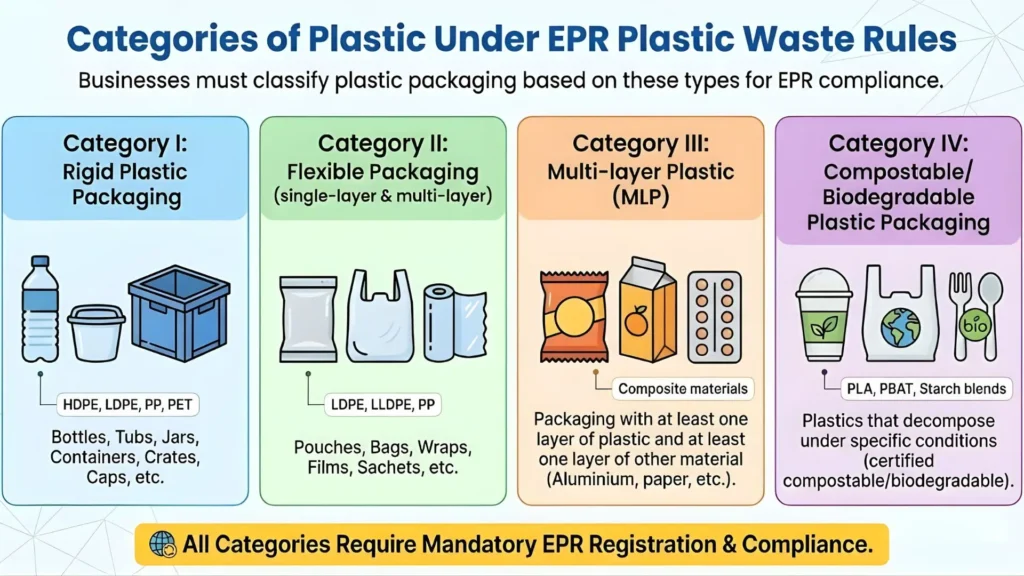
Category I — Rigid Plastic Packaging
Rigid plastic packaging is the most visible category — the bottles, jars, and containers most people associate with plastic recycling. India has a relatively mature recycling infrastructure for rigid plastics, particularly PET and HDPE, which is why the compliance cost for this category tends to be lower than others. But do not assume all rigid plastics are straightforward. Certain sub-types — like PVC bottles and mixed-material closures — can be harder to move in the recycling market.
| Product | Industries That Use It | Plastic Resin | Recyclability in India |
| PET Bottles (all sizes) | Beverages, juices, cooking oil, mineral water, carbonated drinks, pharmaceuticals | PET | Very High — active PET collection infrastructure |
| HDPE Bottles | Shampoo, conditioner, detergent, dairy, motor oil, household cleaners | HDPE | High — strong secondary market for HDPE |
| PP Bottles and Containers | Medicines, syrups, ketchup, sauces, curd, protein powder tubs | PP | Moderate — growing but patchy recycler network |
| PVC Bottles | Edible oils, mineral water (some brands), pharmaceutical liquids | PVC | Low — PVC is difficult to recycle in India |
| Plastic Jars | Pickles, jams, peanut butter, ghee, cosmetics, spices, supplements | PET / PP / HDPE | Moderate to High depending on resin |
| Rigid Plastic Trays | Fresh produce, meat, bakery items, ready-to-eat meals, electronics | PET / PP / PS | Moderate — PET trays recyclable; PS trays less so |
| Plastic Tubs and Buckets | Ice cream, butter, margarine, paint, bulk food items | PP / HDPE | Moderate to High |
| Plastic Cans and Drums (small) | Paints, lubricants, agrochemicals, industrial fluids | HDPE / PP | Moderate — depends on contamination level |
| Rigid Plastic Cups | Yogurt, curd, desserts, single-serve dairy, vending machine cups | PP / PS | Low to Moderate — PS cups rarely recycled |
| Blister Packs (Rigid Base) | Pharmaceutical tablets, capsules, hardware items, toys | PVC / PET / PP | Low — difficult due to mixed materials in blister |
| Plastic Caps and Closures | Bottle caps, flip-top lids, tamper-evident closures, screw caps | PP / HDPE | Moderate — often not collected separately |
| Rigid Plastic Tubes | Hard toothpaste tubes, industrial adhesive tubes | HDPE / PP | Low — multi-material construction complicates recycling |
| Plastic Boxes and Clamshells | Electronics, hardware, toys, stationery, gifting products | PP / PET / PVC | Moderate — PET clamshells are recyclable |
| Rigid Pallets and Distribution Crates | Beverage distribution, fruit and vegetable logistics | HDPE / PP | High — high reuse value, strong industrial market |
| Plastic Seed and Nursery Trays | Horticulture, agriculture nurseries, gardening retail | PP | Moderate |
| Plastic Medical Device Packaging | Syringes, surgical instruments, single-use medical kits | PP / PET | Low — bio-hazard contamination limits recyclability |
| 2026 Note: CPCB's inspection teams have flagged pharmaceutical and FMCG companies for under-declaring PP and PVC rigid packaging. If your product uses anything other than PET bottles, double-check that all rigid packaging types are included in your annual declaration. |
Category II — Flexible Plastic Packaging Below 75 Microns
This is the most challenging and environmentally damaging category. Flexible plastics below 75 microns are lightweight, low-value to recyclers, and almost entirely absent from formal collection channels. They clog drains, contaminate water bodies, and end up in landfills by default. That is exactly why their EPR obligation is significant — and why the 2026 Environmental Compensation rates for shortfalls in this category have been revised upward.
If your business uses sachets, thin pouches, or any flexible film packaging below 75 microns, you are almost certainly in this category. The list is longer than most people realise.
| Product | Industries / Applications | Plastic Resin | EPR Compliance Note |
| Single-serve sachets | Shampoo, conditioner, face wash, fairness cream, hair oil, ketchup, spices, instant coffee, ORS | LDPE / laminated film | High-volume SKUs; declare by total weight of all sachets sold |
| Thin carry bags (below 75 microns) | Local retail, kirana stores, vegetable vendors, small businesses | LDPE / HDPE | Now banned for commercial sale but still widely used; producers and distributors still carry EPR obligation |
| Pillow pouches for snacks | Biscuits, wafers, namkeen, puffed snacks, sugar confectionery | BOPP / LDPE laminate | One of the highest-volume flexible packaging types in FMCG |
| Thin flexible stand-up pouches | Dal, rice (small packs), flavoured milk, juice drinks, protein shakes | Laminated multi-film | Declare under Category II if total film thickness below 75 microns; may also qualify as MLP |
| Cling film and food wrap | Deli counters, bakeries, restaurants, household food storage, supermarkets | PVC / LDPE | Often overlooked by food businesses; still carries EPR obligation |
| Bread and bakery packaging bags | Sliced bread, buns, rolls, cakes, cookies, rusks | LDPE / PP film | High volume in organised food retail; frequently underdeclared |
| Thin garment and apparel bags | Retail clothing, e-commerce fashion, branded apparel poly bags | LDPE | Fashion and apparel brands must declare all packaging — online and offline |
| Produce bags for fruits and vegetables | Supermarkets, organised retail, mandi packaging | LDPE | Pre-packed produce brands must include these in their EPR declaration |
| Thin pharmaceutical pouches | ORS sachets, powder medicine, single-dose drug packaging, eye drop pouches | Laminated foil / LDPE | Pharma companies frequently overlook these in EPR filings; CPCB is now auditing this sector |
| Thin e-commerce mailer bags (below 75 microns) | Small e-commerce orders, jewellery packaging, accessories delivery | LDPE / co-extruded film | E-commerce sellers must include all delivery packaging in their EPR declaration under 2026 clarification |
| Thin courier document envelopes | Bills, invoices, legal documents in thin polybags | LDPE | Often missed; still carries obligation if plastic content below 75 microns |
| Thin overwrap on multipacks | Grouping of individual units (water bottles, snack packs) in thin plastic sleeve | LDPE / LLDPE | The outer wrap counts separately from the individual unit packaging inside |
| Seed and fertiliser sachets (small retail packs) | Agricultural retail, home gardening kits, small-pack fertiliser | LDPE / laminated film | Often missed by agri-input companies in their EPR filings |
| Critical 2026 Update: CPCB's revised Environmental Compensation rates for Category II shortfalls came into effect in FY 2025-26. The per-MT penalty for flexible packaging below 75 microns is now significantly higher than previous years. If your business sells high volumes of sachets or thin pouches, this category warrants immediate attention. |
Category III — Multi-Layered Plastic Packaging
Multi-layered plastic packaging — commonly called MLP — is the most complicated and costly category to deal with under EPR. MLP combines two or more layers of different materials (plastic, aluminium foil, paper) that are bonded together and cannot be separated. Because of this, MLP cannot be recycled through conventional mechanical recycling. It can only be handled through co-processing (in cement kilns) or energy recovery (in waste-to-energy plants).
The combination of limited processing infrastructure, high demand for certificates, and the 2026 upward revision of EC rates makes Category III the single most expensive EPR obligation to fulfil. Businesses in the FMCG, food, pharma, and personal care sectors — which rely heavily on MLP for shelf life extension — need to plan this carefully.
| Product | Industries / Applications | Layer Composition | Key Compliance Note |
| Chips and extruded snack packets | Potato chips, namkeen, puffed rice, popcorn, bhujia | BOPP + metallised film + LDPE inner layer | One of India's highest-volume MLP items; major FMCG brands face large Category III obligations |
| Instant noodle and pasta packets | Masala noodles, vermicelli, instant pasta packs | Metallised BOPP + LDPE or PP laminate | High-frequency consumer item; declares per total weight of all packets sold |
| Tetrapaks and aseptic cartons | Fruit juices, flavoured milk, coconut water, soups, dairy | Paperboard + LDPE + aluminium foil + LDPE inner | Though paper-dominant, the plastic and foil layers mean EPR obligation applies |
| Laminate toothpaste and personal care tubes | Toothpaste, hair colour, face cream, fairness cream in squeeze tubes | LDPE + aluminium foil + printed outer layer | Oral care and personal care brands commonly underdeclare these; CPCB is actively auditing this segment |
| Coffee and tea pouches | Ground coffee, instant coffee, specialty tea, chai masala pouches | PET + aluminium + LDPE or PP laminate | Premium beverage brands entering India must include import packaging in their EPR declaration |
| Sauce and condiment pouches | Ketchup, chilli sauce, mayo, mustard, vinegar, soy sauce stand-up pouches | PET + LDPE + nylon laminates | Very common in food service and retail; each SKU adds to Category III obligation |
| Biscuit and cookie secondary wrappers | Cream biscuit inner trays, metallised outer wraps, cookie sleeves | Metallised BOPP + LDPE layers | Biscuit companies often declare only the outer carton; inner MLP wrapper must also be declared |
| Chocolate and confectionery foil wrappers | Chocolate bars, toffees, energy bars, protein bars | Aluminium foil + LDPE or printed OPP film | Often treated as 'just foil'; the plastic lamination makes it Category III MLP |
| Spice and masala retail pouches | Ground spices, curry powders, blended masalas in 50g-500g retail packs | BOPP + metallised film + LDPE | Indian spice brands — both domestic and export-oriented — carry significant Category III obligations |
| Milk and dairy multilayer pouches | Pasteurised milk, flavoured milk, cream, lassi, buttermilk | LDPE + LLDPE co-extruded three-layer film | Dairy cooperatives and private dairy brands are among the largest Category III obligated entities |
| Alu-alu pharmaceutical blister packs | High-end medicines, moisture-sensitive tablets, capsules | Aluminium foil + nylon + aluminium foil | Pharma sector faces strict CPCB scrutiny; 2026 inspections specifically targeting this sub-segment |
| Frozen food packaging | Frozen vegetables, french fries, frozen meals, ice cream bars, frozen snacks | PET + LDPE or metallised film | Organised frozen food brands are a growing segment with growing EPR obligations |
| Pet food pouches | Wet and dry dog food, cat food, bird feed in sealed pouches | PET + aluminium + PP or LDPE | Rapidly growing pet care sector; many brands new to EPR compliance as of 2025-26 |
| Nutritional supplement sachets | Protein powder, nutrition drink sachets, vitamin supplement single-dose packs | Foil-laminated multi-layer | Health and wellness brands frequently underdeclare these in EPR filings |
| Detergent and cleaning product sachets | Single-dose detergent pods, fabric conditioner sachets, floor cleaner refill pouches | LDPE + foil laminate or PVA film (for pods) | Household care brands with sachet-based marketing strategies carry large MLP obligations |
| Why Category III Costs More: In India, only a limited number of cement kilns and waste-to-energy plants are certified to process MLP. Because processing capacity is scarce and demand for certificates is high, Category III EPR certificate prices consistently trade at Rs. 12,000 to Rs. 20,000 per MT — two to four times the rate of rigid plastic certificates. For high-volume FMCG brands, this is a material cost that needs to be planned into budgets annually. |
Category IV — Plastic Carry Bags and Films at 75 Microns and Above
Category IV covers plastic bags and films at or above the 75-micron threshold — the legal minimum thickness for plastic carry bags in India since the 2022 PWM Rules prohibited thinner bags. These products are generally more recyclable than their sub-75-micron counterparts, but they still carry full EPR obligations.
One important thing to note: the e-commerce sector was specifically called out in CPCB's 2026 advisory. All secondary and transit packaging — bubble wrap, air pillows, mailer bags, and pallet stretch film — used by e-commerce businesses now falls within the scope of EPR obligations for those businesses.
| Product | Industries / Applications | Plastic Resin | 2026 Compliance Note |
| Branded plastic carry bags (75 microns+) | Retail stores, departmental stores, supermarkets, brand outlets | LDPE / HDPE | Must display brand name, thickness, and BIS mark; EPR registration mandatory for producer |
| Woven polypropylene bags and sacks | Grain, flour, rice, sugar, fertiliser, cement, animal feed | PP woven fabric | One of the highest-volume packaging types in agri-input and commodities sector |
| Heavy-duty courier and e-commerce mailer bags | E-commerce deliveries, document shipments, returns packaging | LDPE / co-extruded PE | 2026 CPCB advisory specifically includes these; e-commerce sellers must now account for all delivery packaging |
| Bubble wrap and air pillow packaging | Electronics, ceramics, glassware, furniture parts, fragile goods | LDPE / LLDPE | Now explicitly covered for e-commerce companies under 2026 CPCB clarification |
| Stretch wrap and pallet film | Pallet stabilisation, warehouse logistics, transit packaging for goods | LLDPE stretch film | Logistics companies and large manufacturers using stretch wrap now carry EPR obligations for this material |
| Bin liners and refuse sacks (75 microns+) | Household waste management, commercial kitchens, office bins | LDPE | Consumer brands selling garbage bags at 75+ microns must register for EPR |
| Zip-lock and resealable bags (heavy gauge) | Food storage, laboratory samples, jewellery packaging, hardware parts | LDPE / LLDPE | Speciality packaging manufacturers often miss these in their declarations |
| Laminated non-woven PP bags | Promotional shopping bags, corporate gifting bags, supermarket reusable bags | PP non-woven + BOPP or PE lamination | The plastic lamination coat makes these Category IV; many brands incorrectly assume non-woven is exempt |
| Heavy garment and dry cleaning bags | Dry cleaning, premium apparel retail, suit covers, saree packaging | LDPE / HDPE (75+ microns) | Retail and dry cleaning chains must account for these in annual EPR declarations |
| Agricultural mulch film (retail packed) | Horticulture, polyhouse farming, soil moisture management | LDPE | When sold as retail packaged product, carries EPR obligation for the seller/brand owner |
| Plastic shrink wrap for retail multipacks | Grouping of beverage bottles, consumer goods in shrink film | PE shrink film | Often the highest-volume Category IV item for beverage and FMCG companies after rigid bottle count |
| For E-Commerce Businesses: Based on CPCB's February 2026 advisory, if your business ships products using bubble wrap, air pillows, plastic mailer bags, or stretch film — and you source and use that packaging material yourself — you carry an EPR obligation for those materials. This applies to D2C brands, marketplace sellers with own labels, and third-party logistics providers who supply the packaging material. |
Category V — Plastic Sheets and Industrial Plastic Packaging
Category V is the category that most businesses in the industrial, construction, and agricultural sectors either do not know about — or quietly assume does not apply to them. That assumption is wrong. If you manufacture or import plastic sheeting, films, bags, or containers used as packaging in industrial contexts, you carry EPR obligations under Category V.
The MoEFCC advisory issued in February 2026 specifically addressed B2B plastic packaging. The clarification makes it clear that the commercial, industrial, or agricultural nature of the end use does not exempt the seller from EPR obligations if they are introducing plastic packaging into the domestic market.
| Product | Industries / Applications | Plastic Resin | Compliance Note |
| Greenhouse and polyhouse covering films | Horticulture, floriculture, vegetable farming, tunnel farming | LDPE / EVA greenhouse film | Agricultural plastic producers and importers carry EPR obligation under Category V |
| Silage wrap and bale film | Dairy farming, animal husbandry, fodder preservation | LLDPE stretch-based film | Agri-input companies supplying these must now register for EPR under 2026 clarifications |
| FIBC bags (Flexible Intermediate Bulk Containers / jumbo bags) | Chemicals, minerals, construction aggregates, grains, pigments, sugar | PP woven + liner (LDPE or PE) | One of the highest-volume Category V items; chemical and construction companies are primary obligated entities |
| Construction sheeting and damp-proof membrane | Building construction, infrastructure projects, waterproofing | HDPE / LDPE sheets | Construction material suppliers must declare these under Category V |
| Plastic tarpaulins and cargo covers | Road transport, open truck cargo protection, logistics | HDPE woven + LDPE lamination | Tarpaulin manufacturers and importers carry EPR obligation; large fleet operators who buy tarpaulins for packaging may also qualify |
| Industrial HDPE and PP drums | Chemical storage and transport, food-grade liquids, edible oils (bulk), agrochemicals | HDPE (blow-moulded) | Industrial drum manufacturers and drum refillers carry Category V EPR obligations |
| Intermediate Bulk Containers (IBCs) | Chemicals, lubricants, food-grade liquids in 500–1000 litre containers | HDPE inner bottle + steel cage | IBC manufacturers and importers must declare the plastic bottle component under Category V |
| Anti-static and ESD packaging films | Electronic components, printed circuit boards, semiconductor devices | PE with anti-static additives | Electronics manufacturing sector; often overlooked in EPR declarations by component manufacturers |
| Vacuum packaging films for industrial use | Meat processing, cheese manufacturing, industrial component preservation | Nylon-PE or EVOH multilayer | When used as packaging material for domestic market goods, these attract EPR — may overlap with Category III for MLP variants |
| PP corrugated sheets (packaging use) | Glass sheet transport, tile packaging, furniture in transit, electronic goods dividers | PP twin-wall corrugated | Niche but growing; manufacturers and importers of PP corrugated packaging must register |
| Plastic strapping and banding | Carton strapping, pallet banding, newspaper bundling, tile and brick bundling | PP / PET strapping | Often completely absent from EPR declarations; strapping manufacturers and importers are obligated entities |
| Protective foam packaging (plastic-based) | Electronics, glassware, fragile industrial goods, appliances | Expanded Polystyrene (EPS) or PE foam | EPS manufacturers and importers carry EPR obligation; one of the hardest-to-recycle materials in the system |
| Plastic corner protectors and edge guards | Furniture, glass, metal sheets in transit packaging | PP / HDPE moulded profiles | Small volume per unit but large aggregate tonnage in furniture and glass sectors |
| 2026 Advisory Impact on Category V: The February 2026 MoEFCC advisory specifically addressed businesses that supply plastic packaging to other businesses — arguing they were outside EPR scope because their buyer is a commercial entity. CPCB has now clarified this position. If you manufacture or import any Category V item and sell it in India, you carry EPR obligations regardless of who your buyer is. |
All Products, Categories, and Compliance Difficulty
Go through your product portfolio, find your packaging types in the list, identify the EPR category, and note the compliance difficulty. Any item marked High in the last column deserves immediate attention in your compliance planning.
| Packaging Product | Category | Certificate Approx. Cost (per MT) | Compliance Difficulty |
| RIGID PLASTICS | |||
| PET bottles and containers | I | Rs. 4,000-6,000 | Low — strong recycler network |
| HDPE bottles, jugs, buckets | I | Rs. 4,000-7,000 | Low to Moderate |
| PP containers, cups, medical trays | I | Rs. 5,000-8,000 | Moderate |
| PVC bottles and blister bases | I | Rs. 6,000-10,000 | Moderate to High — limited PVC recyclers |
| Rigid foam (EPS) packaging | V | Rs. 8,000-14,000 | High — very limited EPS recyclers in India |
| FLEXIBLE PLASTICS BELOW 75 MICRONS | |||
| Sachets (shampoo, spices, pharma) | II | Rs. 9,000-14,000 | High — few formal recyclers |
| Thin carry bags (below 75 microns) | II | Rs. 9,000-13,000 | High — also subject to use restrictions |
| Snack and biscuit pillow pouches (thin) | II | Rs. 10,000-14,000 | High |
| Thin cling film and food wrap | II | Rs. 8,000-12,000 | Moderate to High |
| Thin mailer bags (below 75 microns) | II | Rs. 8,000-12,000 | Moderate to High |
| MULTI-LAYERED PACKAGING (MLP) | |||
| Chips and snack packets | III | Rs. 14,000-20,000 | Very High — co-processing only |
| Tetrapaks and aseptic cartons | III | Rs. 13,000-18,000 | Very High |
| Laminate toothpaste and cosmetic tubes | III | Rs. 14,000-20,000 | Very High |
| Sauce and condiment foil pouches | III | Rs. 12,000-18,000 | Very High |
| Alu-alu pharma blisters | III | Rs. 15,000-22,000 | Very High — pharmaceutical sector under CPCB scrutiny |
| Instant noodle and coffee pouches | III | Rs. 13,000-19,000 | Very High |
| CARRY BAGS AND FILMS 75 MICRONS+ | |||
| Branded carry bags (75 microns+) | IV | Rs. 5,000-9,000 | Moderate |
| Woven PP bags and sacks | IV | Rs. 4,000-7,000 | Low to Moderate — good PP recycling market |
| E-commerce mailer bags (75 microns+) | IV | Rs. 5,000-8,000 | Moderate — now explicitly covered in 2026 |
| Bubble wrap and air pillows | IV | Rs. 6,000-10,000 | Moderate — covered under 2026 e-commerce advisory |
| Stretch and pallet wrap | IV | Rs. 5,000-9,000 | Moderate |
| Shrink wrap and multipack overwrap | IV | Rs. 5,000-8,000 | Low to Moderate |
| INDUSTRIAL AND AGRICULTURAL PLASTIC | |||
| FIBC jumbo bags | V | Rs. 5,000-9,000 | Moderate — strong industrial PP recycling |
| Greenhouse and agricultural films | V | Rs. 6,000-10,000 | Moderate — covered under 2026 advisory |
| HDPE drums and IBCs | V | Rs. 4,000-7,000 | Low to Moderate |
| Construction sheeting and tarpaulins | V | Rs. 5,000-9,000 | Moderate |
| PP strapping and banding | V | Rs. 5,000-9,000 | Moderate — commonly underdeclared |
| Anti-static and vacuum packaging films | V | Rs. 7,000-12,000 | Moderate to High |
* Certificate prices are indicative market rates as of early 2026. Actual prices vary on the CPCB EPR marketplace based on supply, demand, and category.
How to Use This Product List for Your EPR Compliance Audit
Reading through a product list is useful. Actually applying it to your business is where the real work happens. Here is a practical, step-by-step approach that compliance teams and consultants use to translate a product list into an accurate EPR declaration:
- Map every SKU to its packaging components. Go product by product through your entire range. For each SKU, list every piece of plastic packaging: primary packaging (what the product is directly in), secondary packaging (the outer box or sleeve), and tertiary packaging (transit or distribution packaging).
- Identify the plastic resin and thickness for each component. Your packaging vendor or material safety data sheet will tell you the resin type. For films and flexible packaging, the thickness in microns determines whether it is Category II or IV.
- Assign each packaging component to the correct EPR category. Use the tables in this guide. When in doubt between two categories, consult your State PCB or a registered environmental compliance advisor. CPCB's 2026 portal now allows you to raise formal category classification queries.
- Calculate total weight introduced into the market by category. Multiply the weight of packaging per unit by total units sold in the financial year. This is your declared quantity. The CPCB portal's new category-wise declaration form requires this breakdown — aggregate tonnage is no longer accepted.
- Apply the target percentage to get your EPR obligation. For each category, multiply your declared quantity by the applicable recycling target percentage. This gives you the MT of EPR certificates you need to procure.
- Procure EPR certificates from the CPCB portal marketplace. Search for registered recyclers and processors by category on the portal. Verify their registration status and Consent to Operate before purchasing. Keep full documentation of every transaction.
- File your annual return before the deadline. The annual return is where you declare plastic quantities introduced and EPR obligations fulfilled. Missing this deadline treats your full obligation as unfulfilled — even if you have the certificates.
| Pro Tip: The single most common reason for EPR underdeclaration is focusing only on primary packaging and forgetting secondary and tertiary packaging, as well as e-commerce delivery packaging. Do a complete audit that covers every layer of plastic your business introduces into the market — not just the packet the consumer sees. |
Conclusion: Know Your Products. Know Your Obligation. Act Now.
The list of plastic packaging products under EPR is longer and more detailed than most businesses realize. It reaches into sachets and toothpaste tubes, into greenhouse films and jumbo bags, into e-commerce mailer packaging and pharmaceutical blisters. If plastic is involved and you are the one putting it into the Indian market, the obligation is almost certainly yours.
The 2026 regulatory environment has made one thing clear: CPCB is no longer relying on self-reporting alone. Product-level audits, factory inspections, and category-wise declaration requirements mean that imprecise, aggregate EPR filings are a compliance risk. The businesses that will navigate this well are the ones that have done the work of mapping every packaging component to the correct category — and have the documentation to back it up.
Use the product lists and tables in this guide as your starting point. Do a thorough packaging audit. Build your EPR declaration from accurate, verified data. And if your business has complex packaging — multi-layer, multi-category, or both domestic and imported — get a registered environmental compliance advisor involved before you file.
| Next Step: If you have identified products in your portfolio that need EPR registration, visit eprplastics.cpcb.gov.in to register or update your existing registration. For complex cases, consult a CPCB-empanelled environmental advisor before making declarations. |
Frequently Asked Questions
My product uses both a rigid bottle (Category I) and a foil sachet inside (Category III). Do I declare both?
Yes, absolutely. Each packaging component must be declared under its own category. The rigid bottle and the inner foil sachet are separate packaging items with separate EPR obligations. There is no blending or combined calculation across categories. Declare each component's weight separately and procure certificates for each category accordingly.
We are a small D2C brand with a turnover under Rs. 50 lakh. Are we still required to register for EPR?
Yes. The PWM Rules do not include any turnover-based exemption for brand owners. Even a startup selling products under its own label in plastic packaging is legally required to register on the CPCB EPR portal. The obligation is triggered by the act of introducing plastic packaging into the market — not by your revenue size.
Does imported packaging count toward my EPR obligation?
Yes. If you import products in plastic packaging for sale in India, you are classified as an Importer under the rules, and that plastic packaging forms part of your EPR obligation. This includes both the product's primary packaging and any secondary or transit packaging that enters the domestic market along with the product.
Can I use the same EPR certificate for two different packaging categories?
No. EPR certificates are category-specific. A certificate issued for Category I rigid plastics cannot be used to fulfil a Category III MLP obligation. Each certificate specifies the exact plastic category and the quantity in MT. You must hold certificates matching the category and quantity of each specific obligation.
We switched from MLP packaging to mono-material recyclable packaging mid-year. How do we declare?
You declare based on actual quantities introduced into the market during the financial year. If you used MLP packaging for the first half of the year and switched to mono-material PP in the second half, you declare the MLP quantity under Category III and the mono-material PP quantity under Category I (if rigid) or Category II/IV (if flexible), proportional to the period each was in use. Keep production and procurement records to support the split declaration.
Are compostable or biodegradable plastic packaging products also covered under EPR?
This is an area where CPCB is still developing clear guidelines. As of 2026, certified compostable packaging made from materials compliant with IS 17088 (the Indian standard for compostable plastics) is treated differently under the rules. However, packaging marketed as biodegradable without proper certification still attracts EPR obligations. If you are using compostable packaging, verify its certification status and check the latest CPCB clarification before assuming exemption.
Does packaging used only for exports need to be declared under EPR?
No. EPR obligations under the PWM Rules apply to plastic packaging introduced into the Indian domestic market. Products manufactured in India exclusively for export — and never sold domestically — do not create domestic EPR obligations. However, if the same product is sold both domestically and exported, only the domestic market portion attracts EPR.