
- EPR Registration for E-Waste is now mandatory under the E-Waste (Management) Rules, 2022 — non-compliance invites heavy penalties.
- Producers, Importers, and Brand Owners (PIBOs) must register on the CPCB's online EPR portal before selling or importing EEE products.
- The EPR registration process involves document submission, fee payment, and annual target setting for e-waste collection.
- Updated 2026 guidelines introduce stricter EPR targets, digital return filing, and higher accountability for all stakeholders.
What Is EPR Registration for E-Waste?
If you manufacture, import, or sell electrical or electronic equipment in India, EPR Registration for E-Waste is not optional — it is a legal requirement. The Central Pollution Control Board (CPCB) administers this process under the E-Waste (Management) Rules, 2022, replacing the earlier 2016 rules to introduce a more robust extended producer responsibility (EPR) framework.
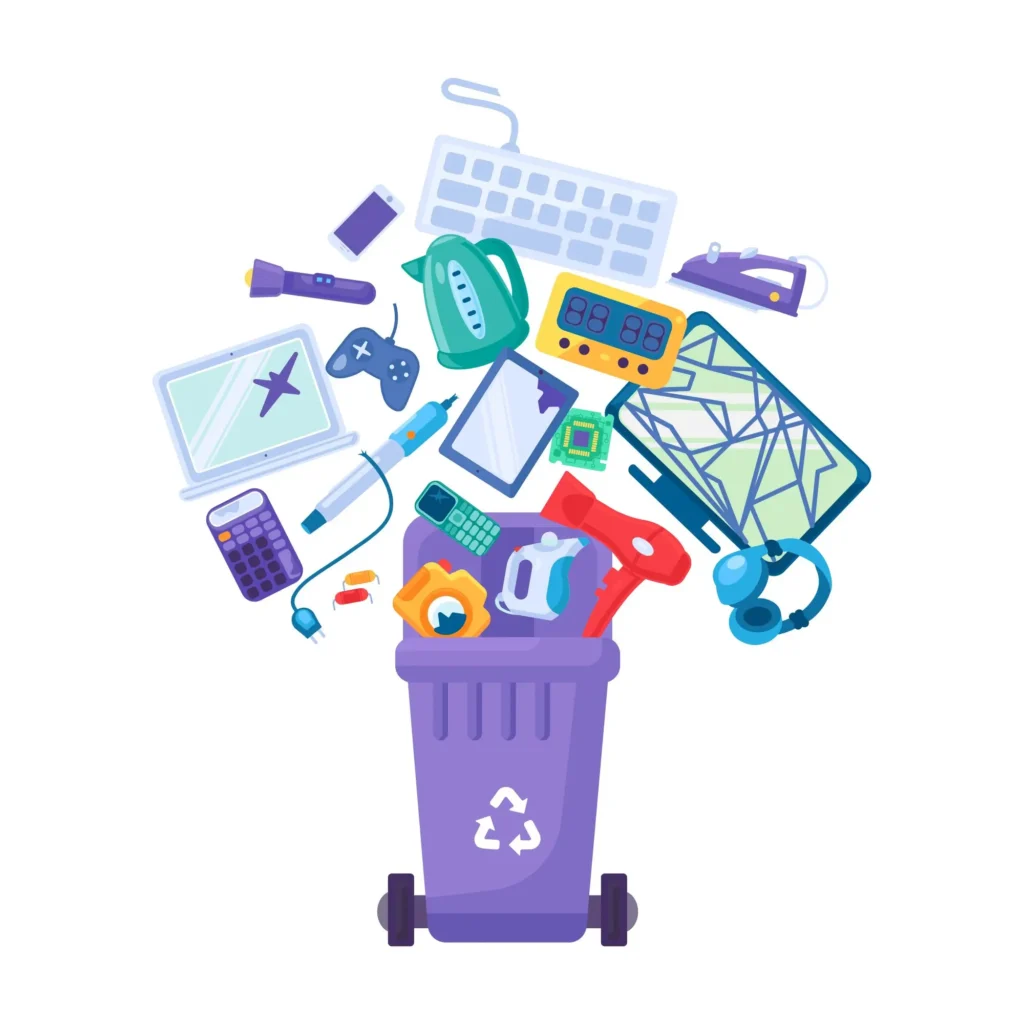
Simply put, EPR (Extended Producer Responsibility) means that the entity responsible for placing an electronic product into the market is also responsible for managing the product at the end of its life. This includes collecting, channelizing, and ensuring the safe disposal or recycling of e-waste generated from those products.
India is the third-largest generator of e-waste globally, producing over 4 million metric tonnes annually. With this scale, the government has tightened the EPR framework in 2022 and further refined compliance norms heading into 2026. Whether you are a startup launching a new gadget brand or a large-scale electronics manufacturer, you need to understand and complete your EPR Registration for E-Waste before you can legally operate.
Why EPR Registration for E-Waste Matters in 2026
The Indian electronics market is growing at a rapid pace. More products mean more e-waste. Improper disposal of e-waste — which contains toxic materials like lead, mercury, cadmium, and hexavalent chromium — poses severe health and environmental risks. That is exactly why the government has made EPR registration for e-waste mandatory and why CPCB has significantly strengthened enforcement in 2026.
Here are the core reasons why EPR compliance has become a business-critical priority:
Legal Mandate:
Selling or importing electronic products without valid EPR registration is a punishable offence under the Environment Protection Act, 1986. CPCB actively tracks unregistered entities.
Market Access:
Many B2B buyers, e-commerce platforms, and government procurement policies now require suppliers to hold a valid EPR Certificate before onboarding them.
Investor & ESG Compliance:
With ESG (Environmental, Social, Governance) reporting becoming mainstream in 2025–2026, having EPR compliance on record directly strengthens your sustainability score.
Avoid Penalties:
CPCB has increased scrutiny and show-cause notices for non-compliant PIBOs. Financial penalties can run into lakhs of rupees per day of non-compliance.
Who Needs to Apply for EPR Registration for E-Waste?
Not just manufacturers — a wide range of entities involved in the lifecycle of electronic equipment are legally required to obtain EPR registration for e-waste. The 2022 Rules define these clearly:
| Entity Type | Who They Are |
| Producer | Any company that manufactures electrical or electronic equipment (EEE) in India |
| Importer | Entities that import EEE or components for sale or use in India |
| Brand Owner (BO) | Companies that sell EEE in India under their own brand name |
| Refurbisher | Entities involved in refurbishing used EEE for resale |
| Dismantler | Facilities that dismantle e-waste to recover components or materials |
| Recycler | Authorized facilities that recycle e-waste in an environmentally sound manner |
| Producer Responsibility Organization (PRO) | Organizations that help PIBOs fulfill their EPR obligations collectively |
If you are a Producer Responsibility Organization (PRO), you facilitate EPR compliance for PIBOs. However, PROs themselves must also obtain separate registration from CPCB before they can operate.
E-Waste Product Categories Covered Under EPR
The E-Waste (Management) Rules, 2022 cover a broad spectrum of electrical and electronic equipment (EEE). Here are the major product categories for which EPR registration for e-waste applies:
- IT & Telecom Equipment — Computers, laptops, servers, mobile phones, printers, scanners
- Consumer Electrical & Electronics — Televisions, washing machines, refrigerators, air conditioners
- Lighting Equipment — Fluorescent lamps, LED bulbs, CFLs
- Electrical & Electronic Tools — Drills, saws, sewing machines, electric motors
- Medical Devices — Dialysis machines, MRI equipment, cardiology machines (select categories)
- Monitoring & Control Instruments — Smoke detectors, thermostats, heating regulators
- Automatic Dispensers — Vending machines, ATMs, point-of-sale terminals
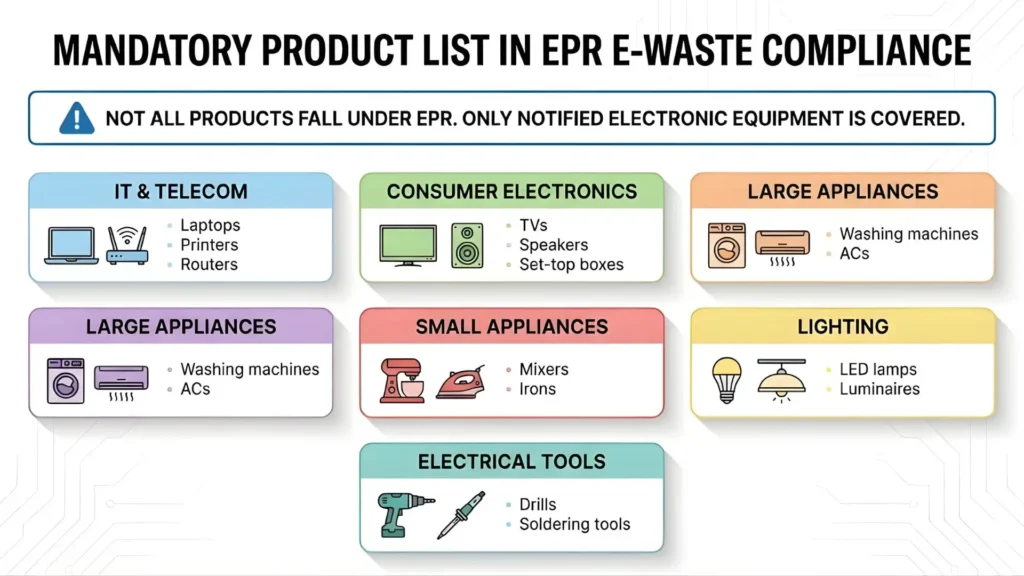
If your product falls under any of the above categories, EPR registration for e-waste is compulsory for you before you can sell in the Indian market.
EPR Registration for E-Waste: Step-by-Step Process (2026)
The EPR registration process for e-waste is entirely online, managed through the CPCB's dedicated EPR portal. Here is a clear, step-by-step breakdown to help you navigate the process without confusion:
| Step | Action | Details |
| 1 | Visit CPCB Portal | Go to https://eprewaste.cpcb.gov.in and create your account with valid credentials. |
| 2 | Choose Entity Type | Select your category: Producer, Importer, or Brand Owner (PIBO) or Refurbisher/Dismantler/Recycler (RD). |
| 3 | Upload Documents | Submit all required documents in prescribed format (PDF/JPG). Ensure clarity and completeness. |
| 4 | Pay Registration Fee | Complete the fee payment through the online portal. Keep the transaction ID for records. |
| 5 | Submit Application | Review all details carefully and submit. You will receive an acknowledgment number. |
| 6 | CPCB Review | CPCB reviews your application, verifies documents, and may request clarifications. |
| 7 | Certificate Issued | Once approved, your EPR Registration Certificate is issued digitally through the portal. |
| 8 | Set Annual Targets | After registration, set your annual collection and channelization targets as per CPCB norms. |
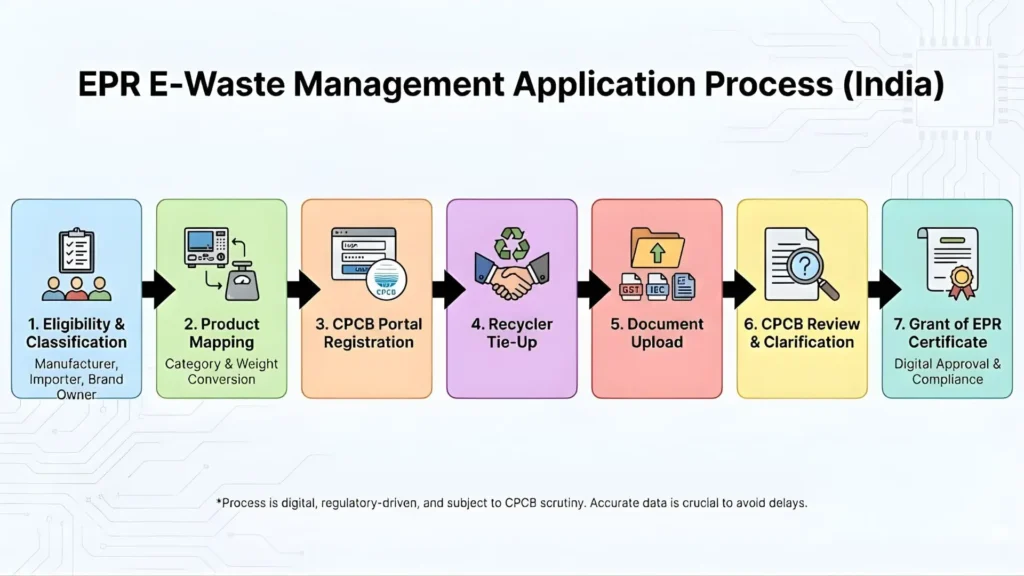
Timeline for EPR Registration
On average, EPR registration for e-waste takes 30 to 60 working days, provided all documents are in order and no clarifications are sought by CPCB. Applications with incomplete documentation or discrepancies can take longer. It is advisable to begin the registration process well in advance of your product launch or import date.
Documents Required for EPR Registration for E-Waste
Incomplete documentation is one of the most common reasons for delays or rejection of EPR registration applications. Here is a comprehensive list of documents you will need:
| Document Required | Applicable To |
| Certificate of Incorporation / Partnership Deed | All Entity Types |
| PAN Card of the Company / Firm | All Entity Types |
| GST Registration Certificate | All Entity Types |
| Authorized Signatory Details & ID Proof | All Entity Types |
| Factory License / Trade License | Producers, Importers |
| Details of Products Manufactured / Imported | Producers, Importers |
| Consent to Establish / Operate from State PCB | Dismantlers, Recyclers |
| List of Clients / OEMs (if applicable) | Dismantlers, Recyclers, Refurbishers |
| Site Plan / Layout of Facility | Dismantlers, Recyclers, Refurbishers |
| Technology / Process Description | Recyclers, Dismantlers |
| Previous Year E-Waste Collection Data (if renewal) | All Entity Types |
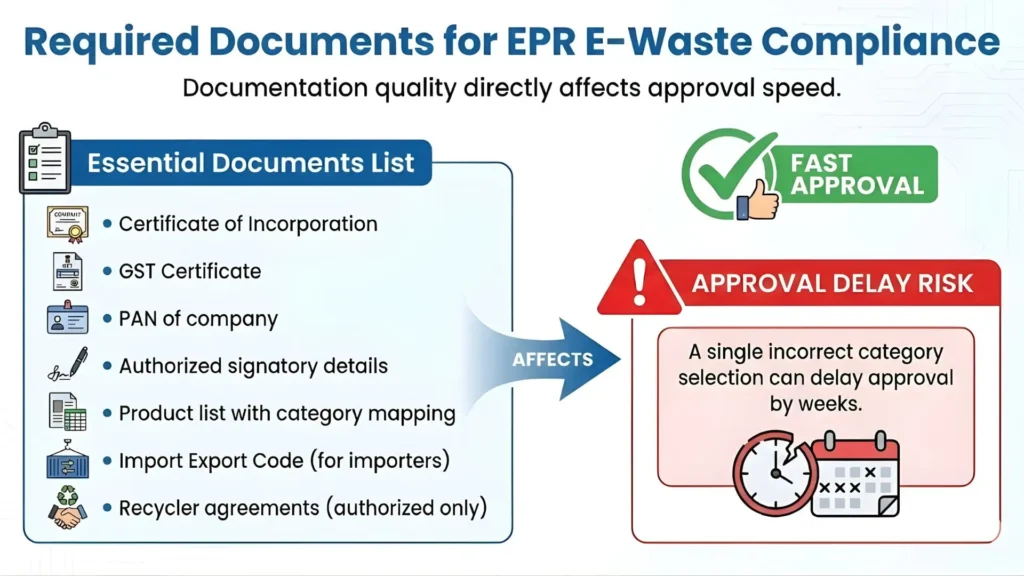
All documents must be self-attested and uploaded in clearly legible PDF or image format. Ensure that the name and details on all documents are consistent and match the entity applying for registration.
EPR Registration Fees for E-Waste in India (2026)
The registration fees for EPR under the e-waste framework are set by CPCB and are relatively nominal compared to the compliance benefits and legal protection they offer. Below are the approximate fees applicable in 2026:
| Entity Type | Approximate Fee (INR) | Validity |
| Producer / Importer / Brand Owner (PIBO) | Rs. 10,000 | 1 Year (Renewable) |
| Refurbisher | Rs. 5,000 | 1 Year (Renewable) |
| Dismantler | Rs. 5,000 | 1 Year (Renewable) |
| Recycler | Rs. 5,000 | 1 Year (Renewable) |
| Collection Center Authorization | As per State PCB norms | As notified |
| Renewal Fee | Same as registration fee | Annual |
Note: Fees are subject to revision by CPCB from time to time. Always verify the latest fee structure on the official CPCB EPR portal before making payment. Additionally, State Pollution Control Boards (SPCBs) may charge separate fees for collection centre authorizations.
EPR Targets: What You Need to Collect Every Year
One of the most important aspects of EPR registration for e-waste is understanding your annual collection targets. Under the E-Waste (Management) Rules, 2022, CPCB has mandated progressive collection targets for PIBOs:
- Collect at least 60% of the estimated e-waste generated from products sold in past years Year 1 (2023-24):
- Increase target to 70% of estimated e-waste generated Year 2 (2024-25):
- Achieve 80% collection — this is the target applicable for the current 2026 compliance cycle Year 3 (2025-26):
- 90% and above, progressing toward full circular economy goals Year 4 onwards:
Registered entities must file quarterly and annual returns on the CPCB EPR portal, reporting their actual e-waste collection and channelization figures. Shortfalls attract financial penalties. Surplus collection can be traded as EPR credits on the CPCB's EPR exchange.
EPR Credits and the E-Waste Exchange — New in 2026
One of the most significant innovations introduced under the revised E-Waste (Management) Rules, 2022 is the concept of EPR certificates (credits). Here is how it works:
- Recyclers and dismantlers generate EPR credits for every tonne of e-waste they process safely and in an environmentally sound manner.
- PIBOs (Producers, Importers, Brand Owners) can purchase these EPR credits on the CPCB's centralized EPR exchange portal to fulfill their annual collection targets.
- This creates a market-based mechanism where registered recyclers are financially incentivized to process more e-waste.
- In 2026, CPCB has introduced stricter verification requirements for EPR credit generation, including geo-tagged facility photos and third-party audits.
This EPR certificate exchange system makes EPR registration for e-waste not just a compliance requirement but also a business opportunity for the formal recycling sector.
Penalties for Non-Compliance with EPR Registration for E-Waste
If you think you can skip EPR registration for e-waste and get away with it, the 2026 enforcement landscape says otherwise. CPCB has significantly ramped up compliance monitoring, including surprise inspections, portal-based tracking, and inter-agency data sharing with customs and GST departments. Here is what non-compliance costs you:
| Violation / Non-Compliance | Penalty / Consequence |
| Failure to Register under EPR | Up to Rs. 1 Lakh per day of default + Closure notice |
| Not Meeting Annual EPR Targets | Financial penalty linked to the shortfall in collection targets |
| Non-Submission of Annual Returns | Rs. 10,000 per month penalty + cancellation of certificate risk |
| Selling e-waste to unauthorized dismantlers | Criminal prosecution under Environment Protection Act 1986 |
| Providing False Information to CPCB | Suspension / Cancellation of EPR Certificate |
Beyond financial penalties, non-compliance can result in reputational damage, loss of import licenses, and inability to participate in government tenders. The cost of non-compliance far exceeds the effort of getting registered.
Key 2026 Updates to EPR Registration for E-Waste
The EPR framework is evolving rapidly. Here are the most significant updates and developments shaping EPR registration for e-waste in 2026 that every business should be aware of:
Mandatory Digital Filing:
All quarterly and annual EPR returns must now be filed digitally on the CPCB portal. Physical submissions are no longer accepted from FY 2025-26 onwards.
Stricter EPR Target Verification:
CPCB has introduced real-time weight-slip integration for recyclers and dismantlers. PIBOs will only get credit for verified and audited e-waste processing.
EPR Credit Expiry Policy:
EPR credits generated in a financial year now have a validity of two financial years. Unused credits beyond this period will lapse, encouraging consistent and planned e-waste collection.
Interoperability with BIS & Customs:
From 2026, CPCB is linking EPR registration data with BIS (Bureau of Indian Standards) and Customs databases. Products without valid EPR registration may face import clearance issues.
Extended Coverage to Solar PV and Batteries:
Solar photovoltaic modules and lithium-ion batteries are now included under the e-waste EPR framework through separate but linked rules, expanding the scope significantly.
Increased PRO Accountability:
Producer Responsibility Organizations are now required to submit audited reports and face direct CPCB scrutiny for any shortfall in targets achieved on behalf of their enrolled PIBOs.
Conclusion: Get Your EPR Registration for E-Waste Done Right in 2026
EPR Registration for E-Waste is no longer just a regulatory checkbox — it is a foundational element of responsible business in India's electronics sector. As enforcement tightens and the EPR ecosystem matures in 2026, being registered, compliant, and actively meeting your targets puts you ahead of the curve.
Whether you are a large electronics manufacturer, a small gadget importer, or a recycler looking to generate EPR credits, understanding the EPR registration process end-to-end is critical to avoiding penalties and contributing to India's e-waste management goals.
Take action today. Visit the official CPCB EPR portal, gather your documents, and begin your EPR Registration for E-Waste process. If you need expert assistance with documentation, target management, or annual compliance, partner with a CPCB-registered PRO to make the process seamless and stress-free.
Frequently Asked Questions
Is EPR registration for e-waste mandatory for small businesses and startups?
Yes. The E-Waste (Management) Rules, 2022 do not have a turnover-based exemption. Any entity that manufactures, imports, or sells EEE in India — regardless of size — must obtain EPR registration for e-waste. However, small businesses can partner with a registered PRO to manage target fulfillment more easily.
How long does it take to get an EPR certificate?
Typically, 30 to 60 working days from the date of complete application submission. If CPCB requests additional information or clarification, this timeline may extend. Ensure all documents are complete and consistent to avoid delays.
Can I sell my products while my EPR registration is being processed?
Strictly speaking, EPR registration should be in place before commencing sales or imports. However, many businesses begin the registration process as soon as they apply. CPCB may issue show-cause notices for sales made before registration is obtained. Seek legal advice if you are in this situation.
What happens if I miss my annual EPR target?
If you fall short of your annual e-waste collection target, CPCB will levy a financial penalty based on the shortfall. The shortfall must be covered in subsequent years along with the current year's target. Repeated non-achievement can result in suspension of your EPR certificate.
What is a Producer Responsibility Organization (PRO) and do I need one?
A PRO is a CPCB-registered body that helps PIBOs meet their EPR obligations. If you do not have the infrastructure to set up your own collection and channelization network, partnering with a PRO is the most practical option. The PRO then reports on your behalf and manages recycler partnerships.
Is EPR registration for e-waste the same as BIS registration?
No. BIS (Bureau of Indian Standards) registration is about product quality and safety standards. EPR registration for e-waste is about end-of-life management. Many electronic products need both BIS certification and EPR registration — they are separate, complementary compliance requirements.
How do I renew my EPR registration?
EPR registration is typically valid for one year and must be renewed annually before expiry. The renewal process involves submitting updated documents, paying the renewal fee, and filing your previous year's annual return on the CPCB portal. It is advisable to initiate renewal at least 60 days before expiry.