- Covers every battery chemistry: Lead-acid, lithium-ion, nickel-cadmium, EV, portable, automotive, and industrial batteries are all regulated under the same Battery Waste Management Rules, 2022 framework, regardless of shape, weight, or use.
- Targets get steeper through 2030-31: EV and portable batteries must hit 90% material recovery by 2026-27, and producers must use a minimum share of recycled material in new batteries, rising from 5% in 2027-28 to 20% by 2030-31.
- 2025 amendment made labelling mandatory: Since 24 February 2025, producers must print a QR code or barcode carrying their EPR registration number on the battery, pack, or packaging.
- Shortfalls are covered through EPR certificates: Producers who miss their annual target can buy EPR certificates from registered recyclers or refurbishers through the CPCB portal to close the gap, plus a 10% penalty margin on the current year's liability.
Introduction
EPR Registration for Battery Waste is a mandatory CPCB registration under the Battery Waste Management Rules, 2022, requiring every producer, importer, refurbisher, and recycler of batteries — lead-acid, lithium-ion, EV, portable, automotive, or industrial — to register on the centralized CPCB battery EPR portal.

Registered producers must meet annual collection, recycling, and recycled-material targets set out in Schedule II, file an EPR Action Plan by 30 June each year, and either meet targets directly or buy EPR certificates from recyclers to cover any shortfall. The Battery Waste Management (Amendment) Rules, 2025 added mandatory QR code/barcode labelling carrying the EPR registration number.
What Is EPR Certification for Battery Waste?
EPR Registration for Battery Waste is the mandatory Central Pollution Control Board (CPCB) registration that every producer, importer, refurbisher, and recycler of batteries in India must obtain under the Battery Waste Management Rules, 2022. Notified by the Ministry of Environment, Forest and Climate Change (MoEFCC) on 22 August 2022, these rules replaced the older Batteries (Management and Handling) Rules, 2001 and extended coverage well beyond lead-acid batteries to include lithium-ion, nickel-cadmium, portable, automotive, industrial, and electric vehicle (EV) batteries — essentially every battery chemistry, shape, weight, and application sold in India.
Under Extended Producer Responsibility, the producer that places a battery in the market stays responsible for what happens to it at end of life. That means registering with CPCB, declaring collection and recycling targets, submitting a yearly EPR Action Plan, and either meeting those targets through your own or partnered recycling infrastructure, or making up any shortfall by purchasing EPR certificates.
Registration happens on the centralized CPCB EPR portal for battery waste, which is separate from the portals used for plastic, e-waste, tyre, and used oil EPR, although CPCB's Single Sign-On at epr.cpcb.gov.in now links all five together for businesses that need more than one category.
Why Battery EPR Registration Matters in 2026
- It's a hard legal requirement, not a suggestion: Selling batteries without valid EPR Registration is a violation of the Environment (Protection) Act, 1986, and non-registration attracts Environmental Compensation.
- EV growth is driving stricter enforcement: As India's EV and energy-storage sectors expand, CPCB has sharpened its focus on lithium-ion battery recovery, recycled-material sourcing, and e-commerce accountability.
- Labelling is now checked at the product level: Since the 2025 amendment, your EPR registration number effectively has to be visible on the product itself through a QR code or barcode — making non-compliance far easier for regulators to spot.
- Recycled-content targets start soon: With the minimum recycled-material mandate beginning in FY 2027-28, producers who haven't secured recycler partnerships now may struggle to meet sourcing requirements later.
- Marketplace and OEM scrutiny: E-commerce platforms and vehicle/electronics OEMs increasingly ask battery suppliers for proof of valid EPR Registration before onboarding.
Who Needs EPR Certification for Battery Waste?
The Battery Waste Management Rules, 2022 apply to every entity in the battery value chain, not just manufacturers. You likely need to register if you are one of the following:
- Producers (manufacturers and importers): Anyone manufacturing, assembling, or importing batteries — standalone or built into equipment, vehicles, or electronics — for sale in India.
- Brand owners: Companies that sell batteries or battery-powered products under their own brand, even if manufactured by a third party.
- Refurbishers: Entities that recondition or extend the life of used batteries, including those exploring second-life applications such as stationary energy storage.
- Recyclers: Facilities that dismantle and process waste batteries to recover materials like lead, lithium, cobalt, nickel, plastics, and glass, and generate EPR certificates in return.
- E-commerce platforms and service providers: Recent regulatory guidance extends certain obligations to e-commerce entities and battery-related service providers involved in the supply chain.
Registration applies regardless of battery chemistry or end-use — lead-acid automotive batteries, lithium-ion batteries in laptops and phones, EV traction batteries, and industrial batteries used in telecom or power backup all fall under the same rules.
Battery EPR Targets: What Schedule II Requires
Collection, recycling, and recycled-material targets are laid out in Schedule II of the Battery Waste Management Rules, 2022, and they get progressively stricter through 2030-31:
| Battery Type | Target | Timeline |
| EV & Portable Batteries | Material recovery increasing to 90% | By 2026-27 |
| Automotive & Industrial Batteries | Material recovery increasing to 60% | By 2026-27 |
| EV Batteries — Collection | 70% collection of EV batteries placed in market | By 2027-28 |
| EV Batteries — Recovery | Rises from 70% to 90% of dry weight | 2024-25 to 2026-27 |
| Minimum Recycled Material in New Batteries | Starts at 5%, rises to 20% | FY 2027-28 to FY 2030-31 |
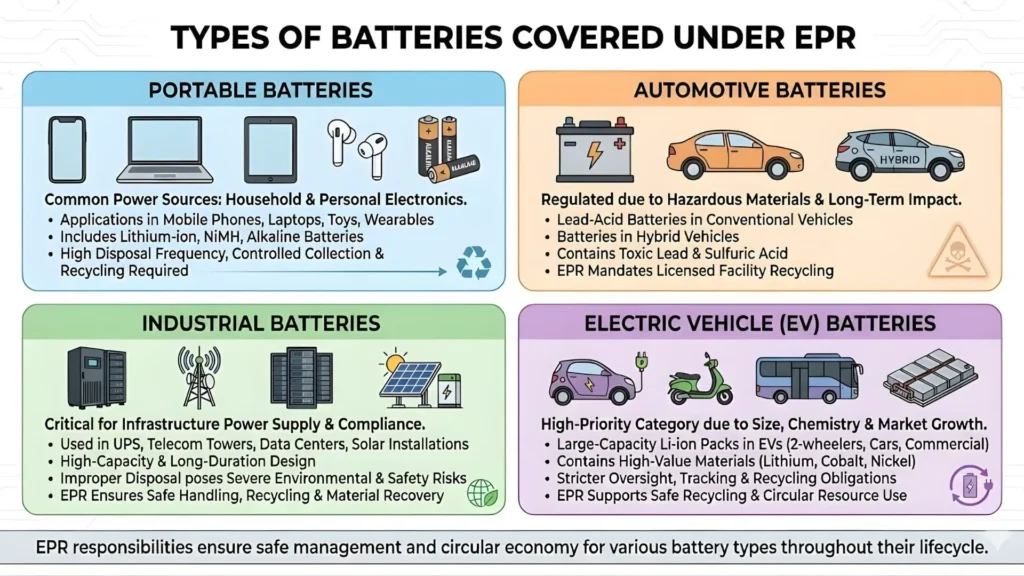
Recycling, under these Rules, specifically means recovering battery materials such as lead, lithium, nickel, cobalt, plastics, rubber, and glass — not simply collecting waste batteries. Producers must also ensure collected batteries are sent only for recycling or refurbishment, never for landfilling or incineration.
Latest Battery EPR Notifications & Updates (2024–2026)
Battery Waste Management (Amendment) Rules, 2025
Notified on 24 February 2025 (S.O. 958(E)) and effective immediately, this is the most significant recent update. Producers must now print a barcode or QR code carrying their EPR registration number on the battery or battery pack, the equipment containing it, or its packaging — with the EPR registration number also required on the product information brochure. Producers can alternatively comply by submitting written information to CPCB, which maintains a centralized, quarterly-updated public list of compliant producers.
The amendment also exempted marking of the 'Cd' or 'Pb' chemical symbols where cadmium content is 0.002% (20 ppm) or lead content is 0.004% (40 ppm) or below by weight, and clarified that certain packaging obligations don't apply to packaging already covered under Rule 26 of the Legal Metrology (Packaged Commodities) Rules, 2011.
Environmental Compensation Guidelines for Battery Waste (September 2024)
CPCB issued detailed EC guidelines on 10 September 2024, clarifying how environmental compensation is calculated for producers and recyclers who fail to meet their EPR obligations — based on the cost of collection, handling, transportation, and material-recovery processing for the shortfall quantity.
Labelling Requirements and Recycled Material Notice (May 2024)
A CPCB notice dated 17 May 2024 set out detailed labelling requirements and recycled-material declaration norms that producers needed to align with ahead of the 2025 amendment.
Annual Return Filing Extensions (2024–2025)
CPCB has periodically extended annual return deadlines to give producers more time to reconcile sales and recycling data — including an extension for FY 2024-25 annual returns to 30 September 2025, and an earlier extension for producers up to 31 March 2025. These extensions are announced on the battery EPR portal itself, so it's worth checking there each filing season rather than assuming a fixed date.
Second-Life Battery Recognition
Several industry compliance guides note that the current regulatory direction increasingly recognises second-life applications — such as using retired EV batteries for stationary energy storage — as a legitimate stage before final recycling, provided refurbishers handling these batteries are properly registered on the CPCB portal.
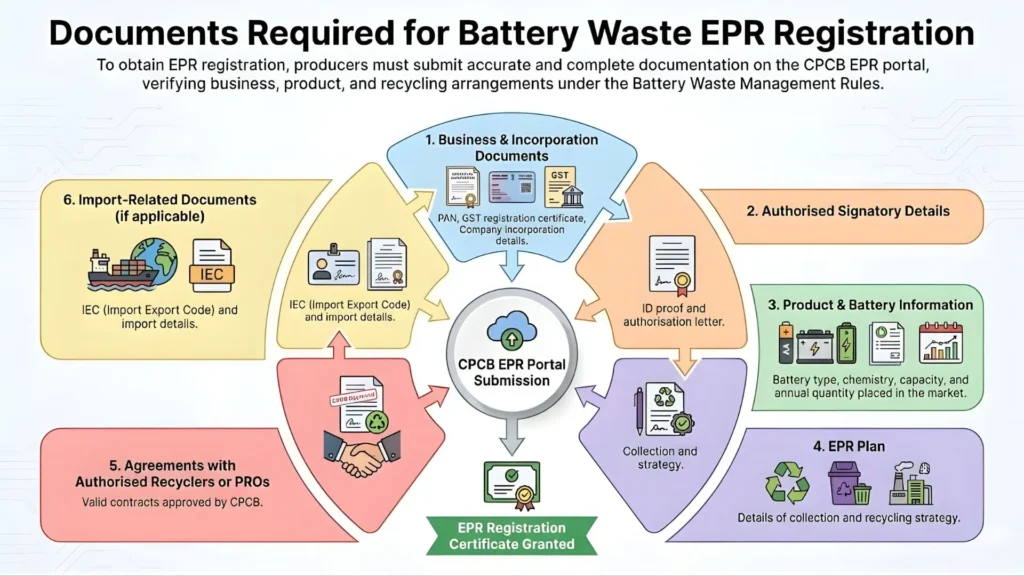
Documents Required for Battery EPR Registration
- Certificate of Incorporation, PAN, and GST registration certificate
- Authorized signatory's ID proof and a board resolution or authorization letter
- Registered office and manufacturing/import facility address proof
- Battery chemistry and type declaration for every product line (lead-acid, lithium-ion, EV, portable, automotive, industrial)
- Previous financial year's sales, production, or import volume data, by battery type and dry weight
- EPR Action Plan (Form 1(C)) detailing collection, recycling, and refurbishment mechanisms and recycler/refurbisher tie-ups
- Recycler or refurbisher registration proof, for entities registering on the processing side
- SPCB/PCC hazardous-waste handling authorization, for recyclers specifically
- Labelling compliance documentation confirming QR code/barcode implementation as per the 2025 amendment
Step-by-Step EPR Registration Process for Battery Waste
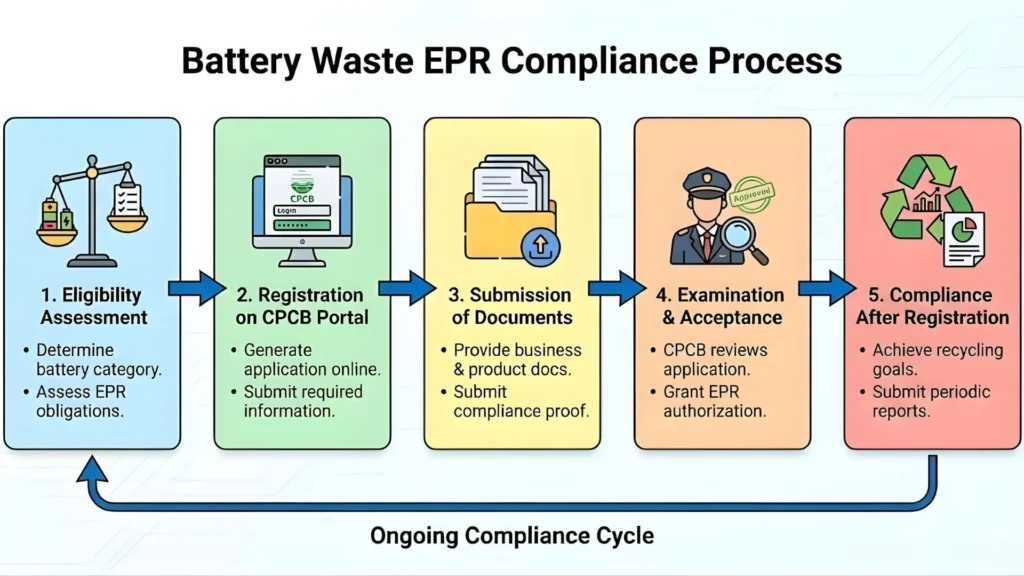
- Identify your role: Determine whether you're registering as a Producer/Importer, Refurbisher, or Recycler — each has a slightly different application path on the portal.
- Register on the CPCB battery EPR portal: Producers register centrally with CPCB; recyclers and refurbishers must also register with their concerned SPCB/PCC through the same centralized system.
- Declare battery chemistry and volumes: Enter chemistry-wise sales, production, or import data, since your targets are calculated from this by battery type and dry weight.
- Submit Form 1(C) — your EPR Action Plan: Detail how you'll meet your collection, recycling, and recycled-material targets, including named recycler or refurbisher partnerships.
- Upload supporting documents and pay the fee: Complete document upload and fee payment through the portal's integrated gateway.
- CPCB/SPCB review: The authority verifies your application; recyclers may need to additionally demonstrate hazardous-waste handling compliance.
- Receive your EPR Certificate: Once approved, your Battery EPR Registration becomes visible on the CPCB portal's public dashboard.
- File your Annual Return and Action Plan every year: Producers must submit a fresh EPR Action Plan by 30 June each year for the battery volumes manufactured in the preceding financial year, and file annual returns showing target achievement.
EPR Certificates & Credit Trading for Battery Waste
Recyclers and refurbishers generate EPR certificates for the batteries they process, based on the weight processed, the percentage of material-recovery targets fulfilled, and the geographical source of the battery. Producers who fall short of their own annual target can purchase these certificates through the CPCB portal's exchange mechanism to close the gap.
Industry compliance trackers report EPR certificates trading in a broad range depending on battery chemistry — lead-acid recovery credits, for instance, tend to be priced differently from lithium-ion recovery credits given the different material values and recovery costs involved. If a producer remains in deficit after purchasing available certificates, the shortfall calculation typically adds a 10% penalty margin on top of the current year's liability, in addition to any leftover liability carried from previous years.
EPR Registration Fees for Battery Waste
CPCB sets battery EPR fees separately for producers/manufacturers and for recyclers/refurbishers, with processing entities typically tiered by their registered recycling or refurbishment capacity. Because fee tables are revised periodically, always confirm the current schedule on the CPCB battery EPR portal before making payment.
| Applicant Type | Fee Basis |
| Producers / Manufacturers / Importers | Based on company scale and battery category/volume introduced in the market |
| Recyclers | Tiered by registered recycling capacity (tonnes per annum) |
| Refurbishers | Tiered by refurbishment capacity and battery type handled |
Validity, Renewal & Annual Filing Timeline
- EPR Registration for battery producers, recyclers, and refurbishers remains active on an ongoing basis, subject to periodic renewal and continuous compliance filing
- A fresh EPR Action Plan (Form 1(C)) must be submitted by 30 June every year, covering battery volumes from the preceding financial year
- Annual returns confirming target achievement are due after the financial year closes, though CPCB has periodically extended these deadlines — recent examples include extensions to 30 September 2025 for FY 2024-25 returns
- Typical CPCB review and approval for new applications runs 15–40 working days for complete submissions
Benefits of EPR Registration for Battery Waste
- Legal and reputational protection: Avoids Environmental Compensation, registration cancellation, and potential prosecution under the Environment (Protection) Act.
- Access to the EPR credit market: Recyclers and refurbishers that exceed material-recovery targets can generate and sell surplus EPR certificates as an additional revenue stream.
- Smoother OEM and marketplace onboarding: A valid, portal-visible EPR Certificate is increasingly a precondition for battery suppliers working with EV manufacturers, electronics OEMs, and e-commerce platforms.
- Future-proofing for recycled-content rules: Producers who build recycler relationships now are better positioned to meet the FY 2027-28 minimum recycled-material mandate without scrambling later.
- Stronger ESG and circular-economy credentials: Documented battery EPR compliance strengthens sustainability reporting for companies in the EV, electronics, and energy-storage sectors.
Common Mistakes That Delay Battery EPR Registration
- Under-declaring battery volumes or dry weight, creating mismatches with GST and sales records
- Submitting a vague EPR Action Plan without named recycler or refurbisher partnerships
- Missing the 30 June annual Action Plan deadline for the preceding financial year's battery volumes
- Overlooking the 2025 amendment's QR code/barcode labelling requirement until close to an audit or marketplace review
- Registering only as a producer when the business also refurbishes or recycles batteries in-house, requiring a separate registration
- Assuming EPR certificates alone can cover a large shortfall without checking current market availability by battery chemistry
How Silvereye Certifications Helps with Battery EPR Registration
Silvereye Certifications is a regulatory compliance consultancy supporting Indian and international businesses with BIS, CDSCO, WPC-ETA, TEC/MTCTE, and EPR Authorization, among other approvals. For EPR Registration for Battery Waste specifically, Silvereye Certifications helps producers, importers, refurbishers, and recyclers with:
- Assessing which battery chemistries and product lines require registration
- Preparing and filing Form 1(C) and the annual EPR Action Plan in a CPCB-aligned format
- Setting up recycler and refurbisher tie-ups to support realistic, achievable targets
- Guiding QR code/barcode labelling compliance under the 2025 amendment
- Managing annual return filing and tracking deadline extensions announced on the CPCB portal
- Advising on EPR certificate purchases to cover target shortfalls before compensation liability is triggered
Since Silvereye Certifications also manages BIS, CDSCO, WPC, and TEC/MTCTE approvals, EV and electronics companies that need battery EPR alongside other product certifications can handle related compliance requirements through a single consultancy relationship.
Conclusion
EPR Registration for Battery Waste has moved well beyond its lead-acid battery origins into a comprehensive framework covering every chemistry from lithium-ion to EV traction batteries. With material-recovery targets climbing steadily through 2030-31, mandatory QR-code labelling now in effect since the 2025 amendment, and recycled-content requirements arriving in FY 2027-28, producers who build strong recycler and refurbisher partnerships early will have a real compliance and cost advantage over those scrambling to catch up.
If you'd rather have registration, Action Plan filing, labelling compliance, and annual returns handled by specialists, Silvereye Certifications supports EPR Registration for Battery Waste from first application through renewal.
Frequently Asked Questions
Who needs EPR Registration for Battery Waste?
Every producer, importer, brand owner, refurbisher, and recycler dealing in batteries — lead-acid, lithium-ion, nickel-cadmium, portable, automotive, industrial, or EV — must register under the Battery Waste Management Rules, 2022, regardless of company size.
What is the EPR target for lithium-ion batteries?
EV and portable batteries, which include most lithium-ion applications, must achieve increasing material recovery targets rising to 90% by 2026-27 under Schedule II of the Rules.
What is Form 1(C) in battery EPR registration?
It's the prescribed EPR Action Plan format producers submit to CPCB, detailing the quantity, weight, and dry weight of battery materials (nickel, cobalt, lead, lithium, plastics, and others) manufactured in the preceding financial year, and how collection/recycling targets will be met.
What happens if I miss my battery EPR target?
You become liable for Environmental Compensation based on the shortfall quantity, or you can purchase EPR certificates from recyclers/refurbishers to cover the gap — typically at your current year's deficit plus any leftover prior liability, plus a 10% penalty margin.
What changed in the Battery Waste Management Amendment Rules, 2025?
Producers must now print a QR code or barcode carrying their EPR registration number on the battery, pack, equipment, or packaging, with an alternative compliance route through written CPCB submission, plus new exemptions for low-concentration cadmium and lead marking.
When must the annual EPR Action Plan be submitted?
By 30 June each year, covering the batteries manufactured or imported in the preceding financial year.
Do e-commerce platforms need battery EPR registration?
Recent regulatory guidance extends certain obligations to e-commerce entities and battery-related service providers in the supply chain, so platforms selling batteries or battery-powered products should assess their specific obligations.
What is an EPR certificate in the battery waste context?
It's a certificate generated by a registered recycler or refurbisher when they process waste batteries, based on weight processed and target fulfilment. Producers can buy these certificates to meet their own EPR obligations if they fall short.
Are automotive and industrial batteries held to the same targets as EV batteries?
No. Automotive and industrial batteries have a separate, somewhat lower material-recovery target (increasing to 60% by 2026-27) compared to EV and portable batteries (increasing to 90% by 2026-27).
When does the recycled-material requirement for new batteries start?
Producers must begin incorporating a minimum share of domestically recycled materials starting at 5% in FY 2027-28, rising to 20% by FY 2030-31.
What penalties apply to recyclers who don't meet their obligations?
Recyclers can face Environmental Compensation, cancellation of their CPCB registration, or prosecution under Section 15 of the Environment (Protection) Act, 1986, which can include imprisonment of up to five years, a fine, or both.