
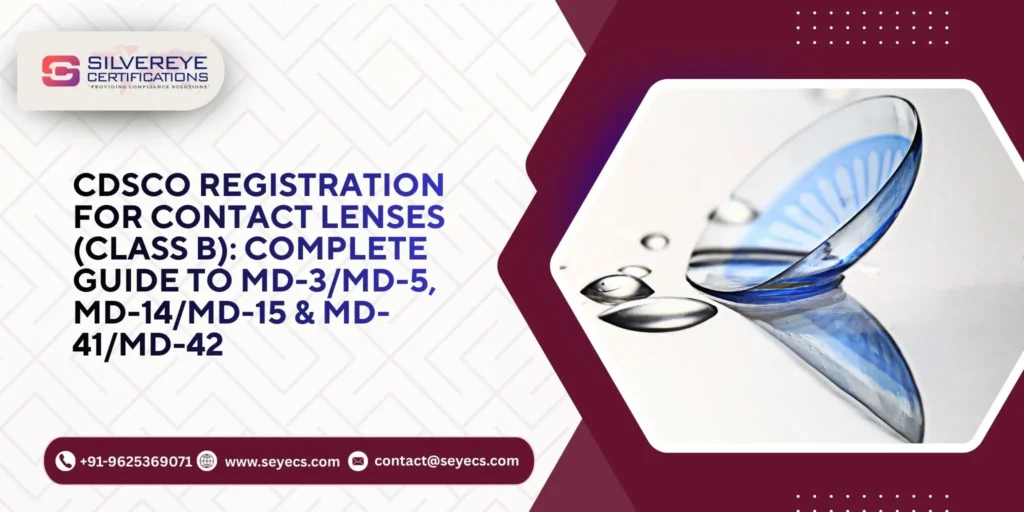
- Contact lenses are classified as a Class B medical device under Schedule III of MDR 2017, so CDSCO registration is mandatory before manufacture, import, or sale in India.
- Indian manufacturers apply through Form MD-3 and receive the MD-5 manufacturing license from the State Licensing Authority.
- Importers must file Form MD-14 and obtain the MD-15 import license from the Central Licensing Authority (DCGI) at CDSCO.
- Wholesalers and distributors need Form MD-41 application and MD-42 grant of license from the State Licensing Authority before stocking or supplying contact lenses.
Introduction
CDSCO registration for contact lenses is mandatory because contact lenses are notified as a Class B medical device under the Medical Device Rules, 2017. Indian manufacturers need Form MD-3 application and MD-5 grant of license from the State Licensing Authority. Importers require Form MD-14 application and MD-15 grant of license from CDSCO's Central Licensing Authority (DCGI), filed on the Sugam portal.
Wholesalers and distributors need Form MD-41 application and MD-42 grant of license. Manufacturing and wholesale licenses are valid for 5 years, while the import license remains valid on an ongoing basis subject to a five-yearly retention fee.
What Is CDSCO Registration for Contact Lenses?
CDSCO registration for contact lenses is the regulatory approval that a manufacturer, importer, or wholesale distributor must obtain from the Central Drugs Standard Control Organisation (CDSCO) before contact lenses can be legally manufactured, imported, sold, or distributed anywhere in India. CDSCO operates under the Ministry of Health and Family Welfare and regulates every notified medical device — including ophthalmic devices such as contact lenses — through the Medical Device Rules, 2017 (MDR 2017).
Because contact lenses sit directly on the cornea and involve extended contact with a sensitive body tissue, they cannot be treated as a general consumer product. CDSCO registration confirms that the material, manufacturing process, packaging, and labelling of the contact lens meet India's safety and quality benchmarks before the product reaches an optician, hospital, or end consumer.
Why Contact Lenses Are Classified as a Class B Medical Device
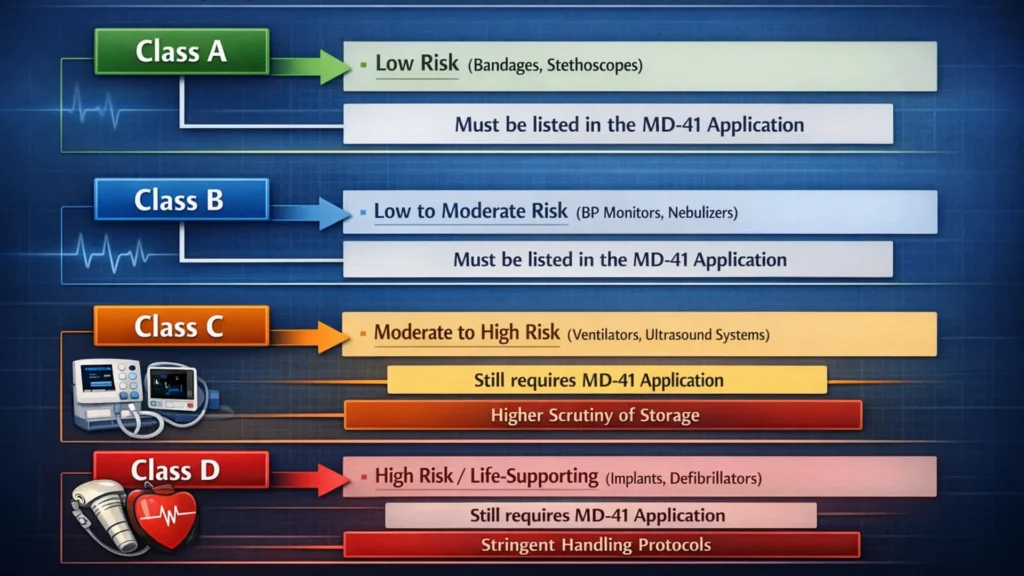
Under Schedule III of MDR 2017, medical devices are grouped into four risk-based classes — A, B, C, and D — depending on intended use, duration of body contact, degree of invasiveness, and potential systemic effect. Contact lenses fall under Class B (low-to-moderate risk) because they are worn directly on the cornea for corrective or therapeutic purposes and involve short-to-medium-term surface contact with living tissue, which carries more risk than a purely external device like a spectacle frame but far less than an implantable device.
| Class | Risk Level | Example Ophthalmic Devices |
| Class A | Low risk | Spectacles, trial lens sets, visual charts |
| Class B | Low-to-moderate risk | Contact lenses, corneal instruments, ophthalmic tonometers |
| Class C | Moderate-to-high risk | Intraocular implants, ophthalmic laser systems |
| Class D | Highest risk | Aqueous/vitreous humour replacement medium kit |
Who Needs CDSCO Registration for Contact Lenses?
Every business activity in the contact lens supply chain — manufacturing, importing, or wholesale distribution — needs its own separate CDSCO license, even if the same company performs more than one activity.
| Business Activity | Application Form | License Form | Licensing Authority |
| Manufacturing in India | MD-3 | MD-5 | State Licensing Authority (SLA) |
| Import from abroad | MD-14 | MD-15 | Central Licensing Authority (DCGI, CDSCO) |
| Wholesale / Distribution | MD-41 | MD-42 | State Licensing Authority (SLA) |
Manufacturing License for Contact Lenses: MD-3 Application & MD-5 Grant of License
Indian manufacturers who produce contact lenses domestically must obtain a manufacturing license under Form MD-5 by submitting Form MD-3 to the State Licensing Authority (SLA) — typically the State Drug Controller — of the state where the manufacturing unit is located. Since contact lenses are Class B, this falls under the lighter of the two manufacturing pathways (MD-3/MD-5), unlike Class C or D devices that require Form MD-7.
Who Grants the MD-5 License for Contact Lenses?
The State Licensing Authority of the state where the manufacturing facility operates grants the MD-5 license. This is a state-level jurisdiction because contact lenses are Class B — Class C and D devices are instead handled centrally by the DCGI.
Eligibility for MD-3 / MD-5 Application
- The applicant must be a legally incorporated manufacturing entity with a physical facility in India.
- The manufacturing site must have a documented quality management system covering material sourcing, moulding or lathe-cutting, sterilization, and packaging.
- A qualified technical staff member responsible for quality control must be designated.
- The device must conform to relevant IS/ISO standards applicable to soft or rigid contact lens materials.
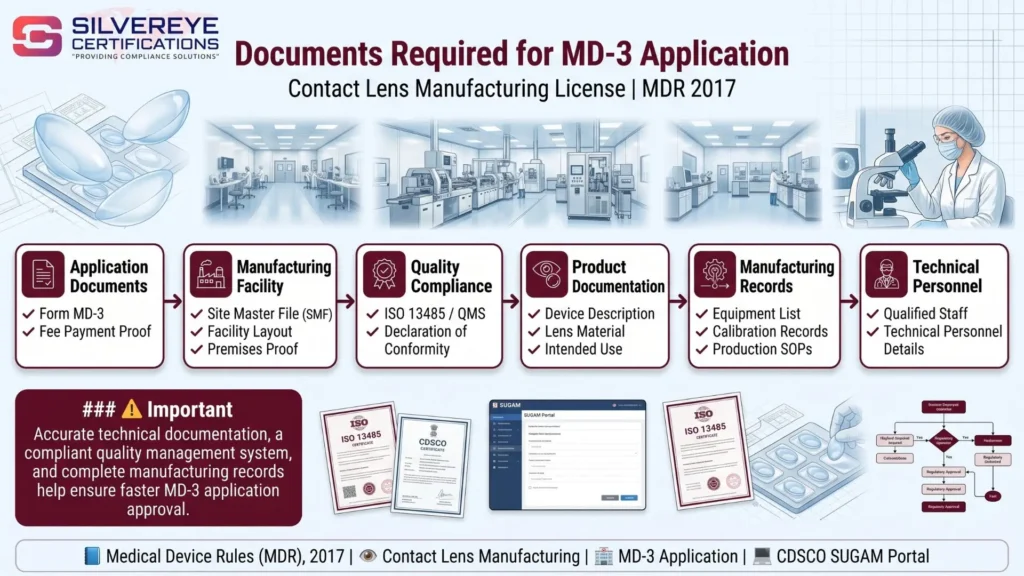
Documents Required for MD-3 Application (Contact Lens Manufacturing)
- Completed Form MD-3 application on the CDSCO Sugam portal
- Site Master File (SMF) with facility layout and floor plan
- Quality Management System documentation — ISO 13485 certificate if available, or an equivalent QMS record
- Device description covering lens material (hydrogel, silicone hydrogel, RGP, etc.), design, and intended use
- Declaration of conformity referencing the applicable IS/ISO standard for contact lenses
- Proof of ownership or lease of the manufacturing premises
- Details of key technical personnel and their qualifications
- List of manufacturing equipment with calibration records
- Standard Operating Procedures for lens production, sterilization, and packaging
- Fee payment challan or online payment confirmation
MD-3 / MD-5 Fee Schedule for Contact Lenses (Class B)
| Fee Head | Approximate Amount |
| MD-3 application fee (one device category) | ₹3,000 |
| MD-3 application fee (2–10 device categories) | ₹3,000 + ₹1,000 per additional category |
| MD-5 license grant fee | ₹1,500 per device |
Fees are notified under the MDR 2017 Fourth Schedule and are subject to periodic revision — always verify the current rate on cdsco.gov.in before submitting payment.
MD-3 / MD-5 Processing Timeline
A complete, deficiency-free MD-3 application for a Class B device like contact lenses is typically processed within 30 to 90 days, including a facility inspection by the SLA before the license is granted.
Import License for Contact Lenses: MD-14 Application & MD-15 Grant of License
Any company that wants to import contact lenses manufactured outside India must obtain an import license under Form MD-15 by filing Form MD-14 with the Central Licensing Authority — the Drug Controller General of India (DCGI) — through the CDSCO Sugam portal. This applies whether the lenses are daily disposable soft lenses, coloured cosmetic lenses, toric lenses, or rigid gas-permeable lenses, since all fall under the same Class B notification.
Who Can Apply for the MD-14 Import License?
The applicant must be an Indian Authorised Agent appointed by the foreign contact lens manufacturer — either the Indian importer itself or a distributor already holding a valid wholesale license (MD-42) or manufacturing license in India. A foreign manufacturer cannot apply to CDSCO directly.
Key Conditions Before Filing MD-14
- The Indian importing entity must be a legally incorporated company registered in India
- The foreign manufacturer must hold a valid manufacturing authorization or equivalent approval in its home country
- The contact lens should ideally be approved in a Reference Country — such as US FDA, EU CE, TGA Australia, Health Canada, or PMDA Japan
- A Free Sale Certificate (FSC) or CE Certificate from the country of origin is generally required
- A Power of Attorney or authorization letter from the foreign manufacturer to the Indian importer must be submitted, apostilled or notarized as applicable
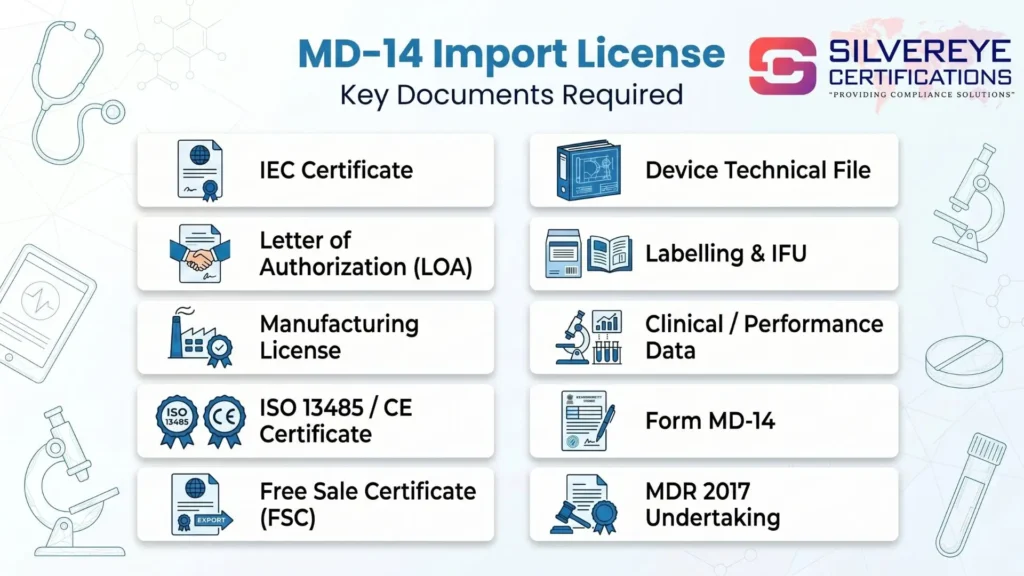
Documents Required for MD-14 Application (Contact Lens Import)
- Completed Form MD-14 filed via the CDSCO Sugam portal
- Certificate of Incorporation of the Indian importing company
- Wholesale license (MD-42) or manufacturing license of the Indian authorised agent
- Power of Attorney / authorization from the foreign manufacturer
- Free Sale Certificate or CE Certificate or equivalent Reference Country approval
- Device Master File covering lens material, base curve, diameter, water content, and intended wear schedule
- Labelling samples with Indian importer details in English
- Instructions for Use (IFU) / patient information leaflet
- Test reports from an accredited laboratory (NABL or equivalent)
- Declaration that the device is not banned in the country of origin
- Fee payment receipt
MD-14 / MD-15 Fee Schedule for Contact Lenses (Class B)
| Fee Head | Approximate Amount |
| MD-14 application fee | ₹1,000 – ₹3,000 |
| MD-15 import license fee (Class B, per device) | ₹2,000 |
Confirm the exact figure on cdsco.gov.in, as fees differ for fresh applications versus renewals and are periodically revised.
MD-14 / MD-15 Processing Timeline
For a Class B device such as contact lenses, a complete MD-14 application is generally processed within 30 to 60 days. Incomplete documentation or deficiency queries from CDSCO can extend this timeline significantly.
Wholesale License for Contact Lenses: MD-41 Application & MD-42 Grant of License
Distributors, stockists, and businesses supplying contact lenses to opticians, eye clinics, and pharmacies — without manufacturing or importing them directly — must obtain a wholesale license under Form MD-42 by submitting Form MD-41 to the State Licensing Authority of the relevant state. This license authorizes storage and onward distribution but not manufacturing or relabelling.
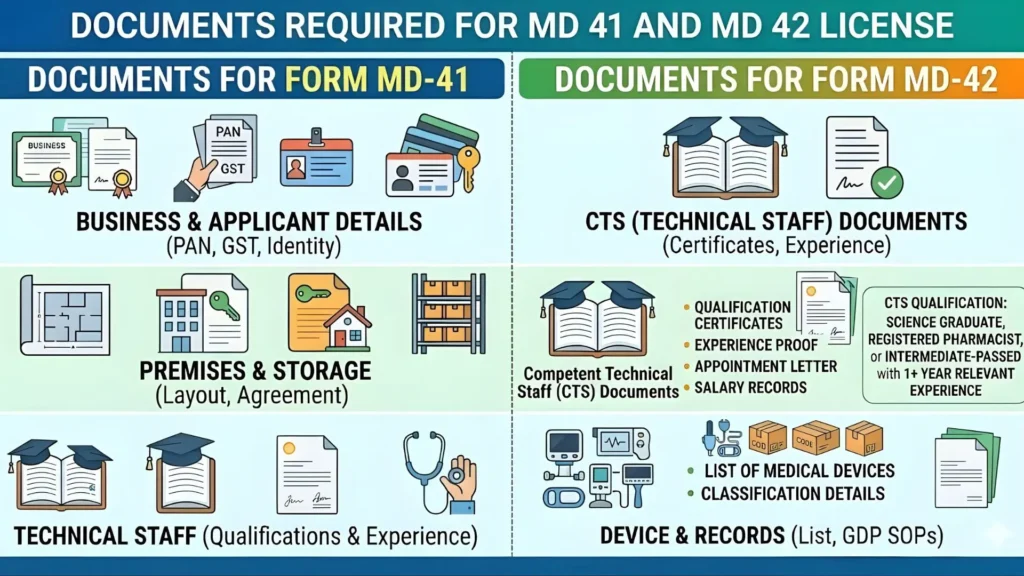
Documents Required for MD-41 Application (Contact Lens Wholesale)
- Completed Form MD-41 application
- Certificate of Incorporation or Partnership Deed of the applicant firm
- Proof of ownership or lease of the storage premises
- Storage facility details, including temperature and humidity control evidence for lens solutions
- Details of the Qualified Person (pharmacist or equivalent technical staff) with registration proof
- No-objection certificate from local municipal authorities, where required by the state
- Declaration of compliance with MDR 2017 storage and handling norms
- Fee payment challan
MD-41 / MD-42 Fee Schedule
| Fee Head | Approximate Amount |
| MD-41 application fee | ₹2,000 – ₹5,000 (varies by state) |
| MD-42 license grant fee | ₹5,000 – ₹10,000 (varies by state) |
State Licensing Authorities set the final fee amount, so confirm the exact figure with your state's drug control department before applying.
MD-41 / MD-42 Processing Timeline
Wholesale license applications for contact lenses are typically processed within 30 to 60 days through the concerned SLA.
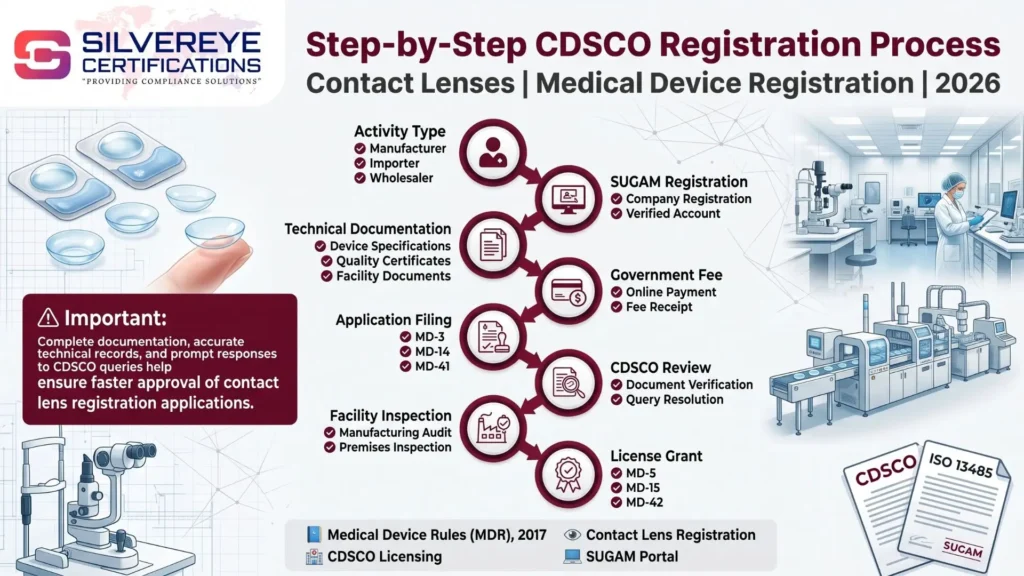
Step-by-Step CDSCO Registration Process for Contact Lenses
- Confirm your activity type — manufacturing, importing, or wholesale distribution — since each requires a different form.
- Register your company on the CDSCO Sugam portal and create a verified user account.
- Compile your technical documentation package, including device specifications, quality certificates, and facility or import-related evidence.
- Pay the applicable government fee online through the Sugam portal payment gateway and retain the receipt.
- Submit the relevant form — MD-3, MD-14, or MD-41 — along with all supporting documents.
- Respond promptly to any deficiency queries raised by CDSCO or the State Licensing Authority.
- Undergo a facility inspection, where applicable (mandatory for manufacturing licenses; may apply to certain wholesale premises).
- Receive the granted license — MD-5, MD-15, or MD-42 — and download the certificate from the Sugam portal.
Validity and Renewal of Contact Lens CDSCO Licenses
| License Type | Validity | Renewal Form |
| MD-5 (Manufacturing) | 5 years | MD-6, filed before expiry |
| MD-15 (Import) | Ongoing, subject to a five-yearly retention fee | Retention fee payment; MD-16 for renewal-related filings |
| MD-42 (Wholesale) | 5 years | MD-43, filed before expiry |
Start your renewal process at least 90 days before the license expiry date to allow time for any CDSCO queries. Missing the renewal window can disrupt supply and, in some cases, force a fresh application.
Benefits of CDSCO Registration for Contact Lens Businesses
- Legal authorization to manufacture, import, or distribute contact lenses in India — operating without the correct license is not permitted
- Credibility with opticians, eye hospitals, and e-commerce marketplaces, which increasingly verify CDSCO registration before listing or stocking a product
- Eligibility to participate in government and institutional tenders where CDSCO registration is a mandatory condition
- Reduced risk of product seizure, financial penalty, or enforcement action under the Drugs and Cosmetics Act, 1940
- Access to India's expanding vision-care market, driven by rising myopia prevalence and growing demand for cosmetic and corrective lenses
Common Mistakes to Avoid in Contact Lens CDSCO Registration
- Assuming contact lenses fall under Class A (like spectacles) — they are Class B and follow a different documentation standard
- Applying for MD-3 without a complete Site Master File or quality documentation, which triggers deficiency notices
- Submitting an expired Free Sale Certificate or CE Certificate with the MD-14 import application
- Missing Indian importer details on the product label — a frequent reason for import application deficiencies
- Treating coloured or cosmetic contact lenses as non-medical accessories — they remain Class B devices under CDSCO and require the same registration
- Delaying renewal filing, which can disrupt supply continuity for manufacturers, importers, and wholesalers alike
Conclusion
CDSCO registration for contact lenses is a mandatory, non-negotiable requirement for anyone manufacturing, importing, or distributing them in India, because the product is classified as a Class B medical device under MDR 2017. Indian manufacturers work through Form MD-3 and MD-5, importers through Form MD-14 and MD-15, and wholesale distributors through Form MD-41 and MD-42 — each pathway carrying its own documentation, fee, and timeline. Getting the classification, forms, and documentation right the first time avoids costly deficiency cycles and keeps your contact lens business compliant and market-ready.
Silvereye Certifications supports manufacturers, importers, and distributors through the entire CDSCO registration journey for contact lenses — from device classification and documentation to Sugam portal filing and post-approval compliance. Reach out for a regulatory assessment tailored to your contact lens business.
Frequently Asked Questions
Is CDSCO registration mandatory for contact lenses in India?
Yes. Contact lenses are notified as a Class B medical device under MDR 2017, and manufacturing, importing, or distributing them without the applicable CDSCO license is not permitted.
Which CDSCO license form applies to contact lens manufacturers in India?
Indian manufacturers apply through Form MD-3 and receive the manufacturing license in Form MD-5 from the State Licensing Authority.
Which CDSCO license do I need to import contact lenses into India?
Importers must file Form MD-14 with CDSCO's Central Licensing Authority (DCGI) and receive the import license in Form MD-15.
Do contact lens wholesalers and distributors need a separate CDSCO license?
Yes. Wholesalers and distributors need Form MD-41 application and MD-42 grant of license from the State Licensing Authority, separate from any manufacturing or import license.
Are coloured or cosmetic contact lenses regulated differently from corrective lenses?
No. Coloured, cosmetic, and corrective contact lenses are all classified as Class B ophthalmic devices under MDR 2017 and follow the same CDSCO registration pathway.
How long does it take to get a CDSCO import license for contact lenses?
For a Class B device such as contact lenses, a complete and deficiency-free MD-14 application is typically processed within 30 to 60 days.
How long is the MD-5 manufacturing license for contact lenses valid?
The MD-5 manufacturing license is valid for 5 years and must be renewed via Form MD-6 before expiry.
Is the CDSCO import license for contact lenses valid permanently?
The MD-15 import license remains valid on an ongoing basis, subject to payment of a retention fee every 5 years. Failing to pay the retention fee on time attracts a late fee.
Is ISO 13485 certification compulsory for contact lens CDSCO registration?
ISO 13485 is not legally mandatory for a Class B device like contact lenses, but it strengthens the application and reduces the likelihood of deficiency queries, especially for import applications.
Can a foreign contact lens manufacturer sell directly in India without an Indian importer?
No. Foreign manufacturers must appoint an Indian Authorised Agent who holds the relevant CDSCO registration to file the MD-14 import application on their behalf.
What happens if I sell contact lenses in India without a valid CDSCO license?
Selling contact lenses without a valid CDSCO license violates the Medical Device Rules, 2017 and the Drugs and Cosmetics Act, 1940, and can lead to product seizure, financial penalties, and prosecution.
When should I start the renewal process for my contact lens CDSCO license?
Start the renewal process at least 90 days before the license expiry date to allow time for CDSCO to review the application and raise any queries.