

Cosmetic import license process in India involves submitting an application to CDSCO, obtaining the Import Registration Certificate, and meeting the applicable regulatory requirements.
- Two forms, one registration process: Form COS-1 is the application submitted to CDSCO, while Form COS-2 is the Import Registration Certificate issued after approval.
- Registration is mandatory before importing cosmetics: Under Rule 12(1) of the Cosmetics Rules, 2020, cosmetics must be registered before import into India. Ensure your products and manufacturing premises meet the applicable requirements.
- Plan for the registration timeline: CDSCO lists a targeted internal timeline of 180 working days for fresh registration, endorsement and re-registration applications. Prepare your documents carefully and apply well before your planned product launch.
- Understand the registration fees: The total cost depends on the applicable cosmetic category, manufacturing site and product variants. Review the relevant CDSCO fee schedule to estimate your registration expenses accurately.
Introduction
The cosmetic import license process in India requires registration with the Central Drugs Standard Control Organization (CDSCO) before cosmetics can be imported. Under the Cosmetics Rules, 2020, the manufacturer, its authorized agent, an importer in India, or an authorized Indian subsidiary may submit an online application through the CDSCO SUGAM portal using Form COS-1. The application must include the prescribed documents and applicable fees.
CDSCO reviews the application and may request additional information or clarification. Once the application is approved, the authority issues the Import Registration Certificate in Form COS-2. Registration covers the applicable cosmetic products, variants, pack sizes, and manufacturing premises as required under the rules. Applicants should consult the official CDSCO guidance for the current document checklist and fee requirements before submitting their applications.
How to Get a Cosmetic Import License in India: Process, Eligibility and Documents
The cosmetic import license process in India involves registering the cosmetic products and their manufacturing premises with the Central Drugs Standard Control Organization (CDSCO) before import. The process is governed by the Drugs and Cosmetics Act, 1940, and the Cosmetics Rules, 2020. Applications are submitted online through the CDSCO SUGAM portal using Form COS-1. After reviewing the application and supporting documents, CDSCO may grant the Import Registration Certificate in Form COS-2.
Who Can Apply for a Cosmetic Import License in India?
Under Rule 12(2) of the Cosmetics Rules, 2020, an application for cosmetic import registration may be submitted by the foreign manufacturer, its authorised agent in India, an importer in India, or an Indian subsidiary authorised by the manufacturer. The application must include the prescribed information and supporting documents.
The manufacturer’s authorisation must be authenticated in accordance with Rule 12(3) and the First Schedule of the Cosmetics Rules, 2020. The applicant should ensure that the details of the manufacturer, manufacturing premises, authorised representative and products are consistent throughout the application.
What Are the Eligibility Requirements for Cosmetic Import Registration?
To obtain cosmetic import registration, the products and manufacturing premises must meet the applicable requirements of the Cosmetics Rules, 2020. The applicant must provide the prescribed product and manufacturer information, along with the required supporting documents and fees.
The cosmetics must comply with the applicable quality and safety standards under Rule 39. Products covered by the Ninth Schedule must meet the relevant specifications; products not covered by that schedule must comply with the applicable requirements under the rules and relevant standards in the country of origin.
The applicant must also ensure that the cosmetic's ingredients and colourants comply with the applicable restrictions. CDSCO's guidance addresses prohibited ingredients, permitted colours and limits for certain heavy metals. The rules also contain requirements relating to animal testing and product labelling.
ISO 22716 certification should not be described as a universal mandatory requirement without confirming its applicability to the particular application. Applicants should follow the current CDSCO checklist and applicable regulatory provisions.
Documents Required for Cosmetic Import License in India
To apply for a cosmetic import license in India, applicants must submit the prescribed documents to CDSCO along with Form COS-1. The documents help verify the manufacturer, product composition, manufacturing premises, and compliance with the Cosmetics Rules, 2020.
| Document | Purpose |
|---|---|
| Covering Letter | States the purpose and details of the cosmetic import registration application. |
| Manufacturer Authorisation | Confirms that the applicant is authorised to represent the foreign manufacturer, where applicable. |
| Free Sale Certificate (FSC) | Provides evidence that the cosmetic is permitted for sale in its country of origin, subject to the applicable requirements. |
| Product Ingredient List | Includes the ingredients and their percentage composition, using appropriate ingredient names. |
| Product Specifications and Test Methods | Provides the product's specifications and the methods used to test its quality. |
| Proposed Product Labels | Shows the labelling information intended for the cosmetic product in India. |
| Pack Insert, Where Applicable | Provides accompanying product information, where required. |
| Manufacturing Licence or Supporting Undertaking | Provides the manufacturing licence or an undertaking explaining why one is not required in the country of origin, as applicable. |
| Non-Animal Testing Declaration | Addresses the applicable requirements concerning animal testing. |
| Prescribed Fee Payment Receipt | Confirms payment of the applicable registration fee. |
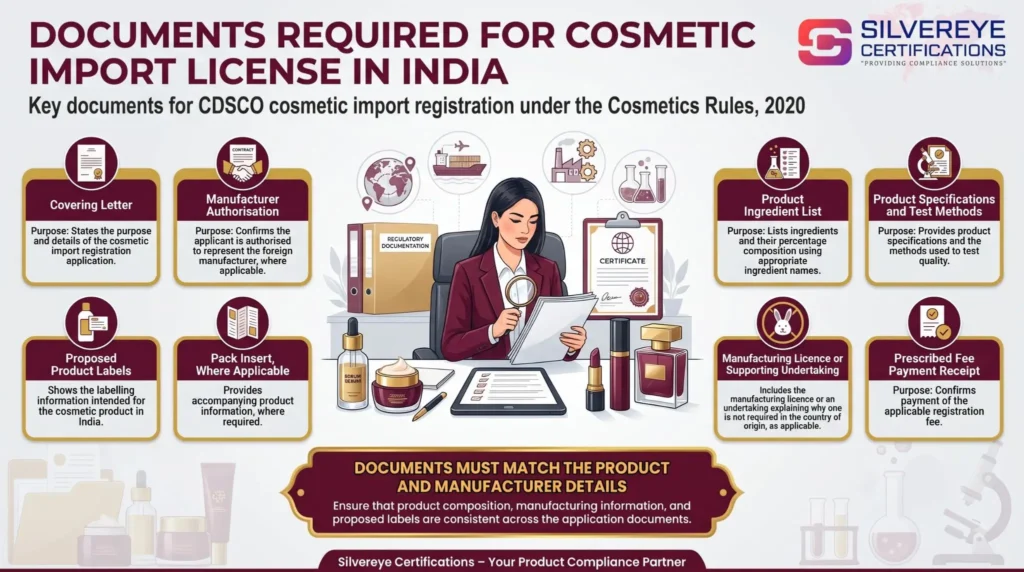
Important: The exact document requirements may vary depending on the application and product. Foreign manufacturer authorization documents must meet the applicable authentication requirements under the Cosmetics Rules, 2020. Before filing, check the latest official CDSCO cosmetics guidance to confirm the required documents and submission format.
Cosmetic Import License Process in India: Step-by-Step Guide from COS-1 to COS-2
The cosmetic import license process involves submitting an application to CDSCO, providing the required supporting documents, and obtaining the Import Registration Certificate before importing cosmetics into India.
- Step 1: Identify the Eligible Applicant
Determine whether the foreign manufacturer, its authorised agent, an Indian importer, or an authorised Indian subsidiary will submit the application, as permitted under the Cosmetics Rules, 2020. - Step 2: Register on the CDSCO SUGAM Portal
Create an account and select the applicable cosmetic import registration service for online application submission. - Step 3: Classify Your Cosmetic Products
Identify the applicable product category and compile the details of the products, variants, and manufacturing premises to be included in the application. - Step 4: Prepare the Required Documents
Collect the manufacturer authorisation, Free Sale Certificate, ingredient list with percentage composition, proposed product labels, product specifications, and other documents required by CDSCO. - Step 5: Submit Form COS-1
Complete the application with the applicant's details, manufacturer information, manufacturing premises, and product particulars. Upload the required supporting documents through the designated portal. - Step 6: Pay the Prescribed Registration Fees
Pay the applicable fees through the prescribed payment mechanism and retain the payment receipt for reference. - Step 7: Respond to CDSCO Queries
Monitor the application status and provide any additional information or clarification requested by CDSCO during the review. - Step 8: Obtain Form COS-2
Once the application is approved, CDSCO issues the Import Registration Certificate in Form COS-2 for the cosmetics covered by the registration. - Step 9: Maintain Regulatory Compliance
Before importing, verify that the products and manufacturing premises are covered by the applicable registration. Follow the relevant requirements for product safety, labelling, changes to registered details, and retention fees.
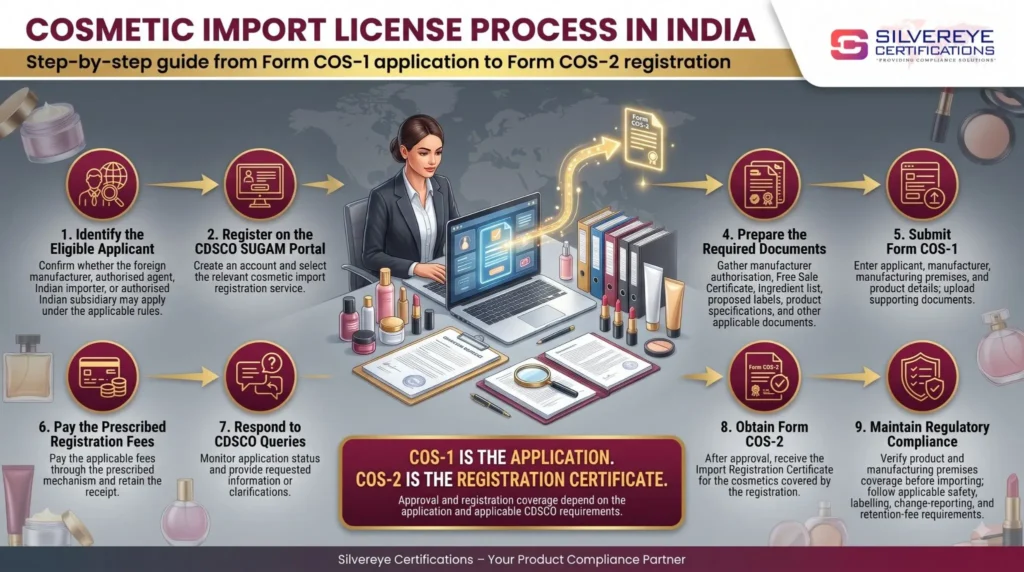
Note: The applicable requirements depend on the nature of the application. Check the latest official CDSCO cosmetics guidance before submitting your application.
What Is Form COS-1 in the Cosmetic Import License Process?
Form COS-1 is the application used to obtain an Import Registration Certificate for cosmetics imported into India. It contains information about the applicant, foreign manufacturer, manufacturing premises, and cosmetic products being submitted for registration. The supporting documents must be consistent with the information entered in the application.
Under Rule 13(4), a single application and registration certificate may cover one or more cosmetics manufactured by the same manufacturer, provided the manufacturing arrangements satisfy the conditions specified in the rule. Product categories, variants, pack sizes, and manufacturing sites must be declared as required by CDSCO. Correct classification and complete documentation can help reduce avoidable queries during the review.
What Is Form COS-2, and What Does It Authorize?
Form COS-2 is the Import Registration Certificate issued by the Central Licensing Authority after approval of the COS-1 application. It covers the cosmetics and manufacturing arrangements included in the approved registration. The relevant products must comply with the applicable requirements of the Cosmetics Rules, 2020 before they are imported into India.
Registration details should be kept up to date. For example, changes to product composition, labelling, testing, specifications, or the name or address of the registration holder or overseas manufacturer may require notification, endorsement, or prior approval, depending on the type of change. A change in the constitution of the registration holder or overseas manufacturer is subject to the specific requirements of Rule 15.
Cosmetic Import License Fees for COS-1 and COS-2
The fees for cosmetic import registration are prescribed under the Third Schedule of the Cosmetics Rules, 2020 and are paid through Bharatkosh. CDSCO's published FAQ lists the following amounts for the specified registration fee heads:
| Fee head | Amount listed by CDSCO |
|---|---|
| Grant or retention of registration certificate for each cosmetic category | USD 1,000 |
| Registration of each product variant | USD 50 |
| Registration of each manufacturing site | USD 500 |
| Grant or retention of registration for each additional cosmetic category | USD 1,000 |
These amounts should be checked against the current applicable fee provisions before filing. CDSCO's FAQ also describes separate endorsement requirements for adding products or manufacturing sites to an existing certificate, including different fee treatment in certain circumstances. Therefore, do not calculate the final cost solely by multiplying the figures in this table without confirming the application type and applicable fee schedule.
How Long Does the Cosmetic Import License Process Take?
Under Rule 13(1) of the Cosmetics Rules, 2020, the Central Licensing Authority may grant or reject a complete application within six months from the date of application, with reasons recorded in writing in the case of rejection. CDSCO's published FAQ separately mentions a targeted processing timeline of 90 days, referring to its circular dated 30 May 2014. This target should not be treated as a guaranteed approval date.
The actual timeline may depend on the completeness of the dossier, the accuracy of the product information, and whether additional clarification is required. Preparing the documents carefully and responding promptly to CDSCO queries can help avoid unnecessary delays.
Cosmetic Import Registration Certificate Validity and Retention Fees
Under Rule 14 of the Cosmetics Rules, 2020, the Import Registration Certificate in Form COS-2 remains valid in perpetuity, subject to payment of the prescribed retention fee before completion of each five-year period from the date of issue, unless the certificate is suspended or cancelled.
If the retention fee is not paid by the due date, the rules provide for a late fee of 2% of the retention fee for every month or part thereof, subject to the prescribed 180-day period. If the required payment remains outstanding beyond that period, the certificate is deemed cancelled. Importers should therefore track the retention-fee deadline rather than describe COS-2 as a certificate that automatically expires every five years.
What Compliance Standards Must Imported Cosmetics Meet?
Under Rule 39 of the Cosmetics Rules, 2020, imported cosmetics must comply with the specifications prescribed in the Ninth Schedule or other applicable quality and safety standards. If a cosmetic is not covered by the Ninth Schedule, it must meet the requirements under the rules and the applicable specifications and standards in its country of origin.
The importer must also ensure that ingredients, colourants, product claims, and labels comply with the relevant provisions. Labelling requirements depend on the product and applicable rules, including the relevant declarations, batch details, manufacturing information, and expiry or use-before information where required. Product claims must not be false or misleading under Rule 36.
What Are the Benefits of Completing the Cosmetic Import License Process?
Obtaining the required registration allows businesses to import the registered cosmetics in accordance with Indian regulatory requirements. It helps establish a documented compliance record for product registration, manufacturing premises, product variants, and supporting documentation.
A valid registration can also support regulatory checks by customs authorities, distributors, and retail partners. However, registration alone does not guarantee customs clearance, marketplace onboarding, or unrestricted market access. Importers must continue to meet applicable customs, labelling, product safety, and other legal requirements.
Important: If a cosmetic is already registered under Rule 13 and another person or entity wants to import it, Rule 17 provides a separate application route using Form COS-4 for an Import Registration Number in Form COS-4A. This route has its own conditions and should be considered before assuming that every importer needs a new COS-2 certificate.
What Are the Penalties for Importing Cosmetics Without a Valid COS-2 Certificate?
Under Rule 12(1) of the Cosmetics Rules, 2020, cosmetics must be registered with CDSCO before they are imported into India. Importing unregistered cosmetics can lead to regulatory action, including detention or refusal of clearance of the shipment, depending on the applicable customs and regulatory provisions. Non-compliant products may also be subject to seizure or other enforcement measures under the relevant law.
The exact consequences depend on the nature of the violation and the legal provisions applicable to the case. Importers should not assume that registration can be obtained retrospectively after the goods arrive. Before arranging a commercial shipment, verify that the required registration or applicable import authorisation is in place and covers the products being imported.
What Mistakes Can Delay the Cosmetic Import License Process?
Errors in the application and supporting documents can lead to queries from CDSCO and delay the review of a cosmetic import registration application. Common issues include inconsistencies between the product details in Form COS-1, the Free Sale Certificate and the manufacturer's authorisation; incorrect product categorisation; missing ingredient information; and labels that do not match the submitted product details.
Applicants should also check that foreign documents meet the applicable authentication requirements and that all required declarations and supporting documents are included. If CDSCO requests clarification through the SUGAM portal, the applicant should respond with complete and consistent information. Retention-fee deadlines should also be tracked to maintain the registration certificate in accordance with the Cosmetics Rules, 2020.
Why Choose Silvereye Certifications for Cosmetic Import License?
Silvereye Certifications helps businesses navigate the cosmetic import license process in India by providing guidance on CDSCO registration requirements, application documentation, and regulatory compliance. From preparing the COS-1 application to understanding product classification and responding to regulatory queries, the team helps applicants manage the registration process more efficiently.
With support for document review, manufacturer authorisation, product information, and labelling requirements, Silvereye Certifications helps businesses identify potential documentation gaps before submission. The aim is to make the registration process clearer, reduce avoidable application errors, and help importers understand their ongoing compliance responsibilities after receiving the COS-2 Import Registration Certificate.
Whether you are a foreign cosmetic manufacturer, an Indian importer, or an authorised representative, Silvereye Certifications can guide you through the applicable requirements so you can prepare your application with greater confidence.
Conclusion: How to Complete the Cosmetic Import License Process Successfully
The cosmetic import license process in India involves selecting an eligible applicant, preparing the prescribed documents, submitting Form COS-1 through the CDSCO SUGAM portal, paying the applicable fees, and addressing any queries raised during the review. Once approved, Form COS-2 serves as the Import Registration Certificate for the cosmetics covered by the registration.
Careful product classification, accurate documentation, and timely responses to CDSCO queries can help reduce avoidable delays. After registration, importers must continue to comply with applicable product safety, labelling, and import requirements and pay the prescribed retention fee before each five-year period ends. Checking the latest CDSCO guidance before filing helps ensure that the application follows the current regulatory requirements.
Frequently Asked Questions
What is the difference between COS-1 and COS-2?
Form COS-1 is the online application filed with CDSCO to register a cosmetic for import into India. Form COS-2 is the Import Registration Certificate CDSCO issues once the COS-1 application is approved.
Who can apply for a cosmetic import license in India?
The foreign manufacturer (if it has a registered presence in India), an Authorized Indian Agent nominated by the manufacturer, an Indian importer, or an Indian subsidiary of the manufacturer can file Form COS-1 under Rule 13 of the Cosmetics Rules, 2020.
How long does the cosmetic import license process take?
CDSCO aims to process a complete application within 180 working days under Rule 13(5) of the Cosmetics Rules, 2020, though the actual time depends on document completeness and how quickly you respond to any CDSCO queries.
Can I import cosmetics into India and register them later?
No. Indian law does not permit post-import or retrospective registration. The COS-2 Import Registration Certificate must be granted before the cosmetic is imported.
How much does the cosmetic import license process cost?
Under the Third Schedule of the Cosmetics Rules, 2020, the government fee is USD 1,000 per product category, USD 50 per variant, and USD 500 per additional manufacturing site, paid through the Bharatkosh gateway.
Is a GMP certificate mandatory for the cosmetic import license process?
Yes. The manufacturing site must hold a valid GMP certificate — CDSCO accepts ISO 22716 or an equivalent certification from a recognized regulatory authority — as part of the COS-1 dossier.
Do animal-tested cosmetics qualify for a COS-2 license?
No. Cosmetics tested on animals after 12 November 2014 cannot be registered or imported into India, and a non-animal testing declaration is a mandatory part of the COS-1 application.
Does the COS-2 Import Registration Certificate expire?
The certificate remains valid on an ongoing basis, subject to paying the prescribed retention fee before completion of every 5-year period from the date of issue. Missing this deadline can lapse the certificate, so most applicants treat it as a 5-year renewal cycle.
Can one COS-1 application cover multiple products?
Yes, provided the products belong to the same manufacturer and fall under the correct CDSCO product category and variant classification, a single COS-1 filing can cover multiple products, variants, and manufacturing sites, subject to the applicable fees.
What happens if CDSCO finds discrepancies in my COS-1 application?
CDSCO intimates the discrepancies to the applicant through the SUGAM portal. Once the applicant addresses them satisfactorily, the application proceeds to approval; unresolved discrepancies can delay or result in rejection of the application.
Can a rejected COS-1 application be appealed?
Yes. If an application is rejected, the applicant may generally file an appeal with the Central Government within the prescribed period after the rejection order, as provided under the Cosmetics Rules, 2020.
Where is the cosmetic import license process filed?
The entire process — from Form COS-1 submission to receiving Form COS-2 — is conducted online through CDSCO's SUGAM portal, which is the single digital platform for all cosmetic registration filings in India.