
- CDSCO Manufacturer License for Perfumes is a mandatory legal requirement under the Drugs and Cosmetics Act, 1940 for any business that manufactures perfumes or fragrance products in India for commercial sale.
- The licensing process involves two key forms — COS-5 (Application for Cosmetic Manufacturer License) and COS-8 (Grant of Manufacturing License) — filed through the SUGAM portal and processed via the State Licensing Authority (SLA).
- Manufacturer license approval timelines range from 45 to 120 working days depending on facility readiness, document accuracy, and State Licensing Authority inspection schedules in your state.
- A valid CDSCO Manufacturer License for Perfumes is product-specific, facility-specific, and must be renewed periodically — failure to comply exposes your business to product seizure, factory shutdown notices, and criminal liability.
Introduction
You've built your perfume formulations. You've sourced your raw materials. You have the facility, the equipment, and the team in place. But before a single bottle of perfume rolls off your production line for commercial sale in India, you need one critical piece of documentation — the CDSCO Manufacturer License for Perfumes.
Under the Drugs and Cosmetics Act, 1940, perfumes and fragrances are classified as cosmetics. That means every business that manufactures these products in India — whether you're a small-batch artisan fragrance studio in Kannauj, a mid-sized cosmetic manufacturer in Pune, or a large-scale industrial perfume production facility in Gujarat — must hold a valid Manufacturer License before producing goods for sale.
Understanding CDSCO's Role in Cosmetic Manufacturing
CDSCO — the Central Drugs Standard Control Organization — is India's national regulatory body for drugs, cosmetics, and medical devices. It operates under the Ministry of Health and Family Welfare. But when it comes to cosmetic manufacturing licenses, CDSCO does not work alone.
For cosmetic manufacturers, India uses a dual-regulatory structure:
- CDSCO (Central Level): Sets the regulatory framework, standards, forms, and guidelines. The SUGAM portal is managed by CDSCO. Central approval is required for certain product categories.
- State Licensing Authority (SLA): This is the Drug Controller of each respective state. The SLA is actually responsible for granting and managing manufacturer licenses for cosmetics. Your application, inspection, and license issuance happens through the SLA of the state where your manufacturing facility is located.
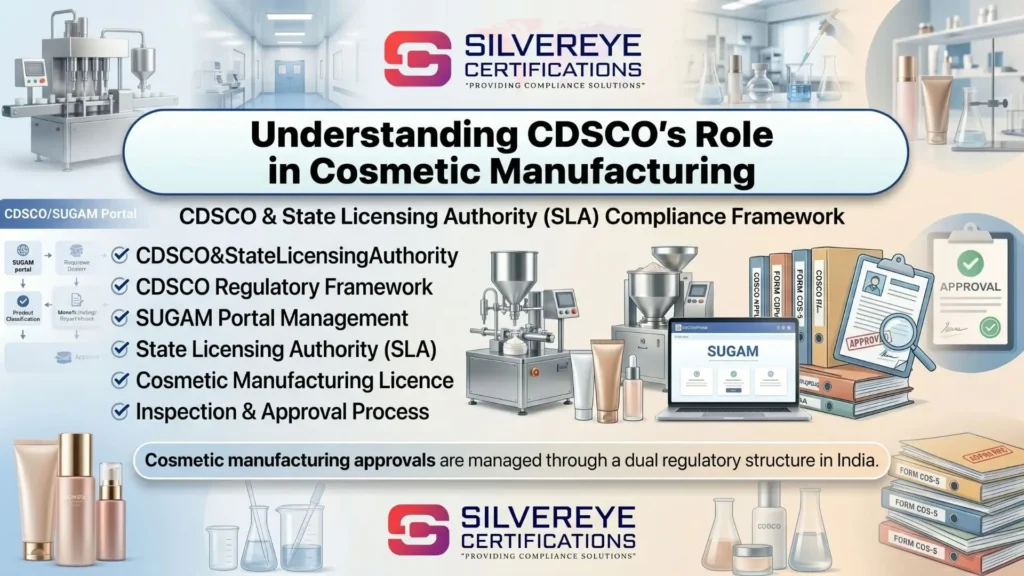
So when we talk about the CDSCO Manufacturer License for Perfumes, we are referring to the cosmetic manufacturing license issued under the framework set by CDSCO and the Drugs and Cosmetics Rules, 1945, processed and granted by your State Drug Controller / State Licensing Authority.
What Is Form COS-5 — Application for Cosmetic Manufacturer License?
Form COS-5 is the official application form that a cosmetic manufacturer must fill and submit to their State Licensing Authority when applying for a new manufacturer license for cosmetics — including perfumes and fragrances. It is submitted through the SUGAM online portal as part of India's digital licensing initiative for the cosmetics sector.
Form COS-5 captures comprehensive information about your manufacturing facility, the products you intend to manufacture, your technical and quality personnel, and your compliance with Good Manufacturing Practices (GMP). It is essentially your formal application to the State Licensing Authority saying: "We are a legitimate, compliant manufacturing unit and we seek authorization to manufacture these specific perfume products at this facility."
Key Sections of Form COS-5
| Section | Details Required |
| Applicant/Business Details | Legal name, type of entity, registered address, contact details of the manufacturer |
| Manufacturing Facility | Full address of the manufacturing premises, area in sq. metres, layout details |
| Products to be Manufactured | List of products — brand name, category (EDT, EDP, body spray, etc.), formulation details |
| Technical Staff | Details of technically qualified person — name, qualification, experience |
| Manufacturing Equipment | List of machinery and equipment installed at the facility |
| Quality Control Setup | Description of in-house QC lab, testing equipment, and QC procedures |
| Water System | Type of water system — purified water, RO, etc. — for manufacturing use |
| Storage Facilities | Details of raw material storage, finished goods storage, temperature controls |
| Declaration | Signed declaration by the applicant confirming compliance with all Drugs and Cosmetics Rules |
What Is Form COS-8 — Grant of Cosmetic Manufacturing License?
Form COS-8 is the actual Manufacturer License document issued by the State Licensing Authority after your COS-5 application has been reviewed, the manufacturing facility has been inspected and found compliant, and all requirements have been satisfied.
COS-8 is your legal permission to manufacture the specified perfume and cosmetic products at your licensed facility. It contains your unique license number, the list of approved products, the facility address, validity period, and any specific conditions imposed by the SLA.
Once COS-8 is in hand, you can legally manufacture, package, label, and dispatch your perfume products for commercial sale across India. Operating a perfume manufacturing unit without a valid COS-8 is a criminal offence under the Drugs and Cosmetics Act, 1940 — and enforcement actions by State Drug Controllers are a real and active risk in 2026.
What COS-8 Contains
| Field | Details in COS8 |
| License Number | Unique identifier assigned by the State Licensing Authority |
| Licensee Name | Legal name of the manufacturer / business entity |
| Facility Address | Exact address of the manufacturing premises covered by the license |
| Products Licensed | Specific perfume and cosmetic products authorised for manufacture |
| Conditions of License | Any special conditions imposed by SLA during inspection or review |
| Validity Period | Date of issue and date of expiry of the manufacturing license |
| Issuing Authority | Name and designation of the SLA officer who granted the license |
Why Is CDSCO Manufacturer License for Perfumes Non-Negotiable in 2026?
Some first-time entrepreneurs in the fragrance business ask whether this license is really necessary — especially for small-batch or artisan production. The answer is unambiguous: yes, it is mandatory for any commercial manufacturing activity, regardless of scale. Here's why it matters more than ever in 2026:
- Increased State Drug Controller Inspections: State Drug Controllers across Maharashtra, Rajasthan, Gujarat, Uttar Pradesh, and Delhi are conducting regular inspections of cosmetic manufacturing units. Unlicensed facilities face immediate closure.
- E-commerce Compliance Requirements: Platforms like Amazon, Flipkart, Nykaa, and Myntra are actively requiring CDSCO-compliant manufacturing documentation before onboarding cosmetic brands.
- Retail and Distribution Chains: Large retail chains and modern trade distributors request valid manufacturing license copies before agreeing to stock perfume products.
- Export Eligibility: If you plan to export your perfumes internationally, buyer countries and Indian export bodies often require proof of a valid Indian cosmetic manufacturing license.
- Consumer Safety and Liability: A manufacturing license ensures your products have been verified for facility standards — protecting you from product liability claims.
- Brand Investment Protection: Building a perfume brand without a valid license is building on sand — one enforcement action can wipe out years of brand investment.
Complete List of Perfume & Fragrance Products Covered Under CDSCO Cosmetic Manufacturer License
The following 42 perfume and fragrance product types are classified as cosmetics under the Drugs and Cosmetics Act, 1940, and require a valid COS-8 Manufacturing License for commercial production in India. A single license can cover all products manufactured at your facility — provided each product is listed in your COS-5 application at the time of filing.
| S.No. | Product Name | Category | Base / Form | Regulatory Note |
|---|---|---|---|---|
| 1 | Eau de Parfum (EDP) | Alcohol-based | 15–20% fragrance in alcohol | Classified as cosmetic; COS8 mandatory for manufacture |
| 2 | Eau de Toilette (EDT) | Alcohol-based | 5–15% fragrance in alcohol | Classified as cosmetic; COS8 mandatory for manufacture |
| 3 | Eau de Cologne (EDC) | Alcohol-based | 2–5% fragrance in alcohol | Classified as cosmetic; COS8 mandatory for manufacture |
| 4 | Parfum / Extrait de Parfum | Alcohol-based | 20–40% fragrance in alcohol | Highest concentration; COS8 required; full INCI disclosure needed |
| 5 | Eau Fraîche | Alcohol-based | 1–3% fragrance in alcohol + water | Light concentration; cosmetic classification applies |
| 6 | Eau de Parfum Intense | Alcohol-based | EDP with higher-than-standard fragrance load | Variant of EDP; same cosmetic classification; COS8 required |
| 7 | After Shave Splash / Lotion | Alcohol-based | Alcohol + fragrance + skin actives | Cosmetic; if therapeutic claims are made, drug license may also be required |
| 8 | After Bath Splash / Cooling Cologne | Alcohol-based | Dilute alcohol + fragrance + cooling agents | Avoid therapeutic claims (e.g. "antibacterial") to remain within cosmetic scope |
| 9 | Cologne Spray (Men's) | Alcohol-based | EDT concentration in pump spray | Standard cosmetic; COS8 covers all spray formats at licensed facility |
| 10 | Body Spray / Deodorant Spray | Spray | Alcohol + fragrance + propellant | Deodorant sprays are cosmetics under D&C Act; COS8 required |
| 11 | Body Mist | Spray | Low-alcohol fragrance mist | Cosmetic; COS8 mandatory; label must carry MFG license number |
| 12 | Alcohol-Free Perfume Spray | Spray | Water + fragrance + solubiliser in spray format | Growing segment; COS8 required; list as separate format in COS5 application |
| 13 | Pocket Perfume Spray (Mini) | Spray | EDP / EDT in travel-size spray format | Format variation; same product license applies; label must show MFG license number |
| 14 | Deodorant Roll-On | Spray | Liquid gel + fragrance in roller format | Cosmetic classification; COS8 required |
| 15 | Room / Linen Spray | Spray | Alcohol + water + fragrance | If marketed for home use only, may fall outside cosmetic scope; clarify end-use with SLA |
| 16 | Perfume Oil (Concentrated) | Oil-based | Fragrance in carrier oil (no alcohol) | Alcohol-free format; classified as cosmetic; COS8 required for commercial manufacture |
| 17 | Roll-On Perfume Oil | Oil-based | Fragrance oil in roller bottle | Popular format; classified as cosmetic; COS8 mandatory |
| 18 | Body Oil with Fragrance | Oil-based | Carrier oil blend + fragrance | Dual function (skin + fragrance); classified as cosmetic under D&C Act |
| 19 | Massage Oil with Fragrance | Oil-based | Carrier oil + essential oils + fragrance | Cosmetic if no therapeutic claims; avoid medicinal language on label |
| 20 | Baby Cologne / Baby Fragrance | Oil-based | Very mild fragrance in oil or low-alcohol base | Products for infants face stricter labelling scrutiny; COS8 essential |
| 21 | Beard Oil with Fragrance | Oil-based | Jojoba / argan oil + fragrance | Men's grooming cosmetic; COS8 covers this under the facility's cosmetics license |
| 22 | Scented Body Lotion | Oil-based | Emulsion base + fragrance | Cosmetic; covered under COS8 if listed in COS5 application |
| 23 | Scented Shea Body Lotion | Oil-based | Shea butter emulsion + fragrance | List as separate SKU in COS5 product list for clear SLA approval |
| 24 | Fragrance Diffuser Oil (Personal Use) | Oil-based | Essential oil blend in carrier oil | If marketed for skin/body application, cosmetic license applies; home reed diffusers may differ |
| 25 | Attar / Itr (Traditional) | Attar / Itr | Steam-distilled in sandalwood oil base | Classified as cosmetic; COS8 required even for traditional deg-bhapka process |
| 26 | Synthetic Attar (Non-Alcoholic) | Attar / Itr | Synthetic fragrance in oil base | Same classification as traditional attar; COS8 mandatory |
| 27 | Musk Attar | Attar / Itr | Musk-dominant fragrance compound in oil | Confirm synthetic musk compliance with IFRA guidelines; cosmetic license required |
| 28 | Rose Attar (Gulab) | Attar / Itr | Rose absolute / essential oil in sandalwood | Traditional Kannauj product; COS8 required for commercial sale |
| 29 | Oud / Agarwood Oil | Attar / Itr | Oud resin extract in carrier oil | Classified as cosmetic; CITES compliance may apply for agarwood sourcing |
| 30 | Khas Attar (Vetiver) | Attar / Itr | Vetiver essential oil distilled in sandalwood | Traditional; COS8 from UP SLA for Kannauj manufacturers |
| 31 | Hina / Mehndi Attar | Attar / Itr | Floral-herbal blend in oil base | Used on skin; cosmetic classification; COS8 required for commercial manufacture |
| 32 | Bukhoor / Bakhoor (Scented Chips) | Attar / Itr | Wood chips soaked in fragrance oils | Not a cosmetic if for burning only; if applied to skin, cosmetic rules apply — clarify with SLA |
| 33 | Solid Perfume / Perfume Balm | Solid / Wax | Beeswax or carnauba wax + fragrance oil | Cosmetic product; growing D2C format; COS8 required |
| 34 | Perfume Wax (Pocket Perfume) | Solid / Wax | Wax base + concentrated fragrance | Same cosmetic classification as liquid perfumes; license required |
| 35 | Deodorant Stick (Fragrance-Based) | Solid / Wax | Wax / gel base + fragrance + antiperspirant agents | If contains aluminium-based antiperspirant, review drug vs cosmetic boundary with SLA |
| 36 | Perfume Powder / Dusting Powder | Solid / Wax | Talc or starch base + fragrance | Includes scented talc; classified as cosmetic; COS8 mandatory |
| 37 | Scented Body Butter | Solid / Wax | Shea / cocoa butter + fragrance | Dual-function cosmetic; COS8 covers fragrance + moisturiser combinations |
| 38 | Scented Soap Bar (Fragrance-Forward) | Solid / Wax | Soap base + high fragrance load | Soaps are cosmetics under D&C Act; COS8 required; include in product list |
| 39 | Hair Perfume / Hair Mist | Hair Fragrance | Low-alcohol + conditioning agents + fragrance | Classified as hair cosmetic; COS8 required; growing premium segment |
| 40 | Scented Hair Oil | Hair Fragrance | Carrier oil blend + fragrance | Label must carry INCI names and COS8 license number |
| 41 | Scented Hair Serum | Hair Fragrance | Silicone / oil base + fragrance | COS8 covers all hair cosmetics listed in the application |
| 42 | Fragrant Hair Conditioner | Hair Fragrance | Conditioning emulsion + fragrance | Covered under COS8 if included in the product list at application stage |
Eligibility Criteria for CDSCO Manufacturer License for Perfumes
Before you file Form COS-5, you need to ensure your business and facility meet all the eligibility requirements. Here's what the State Licensing Authority looks for:
| Eligibility Criterion | Requirement |
| Legal Entity | Must be a registered business — Private Limited Company, LLP, Sole Proprietorship, Partnership, or HUF |
| Manufacturing Premises | Must own or lease a dedicated manufacturing facility meeting GMP layout requirements |
| Facility Area | Sufficient floor area as per GMP norms — typically minimum 50–100 sq. metres for small-scale perfume manufacturing |
| Technical Qualified Person | Must have a full-time, on-site Technically Qualified Person (TQP) — typically a B.Pharm, M.Pharm, B.Sc Chemistry, or equivalent |
| Equipment | Must have installed the manufacturing equipment appropriate for the products to be manufactured |
| QC Lab | Must have or have access to an in-house or approved external quality control laboratory |
| Water System | Must have an approved water purification and supply system compliant with GMP requirements |
| GSTIN | Valid GST registration under Indian law |
| SUGAM Account | Must have a registered account on CDSCO's SUGAM portal |
| State Drug Controller | Application must be filed with the SLA of the state where the manufacturing facility is located |
Key Benefits of Obtaining CDSCO Manufacturer License for Perfumes
The CDSCO Manufacturer License for Perfumes is not just about regulatory compliance. It is a business asset that unlocks significant commercial opportunities:
- Legal Manufacturing Rights: You can legally manufacture, package, label, and sell your perfume products across India without fear of enforcement action.
- Market Credibility: A licensed manufacturer signals quality and legitimacy to distributors, retailers, and consumers — a critical competitive advantage in a crowded fragrance market.
- E-commerce Listing: You can get your products listed on major e-commerce platforms that require CDSCO documentation — opening up India's rapidly growing online fragrance market.
- Export Opportunities: Licensed Indian cosmetic manufacturers can apply for export approvals and tap into international markets across the Middle East, Southeast Asia, and beyond.
- Brand Registration Support: Many brand registration and trademark applications in the cosmetics space benefit from accompanying CDSCO manufacturing license documentation.
- Contract Manufacturing: Your licensed facility can take on contract manufacturing for other brands — an additional revenue stream for your business.
- Institutional and B2B Sales: Hotels, airlines, hospitality chains, and corporate gifting companies prefer sourcing from licensed manufacturers for compliance and audit purposes.
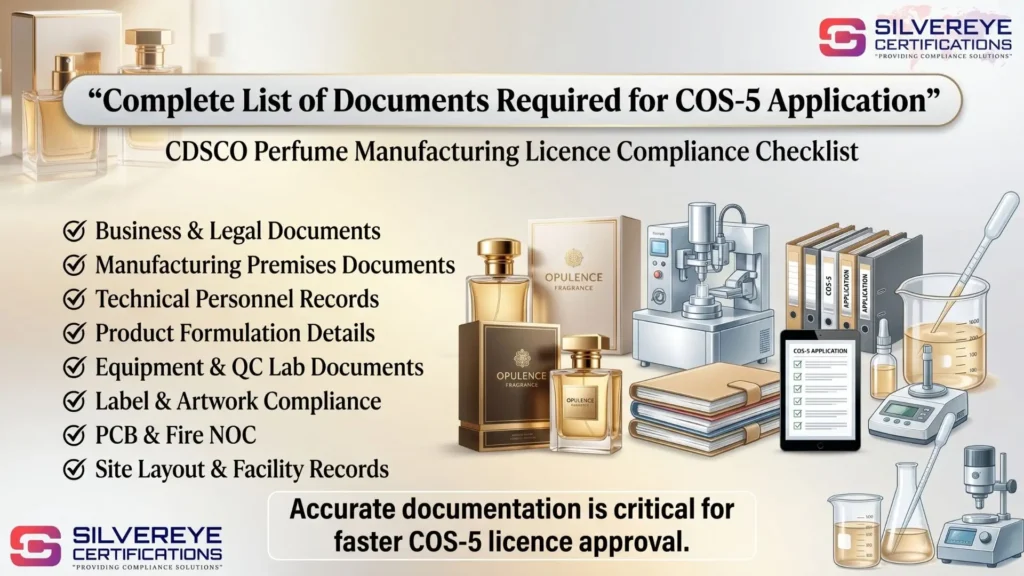
Complete List of Documents Required for COS-5 Application
Document preparation is the make-or-break stage of your CDSCO Manufacturer License for Perfumes application. Being thorough and organized here directly determines how fast your application is processed. Here is the complete document checklist:
Business and Legal Documents
- Certificate of Incorporation / Partnership Deed / Shop & Establishment Certificate
- PAN Card of the business entity
- GST Registration Certificate (GSTIN)
- Memorandum and Articles of Association (for companies)
- Aadhar / identity proof of all directors or partners
- Board Resolution authorizing the signatory to apply for the license (for companies)
Manufacturing Premises Documents
- Ownership proof or registered lease agreement for the manufacturing premises
- Site plan / layout plan of the manufacturing facility (drawn to scale, showing all areas: manufacturing, storage, QC lab, change rooms, utilities)
- Photographs of the facility — manufacturing area, QC lab, storage areas, entry/exit points
- NOC from local authority / municipality / panchayat (if applicable)
- Pollution Control Board (PCB) consent or NOC (for applicable manufacturing categories)
- Fire NOC from the local fire department
Technical and Quality Personnel Documents
- Academic qualification certificates of the Technically Qualified Person (TQP) on the premises
- Experience certificate and appointment letter of the TQP
- Declaration by the TQP that they are full-time and not associated with any other manufacturing unit
- List of all technical and production staff with their roles
Product and Formulation Documents
- Complete list of perfume products to be manufactured with product names and categories
- Full formulation of each product — ingredient list in INCI format with percentage composition
- Proposed label / pack artwork compliant with Indian cosmetic labelling norms
- Safety assessment report or stability data for formulations (where applicable)
Equipment and Infrastructure Documents
- List of all manufacturing equipment installed at the facility with make, model, and capacity
- Equipment qualification and calibration records (if available at application stage)
- List of quality control equipment in the QC lab
- Water system validation documents or description of the water treatment system
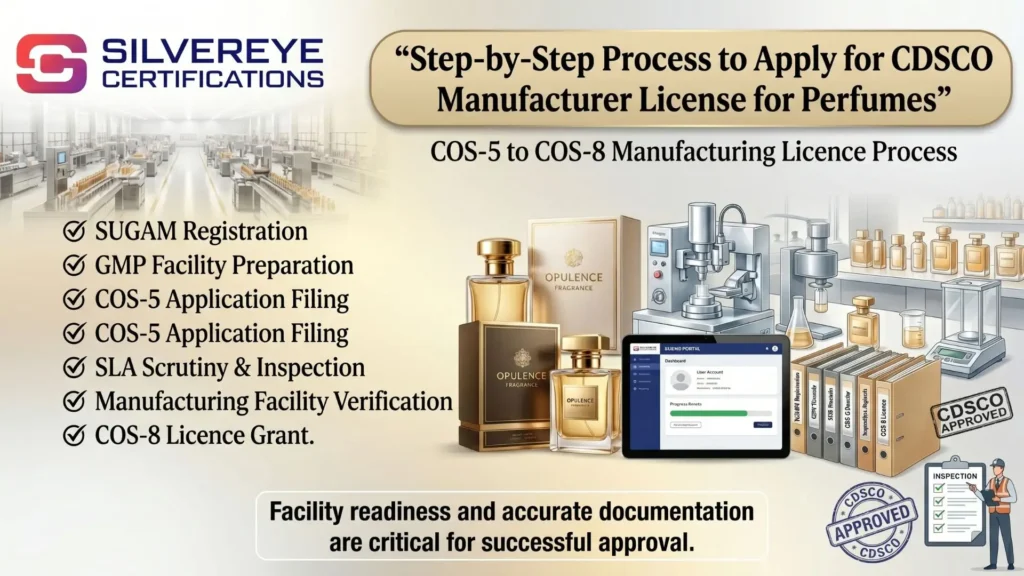
Step-by-Step Process to Apply for CDSCO Manufacturer License for Perfumes
Here is the exact step-by-step process to apply for your Manufacturer License through Form COS-5 in 2026:
- Step 1 — Register on SUGAM Portal: Visit https://sugam.cdsco.gov.in and create your manufacturer account. Complete your company profile thoroughly — incomplete profiles cause application delays from the very first step.
- Step 2 — Prepare Your Facility for GMP Compliance: Before filing the application, ensure your manufacturing facility meets GMP requirements as per Schedule M of the Drugs and Cosmetics Rules, 1945 (as applicable to cosmetics). This is a physical readiness step — your documentation must reflect reality.
- Step 3 — Prepare All Required Documents: Compile all documents listed in the previous section. Organize them in the format required by the SLA of your state. Different states have slightly different document requirements and formats — check your State Drug Controller's website or office for specific requirements.
- Step 4 — Fill Form COS-5 Online on SUGAM: Log in to your SUGAM account. Navigate to the 'Cosmetic Manufacturer License' section and begin filling Form COS5. Enter all details about your facility, products, personnel, and equipment. Upload all supporting documents in the specified formats.
- Step 5 — Pay the Application Fee: On completion of the form, pay the prescribed application fee through the SUGAM portal's online payment gateway. The fee varies by state and number of products. Retain the payment receipt.
- Step 6 — Submit the Application: After payment, submit your application. You will receive an Application Reference Number (ARN). This is your tracking number — use it for all follow-up with the SLA.
- Step 7 — Inspection Report Submission: The drug inspector submits their inspection report to the SLA. If the facility is found compliant, the process moves to license grant. If deficiencies are noted, you will be given time to rectify them before re-inspection.
- Step 8 — Grant of Manufacturing License (COS-8): Once all requirements are met and the inspection is satisfactory, the SLA grants your Manufacturer License in Form COS8. The digitally signed COS8 document is issued through the SUGAM portal. Download, print, and display it at your facility as required.
GMP Requirements for Perfume Manufacturing Facilities in India
Good Manufacturing Practices (GMP) are not just a checklist — they are the foundation on which your CDSCO Manufacturer License for Perfumes rests. Here are the key GMP requirements that the SLA inspector will assess during facility inspection:
| GMP Area | Key Requirements |
| Premises & Layout | Separate areas for manufacturing, storage, QC, packaging, dispatch; adequate size; proper flooring and wall finish; controlled access |
| Ventilation & Air | Adequate ventilation to prevent cross-contamination; HVAC or exhaust systems; temperature and humidity controls where required |
| Water System | Purified water or RO water for manufacturing; validated water treatment system; regular water quality testing |
| Manufacturing Equipment | Stainless steel or inert material contact surfaces; equipment cleaned and documented; calibration records maintained |
| Raw Material Control | Segregated raw material storage; quarantine areas; CoA verification for all incoming materials; proper labelling |
| Finished Goods Storage | Clean, dry, temperature-appropriate storage; FIFO system; segregation of approved, quarantine, and rejected goods |
| QC Laboratory | Equipped for physical, chemical, and microbiological testing; calibrated instruments; trained staff |
| Personnel Hygiene | Change rooms; handwashing facilities; gowning procedures; health and hygiene protocols for all staff |
| Documentation | Batch manufacturing records; SOPs for all critical processes; training records; deviation and CAPA records |
| Waste Management | Proper disposal of manufacturing waste, packaging waste, and rejected materials in compliance with local regulations |
CDSCO Manufacturer License Fees for Perfumes
The fee for the CDSCO Manufacturer License for Perfumes varies by state and is governed by the Drugs and Cosmetics Rules, 1945. Below is a general reference fee structure. Always verify current fees with your respective State Licensing Authority or the SUGAM portal before filing:
| Fee Type | Number of Products | Approximate Fee (INR) | Notes |
| New License Application | 1–5 products | ₹2,000 – ₹5,000 | State-wise variation; payable on SUGAM portal |
| New License Application | 6–20 products | ₹5,000 – ₹12,000 | Additional fee per product in many states |
| New License Application | 21–50 products | ₹12,000 – ₹25,000 | Higher fee bracket for larger product ranges |
| New License Application | 50+ products | ₹25,000+ | Contact SLA for exact computation |
| License Renewal | Per license | ₹2,000 – ₹6,000 | Due before expiry; same SUGAM portal process |
| Amendment / Modification | Per amendment | ₹1,500 – ₹3,000 | Adding new products, change of premises, etc. |
| Duplicate License | Per request | ₹500 – ₹1,000 | In case of loss or damage to original |
Validity of CDSCO Manufacturer License for Perfumes
Understanding the validity structure of your COS-8 license is critical for business continuity planning. Here are the key validity details:
| Particulars | Details |
| Standard Validity | 5 years from the date of issue of Form COS8 (subject to state-wise provisions) |
| Renewal Window | Apply for renewal at least 3 months before the expiry date |
| Manufacturing After Expiry | Strictly prohibited — manufacturing cosmetics with an expired license is a criminal offence |
| Grace Period | Some states allow a grace period of up to 6 months post-expiry for renewal — check with your SLA |
| Product Additions | Adding new perfume products to an existing license requires a license amendment, not a fresh application |
| Premises Change | Moving to a new manufacturing facility requires a fresh COS5 application and SLA inspection of the new premises |
| Ownership Change | Change in ownership or entity name requires fresh application — license is not transferable |
| License Display | COS8 must be displayed prominently at the manufacturing premises at all times |
How to Renew Your CDSCO Manufacturer License for Perfumes
Renewal of your COS-8 license is straightforward if approached systematically and well in advance of the expiry date. Here is the renewal process and timeline:
| Renewal Stage | Recommended Timeline | Action Required |
| Proactive Renewal Start | 6 months before expiry | Review all documents, update formulations list, check TQP records, prepare renewal package |
| File Renewal Application | 3–4 months before expiry | Submit renewal application on SUGAM with updated documents and fee payment |
| SLA Review Period | 2–3 months before expiry | SLA reviews documents; may seek clarifications; facility re-inspection possible |
| Last-Safe Window | 1 month before expiry | All formalities must be complete; manufacturing continuity at risk if delayed beyond this |
| Grace Period (if any) | Within 6 months post-expiry | Manufacturing must cease until renewed; submit renewal with valid reason for delay |
| License Lapse | After grace period ends | License permanently lapses; fresh COS5 application and inspection required |
For renewal, you will need to submit updated versions of time-sensitive documents such as the TQP's current appointment letter, recent product batch records, updated equipment calibration logs, and the current lease agreement for the manufacturing premises if the original has been renewed.
Labelling Requirements for Manufactured Perfumes Under CDSCO
Holding a CDSCO Manufacturer License for Perfumes also obligates you to ensure every product leaving your facility carries a compliant label. The Drugs and Cosmetics Act and Legal Metrology (Packaged Commodities) Rules, 2011 govern labelling requirements for manufactured cosmetics in India. Here's what every perfume label must carry:
- Brand name and product name
- Name and complete address of the Indian manufacturer (your licensed facility address)
- Manufacturing license number (your COS8 license number)
- Batch number and date of manufacture
- Best before / expiry date (month and year format)
- Net quantity / net volume in metric units (ml or grams)
- Full ingredient list in INCI format
- Directions for use and any precautions or warnings
- Maximum Retail Price (MRP) inclusive of all applicable taxes
- Customer care contact details
- Country of manufacture ("Made in India" for domestically manufactured products)
Who Specifically Needs This License in the Perfume Industry?
The CDSCO Manufacturer License for Perfumes applies to a broad range of business types in India's fragrance and cosmetics sector. Here is a practical breakdown of who needs it:
| Business Type | License Required? | Notes |
| Perfume brand with own manufacturing unit | Yes — COS-5/COS-8 | Primary scenario; most common applicant type |
| Contract manufacturer for other perfume brands | Yes — COS-5/COS-8 | License covers contract manufacturing activities |
| Artisan/small-batch perfume maker (commercial) | Yes — COS-5/COS-8 | Scale does not exempt from licensing requirement |
| Attar / itr manufacturer (traditional | Yes — COS-5/COS-8 | Attar is classified as cosmetic; same rules apply |
| Fragrance compound supplier to manufacturers | Depends on product | If selling final-use cosmetics, license required |
| Importer reselling without manufacturing | No COS-5/COS-8 | Needs Import License (COS1/COS2), not manufacturer license |
| Home-based perfumer selling commercially | Yes — COS-5/COS-8 | Commercial activity requires licensed premises |
| Job worker / toll manufacturer | Yes — COS-5/COS-8 | Job work in cosmetics requires own manufacturer license |
Special Note for Kannauj Perfume Manufacturers
Kannauj in Uttar Pradesh is India's perfume capital — home to hundreds of traditional attar manufacturers, ittar distillers, and fragrance houses that have been operating for generations. If you are a Kannauj-based manufacturer looking to formalise your operations or expand into modern perfume formats, here's what you need to know specifically:
- All commercial attar and perfume manufacturers in Kannauj must hold a valid CDSCO Manufacturer License (COS-8) from the Uttar Pradesh State Licensing Authority (Drugs Controller, UP).
- Traditional attar manufacturing using deg-bhapka (distillation) methods is still classified as cosmetic manufacturing and requires the same licensing as modern perfume production.
- Kannauj manufacturers exporting directly to the Middle East, Europe, or the US will need their COS8 as part of the export documentation package.
- The Uttar Pradesh government's ODOP (One District One Product) scheme supports Kannauj's perfume sector — licensed manufacturers can access scheme benefits more effectively.
Conclusion — Building a Compliant Perfume Manufacturing Business in 2026
Obtaining the CDSCO Manufacturer License for Perfumes through Form COS-5 and receiving your COS-8 grant is one of the most important foundational steps you can take as a perfume manufacturer in India. It is not a bureaucratic hurdle — it is the legal and commercial foundation on which every legitimate fragrance business in India must be built.
In 2026, India's fragrance market is at an inflection point. Domestic consumption of premium and mid-range perfumes is growing rapidly. Indian brands are competing with international names. E-commerce has democratised distribution. And in this environment, regulatory compliance is not a burden — it is a brand differentiator.
Whether you are a new entrepreneur launching your first perfume brand from scratch, a traditional attar manufacturer in Kannauj formalising your operations, or a contract manufacturer looking to expand your client base — the CDSCO Manufacturer License for Perfumes is your essential business credential.
Start with the right facility, get your GMP compliance in order, prepare your documents carefully, and file a complete and accurate COS5 application. Handle the process with the seriousness it deserves, and your COS8 will follow.
Need expert guidance navigating the CDSCO manufacturer licensing process? Working with a regulatory consultant who specialises in cosmetic licensing in India can save you months of back-and-forth with the State Licensing Authority and help you get your facility inspection-ready on the first attempt.
Frequently Asked Questions
What is the difference between Form COS-5 and Form COS-8?
Form COS-5 is the application form that a manufacturer submits to the State Licensing Authority requesting a Manufacturer License for cosmetics including perfumes. Form COS-8 is the actual Manufacturing License.
Who issues the CDSCO Manufacturer License for Perfumes — CDSCO or the state?
The State Licensing Authority (SLA) — which is the Drug Controller of your respective state — issues the Manufacturer License in Form COS-8. CDSCO (Central) sets the regulatory framework and manages the SUGAM portal, but the actual licensing, inspection, and grant of COS-8 is managed at the state level through the State Drug Controller's office.
Is a separate license required for each perfume product or does one license cover all products?
A single COS-8 Manufacturing License can cover multiple perfume products manufactured at the same facility, as long as all products are listed in the original COS-5 application and approved by the SLA.
What qualifications does the Technically Qualified Person (TQP) need to have?
The Technically Qualified Person for a cosmetic manufacturing facility typically needs to hold a degree in Pharmacy (B.Pharm or M.Pharm), Chemistry (B.Sc or M.Sc), or a related science discipline with relevant manufacturing experience. State-wise requirements may differ slightly.
How long does it take to get the CDSCO Manufacturer License for Perfumes?
The timeline from COS-5 submission to COS-8 grant typically ranges from 45 to 120 working days, depending on application completeness, SLA workload, speed of facility inspection scheduling, and how quickly any queries are resolved
Can I start manufacturing perfumes before receiving COS-8?
No. Manufacturing cosmetics including perfumes without a valid COS-8 Manufacturing License is illegal under the Drugs and Cosmetics Act, 1940. You must wait until your COS-8 is formally issued and in your possession before commencing commercial manufacturing.
What happens if my Technically Qualified Person resigns or leaves?
If your TQP leaves, you must immediately inform the SLA and appoint a replacement TQP who meets the qualification criteria. You need to file an amendment to your license with the new TQP's details. Operating without a TQP on premises is a violation of your license conditions and can result in suspension of your COS-8 license.
Is a CDSCO Manufacturer License for Perfumes required for home-based perfumers?
Yes — if you are selling your perfumes commercially, even in small quantities, you need a valid manufacturing license. Home-based manufacturing does not exempt you from the Drugs and Cosmetics Act.
What is the validity period of the COS-8 Manufacturer License?
The CDSCO Manufacturer License for Perfumes in Form COS8 is typically valid for 5 years from the date of issue, subject to the specific provisions of your state.
Do I need separate licenses for manufacturing perfumes and manufacturing other cosmetics at the same facility?
No — a single COS8 Manufacturing License covers all cosmetic categories that you have listed and received approval for, including perfumes, body lotions, hair care products, and skin care products, as long as they are all manufactured at the same licensed facility. Each product must have been listed in your COS-5 application and included in your COS-8 grant.
What is the penalty for manufacturing perfumes without a valid CDSCO license?
Manufacturing cosmetics including perfumes without a valid COS8 license is a cognisable offence under the Drugs and Cosmetics Act, 1940. Penalties include imprisonment of up to 3 years, fines, seizure and destruction of all products, and closure of the manufacturing facility.
Can I apply for a CDSCO Manufacturer License if I am operating from a rented facility?
Yes — you can apply using a rented manufacturing facility, as long as you have a valid, registered lease agreement for the premises. The lease duration should ideally cover the validity period of the license (5 years).