

- BIS CRS Registration is mandatory for all Video Cameras sold or imported in India under the Electronics and Information Technology Goods (CRO) Order, 2021 — covering consumer camcorders, professional video cameras, action cameras, and cinema cameras.
- The applicable standard IS 616:2017 is migrating to IS/IEC 62368-1:2023 — migration deadline is 1 November 2028 per MeitY notification S.O. 4997(E) dated 29 October 2025.
- BIS amended CRS license validity to 5 years effective 25 February 2026 — annual fee payment is still mandatory every year to maintain license validity.
- Video Cameras with wireless connectivity (Wi-Fi, Bluetooth, or NFC) additionally require WPC type approval — both BIS CRS and WPC are mandatory for legal sale in India.
Introduction
BIS CRS (Compulsory Registration Scheme) is mandatory government certification for Video Cameras sold in India, issued by the Bureau of Indian Standards (BIS) under the Department of Consumer Affairs. Video Cameras are listed at Sl. No. 35 in the BIS migration guidelines (9 March 2026) under the Electronics and Information Technology Goods (CRO) Order, 2021.Current applicable standard: IS 616:2017 — being replaced by IS/IEC 62368-1:2023. Migration deadline: 1 November 2028 per MeitY notification S.O. 4997(E) dated 29 October 2025.

From 25 February 2026, CRS licenses are valid for 5 years — annual fees must still be paid every year in advance to keep the license active. Video Cameras with Wi-Fi, Bluetooth, or NFC also require WPC type approval for the wireless module — a separate mandatory compliance from BIS CRS. No Video Camera brand can legally manufacture, import, or sell in India without a valid BIS CRS license.
What is BIS CRS Registration for Video Cameras?
BIS CRS Registration is the mandatory product safety certification for Video Cameras in India. It is issued by the Bureau of Indian Standards (BIS) under the Department of Consumer Affairs, Government of India, and is required under the Electronics and Information Technology Goods (Requirement of Compulsory Registration) Order, 2021 (CRO 2021). Every Video Camera sold, manufactured, or imported into India must carry a valid BIS CRS licence before it can legally enter the Indian market.
Video Cameras — devices specifically designed to capture moving images and video footage, including consumer camcorders, professional broadcast video cameras, action cameras, cinema cameras, and handheld video recorders — are listed at Sl. No. 35 in the BIS implementation guidelines dated 9 March 2026 (Ref: Reg/IS/IEC 62368-1:2023/Guidelines/01). They fall under the audio/video apparatus category governed by IS 616:2017.

The current applicable safety standard for Video Cameras is IS 616:2017 — India's adoption of IEC 60065:2014, the safety standard for audio, video, and similar electronic apparatus. As per MeitY notification S.O. 4997(E) dated 29 October 2025, this standard is being superseded by IS/IEC 62368-1:2023. The transition deadline is 1 November 2028, after which IS 616:2017 will be officially withdrawn for Video Cameras.
An important distinction: the BIS CRS notification for 'Video Cameras' at Sl. No. 35 is separate from 'Digital Cameras' at Sl. No. 34 and 'Webcams (Finished Product)' at Sl. No. 36 — each is a distinct product category with its own certification requirement. A brand selling both video cameras and digital cameras must obtain separate BIS CRS licences for each category.
Types of Video Cameras Covered Under BIS CRS Registration
The BIS CRS notification covers all types of Video Cameras sold as standalone products in India. Here is a clear breakdown of which camera types fall within this certification requirement and how they differ from adjacent categories:
| Video Camera Type | Description | BIS CRS Category | Required? |
| Consumer Camcorder | Handheld video camera for personal and family video recording — typically MiniDV, AVCHD, or memory card-based | Video Cameras (Sl. No. 35) | Yes — mandatory |
| Professional Video Camera / Broadcast Camera | High-end video cameras for news, documentary, film production — shoulder-mount or studio configurations | Video Cameras (Sl. No. 35) | Yes — mandatory |
| Action Camera | Compact, rugged video cameras for sports and outdoor activities — e.g. GoPro-style cameras | Video Cameras (Sl. No. 35) | Yes — mandatory |
| Cinema Camera / Digital Cinema Camera | High-resolution video cameras for film production — RAW video capture, cinema-grade colour science | Video Cameras (Sl. No. 35) | Yes — mandatory |
| 360-Degree Video Camera | Dual-lens or multi-lens cameras for immersive 360° video capture | Video Cameras (Sl. No. 35) | Yes — mandatory |
| Body-Worn / Body Camera (Wearable Video) | Video cameras worn on the body — used by law enforcement, security, field workers | Video Cameras (Sl. No. 35) | Yes — mandatory if standalone finished product |
| Mirrorless / DSLR with Video Mode | Cameras primarily designed as digital still cameras but with video recording capability | Digital Cameras (Sl. No. 34) | Covered under Digital Cameras — separate CRS category |
| Webcam / Conference Camera | Cameras designed for video calling and conferencing — computer-connected | Webcams Finished Product (Sl. No. 36) | Covered under Webcams — separate CRS category |
The key differentiator for 'Video Cameras' under Sl. No. 35 is that the device is primarily designed and marketed for video recording as its core function. Cameras where video is a secondary feature (like DSLRs or mirrorless cameras primarily used for still photography) are covered under Digital Cameras (Sl. No. 34), while computer-connected video devices are Webcams (Sl. No. 36). Understanding this classification upfront prevents incorrect product categorization — a common source of BIS CRS queries and delays.
Who Needs BIS CRS Certification for Video Cameras?
The BIS CRS certification requirement covers every entity in the Video Camera supply and sales chain in India:
- Indian manufacturers producing consumer camcorders, professional video cameras, action cameras, or cinema cameras for the domestic market
- Foreign manufacturers — global video camera brands (Sony, Canon, Panasonic, JVC, Blackmagic Design, GoPro, DJI, etc.) whose products are imported and sold in India
- Authorized Indian Representatives (AIRs) acting on behalf of foreign video camera brands for all BIS CRS compliance purposes
- Importers bringing video cameras into India for commercial distribution, rental companies, or retail sale
- OEM and ODM brands whose video camera hardware enters India under any domestic or international brand label
- Professional equipment distributors supplying video cameras to broadcast studios, film production companies, or news organisations
- E-commerce sellers that source and list video cameras on Amazon India, Flipkart, or other platforms under their own or a principal brand
India has a large and growing video production ecosystem — spanning Bollywood and regional film industries, corporate video production, news broadcasting, social media content creation, wedding videography, sports coverage, and education. Every Video Camera entering this market — whether a budget action camera or a cinema-grade professional camera — requires BIS CRS certification before it can legally be sold or imported.
Video Camera vs Digital Camera vs Webcam — BIS CRS Classification Explained
One of the most common questions for BIS CRS applicants in the imaging space is: which product category does my camera fall under? This matters because BIS CRS requires separate licences for Video Cameras (Sl. No. 35), Digital Cameras (Sl. No. 34), and Webcams Finished Product (Sl. No. 36). Getting the classification right from the start prevents BIS queries and application delays.
| Product Category | Primary Function | Current Standard | Key Distinction |
| Video Cameras | Primarily designed to record video footage — consumer to professional | IS 616:2017 → IS/IEC 62368-1:2023 | Core function is video capture — camcorders, action cameras, broadcast cameras, cinema cameras |
| Digital Cameras | Primarily designed to capture still photographs — may also record video | IS 13252 (Part 1):2010 → IS/IEC 62368-1:2023 | Core function is still photography — DSLRs, mirrorless, point-and-shoot cameras |
| Webcams (Finished Product) | Video capture for computer-connected video calling and conferencing | IS 616:2017 → IS/IEC 62368-1:2023 | Connects to a computer (USB or wireless) for live video streaming — webcam and conference cameras |
The classification test is based on the primary intended use and design of the camera, not on its technical capability. A Sony ZV-E series camera marketed primarily as a video/vlogging camera → Video Camera (Sl. No. 35). A Sony Alpha mirrorless camera marketed primarily for still photography with video as a secondary feature → Digital Camera (Sl. No. 34). A Logitech webcam → Webcams Finished Product (Sl. No. 36). When in doubt, consult a BIS CRS expert before applying — incorrect classification requires re-application.
Wireless Video Cameras and WPC Type Approval — Mandatory Dual Compliance
Modern video cameras — especially consumer camcorders, action cameras, and professional cameras — increasingly include built-in Wi-Fi, Bluetooth, or NFC for wireless file transfer, remote control via smartphone apps, and live streaming. If your Video Camera includes any of these wireless features, it requires WPC (Wireless Planning and Coordination Wing) type approval for the wireless module in addition to BIS CRS.
| Video Camera Connectivity | BIS CRS Required? | WPC Type Approval Required? |
| Wired-only video camera (no wireless features) | Yes — mandatory | No — not required |
| Wi-Fi enabled video camera (for file transfer, remote control, live streaming) | Yes — mandatory | Yes — mandatory for Wi-Fi module |
| Bluetooth enabled video camera (for remote shutter, app control) | Yes — mandatory | Yes — mandatory for Bluetooth module |
| NFC enabled video camera (for device pairing) | Yes — mandatory | Yes — mandatory for NFC module |
| 4G / LTE connected video camera (for live broadcast streaming) | Yes — mandatory | Yes — mandatory for cellular module (type approval + spectrum allocation) |
| Action camera with Wi-Fi + Bluetooth (most modern action cameras) | Yes — mandatory | Yes — mandatory for both Wi-Fi and Bluetooth modules |
WPC type approval is issued by the Wireless Planning and Coordination Wing under the Ministry of Communications. It covers the radio frequency parameters, transmission power, and spectrum compliance of the wireless module — completely separate from the product safety compliance covered by BIS CRS. Both certifications must be obtained before your Video Camera can be legally imported or sold in India. Running both processes simultaneously minimises your total time to market.
Key 2026 Regulatory Updates — BIS CRS for Video Cameras
BIS Extends CRS License Validity to 5 Years — Amendment Dated 25 February 2026
The Bureau of Indian Standards amended the BIS (Conformity Assessment) Regulations, 2018 on 25 February 2026, revising the validity and continuation provisions for all CRS licenses under Scheme-II. This directly affects every Video Camera brand holding or applying for a BIS CRS license:
| Parameter | Previous Rule | New Rule (w.e.f. 25 Feb 2026) |
| Initial Licence Validity | 1 Year | 5 Years |
| Licence Renewal Period | 1 Year | 5 Years |
| Annual Fee Payment | Required annually | Still required annually — paid in advance by prescribed due date |
| Production Details Submission | Annually with fee | Annually with fee — no change |
| Non-Payment Consequence | Suspension possible | Suspension / Deferment and Cancellation / Expiry under BIS (CA) Regulations, 2018 as amended |
What this means for Video Camera brands: Your CRS license is now valid for 5 years from the date of grant — a significant improvement that reduces the administrative burden of annual renewal applications. However, annual fees must still be paid every year in advance by the prescribed due date, with production details submitted alongside. Failing to pay even one annual fee within the 5-year period triggers suspension and can lead to license cancellation. The 5-year validity is a stability benefit, not a waiver of annual compliance obligations.
MeitY Notification S.O. 4997(E) Dated 29 October 2025 — IS/IEC 62368-1:2023 Migration
MeitY issued notification S.O. 4997(E) on 29 October 2025, formally amending the CRO 2021 to notify IS/IEC 62368-1:2023 as the new mandatory safety standard for Video Cameras, superseding IS 616:2017. Video Cameras are listed at Sl. No. 35 in the BIS implementation guidelines dated 9 March 2026.
The concurrent running period — during which both IS 616:2017 and IS/IEC 62368-1:2023 are valid — ends on 1 November 2028. After this date, IS 616:2017 is officially withdrawn for Video Cameras. All existing video camera CRS licensees must complete migration before this date.
| Critical Deadline: 1 November 2028 — Every Video Camera CRS Licensee Must Act • Last date of concurrent running of IS 616:2017 and IS/IEC 62368-1:2023 for Video Cameras • After 1 November 2028: IS 616:2017 is officially WITHDRAWN for Video Cameras • Any CRS licence not migrated to IS/IEC 62368-1:2023 by this date will be made inoperative • BIS will initiate licence cancellation or model deletion for non-migrated licensees post deadline • New applicants applying under IS 616:2017 must commit to IS/IEC 62368-1:2023 migration by this date • Professional video camera and cinema camera brands — plan migration early to avoid disrupting supply to film and broadcast clients |
Applicable BIS Standards for Video Cameras — Current vs New (2026 Update)
Video Cameras, like Bluetooth Speakers and Webcams, fall under IS 616:2017 — the audio/video equipment safety standard — rather than IS 13252. Understanding this is critical for selecting the correct standard when applying for BIS CRS or planning the IS/IEC 62368-1:2023 migration.
| Standard | Full Name | Technical Basis | Status for Video Cameras |
| IS 616:2017 | Safety Requirements for Mains Operated Electronic and Related Apparatus for Household and Similar General Use | Indian adoption of IEC 60065:2014 — safety standard for audio, video, and similar electronic apparatus | Currently valid — officially withdrawn for Video Cameras after 1 November 2028 |
| IS/IEC 62368-1:2023 | Audio/Video, Information and Communication Technology Equipment — Part 1: Safety Requirements | IEC 62368-1:2023, 3rd Edition — Hazard-Based Safety Engineering (HBSE) approach — unified standard for A/V, IT, and communication technology products | New mandatory standard — all Video Camera CRS licensees must comply by 1 November 2028 |
IS/IEC 62368-1:2023 was designed to consolidate and replace both IEC 60065 (audio/video standard) and IEC 60950-1 (IT equipment standard). For Video Camera manufacturers, this means a single HBSE-based standard now governs products that previously spanned both IEC 60065 (for AV functionality) and IEC 60950-1 (for digital/IT functionality in modern cameras with Wi-Fi, USB, and processing capabilities). The migration requires product retesting at a BIS-recognised laboratory and technical documentation updates aligned with the HBSE energy classification framework.
India's Video Camera Market — Why BIS CRS Compliance Is a Business Imperative
India's video production and content creation landscape is one of the most vibrant in the world. The combination of Bollywood, regional cinema, a massive digital content creator economy, news broadcasting, corporate video, and the growing sports coverage ecosystem creates sustained demand for video cameras across every price and performance tier.
| Market Segment | BIS CRS Compliance Relevance |
| Consumer Camcorders and Family Video | Imported consumer camcorders from Sony, Panasonic, JVC. BIS CRS and WPC (for Wi-Fi models) are mandatory for customs clearance and retail distribution. |
| Social Media and Content Creation | Vlogging cameras, action cameras — GoPro, DJI, Sony ZV series. High-growth D2C segment where marketplace listings (Amazon, Flipkart) mandatorily require BIS CRS R-number. |
| Film and Cinema Production | Blackmagic Design, RED, ARRI, Sony Cinema Line — professional cinema cameras for Indian film industry. BIS CRS required for legal import and distribution through authorised channels. |
| News and Broadcast | ENG (Electronic News Gathering) cameras — Sony, Panasonic, JVC. Broadcast companies and news organisations procuring cameras require BIS-certified equipment from authorised distributors. |
| Corporate Video and Events | Professional video cameras for corporate communications, events, live streaming. Enterprise and institutional procurement mandates BIS certification. |
| Sports and Outdoor Video | Action cameras — GoPro, DJI, Insta360. Fast-growing segment driven by sports, adventure, and travel content. BIS CRS and WPC mandatory for all wireless-enabled models. |
| Wedding and Event Videography | Professional consumer and semi-professional video cameras used by videography businesses. BIS-certified cameras from authorised distributors command trust in this B2B procurement segment. |
| Security and Surveillance (body cameras) | Body-worn cameras for law enforcement and security. BIS CRS mandatory for standalone video camera products in this segment. |
Across every segment, BIS CRS certification is not optional. It is the legal and commercial prerequisite for accessing India's Rs. 3,000+ crore video camera market — from budget action cameras to cinema-grade professional systems.
Documents Required for BIS CRS Registration — Video Cameras
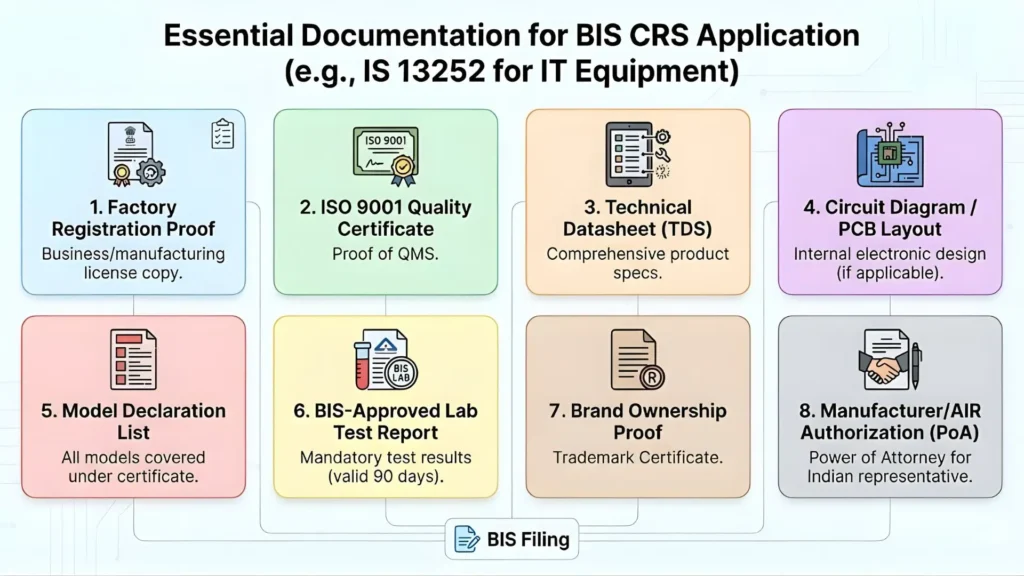
For Indian Manufacturers
- Completed BIS CRS application form — filed via manakonline.in under Scheme-II
- Business registration certificate — Company Incorporation / MSME Certificate / LLP Agreement / Partnership Deed
- GST Registration Certificate
- Manufacturing or assembly facility address proof — ownership deed or lease agreement
- Product details — brand name, model number(s), camera type (camcorder / action / professional), resolution, key specifications
- Safety Test Report from a BIS-recognized laboratory under IS 616:2017 or IS/IEC 62368-1:2023
- Product photographs — all angles including lens, viewfinder, controls, ports, battery compartment, and retail packaging
- Packaging specimens showing BIS Standard Mark placement space and R-number field
- Technical documentation — circuit diagrams, block diagrams, battery specification, charger details, wireless module specs (if applicable)
- Declaration of conformity signed by the authorized signatory
- Authorized signatory identity documents — PAN, Aadhaar, designation letter
- Bank details for BIS fee payments
- WPC type approval certificate for wireless module(s) — mandatory if camera has Wi-Fi / Bluetooth / NFC (can be coordinated simultaneously)
For Foreign Manufacturers / Importers
- All company registration and identity documents of the foreign manufacturer or brand owner
- Authorized Indian Representative (AIR) appointment letter — notarized and signed by the foreign manufacturer
- AIR company registration documents — Indian entity certificate, GST, PAN
- Import Export Code (IEC) of the AIR or Indian importer
- Power of Attorney or MOU between the foreign manufacturer and the Indian AIR
- Safety Test Report from a BIS-recognized or MRA-accredited partner laboratory (IS 616:2017 or IS/IEC 62368-1:2023)
- Brand / trademark ownership certificate or registration document
- Country of origin certificate for the Video Camera
- Product photographs — all angles, accessories (battery, charger, carry case), and retail packaging
- Packaging and label specimens showing designated BIS Standard Mark and Registration Number space
- Technical file — product description, bill of materials, battery cell specifications, sensor details, wireless module make and model, firmware version
- Declaration of conformity from the foreign manufacturer
- WPC type approval for wireless module(s) — mandatory for Wi-Fi / Bluetooth / NFC enabled video cameras
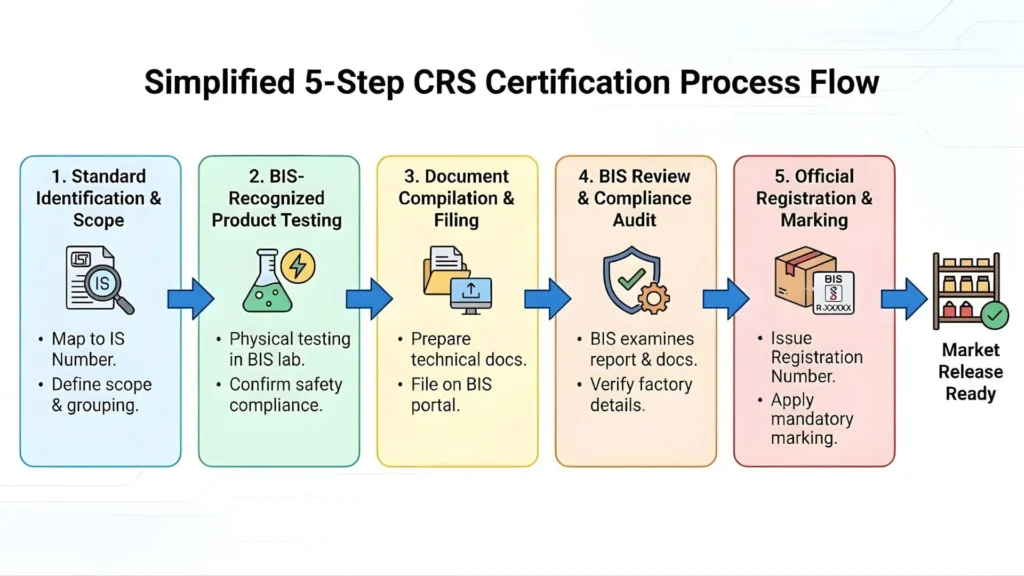
Step-by-Step BIS CRS Registration Process — Video Cameras
| Step | Stage | Key Details |
| 1 | Product Category Confirmation | Confirm your camera is a 'Video Camera' (Sl. No. 35) — not a Digital Camera (Sl. No. 34) or Webcam (Sl. No. 36). Classification is based on primary intended use. |
| 2 | Wireless Compliance Check | Identify all wireless features (Wi-Fi, Bluetooth, NFC, 4G) — WPC type approval is mandatory for each wireless technology. Plan both BIS CRS and WPC simultaneously. |
| 3 | Standard Selection | Choose IS 616:2017 or IS/IEC 62368-1:2023 — new applicants strongly advised to apply under IS/IEC 62368-1:2023 directly to avoid future migration costs |
| 4 | Laboratory Selection | Identify a BIS-recognised laboratory authorised to test Video Cameras under IS 616:2017 or IS/IEC 62368-1:2023 — confirm lab capability for camera product testing |
| 5 | Sample Submission | Submit video camera samples to the lab — include battery, charger, all cables, accessories, and retail packaging |
| 6 | Safety Testing | Lab tests against IS 616:2017 or IS/IEC 62368-1:2023 — covers electrical safety, battery safety, thermal management, charger safety, mechanical safety |
| 7 | Obtain Safety Test Report | Receive the safety test report from the BIS-recognised lab upon successful testing |
| 8 | WPC Type Approval (Parallel) | For wireless video cameras — simultaneously apply for WPC type approval for Wi-Fi / Bluetooth / NFC modules through the WPC online portal |
| 9 | Document Compilation | Prepare all required documents — company registration, AIR appointment, test reports, WPC certificates, brand proof, technical file |
| 10 | Online CRS Application Submission | File BIS CRS application via manakonline.in under Scheme-II — upload all test reports and required documents |
| 11 | BIS Application Scrutiny | BIS reviews the application — may raise queries on product classification, test report scope, wireless module documentation, or technical file completeness |
| 12 | Factory Inspection (if applicable) | For Indian manufacturers — BIS may conduct a factory inspection to verify manufacturing and quality control systems |
| 13 | CRS Licence Grant | BIS issues the CRS licence — valid for 5 years as per the 25 February 2026 amendment |
| 14 | BIS Standard Mark Affixing | Affix ISI Mark and Registration Number R-XXXXXXXX on the video camera body, packaging, or label — verify placement meets BIS requirements |
| 15 | Annual Fee + Production Details | Pay annual licence fee in advance every year and submit production details by the prescribed due date |
| 16 | IS/IEC 62368-1:2023 Migration | For existing licensees — submit updated test reports under IS/IEC 62368-1:2023 before 1 November 2028 |
BIS CRS Registration Fees — Video Cameras
| Fee Component | Description | When Payable |
| Application Processing Fee | One-time fee paid when submitting the BIS CRS application online | At application submission |
| Annual Licence Continuation Fee | Paid every year in advance by the prescribed due date — mandatory throughout the 5-year licence period | Annually (in advance) |
| Safety Testing Fee (Lab) | Charged by the BIS-recognised laboratory for Video Camera safety testing — varies by lab, camera type, complexity, and number of models | Before or during lab testing |
| Renewal Processing Fee | Applicable at the end of the 5-year licence period when applying for the next 5-year renewal | At 5-year renewal |
| Change in Scope Fee | Applicable when adding new video camera models or variants to an existing licence scope | At scope change request |
| Late Annual Fee Surcharge | Applied when annual fee is not paid by the prescribed due date — risk of suspension if unresolved | As and when applicable |
| WPC Type Approval Fee | Separate fee paid to WPC for wireless module type approval — mandatory for Wi-Fi / Bluetooth / NFC cameras; governed separately from BIS CRS | At WPC application submission |
Note: BIS fee amounts are revised periodically. WPC type approval fees are governed separately by WPC, Ministry of Communications. Always verify current fee schedules on bis.gov.in and wpc.gov.in, or consult a certified compliance consultant like Silvereye Certifications for accurate, current fee guidance before initiating the process.
BIS CRS License Validity, Renewal & Annual Compliance — Video Cameras 2026
Initial License Grant — 5 Years
- Video Camera CRS license is now granted for an initial period of 5 years from the date of issue (post 25 Feb 2026 amendment)
- Annual fees must be paid in advance by the prescribed due date every year throughout the 5-year period
- Production details — model-wise quantities manufactured or imported — must accompany each annual fee payment
- BIS Standard Mark with R-number must remain accurately displayed on all active product batches
License Renewal — Further 5 Years
- At the end of the 5-year period, the license is renewed for a further 5 years
- Renewal fees follow the same annual payment structure — paid in advance each year during the renewal period
- By the time of first post-2026 renewal, all video camera models must already be IS/IEC 62368-1:2023 compliant
Consequences of Non-Compliance with Annual Obligations
- Non-payment of annual fee by due date → suspension or deferment of CRS license
- Continued non-payment → cancellation or expiry of the license
- Cancelled license → Video Cameras cannot be legally sold, imported, or distributed in India
- Non-migration to IS/IEC 62368-1:2023 by 1 November 2028 → license made inoperative or models removed from scope
- Reinstating a cancelled licence requires a completely fresh application — entire process starts from scratch
| Annual Compliance Checklist for Video Camera CRS Licensees • Set reminders 60–90 days before your annual BIS fee due date — BIS does not send proactive reminders • Prepare model-wise production details at least 30 days before the annual submission deadline • Track the IS/IEC 62368-1:2023 migration deadline — 1 November 2028 — plan and begin testing well in advance • For wireless video cameras — ensure WPC type approvals are current and renewed before expiry • Verify BIS Standard Mark placement and R-number accuracy on all active product batches for every model • Assign a dedicated compliance manager or work with a consultant to manage annual obligations across your camera portfolio |
IS/IEC 62368-1:2023 Migration Guidelines — Video Camera Brands
Existing CRS Licensees — Action Required Before 1 November 2028
- Implement IS/IEC 62368-1:2023 compliance for all Video Camera models in your license scope by 1 November 2028 — no exceptions.
- Submit complete Test Reports from a BIS-recognized laboratory (tested under IS/IEC 62368-1:2023) for all lead models covered under your CRS license.
- Upload updated test reports through the Standard Revision / Amendment / Essential Requirement provision available in your BIS portal login ID.
- Provide a signed undertaking confirming IS/IEC 62368-1:2023 requirements have been implemented in all series models (variants of lead models) within your license scope.
- BIS will issue a confirmation letter once migration is verified — listing all compliant video camera models.
- Failure to complete migration by 1 November 2028 → license cancellation or model deletion. Legal right to sell those video cameras in India is immediately lost.
New Applicants — First-Time BIS CRS for Video Cameras
- Applications where samples have already been submitted to a laboratory under IS 616:2017 can still be processed under the old standard
- New applications can be filed directly under IS/IEC 62368-1:2023 — strongly recommended to avoid future migration costs, retesting, and documentation updates
- Applying under IS 616:2017 requires a signed declaration committing to IS/IEC 62368-1:2023 migration by 1 November 2028
- After 1 November 2028, no new CRS license will be granted under IS 616:2017 for Video Cameras
Change in Scope — Adding New Video Camera Models
- Adding new video camera models to an existing licence scope follows the same guidelines as for new applicants
- Scope change requests under IS 616:2017 are permitted only until the licensee's own IS/IEC 62368-1:2023 switchover date or 1 November 2028 — whichever is earlier
Complete List of 38 Products Migrating to IS/IEC 62368-1:2023 Under BIS CRS (2026)
All 38 product categories under BIS CRS migration as per the BIS implementation guidelines dated 9 March 2026. Video Cameras appear at Sl. No. 35 — note the adjacent Digital Cameras (Sl. No. 34) and Webcams (Sl. No. 36) are separate categories requiring separate licences:
| Sl. No. | Product Category | Current Standard | New Standard | Deadline |
| 1 | Electronic Games (Video) | IS 616:2017 | IS/IEC 62368-1:2023 | 1 Nov 2028 |
| 2 | Laptops / Notebooks / Tablets | IS 13252 (Part 1):2010 | IS/IEC 62368-1:2023 | 1 Nov 2028 |
| 3 | Plasma / LCD / LED Television | IS 616:2017 & IS 18112:2025 | IS/IEC 62368-1:2023 & IS 18112:2025 | 1 Nov 2028 |
| 4 | Optical Disc Players (200W and above) | IS 616:2017 | IS/IEC 62368-1:2023 | 1 Nov 2028 |
| 5 | Visual Display Units / Video Monitors | IS 13252 (Part 1):2010 | IS/IEC 62368-1:2023 | 1 Nov 2028 |
| 6 | Printers / Multi-Function Devices / Plotters | IS 13252 (Part 1):2010 | IS/IEC 62368-1:2023 | 1 Nov 2028 |
| 7 | Scanners, Barcode Readers, Iris Scanners, Optical Fingerprint Scanners | IS 13252 (Part 1):2010 | IS/IEC 62368-1:2023 | 1 Nov 2028 |
| 8 | Wireless Keyboards | IS 13252 (Part 1):2010 | IS/IEC 62368-1:2023 | 1 Nov 2028 |
| 9 | Telephone Answering Machines | IS 13252 (Part 1):2010 | IS/IEC 62368-1:2023 | 1 Nov 2028 |
| 10 | Amplifiers (2000W and above) | IS 616:2017 | IS/IEC 62368-1:2023 | 1 Nov 2028 |
| 11 | Electronic Musical Systems | IS 616:2017 | IS/IEC 62368-1:2023 | 1 Nov 2028 |
| 12 | Set Top Boxes | IS 13252 (Part 1):2010 | IS/IEC 62368-1:2023 | 1 Nov 2028 |
| 13 | Automatic Data Processing Machines | IS 13252 (Part 1):2010 | IS/IEC 62368-1:2023 | 1 Nov 2028 |
| 14 | Power Adaptors for IT Equipment | IS 13252 (Part 1):2010 | IS/IEC 62368-1:2023 | 1 Nov 2028 |
| 15 | Power Adaptors for Audio / Video Equipment | IS 616:2017 | IS/IEC 62368-1:2023 | 1 Nov 2028 |
| 16 | Mobile Phones | IS 13252 (Part 1):2010 & IS 16333 (Part 3):2022 | IS/IEC 62368-1:2023 & IS 16333 (Part 3):2022 | 1 Nov 2028 |
| 17 | Cash Registers | IS 13252 (Part 1):2010 | IS/IEC 62368-1:2023 | 1 Nov 2028 |
| 18 | Point of Sale Terminals | IS 13252 (Part 1):2010 | IS/IEC 62368-1:2023 | 1 Nov 2028 |
| 19 | Copying Machines / Duplicators | IS 13252 (Part 1):2010 | IS/IEC 62368-1:2023 | 1 Nov 2028 |
| 20 | Smart Card Readers | IS 13252 (Part 1):2010 | IS/IEC 62368-1:2023 | 1 Nov 2028 |
| 21 | Mail / Postage / Franking Machines | IS 13252 (Part 1):2010 | IS/IEC 62368-1:2023 | 1 Nov 2028 |
| 22 | Passport Readers | IS 13252 (Part 1):2010 | IS/IEC 62368-1:2023 | 1 Nov 2028 |
| 23 | Power Bank (Portable Application) | IS 13252 (Part 1):2010 | IS/IEC 62368-1:2023 | 1 Nov 2028 |
| 24 | CCTV Cameras / CCTV Recorders | IS 13252 (Part 1):2010 + IP Security ERs | IS/IEC 62368-1:2023 + IP Security ERs | 1 Nov 2028 |
| 25 | Smart Watches | IS 13252 (Part 1):2010 | IS/IEC 62368-1:2023 | 1 Nov 2028 |
| 26 | Keyboards | IS 13252 (Part 1):2010 | IS/IEC 62368-1:2023 | 1 Nov 2028 |
| 27 | Automatic Teller Cash Dispensing Machines | IS 13252 (Part 1):2010 | IS/IEC 62368-1:2023 | 1 Nov 2028 |
| 28 | USB Type External Hard Disk Drives | IS 13252 (Part 1):2010 | IS/IEC 62368-1:2023 | 1 Nov 2028 |
| 29 | Wireless Headphones and Earphones | IS 616:2017 | IS/IEC 62368-1:2023 | 1 Nov 2028 |
| 30 | USB External Solid-State Storage Devices (above 256 GB) | IS 13252 (Part 1):2010 | IS/IEC 62368-1:2023 | 1 Nov 2028 |
| 31 | Standalone SMPS (output voltage 48V max) | IS 13252 (Part 1):2010 | IS/IEC 62368-1:2023 | 1 Nov 2028 |
| 32 | Televisions other than Plasma / LCD / LED | IS 616:2017 & IS 18112:2025 | IS/IEC 62368-1:2023 & IS 18112:2025 | 1 Nov 2028 |
| 33 | Wireless Microphones | IS 616:2017 | IS/IEC 62368-1:2023 | 1 Nov 2028 |
| 34 | Digital Cameras | IS 13252 (Part 1):2010 | IS/IEC 62368-1:2023 | 1 Nov 2028 |
| 35 | Video Cameras ★ | IS 616:2017 | IS/IEC 62368-1:2023 | 1 Nov 2028 |
| 36 | Webcams (Finished Product) | IS 616:2017 | IS/IEC 62368-1:2023 | 1 Nov 2028 |
| 37 | Smart Speakers (with / without Display) | IS 616:2017 | IS/IEC 62368-1:2023 | 1 Nov 2028 |
| 38 | Bluetooth Speakers | IS 616:2017 | IS/IEC 62368-1:2023 | 1 Nov 2028 |
Video Cameras are listed at Sl. No. 35 in the BIS Migration Guidelines issued on 9 March 2026. Current standard: IS 616:2017. New mandatory standard: IS/IEC 62368-1:2023. Migration deadline: 1 November 2028. Note: Digital Cameras (Sl. No. 34) and Webcams (Sl. No. 36) are separate product categories requiring separate BIS CRS licenses.
Key Benefits of BIS CRS Registration for Video Camera Brands
- Legal right to sell in India: BIS CRS is the mandatory legal gateway — no video camera can be legally imported, distributed, or sold in India without it
- Customs clearance: The BIS Registration Number (R-XXXXXXXX) is required at Indian customs — without it, video camera consignments are detained, returned, or confiscated
- E-commerce marketplace access: Amazon India, Flipkart, and other major platforms require a valid BIS CRS R-number for video camera product listings — uncertified products are de-listed
- Professional and broadcast distribution: Authorized distributors of professional video cameras for film, broadcast, and corporate clients require BIS CRS as a supply chain qualification
- Government and institutional procurement: Government media departments, police body camera procurement, education institutions — all specify BIS-certified video cameras
- Film and production industry access: Bollywood and regional film industry production companies increasingly require BIS-certified equipment for their procurement processes
- Consumer trust and credibility: The BIS Standard Mark signals product safety and regulatory compliance — important in a market where counterfeit and uncertified cameras are a real problem
- Protection from enforcement action: Valid BIS CRS shields your brand from product seizure, import bans, financial penalties, and prosecution under the BIS Act, 2016
- 5-year license stability (2026 update): Reduced administrative overhead — 5-year license term with fewer renewal cycles and lower ongoing compliance management costs
Eligibility Criteria for BIS CRS Registration — Video Cameras
| Applicant Type | Eligibility Requirement | Key Condition |
| Indian Manufacturer | Registered business entity in India — Company, LLP, MSME, or Proprietorship | Must have a manufacturing or assembly facility producing video cameras in India |
| Foreign Manufacturer | Any registered overseas entity or brand owner | Must appoint a registered Indian entity as AIR before applying — cannot apply directly |
| Authorised Indian Representative (AIR) | Indian company, LLP, or individual | Must hold a valid IEC code and a formal written appointment from the foreign manufacturer |
| Indian Importer / Distributor | Registered Indian business entity with valid IEC | Can act as AIR for the foreign video camera brand and hold the CRS licence on their behalf |
| Professional Equipment Distributor | Registered Indian entity with IEC | Importers and distributors of professional video cameras for film, broadcast, and corporate markets must hold or coordinate BIS CRS for all models they distribute |
There is no minimum revenue, production volume, or capital requirement for BIS CRS eligibility. A startup importing budget action cameras and a global professional cinema camera company establishing India distribution are both equally required — and equally eligible — to obtain BIS CRS Registration before their video cameras can legally enter the Indian market.
Silvereye Certifications — India's Trusted BIS CRS Consultant for Video Camera Brands
BIS CRS Registration for Video Cameras requires a consultant who understands the nuances of imaging product classification, IS 616:2017 and IS/IEC 62368-1:2023 testing requirements, WPC type approval for wireless-enabled cameras, and the specific documentation needs of both consumer and professional camera segments. Silvereye Certifications brings all of this expertise — and stays current with every regulatory change in India's electronics compliance landscape.
Silvereye Certifications is one of India's most experienced BIS CRS consulting firms, with a proven track record in audio/video products, imaging devices, consumer electronics, and professional equipment certification. Whether you represent a global action camera brand entering the Indian D2C market, a professional video camera manufacturer supplying to Bollywood studios, or a consumer camcorder importer — Silvereye delivers compliance results that keep your business running and your products legally on sale in India.
Conclusion
BIS CRS Registration for Video Cameras is a non-negotiable legal requirement for every brand — consumer to professional — that wants to operate in India's vibrant video camera and content creation market. The 2025-2026 regulatory updates bring added urgency and complexity: MeitY has mandated migration from IS 616:2017 to IS/IEC 62368-1:2023 by 1 November 2028, BIS has extended licence validity to 5 years while keeping annual compliance obligations in place, and wireless-enabled video cameras face a dual compliance requirement of BIS CRS plus WPC type approval.
Getting the product classification right — Video Camera vs Digital Camera vs Webcam — is an additional critical step that brands must address from the outset.
Frequently Asked Questions
Is BIS CRS Registration mandatory for all Video Cameras sold in India?
Yes, completely mandatory. Video Cameras are listed under the Electronics and Information Technology Goods (Requirement of Compulsory Registration) Order, 2021. Every video camera — consumer camcorder, action camera, professional broadcast camera, cinema camera — sold, imported, or manufactured in India must carry a valid BIS CRS licence and the BIS Standard Mark. Selling without certification violates the BIS Act, 2016.
How is a Video Camera different from a Digital Camera for BIS CRS purposes?
The distinction is based on primary intended use. A Video Camera (Sl. No. 35) is primarily designed and marketed for video recording — camcorders, action cameras, cinema cameras, broadcast cameras. A Digital Camera (Sl. No. 34) is primarily designed for still photography — DSLRs, mirrorless cameras, point-and-shoot cameras — even if it also records video.
What standard applies to Video Cameras under BIS CRS in 2026?
Video Cameras currently fall under IS 616:2017 — the audio/video equipment safety standard (based on IEC 60065:2014). This is being replaced by IS/IEC 62368-1:2023 as per MeitY notification S.O. 4997(E) dated 29 October 2025. Both standards run concurrently until 1 November 2028, after which only IS/IEC 62368-1:2023 is valid.
Does my action camera (like GoPro-style) need BIS CRS as a Video Camera?
Yes. Action cameras are video recording devices primarily designed to capture video footage — they fall squarely under the 'Video Cameras' category at Sl. No. 35 in the BIS CRS notification. They require BIS CRS certification under IS 616:2017 (migrating to IS/IEC 62368-1:2023).
Do Video Cameras with Wi-Fi need WPC type approval in addition to BIS CRS?
Yes. Any Video Camera with Wi-Fi, Bluetooth, NFC, or 4G/LTE connectivity requires WPC (Wireless Planning and Coordination Wing) type approval for the wireless module in addition to BIS CRS for product safety. WPC is a separate mandatory compliance issued by the Ministry of Communications.
How long is the BIS CRS licence valid for Video Cameras in 2026?
Following the BIS amendment effective 25 February 2026, the CRS licence for Video Cameras is now valid for 5 years from the date of grant. Renewal is also for 5 years. Annual fees must still be paid every year in advance by the prescribed due date, with production details. The 5-year term reduces renewal administrative work but does not eliminate annual compliance obligations.
What is the IS/IEC 62368-1:2023 migration deadline for Video Camera brands?
The migration deadline is 1 November 2028. After this date, IS 616:2017 is officially withdrawn for Video Cameras. Existing licensees who have not completed migration will have their licences made inoperative or models deleted from scope.
Can a foreign video camera manufacturer apply directly for BIS CRS in India?
No. A foreign manufacturer must appoint an Authorized Indian Representative (AIR) — a registered Indian entity with a valid IEC code — who submits the BIS CRS application and holds the license on their behalf. The AIR is fully responsible for all compliance obligations including annual fees, production reporting, and BIS correspondence.
Can multiple video camera models be covered under one BIS CRS licence?
Yes. A single BIS CRS licence can cover multiple video camera models within the same product category. Lead models are safety-tested and certified. Series models — variants of the lead model (e.g., different colour options, storage configurations, or minor accessory differences that do not affect safety parameters) — can be added through a signed undertaking per BIS guidelines.
What are the penalties for importing or selling Video Cameras without BIS CRS in India?
Selling, importing, or distributing Video Cameras in India without a valid BIS CRS licence violates the BIS Act, 2016 and the CRO 2021 notification. Consequences include: customs detention or rejection of camera consignments, product seizure from retail and distribution channels, de-listing from e-commerce platforms, financial penalties from BIS enforcement authorities, and criminal prosecution for large-scale or repeat violations.