

- Mandatory CRS license required before selling or importing any USB-driven barcode reader, barcode scanner, iris scanner or optical fingerprint scanner in India.
- Compliance now migrates to IS/IEC 62368-1:2023 from IS 13252 (Part 1):2010 — concurrent running allowed until 01 November 2028 per BIS Guidelines dated 09 March 2026.
- BIS CRS license validity extended to 5 years (initial grant + renewal) under the BIS (Conformity Assessment) Regulations amendment dated 25 February 2026 — annual fees still apply.
Introduction
BIS CRS Registration For barcode readers, barcode scanners, iris scanners, and optical fingerprint scanners sold or imported in India under MeitY's Electronics and IT Goods (Requirement of Compulsory Registration) Order, 2021. Manufacturers and importers must get their products tested at a BIS-recognized laboratory against IS 13252 (Part 1):2010 — now migrating to IS/IEC 62368-1:2023 (deadline: 01 November 2028) — and register on the BIS CRS portal. As of 25 February 2026, the CRS license is valid for five years (fees paid annually). The process typically takes 60–90 days.
What Is BIS CRS Registration and Why Does It Apply to Barcode Readers?
The Bureau of Indian Standards (BIS) operates the Compulsory Registration Scheme (CRS) under the Electronics and Information Technology Goods (Requirement of Compulsory Registration) Order, 2021 — commonly called the CRO. Under this scheme, specific electronic products cannot be legally sold, distributed, or imported into India without a valid BIS CRS certificate bearing the CRS mark.

USB-driven barcode readers, barcode scanners, iris scanners, and optical fingerprint scanners fall explicitly within the CRO product list. This means every manufacturer — whether domestic or foreign — and every importer bringing these devices into India must obtain a BIS CRS registration before placing the product in the Indian market.

The rationale is straightforward: barcode readers and scanners are now embedded in critical infrastructure — retail POS terminals, logistics warehouses, airport baggage systems, banking ATMs, and government identity verification systems. BIS certification ensures these devices meet India's safety and electromagnetic compatibility (EMC) standards, protecting consumers, end-users and critical digital infrastructure.
Which Exact Products Are Covered?
The CRO uses precise product descriptions. The following devices fall under the barcode reader / scanner category:
| Product | Coverage Notes |
| USB-driven barcode readers | Wired USB barcode scanners used in POS, inventory, logistics |
| Barcode scanners (handheld & fixed mount) | Laser, CCD, and 2D imager type scanners |
| Iris scanners | Biometric iris recognition devices |
| Optical fingerprint scanners | Fingerprint readers using optical technology |
Note: Wireless barcode scanners that use Bluetooth or Wi-Fi may also fall under additional wireless device regulations. Always confirm your product's connectivity with a BIS consultant before applying.
Key 2026 Regulatory Updates You Must Know
Migration to IS/IEC 62368-1:2023 (MeitY S.O. 4997(E) & BIS Guidelines, March 2026)
MeitY issued Notification S.O. 4997(E) on 29 October 2025, amending the CRO to notify IS/IEC 62368-1:2023 as the new safety standard for AV, IT and communication equipment — including barcode readers (previously tested under IS 13252 (Part 1):2010). BIS subsequently issued Guidelines Ref: Reg/IS/IEC 62368-1:2023/Guidelines/01 dated 09 March 2026 laying out the migration framework.
- Concurrent running: Both IS 13252 (Part 1):2010 and IS/IEC 62368-1:2023 are valid until 01 November 2028.
- After 01 November 2028: IS 13252 (Part 1):2010 stands withdrawn; only IS/IEC 62368-1:2023 will be accepted.
- New applicants from today can still apply under IS 13252 (Part 1):2010 provided samples are already submitted or tests underway — but must commit to IS/IEC 62368-1:2023 migration before the deadline.
- Existing licensees must submit IS/IEC 62368-1:2023 test reports for lead models through the Standard Revision provision in their BIS login and provide an undertaking for series models.
CRS License Validity Extended to 5 Years (Amendment dated 25 February 2026)
The BIS (Conformity Assessment) Regulations, 2018 were amended on 25 February 2026 to revise validity and continuation provisions under Scheme-II (which covers CRS licenses):
- Initial license validity: 5 years (previously 2 years)
- Renewal period: Further 5 years
- Fees: Payable on annual basis in advance by the prescribed due date
- Non-payment consequence: Suspension/deferment or cancellation/expiry as per the Regulations
- Action: Ensure annual fees + production details are submitted on time to avoid suspension
Applicable Indian Standards for Barcode Reader CRS Registration
Getting the standard right is one of the most common points of confusion for first-time applicants. Here is a clear comparison for barcode readers in 2026:
| Standard | Type | Status in 2026 | Applicable Till |
| IS 13252 (Part 1):2010 | Safety — IT equipment | Currently valid (concurrent) | 01 November 2028 |
| IS/IEC 62368-1:2023 | Safety — AV/IT/ICT equipment (supersedes IS 13252) | Valid — migration mandatory | Ongoing (post Nov 2028 only this applies) |
IS/IEC 62368-1:2023 is a comprehensive hazard-based safety engineering standard that replaces the older prescriptive approach of IS 13252 (Part 1):2010. It covers electrical, thermal, mechanical, radiation, and chemical hazard categories. Testing under IS/IEC 62368-1:2023 is widely accepted globally, making it easier for foreign manufacturers to reuse international test data where a BIS-recognized lab countersigns or supplements the report.
Who Must Apply for BIS CRS Registration for Barcode Readers?
| Applicant Type | Eligibility Condition |
| Indian Manufacturer | Must have a manufacturing facility in India; applies directly for each model |
| Foreign Manufacturer | Must appoint an Authorised Indian Representative (AIR) to apply on their behalf |
| Importer / Brand Owner | Must hold a valid BIS CRS licence for each model they import into India — cannot sell without this |
| OEM / ODM Supplier | Each unique model with a different product configuration requires a separate CRS application |
There is no minimum company size or turnover requirement. A startup importing a single model of USB barcode scanner must comply exactly the same as a large enterprise importing hundreds of models. The obligation is product-based, not company-based.
Documents Required for BIS CRS Registration — Barcode Readers
| Document | Details / Notes |
| Application Form | Online application filed through BIS CRS portal (manak.bis.gov.in) |
| Test Report | Issued by a BIS-recognised test laboratory; must cover IS 13252 (Part 1):2010 or IS/IEC 62368-1:2023 |
| Product Photograph | Clear image of the product with visible model number and brand name |
| Declaration of Conformity (DoC) | Signed by the authorised signatory of the applicant company |
| Company Registration Certificate | Certificate of Incorporation / GST Registration (for Indian entities) |
| AIR Appointment Letter | Mandatory for foreign manufacturers — signed agreement between manufacturer and Indian AIR |
| Factory / Facility Details | Name, address and manufacturing/assembly location of the product |
| Undertaking for IS/IEC 62368-1:2023 Migration | Required if applying under IS 13252 (Part 1):2010 — commits to migration before 01 November 2028 |
| Series Model List | If the application covers a family of models (lead + series), full list with variant details |
| Import Documents (if applicable) | Commercial invoice, packing list, and Bill of Entry for imported samples sent for testing |
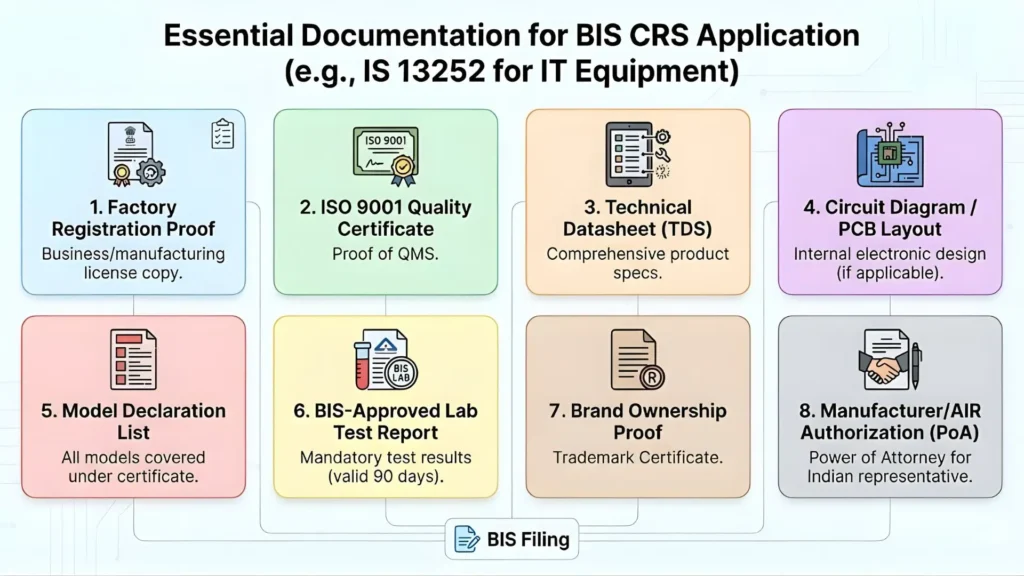
Important: All documents submitted on the BIS CRS portal must be in English or accompanied by a certified English translation. Documents signed by overseas entities must typically be notarised or apostilled as per BIS requirements.
Step-by-Step BIS CRS Registration Process for Barcode Readers (2026)
| Step | Activity | Responsible Party | Approx. Timeline |
| Step 1 | Identify the applicable CRS product category and standard (IS 13252 / IS/IEC 62368-1:2023) | Applicant / Consultant | Day 1–2 |
| Step 2 | Select a BIS-recognised test laboratory from the approved list on bis.gov.in | Applicant / Consultant | Day 2–5 |
| Step 3 | Submit product samples to the BIS-recognised laboratory for testing | Applicant | Day 5–10 |
| Step 4 | Laboratory conducts safety tests and issues Test Report | BIS Lab | Day 10–45 |
| Step 5 | Prepare and compile all documents including DoC, AIR letter, facility details | Applicant / Consultant | Day 30–50 |
| Step 6 | Create applicant account on BIS CRS portal and file online application | Applicant / AIR | Day 50–55 |
| Step 7 | Pay registration fees online through the BIS portal | Applicant | Day 55–56 |
| Step 8 | BIS grants CRS certificate and Registration Number upon successful review | BIS | Day 80–90 |
| Step 9 | Affix the BIS Standard Mark (R number) on the product / packaging | Applicant | Post-grant |
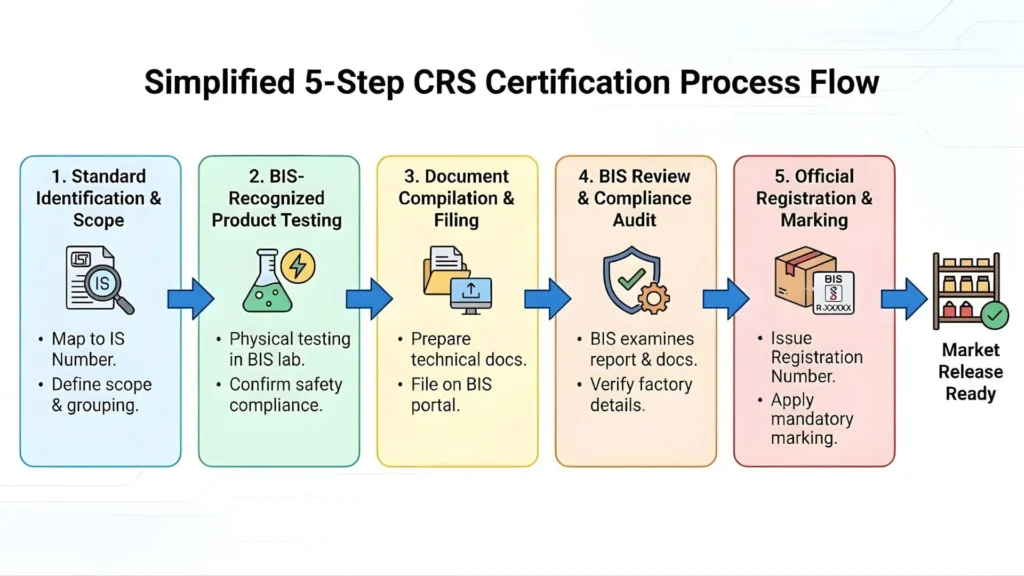
The typical end-to-end timeline is 60 to 90 days from sample submission to grant of license. Laboratory testing is usually the longest variable. Working with an experienced BIS CRS consultant can reduce delays caused by document deficiencies or portal filing errors.
BIS CRS Registration Fees for Barcode Readers (2026)
| Fee Component | Amount / Basis |
| Application Processing Fee | As per BIS fee schedule (payable online at the time of application filing) |
| Annual Licence / Continuation Fee | Payable each year in advance by the prescribed due date |
| Renewal Fee | Payable at the time of renewal (every 5 years); fees on annual basis during renewal period |
| Laboratory Testing Charges | Varies by lab (approx. INR 15,000 – INR 60,000 per model depending on scope) |
| Factory Inspection Fee (if applicable) | Charged by BIS for on-site verification, if required |
Note: BIS revises its fee schedule periodically. Always check the latest fee structure on the official BIS CRS portal (manak.bis.gov.in) or through a certified BIS consultant before planning your budget. Fees are non-refundable once paid.
As per the 25 February 2026 amendment, fees are no longer tied to a 2-year renewal cycle. The 5-year licence means you now pay annual fees for 5 consecutive years before the first renewal — this is more predictable for long-term budget planning.
CRS License Validity and Renewal — What Changed in 2026?
| Parameter | Before Feb 2026 | After 25 Feb 2026 Amendment |
| Initial Validity | 2 years | 5 years |
| Renewal Period | 2 years | 5 years |
| Fee Payment | On renewal cycle | Annual, paid in advance |
| Non-Payment Consequence | Licence lapse | Suspension/Deferment → Cancellation |
| Production Details | Required at renewal | Submitted annually with fees |
The 5-year validity is a significant improvement for manufacturers and importers. It reduces the administrative burden of frequent renewals and gives businesses a longer planning horizon. However, the annual fee obligation is firm — missing the annual payment by the due date will trigger the suspension or cancellation process under the BIS (Conformity Assessment) Regulations, 2018, as amended.
Complete BIS CRS Coverage: Barcode Readers, Scanners & Related Devices
The table below covers the full range of barcode reader and scanner product types commonly encountered in the Indian market, with their BIS CRS status, applicable standard, and compliance notes:
| Product Type | Technology | CRS Required? | Applicable Standard | Common Use Case |
| USB Barcode Reader (Wired) | Laser / CCD / 2D Imager | Yes | IS/IEC 62368-1:2023 (migration from IS 13252 Pt.1:2010) | POS, retail, inventory management |
| Handheld Barcode Scanner | Laser / Imager | Yes | IS/IEC 62368-1:2023 | Warehousing, logistics, e-commerce fulfilment |
| Fixed-Mount Barcode Scanner | 2D Imager / Laser | Yes | IS/IEC 62368-1:2023 | Conveyor lines, checkout counters |
| Omni-directional Barcode Scanner | Multi-line laser | Yes | IS/IEC 62368-1:2023 | Supermarkets, high-volume retail |
| QR Code Reader (USB) | 2D Imager / CMOS | Yes | IS/IEC 62368-1:2023 | Ticketing, digital payments, traceability |
| Iris Scanner (Biometric) | NIR Camera + Algorithm | Yes | IS/IEC 62368-1:2023 | Aadhaar authentication, border control, banking KYC |
| Optical Fingerprint Scanner | Optical Sensor | Yes | IS/IEC 62368-1:2023 | Biometric attendance, banking, access control |
| Wireless Barcode Scanner (Bluetooth) | Bluetooth + 2D Imager | Yes (CRS + possible BT norms) | IS/IEC 62368-1:2023 + relevant wireless standard | Mobile POS, field data capture |
| Wearable Ring Scanner | 2D Imager | Yes | IS/IEC 62368-1:2023 | Warehouse picking, courier sorting |
| Industrial Barcode Verifier | Imager | Yes | IS/IEC 62368-1:2023 | Print quality verification in manufacturing |
| Document Barcode Scanner (multi-line) | CCD Line Imager | Yes | IS/IEC 62368-1:2023 | Passport readers, identity document processing |
| Barcode Printer-Scanner Combo | Thermal + Imager | Yes (scanner component) | IS/IEC 62368-1:2023 | Logistics labelling and scanning |
Note: If your product is a combination device (e.g., a barcode scanner with built-in Wi-Fi or cellular), additional standards may apply. Confirm the exact product scope with a BIS consultant before starting the registration process.
Benefits of BIS CRS Registration for Barcode Reader Manufacturers and Importers
| Benefit | What It Means in Practice |
| Legal Market Access | Only BIS CRS registered products can be legally sold in India — no registration means no legal sales |
| Consumer Trust | The BIS ISI mark signals quality and safety to Indian buyers, retailers and enterprise procurement teams |
| Customs Clearance | Import consignments without valid BIS CRS certificates can be held or rejected at Indian customs |
| Eligibility for Government Tenders | Most government and PSU tenders require BIS-certified products — CRS opens this market |
| Competitive Advantage | BIS certification differentiates your product from uncertified grey-market imports |
| 5-Year Licence Stability (2026) | New 5-year validity reduces renewal overhead and gives long-term business certainty |
| IS/IEC 62368-1:2023 Alignment | Aligns Indian certification with global safety standards, making international test data partially reusable |
IS/IEC 62368-1:2023 Migration Checklist for Existing BIS CRS Licenses
If you already hold a BIS CRS license for your barcode readers under IS 13252 (Part 1):2010, here is what you need to do before 01 November 2028:
| Action Item | Details |
| Get lead models re-tested | Submit samples of your lead model(s) to a BIS-recognised lab for testing under IS/IEC 62368-1:2023 |
| Obtain new test reports | Ensure test reports are issued specifically referencing IS/IEC 62368-1:2023 |
| Upload via Standard Revision provision | Log into your BIS licence portal and use the Standard Revision/Amendment/Essential Requirement provision to upload new test reports |
| Submit series model undertaking | Provide a signed undertaking that all series models covered by the licence are also compliant with IS/IEC 62368-1:2023 |
| Receive BIS confirmation letter | BIS will issue a formal letter confirming successful migration for all listed models |
| Do not wait until 2028 | Start migration now — labs get congested as the deadline approaches, and delays may result in licence cancellation |
Conclusion
Navigating BIS CRS registration for barcode readers, scanners, iris scanners, and fingerprint scanners requires expertise in product classification, laboratory coordination, BIS portal compliance, and the evolving IS/IEC 62368-1:2023 migration framework. Silvereye Certifications brings years of hands-on experience helping manufacturers and importers — Indian and international — achieve and maintain BIS CRS certification efficiently.
Our Services Include:
- BIS CRS product eligibility assessment and product category confirmation
- BIS-recognised laboratory identification and sample submission coordination
- Full document preparation: DoC, AIR appointment, facility details, undertakings
- BIS CRS portal application filing and fee management
- IS/IEC 62368-1:2023 migration support for existing licensees
- Annual fee and licence renewal management
- Post-certification compliance: marking, production reporting, model additions
- End-to-end support for foreign manufacturers via Authorised Indian Representative (AIR) services
Frequently Asked Questions
Is BIS CRS registration mandatory for barcode readers sold in India?
Yes. USB-driven barcode readers, barcode scanners, iris scanners, and optical fingerprint scanners are explicitly listed under the Electronics and IT Goods (Requirement of Compulsory Registration) Order, 2021. Selling or importing these products without a valid BIS CRS certificate is a legal violation.
Which standard applies to barcode readers in 2026 — IS 13252 or IS/IEC 62368-1:2023?
Both are currently valid under the concurrent running period allowed until 01 November 2028. New applicants can apply under IS 13252 (Part 1):2010 if testing is already underway, but must commit to migrating to IS/IEC 62368-1:2023 before the deadline. After November 2028, only IS/IEC 62368-1:2023 will be accepted.
How long is a BIS CRS licence valid for barcode readers?
As per the BIS (Conformity Assessment) Regulations amendment dated 25 February 2026, the initial licence is now valid for 5 years, and renewal is granted for a further 5 years. Annual fees must be paid in advance — non-payment triggers suspension or cancellation.
Can a foreign manufacturer apply directly for BIS CRS registration?
No. Foreign manufacturers must appoint an Authorised Indian Representative (AIR) — typically an Indian company — who files and holds the BIS CRS application on their behalf. The AIR takes legal responsibility for the product's compliance in India.
How long does BIS CRS registration take for barcode readers?
The typical timeline is 60 to 90 days from sample submission to grant of certificate. Laboratory testing is the longest variable. Document preparation and portal filing can be done in parallel to save time.
Do I need a separate BIS CRS licence for each barcode scanner model?
Each product configuration with different electrical or mechanical characteristics generally requires its own application. However, BIS allows series models — variants with minor differences from a lead model — to be covered under the same licence subject to BIS guidelines.
What happens if my barcode reader is a combination device (e.g., scanner + Wi-Fi)?
Combination devices may attract additional certification requirements beyond the base IS/IEC 62368-1:2023. Wireless functionality may require compliance with relevant wireless standards. Confirm the full compliance scope with a BIS consultant before starting testing.
What is the penalty for selling barcode readers without BIS CRS certification?
Under the BIS Act, 2016, penalties for selling uncertified products include fines up to INR 2 lakh for first offences, higher fines for repeat violations, and potential imprisonment up to 2 years. Products can also be seized and confiscated.
I already have a BIS CRS licence under IS 13252 (Part 1):2010. Do I need to do anything?
Yes. You must migrate your licence to IS/IEC 62368-1:2023 by 01 November 2028. This requires getting lead models re-tested at a BIS-recognised lab under the new standard and uploading the new test reports via the Standard Revision provision in your BIS login. Start early — the 2028 deadline will create lab backlogs.
Can I reuse international test reports (CE, FCC, etc.) for BIS CRS registration?
International test reports from accredited labs can sometimes be used as a reference, but a BIS-recognised Indian laboratory must issue or endorse the final test report. The extent of reuse depends on the scope of the international test and the BIS lab's assessment. Partial reuse is possible for IS/IEC 62368-1:2023 since it is aligned with the IEC standard.