
- What it is: A BIS license that authorises a manufacturer to use the ISI Mark on products that conform to the applicable Indian Standard and are covered under the approved license scope.
- What it tells buyers: The ISI Mark indicates that the product is covered by a valid BIS license. Buyers can check the CM/L (License) number and related license details through the BIS Care app.
- Two application routes: Manufacturers may apply through the Normal Procedure (typically around four months) or the Simplified Procedure (typically around one month), subject to eligibility and applicable BIS requirements. Applications are submitted online through the Manak Online portal.
- Key fees and validity: The application fee is ₹1,000, and the inspection fee is ₹7,000 per man-day. An initial BIS license is generally granted for up to two years and can be renewed for a period of one to five years, subject to BIS requirements.
Introduction
ISI Mark Certification is a product certification license granted by the Bureau of Indian Standards (BIS) under Scheme-I of the BIS (Conformity Assessment) Regulations, 2018. It authorizes a manufacturer to use the ISI Standard Mark, along with the applicable Indian Standard (IS) number and CM/L license number, on products that conform to the relevant Indian Standard and fall within the approved license scope.
For products covered by an applicable Quality Control Order (QCO), obtaining the required BIS license is mandatory from the date the order comes into force, subject to its scope and any specified exemptions. Manufacturers must meet the applicable requirements before manufacturing or selling such products in India. Importers should also ensure that covered imported products comply with the relevant QCO requirements.

Applications are submitted online through the BIS Manak Online portal. Depending on the product and the applicant’s eligibility, the application may follow the Normal Procedure, which typically takes around four months, or the Simplified Procedure, which typically takes around one month. These are indicative timelines, not guaranteed approval periods.
An initial BIS license is generally granted for up to two years and may be renewed for a period of one to five years, subject to BIS requirements.
What Is ISI Mark Certification? Meaning, Purpose and How It Works
The ISI Mark is a product conformity mark operated by the Bureau of Indian Standards (BIS). It indicates that a product covered by a BIS license conforms to the relevant Indian Standard (IS) and that the manufacturer is authorized to use the Standard Mark within the scope of that license.

Before granting a license, BIS assesses whether the manufacturer has the necessary production facilities, quality-control arrangements and testing capabilities. The product is also evaluated through the applicable inspection and testing process. After the license is granted, the manufacturer must continue to follow BIS requirements, as the license remains subject to surveillance and compliance checks.
Under Section 13 of the BIS Act, 2016, BIS grants a license to use a specified Standard Mark for goods or articles that conform to the applicable standard. In practical terms, the process involves three connected elements:
- The Indian Standard (IS): This sets the technical requirements for a product, which may cover safety, strength, dimensions, performance, materials or other product-specific characteristics.
- The BIS license: This authorises a manufacturer to use the Standard Mark on the products and varieties covered by the license at the approved manufacturing premises. The license is not a blanket approval for every product made by that company.
- The Standard Mark and license number: The mark is displayed in the form and manner prescribed for the product. The associated CM/L number helps buyers and businesses verify the license details through the BIS Care app.
An ISI license is not simply a one-time test certificate. Manufacturers must maintain conformity with the applicable Indian Standard and comply with BIS requirements throughout the license period. BIS may conduct factory surveillance and market surveillance to check continued compliance.
ISI Mark Full Form, History and Meaning
ISI stands for Indian Standards Institution, the organization that operated India's original certification marks scheme. Although the organization was replaced by the Bureau of Indian Standards, the name ISI Mark continued to be used for the familiar product certification mark.
The history of the ISI Mark and BIS certification can be understood through these milestones:
| Year | Milestone | Why it matters |
|---|---|---|
| 1947 | Indian Standards Institution (ISI) established | Created India's national standards organisation |
| 1952 | Indian Standards Institution (Certification Marks) Act | Provided the legal foundation for the certification marks scheme |
| 1955–1956 | ISI Certification Marks Scheme launched | Enabled manufacturers to obtain licences to use the ISI Mark on conforming products |
| 1986 | Bureau of Indian Standards Act, 1986 enacted | Provided for the establishment of BIS as the national standards body |
| 1987 | BIS came into existence on 1 April | BIS took over the functions of the erstwhile ISI |
| 2016 | Bureau of Indian Standards Act, 2016 | Established the current legal framework for BIS certification |
| 2018 | BIS (Conformity Assessment) Regulations, 2018 | Set out the conformity assessment framework, including Scheme-I |
The term ISI Mark remains widely recognised by consumers and manufacturers. Today, BIS administers the product certification scheme and grants licences to eligible manufacturers for using the applicable Standard Mark.
What Should You Check on an ISI-Marked Product?
When checking a product carrying the ISI Mark, look for the following details in the form required by the applicable product standard and BIS marking requirements:
- ISI Standard Mark: The prescribed BIS Standard Mark displayed on the product or its packaging, as applicable.
- Indian Standard number: The IS number against which the product has been certified.
- CM/L license number: The manufacturer's BIS license number, generally displayed with the Standard Mark.
The CM/L number is particularly useful for verification. Consumers and businesses can enter it in the BIS Care app using the license-details verification feature to check the license information.
If a product displays an ISI-style logo but the license details cannot be verified, do not assume that it is genuine. Check the details with BIS before purchasing, distributing or selling the product.
ISI Mark vs BIS Standard Mark vs CRS Mark vs BIS Hallmark
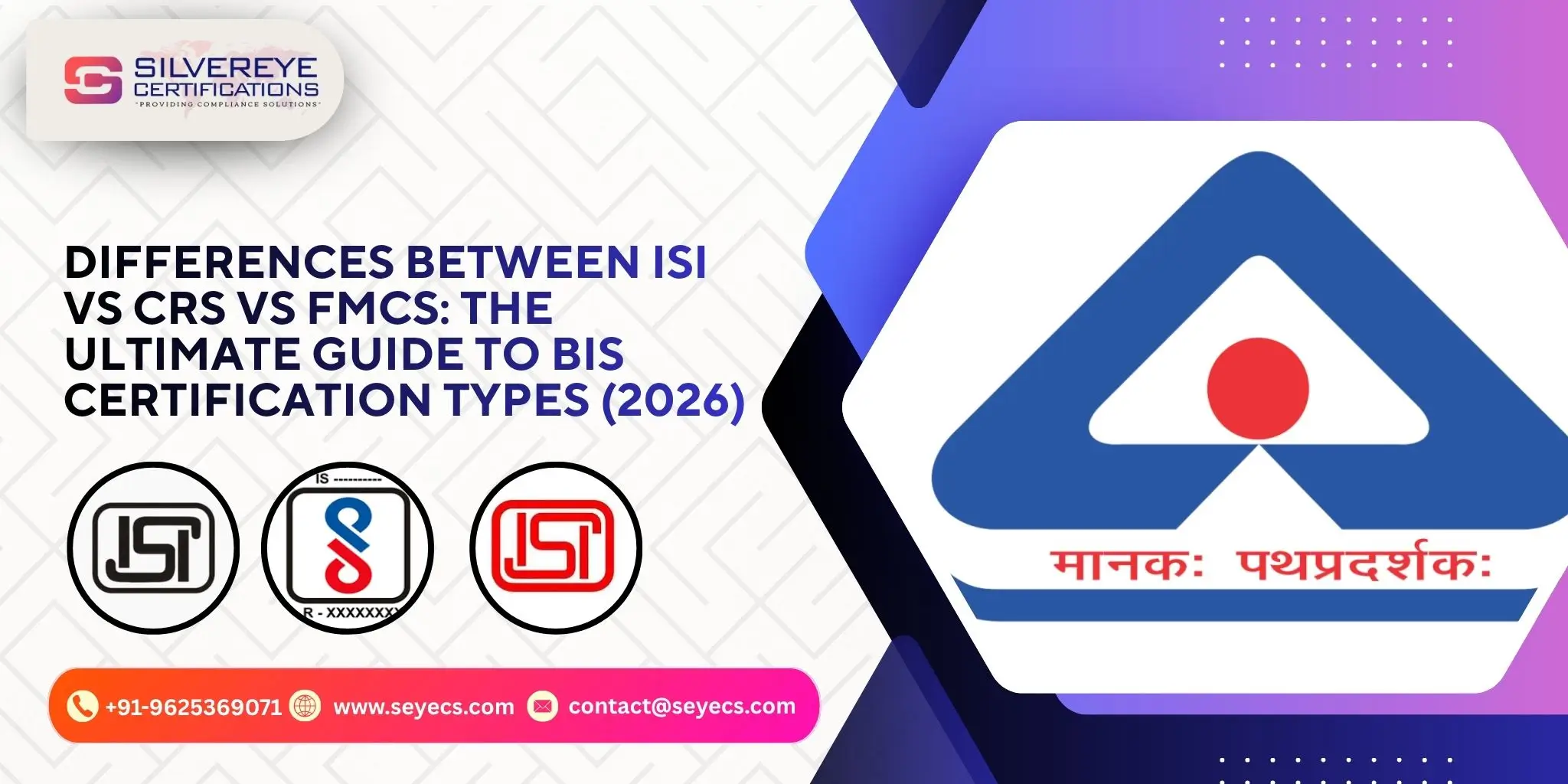
The terms ISI Mark, BIS Mark, CRS Mark and BIS Hallmark are often used interchangeably, but they relate to different BIS certification or conformity assessment arrangements. Understanding the difference helps manufacturers identify the correct compliance route.
| Mark or scheme | What it covers | How it is verified | Certification route |
|---|---|---|---|
| ISI Mark | Products covered under the applicable Scheme-I certification requirements, such as certain cement, steel, electrical and consumer products | CM/L licence details through the BIS Care app or BIS website | Scheme-I |
| CRS Mark | Notified electronics and IT products covered under the Compulsory Registration Scheme | R-number through the BIS Care app's CRS verification feature | Compulsory Registration Scheme (CRS) |
| BIS Hallmark | Applicable gold and silver jewellery and artefacts | HUID through the BIS Care app | BIS Hallmarking Scheme |
| ISI Mark for foreign-manufactured products | Products manufactured outside India and certified for conformity with relevant Indian Standards | CM/L licence details through BIS verification facilities | Foreign Manufacturers Certification Scheme (FMCS), under Scheme-I |
Is the ISI Mark the same as the BIS Mark?
In common usage, people often use ISI Mark and BIS Mark to refer to the product Standard Mark issued under Scheme-I. More precisely, BIS operates different conformity assessment schemes, and the applicable mark and verification method depend on the product and scheme. The CRS mark and hallmark, for example, follow different requirements from the ISI Mark.
Is FMCS a different product mark?
No. The Foreign Manufacturers Certification Scheme (FMCS) is the route through which eligible manufacturers with factories outside India obtain BIS certification. It is not a separate product mark. The applicable Standard Mark and licence requirements depend on the relevant Indian Standard and certification scope.
Is BIS ISI Mark Certification Mandatory in India?
BIS ISI Mark Certification is mandatory only for products covered by an applicable compulsory certification requirement. The Central Government makes certification compulsory for specified products through Quality Control Orders (QCOs) issued under the relevant legal provisions.
If a QCO applies to your product and its compliance date has taken effect, the manufacturer must obtain the required BIS licence and comply with the order's conditions before undertaking activities prohibited without certification. The exact obligation depends on the product description, applicable Indian Standard, effective date, exemptions and other conditions in the QCO.
If no compulsory certification requirement applies to the product, BIS certification may still be available on a voluntary basis where the relevant scheme permits it. Businesses may choose to obtain certification to meet customer expectations, tender conditions or market requirements.
Why You Should Check the Latest QCO Before Applying
The list of products under compulsory BIS certification is not permanent. The Government may introduce new QCOs, amend existing orders, extend implementation dates or withdraw requirements. A product's certification status can therefore change.
For example, BIS's current Scheme-I product information identifies packaged drinking water and packaged natural mineral water among products de-notified from compulsory BIS certification. This does not mean that all other regulatory requirements for these products have been removed; applicable FSSAI and other requirements must be checked separately.
Before applying, verify:
- Whether your exact product is covered by a current QCO.
- Which Indian Standard and product description apply.
- The QCO's effective date and any exemptions.
- Whether the product falls under Scheme-I, CRS or another BIS certification route.
- Whether any recent amendment, withdrawal or transition provision affects your case.
Always refer to the latest BIS Products under Compulsory Certification information and the relevant Gazette notification rather than relying on an old product list or an outdated article.
Who Needs ISI Mark Certification in India?
The requirement for ISI Mark Certification depends on the product, its manufacturing location and the applicable Quality Control Order (QCO). Different businesses have different responsibilities under the BIS certification framework.
| Business or applicant type | What it means for you |
|---|---|
| Manufacturer in India | If your product is covered by a QCO, you must obtain the applicable BIS licence before manufacturing or selling it in India, subject to the order's effective date and exemptions. Apply through Manak Online under Scheme-I where applicable. The licence scope is linked to the product, relevant Indian Standard and manufacturing premises. |
| Overseas manufacturer selling in India | Apply through the Foreign Manufacturers Certification Scheme (FMCS) for products covered by the relevant Scheme-I requirements. Foreign manufacturers are processed under Option 1 (Normal Procedure); Option 2 (Simplified Procedure) is not available to them. |
| Importer | Check whether the imported product is covered by a QCO and whether the overseas manufacturer holds the required valid BIS licence. Section 17 of the BIS Act also restricts the import of notified goods without the applicable Standard Mark and valid licence, subject to permitted exceptions. |
| Trader, distributor or stockist | Before purchasing or storing a QCO-covered product, verify the manufacturer's BIS licence and product scope. Section 17 covers activities such as distribution, sale and storage of notified goods without the required Standard Mark and licence. |
| Retailer or seller | Do not sell or offer for sale products that require BIS certification unless the applicable certification requirements are met. Verify the licence number and ensure the product matches the approved scope. |
| Buyer or procurement officer | Check the CM/L number, product description, Indian Standard and licence validity before placing an order. Also review the tender or purchase specification, as it may prescribe additional certification requirements. |
Important: Not every product requires an ISI licence. First confirm whether the exact product is covered by a QCO in force and whether any exemption or transition provision applies.
Benefits of BIS ISI Mark Certification
For manufacturers, obtaining the applicable BIS licence is more than displaying a recognised mark. It establishes conformity with a relevant Indian Standard and supports access to markets where certification is required or commercially preferred.
Key benefits include:
- Regulatory compliance: For products covered by an applicable QCO, a valid BIS licence helps the manufacturer meet the relevant compulsory certification requirement.
- Buyer confidence: The ISI Mark helps buyers identify products covered by BIS certification. They can also verify the licence details using the BIS Care app.
- Tender and procurement opportunities: Some government, institutional and private-sector tenders specify BIS certification as a condition. A valid licence can help manufacturers meet those requirements.
- Market credibility: A verifiable licence provides evidence that the product is covered by a recognised conformity assessment scheme.
- Quality-control discipline: The manufacturer must maintain product conformity and follow the applicable quality assurance arrangements throughout the licence period.
- Business continuity: Obtaining the required licence before the applicable QCO deadline helps manufacturers avoid disruption to the manufacture or sale of regulated products.
Note: BIS certification does not guarantee product acceptance by every buyer, retailer or online marketplace. Individual procurement and listing requirements may differ.
How to Verify Whether an ISI Mark Is Genuine
Before purchasing, importing or distributing an ISI-marked product, verify its licence details. The CM/L number printed with the Standard Mark is the key reference.
Follow these steps:
- Find the CM/L number: Look for the licence number displayed with the ISI Standard Mark on the product, label or packaging, as applicable.
- Open the BIS Care app: Select Verify Licence Details and enter the CM/L number. BIS provides this facility for checking the authenticity of products carrying its Standard Mark.
- Check the BIS website: You can also use the available BIS online verification facilities to check licence information.
- Match the product details: Confirm that the licence belongs to the stated manufacturer and covers the product and relevant Indian Standard. Check the licence status and validity.
- Report suspected misuse: If the number is invalid, expired or associated with a different product, report the suspected misuse to BIS through its available complaint channels.
What Are the Penalties for Misusing the ISI Mark?
Using the BIS Standard Mark without a valid licence, or using it in a manner that violates the BIS Act, can lead to enforcement action.
Under Section 17 read with Section 29(3) of the BIS Act, 2016, a person who contravenes Section 17 may face:
- Imprisonment: Up to two years.
- Fine for the first contravention: Not less than ₹2 lakh.
- Fine for subsequent contraventions: Not less than ₹5 lakh.
- Additional financial exposure: The fine may extend to ten times the value of the goods involved, as provided under the Act, or the court may impose both imprisonment and a fine.
BIS may also take enforcement measures, including search and seizure operations, where suspected misuse is identified. The precise action and penalty depend on the nature of the contravention and the applicable legal provisions.
Do not rely on a logo alone when checking a product. Always verify the licence number and confirm that the product is within the licence scope.
Latest BIS ISI Mark and QCO Updates for 2026
BIS certification requirements and QCO implementation dates can change through new notifications, amendments and revised guidelines. The following developments are relevant for manufacturers, importers and businesses planning certification in 2026.
| 2026 update | What it means for manufacturers and businesses |
|---|---|
| Revised Guidelines for Grant of Licence – 25 February 2026 | BIS issued revised Scheme-I guidelines covering application processing, the Normal and Simplified Procedures, factory assessment, testing and other grant-of-licence requirements. Applicants should follow the latest version rather than relying on older checklists. |
| Transition Facilitation (Quality Control) Order, 2026 – 25 June 2026 | DPIIT introduced a conditional framework under which eligible domestic industry can procure supplies from manufacturers holding Scheme-II licences instead of Scheme-I licences for goods covered by the specified QCOs. Permission depends on the Order's conditions, including technical capability and compliance history. It is not a blanket exemption from QCO requirements. |
| Steel and Steel Products QCO Amendment – June 2026 | The amendment published in the Gazette on 22 June 2026 placed enforcement of specified entries in the Steel and Steel Products QCO in abeyance for defined periods. Steel manufacturers, importers and buyers should check the affected IS numbers and dates before planning compliance. |
| Updated BIS recognised and empanelled laboratory lists – 2026 | BIS's laboratory listing page was updated on 24 June 2026. Applicants should check the current Indian Standard-wise laboratory facilities before selecting a laboratory for testing. |
| Ongoing QCO amendments and withdrawals | Product coverage and implementation dates may change. Before applying, verify the latest Gazette notification and BIS compulsory-certification list for the exact product and Indian Standard. |
How to use these updates: Do not assume that a QCO has been withdrawn or that a product is exempt merely because an amendment has been announced. Check the actual notification, affected product or IS number, effective date and any conditions before deciding whether certification is required.
ISI Mark Certification: Eligibility and Requirements
BIS does not grant an ISI licence simply because a business is registered. The manufacturer must demonstrate that it can consistently produce goods conforming to the applicable Indian Standard and meet the relevant BIS certification requirements.
Before applying, review the following:
- Manufacturing facilities: The premises and production arrangements must be suitable for manufacturing the product covered by the application.
- Production process and quality control: The manufacturer must establish suitable process controls and a quality assurance system to maintain conformity.
- Product conformity: The product must meet the applicable Indian Standard, including its relevant performance, safety and testing requirements.
- Testing arrangements: The manufacturer must have suitable arrangements for the tests required under the applicable product requirements. An in-house laboratory is not universally compulsory; permitted alternatives may include shared facilities, cluster-based testing and subcontracting to eligible external laboratories, subject to applicable conditions and product-specific exceptions.
- Legal identity and premises: The applicant must provide the prescribed business and manufacturing-premises details.
- Product and factory scope: The application must identify the relevant product, Indian Standard and manufacturing location. The licence covers only the approved product varieties and premises.
- Foreign manufacturers: Manufacturers located outside India must follow the applicable FMCS route under Scheme-I.
Do you need GST registration or Udyam registration?
GST registration should not be treated as a universal BIS eligibility condition for every applicant. Provide the business and tax documents applicable to your legal entity and the requirements shown in the application.
Similarly, Udyam registration is relevant where an eligible applicant is claiming an applicable MSME concession. It is not a universal prerequisite for obtaining an ISI licence.
Documents Required for BIS ISI Mark Certification
The exact document checklist depends on the product, Indian Standard, application route and manufacturing arrangements. The Form-V application, self-evaluation cum verification report and applicable product manual should guide your final submission.
The following are common documents and records that applicants may need to prepare:
| Document or information | Purpose |
|---|---|
| Online Form-V application and prescribed declarations | Records the applicant's details, product, applicable Indian Standard and manufacturing premises. |
| Proof of business constitution | Establishes the legal identity of the applicant, such as a proprietorship, partnership or company. |
| Proof of manufacturing premises | Confirms the factory address and premises covered by the application. |
| Factory layout and manufacturing process flow chart | Helps BIS understand the production process, manufacturing stages and testing arrangements. |
| List of manufacturing machinery and equipment | Shows the facilities available for manufacturing the product. |
| Testing facilities and arrangements | Provides details of in-house, shared, cluster-based or external testing arrangements, as permitted for the product. |
| Calibration records, where applicable | Provides evidence that relevant measuring and testing equipment is maintained and calibrated. |
| Product test reports | Required with the application under Option 2 (Simplified Procedure), subject to the applicable BIS laboratory and report-validity requirements. |
| Raw material test reports or certificates, where applicable | Establishes raw material conformity where the relevant product standard makes it a requirement. |
| Authorisation letter for the authorised signatory | Confirms the authority of the person submitting or handling the application on behalf of the manufacturer. |
| Udyam registration certificate, if claiming an eligible MSME concession | Supports a claim for an applicable fee concession, subject to BIS conditions. |
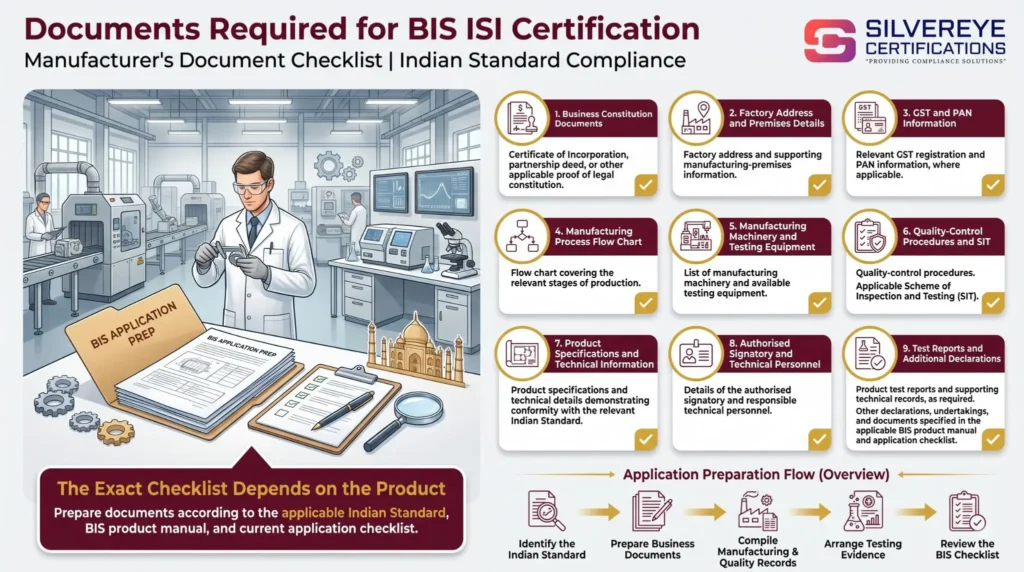
Before submitting: Check the latest BIS product manual, Form-V requirements and Manak Online document checklist. Do not assume that every applicant needs every document listed above. Additional records may be requested depending on the product, testing route and factory assessment.
ISI Mark Certification: Normal vs Simplified Procedure
Under Scheme-I, BIS provides two application options for granting an ISI Mark license: Option 1 (Normal Procedure) and Option 2 (Simplified Procedure). Both lead to the same type of BIS license. The main difference is when product testing takes place and how BIS verifies conformity.
The applicant must select an option available for the product. Option 2 is not automatically available just because a recognised laboratory exists. The product must fall within the category listed in Annexure II(C) of the current BIS Grant of License Guidelines.
| Comparison point | Option 1: Normal Procedure | Option 2: Simplified Procedure |
|---|---|---|
| Test report before application | Generally not required for the product at the application stage. BIS arranges sample testing after the factory visit. Product-specific raw material reports may still be required. | Required before applying. The report must come from a laboratory accepted by BIS for the relevant product and Indian Standard. |
| Report validity | Not applicable as a general pre-application product-report requirement. | Latest product test report must generally be no more than 90 days old. Where multiple reports are submitted, the oldest must generally be no more than 180 days old. |
| Factory visit | BIS assesses the manufacturing facilities, production process, quality control and testing arrangements. Product samples are drawn for testing. | BIS conducts a verification visit and draws a sample for further testing. |
| Testing sequence | Factory assessment and sample drawal are followed by third-party laboratory testing, or factory testing where permitted. | The applicant submits conforming product test reports with the application. BIS draws a verification sample during the factory visit, and its test result is reviewed after the licence is granted. |
| Licence decision | The licence is granted after satisfactory assessment and establishment of product conformity. | The licence may be granted after a satisfactory factory visit, applicable fee payment and verification of sample-dispatch proof. The verification sample report is reviewed after grant. |
| Expected processing period | BIS guidelines expect processing within 90 days, subject to satisfactory results at the first instance. The BIS FAQ gives an average of around four months. | BIS guidelines expect processing within 30 days, subject to satisfactory results at the first instance. The BIS FAQ gives an average of around one month. |
| Who can apply? | Domestic manufacturers and foreign manufacturers, subject to the applicable requirements. | Domestic manufacturers only, and only for products listed under Option 2. |
Important points before choosing an option:
- Option 2 is not available to foreign manufacturers. Their applications are processed under Option 1.
- Certain products are categorically assigned to Option 1 or Option 2 under the current BIS guidelines.
- A manufacturer whose previous licence for the same product and premises was cancelled, expired or surrendered because of sample non-conformity may be restricted to Option 1.
- The test report submitted under Option 2 must cover the relevant product and applicable Indian Standard. A report from an otherwise recognised laboratory is not sufficient if the product is not eligible for Option 2.
Always check the current BIS List of Products under Simplified Procedure before arranging testing or submitting an application.
ISI Mark Certification Process: Step-by-Step
The application process begins with identifying the correct Indian Standard and confirming the available application option. Follow these steps to prepare your application.
- Identify the applicable Indian Standard: Find the correct IS number and review the relevant product manual, including its testing requirements and Scheme of Inspection and Testing (SIT).
- Check the application option: Confirm whether your product is listed under Option 1 or Option 2. If Option 2 is available, check the laboratory requirements and arrange the required product testing before applying.
- Register on Manak Online: Create an applicant account on the official BIS portal and complete the prescribed online application in Form V.
- Upload the required documents: Submit the business, factory, manufacturing, quality-control and testing information, along with the self-evaluation cum verification report and applicable declarations.
- Pay the applicable fees: Pay the application fee, the inspection fee when required and the prescribed advance marking-fee amount. Under the February 2026 guidelines, 50% of the applicable annual minimum marking fee is collected when the application is submitted.
- Respond to BIS queries: Monitor the Manak Online dashboard and provide clarifications or additional documents requested by the concerned BIS office.
- Attend the factory visit: Make the manufacturing premises, quality-control personnel, machinery, testing facilities or permitted testing arrangements, calibration records and production documents available for assessment.
- Complete product testing: Under Option 1, BIS-arranged sample testing or permitted factory testing establishes conformity. Under Option 2, BIS reviews the test report submitted with the application and the verification sample drawn during the factory visit.
- Complete the grant requirements: If BIS is satisfied, pay the remaining applicable minimum marking fee and annual licence fee, along with any other outstanding dues. BIS then communicates the licence decision through the prescribed process.
- Begin marking only after the licence is granted: Once the licence is operative, use the Standard Mark and CM/L number strictly according to the approved product scope and BIS marking requirements. Maintain the applicable production, testing and quality-control records.
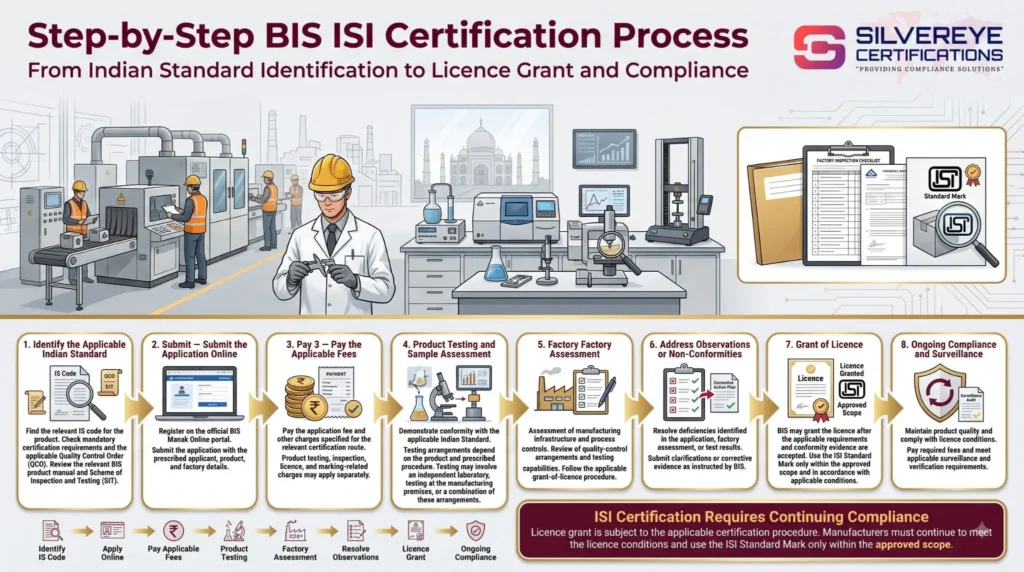
Remember: A test report, factory visit or application acknowledgement does not authorise you to use the ISI Mark. You may begin marking only after BIS grants the licence and it becomes operative.
For a detailed explanation of the portal and application stages, see our guide to BIS ISI Mark Certification in India.
BIS ISI Mark Certification Fees in 2026
The total cost of obtaining an ISI Mark license depends on the applicable BIS fees, product-specific marking fee, inspection requirements and laboratory testing expenses. The following table summarises the principal Scheme-I charges.
| Fee component | Amount or basis | When it is payable |
|---|---|---|
| Application fee | ₹1,000 | At the time of submitting the application |
| Inspection fee | ₹7,000 per man-day | In advance, for the applicable factory visit |
| Annual licence fee | ₹1,000 | As part of the licence-grant payment |
| Annual minimum marking fee | Product-specific; varies by Indian Standard and applicable enterprise category | 50% is collected at application submission; the balance is payable at the time of grant |
| Actual marking fee | Calculated using the applicable product-wise unit rate and marked production | Reconciled against the minimum marking fee, with any additional amount payable as applicable |
| Renewal application fee | ₹1,000 | With the renewal application |
| Product testing charges under Option 1 | Depends on the product and tests required | Paid by the applicant to the testing laboratory |
| Verification sample testing under Option 2 | Included in the applicable annual minimum marking fee | Not separately payable by the applicant for that verification sample |
MSME Concessions on BIS Minimum Marking Fees
BIS has notified concessions on the annual minimum marking fee for eligible enterprises. Under the notification dated 17 March 2026, the following concessions are available up to 31 May 2029, subject to the applicable eligibility conditions:
| Enterprise category | Concession on the large-scale minimum marking fee |
|---|---|
| Micro enterprise | 80% |
| Small enterprise | 50% |
| Eligible start-up | 80% |
| Eligible women entrepreneur enterprise | Additional 10% concession on the applicable micro, small or medium enterprise fee |
These concessions apply to the minimum marking fee, not automatically to every BIS charge or laboratory expense. Check the current Manak Online fee calculator and the applicable notification before calculating your payable amount.
What Determines the Total ISI Certification Cost?
The final amount may vary depending on:
- The product and applicable Indian Standard.
- The annual minimum marking fee and unit marking rate.
- The enterprise category and eligibility for concessions.
- The number of inspection man-days required.
- The product testing and retesting requirements.
- The duration of the licence and applicable advance fees.
Practical tip: Check the product-wise marking fee on the official Manak Online portal before preparing your certification budget. Do not rely on a single fixed ISI certification price for every product.
BIS ISI Mark License Validity
A BIS ISI Mark license is granted for a specified period and manufacturing premises. The manufacturer must maintain conformity and complete renewal formalities to continue using the Standard Mark.
| Licence aspect | BIS requirement |
|---|---|
| Initial validity | Generally up to two years, subject to the applicable provisions and the period granted by BIS |
| Renewal period | Minimum one year and up to five years |
| Product scope | Limited to the products and varieties approved under the licence |
| Manufacturing premises | Valid for the factory address stated in the licence |
| Change in product scope | Requires an application to BIS through the prescribed change-of-scope process |
| Factory relocation | Requires the prescribed relocation process, including suspension and verification of the new premises before marking can resume |
A BIS licence is not a general approval for every product manufactured by a company. It applies only to the approved products, varieties and factory premises stated in the licence.
BIS ISI Mark License Renewal: Process and Timeline
A manufacturer must apply for renewal through Manak Online to continue using the ISI Mark beyond the licence's validity period. BIS permits renewal for a period ranging from one year to five years, depending on the period requested and the applicable requirements.
Documents and Details Required for Renewal
The renewal application generally involves:
- The prescribed renewal application (Form XII).
- Production and marking details for the relevant period.
- A production statement authenticated by a Chartered Accountant or Cost Accountant for marking-fee calculation.
- Applicable renewal application fee and annual licence fee.
- Advance minimum marking fee for the requested renewal period.
- Payment of any outstanding dues.
The precise documents and information should be checked on the licence holder's Manak Online dashboard and against the current BIS renewal guidelines.
Renewal Timeline and Late Applications
BIS does not prescribe a universal month-by-month preparation calendar for every manufacturer. However, applying well before expiry gives you time to reconcile production records, clear dues and respond to any queries.
| Suggested timing | Action to take |
|---|---|
| Four to three months before expiry | Review licence conditions, production records and the current Indian Standard. Check whether the relevant QCO has been amended. |
| Three to two months before expiry | Reconcile marking and production details, review testing and calibration records, and address outstanding BIS observations. |
| Around two months before expiry | Aim to submit the renewal application through Manak Online, with the required documents and fees. |
| Before the expiry date | Check that BIS has received the application and applicable fees. Monitor the dashboard for queries or further requirements. |
What if you apply after the licence expires?
Under Regulation 8 of the BIS (Conformity Assessment) Regulations, 2018:
- If the renewal application and requisite fee are not received before expiry, BIS may defer the renewal decision for up to 90 days from the validity date, subject to the applicable provisions.
- If the renewal application is submitted after the licence validity date, a late fee of ₹5,000 is applicable.
- If the licence is under suspension, it cannot be renewed until the suspension is revoked. The applicable deferment provisions must also be considered.
Do not treat the 90-day deferment as an automatic extension of permission to use the ISI Mark. Follow the licence status and instructions communicated by BIS.
After Getting the ISI License: What Does BIS Check?
Obtaining the licence is not the end of the certification process. Manufacturers must continue to meet the applicable Indian Standard, maintain quality-control arrangements and cooperate with BIS surveillance.
BIS may carry out the following checks:
- Factory surveillance: BIS may inspect the manufacturing premises with or without prior intimation. Officers verify production controls, the Quality Assurance Plan (QAP) or accepted Scheme of Inspection and Testing (SIT), testing arrangements and other licence conditions.
- Sample testing: BIS may draw samples during factory visits and arrange testing at an applicable third-party laboratory. The product-specific surveillance requirements determine the sampling and testing arrangements.
- Market surveillance: BIS may collect products from the market and test them to check whether they continue to conform to the relevant Indian Standard.
- Records and cooperation: Manufacturers must maintain the required production, inspection, testing and marking records and provide access to BIS officers when required.
- Suspension or cancellation: Non-conforming samples, failure to follow licence conditions, unauthorised marking or other violations may lead to suspension or cancellation under the applicable provisions.
Under the BIS Factory Surveillance Guidelines dated 25 February 2026, BIS generally plans one factory surveillance visit for each licence during a five-year period. Certain products may require more frequent visits, and the frequency can increase where non-compliance is observed.
Common Mistakes to Avoid During BIS ISI Certification
Avoiding the following mistakes can help prevent delays, additional costs and compliance problems:
- Selecting the wrong Indian Standard: Check the product description, applicable IS number and latest product manual before applying.
- Assuming every product qualifies for Option 2: Confirm that the product is listed under the current Simplified Procedure category.
- Using an ineligible laboratory: Verify that the laboratory is accepted by BIS for the relevant product and testing requirements.
- Submitting an outdated test report: For Option 2, check the 90-day latest-report and 180-day oldest-report limits.
- Ignoring raw material requirements: Submit raw material conformity evidence wherever the product standard makes it mandatory.
- Keeping incomplete factory records: Maintain the required production, quality-control, equipment and calibration records.
- Using the ISI Mark before licence grant: Do not print, apply or advertise the Standard Mark as an approved licence holder before the licence becomes operative.
- Missing renewal deadlines: Review production records, fees and licence conditions well before expiry.
- Failing to inform BIS about factory relocation: Follow the prescribed shifting procedure and stop marking during the suspension period.
- Relying on outdated QCO information: Check the latest Gazette notification and BIS compulsory-certification list before making compliance decisions.
Professional Assistance for BIS ISI Mark Certification
Manufacturers can apply for BIS certification directly through Manak Online. However, professional assistance may be useful when the product has complex testing requirements, the factory is not familiar with BIS procedures or the applicant needs help preparing the documentation.
Before appointing a consultant, ask:
- Which application option is available for the product, and what is the reason?
- Which Indian Standard and product manual apply?
- Who will coordinate the product testing and factory-readiness process?
- What documents and testing arrangements will be required?
- Are BIS fees, laboratory charges and professional fees shown separately?
- Who will help respond to BIS queries and coordinate the application?
A consultant can provide documentation, application and coordination support, but only BIS can assess the application and grant the licence. No consultant can guarantee approval or an exact grant date.
Why Choose Silvereye Certifications for BIS ISI Mark Support?
Silvereye Certifications (SEYECS) provides compliance guidance and application support to manufacturers seeking BIS certification and other regulatory approvals in India.
Our support can include:
- Product and standard identification: Guidance on identifying the relevant Indian Standard and checking the applicable certification route.
- Application-option guidance: Help checking whether the product may be processed under the Normal or Simplified Procedure.
- Documentation support: Assistance with preparing the prescribed application information, factory details and supporting documents.
- Testing coordination: Guidance on identifying suitable laboratories and coordinating product testing requirements.
- Factory-readiness support: Help reviewing manufacturing, quality-control and testing arrangements before the BIS assessment.
- Application follow-up: Assistance with portal submissions, responding to queries and coordinating with the applicant during the process.
If you are planning to obtain an ISI Mark licence, Silvereye Certifications can help you understand the applicable requirements and prepare your application. The final assessment and licence decision remain with BIS.
Conclusion
BIS ISI Mark Certification requires more than submitting an online application or obtaining a product test report. Manufacturers must identify the correct Indian Standard, select an eligible application route, demonstrate suitable manufacturing and quality-control arrangements, and establish product conformity through the applicable BIS assessment process.
The Normal Procedure and Simplified Procedure follow different testing sequences, but both lead to the same Scheme-I licence. Before applying, check the current product list, laboratory requirements, fees and QCO status. After the licence is granted, maintain conformity, cooperate with surveillance and apply for renewal before expiry to continue using the ISI Mark legally.
Frequently Asked Questions
What is ISI mark certification?
It is a BIS license under Scheme-I that allows a manufacturer to use the ISI mark on a product made to a specific Indian Standard.
What is the full form of ISI?
Indian Standards Institution. The body is now the Bureau of Indian Standards, but the ISI name is still used for the mark.
Is the ISI mark the same as the BIS mark?
In everyday use, yes. The ISI mark is the BIS Standard Mark used for products under Scheme-I.
Is ISI mark certification compulsory?
Only for products covered by a Quality Control Order in force. Otherwise it is voluntary. Check the BIS list of products under compulsory certification.
How can I check if an ISI mark is real?
Take the CM/L license number printed with the mark and enter it in the BIS Care app under “Verify License Details”, or check the license status on the BIS website.
What is the difference between the ISI mark and the CRS mark?
The ISI mark falls under Scheme-I and is verified with a CM/L number. The CRS mark covers notified electronics and IT products and is verified with an R-number.
How long does it take to get an ISI license?
BIS gives average times of about one month under the simplified procedure and about four months under the normal procedure, from a complete recorded application.
How much does ISI mark certification cost?
BIS charges ₹1,000 as application fee, ₹7,000 per man-day for inspection and ₹1,000 as annual licence fee, plus a product-specific minimum marking fee. Testing is extra and GST applies.
How long is an ISI licence valid?
It is first granted for up to two years and can be renewed, with renewal allowed up to five years from the last date of validity.
Can one license cover more than one product?
No. BIS issues one license for one product and one Indian Standard at one factory location, though it can include several varieties listed in its scope.
What happens if someone uses the ISI mark without a license?
It can attract penal action under the BIS Act, 2016. Reports on BIS enforcement in July 2026 cited up to two years’ imprisonment and a ₹2 lakh fine for a first offence.
Does the Transition QCO 2026 replace the ISI mark?
No. It offers a Scheme-II route for DPIIT-approved manufacturers in notified sectors. Compliance with the Indian Standard still applies, and most applicants continue under Scheme-I.