
- The EPR E-Waste Registration process is managed through the CPCB’s centralized E-Waste EPR Portal, covering application submission and applicable compliance activities.
- Four stakeholder categories—Producer, Refurbisher, Dismantler, and Recycler—follow category-specific registration requirements and application procedures.
- Application approval timelines depend on the completeness of the documents and CPCB’s review. Avoid promising a fixed 15–60 working-day timeline unless it is supported by current official guidance.
- Registration approval is only the beginning. Businesses must also manage applicable quarterly and annual returns, EPR target tracking, record maintenance, and renewal requirements to remain compliant.
Introduction
The EPR E-Waste Registration process is governed by the E-Waste (Management) Rules, 2022 and administered by the Central Pollution Control Board (CPCB). It covers registration and ongoing compliance for Producers, Refurbishers, Dismantlers, and Recyclers through the centralized CPCB E-Waste EPR Portal.
The process generally involves creating an account, selecting the appropriate entity category, uploading the required documents, paying applicable fees, and submitting the application. The review timeline depends on the completeness of the application and CPCB’s assessment; businesses should verify current timelines through official guidance rather than rely on a fixed approval period.
After registration, applicable obligations may include EPR target management, procurement or transfer of eligible EPR certificates, quarterly and annual return filing, record maintenance, and renewal where required. Therefore, EPR E-Waste compliance is an ongoing responsibility, not simply a one-time registration.
What Is the EPR E-Waste Registration Process?
The EPR E-Waste Registration process is the procedure businesses follow under the E-Waste (Management) Rules, 2022 to register with the Central Pollution Control Board (CPCB) and meet their applicable e-waste management obligations. It covers registration, documentation, recycling targets, return filing, and other compliance activities for regulated electrical and electronic equipment (EEE).
The Rules came into force on 1 April 2023, replacing the earlier E-Waste (Management) Rules, 2016. They introduced a centralized online system through which eligible entities register, producers manage their Extended Producer Responsibility (EPR) targets, and registered recyclers generate EPR certificates.
Understanding this process is important for businesses dealing with regulated electronic products. If a company operates in more than one regulated waste category, such as e-waste and plastic packaging, it may need to meet separate registration and compliance requirements under the applicable rules for each category.
Who Needs to Go Through the EPR E-Waste Process?
The E-Waste (Management) Rules, 2022 identify specific stakeholder categories that must register on the CPCB portal. These include manufacturers, producers, refurbishers, and recyclers. A company's obligations depend on its actual business activities and the applicable rules. Micro enterprises are excluded from the general applicability of these Rules, so businesses should check their eligibility before applying.
| Entity Type | Role in the Process |
|---|---|
| Producer | Manufactures or sells specified electrical and electronic equipment under its own brand, or imports covered products into India, and must meet applicable EPR targets. |
| Manufacturer | Manufactures covered electrical and electronic equipment and must meet the registration and compliance requirements applicable to manufacturers. |
| Refurbisher | Refurbishes used electrical and electronic equipment and follows the registration and reporting requirements applicable to refurbishers. |
| Recycler | Processes e-waste in accordance with applicable requirements and generates EPR certificates through the CPCB portal for eligible recycling activities. |
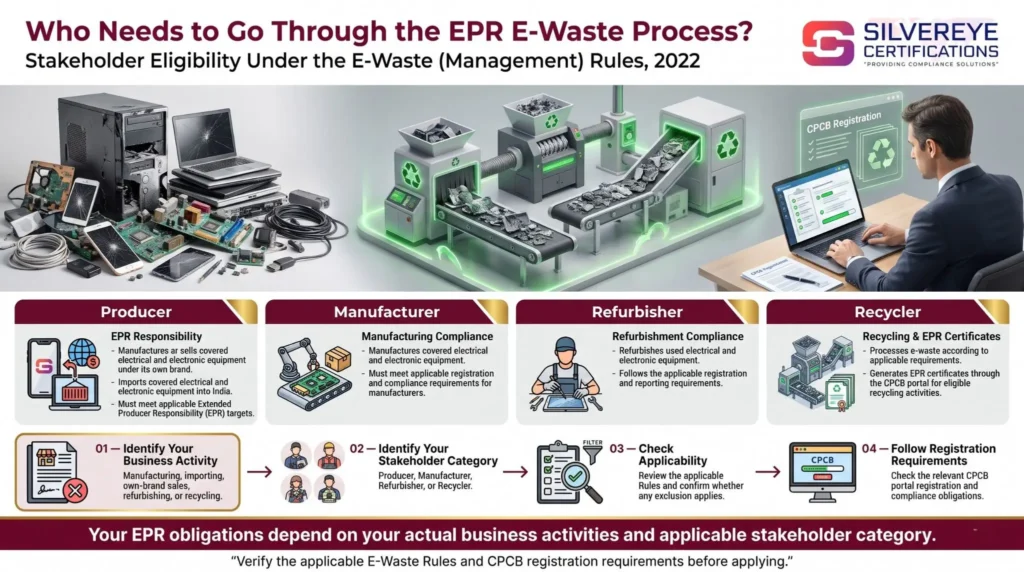
Important: Registration requirements are category-specific. If a business falls under more than one regulated category, it may need separate registrations. Confirm the correct category and any dismantling-related requirements with CPCB before submitting an application.
Stage 1: Pre-Registration Preparation
Before accessing the CPCB portal, prepare the information and documents required for your particular stakeholder category. Complete and consistent documentation can help reduce avoidable application queries.
- Identify your entity category: Determine whether your business falls under the manufacturer, producer, refurbisher, or recycler category.
- Check your products: If you are a producer or manufacturer, verify whether your electrical and electronic equipment is covered under Schedule I of the E-Waste (Management) Rules, 2022.
- Prepare business documents: Depending on the category, these may include the Certificate of Incorporation, company PAN, GST registration, authorized signatory details, and other documents specified in the applicable CPCB procedure.
- Prepare facility-related approvals: Refurbishers and recyclers should check the applicable requirements for facility details and State Pollution Control Board consents, including Consent to Establish (CTE) and Consent to Operate (CTO), where required.
- Organize operational information: Producers should prepare relevant product and sales data, while recyclers and refurbishers should prepare the facility, capacity, and processing information required for their applications.
The precise document checklist can differ by entity category. Use the relevant CPCB standard operating procedure (SOP) rather than relying on a single checklist for every applicant.
Stage 2: CPCB Portal Registration — Step by Step
The CPCB E-Waste EPR Portal is the official online platform for registration and related compliance activities.
Follow these general steps:
- Access the portal: Visit the official CPCB E-Waste EPR Portal and review the registration instructions for your category.
- Create an account: Complete the sign-up process using the business and authorized contact details requested by the portal.
- Verify your account: Complete the prescribed authentication steps. Where applicable, use the available Single Sign-On (SSO) facility.
- Select your entity category: Choose the relevant registration module and check the category-specific application requirements.
- Enter business details: Provide the requested company, product, facility, capacity, or sales information, as applicable.
- Upload supporting documents: Submit the documents and declarations specified in the relevant CPCB SOP.
- Pay the applicable fee: Complete the payment required for your application, if applicable, and retain the transaction details.
- Review and submit: Check all entries carefully before submitting the application and retaining the acknowledgment for reference.
- Respond to CPCB queries: If CPCB requests clarification or additional documents, respond within the specified timeframe.
- Check the registration status: Track the application through the portal and follow any further instructions before commencing regulated activities.
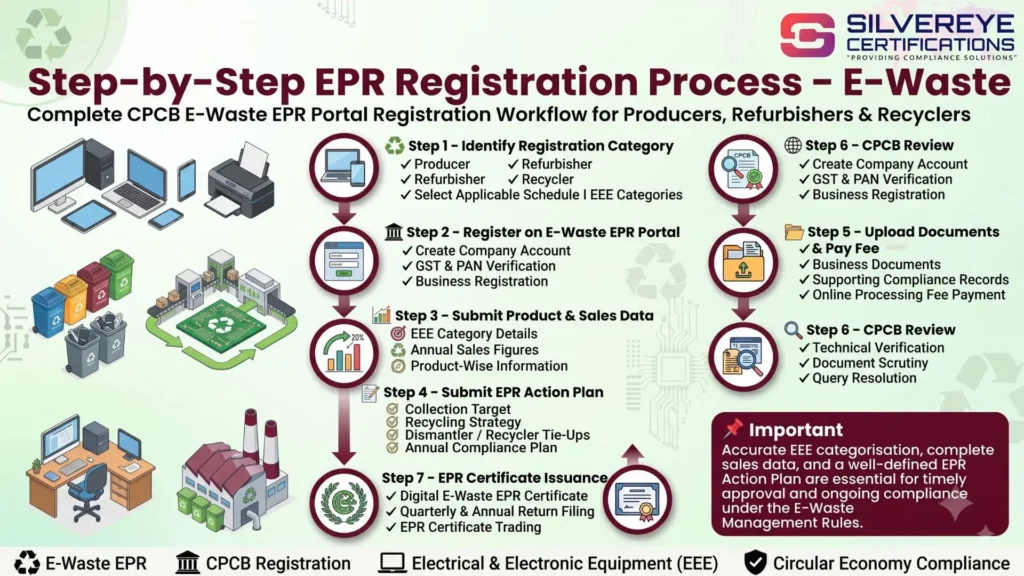
The registration procedure and supporting documents vary by stakeholder category. Application review timelines should be checked against the current CPCB SOP; a fixed approval period of 15–60 working days should not be promised without verifying the applicable procedure.
Stage 3: Post-Registration — The Ongoing Compliance Process
Receiving an EPR registration certificate does not end a business's compliance responsibilities. The next steps depend on the entity's category and applicable obligations under the Rules.
- Manage EPR targets: Producers must obtain and implement applicable EPR targets through the portal, based on the relevant rules and schedules.
- Use eligible EPR certificates: Producers meet their applicable recycling obligations through EPR certificates purchased online from registered recyclers. Eligible recyclers generate certificates through the portal.
- File quarterly returns: Applicable entities must submit quarterly returns through the portal within the prescribed deadlines.
- File annual returns: Submit the annual return by the applicable deadline. Under the general provisions of the 2022 Rules, returns are due by the end of the month following the relevant quarter or year, unless a specific provision or official extension applies.
- Maintain accurate records: Keep supporting records of sales, processing, recycling, and other relevant activities as required for your category.
- Monitor registration validity: Check the validity period and renewal requirements applicable to your registration. Do not assume that every stakeholder category requires annual renewal.
For example, the CPCB portal announced an extension for FY 2025–26 annual returns until 30 September 2026. That deadline has now passed, so businesses that have not filed should check the portal for any subsequent notice and take appropriate action promptly.
Ongoing compliance also means monitoring CPCB notifications and amendments, responding to official requests, and ensuring that transactions involving e-waste and EPR certificates are supported by accurate records.
Documents Required at Each Stage of the EPR E-Waste Process
The documents required for EPR E-Waste Registration depend on the applicant's stakeholder category and the stage of compliance. Prepare the relevant documents according to the applicable CPCB Standard Operating Procedure (SOP).
| Process Stage | Documents or Information to Prepare |
|---|---|
| Initial registration | Company incorporation details, PAN, GST details where applicable, authorized signatory information, and prescribed declarations |
| Producer / Importer | Schedule I product details, applicable sales or import data, brand information, and other documents specified in the producer registration procedure |
| Manufacturer | Manufacturing facility details, product information, and supporting documents required by the applicable procedure |
| Refurbisher / Recycler | Facility address and coordinates, PAN, GST details, applicable CTE/CTO, process information, and capacity details |
| Quarterly and annual compliance | Relevant sales, recycling, refurbishment, EPR certificate, and other operational records required for the applicable return |
| Renewal or amendment | Existing registration certificate, updated business or facility information, applicable declarations, and fee payment details where required |
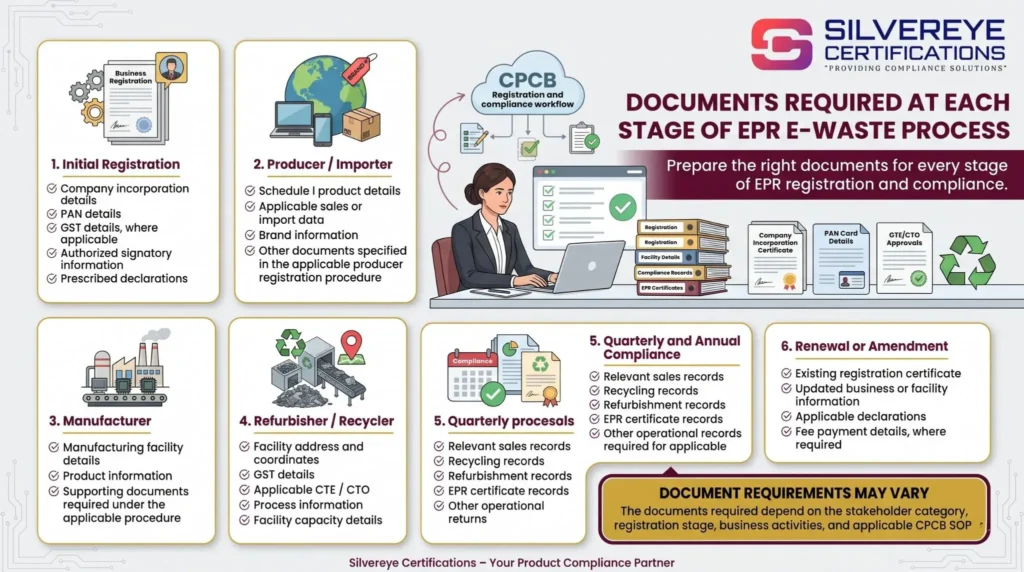
Note: Not every document applies to every entity. Requirements such as facility videos, specific environmental consents, and additional technical records should be confirmed against the current CPCB instructions for the relevant category. Documents used for other EPR waste streams may be reusable, but each registration has its own requirements.
Latest Notifications Affecting the EPR E-Waste Process (2022–2026)
The regulatory framework has evolved since the E-Waste (Management) Rules, 2022 were notified. The following developments are particularly relevant to businesses managing registration and ongoing compliance.
| Notification or Development | Date / Period | Impact on the Process |
|---|---|---|
| E-Waste (Management) Rules, 2022 | Notified 2 November 2022; effective 1 April 2023 | Established the current framework for registration, EPR obligations, recycling certificates, and online compliance. |
| E-Waste (Management) Amendment Rules, 2024 | 8 March 2024 | Revised the definition of a dismantler, allowed the government to relax certain return-filing timelines, and provided for EPR certificate exchange platforms and price bands. |
| E-Waste (Management) Amendment Rules, 2024 | 12 November 2024 | Revised the provision on action for contraventions, linking penalties to Section 15 of the Environment (Protection) Act, 1986. |
| Environmental Compensation Guidelines | Approved in September 2024; published on the CPCB portal | Established a framework for calculating environmental compensation for specified non-compliance. |
| CPCB Single Sign-On (SSO) | Available in 2026 | Enables access to CPCB's EPR portals through the centralized SSO facility. |
| EPR certificate validity and transfer | Current portal instructions | The CPCB portal states that EPR certificates are valid for two years and provides for certificate transfer between eligible registered entities. |
| Annual return deadline for FY 2025–26 | Extended to 30 September 2026 | CPCB announced an extension for filing annual returns for that financial year. The announced deadline has passed; check for any subsequent notice if filing remains outstanding. |
Important: Do not assume that every regulatory development changes the registration procedure itself. Some amendments concern certificate trading, return deadlines, or enforcement rather than the initial application.
Fees Involved in the EPR E-Waste Process
The cost of EPR E-Waste compliance may include an initial registration fee, annual maintenance charges, renewal charges, and other applicable fees. These are not necessarily the same for every stakeholder category.
CPCB's published FAQ lists a fee structure that includes ₹15,000 for first-time registration of recyclers and refurbishers, along with ₹5,000 in annual maintenance charges for specified stakeholder categories. Renewal charges and amendment fees may differ. Confirm the applicable amount for your entity on the official portal before payment.
| Fee Category | What to Check |
|---|---|
| Initial registration | Applicable fee for the selected stakeholder category |
| Annual maintenance | Whether annual maintenance charges apply to the registration |
| Renewal | Renewal fee and validity conditions for the relevant category |
| Amendment or addendum | Fee applicable when updating registration details |
| Additional approvals | Any separate State Pollution Control Board consent or other applicable charges |
Registration validity is not automatically one year. CPCB's published fee information specifies five-year validity for certain recycler and refurbisher registrations, while other categories may have different conditions. Check the applicable SOP and your registration certificate rather than using a single validity period for all entities.
Targets: The Core of the Ongoing Compliance Process
For producers covered by the applicable EPR provisions, recycling targets are calculated using the quantity of electrical and electronic equipment placed on the market in an earlier year, adjusted according to the product's average life. This means the target is not necessarily based on current-year sales alone.
Under Schedule III of the E-Waste (Management) Rules, 2022, the general recycling targets are as follows.
| Financial Year | General Recycling Target |
|---|---|
| FY 2023–24 | 60% |
| FY 2024–25 | 60% |
| FY 2025–26 | 70% |
| FY 2026–27 | 70% |
| FY 2027–28 onward | 80% |
These percentages represent the general target schedule for applicable producers, not a universal obligation for every stakeholder. New producers with a shorter sales history may fall under the separate target schedule in Schedule IV. Importers of used electrical and electronic equipment also have a specific 100% EPR obligation for the imported equipment at end of life if it is not re-exported.
Businesses should verify the target calculated for their products and financial year on the CPCB portal before preparing their compliance plan.
The Renewal Process, Step by Step
Renewal depends on the stakeholder category and the validity conditions stated in the applicable registration procedure. Do not assume that every EPR E-Waste registration must be renewed annually.
For registrations that require renewal, the following preparation steps can help:
- Check the registration certificate: Confirm its expiry date and the applicable renewal requirements.
- Start early: Follow the renewal lead time specified by CPCB. For producer registrations covered by the published procedure, the application is required 120 days before expiry.
- Update business information: Review company details, product information, facility information, and relevant operational data.
- Review compliance records: Ensure applicable returns have been filed and supporting records are available.
- Check applicable fees: Confirm the renewal and maintenance charges for your stakeholder category.
- Submit the renewal application: Complete the portal procedure and retain the acknowledgment.
- Respond to queries: Provide any additional information requested by CPCB within the stipulated timeframe.
Tip: Maintain an internal compliance calendar for registration expiry, annual maintenance charges, return deadlines, and EPR target completion. These dates may differ, so tracking them separately helps prevent missed obligations.
What Happens If the EPR E-Waste Process Is Skipped or Delayed?
Failure to comply with the E-Waste (Management) Rules, 2022 can result in regulatory action. The consequences depend on the nature of the violation, the applicable legal provisions, and the relevant CPCB guidelines.
| Compliance Failure | Potential Consequence |
|---|---|
| Operating without required registration | Regulatory action and applicable monetary penalties |
| Failing to meet EPR targets | Environmental compensation and continued liability for applicable outstanding obligations |
| Missing required returns | Non-compliance action and possible further regulatory consequences |
| Dealing with unregistered entities | Regulatory action for violations of applicable registration and channelization requirements |
| Submitting false information or generating certificates improperly | Possible suspension or cancellation of registration, environmental compensation, or other applicable penalties |
Under the E-Waste (Management) Rules, 2022, environmental compensation may apply to specified violations, including EPR shortfalls and violations involving false certificates. The 2024 amendment also revised the contravention provision to refer to Section 15 of the Environment (Protection) Act, 1986.
Avoid relying on fixed daily or monthly penalty amounts unless the specific amount is supported by the applicable legal provision or official order. Payment of environmental compensation does not necessarily remove the underlying EPR obligation.
Benefits of Following the EPR E-Waste Process Correctly
Following the applicable registration and compliance process helps businesses manage regulatory responsibilities more effectively.
- Better documentation: Consistent records make it easier to prepare returns and respond to regulatory queries.
- Improved compliance management: Monitoring targets, returns, and certificate transactions reduces the risk of missed obligations.
- Greater operational continuity: Timely registration and compliance reviews help businesses avoid preventable disruptions.
- Traceable recycling records: Eligible EPR certificate transactions provide a documented record of progress toward applicable recycling obligations.
- Better audit preparedness: Organized records support internal reviews and regulatory verification.
- More efficient planning: An updated compliance calendar helps businesses coordinate registration, fees, returns, and renewal requirements.
These benefits depend on accurate information, eligible transactions, and compliance with the applicable rules. Registration alone does not guarantee import clearance, product approval, or exemption from other regulatory requirements.
How Silvereye Certifications Simplifies the EPR E-Waste Process
Silvereye Certifications provides regulatory compliance support to Indian and international businesses across areas such as BIS Certification, CDSCO, WPC-ETA, TEC/MTCTE, and EPR registration.
For businesses managing EPR E-Waste Registration, support may include:
- Category identification: Helping identify the relevant registration route and document requirements.
- Document review: Checking application details for missing information and inconsistencies before submission.
- Application assistance: Supporting the preparation and submission of registration documents through the applicable CPCB process.
- Facility compliance coordination: Helping recyclers and refurbishers organize the facility information and environmental approvals required for their category.
- Ongoing compliance support: Assisting with applicable return preparation, EPR certificate reconciliation, and compliance-calendar tracking.
- Renewal assistance: Helping businesses review registration validity and prepare renewal documentation where required.
Businesses that also need product-related compliance support can coordinate their EPR work alongside other relevant certification requirements.
With a structured approach to documentation and compliance planning, Silvereye Certifications helps businesses navigate the EPR E-Waste process more efficiently and stay informed about applicable regulatory requirements.
Conclusion
The EPR E-Waste Registration process involves more than submitting an application. Businesses must identify the correct entity category, prepare the required documents, complete CPCB portal registration, and meet applicable EPR targets, return-filing deadlines, and renewal requirements. Maintaining accurate records and monitoring regulatory updates can help reduce compliance risks and avoid delays.
Silvereye Certifications supports businesses throughout the EPR compliance journey, from initial CPCB registration and document preparation to applicable return filing and renewal assistance. Whether your business needs support with e-waste, plastic, battery, tyre, or used-oil EPR, our team can help you understand the relevant requirements and manage the process more efficiently.
Need assistance with EPR E-Waste Registration? Contact Silvereye Certifications for professional guidance tailored to your business requirements.
Frequently Asked Questions
What is the first step in the EPR E-Waste process?
The first step is identifying your correct entity category — Producer/Importer/Brand Owner, Refurbisher, Dismantler, or Recycler — since this determines which module, documents, and application form you'll use on CPCB's centralized E-Waste EPR Portal.
How long does the complete EPR E-Waste process take?
Registration approval typically takes 15 to 30 working days for a complete, query-free application, extending to 45–60 working days if CPCB requests clarifications or additional documents. The broader compliance process — targets, returns, renewal — then runs continuously each year.
Is the EPR E-Waste process fully online?
Yes. The entire process, from account creation to certificate issuance and annual return filing, runs through CPCB's centralized E-Waste EPR Portal. From FY 2025-26 onward, even quarterly and annual returns must be filed digitally, with physical submissions no longer accepted.
What documents are needed to start the process?
At minimum: Certificate of Incorporation, PAN, GST registration, and authorized signatory ID proof. Producers and Importers additionally need Schedule I product classification; Dismantlers and Recyclers need Consent to Establish/Operate and a geo-tagged facility video.
Can one business complete the process for multiple waste categories at once?
Each waste category — e-waste, plastic, battery, tyre, used oil — requires a separate registration process on its own CPCB portal module, even though core documents like PAN, GST, and incorporation can generally be reused across applications.
What happens after the EPR E-Waste registration is approved?
The ongoing compliance process begins: setting annual collection targets, procuring EPR certificates, filing quarterly and annual returns, and maintaining audit-ready records ahead of the next renewal cycle.
What is the renewal process for EPR E-Waste registration?
Renewal involves updating your sales/collection data, refreshing your EPR Action Plan, filing the previous year's annual return, and paying the renewal fee — ideally started at least 60 days before your certificate's expiry to avoid a compliance gap.
What is an EPR Action Plan, and where does it fit in the process?
The EPR Action Plan is submitted during initial registration and describes how you will collect and channelize e-waste, backed by named recycler or PRO agreements. It's a mandatory step, not an optional attachment, and gets refreshed again at renewal.
Does the process differ for Recyclers compared to Producers?
Yes. Producers/Importers/Brand Owners follow the PIBO registration module and carry collection targets, while Recyclers and Dismantlers follow the RD module, need CTE/CTO and facility verification, and generate EPR certificates rather than purchasing them.
What if I miss a step, like a CPCB clarification request, during the process?
Applicants are generally expected to respond to CPCB queries within a set window (commonly around 7 working days). Missing this window can push the application further back in the review queue and extend your overall timeline.
Can I get help completing the EPR E-Waste process?
Yes. Compliance consultants such as Silvereye Certifications support the full process — from category identification and document preparation to portal submission, Action Plan drafting, and annual renewal tracking.
What's new in the EPR E-Waste process for 2026?
2026 brought a CPCB Single Sign-On (SSO) option for businesses already registered on another EPR module, mandatory digital-only quarterly and annual returns, a two-financial-year expiry on unused EPR credits, and closer linkage between EPR registration data and BIS/Customs systems.