- One core set, five add-ons: Every category shares a common document base (incorporation, PAN, GST, authorized signatory proof), then layers on category-specific paperwork like Schedule I classification or CTE/CTO consents.
- Address consistency is critical: GST, CTE, CTO, and factory address details must match exactly across every document — mismatches are the most common cause of CPCB queries and rejections.
- The EPR Action Plan is a document, not a formality: It must show real recycler, refurbisher, or retreader tie-ups and target-wise numbers, not vague intent.
- New verification steps in 2025–26: E-Waste applications increasingly require a geo-tagged facility video, and physical or virtual site verification within three months of approval is becoming standard practice.
Introduction
The documents required for EPR Registration generally include your Certificate of Incorporation, PAN, GST registration, authorized signatory ID proof, and an EPR Action Plan showing how you'll meet collection or recycling targets. Beyond this common set, each category adds its own paperwork: Plastic needs packaging category and sales data; E-Waste needs a geo-tagged facility video and Schedule I product classification; Battery needs chemistry-wise declarations; Tyre and Used Oil recyclers need Consent to Establish (CTE) and Consent to Operate (CTO).

Missing or mismatched documents — especially address inconsistencies across GST, CTE, and CTO — are the single biggest reason CPCB applications get delayed.
Why Getting Your Documents Right Matters
CPCB and the State Pollution Control Boards (SPCBs) review every EPR Registration application primarily through its paperwork — there's no in-person interview or negotiation stage. That means the documents required for EPR Registration aren't a bureaucratic afterthought; they're the entire basis on which your application gets approved, queried, or rejected.
Real-world rejection patterns are consistent across categories: an address on the GST certificate that doesn't match the Consent to Operate (CTO), a self-declaration missing a signature and company seal, or a geo-tagged facility video link that stops working after submission. None of these are complex problems, but each one can add weeks to your approval timeline. Getting the documentation right the first time is the single biggest lever you have over how fast your EPR Certificate is issued.
Documents Required for EPR Registration Category
Regardless of whether you're registering for Plastic, E-Waste, Battery, Tyre, or Used Oil EPR, CPCB portals ask for this common foundation of documents:
- Certificate of Incorporation, Partnership Deed, or Shop & Establishment proof, depending on business structure
- PAN card of the company/entity
- GST registration certificate, showing an address that matches your other documents
- Authorized signatory's identity proof (Aadhaar/PAN) and a board resolution or authorization letter naming them
- Registered office and, where applicable, factory/manufacturing unit address proof
- Contact details — email ID and mobile number — for OTP-based portal verification
- Digital Signature Certificate (DSC) or Aadhaar e-sign, for entities required to sign digitally
- Previous financial year's sales, production, or import data (used to calculate your annual target)
- EPR Action Plan describing your collection/recycling mechanism, target numbers, and recycler or PRO tie-ups
- Self-declaration on company letterhead, signed and sealed, confirming the accuracy of submitted data
Documents Required for Plastic EPR Registration
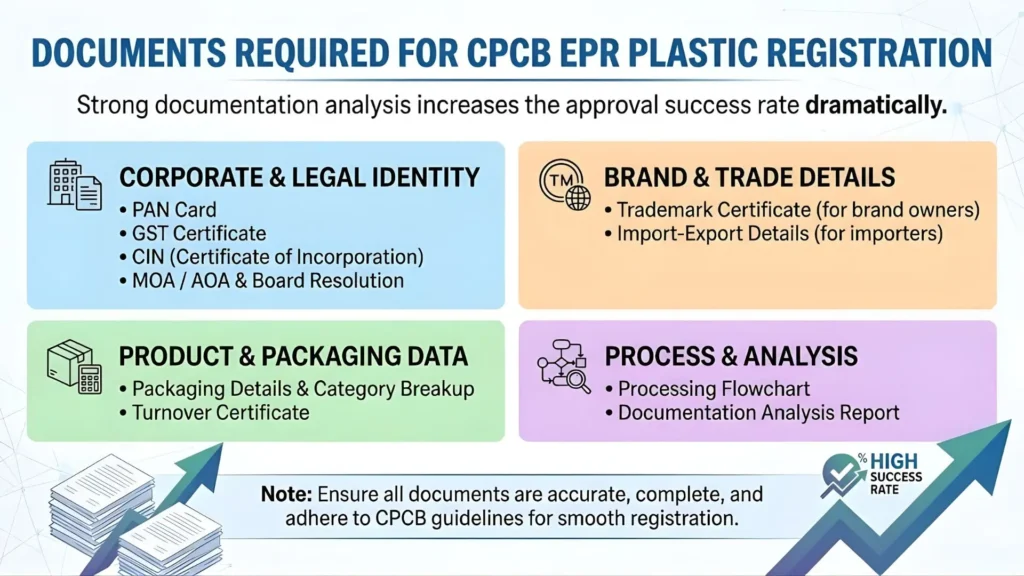
Plastic Waste EPR Registration is filed against Form I of the Plastic Waste Management Rules. In addition to the core document set, PIBOs and Plastic Waste Processors (PWPs) typically need:
- Proof of selling in more than two states (GST returns or tax invoices), if applying centrally with CPCB rather than an SPCB/PCC
- District Industries Centre (DIC) Certificate, if the applicant has its own production facility
- Valid Consents under the Air and Water Acts, if operating a manufacturing unit
- Details of the type and quantity of plastic packaging products produced or marketed, category-wise
- A representative image of the plastic packaging, covering each applicable EPR category
- Copy of the previous EPR Registration certificate, if this is a renewal application
- Agreements with registered Plastic Waste Processors (PWPs) or Producer Responsibility Organisations (PROs) supporting the Action Plan
Since the Plastic Waste Management (Amendment) Rules, 2026, applicants must also be prepared to submit recycled-content sourcing details and reuse-target documentation for rigid and drinking-water packaging, verified where required by a Registered Environmental Auditor.
Documents Required for E-Waste EPR Registration
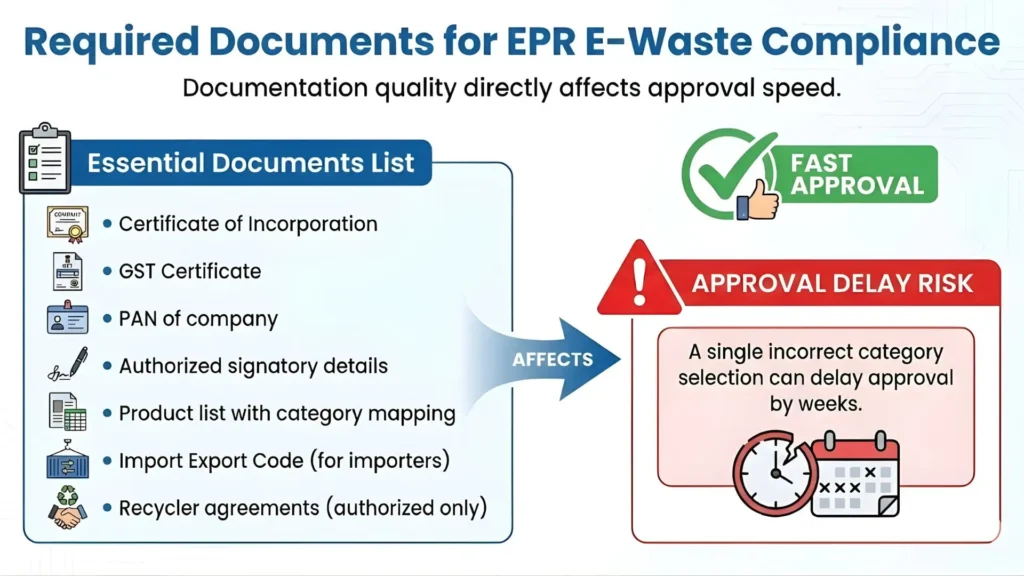
E-Waste EPR Registration tends to be the most document-intensive category because it covers 21 notified EEE categories under Schedule I and carries no turnover-based exemption. Expect to submit:
- Schedule I product/category codes for every notified electronic item you manufacture, import, or sell
- Technical documentation, including supplier declarations and material analytical reports
- RoHS (Restriction of Hazardous Substances) compliance declaration for applicable products
- Signed agreements with authorized dismantlers, recyclers, or Treatment, Storage and Disposal Facilities (TSDFs)
- A detailed EPR Plan covering your e-waste channelization system, collection mechanism, and target-wise numbers
- Awareness-program methodology and budget, if included as part of your compliance strategy
- A geo-tagged video of the manufacturing or warehousing facility, kept live and publicly accessible after submission
- Authorized signatory details — name, email, Aadhaar, and PAN — on the application
CPCB typically completes e-waste application review in around 30 working days, and may follow up with physical or virtual site verification within three months of approval, so keep your facility video and address documentation genuinely current, not just filed away.
Documents Required for Battery Waste EPR Registration
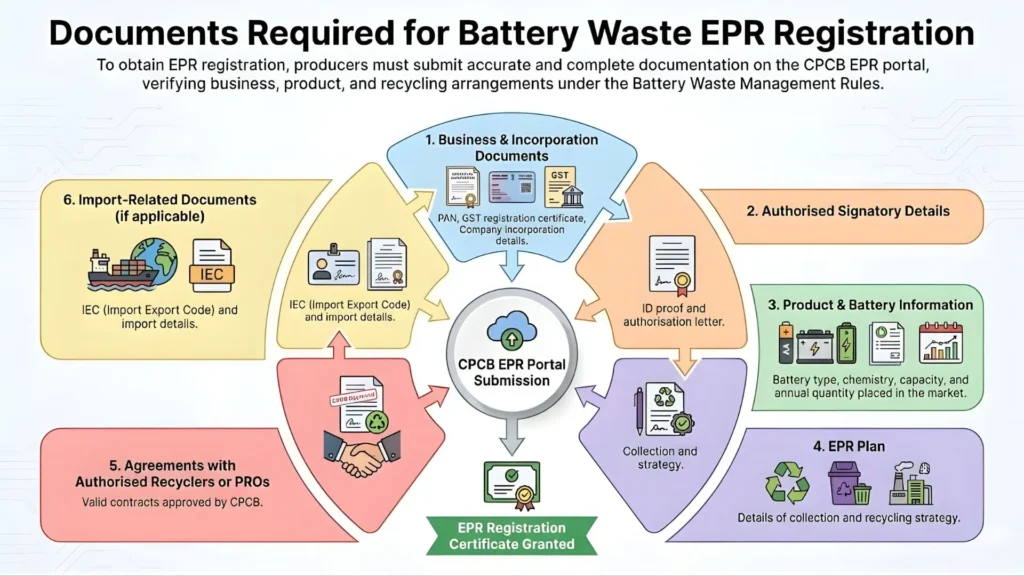
Battery Waste EPR Registration under the Battery Waste Management Rules, 2022 needs the common document base plus:
- Battery chemistry and type declaration — lead-acid, lithium-ion, nickel-based, EV, portable, automotive, or industrial — for every product line
- Details of batteries sold standalone versus embedded in equipment, since both routes count toward your EPR target
- Agreements with registered recyclers or refurbishers supporting your collection and recycling Action Plan
- For recyclers and refurbishers specifically: SPCB/PCC registration proof and hazardous-waste handling authorization
- Declaration of second-life battery use pathways (such as stationary energy storage), where applicable under the 2025 amendment
- Labelling compliance documentation, confirming battery packs meet CPCB's recycled-material and marking requirements
Documents Required for Tyre Waste EPR Registration
Waste Tyre EPR Registration, filed under Schedule IX of the Hazardous and Other Wastes (Management and Transboundary Movement) Amendment Rules, 2022, requires:
- Tyre category and size classification for all tyre types manufactured or imported
- Annual manufacturing or import volume data, since this determines your two-year-lagged recycling target
- Consent to Establish (CTE) and Consent to Operate (CTO) from the concerned SPCB/PCC — mandatory for recyclers and retreaders
- Proof of registration as Producer, Recycler, or Retreader, filed separately if the applicant operates in more than one capacity
- Retreading capacity or recycling capacity documentation, for retreaders and recyclers respectively
- Bank and payment details for the applicable registration fee, if charged
Documents Required for Used Oil EPR Registration
Used Oil EPR, introduced under Chapter VII of the Hazardous and Other Wastes (Management and Transboundary Movement) Second Amendment Rules, 2023, is the newest category and asks for:
- Base oil or finished lubricant production/import volume data for producers and importers
- Hazardous waste authorization or relevant SPCB consent for collection agents and recyclers
- An EPR Plan detailing collection, safe transportation, and storage arrangements for used oil
- Public-facing contact details (website or listed channel) for collection point information, as required under the Rules
- Agreements or arrangements with registered recyclers to whom collected used oil will be supplied
- Recycler-side documentation: proof of re-refining capacity and compliance with CPCB's Standard Operating Procedures for used oil processing
Additional Documents for Recyclers, Refurbishers & Retreaders
If you're registering on the processing side rather than as a producer, expect these documents across most categories:
- Consent to Establish (CTE) and Consent to Operate (CTO) from your SPCB/PCC
- Authorization under the Hazardous and Other Wastes (Management and Transboundary Movement) Rules, where the waste stream qualifies as hazardous (batteries, tyres, used oil)
- Processing/recycling capacity certification (tonnes per annum), which determines your applicable fee slab
- Site layout or facility details supporting your registered processing capacity
- Environmental compliance reports or previous audit records, if requested during CPCB/SPCB review
Recent Notifications Affecting Document Requirements (2025–2026)
- Plastic Waste Management (Amendment) Rules, 2026 (G.S.R. 237(E), 31 March 2026): Added recycled-content sourcing evidence and reuse-target documentation to the plastic EPR application, with verification available through a Registered Environmental Auditor under the Environment Audit Rules, 2025.
- Plastic Waste Management (Amendment) Rules, 2025: Made QR code, barcode, or unique-number labelling proof a documentation requirement effective 1 July 2025, tying packaging traceability directly to the registration record.
- Battery Waste Management (Amendment) Rules, 2025: Introduced documentation for second-life battery use and strengthened labelling/traceability declarations.
- E-Waste (Management) Amendment Rules, 2024: Expanded the Schedule I document set to include solar photovoltaic modules/cells, EV components, and most electronic medical devices, meaning producers in these segments now need category-specific declarations they may not have needed before.
- Used Oil EPR enforcement notice (February 2025): CPCB directed SPCBs/PCCs to push pending producers, importers, and recyclers to complete documentation and registration within 15 days, given low sign-up numbers since the June 2024 portal launch.
Document Format & Submission Guidelines
- Most portals cap individual file uploads at 5 MB — compress scanned documents before uploading
- Submit self-attested copies unless the portal explicitly asks for notarized or original documents
- Ensure every address (GST, CTE, CTO, incorporation certificate) matches exactly — even a spelling or floor-number mismatch can trigger a query
- Self-declarations must be on company letterhead, signed by the authorized signatory, and carry the company seal
- Geo-tagged facility videos or photos, where required, must remain live and publicly accessible after submission, not just at the time of upload
- Keep a master folder of all EPR documents so renewal applications and multi-category filings don't require re-collecting the same paperwork
Common Document Mistakes That Delay or Reject Applications
- Address mismatch between GST, CTE, CTO, and the application form
- Inactive or broken geo-tagged video links after submission (common in e-waste applications)
- Unsigned or unsealed self-declarations
- Incorrect Schedule I / EEE category codes, or wrong plastic packaging category selection
- Sales or production data that doesn't reconcile with GST filings
- Vague EPR Action Plans without named, verifiable recycler or PRO agreements
- Submitting documents for only one waste category when the business actually needs multiple registrations
EPR Registration Fees (Category-Wise)
Fees are set independently on each CPCB portal and revised periodically, so treat the figures below as directional and verify current numbers on the live portal before paying.
| Category | Fee Basis |
| Plastic | Based on PIBO/PWP category and packaging volume |
| E-Waste | Tiered by producer/recycler status; concessional ₹10,000 fee for producers whose sales have just started |
| Battery | Tiered separately for producers vs. recyclers, linked to recycling capacity |
| Tyre | Nominal fee per CPCB's published schedule, if applicable |
| Used Oil | Based on producer/importer/collection agent/recycler category |
Validity & Renewal Timeline
| Category | Validity | Documents Needed at Renewal |
| Plastic | Ongoing, tied to annual targets | Updated sales data, Action Plan refresh, prior certificate copy |
| E-Waste | Ongoing, tied to annual returns | Updated Schedule I data, refreshed recycler agreements |
| Battery | Ongoing, tied to annual returns | Updated chemistry-wise sales data, recycler tie-up proof |
| Tyre | 2 years, then renewal | Updated volume data, valid CTE/CTO for recyclers/retreaders |
| Used Oil | Ongoing, tied to annual returns | Updated production/import volumes, recycler supply proof |
Benefits of Getting Your EPR Documentation Right the First Time
- Faster approval: Complete, consistent documentation is the biggest factor separating a 15-day approval from a 40-day query cycle.
- Fewer compliance risks later: Well-organized documents form the audit trail CPCB/SPCB and ESG reviewers ask for during renewal or inspection.
- Avoids Environmental Compensation exposure: Selling regulated products without a valid, properly documented EPR Registration is a violation of the Environment (Protection) Act, 1986, and can attract per-day compensation penalties.
- Smoother multi-category filing: A well-maintained document set for one category (GST, incorporation, signatory proof) speeds up registration for every additional category your business needs.
- Stronger buyer and marketplace trust: Clean documentation signals genuine compliance readiness to distributors, marketplaces, and institutional buyers who now ask for EPR proof before onboarding.
How Silvereye Certifications Helps with EPR Documentation
Silvereye Certifications is a regulatory compliance consultancy supporting Indian and international businesses with BIS, CDSCO, WPC-ETA, TEC/MTCTE, and EPR Authorization, among other approvals. For the documents required for EPR Registration specifically, Silvereye Certifications helps producers, importers, brand owners, and recyclers with:
- A category-wise document checklist tailored to your product mix before you start the application
- Pre-submission review to catch address mismatches, formatting issues, and missing declarations before CPCB does
- Drafting a CPCB-aligned EPR Action Plan backed by verifiable recycler, refurbisher, or retreader agreements
- Coordinating CTE/CTO, hazardous-waste authorization, and other consent documents with the relevant SPCB/PCC
- Managing renewal documentation so validity deadlines — like the 2-year tyre EPR cycle — don't catch your business off guard
Because Silvereye Certifications also manages BIS, CDSCO, WPC, and TEC/MTCTE documentation, businesses needing EPR alongside other product certifications can consolidate their paperwork and consultancy relationship instead of managing several vendors for overlapping compliance needs.
Conclusion
The documents required for EPR Registration aren't complicated individually, but getting all of them consistent — same addresses, correctly classified products, a genuinely detailed Action Plan — is what actually determines whether your application clears CPCB review in two weeks or two months.
Build your document set category by category, double-check every address against your GST and consent documents, and treat your EPR Action Plan as a real operating plan rather than a formality. If you'd rather have your documentation reviewed and prepared professionally before submission, Silvereye Certifications supports document preparation and filing across all five EPR categories, from first application to renewal.
Frequently Asked Questions
What is the most basic document required for any EPR Registration?
Your Certificate of Incorporation (or equivalent business registration proof) along with PAN and GST registration form the foundation every CPCB EPR portal asks for, regardless of category.
Do I need a Digital Signature Certificate (DSC) for EPR Registration?
Many CPCB portals accept a DSC or Aadhaar-based e-sign for the authorized signatory. Requirements can vary slightly by category, so check the specific portal's submission guidelines before applying.
Why do E-Waste EPR applications ask for a geo-tagged facility video?
It's part of CPCB's site-verification process to confirm the manufacturing or warehousing facility genuinely exists at the declared address. The video link must stay live and public after submission, or the application can be flagged.
What is an EPR Action Plan, and is it a mandatory document?
Yes, it's mandatory across all five categories. It's the document where you explain how you'll meet your collection, recycling, reuse, or refurbishment targets, typically backed by named recycler or PRO agreements rather than general statements
Why does my address need to match across GST, CTE, and CTO?
CPCB and SPCB reviewers cross-check these documents against each other. Even a minor mismatch — a different floor number or spelling — is one of the most common reasons applications get sent back for clarification.
Do recyclers need different documents than producers?
Yes. Recyclers, refurbishers, and retreaders generally need Consent to Establish (CTE), Consent to Operate (CTO), and processing-capacity certification, in addition to the common document base that producers also submit.
Is a RoHS declaration required for all E-Waste EPR applications?
It's required where applicable to the product category under Schedule I. Check whether your specific EEE items fall under RoHS-restricted categories before assuming it's needed.
Can I reuse the same documents across multiple EPR categories?
Core documents like incorporation certificate, PAN, GST, and signatory proof can generally be reused across Plastic, E-Waste, Battery, Tyre, and Used Oil applications. Category-specific documents — like Schedule I classification or CTE/CTO — still need to be prepared separately for each portal.
What happens if I submit incomplete documents?
CPCB or the SPCB will typically raise a query or request additional documents rather than reject outright, but this can push your approval timeline from roughly 15–30 working days out to 35–40 days or more.
Do documents need to be renewed along with the EPR Certificate?
Yes. At renewal, most portals expect updated sales/production data and refreshed recycler or Action Plan documentation, even if your core company documents (PAN, GST, incorporation) haven't changed.
Are there new document requirements because of the 2026 Plastic Amendment Rules?
Yes. Producers now need to be ready to show recycled-content sourcing and reuse-target documentation for applicable packaging categories, with verification available through a Registered Environmental Auditor where required.