
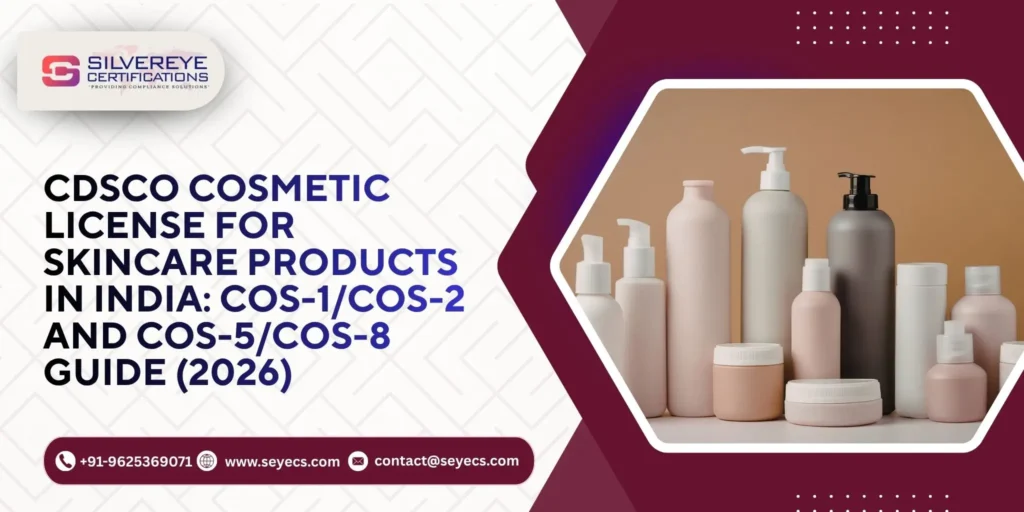
- Skincare products such as moisturisers, sunscreens, face washes, serums and toners must comply with India's applicable cosmetic regulations before being marketed. The required approval or licence depends on whether the product is imported or manufactured in India.
- Importers apply using Form COS-1 to obtain a COS-2 import registration certificate, while domestic manufacturers apply using Form COS-5 to obtain a COS-8 manufacturing license through the relevant State Licensing Authority.
- Restricted and prohibited ingredients must be checked against India's applicable cosmetic rules. Ingredients such as mercury compounds and prohibited lead compounds are restricted or prohibited as specified under the rules. Skin-lightening ingredients such as hydroquinone require careful regulatory assessment, and sunscreen UV filters must comply with the applicable requirements for permitted ingredients.
- Product claims affect regulatory classification. Claims such as “treats melasma” or “treats hyperpigmentation” may raise questions about whether a product falls within the cosmetic definition or requires a different regulatory pathway. Review the product's composition, intended use and claims before deciding on the applicable approval route.
Introduction
CDSCO Cosmetic License For Skincare products, including moisturizers, face washes, sunscreens, serums, toners and face masks, are regulated under India's Cosmetics Rules, 2020, where they meet the legal definition of cosmetics. The applicable regulatory requirements depend on whether the products are imported or manufactured domestically.
Importers apply using Form COS-1 and, upon approval, receive a COS-2 registration certificate from CDSCO's Central Licensing Authority. Domestic manufacturers apply using Form COS-5 and, upon approval, receive a COS-8 manufacturing license from the relevant State Licensing Authority. Both are subject to applicable retention-fee requirements under the rules.
Skincare products also require careful assessment of ingredient restrictions, product safety and labelling requirements. Ingredients such as mercury compounds and certain lead compounds are prohibited or restricted as specified under applicable regulations. Skin-lightening ingredients, including hydroquinone, require particular scrutiny, while sunscreen formulations must comply with the applicable requirements for permitted UV filters. Products making claims to treat conditions such as melasma or acne may require additional regulatory assessment depending on their composition, intended use and claims.
Because skincare covers a wide range of products, determining the correct product classification, ingredient compliance and licensing route is an important part of planning a launch in India. Sunscreens require appropriate assessment of their UV filters, skin-lightening products need careful ingredient review, and anti-ageing serums must use claims that accurately reflect their intended cosmetic purpose and do not imply an unapproved therapeutic use.
Why Do Skincare Products Need CDSCO Registration in India?
Under the Drugs and Cosmetics Act, 1940, products intended to clean, moisturize, protect or beautify the skin may qualify as cosmetics when they meet the legal definition. Common examples include moisturizers, face washes, sunscreens and serums. Imported cosmetics must have the applicable CDSCO import registration, while domestically manufactured cosmetics require the relevant manufacturing license from the State Licensing Authority, subject to applicable rules and exemptions.
Skincare products require careful regulatory assessment for two important reasons. First, certain ingredients, including skin-lightening agents, UV filters and other active ingredients, are subject to specific restrictions or conditions under India's cosmetic standards. Second, product marketing claims can affect regulatory classification. Claims suggesting that a product treats a disease or medical condition may require assessment under the applicable drug regulations rather than the cosmetic pathway.
CDSCO Skincare Product Categories and Regulatory Requirements
The following table covers common skincare products and highlights key compliance considerations. The applicable classification depends on the product's composition, intended use, claims and relevant regulatory standards.
| Product Type | Product Category | Regulatory Considerations |
|---|---|---|
| Moisturisers and face creams | Skin moisturising and conditioning | Ensure ingredient compliance, appropriate labelling and cosmetic claims. Avoid unsupported disease-treatment claims. |
| Face washes and cleansers | Skin cleansing | Check ingredient restrictions and ensure claims accurately reflect the product's intended cosmetic use. |
| Toners and essences | Skin conditioning | Review the formulation and concentration of active ingredients against applicable requirements. |
| Sunscreens | Sun protection | Verify permitted UV filters and substantiate SPF and other performance claims with appropriate testing. |
| Serums | Skin conditioning and appearance enhancement | Review ingredients and claims carefully, particularly when the product is marketed for acne, pigmentation or other skin conditions. |
| Face masks and sheet masks | Skin conditioning and cleansing | Ensure formulation safety, ingredient compliance and appropriate product labelling. |
| Exfoliants and scrubs | Skin exfoliation | Check the safety and regulatory status of exfoliating ingredients and particles used in the formulation. |
| Skin-brightening products | Skin appearance and tone | Review skin-lightening ingredients against India's prohibited and restricted ingredient requirements before filing. |
| Anti-ageing creams and serums | Skin appearance and conditioning | Ensure claims are truthful, substantiated and consistent with the product's regulatory classification. |
| Body lotions | Body moisturising and conditioning | Confirm ingredient compliance, product safety and applicable labelling requirements. |
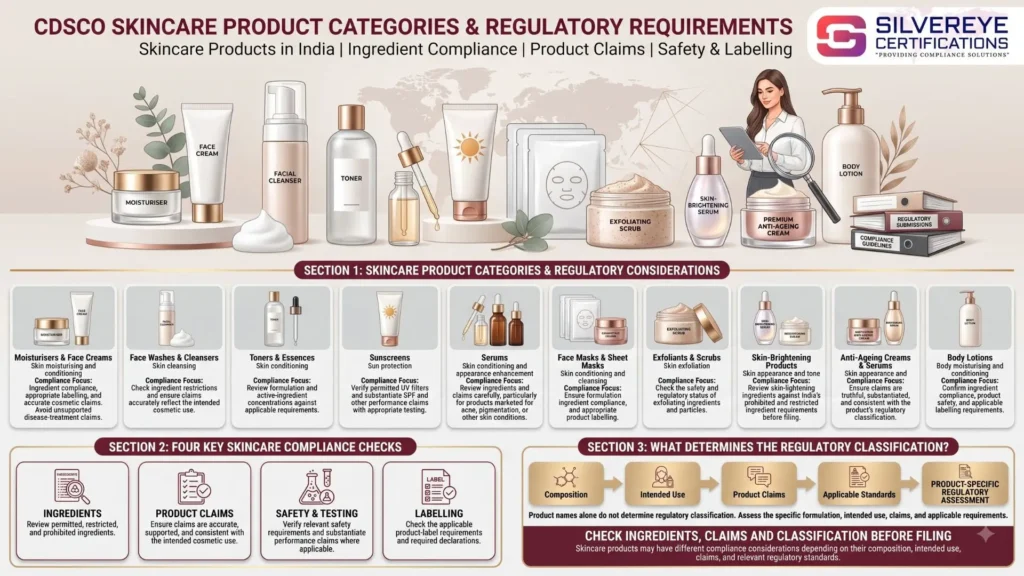
Important: These are general product descriptions, not formal CDSCO license categories. The regulatory route and documentation requirements must be determined for the specific product.
Prohibited and Restricted Skincare Products Ingredients in India
India regulates cosmetic ingredients through the Cosmetics Rules, 2020, applicable Bureau of Indian Standards (BIS) specifications, including IS 4707, and relevant amendments or notifications. Ingredients may be prohibited, restricted to specified uses or permitted subject to conditions. A formulation should be reviewed against the current requirements before import registration or manufacturing approval.
- Hydroquinone: Check the intended use and concentration against the applicable ingredient restrictions. Do not assume that a skin-lightening formulation containing hydroquinone is acceptable for cosmetic registration in India. The formulation should be assessed against the current BIS ingredient standard before filing.
- Mercury and mercury compounds: Mercury is subject to specific restrictions under Indian cosmetic regulations. Certain uses or concentrations may be prohibited, while the rules provide limited exceptions under specified conditions. Verify the applicable provision rather than treating every mercury-related requirement as identical.
- Lead compounds: Cosmetic formulations must comply with restrictions on lead compounds, particularly those used for colouring. The rules also prescribe limits for lead contamination in permitted cosmetic colourants. Therefore, it is more accurate to assess the ingredient's purpose and the applicable standard than to state that every trace of lead is automatically prohibited.
- UV filters in sunscreens: Sunscreen formulations must comply with India's applicable requirements for permitted UV filters. Approval in another market, such as the EU or US, does not automatically establish compliance in India. Check each UV filter against the current Indian standards before submitting the application.
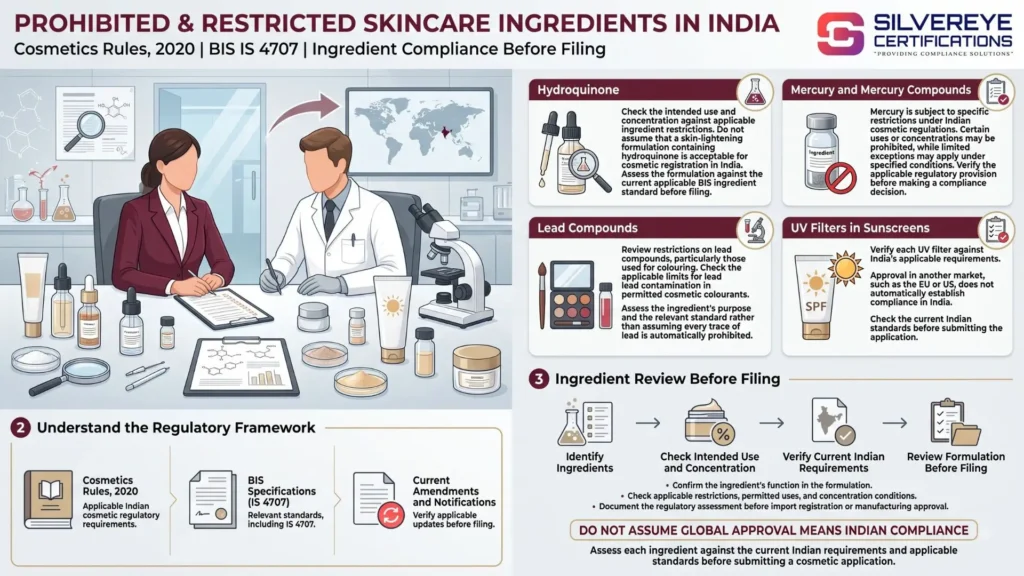
Because ingredient standards and regulatory guidance can change, manufacturers and importers should confirm the current status of skin-lightening agents, exfoliating acids, UV filters and other active ingredients before finalizing a formulation.
When Is a Skincare Product Classified as a Drug Instead of a Cosmetic?
One of the most important steps in skincare product registration in India is determining whether a product qualifies as a cosmetic or falls under another regulatory category. Classification depends on the product's composition, intended use, claims and applicable legal definitions. Marketing language alone does not determine the classification, but therapeutic claims can trigger additional regulatory scrutiny.
| Claim Area | Example of a Cosmetic Claim | Example That May Require Drug Classification Review |
|---|---|---|
| Skin tone and pigmentation | “Helps improve the appearance of uneven skin tone” | “Treats melasma” |
| Acne and blemishes | “Helps reduce the appearance of blemishes” | “Treats acne infection” |
| Sun protection | “Provides sun protection with a substantiated SPF claim” | Claims to treat a specific skin disease caused by UV exposure |
| Anti-ageing | “Reduces the appearance of fine lines” | Claims to treat a medical condition or correct a physiological disorder |
Review product labels, packaging, advertisements and website claims before applying for registration. Claims should be accurate, supported by appropriate evidence and consistent with the product's intended cosmetic use. Where the classification is unclear, obtain regulatory advice before finalizing the formulation or marketing material.
Import vs. Manufacturing: Which Registration Route Applies to Your Skincare Product?
The applicable route depends primarily on where the cosmetic is manufactured and the activity being undertaken.
| Parameter | Import Route (COS-1 → COS-2) | Manufacturing Route (COS-5 → COS-8) |
|---|---|---|
| Applies to | Cosmetics manufactured outside India and imported for sale | Cosmetics manufactured in India |
| Licensing authority | CDSCO's Central Licensing Authority | Relevant State Licensing Authority |
| Who applies | Eligible applicant, such as an authorised Indian agent | Indian manufacturer or eligible applicant |
| Validity | In perpetuity, subject to applicable retention-fee requirements | In perpetuity, subject to applicable retention-fee requirements |
Importer Route: From COS-1 Application to COS-2 Registration
Foreign skincare brands entering India and Indian businesses importing products such as moisturizers, sunscreens and serums must comply with the applicable cosmetic import registration requirements before marketing their products in India.
- Eligibility: The application must be submitted by an eligible applicant in accordance with the Cosmetics Rules, 2020. Foreign manufacturers should confirm the applicable requirements for appointing an authorized Indian agent.
- Supporting documents: Depending on the application, documents may include a Certificate of Free Sale, manufacturing-site details, ingredient lists, product specifications, labelling information and a Power of Attorney, where applicable.
- Ingredient screening: Check UV filters, skin-lightening ingredients and other active ingredients against India's applicable ingredient standards before preparing the application.
- Application process: Prepare the required product documentation, submit Form COS-1 through the applicable CDSCO online process, respond to regulatory queries and obtain Form COS-2 upon approval.
For additional information, refer to the relevant CDSCO guidance on cosmetic import registration and the supporting documentation required for your product.
Manufacturer Route: From COS-5 Application to COS-8 License
Businesses manufacturing skincare products in India must obtain the applicable cosmetic manufacturing license from the relevant State Licensing Authority before commencing regulated manufacturing activities.
- Eligibility: The manufacturing facility must meet applicable requirements for premises, equipment, personnel, hygiene and quality control.
- Supporting documents: Depending on the application, documentation may include the site layout, manufacturing equipment details, product information, technical personnel qualifications and applicable GMP documentation.
- Application process: Submit Form COS-5 with the required supporting documents and declarations. The State Licensing Authority assesses the application and may inspect the facility before issuing Form COS-8 upon approval.
- Third-party manufacturing: Businesses that do not operate their own manufacturing facility may explore the applicable loan license route, using Form COS-6 for the application and Form COS-9 for the license, subject to the rules and eligibility requirements.
Inspection arrangements and processing timelines depend on the applicable requirements and the State Licensing Authority. Confirm the current procedure before planning a product launch.
Documents Required CDSCO Cosmetic License for Skincare Products
| Route | Core documents |
| Import (COS-1) | Certificate of Free Sale; manufacturer's GMP certificate; full ingredient list; safety and test data (including SPF test reports for sunscreens); English-language labels; Power of Attorney; Importer Exporter Code (IEC) |
| Manufacturing (COS-5) | Site Master File; plant layout; equipment list; product list mapped to skincare sub-categories; proof of the technical person's qualification; Form COS-7 GMP self-declaration |
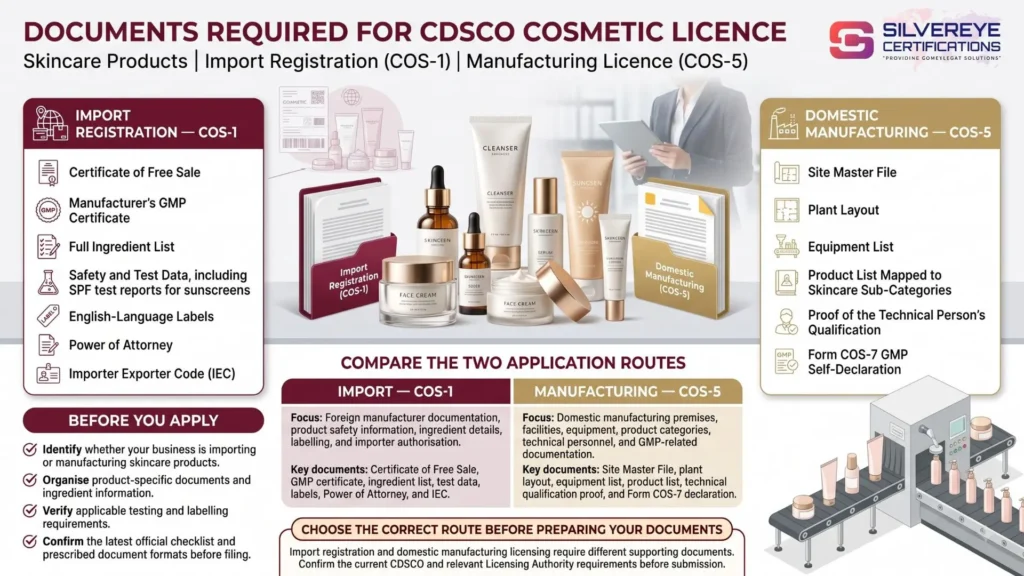
The exact checklist can change, so confirm it against the current CDSCO or State Licensing Authority requirements before you compile the file.
Step by Step Process For CDSCO Cosmetic License for Skincare Products
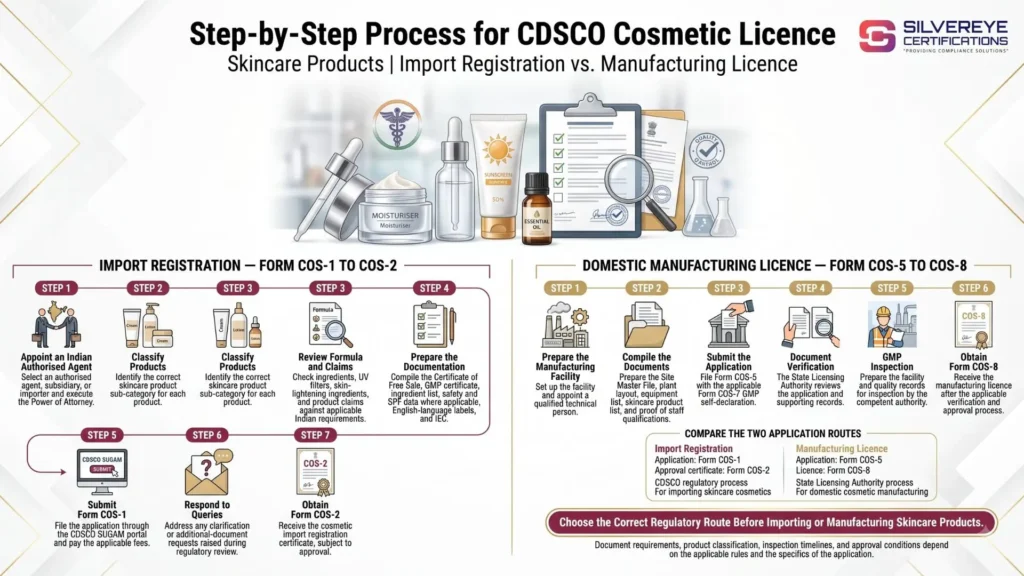
Importers: Form COS-1 to Form COS-2
Foreign brands, and Indian importers buying moisturisers, sunscreens or serums from overseas makers, need CDSCO import registration before customs clearance is possible.
- Appoint an Indian authorised agent, subsidiary or importer and sign the Power of Attorney.
- Classify each product under the correct skincare sub-category.
- Screen the formula and claims. Check actives, UV filters and any lightening ingredient against India's lists, and review label wording for therapeutic claims.
- Compile the dossier: Certificate of Free Sale, GMP certificate, ingredient list, safety and SPF data, English labels and IEC.
- File Form COS-1 on the CDSCO SUGAM portal and pay the fees.
- Answer CDSCO queries until the review is complete.
- Receive Form COS-2, the registration certificate, valid for 5 years.
Manufacturers: Form COS-5 to Form COS-8
Domestic makers, including contract manufacturers who produce for other brands, need a licence from their State Licensing Authority before production starts.
- Set up the facility and put a qualified technical person in charge.
- Prepare the documents: Site Master File, plant layout, equipment list, skincare product list and staff qualification proof.
- File Form COS-5 with the Form COS-7 GMP self-declaration.
- Document verification by the State Licensing Authority.
- Physical GMP inspection, typically scheduled within 30 to 60 days.
- Receive Form COS-8, generally within about 45 days of completed verification.
For the general step-by-step import process that applies to every cosmetic category, and for loan licence details, see our companion guides on cosmetic import registration and loan licences.
What Are the Fees for Skincare Product Registration in India?
Government fees depend on the registration route and the applicable provisions of the Cosmetics Rules, 2020. The following table summarizes the prescribed fee basis.
| Registration Route | Fee Component | Prescribed Fee |
|---|---|---|
| Import (COS-1/COS-2) | Registration for each cosmetic category | US$1,000 |
| Import (COS-1/COS-2) | Each additional cosmetic category | US$1,000 |
| Import (COS-1/COS-2) | Each product variant | US$50 |
| Import (COS-1/COS-2) | Each manufacturing site | US$500 |
| Manufacturing (COS-5/COS-8) | Initial licence covering up to 10 items in each category | ₹10,000 |
| Manufacturing (COS-5/COS-8) | Each additional item | ₹500 |
| Manufacturing (COS-5/COS-8) | Each additional category, covering up to 10 items | ₹10,000 |
These fees are prescribed under the Third Schedule of the Cosmetics Rules, 2020. Additional expenses, such as testing, document authentication and regulatory consultancy, are separate and depend on the application.
A skincare brand selling a cleanser, moisturizer and sunscreen should not automatically assume that all three can be registered under one category fee. The applicable fee depends on the regulatory categorization, product variants and manufacturing sites covered by the application. Confirm the correct categorization and fee calculation before filing.
Validity and Retention Fees for Skincare Product Licenses
| Aspect | COS-2 (Import Registration) | COS-8 (Manufacturing Licence) |
|---|---|---|
| Validity | In perpetuity, subject to applicable conditions | In perpetuity, subject to applicable conditions |
| Retention requirements | Applicable retention fee payable every five years under the Cosmetics Rules, 2020 | Applicable retention fee payable every five years under the Cosmetics Rules, 2020 |
| Late payment risk | Non-payment may lead to cancellation of the registration certificate under the prescribed rules | Non-payment may lead to cancellation of the manufacturing licence under the prescribed rules |
Important: COS-2 and COS-8 are not generally limited to five-year validity periods. They remain valid in perpetuity, subject to the applicable retention-fee requirements and other conditions under the Cosmetics Rules, 2020. Confirm the current retention procedure and deadlines before making a payment.
How Long Does Skincare Product Registration Take?
The time required for skincare product registration depends on the application type, document completeness, product category and regulatory review. The following stages provide a general overview rather than guaranteed approval deadlines.
| Stage | Import Route (COS-1/COS-2) | Manufacturing Route (COS-5/COS-8) |
|---|---|---|
| Document preparation | Depends on the product portfolio and supporting documents | Depends on facility readiness and technical documentation |
| Regulatory review | CDSCO reviews the application and may request additional information | The State Licensing Authority reviews the application and supporting records |
| Site inspection | Overseas-site inspection may apply where required | Facility inspection may be required under applicable rules |
| Grant of registration/licence | COS-2 is issued after approval | COS-8 is issued after approval |
Prepare complete documentation before filing and allow time for any regulatory queries, additional evidence or inspection requirements. Confirm the applicable processing procedure with the relevant authority rather than relying on a fixed timeline.
Common Mistakes to Avoid During Skincare Product Registration
- Ignoring ingredient restrictions: Review skin-lightening formulations, including those containing hydroquinone, against the applicable Indian ingredient standards before applying.
- Assuming foreign approval is sufficient: A UV filter permitted in the EU or US is not automatically acceptable in India. Verify the applicable Indian requirements.
- Making unsupported medical claims: Claims such as “treats melasma” or “heals acne” may require additional regulatory assessment depending on the product's composition, intended use and claims.
- Submitting incomplete testing documents: Provide appropriate safety, quality and SPF performance evidence where required for the product.
- Misclassifying the product: Assess the formulation, intended use, labelling and marketing claims before determining whether the product qualifies as a cosmetic.
Benefits of Proper Skincare Product Licensing
- Legal market access: Obtaining the applicable registration or license helps businesses meet the regulatory requirements for importing or manufacturing skincare products in India.
- Retail and marketplace readiness: Retailers and e-commerce platforms may request relevant regulatory documentation before onboarding skincare products.
- Consumer confidence: Appropriate ingredient controls, product safety evidence and compliant labelling support responsible marketing and consumer confidence.
- Reduced compliance risk: Correct classification, ingredient review and documentation can help minimize avoidable application queries and regulatory delays.
How Silvereye Certifications Helps with Skincare Product Licensing
Silvereye Certifications provides regulatory compliance support to cosmetic manufacturers, importers and direct-to-consumer brands in India. For skincare businesses, support may include:
- Ingredient screening: Reviewing formulations for ingredients that may be prohibited, restricted or subject to specific conditions, including hydroquinone and sunscreen UV filters.
- Claims and label review: Assessing product claims and labelling for consistency with the intended cosmetic use and applicable regulatory requirements.
- Application assistance: Supporting import registration through COS-1/COS-2 and manufacturing licence applications through COS-5/COS-8, as applicable.
- Technical documentation: Helping organise relevant product information, safety evidence and SPF testing documentation for sunscreens.
- Third-party manufacturing guidance: Explaining the applicable licensing options, including the loan-licence route, where relevant.
Skincare brands planning to launch products in India can contact Silvereye Certifications for assistance with preliminary ingredient and claims reviews, documentation preparation and the applicable registration process.
Conclusion
Skincare is India's biggest cosmetic category and its most ingredient-sensitive one. Hydroquinone, mercury and non-approved UV filters can turn a routine filing into a rejected shipment, and one line of therapeutic copy can turn a cosmetic into a drug in CDSCO's eyes.
Whether you import a finished line through COS-1/COS-2, manufacture through COS-5/COS-8 or use a loan licence, treat ingredient screening and claims review as part of the filing, not an afterthought. For a category-specific review of your range, Silvereye Certifications can guide the process end to end.
Frequently Asked Questions
Do I need CDSCO registration to sell face cream in India?
Yes. Face creams and moisturisers are skincare cosmetics and need COS-2 if imported or COS-8 if made in India before legal sale.
Is hydroquinone banned in India?
It is not accepted as a skin-lightening active in cosmetics. It is reported to be allowed only in artificial nail systems at a very low level. Confirm the current status with CDSCO before formulating or importing.
Is sunscreen regulated as a cosmetic or a drug in India?
Sunscreens making cosmetic sun-protection claims, such as protection from sunburn, are regulated as cosmetics if the UV filters are on India's permitted list and SPF claims are backed by accredited testing. Claims to treat or prevent a UV-related medical condition can push a product toward drug classification.
Can an anti-aging serum be registered as a cosmetic?
Appoint an Indian authorised agent or importer, screen ingredients, compile the dossier and file Form COS-1 on SUGAM. You can import once Form COS-2 is granted.
What documents are needed for skincare product registration?
For imports: Certificate of Free Sale, manufacturer's GMP certificate, ingredient list, safety and SPF test data, English labels, Power of Attorney and IEC. For manufacturing: Site Master File, plant layout, equipment list, product list, technical staff proof and the COS-7 declaration.
Are all UV filters used abroad accepted in Indian sunscreens?
No. A filter approved in the EU or US is not automatically accepted in India, so check each one against India's permitted list before formulating and filing.
How long does skincare product registration take?
Import registration can take up to 180 working days. Manufacturing licenses are generally granted about 45 days after document verification, following a 30 to 60 day inspection window.
Can I manufacture skincare products without owning a factory?
Yes, through a loan license (Form COS-6 with the COS-7 GMP self-declaration), which leads to Form COS-9 and lets you manufacture at a third party's licensed facility.
What claims should I avoid on skincare labels?
Avoid medical language such as "treats melasma", "heals acne" or "repairs skin barrier". Safer options include "evens skin tone" and "reduces the appearance of blemishes".
How much does it cost to register a skincare line?
Import fees are commonly about USD 1,000 per category, USD 500 per manufacturing site and USD 50 per variant. State manufacturing license fees are typically ₹2,500 to ₹5,000, varying by state.
Are mercury and lead allowed in Indian cosmetics?
No. Mercury and lead compounds are prohibited in cosmetics sold in India, including trace amounts in some traditional or Ayurvedic-origin formulas.
Can one CDSCO filing cover multiple skincare products?
Often yes, as variants within the same skincare category, which can cost less than separate category filings. Confirm the grouping with CDSCO or a regulatory consultant while filing.