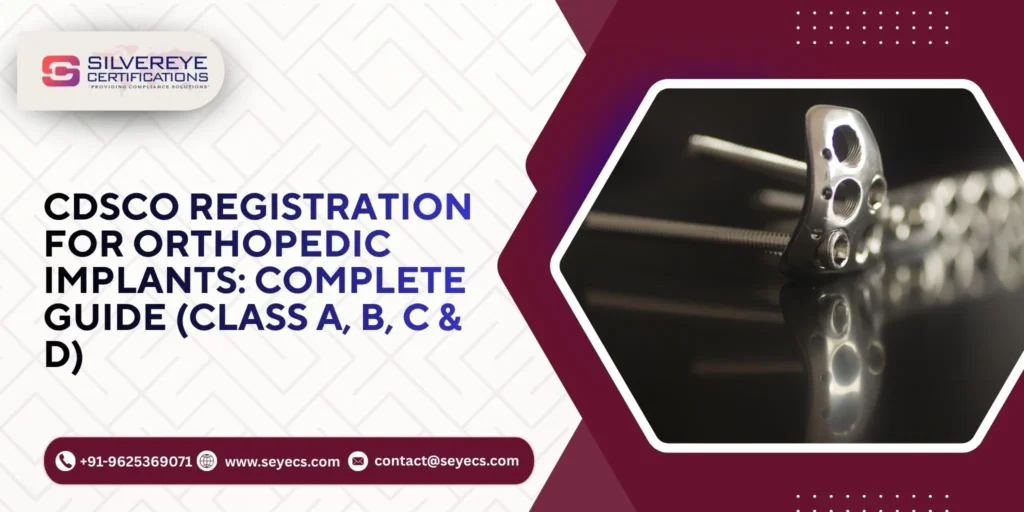
- Orthopedic implants span all four classes: External supports like cervical collars are Class A, rehabilitation equipment is Class B, bone fixation devices are Class C, and permanent joint prostheses are Class D.
- The manufacturing route depends on the device class: Class A/B devices generally use Form MD-3, with the licence granted in Form MD-5 by the State Licensing Authority. Class C/D devices use Form MD-7, with the licence granted in Form MD-9 by CDSCO’s Central Licensing Authority.
- Importers use Forms MD-14 and MD-15: An authorized Indian agent applies through Form MD-14 and, upon approval, receives the import license in Form MD-15 from CDSCO.
- Wholesalers use Forms MD-41 and MD-42: Businesses involved in stocking, supplying or distributing orthopedic implants should confirm the applicable registration requirements. Where required, Form MD-41 is the application and Form MD-42 is the registration certificate.
Introduction
CDSCO registration for orthopedic implants is mandatory under the Medical Devices Rules, 2017, and the applicable process depends on the product’s risk classification. Orthopedic devices span all four CDSCO classes, from Class A external supports to Class D permanent joint replacement implants. Manufacturers of Class A and Class B devices apply using Form MD-3 and receive the license in Form MD-5 from the State Licensing Authority.
For Class C and Class D devices, manufacturers apply using Form MD-7 and receive the license in Form MD-9 from CDSCO’s Central Licensing Authority. This route applies to many higher-risk orthopedic implants, including certain bone plates, screws and joint prostheses, depending on their classification. Importers apply through Form MD-14 and receive the import license in Form MD-15 upon approval, while wholesalers and distributors, where registration is required, apply through Form MD-41 and receive the registration certificate in Form MD-42.
What Is CDSCO Registration for Orthopedic Implants?
CDSCO registration for orthopedic implants refers to the applicable regulatory approval or license issued under India's Medical Devices Rules, 2017 (MDR 2017), administered by the Central Drugs Standard Control Organization (CDSCO) under the Ministry of Health and Family Welfare. The applicable requirements depend on the product, its risk classification and the business activity, such as manufacturing, importing or distributing orthopedic devices.
These products range from external orthopedic supports, including braces, collars and splints, to internal bone-fixation devices, such as plates, screws and wires, and permanent joint replacement prostheses for the hip, knee and shoulder. Medical devices are regulated under the MDR 2017, framed under the Drugs and Cosmetics Act, 1940.
Orthopedic devices can fall across CDSCO's four risk classes: A, B, C and D. An external support, such as a cervical collar, may fall into a lower-risk category, while certain permanent joint replacement prostheses fall into Class D, the highest-risk category. The correct classification of your specific product is essential before selecting the applicable licensing route, including the MD-3/MD-5 route or the MD-7/MD-9 route.
How CDSCO Classifies Orthopedic Devices: Class A, B, C and D
Orthopedic and prosthetic devices may fall into Class A, Class B, Class C or Class D, depending on their intended purpose and applicable classification rules. Factors such as whether the device is implantable, its duration of use, its function and the consequences of device failure can affect its classification. Always check the official classification for the specific product rather than relying only on its name or general description.
| Class | Risk Level | Orthopedic Examples | Manufacturing Route |
|---|---|---|---|
| Class A | Low risk | Certain external, non-invasive orthopedic supports, such as collars, splints and orthoses | Form MD-3 → MD-5, where applicable |
| Class B | Low-to-moderate risk | Certain therapeutic and rehabilitation devices | Form MD-3 → MD-5, where applicable |
| Class C | Moderate-to-high risk | Certain bone-fixation devices, plates, screws and spinal fixation systems | Form MD-7 → MD-9, where applicable |
| Class D | High risk | Certain joint replacement prostheses, including hip and knee implants | Form MD-7 → MD-9, where applicable |
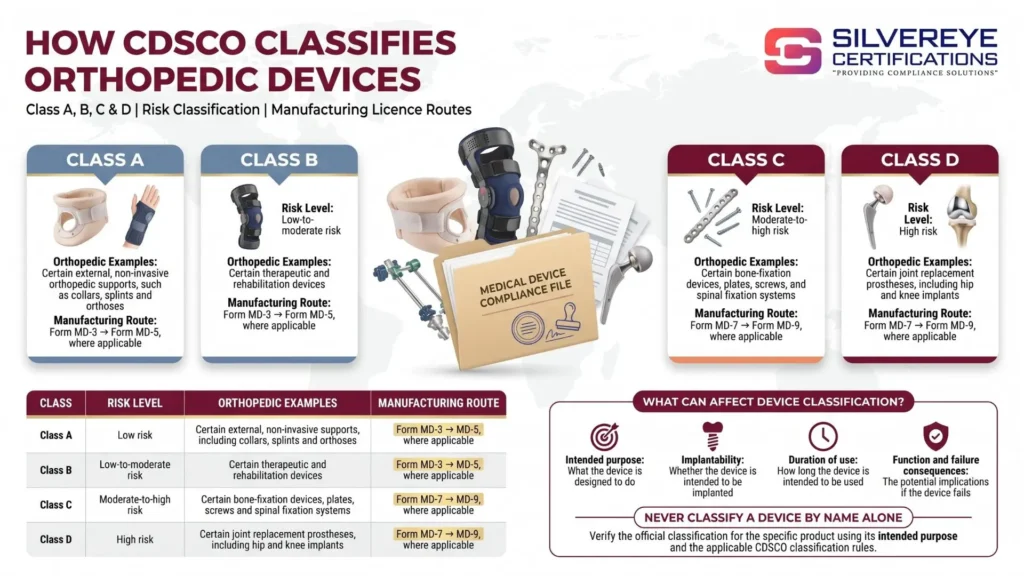
Verify your exact implant's classification before applying. The distinction between Class C and Class D may depend on the device's intended use and specific regulatory classification. Do not assume that every bone plate, spinal implant or joint prosthesis belongs to a particular class based solely on its product name. Check the relevant CDSCO classification list and official guidance before choosing the application form, as an incorrect classification can delay the licensing process.
Who Needs CDSCO Registration for Orthopedic Implants?
The applicable regulatory requirements depend on the business's role in the orthopedic implant supply chain and the device's classification. For domestic manufacturers, Class A and Class B devices generally follow the Form MD-3 application and Form MD-5 license route, while Class C and Class D devices generally follow the Form MD-7 application and Form MD-9 license route, subject to the applicable rules and exemptions.
| Entity | Class A/B Route | Class C/D Route | Issuing Authority |
|---|---|---|---|
| Manufacturer | Form MD-3 → MD-5, where applicable | Form MD-7 → MD-9, where applicable | State Licensing Authority for A/B; Central Licensing Authority for C/D |
| Importer | Form MD-14 → MD-15 | Form MD-14 → MD-15 | CDSCO's Central Licensing Authority |
| Wholesaler / Distributor | Form MD-41 → MD-42, where applicable | Form MD-41 → MD-42, where applicable | Relevant State Licensing Authority, subject to applicable requirements |
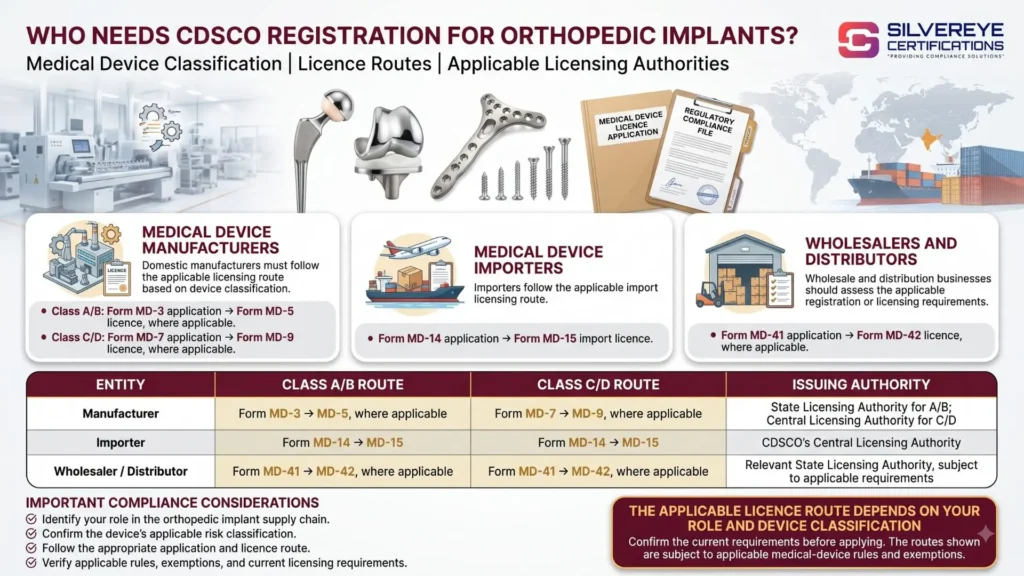
If your business performs more than one activity—for example, manufacturing bone plates and importing joint prostheses from an overseas supplier—you should confirm the separate licensing or registration requirements for each activity and product. This helps ensure that your applications follow the correct regulatory route.
CDSCO Manufacturing License: MD-3/MD-5 (Class A/B) vs. MD-7/MD-9 (Class C/D)
Class A/B Orthopedic Devices — Form MD-3 & MD-5
- Registered business entity and manufacturing premises: The applicant must meet the applicable business registration and manufacturing-site requirements in India.
- Quality Management System (QMS): Maintain a quality system appropriate to the device and applicable regulatory requirements, with ISO 13485:2016 serving as a relevant quality management standard.
- Application submission: Submit the application using Form MD-3 through the applicable online licensing process, along with the required Site Master File and Device Master File, where applicable.
- Licensing authority: The State Licensing Authority (SLA) reviews the application and, upon approval, issues the licence in Form MD-5.
- Processing time: Actual timelines depend on application completeness, regulatory review and any additional information requested. The stated 3–6 months should be treated as an estimate, not a guaranteed timeline.
Class C/D Orthopedic Implants — Form MD-7 & MD-9
- Business and manufacturing requirements: Applicants must meet the applicable business, premises and quality system requirements for the proposed device.
- Technical documentation: The application may require a detailed Device Master File, relevant biocompatibility data, mechanical performance and fatigue testing, risk management documentation and clinical evidence, depending on the device.
- Application submission: Submit the application using Form MD-7 through the applicable online licensing process, along with the required supporting documents.
- Licensing authority: CDSCO's Central Licensing Authority reviews the application and, upon approval, issues the licence in Form MD-9.
- Facility inspection: An inspection may be required as part of the licensing process, depending on the applicable rules and regulatory assessment.
- Processing time: Class C applications and Class D applications may require different review periods. The stated 6–9 months is an estimate only; complex devices requiring additional clinical or technical review may take longer.
Documents Required for Orthopedic Implant Registration
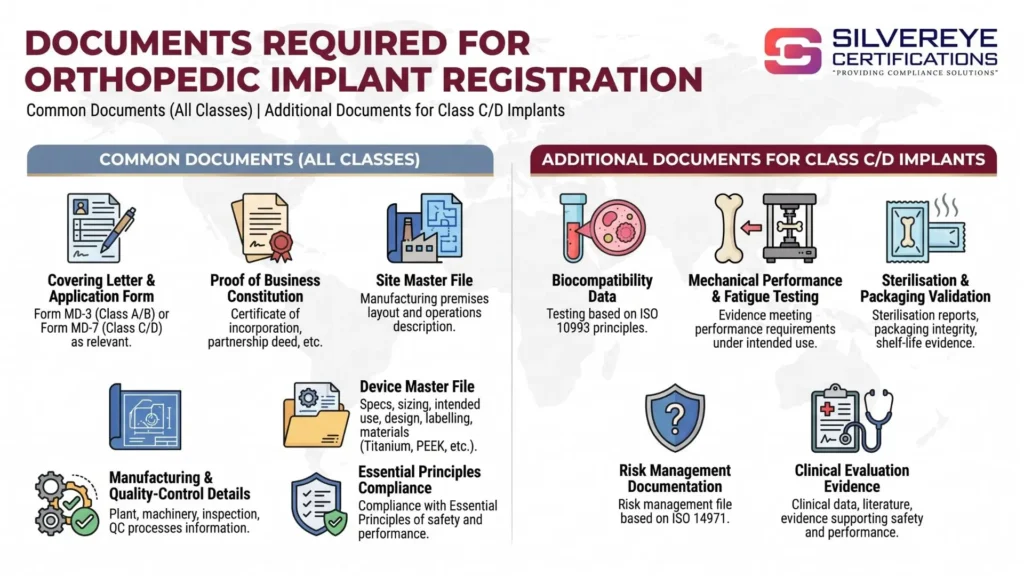
Common Documents (All Classes)
- Covering letter and application form: The applicable application, such as Form MD-3 for Class A/B or Form MD-7 for Class C/D, as relevant.
- Proof of business constitution: Documents such as the certificate of incorporation or partnership deed, along with other applicable business records.
- Site Master File: Information describing the manufacturing premises, layout and relevant operations, where required.
- Device Master File: Technical details covering material specifications, sizing, intended use, device design and labelling. Materials may include titanium, stainless steel, cobalt-chromium, PEEK or UHMWPE, depending on the device.
- Manufacturing and quality-control details: Information about the manufacturing plant, machinery, inspection equipment and quality-control processes.
- Essential Principles compliance: Documentation demonstrating compliance with the applicable Essential Principles of safety and performance under the Medical Devices Rules, 2017.
Additional Documents for Class C/D Implants
- Biocompatibility data: Relevant testing and evaluation based on ISO 10993 principles and the nature and duration of patient contact.
- Mechanical performance and fatigue testing: Evidence that the implant meets relevant performance requirements under its intended conditions of use.
- Sterilisation and packaging validation: Applicable sterilisation validation reports and packaging integrity or shelf-life evidence for devices supplied sterile.
- Risk management documentation: A risk management file developed in line with ISO 14971 principles, where applicable.
- Clinical evaluation evidence: Relevant clinical data, published literature or other acceptable evidence supporting device safety and performance, as required for the specific product.
CDSCO Import License for Orthopedic Implants (MD-14 & MD-15)
Foreign manufacturers seeking to market orthopedic implants in India generally need to follow the applicable CDSCO import licensing requirements. An eligible Authorized Indian Agent submits the application in Form MD-14, and CDSCO's Central Licensing Authority issues the import license in Form MD-15 upon approval. The agent must meet the applicable eligibility and documentation requirements; the required license or registration should be confirmed for the specific business activity.
Documents Required for MD-14 Application
- Covering letter and Form MD-14: The completed application and supporting details.
- Government fee payment proof: Evidence of payment of the applicable regulatory fee.
- Power of Attorney: Authorisation from the foreign manufacturer in the form and manner required by CDSCO.
- Indian agent's credentials: Copies of the applicable wholesale licence, registration or manufacturing licence, as required for the proposed activity.
- Free Sale Certificate or Marketing Authorisation: Regulatory evidence from the country of origin or another accepted authority, where required.
- Device and manufacturing-site documentation: The relevant Device Master File and Plant Master File, including technical, biocompatibility and mechanical performance information as applicable.
- Quality and conformity documents: Relevant ISO 13485 certification and any applicable CE marking or other regulatory approvals, where required.
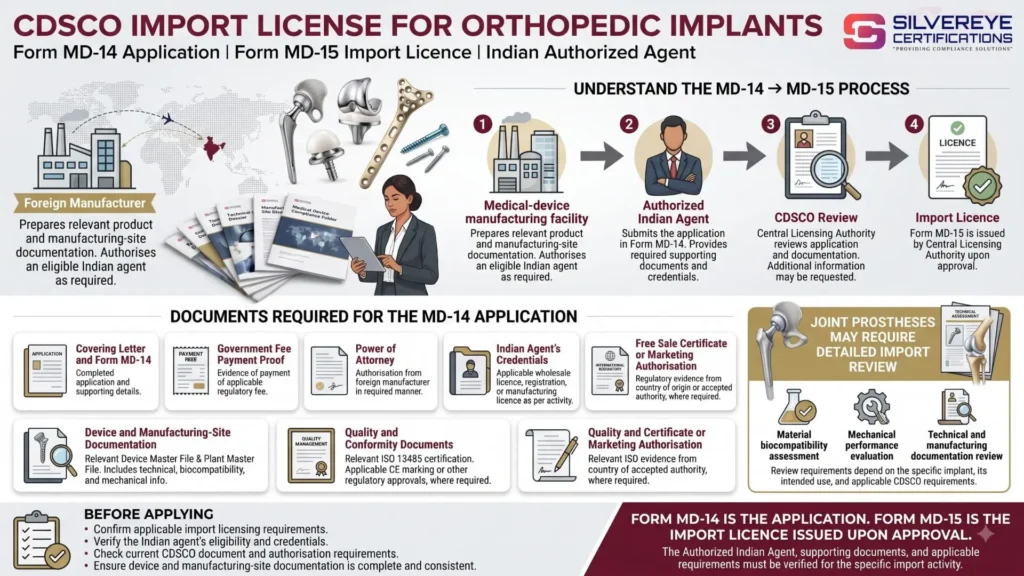
Joint prostheses may require extensive import review. Permanent, load-bearing implants can require detailed assessment of material biocompatibility, wear performance, mechanical safety and clinical evidence. The exact documentation and review timeline depend on the product, its regulatory status and CDSCO's requirements.
CDSCO Wholesale / Distributor License for Orthopedic Implants (MD-41 & MD-42)
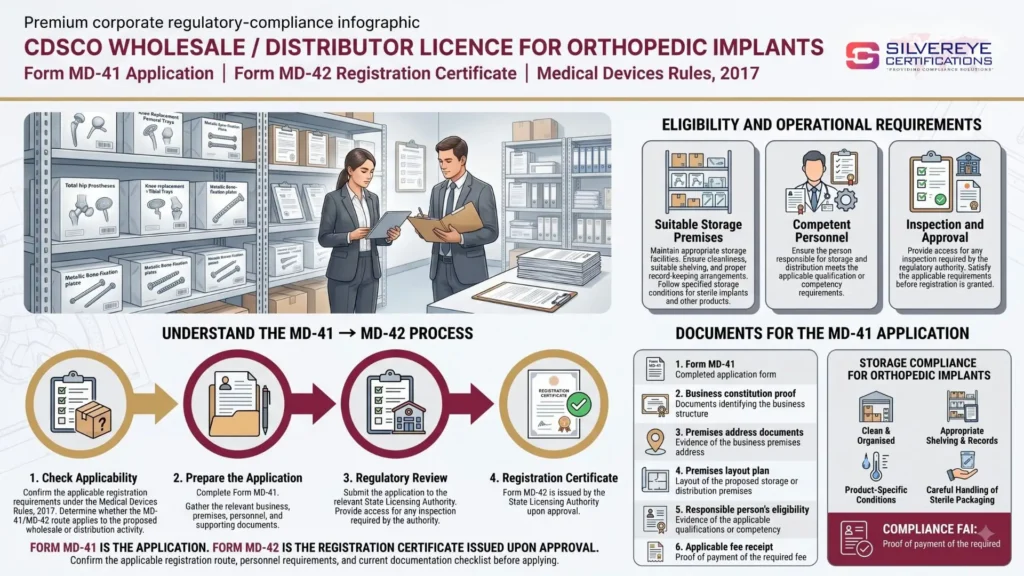
Businesses involved in the wholesale supply or distribution of orthopedic implants should confirm the applicable registration requirements under the Medical Devices Rules, 2017. Where the MD-41/MD-42 route applies, the business submits Form MD-41, and the State Licensing Authority issues the registration certificate in Form MD-42 upon approval.
Eligibility and Documents for MD-41/MD-42
- Suitable storage premises: Maintain appropriate storage facilities, cleanliness, shelving and record-keeping arrangements. Follow the specified storage conditions for sterile implants and other products.
- Competent personnel: Ensure that the person responsible for storage and distribution meets the applicable qualification or competency requirements.
- Application and supporting documents: Prepare Form MD-41, business constitution proof, premises address documents, a layout plan, evidence of the responsible person's eligibility and the applicable fee receipt.
- Inspection and approval: Provide access for any inspection required by the regulatory authority. The registration certificate is issued in Form MD-42 after the application satisfies the applicable requirements.
Fees for Orthopedic Implant Registration
Government fees for CDSCO registration of orthopedic implants depend on the license type and applicable provisions of the Medical Devices Rules, 2017 (MDR 2017). Manufacturing and import fees may vary according to the application and device category. Always check the current fee schedule and payment requirements on the official CDSCO SUGAM portal before submitting an application.
| Licence Type | Applicable Fee | Notes |
|---|---|---|
| Class A/B Manufacturing (MD-3/MD-5) | As prescribed under the applicable MDR 2017 fee schedule | Confirm the current fee for the application. |
| Class C/D Manufacturing (MD-7/MD-9) | As prescribed under the applicable MDR 2017 fee schedule | Applicable fees depend on the application and regulatory requirements. |
| Import Licence (MD-14/MD-15) | As prescribed under the applicable MDR 2017 fee schedule | Confirm the applicable charges for the manufacturing site and device category. |
| Wholesale Registration (MD-41/MD-42) | Verify the current prescribed fee | Confirm the applicable fee and registration requirements with the relevant State Licensing Authority. |
Processing Timeline & Validity
Processing times depend on device classification, application completeness, technical review and inspection requirements. The timelines below are indicative estimates only and should not be treated as guaranteed regulatory deadlines.
| Licence Type | Indicative Processing Time | Validity and Renewal |
|---|---|---|
| MD-5 (Class A/B) | Depends on the application and review process | Confirm the applicable validity and retention or renewal requirements. |
| MD-9 (Class C) | May require several months, depending on technical review and inspection | Confirm the current licence conditions and applicable retention requirements. |
| MD-9 (Class D) | May take longer where extensive technical or clinical evidence is required | Confirm the current licence conditions and applicable retention requirements. |
| MD-15 (Import) | Depends on the product, documentation and regulatory review | Verify the licence's validity and applicable retention-fee requirements. |
| MD-42 (Wholesale Registration) | Depends on the application and State Licensing Authority's process | Confirm the registration validity and renewal requirements under the applicable rules. |
As a best practice, start preparing renewal documents well before the relevant deadline, particularly for higher-risk implants that may require updated technical documentation. Follow the validity, retention-fee and renewal conditions specified for your particular authorisation.
Benefits of CDSCO Registration for Orthopedic Implants
- Legal market access: Appropriate CDSCO authorization helps businesses meet the regulatory requirements for manufacturing, importing or marketing orthopedic devices in India.
- Hospital and procurement eligibility: Hospitals, orthopedic centres and public procurement bodies may require valid medical device licenses and supporting compliance documents when evaluating suppliers.
- Reduced compliance risk: Obtaining the applicable authorization helps businesses avoid regulatory action associated with unauthorized manufacturing, importing or marketing of medical devices.
- Export credibility: Maintaining appropriate Indian regulatory documentation can support a manufacturer's compliance profile, although export approvals depend on the destination country's requirements.
Penalties for Non-Compliance
Manufacturing, importing or distributing orthopedic implants without the required authorization may violate the Medical Devices Rules, 2017 and applicable provisions of the Drugs and Cosmetics Act, 1940. Depending on the nature and severity of the violation, consequences may include seizure of products, regulatory action against licenses, financial penalties or prosecution, where provided by law.
Because orthopedic implants may remain in the body for extended periods, compliance with applicable safety, quality and performance requirements is particularly important. Manufacturers, importers and distributors should verify the regulatory requirements for each product and maintain the necessary licenses and supporting records.
Common Mistakes to Avoid
- Incorrect risk classification: Do not assume every orthopedic product falls under Class A/B. Confirm the official classification of each implant before selecting the application route.
- Choosing the wrong application form: Check whether your product requires the MD-3/MD-5 or MD-7/MD-9 manufacturing route.
- Incomplete technical documentation: Prepare the applicable Device Master File, biocompatibility evidence, mechanical performance data, risk management records and clinical evaluation evidence, as required for the device.
- Underestimating review timelines: Allow sufficient time for technical assessment, inspection and requests for additional information, particularly for higher-risk implants.
- Assuming one authorization covers every activity: Manufacturing, importing and wholesale distribution may have separate licensing or registration requirements.
- Delaying renewal preparation: Track applicable validity periods, retention fees and renewal deadlines to help prevent avoidable interruptions to business operations.
Conclusion
Orthopedic implants span different CDSCO risk classes, making accurate product classification the first and most important step in the registration process. Although a cervical collar and a hip replacement prosthesis are both orthopedic devices, their licensing requirements may differ significantly. Depending on the device's classification, manufacturers may follow the MD-3/MD-5 route through the State Licensing Authority or the MD-7/MD-9 route through CDSCO's Central Licensing Authority. Preparing complete biocompatibility, mechanical performance and other required technical documentation from the beginning can help reduce avoidable delays.
Silvereye Certifications provides end-to-end support for CDSCO medical device registration, including orthopedic device classification, technical dossier preparation, SUGAM portal application assistance and post-approval compliance guidance for manufacturers, importers and distributors across India.
Frequently Asked Questions
Is CDSCO registration mandatory for all orthopedic implants?
Yes. Every notified orthopedic device — whether an external support (Class A/B) or an internal implant (Class C/D) — requires the applicable CDSCO licence or registration before manufacture, import, or distribution in India.
What class do most orthopedic implants fall under?
Orthopedic and prosthetic devices primarily belong to Class B, C, and D. True implants — bone plates, screws, fixation wires, spinal systems, and joint replacement prostheses — are generally Class C or Class D, while external supports like cervical collars and splints are Class A.
What is the difference between the MD-3/MD-5 and MD-7/MD-9 manufacturing routes?
MD-3/MD-5 is the manufacturing license route for Class A/B orthopedic devices, reviewed and granted by the State Licensing Authority. MD-7/MD-9 is the route for Class C/D implants, reviewed and granted directly by CDSCO's Central Licensing Authority.
Are hip and knee replacement implants Class C or Class D?
Permanent joint replacement prostheses — hip, knee, shoulder, elbow, ankle — are generally treated as Class D, CDSCO's highest-risk category, given their permanent implantation and load-bearing function. Bone fixation hardware like plates and screws is generally Class C. Always verify the exact classification of your specific product against CDSCO's current list.
Do importers use different forms depending on the implant's class?
No. Importers use Form MD-14 (application) and receive Form MD-15 (license) from CDSCO's Central Licensing Authority regardless of class, though the depth of technical review scales with the implant's risk.
How long does CDSCO registration take for orthopedic implants?
Class A/B manufacturing licenses (MD-5) typically take 3–6 months. Class C manufacturing licenses (MD-9) for fixation implants typically take 6–9 months. Class D licenses for joint prostheses can take longer given clinical evaluation requirements. Wholesale registrations (MD-42) typically take 30–60 days.
What is the validity of a CDSCO orthopedic implant license?
MD-5, MD-9, and MD-42 are generally valid for 5 years from the date of issue. MD-15 import licences generally continue indefinitely, subject to a 5-year retention fee cycle.
What documents are required for a Class D joint prosthesis application?
Beyond the standard Device Master File, Class D applications typically require biocompatibility data, mechanical/fatigue performance testing, sterilization validation, risk management documentation, and clinical evaluation data or literature-based clinical evidence.
Can one business hold manufacturing, import, and wholesale licenses for orthopedic implants?
Yes, if the business genuinely performs all three activities. Each activity still requires its own separate CDSCO authorization, matched to the implant's class — holding one license does not automatically cover the others.
What happens if I sell an orthopedic implant without CDSCO registration?
You risk stock seizure, financial penalties, cancellation of any existing licences, and prosecution under the Drugs and Cosmetics Act, 1940, which can include imprisonment in serious cases.
Is BIS certification also required for orthopedic implants?
BIS and CDSCO are separate regulatory frameworks. CDSCO governs orthopedic implants as medical devices under MDR 2017. Whether a specific BIS standard for surgical-grade metals or polymers also applies depends on the product's material composition, and should be checked independently of CDSCO compliance.
How do I renew a CDSCO orthopedic implant license?
Renewal applications should be filed at least 60 days before expiry for Class A/B licenses, and at least 90 days before expiry for Class C/D licenses, using the previous license details, updated technical/clinical documentation, and the prescribed renewal or retention fee, submitted through the SUGAM portal to the relevant State or Central Licensing Authority.