- Who it is for: Foreign brands, importers and Indian agents bringing eau de parfum, eau de toilette, cologne or body mist sprays into India for sale.
- What you get: An Import Registration Certificate in Form COS-2, applied for in Form COS-1 through CDSCO's SUGAM portal.
- Government fees: USD 1,000 per category, USD 500 per manufacturing site and USD 50 per variant, paid through Bharatkosh.
- Validity: Perpetual, provided the applicable retention fee is paid before completion of five years from the date of issue.
Introduction
Hydroalcoholic perfume CDSCO registration means obtaining an Import Registration Certificate (Form COS-2) from the Central Licensing Authority before importing ethanol-based perfumes for sale in India.
The importer, authorized agent, or manufacturer submits Form COS-1 through the SUGAM portal, along with documents such as an authenticated manufacturer authorization, Free Sale Certificate, ingredient list, product labels, and fee receipt.
CDSCO may take up to six months to process a complete application, while 90 days is the targeted processing timeline. The applicable fees are USD 1,000 per category, USD 500 per manufacturing site, and USD 50 per variant. The COS-2 certificate has perpetual validity, subject to payment of the applicable retention fee within the prescribed period.
What Does Hydroalcoholic Perfume CDSCO Registration Actually Mean?
A hydroalcoholic perfume is a fragrance dissolved in ethanol and water, the format used in most eau de parfum, eau de toilette, cologne and body mist sprays. In India, perfumes that meet the definition of a cosmetic are regulated as cosmetics. The Drugs and Cosmetics Act, 1940 defines a cosmetic as an article meant to be rubbed, poured, sprinkled or sprayed on the body to cleanse, beautify, promote attractiveness or alter appearance, and a spray perfume generally fits that description.
Imported cosmetics are regulated through registration by the Central Licensing Authority, which is the Drugs Controller General (India) at CDSCO headquarters. Rule 12(1) of the Cosmetics Rules, 2020 says no cosmetic can be imported unless it is registered, subject to applicable exemptions. So when people search for hydroalcoholic perfume CDSCO registration, the process they generally need is cosmetic import registration: Form COS-1 for the application and Form COS-2 for the certificate.
| Common confusion | The clear answer |
|---|---|
| Is hydroalcoholic perfume separately identified by CDSCO? | Yes. CDSCO guidance identifies Hydroalcoholic perfumes and Non hydroalcoholic perfumes as separate subcategories under perfumes. |
| Is this a manufacturing licence? | No. CDSCO registers imported cosmetics. Indian manufacturing licences are issued by State Licensing Authorities. |
| Is it a drug approval? | No. A fragrance making drug-like claims, such as treating or curing a disease, may fall outside the cosmetic category and require assessment under the applicable regulatory framework. |
| Does the alcohol percentage change the registration fee? | No. The prescribed fees are based on categories, manufacturing sites and variants, rather than the alcohol percentage itself. |
Who Needs CDSCO Registration for Hydroalcoholic Perfume?
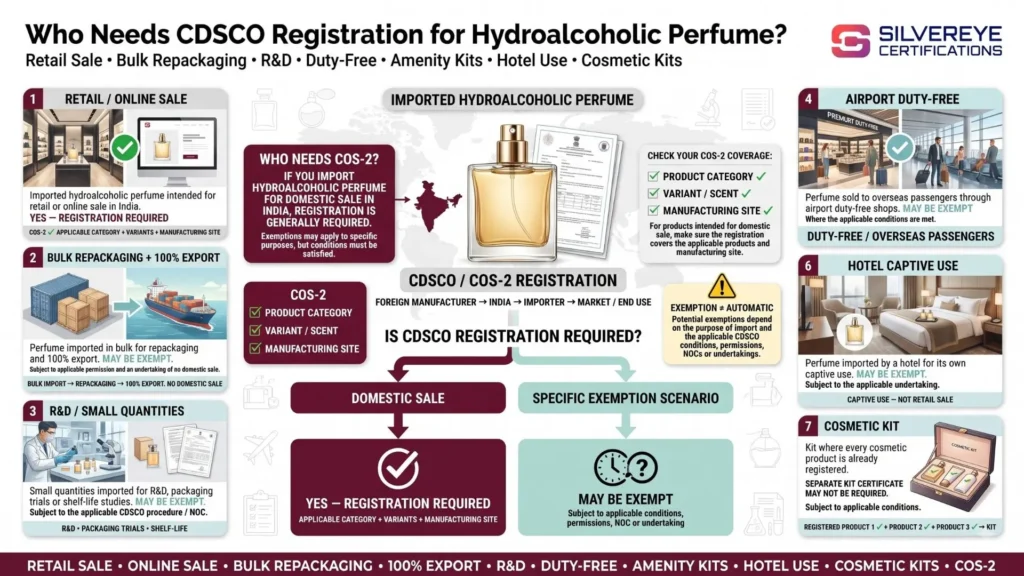
If you plan to sell imported hydroalcoholic perfume in India to consumers, retailers or through online marketplaces, you generally need a valid COS-2 Import Registration Certificate covering the applicable product category, variants and manufacturing site.
CDSCO provides certain exemptions from registration for specific purposes, generally subject to conditions such as no domestic sale.
| Situation | Registration needed? |
|---|---|
| Imported hydroalcoholic perfume for retail or online sale in India | Yes |
| Perfume imported in bulk for repackaging and 100% export | May be exempt, subject to applicable permission and an undertaking of no domestic sale |
| Small quantities for R&D, such as packaging trials or shelf-life studies | May be exempt, subject to the applicable CDSCO procedure/NOC |
| Perfume sold to overseas passengers in airport duty-free shops | May be exempt, where the applicable conditions are met |
| Perfume included in amenity kits for international passengers | May be exempt, where the applicable conditions are met |
| Perfume imported by a hotel for its own captive use | May be exempt, subject to the applicable undertaking |
| Kit where every cosmetic product is already registered | A separate certificate for the kit may not be required, subject to applicable conditions |
What Are the Benefits of Hydroalcoholic Perfume CDSCO Registration?
- Legal access to the Indian market: A valid COS-2 registration is required for the commercial import of applicable cosmetics for sale in India.
- Smoother customs clearance: A valid registration helps demonstrate that the imported cosmetic meets the applicable CDSCO registration requirements.
- Retail and marketplace onboarding: Retailers and e-commerce platforms may ask for regulatory registration documents before onboarding imported cosmetic products.
- Product identification: The applicable Registration Certificate number is required on the product label under the applicable labelling requirements.
- Business expansion: Additional variants, products or manufacturing sites can be added through the applicable endorsement process rather than necessarily starting an entirely new registration.
Who Is Eligible to Apply for Hydroalcoholic Perfume CDSCO Registration?
CDSCO guidance identifies four types of applicants: the manufacturer itself, the manufacturer's authorised agent in India, an importer in India, or an authorised Indian subsidiary.
Most foreign fragrance brands applying for hydroalcoholic perfume registration work through an Indian authorised agent or importer who handles the application and regulatory communication.
| Applicant | What they must show |
|---|---|
| Overseas manufacturer or brand owner | Manufacturing details and the required Indian representation/authorised agent details |
| Authorised Indian agent | Manufacturer authorisation, appropriately authenticated and signed by the relevant parties |
| Importer in India | Manufacturer authorisation along with its own business and importer details |
| Indian subsidiary | Authorisation from the parent manufacturer and applicable business details |
What Requirements Are Specific to Hydroalcoholic Perfume CDSCO Registration?
The overall CDSCO cosmetic import registration requirements apply to perfumes as cosmetics. However, additional attention is important for products containing ethanol, particularly regarding ingredients, fragrance composition, labelling, safety and transportation.
| Area | What to prepare |
|---|---|
| Ingredient list | Names in the applicable standard nomenclature with percentages, signed and stamped by the manufacturer. Ethanol and other solvents should be declared as actually used in the formulation. |
| Fragrance composition | CDSCO's guidance/FAQ allows a manufacturer undertaking regarding fragrance composition and compliance with applicable standards, including IS 4707 (Part 2):2017, where applicable. |
| Prohibited substances | Ingredients restricted or prohibited under the applicable cosmetic standards must not be used. |
| Colourants | If the perfume is tinted, the colours should comply with the applicable permitted colour requirements and heavy-metal limits. |
| Standards | Products should comply with the applicable quality and safety standards, including the relevant Ninth Schedule requirements where applicable. |
| Animal testing | Cosmetics tested on animals after 12 November 2014 are subject to import restrictions under the applicable rules. The required undertaking must be provided. |
| Shelf life | The product should meet the applicable remaining shelf-life requirement at the time of import. |
| Claims | Product claims must not be false or misleading. Claims suggesting treatment or cure of disease can affect the product's regulatory classification. |
| Labels | Provide the original labels for each variant and ensure they comply with Chapter VI of the Cosmetics Rules, 2020 and other applicable requirements. |
What Documents Are Required for Hydroalcoholic Perfume CDSCO Registration?
The list follows CDSCO's guidance for Form COS-1. For hydroalcoholic perfume CDSCO registration, several documents come from overseas, so the table also shows who usually supplies each one. Incomplete or inconsistent documents are a common reason for CDSCO queries and delays.
| Document | Key point | Usually supplied by |
|---|---|---|
| Covering letter | States whether it is a fresh application, endorsement or other applicable request, and lists earlier certificate details where relevant | Indian applicant |
| Manufacturer authorisation | First Schedule format; appropriately authenticated or apostilled; signed by the manufacturer and Indian applicant/agent; should cover the relevant products | Manufacturer and Indian agent |
| Part I of the Second Schedule | Required information and undertaking, completed as applicable to the COS-1 application | Manufacturer or agent |
| Ingredient list | Uses the applicable standard nomenclature and gives ingredient percentages | Manufacturer |
| Labels | Legible original or copy for each product/variant | Manufacturer |
| Specifications and testing methods | Signed and stamped; Certificate of Analysis (COA) may be provided where applicable | Manufacturer |
| Manufacturing licence or authorisation | Authenticated copy from the country of origin, or applicable undertaking where no such licence is issued | Manufacturer |
| Free Sale Certificate | Issued by the national regulator or competent authority/body, appropriately authenticated or apostilled where required, and covering the relevant products | Manufacturer or competent authority/trade body |
| Non-animal testing undertaking | Manufacturer declaration confirming compliance with the applicable animal-testing requirements | Manufacturer |
| Heavy metal and hexachlorophene declaration | Applicable test report, declaration or undertaking as required | Manufacturer |
| Correlation chart | Helps match the products listed in COS-1 with the relevant supporting documents such as the Free Sale Certificate and manufacturer authorisation | Indian applicant |
| Form COS-1 and Bharatkosh receipt | Completed and signed application with proof of the applicable government fee payment | Indian applicant |
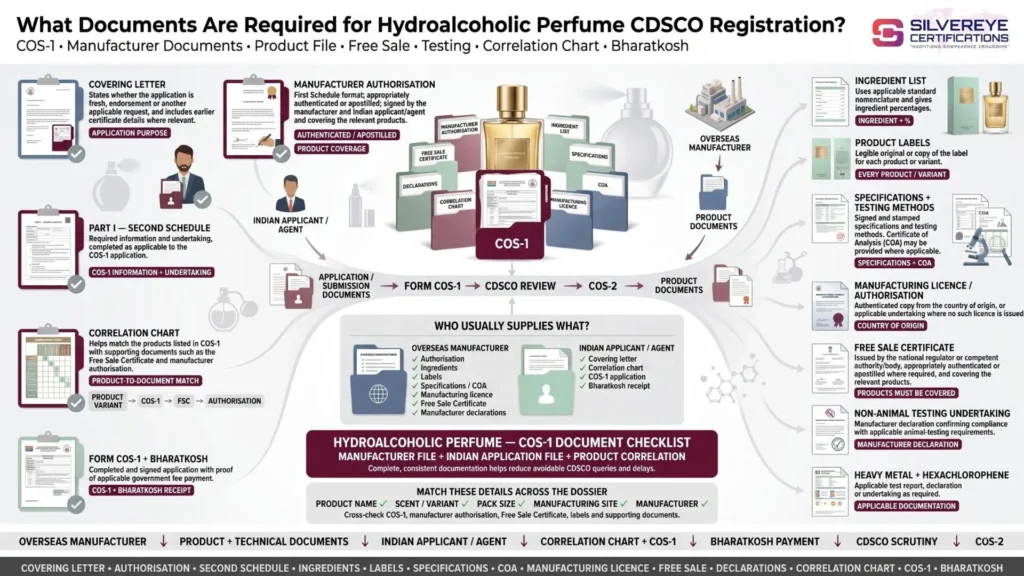
Keep product names, variant names and pack sizes consistent across all documents. A mismatch between the COS-1, manufacturer authorisation, labels and Free Sale Certificate can result in a CDSCO query.
What Are the CDSCO Fees for Hydroalcoholic Perfume Registration?
The applicable fees under the Third Schedule of the Cosmetics Rules, 2020 include:
| Fee head | Amount |
|---|---|
| Registration certificate – each category | USD 1,000 |
| Additional category | USD 1,000 |
| Each manufacturing site | USD 500 |
| Each variant | USD 50 |
For hydroalcoholic perfume CDSCO registration, the applicable government fee is paid through Bharatkosh, and the payment acknowledgement is submitted with the application.
How Much Can the Government Fee Be for Different Product Ranges?
| Scenario | Calculation | Government fee |
|---|---|---|
| One fragrance category, one site, 6 variants | 1,000 + 500 + (6 × 50) | USD 1,800 |
| One fragrance category, one site, 15 variants | 1,000 + 500 + (15 × 50) | USD 2,250 |
| Two categories, one site, 10 variants | 1,000 + 1,000 + 500 + (10 × 50) | USD 3,000 |
| Two manufacturing sites, one category, 8 variants | 1,000 + (2 × 500) + (8 × 50) | USD 2,400 |
What Costs Are Outside the CDSCO Government Fee?
| Cost area | Why it exists |
|---|---|
| Authentication or apostille | Required for certain overseas documents, depending on the applicable authentication route |
| Document preparation and dossier review | Covers correlation charts, covering letters and document consistency checks |
| Label redesign or stickering | May be required for India-specific information such as the RC number and importer details |
| Courier and translation | Applies where original documents must be couriered or documents need translation |
| Consultant or agent fees | Applicable if you outsource filing, documentation or CDSCO query handling |
We have not included rupee figures for these costs because they vary by country, supplier, document requirements and consultant. It is better to ask for itemised quotations. Always confirm the current Third Schedule fees before making payment.
When additional products are added later, the applicable endorsement requirements and fees depend on the category, manufacturing site and product details. If the new products fall within an already registered category and meet the applicable conditions, the endorsement may not attract a new category fee. A new category or new manufacturing site can attract the applicable additional fee.
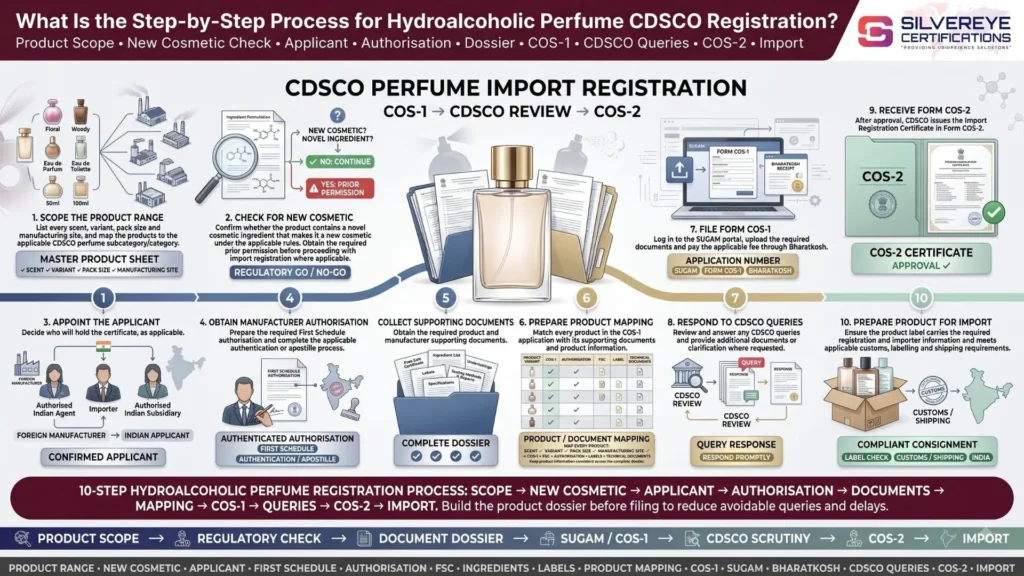
What Is the Step-by-Step Process for Hydroalcoholic Perfume CDSCO Registration?
| Step | What to do | Output |
|---|---|---|
| Scope the product range | List every scent, variant, pack size and manufacturing site, and map the products to the applicable CDSCO perfume subcategory/category | Master product sheet |
| Check whether it is a new cosmetic | Confirm whether the product contains a novel cosmetic ingredient that makes it a new cosmetic under the applicable rules. If so, obtain the required prior permission before proceeding with import registration | Regulatory go/no-go |
| Appoint the applicant | Decide who will hold the certificate: authorised Indian agent, importer or authorised Indian subsidiary, as applicable | Confirmed applicant |
| Obtain manufacturer authorization | Prepare the required First Schedule authorisation and complete the applicable authentication/apostille process | Authenticated authorisation |
| Collect supporting documents | Obtain the Free Sale Certificate, ingredient list, labels, specifications, testing information and undertakings | Complete dossier |
| Prepare the product mapping | Match every product in the COS-1 application with its supporting documents and product information | Product/document mapping |
| File Form COS-1 | Log in to the SUGAM portal, upload the required documents and pay the applicable fee through Bharatkosh | Application number |
| Respond to CDSCO queries | Review and answer any CDSCO queries and provide additional documents or clarification where requested | Query response |
| Receive Form COS-2 | After approval, CDSCO issues the Import Registration Certificate in Form COS-2 | COS-2 certificate |
| Prepare the product for import | Ensure the product label carries the required registration and importer information and meet applicable customs, labelling and shipping requirements | Compliant consignment |
How Long Does Hydroalcoholic Perfume CDSCO Registration Take?
Rule 13 of the Cosmetics Rules, 2020 provides that the Central Licensing Authority may grant or reject a complete application within six months from the date of application. CDSCO's FAQ also refers to a 90-day targeted processing timeline, based on its earlier circular. Therefore, the actual timeline for hydroalcoholic perfume CDSCO registration depends on the completeness of the application, document authentication, and the time taken to respond to CDSCO queries.
| Planning stage | What to plan |
|---|---|
| Before filing | Start the manufacturer authorisation and Free Sale Certificate process early because these documents may require overseas coordination and authentication. |
| During review | Keep the person responsible for technical and regulatory queries available to respond promptly. |
| After grant | Complete India-specific labelling, port documentation and shipment preparations before the first commercial consignment. |
| Planning timeline | Build the launch plan around the six-month statutory period, rather than assuming approval will always be completed within 90 days. |
How Long Is a CDSCO Registration Certificate Valid?
The Import Registration Certificate in Form COS-2 remains valid in perpetuity, subject to payment of the applicable registration certificate retention fee before completion of five years from the date of issue. The certificate may also be suspended or cancelled by the Central Licensing Authority for non-compliance.
There is therefore no separate renewal application in the old three-year sense for a COS-2 registration. Instead, the certificate remains in force when the required retention fee is paid on time.
| Point | Rule |
|---|---|
| Validity | Perpetual, subject to payment of the applicable retention fee |
| Retention fee due | Before completion of five years from the date of issue |
| Late fee | 2% of the retention fee for every month or part of a month, within 180 days |
| After 180 days | The registration certificate is deemed cancelled if the required payment remains unpaid |
| Suspension/cancellation | The Central Licensing Authority may suspend or cancel the registration for non-compliance |
The five-year retention date should be added to your compliance calendar immediately after the COS-2 certificate is granted. CDSCO also publishes cancellation notices for cosmetic registrations, showing that registrations remain subject to ongoing regulatory compliance.
What Changes Must Be Reported After CDSCO Registration?
After registration, certain changes must be reported or submitted to CDSCO within specific timelines under Rule 15 of the Cosmetics Rules, 2020.
| Change | What CDSCO expects |
|---|---|
| Change in labelling, composition, testing or specifications | Inform the Central Licensing Authority within 15 days, along with the required undertaking regarding compliance with applicable BIS standards. |
| Change in name or address of the registration holder or overseas manufacturer | Apply for amendment through the online portal within 60 days of the change and obtain prior approval. |
| Change in constitution of the registration holder or overseas manufacturer | Apply for fresh registration within 180 days of the change. |
| Risk to human health | Notify the Licensing Authority and take the required corrective measures. |
| Regulatory action or product withdrawal abroad | Review the impact on the Indian registration and comply with the applicable reporting and corrective-action requirements. |
A reformulation of a hydroalcoholic perfume can trigger a post-registration compliance requirement. If the composition, labelling, testing or specifications change, the manufacturer, authorised agent, importer or authorised Indian subsidiary should assess the change and make the required notification to CDSCO within the applicable timeline.
What Does CDSCO Registration Not Cover?
A COS-2 Import Registration Certificate covers the CDSCO registration requirement for importing applicable cosmetics. It does not replace other approvals or obligations that may apply to the product, business or shipment.
| Approval or step | Who handles it | Relevant to you if |
|---|---|---|
| Import Registration Certificate (COS-2) | CDSCO / Central Licensing Authority | You import perfume for sale in India |
| Manufacturing licence (COS-8) or loan licence (COS-9) | State Licensing Authority | You manufacture or contract-manufacture perfume in India |
| Customs clearance and tariff classification | Customs / customs broker | Your shipment arrives at an Indian port |
| Flammable-goods shipping requirements | Freight forwarder / carrier | Your perfume formulation is classified as a regulated flammable shipment |
| Packaged-commodity labelling | Legal Metrology authorities, alongside applicable Cosmetics Rules | Your packaged perfume is sold in India |
For ethanol-containing perfumes, also check the product's SDS, formulation and transport classification before shipment because shipping requirements can depend on the actual formulation and concentration.
Why Do CDSCO Perfume Registration Applications Receive Queries?
| Reason | How to avoid it |
|---|---|
| Free Sale Certificate does not cover every product/variant | Match the certificate details with the COS-1 application |
| Manufacturer authorisation is not properly authenticated or signed | Use the applicable First Schedule format and complete authentication before filing |
| Product names differ across documents | Maintain one master product sheet and use consistent names |
| Incorrect cosmetic category/subcategory | Check the applicable Fourth Schedule category and CDSCO perfume subcategory before filing |
| Missing ingredient percentages | Obtain a complete ingredient list signed and stamped by the manufacturer |
| Drug-type claims on the label | Avoid claims suggesting that the perfume treats or cures a disease |
| Slow or incomplete query responses | Assign one person to manage CDSCO queries and document submissions |
How Should You Choose a CDSCO Registration Partner for Perfume?
Many importers outsource hydroalcoholic perfume CDSCO registration to consultants or regulatory agents. Before selecting a partner, ask:
- Have they handled cosmetic import registrations through SUGAM?
- Will they conduct a document and product review before filing?
- Who will prepare and respond to CDSCO queries?
- Will they clearly separate government fees and professional fees?
- Will they track the five-year retention fee deadline after COS-2 is granted?
- Will they explain the requirements for new variants, categories and manufacturing sites before additional products are added?
What Changed for Imported Cosmetics in 2026?
In July 2026, CDSCO issued an official circular concerning vigilance on imported cosmetics being sold in the domestic market without a valid Import Registration Certificate. This is important for businesses importing perfumes because it reinforces the need to have the required cosmetic registration before commercial sale in India.
CDSCO's website also continues to publish cancellation notices for cosmetic registrations, demonstrating that post-registration compliance remains important.
For businesses seeking hydroalcoholic perfume CDSCO registration, the practical approach is straightforward: complete the registration before the first commercial shipment, keep product and supporting documents consistent, report applicable changes on time, and track the five-year retention date.
Conclusion
Hydroalcoholic perfume CDSCO registration is a structured, document-heavy process rather than a complicated one. Choose the right applicant, get the manufacturer authorisation authenticated, arrange the Free Sale Certificate and ingredient details, file Form COS-1, and respond to CDSCO queries promptly.
Once Form COS-2 is granted, maintain compliance through correct product labelling, timely change notifications and payment of the five-year retention fee.
Importers who prepare the overseas documentation early can avoid unnecessary delays during the application process. Start with the manufacturer authorisation, Free Sale Certificate and product documents, and build your launch plan around the six-month statutory processing period.
How Can Silvereye Certifications Help With Hydroalcoholic Perfume CDSCO Registration?
Silvereye Certifications is an Indian regulatory consultancy that supports manufacturers, importers and brand owners with CDSCO, BIS and related compliance requirements.
For hydroalcoholic perfume CDSCO registration, Silvereye Certifications can assist with:
- Document review before filing
- Product and variant mapping to the applicable CDSCO category
- COS-1 application preparation
- Manufacturer authorisation and supporting document review
- CDSCO query support
- Labelling and compliance review
- Retention fee date tracking
If you are planning to import a spray perfume range into India, consider getting the documentation and product details reviewed before finalising your labels and shipping schedule. A review at the beginning can help identify documentation gaps early and reduce avoidable delays later.
Frequently Asked Questions
Do I need CDSCO registration to import alcohol-based perfume?
Yes, if you will sell it in India. Hydroalcoholic perfume is a cosmetic, and CDSCO registration through a valid Import Registration Certificate is needed for imports.
Which form do I file for hydroalcoholic perfume CDSCO registration?
Form COS-1 on CDSCO's SUGAM portal. CDSCO grants Form COS-2 once satisfied.
Is there a different procedure for hydroalcoholic and alcohol-free perfume?
No. Both follow the same registration route and fee structure. The differences appear in the ingredient list, freight handling and customs tariff line.
What is the CDSCO fee for perfume registration?
USD 1,000 per category, USD 500 per manufacturing site and USD 50 per variant, paid through Bharatkosh. An additional category costs USD 1,000.
How long does hydroalcoholic perfume CDSCO registration take?
Up to six months under Rule 13, with a 90-day target mentioned in CDSCO's FAQ. Complete documents and prompt query replies shorten the process.
How long is a hydroalcoholic perfume CDSCO registration valid?
In perpetuity, if the retention fee is paid before five years from issue are complete, unless suspended or cancelled.
Can my Indian distributor apply for a foreign brand?
Yes, as the authorised agent or importer, with a properly authenticated manufacturer authorisation signed by both parties.
Do I need to disclose my full fragrance formula for hydroalcoholic perfume CDSCO registration?
CDSCO's FAQ allows a manufacturer undertaking that the fragrance composition is free of banned ingredients and complies with IS 4707 (Part 2):2017. CDSCO may still raise queries, so be ready.
Is lab testing required before CDSCO registration of perfume?
CDSCO says testing before registration is not mandatory, though samples can be tested if a suspected violation needs checking.
How do I add new scents to my hydroalcoholic perfume CDSCO registration?
Apply for an endorsement. A new category costs USD 1,000, and a new manufacturing site USD 500. If the category is already registered and the site is the same, CDSCO's FAQ says no fee for the endorsement.
What if another importer wants to bring in my CDSCO-registered hydroalcoholic perfume?
They can apply in Form COS-4 for an Import Registration Number in Form COS-4A. It is valid for three years.
What happens if I miss the retention fee?
A late fee of 2% of the retention fee applies for every month or part within 180 days. After that, the certificate is deemed cancelled.