Hydroalcoholic vs non-hydroalcoholic perfumes can fall under cosmetic regulation, and imported cosmetics must be registered with CDSCO through Form COS-1 to obtain Form COS-2, subject to the applicable classification and requirements.
- Alcohol changes the product documentation and logistics, not necessarily the core CDSCO registration pathway. It can affect your composition declaration, labelling, freight handling and customs classification, so the formulation and applicable tariff line should be checked carefully.
- Government fees: USD 1,000 per cosmetic category, USD 500 per manufacturing site, and USD 50 per variant. A COS-2 Registration Certificate remains valid in perpetuity, subject to payment of the applicable retention fee before completion of each five-year period.
- Enforcement is tightening. On 23 July 2026, CDSCO issued a circular titled “Vigilance on imported cosmetics products sold in the domestic market without valid Import Registration Certificate.”
Do Hydroalcoholic and Non-Hydroalcoholic Perfumes Need Different CDSCO Registration?
Both fall within the cosmetics import-registration framework, and imported cosmetics must be registered with CDSCO before import. However, CDSCO's guidance specifically lists hydroalcoholic perfumes and non-hydroalcoholic perfumes as separate subcategories under the broader Perfumes category. The application is submitted through Form COS-1, with the Import Registration Certificate issued in Form COS-2.
- Alcohol content does not create a completely separate CDSCO registration pathway. However, it can affect your ingredient declaration, product documentation, freight handling and customs classification, so the formulation should be reviewed carefully.
- Government fees: USD 1,000 per cosmetic category, USD 500 per manufacturing site and USD 50 per variant, subject to the applicable fee structure under the Cosmetics Rules.
- CDSCO states that cosmetics must be registered along with the applicable pack size, variant(s) and manufacturing premises before import into India.
What Are Hydroalcoholic vs Non-Hydroalcoholic Perfumes?
A hydroalcoholic perfume is a fragrance concentrate dissolved in ethanol and water. Most eau de parfum, eau de toilette, eau de cologne and spray body mists you find on a shelf work this way. The alcohol carries the scent, evaporates quickly and helps the fragrance project from the skin.

A non-hydroalcoholic perfume (often sold as alcohol-free) uses something else as the base. Think perfume oils and attars on a carrier oil, solid perfumes and balms set in wax, and oil-based roll-ons. Some brands also make water or glycol-based sprays without ethanol.
Buyers care about this difference for skin feel, longevity and personal or religious preference. Regulators care about something else entirely: what the product is, what it claims, what is in it and how it is labelled. That is why the CDSCO registration framework is broadly the same, even though CDSCO separately identifies hydroalcoholic and non-hydroalcoholic perfumes as subcategories.
| Feature | Hydroalcoholic perfume | Non-hydroalcoholic perfume |
|---|---|---|
| Typical base | Ethanol and water with fragrance concentrate | Carrier oil, wax, or other non-ethanol base |
| Common formats | Eau de parfum, eau de toilette, cologne, body mist | Attar / perfume oil, solid perfume, oil roll-on |
| Usual packaging | Spray bottle, often 30 ml to 100 ml | Small roller bottle, tin or jar, often 10 ml or less |
| Handling in transit | Usually treated as a flammable liquid by carriers | Depends on the solvents used; check the safety data sheet |
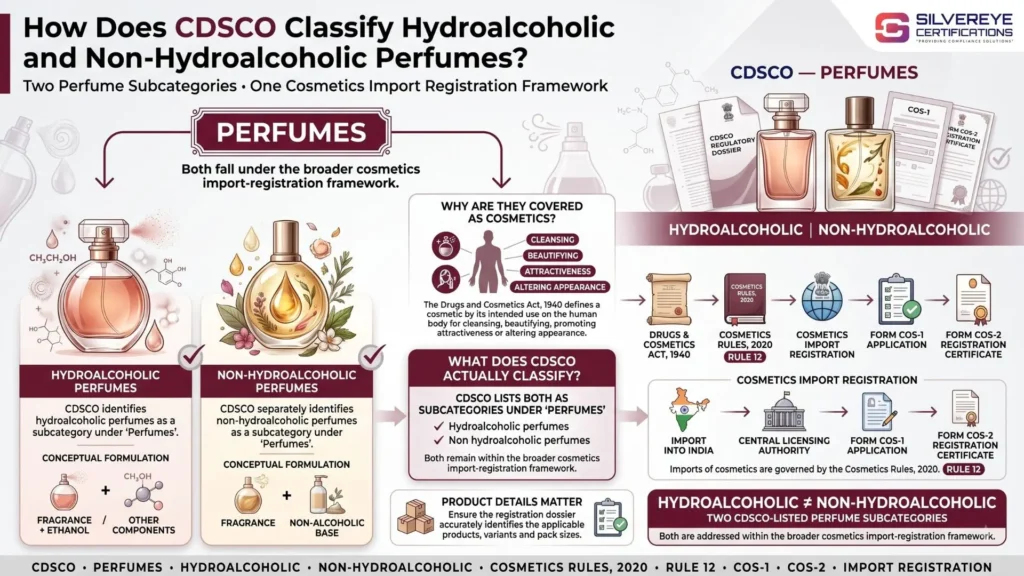
How Does CDSCO Classify Hydroalcoholic and Non-Hydroalcoholic Perfumes?
The important distinction is that CDSCO does identify hydroalcoholic and non-hydroalcoholic perfumes as separate subcategories under “Perfumes.” Both remain within the broader cosmetics import-registration framework. CDSCO's guidance specifically lists:
- Hydroalcoholic perfumes
- Non hydroalcoholic perfumes
as subcategories under Perfumes.
The Drugs and Cosmetics Act, 1940 defines a cosmetic by its intended use on the human body for cleansing, beautifying, promoting attractiveness or altering appearance. The Cosmetics Rules, 2020 apply to cosmetics covered by that definition.
Imports of cosmetics are governed by the Cosmetics Rules, 2020. Rule 12 requires cosmetics intended for import into India to be registered by the Central Licensing Authority. The application is made online in Form COS-1, and the registration certificate is granted in Form COS-2.
CDSCO also requires registration details to cover the applicable pack size, variant(s) and manufacturing premises. The applicable fee depends on the category, manufacturing site and variants.
Where Does the Alcohol Question Actually Matter?
| Area | Does hydroalcoholic vs non-hydroalcoholic matter? | What to do |
|---|---|---|
| CDSCO legal status | Both can fall under the cosmetics framework, but CDSCO identifies them as separate perfume subcategories. | Select the correct product category/subcategory when preparing the application. |
| Registration form and route | Both use the cosmetics import-registration framework. | Apply through Form COS-1 and obtain Form COS-2, where applicable. |
| Government fee | Fee follows the applicable category, manufacturing site and variants. | Budget according to the applicable CDSCO fee structure. |
| Ingredient declaration | Yes, in content. Ethanol appears as an ingredient where used. | Declare the ingredients and applicable percentages/details correctly. |
| Freight and storage | Yes, usually. Ethanol-based sprays may be treated as flammable liquids in transit. | Share the Safety Data Sheet (SDS) with your forwarder before booking. |
| Customs tariff line | Possibly. Classification can differ depending on the product composition and applicable tariff heading. | Confirm the exact customs classification and duty with your customs broker. |
| Labelling | Both remain subject to the applicable Cosmetics Rules labelling requirements. | Check the current labelling requirements before import. |
The key point: Hydroalcoholic and non-hydroalcoholic perfumes follow the same broad CDSCO cosmetics import-registration framework, but they are separately identified as perfume subcategories, so the exact product classification and dossier details matter.
What Import Rules Apply to Perfumes in India?
- Registration before import. No cosmetic can be imported into India unless it has been registered under the Cosmetics Rules, 2020.
- Online application. Form COS-1 is filed through the Central Government's online portal with the prescribed fee and supporting documents.
- Ingredient and quality compliance. Cosmetics must comply with the applicable quality and safety standards, including the requirements specified under the Cosmetics Rules and applicable standards.
- Animal-testing requirements. Imported cosmetics are subject to the applicable animal-testing restrictions and declarations under Indian law.
- Shelf-life requirements. Check the current Cosmetics Rules and applicable import conditions for the required remaining shelf life at the time of import rather than relying on a generic rule.
- No misleading claims. A cosmetic must not make false or misleading claims about the product.
- New cosmetics. If the product qualifies as a “new cosmetic” because it contains a novel ingredient not used or recognised for cosmetic use as specified under the Rules, prior permission in Form COS-3 is required before import registration.
Who Can Apply for CDSCO Perfume Import Registration?
Under Rule 12, the application can be made by the manufacturer, the manufacturer's authorised agent in India, the importer in India, or an authorised Indian subsidiary, as applicable.
| Your situation | Route |
|---|---|
| Foreign brand appointing an Indian importer for the first time | Fresh registration through Form COS-1, with the certificate issued in Form COS-2. |
| Adding new scents or a new pack size to a live certificate | Check whether the change requires endorsement or inclusion under the existing registration, along with any applicable fee and documentation. |
| Importer buying a perfume already registered by someone else | Check the applicable Form COS-4 / COS-4A route for an Import Registration Number where the product is already registered. |
| Brand with a novel cosmetic ingredient | Obtain the applicable prior permission for a new cosmetic before proceeding with import registration. |
What Documents Are Required for Perfume Import Registration?
This list follows CDSCO's official guidance for Form COS-1. Perfume-specific notes are based on how the same requirements apply to fragrance products. CDSCO's published checklist includes the following documents.
| Document | What CDSCO expects | Perfume-specific note |
|---|---|---|
| Covering letter | States the purpose (fresh, endorsement or re-registration) and cross-references the checklist | Mention where the product-to-document correlation chart sits |
| Manufacturer authorisation (First Schedule) | Authenticated before a First Class Magistrate, by the Indian Embassy, or apostilled. Signed by both manufacturer and Indian agent, with the full product list | List every scent, variant and pack size |
| Part I, Second Schedule | Information and undertaking, filled for each COS-1 application | Details must match the COS-1 form and the authorisation |
| Ingredient list with percentages | Standard nomenclature, signed and stamped by the manufacturer | Show ethanol (if used), the fragrance compound and every other ingredient with percentage |
| Fragrance declaration | A manufacturer undertaking may be provided regarding fragrance composition and compliance with applicable requirements | Ask your supplier for it early, as fragrance houses may take time to provide signed documents |
| Labels | Original or copy of original, as per Chapter VI of the Cosmetics Rules, 2020 | Include the label for every product/variant being registered |
| Specifications and testing methods | Signed and stamped. A Certificate of Analysis may be submitted instead of specifications where accepted | Include the specification for each product/scent |
| Manufacturing licence or undertaking | Authenticated copy from the country of origin, or an undertaking if no such licence exists there | Needed for the actual manufacturing site |
| Free Sale Certificate | From the national regulator or a competent body, authenticated or apostilled | Ensure it covers the products being registered |
| Non-animal testing undertaking | Manufacturer declaration | Keep the supporting declaration available with the registration dossier |
| Heavy metal and hexachlorophene declaration | Test report or manufacturer undertaking | Provide the applicable declaration/documentation required by CDSCO |
| Form COS-1 and fee receipt | Application in Form COS-1 plus the original Bharatkosh acknowledgement | Product names, variants, pack sizes and manufacturing sites should match across documents |
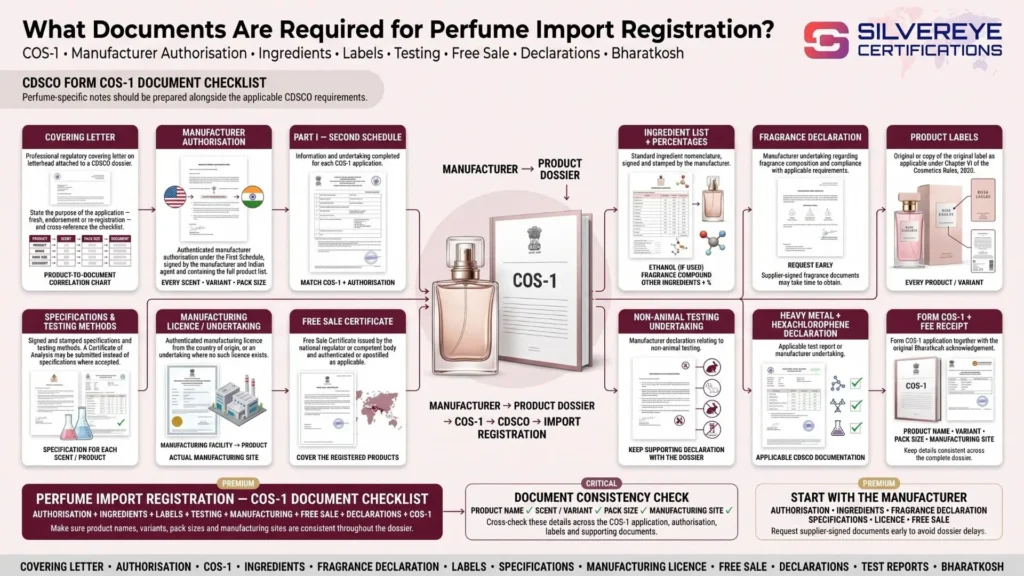
CDSCO's official document checklist also includes a pack insert and lists “other documents (if any)”, so these should not be omitted from the master checklist.
Shipping note: A Safety Data Sheet (SDS) is not listed as a standard document in CDSCO's registration checklist. However, freight forwarders, airlines and carriers may require an SDS or dangerous-goods documentation for ethanol-based perfumes, depending on the formulation and transport mode.
What Are the CDSCO Fees for Perfume Import Registration?
The Third Schedule of the Cosmetics Rules, 2020 sets the following fees for import registration. CDSCO also confirms that the applicable registration fees are paid through Bharatkosh.
| Fee head | Amount |
|---|---|
| Grant or retention of registration certificate, per category | USD 1,000 |
| Additional category on the same certificate | USD 1,000 |
| Each manufacturing site | USD 500 |
| Each variant | USD 50 |
Here is how that adds up. These are worked examples based on the Third Schedule fees only:
| Example | Calculation | Government fee |
|---|---|---|
| One fragrance category, one manufacturing site, 8 variants | 1,000 + 500 + (8 × 50) | USD 1,900 |
| Fragrance plus a deodorant category, one site, 12 variants | 1,000 + 1,000 + 500 + (12 × 50) | USD 3,100 |
Consultant charges, document authentication, translation, courier and any testing sit on top of the government fee. Fees can be revised, so check the current Third Schedule and CDSCO website before budgeting.
Do not automatically treat every different scent or pack size as a separate variant. CDSCO's requirements distinguish pack size and variant, and the exact listing should be checked against the current application requirements when preparing the dossier.
How Do You Register a Perfume for Import into India?
| Step | What happens | Watch out for |
|---|---|---|
| 1. Classify | Place each perfume under the correct Fourth Schedule category and list the applicable variants and pack sizes | One wrong category can result in a fee difference or regulatory query |
| 2. Check for novelty | Confirm whether any ingredient makes it a “new cosmetic” | New cosmetics require the applicable prior permission before import registration |
| 3. Collect documents | Get the manufacturer authorisation, Free Sale Certificate, ingredient list, labels and undertakings from the manufacturer | Authentication abroad can take time; start this step early |
| 4. Set up SUGAM | Create the importer/authorised applicant account and fill Form COS-1 | Names and details must match across the documents |
| 5. Pay the fee | Pay through Bharatkosh and upload the acknowledgement | Keep the Bharatkosh receipt with the application |
| 6. Scrutiny and queries | CDSCO reviews the dossier and may raise queries | Respond to queries promptly and with supporting documents |
| 7. Grant of COS-2 | CDSCO issues the Import Registration Certificate in Form COS-2 | Only the registered products and manufacturing sites should be imported under the certificate |
| 8. Label and import | Ensure the product carries the required Indian labelling and registration details before import | Check the applicable labelling requirements before shipment |
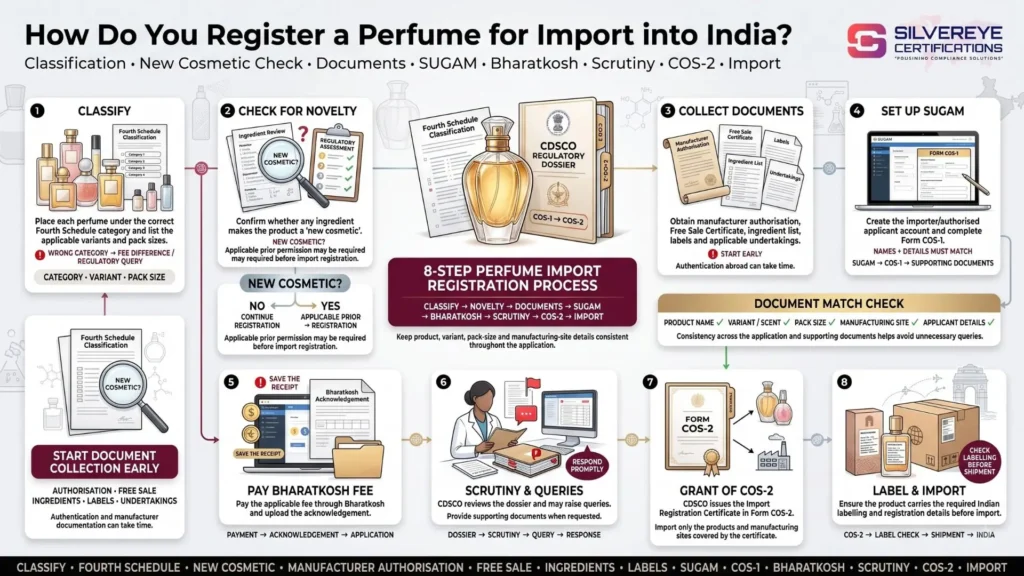
CDSCO's official guidance confirms that the Form COS-1 application is submitted online through the SUGAM portal, and the resulting Form COS-2 is the Import Registration Certificate.
How Long Does CDSCO Perfume Import Registration Take?
Rule 13 gives CDSCO up to six months from the date of application to grant or reject a complete application. CDSCO's FAQ also records a targeted processing time of 90 days, based on a circular dated 30 May 2014. Actual timelines depend on how complete the dossier is, how quickly queries are answered, and how long authentication of foreign documents takes. Treat 90 days as a target, not a guarantee, and plan your shipping calendar with the six-month statutory period in mind.
How Long Is a COS-2 Registration Certificate Valid?
The Import Registration Certificate in Form COS-2 remains valid in perpetuity, subject to payment of the applicable registration certificate retention fee before completion of five years from the date of issue. The certificate can also be suspended or cancelled by the Central Licensing Authority.
| Point | Rule |
|---|---|
| Validity | Perpetual, if the retention fee is paid on time |
| Retention fee due | Before completion of five years from the date of issue |
| Late payment | 2% of the retention fee for every month or part of a month, within 180 days |
| After 180 days | Registration is deemed cancelled |
| Endorsements | Remain subject to the validity of the registration certificate they relate to |
| COS-4A import number | Check the applicable current rule and certificate conditions for the registered product |
Older Form 43 certificates issued under the previous regulatory framework should not simply be treated as equivalent to new COS-2 registrations for adding new products, pack sizes or manufacturing sites. Check the applicable transition and endorsement requirements before expanding an older registration.
What Labelling Rules Apply to Imported Perfumes in India?
| Label element | Requirement |
|---|---|
| Product name and manufacturer | Name and address of the manufacturer, or the applicable country-of-origin declaration where permitted |
| Registration number | Import Registration Certificate number preceded by “RC”, “RC No” or “Reg. Cert. No”, along with the applicable importer/registration-holder details |
| Batch and dating | Batch or lot number and applicable use-before/expiry information |
| Net content | Required, except for a package of perfume, toilet water or similar product not exceeding 60 ml |
| Ingredient list | Required subject to the 60 ml liquid-pack exemption provided by the Rules |
| Small containers | Certain smaller packages have specific provisions for manufacturer/address information under the Rules |
| Manufacturing licence number | For imported products, this may be omitted where the manufacturing licence number is not mandatory in the country of origin, subject to the applicable import requirements |
| Hazard warnings | Where a hazard exists, the label must carry applicable directions for safe use and warnings/cautions |
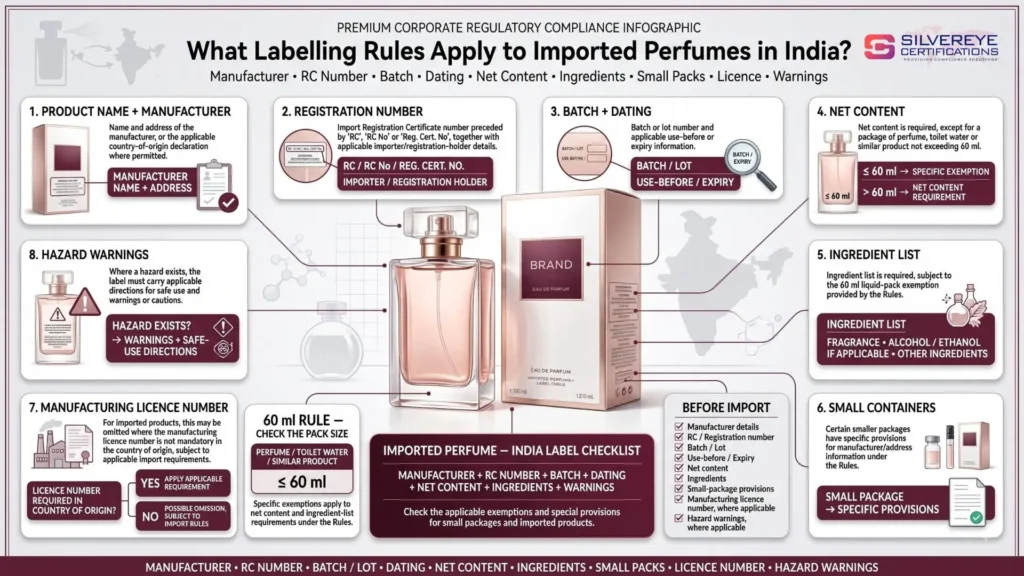
The 60 ml exemptions are specific, rather than a blanket exemption from perfume labelling. Under the Cosmetics Rules, the net-content declaration does not have to appear on perfume/toilet-water packages of 60 ml or less, and the ingredient-list declaration has a corresponding exemption for liquid packs of 60 ml or less. Other applicable labelling requirements still need to be followed.
For imported cosmetics, the Rules also require the registration certificate number on the unit pack. Where India-specific labelling is required, the Rules allow such labelling to be stickered at a bonded warehouse in the specified circumstances.
What Customs and Freight Rules Apply to Alcohol-Based Perfumes?
CDSCO registration allows the cosmetic to be imported under the applicable regulatory framework, but it does not by itself complete customs or freight formalities. Two practical points are particularly important for hydroalcoholic perfumes:
- Dangerous-goods rules in transit: Ethanol-based perfumes may be treated as flammable liquids depending on their formulation and concentration. This can affect packaging, quantity limits and carrier acceptance. Your freight forwarder or carrier should confirm the applicable requirements for the shipment and transport mode.
- Tariff classification: Perfumes fall under HS heading 3303, but the exact tariff classification can depend on the product composition. Get the applicable tariff line and duty confirmed by your customs broker for each product.
A non-hydroalcoholic perfume may not require the same dangerous-goods treatment, but this depends on the ingredients and solvents used. Check the Safety Data Sheet (SDS) rather than assuming that an alcohol-free product is automatically non-hazardous.
Who May Be Exempt From an Import Registration Certificate?
CDSCO provides limited exemptions for certain categories of imported cosmetics, subject to the applicable conditions and, importantly, not for domestic sale. These include certain:
- Cosmetics imported in bulk for repackaging and 100% export
- Cosmetics imported for research and development purposes
- Cosmetics supplied to overseas passengers through duty-free shops at international airports
- Cosmetics contained in amenity kits for international passengers, subject to the applicable conditions
- Cosmetics imported by hotels for their own captive use, subject to the prescribed undertaking
- Kits containing cosmetics where the individual products meet the applicable registration requirements
If you plan to sell perfume to Indian consumers, these exemptions generally will not provide a route around the normal import-registration requirement.
What Are the Benefits of Getting Perfume Registration Right?
- Smoother customs clearance: A valid registration certificate helps demonstrate that the imported cosmetic meets the applicable CDSCO registration requirement.
- Legal sale in India: A valid COS-2 registration is an important regulatory requirement for marketing registered imported cosmetics in India.
- Marketplace and retail readiness: Retailers and e-commerce platforms may request regulatory and product documentation before onboarding a brand.
- Lower detention and enforcement risk: Cosmetics imported or sold without the required registration can face regulatory action, detention or other enforcement measures.
- Room to expand the range: Additional products, categories or manufacturing sites can be added through the applicable endorsement/registration process, subject to CDSCO requirements and fees.
What Are the Common Mistakes Perfume Importers Make?
| Mistake | Why it hurts | Fix |
|---|---|---|
| Assuming alcohol-free perfumes are exempt | They can still fall within the cosmetics import-registration framework | Check registration requirements regardless of the base |
| Missing products in the Free Sale Certificate | CDSCO may raise a query about product coverage | Match the certificate with the COS-1 product list |
| Mismatched names across documents | Can trigger queries and processing delays | Prepare one master product sheet and use consistent information |
| Short shelf life on arrival | Applicable shelf-life requirements must be satisfied at import | Plan production and shipping dates together |
| Printing labels without the RC number | Imported cosmetics must carry the required registration information | Complete the applicable India-specific labelling before sale/import release |
| Ignoring freight rules for ethanol-based sprays | Shipments may face carrier restrictions or repacking requirements | Share the SDS with the forwarder before booking |
| Letting the retention fee lapse | Can result in late fees and deemed cancellation after 180 days | Diarise the five-year retention-fee deadline |
What Changed for Imported Cosmetics in 2026?
On 23 July 2026, CDSCO issued a circular titled “Vigilance on imported cosmetics products sold in the domestic market without valid Import Registration Certificate.” The circular is now listed on CDSCO's official Circulars page.
This reinforces the importance of maintaining a valid Import Registration Certificate for imported cosmetics being sold in India. For perfume importers, the practical takeaway is straightforward: complete registration, product documentation, labelling and freight planning before the first commercial shipment, rather than importing first and trying to regularise the product later.
What Should Perfume Importers Remember About CDSCO Registration?
For a perfume importer, the important point is that hydroalcoholic and non-hydroalcoholic perfumes fall under the same broader CDSCO cosmetics import-registration framework, even though CDSCO identifies them as separate perfume subcategories. Both require the applicable Import Registration Certificate in Form COS-2 before commercial import, and the registration process follows the same overall framework for documents, fees and retention requirements.
The alcohol question still matters in your ingredient declaration, freight booking and customs classification, so these are the areas where importers should pay particular attention.
Plan the sequence properly: classify each product, collect the required authenticated documents from the manufacturer, file Form COS-1, respond to CDSCO queries promptly, and complete the applicable Indian labelling requirements before sale/import release. Doing this properly can turn registration into a well-planned compliance process rather than a recurring source of shipment delays.
How Can Silvereye Certifications Help With Perfume Import Registration?
Silvereye Certifications is an Indian regulatory consultancy that supports manufacturers, importers and brand owners with CDSCO, BIS and related compliance work.
For perfume importers, this can include helping you identify the applicable Fourth Schedule category and product variants, review documents before filing, prepare the COS-1 application, coordinate responses to CDSCO queries, and track the retention-fee deadline after registration.
With the right documentation and planning from the beginning, perfume importers can reduce avoidable queries, documentation gaps and shipment-related compliance delays.
Frequently Asked Questions
Does CDSCO have separate rules for hydroalcoholic and non-hydroalcoholic perfumes?
No. Both are cosmetics under the Drugs and Cosmetics Act, 1940, and both follow the same Cosmetics Rules, 2020 registration route. The alcohol content affects your ingredient list, freight handling and customs tariff line, not the CDSCO pathway.
Do I need CDSCO registration to import alcohol-free perfume oils or attar?
Yes, if you plan to sell them in India. They fall within the definition of a cosmetic. Only the listed exemptions, such as R&D samples or duty-free sales, avoid registration.
Which form do I file to import perfumes?
Form COS-1 on the SUGAM portal. CDSCO grants the Import Registration Certificate in Form COS-2.
What are the CDSCO fees for a perfume import registration?
USD 1,000 per category, USD 500 per manufacturing site and USD 50 per variant, payable through Bharatkosh. An additional category on the same certificate costs USD 1,000.
How long is the registration valid?
It stays valid in perpetuity if the retention fee is paid before five years from issue are complete, unless CDSCO suspends or cancels it.
How long does CDSCO take to approve a perfume registration?
The Rules allow up to six months from application. CDSCO's FAQ mentions a 90-day target. Complete documents and quick query replies shorten the wait.
Who can apply for the import registration?
The overseas manufacturer, its authorised agent, an importer in India, or an authorised Indian subsidiary.
Is each scent treated as a separate variant?
CDSCO defines a variant as a different colour, shade or flavour and treats a pack of several fragrances as one variant. Scents are generally listed as variants, so confirm your range's treatment while preparing the dossier. Different pack sizes are not variants.
Can another company import a perfume that is already registered?
Yes. It can apply in Form COS-4 for an Import Registration Number in Form COS-4A, with an undertaking. That number is valid for three years.
Does the perfume have to be lab tested before registration?
CDSCO says testing before registration is not mandatory. Samples can be tested if a suspected violation needs to be checked, and the consignment can be detained until the report arrives.
What must the label show on imported perfume?
The RC number, importer name and address, manufacturer details, batch number and use-before date. Packs of perfume up to 60 ml can skip the net content statement, and liquid packs up to 60 ml can skip the ingredient list.
What happens if I miss the retention fee?
A late fee of 2% of the retention fee applies for every month or part of a month within 180 days. After that, the registration is deemed cancelled.