- Cosmetic Registration cost roughly USD 1,000 per category, USD 500 per foreign site, and USD 50 per variant — manufacturing licenses (COS-8) cost a few thousand rupees at the state level instead.
- Both COS-2 and COS-8 are effectively long-term approvals kept alive by a retention/renewal fee due before every 5-year mark, not a one-time payment.
- COS-2 renewal is filed through Form COS-4 on the SUGAM portal with an updated Free Sale Certificate; COS-8 stays active through a simple retention-fee payment rather than a fresh application.
- Missing a renewal or retention deadline doesn't just risk a late fee — it can block customs clearance or suspend your manufacturing license entirely.
Introduction
Cosmetic import registration (COS-2) costs approximately USD 1,000 per product category, USD 500 per foreign manufacturing site, and USD 50 per variant, paid to CDSCO via Bharatkosh. Manufacturing licenses (COS-8) cost a few thousand rupees at the state level instead.
Both approvals are built to last long-term rather than expire outright: COS-2 is commonly described as valid for 5 years and renewed via Form COS-4, while CDSCO's own framework treats it — like COS-8 — as valid until a retention fee falls due every 5 years. Miss that deadline, and a late fee applies, with import shipments risking customs detention and manufacturing licenses risking suspension. Filing the renewal or retention payment 2–3 months ahead of the 5-year mark is the safest practice on both routes.
Getting COS-2 or COS-8 approved is only step one. What actually determines whether a cosmetic brand stays legally on Indian shelves for years — not just at launch — is how well it manages cost planning, validity tracking, and renewal or retention deadlines afterward. Businesses that treat these as a one-time filing often get caught out five years later, scrambling to renew a lapsed registration while stock sits at customs.
Cost, Validity, Renewal, and Retention — What's the Difference?
These four terms get used almost interchangeably in casual conversation, but they mean different things in CDSCO's framework, and mixing them up is a common source of confusion:
- Cost — the government fee paid to file the original COS-1 or COS-5 application and obtain COS-2 or COS-8.
- Validity — the period for which a granted COS-2 or COS-8 remains legally active without further action.
- Renewal — the formal process of reapplying (Form COS-4, for COS-2) before a registration's validity period ends.
- Retention — a fee paid to keep an indefinitely valid license or registration (COS-8, and per CDSCO's underlying framework, COS-2 as well) active past each 5-year mark, without necessarily filing a full fresh application.
In practice, most industry guidance describes COS-2 in the simpler shorthand of "5-year validity, renew before expiry." CDSCO's own regulatory framing is closer to the retention-fee model used for COS-8: the registration is valid unless suspended or cancelled, provided the retention fee is paid before completing every 5-year period from the date of issue.
Both descriptions lead to the same practical action for an importer — file and pay before the 5-year mark — so this guide uses "renewal" and "retention" together for COS-2, and recommends confirming the exact current requirement on the SUGAM portal at the time you file, since CDSCO periodically updates process notifications.
Cosmetic Registration Cost For Importer (COS-1/COS-2)
Import registration cost isn't a single number — it scales with how many categories, variants, and manufacturing sites you're registering.
| Cost Component | Typical Amount | Notes |
| Government fee — per product category | USD 1,000 | Charged once for each Fourth Schedule category declared (e.g., skincare, oral hygiene, colour cosmetics) |
| Government fee — per manufacturing site | USD 500 | Charged for each foreign manufacturing facility listed in the application |
| Government fee — per product variant | USD 50 | Charged for each shade, pack size, or formulation variant within a category |
| Document authentication (apostille/notarisation) | Varies by country | Cost of legalising the CFS, GMP certificate, and authorisation letter in the country of origin |
| Translation costs | Varies | Where labels or certificates are not originally in English |
| Regulatory consultant / agent fee (optional) | Varies | Professional fee for filing support, document review, and query handling — not a government charge |
A single COS-1 filing can bundle up to 50 products, variants, and manufacturing sites, which is usually more cost-efficient than filing multiple smaller applications for a growing product line.
Cosmetic Manufacturing License Cost (COS-5/COS-8)
Manufacturing license costs are set at the state level, so exact figures vary by State Licensing Authority, but the components are broadly consistent across states.
| Cost Component | Typical Amount | Notes |
| Manufacturing license fee (state government) | Approx. ₹2,500–₹5,000 | Varies by state; may also depend on the number of product categories covered |
| Site inspection fee | Approx. ₹1,000–₹2,000 | Charged where the State Licensing Authority levies a separate inspection cost |
| Loan-license fee (third-party/contract manufacturing) | Approx. ₹2,000–₹3,000 | Applicable where the applicant manufactures under another entity's premises |
| 5-year retention fee | Generally comparable to the original license fee | Paid to keep COS-8 active past each 5-year mark |
Because COS-8 is state-issued, businesses operating manufacturing facilities in more than one state need a separate license — and separate fee payment — for each premises, even if the parent company is the same.
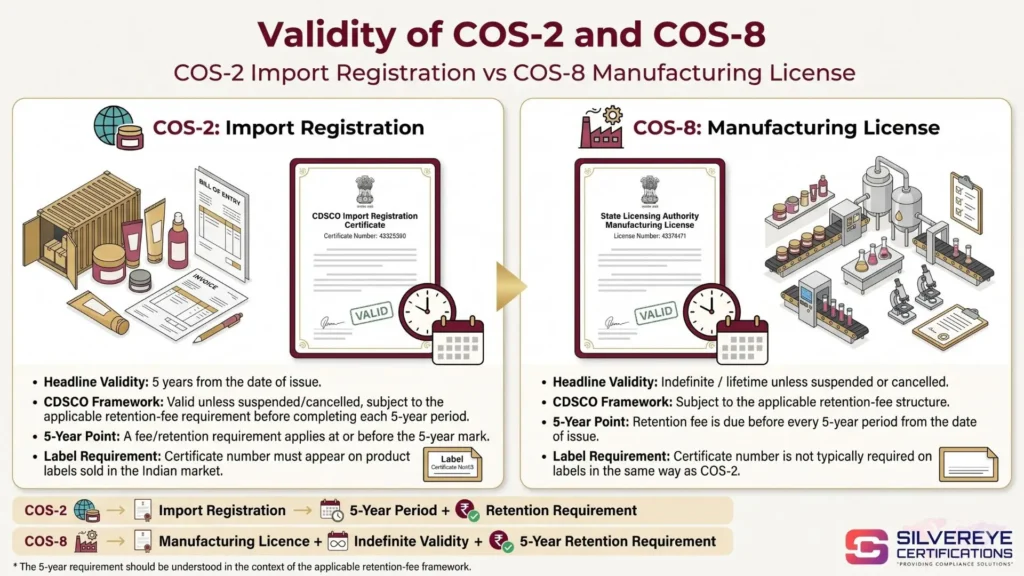
Validity of COS-2 and COS-8
| Aspect | COS-2 (Import Registration) | COS-8 (Manufacturing License) |
| Headline validity | 5 years from date of issue (common industry shorthand) | Indefinite / lifetime, unless suspended or cancelled |
| CDSCO's underlying framework | Valid unless suspended/cancelled, subject to a retention fee due before completing every 5-year period | Same retention-fee structure explicitly applies |
| What stays constant across sources | Something is due at or before the 5-year mark, whether you call it "renewal" or "retention" | Retention fee due before every 5-year period from date of issue |
| Certificate number on labels | Must appear on product labels sold in the Indian market | Not typically required on labels in the same way |
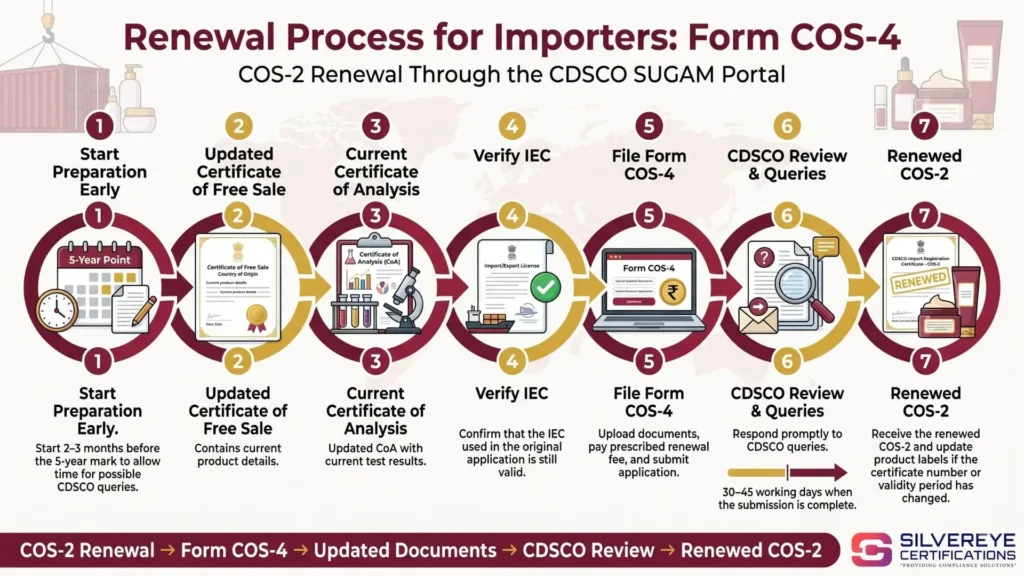
Renewal Process for Importers: Form COS-4
When a COS-2 registration approaches its 5-year mark, the renewal is filed through Form COS-4 on the CDSCO SUGAM portal, not by reusing Form COS-1.
- Start preparing 2–3 months ahead of the 5-year mark — earlier than the statutory minimum, to leave a buffer for any CDSCO queries.
- Obtain an updated Certificate of Free Sale from the country of origin, reflecting current product details.
- Gather a current Certificate of Analysis for the registered products.
- Confirm the Import Export Code (IEC) used in the original application is still valid.
- File Form COS-4 on the SUGAM portal with the updated documents and the prescribed renewal fee.
- Respond to any CDSCO queries promptly — renewal applications are generally processed within 30–45 working days when the submission is complete.
- Receive the renewed COS-2, and update product labels if the renewed certificate number or validity period has changed.
Retention Fee Process for Manufacturers: Keeping COS-8 Active
COS-8 doesn't expire the way a fixed-term license does — but it isn't maintenance-free either. To keep it active past each 5-year mark from the date of issue, the license holder must pay the prescribed retention fee to the State Licensing Authority.
- The retention fee is generally comparable in amount to the original manufacturing license fee, though this varies by state.
- Unlike COS-2's Form COS-4 renewal, retention for COS-8 is typically a fee submission rather than a full fresh application — though the SLA can still request updated documentation if the facility, products, or technical staff have changed materially.
- Retention is tracked from the original date of issue, not from the date of the last payment, so businesses need to calendar each 5-year mark rather than assuming a rolling window.
- If products or manufacturing categories have changed since the original COS-8 grant, it's worth confirming with the SLA whether those changes need to be reflected before or during the retention filing.
Late Fees and Penalties for Missed Renewal or Retention
CDSCO's broader retention-fee framework — used consistently across drugs, cosmetics, and medical device regulation — treats a delayed retention or renewal payment as a compliance lapse that carries a late fee, calculated as a percentage of the retention fee for each month of delay.
The exact percentage and calculation method for cosmetics specifically should be confirmed on the SUGAM portal or with CDSCO/your State Licensing Authority at the time of payment, since this detail is periodically notified rather than fixed in a single static rule.
- A missed COS-2 renewal risks customs detaining or rejecting import shipments at the port of entry — there is no provision to register a product retroactively after it has already been imported.
- A missed COS-8 retention payment risks suspension or cancellation of the manufacturing license, which can halt production entirely until resolved.
- Repeated or prolonged non-compliance can attract enhanced penalties under the Drugs and Cosmetics Act, 1940, beyond the late fee itself.
Because of this, most regulatory consultants recommend building a renewal/retention calendar the moment COS-2 or COS-8 is granted, rather than waiting for a reminder close to the deadline.
Import vs Manufacturing: Cost and Long-Term Compliance Comparison
| Parameter | Import (COS-1/COS-2) | Manufacturing (COS-5/COS-8) |
| Initial government fee | USD 1,000 per category + USD 500 per site + USD 50 per variant | Approx. ₹2,500–₹5,000 (state-dependent) |
| Recurring cost | Renewal fee via Form COS-4 near each 5-year mark | Retention fee near each 5-year mark |
| Currency | USD, paid via Bharatkosh | INR, paid via state-prescribed channel |
| Long-term cost driver | Number of categories, sites, and variants | Number of manufacturing premises and categories |
Why Proactive Renewal and Retention Planning Pays Off
- Uninterrupted market access — products keep clearing customs or continue production without a compliance gap.
- No late fees — filing ahead of the deadline avoids the percentage-based penalty that accrues with delay.
- Easier renewals — an updated CFS and Certificate of Analysis gathered early is far less stressful than assembling them under deadline pressure.
- Protects past investment — since original filing fees are generally non-refundable, letting a registration lapse and having to refile from scratch wastes that initial cost.
How Silvereye Certifications Helps with Cost, Renewal & Retention
Silvereye Certifications is a Noida-based regulatory compliance consultancy supporting manufacturers, importers, and D2C cosmetic brands with BIS Certification, CDSCO Registration, EPR Authorization, and related compliance services across India. On the cost and long-term compliance side, the Silvereye Certifications team assists with:
- Upfront cost estimation across categories, variants, and manufacturing sites, so there are no surprises mid-filing.
- Calendaring COS-2 and COS-8 5-year marks from the date of issue, with reminders well ahead of the renewal/retention window.
- Preparing the Form COS-4 renewal dossier — updated CFS, Certificate of Analysis, and IEC confirmation — for import registrations.
- Managing COS-8 retention fee submissions to the relevant State Licensing Authority, including flagging any material changes that need to be reflected.
- Advising on the current late-fee and penalty structure at the time a renewal or retention deadline is approaching, since these figures are periodically updated.
Brands wanting to avoid a last-minute scramble around their COS-2 or COS-8 5-year mark can reach out to Silvereye Certifications for a compliance calendar and renewal-readiness review.
Conclusion
Cosmetic registration cost in India isn't a one-time number to budget for and forget — it's an ongoing relationship with a 5-year clock, whether you're renewing a COS-2 through Form COS-4 or paying a COS-8 retention fee to your State Licensing Authority. The businesses that stay compliant without disruption are the ones that calendar their 5-year mark the day their registration is granted, not the ones that start gathering documents after a shipment gets held at customs.
Whether you're budgeting for a first-time COS-1 filing or tracking a COS-8 that's approaching its next retention deadline, treating cost, validity, renewal, and retention as four connected pieces of the same compliance picture is what keeps a cosmetic brand on Indian shelves without interruption. For help estimating costs upfront or building a renewal/retention calendar, Silvereye Certifications' regulatory team can guide the process end to end.
Frequently Asked Questions
How much does cosmetic import registration cost in India?
The government fee is commonly cited as USD 1,000 per product category, USD 500 per foreign manufacturing site, and USD 50 per variant, paid through the Bharatkosh gateway. Confirm current rates on the SUGAM portal, since fee schedules can be revised.
How much does a cosmetic manufacturing license cost in India?
State-level fees typically fall in the range of ₹2,500–₹5,000 for the manufacturing license, plus a smaller inspection fee where applicable, though the exact amount varies by state.
How long is a COS-2 import registration valid?
Commonly described as 5 years from the date of issue. CDSCO's own framework treats it as valid until suspended or cancelled, subject to a retention/renewal payment due before completing every 5-year period.
How long is a COS-8 manufacturing license valid?
Indefinitely, unless suspended or cancelled — provided the retention fee is paid before completing every 5-year period from the date of issue.
What form is used to renew COS-2?
Form COS-4, filed on the CDSCO SUGAM portal along with an updated Certificate of Free Sale, Certificate of Analysis, valid IEC, and the prescribed renewal fee.
Is there a late fee for missing a renewal or retention deadline?
CDSCO's broader retention-fee framework applies a late fee calculated as a percentage of the retention fee per month of delay. Confirm the exact cosmetics-specific rate with CDSCO or your State Licensing Authority at the time of payment.
What happens if I import cosmetics with an expired COS-2?
Customs can detain or reject the shipment at the port of entry — Indian law doesn't provide a way to register a product retroactively after it has already been imported.
What happens if a manufacturer misses the COS-8 retention fee deadline?
The manufacturing license risks suspension or cancellation by the State Licensing Authority, which can halt production until the retention fee and any applicable late fee are paid and the license is reinstated.
How far in advance should I start the COS-2 renewal process?
Most regulatory consultants recommend starting 2–3 months ahead of the 5-year mark, even though the minimum document-based filing window cited in CDSCO guidance is often closer to 60 days before expiry.
Does the COS-8 retention fee require a fresh application?
Generally no — it's typically a fee submission to keep the existing license active, though the State Licensing Authority can request updated documentation if the facility or products have changed materially.
Are import and manufacturing fees paid in the same currency?
No. Import registration fees are paid in USD through the Bharatkosh gateway, while manufacturing license and retention fees are paid in INR through the relevant state's prescribed channel.
Can renewal or retention fees change over time?
Yes. Government fee schedules for both COS-2 renewal and COS-8 retention are periodically revised, so it's worth confirming the current amount on the SUGAM portal or with your State Licensing Authority shortly before you file.