
- Importers use Form COS-1 (application) to obtain Form COS-2 (Import Registration Certificate) from CDSCO — valid for 5 years.
- Domestic manufacturers use Form COS-5 (application) to obtain Form COS-8 (Manufacturing License) from their State Licensing Authority — valid indefinitely, subject to a 5-year retention fee.
- Manufacturing licenses require a physical GMP site inspection; import registrations do not, but both routes need correct product categorization under the Fourth Schedule.
- Choosing the wrong route, or filing incomplete technical/GMP documentation, is the single biggest cause of delay across both COS-1 and COS-5 applications.
Introduction
Cosmetic registration Process in India follows two separate CDSCO pathways depending on where the product is made. Importers file Form COS-1 on the CDSCO SUGAM portal and receive Form COS-2, the Import Registration Certificate, valid for 5 years — no site inspection is required, but a Certificate of Free Sale and full safety dossier are.
Domestic manufacturers instead file Form COS-5 with their State Licensing Authority and receive Form COS-8, the Manufacturing License, after a physical GMP inspection of the facility. COS-8 stays valid indefinitely, subject to a retention fee paid every 5 years. Both routes require correct product categorization under the Fourth Schedule of the Cosmetics Rules, 2020, and no cosmetic can legally be sold in India without one of the two.
What Is Cosmetic Registration Process in India?
Cosmetic registration is the CDSCO-administered approval, under the Drugs and Cosmetics Act, 1940 and the Cosmetics Rules, 2020, that legally permits a cosmetic product to be imported into or manufactured within India for sale. Every cosmetic — from skincare and haircare to colour cosmetics, oral care, and personal hygiene products — must fall under one of the roughly 80 product categories listed in the Fourth Schedule of the Cosmetics Rules, 2020 before it can be registered.
There are two distinct application-and-license pairs, and understanding which applies to your business is the first decision to get right:
- Import route — Form COS-1 (application) → Form COS-2 (Import Registration Certificate), granted centrally by CDSCO for cosmetics manufactured outside India.
- Manufacturing route — Form COS-5 (application) → Form COS-8 (Manufacturing License), granted by the State Licensing Authority (State Drug Controller) for cosmetics produced inside India.
Legal Framework Governing Cosmetic Registration
- Drugs and Cosmetics Act, 1940 — the parent legislation defining "cosmetic" and prohibiting the import, manufacture, or sale of any unregistered/unlicensed cosmetic.
- Cosmetics Rules, 2020 — governs registration, manufacturing, labelling, and import of cosmetics; Rule 6 covers manufacturing licenses, Rule 13 covers import registration.
- Central Licensing Authority (CDSCO) — the sole authority for import registration (COS-1/COS-2); applications are filed nationally through the SUGAM portal.
- State Licensing Authority (State Drug Controller) — the authority for manufacturing licenses (COS-5/COS-8); each state office reviews and inspects facilities within its jurisdiction.
- Fourth Schedule — lists the ~80 defined cosmetic product categories used for classification in both routes.
- Legal Metrology (Packaged Commodities) Rules, 2011 — governs mandatory retail label declarations once a registered/licensed cosmetic reaches the Indian market.
Import vs Manufacture: Which Cosmetic Registration Route Applies to You?
Both routes exist under the same Cosmetics Rules, 2020, but they differ in authority, process, and outcome. Use this comparison to identify your route before you start compiling documents.
| Parameter | Import Route (COS-1 → COS-2) | Manufacturing Route (COS-5 → COS-8) |
| Applies to | Cosmetics manufactured outside India and brought in for sale | Cosmetics manufactured inside India, for domestic sale or export |
| Licensing authority | CDSCO (Central Licensing Authority) | State Licensing Authority (State Drug Controller) |
| Who applies | Indian authorised agent, subsidiary, or importer (foreign manufacturers cannot apply directly) | The Indian entity that owns or operates the manufacturing facility |
| Site inspection | Not required for the foreign site; CDSCO reviews documents and safety data | Mandatory physical GMP inspection of the Indian manufacturing premises |
| Typical timeline | Up to 180 working days | Around 45 days after document verification, following a 30–60 day inspection window |
| Validity | 5 years from date of issue | Indefinite, subject to a retention fee every 5 years |
Import Route: COS-1 Application and COS-2 Grant of License
Who Needs COS-1/COS-2 Registration
- Foreign cosmetic manufacturers, applying through an Indian authorised agent, subsidiary, or importer — foreign entities cannot file COS-1 directly.
- Indian importers and distributors bringing finished cosmetics into India for retail, wholesale, or dental/salon/professional distribution.
- D2C and e-commerce brands sourcing finished cosmetics from overseas manufacturers, including private-label and white-label arrangements.
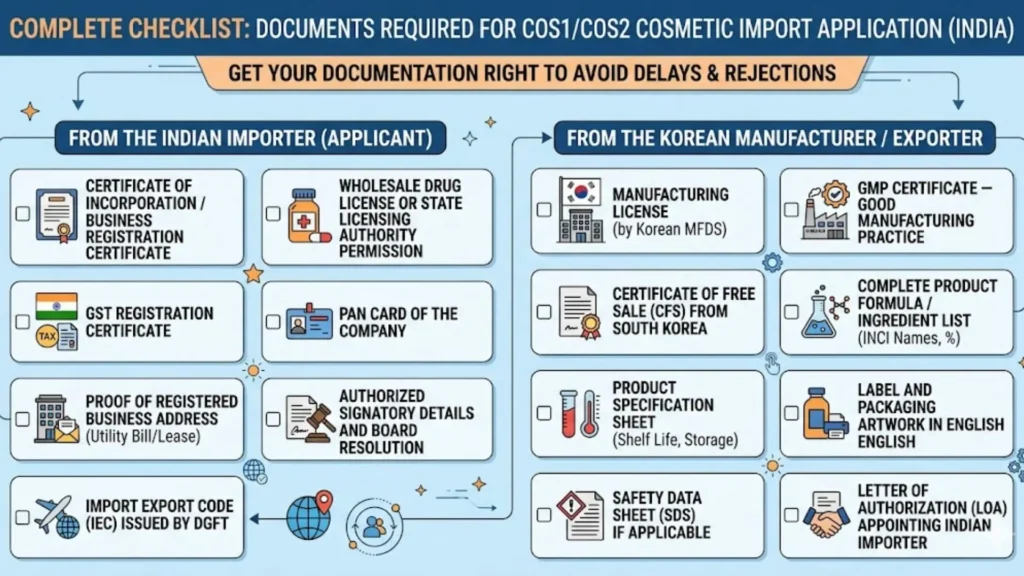
Documents Required for COS-1
- Covering letter and Power of Attorney (POA) from the foreign manufacturer to the Indian agent/importer.
- Duly filled Form COS-1.
- Certificate of Free Sale (CFS) or equivalent marketability certificate from the country of origin.
- Manufacturing licence / GMP certificate of the foreign manufacturing site.
- Product specification sheet and ingredient list with percentage composition.
- Safety and test reports — heavy metal limits, microbiological testing, stability data.
- Product labels and packaging artwork translated into English.
- Non-animal testing declaration (Rule 39(7), Cosmetics Rules, 2020) and Hexachlorophene declaration.
- Import Export Code (IEC) of the Indian importer.
- Proof of government fee payment (SUGAM/Bharat Kosh challan).
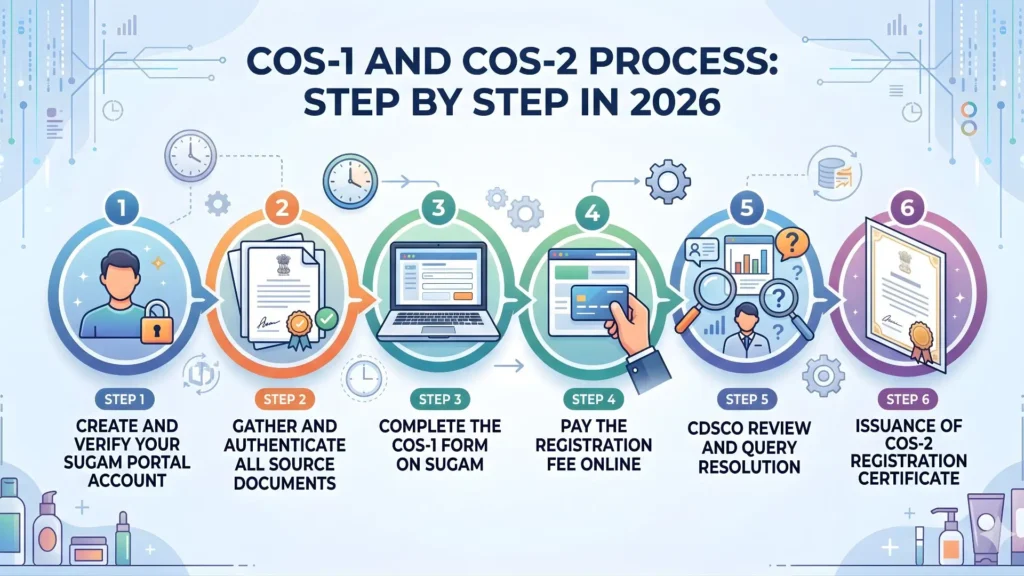
Step-by-Step COS-1 to COS-2 Process
- Appoint an Indian authorised agent via Power of Attorney from the foreign manufacturer.
- Classify each product under the correct Fourth Schedule category.
- Compile the technical and safety dossier — CFS, GMP certificate, ingredient list, safety reports, compliant labels.
- Create an applicant profile on the CDSCO SUGAM portal.
- Pay the government fee online and retain the challan.
- Submit Form COS-1 with the complete document set.
- Respond promptly to CDSCO queries on ingredients, labelling, or safety data.
- Receive Form COS-2 — the Import Registration Certificate — once CDSCO is satisfied.
- Clear customs and distribute the approved products across India.
Manufacturing Route: COS-5 Application and COS-8 Grant of License
Who Needs COS-5/COS-8 Registration
- Any business setting up or operating a cosmetic manufacturing facility inside India, whether for domestic sale, private-label production, or export.
- Contract manufacturers producing cosmetics on behalf of other brands.
- Existing COS-8 licence holders who want to add new products or variants under their existing manufacturing site typically file a fresh or amended COS-5 rather than starting over.
Eligibility and Technical Staff Requirements
A cosmetic manufacturing facility must have a qualified technical/competent person overseeing production. Under the Cosmetics Rules, 2020, this person is generally required to hold one of the following qualifications:
- A diploma in pharmacy recognised under the Pharmacy Act, 1948.
- An intermediate examination with chemistry, or an equivalent examination recognised by the licensing authority.
- A bachelor's degree in cosmetic technology, pharmacy, chemistry, or a related science from a recognised university.
The applicant must also be the owner, director, or an authorised signatory of the manufacturing entity, and generally must not have a prior conviction under the Drugs and Cosmetics Act within the preceding years.
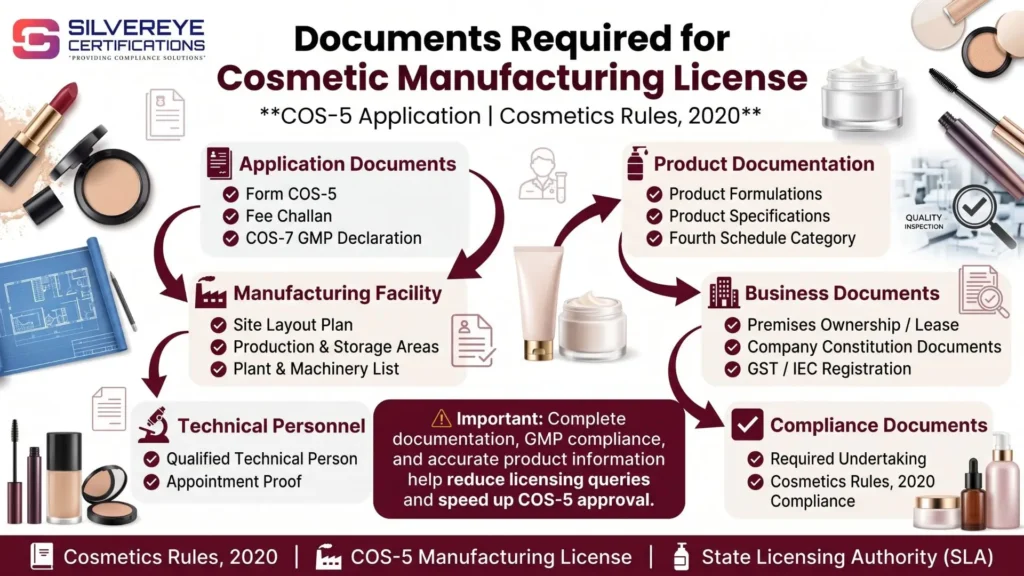
Documents Required for COS-5
- Covering letter and manufacturing site details.
- Site Master File describing the facility, equipment, and processes.
- Plant layout and list of equipment/machinery.
- List of cosmetic products intended to be manufactured, mapped to Fourth Schedule categories.
- Proof of qualified technical staff (educational and experience certificates).
- Form COS-7 — GMP self-declaration for the facility.
- Undertaking of product compliance as per the Cosmetics Rules, 2020.
- Fee payment receipt.
Step-by-Step COS-5 to COS-8 Process
- Register on the CDSCO SUGAM portal and select the cosmetic manufacturing license application.
- Prepare the Site Master File, plant layout, equipment list, and technical staff qualification proof.
- File Form COS-5 along with the Form COS-7 GMP self-declaration and the prescribed fee.
- Submit the application to the State Licensing Authority for review.
- The SLA reviews documents and schedules a physical inspection of the manufacturing premises, typically within 30–60 days.
- Address any deficiencies raised by the inspecting officer or licensing authority.
- Once verification is complete without outstanding queries, the SLA grants Form COS-8 — generally within 45 days of document verification.
- Be ready for a further compliance/GMP audit inspection within 30 days of receiving the license.
- Upload the granted licence to the CDSCO portal for transparency and record-keeping.

Fees for Import Registration and Manufacturing License
Fees differ meaningfully between the two routes because one is a central government fee (import) and the other is a state-level fee (manufacturing) that varies somewhat by state.
| Route | Fee Component | Typical Amount |
| Import (COS-1/COS-2) | Per product category | USD 1,000 |
| Import (COS-1/COS-2) | Per manufacturing site (foreign) | USD 500 |
| Import (COS-1/COS-2) | Per product variant | USD 50 |
| Manufacturing (COS-5/COS-8) | Manufacturing license fee (state government) | Approx. ₹2,500–₹5,000, varies by state |
| Manufacturing (COS-5/COS-8) | Site inspection fee (where applicable) | Approx. ₹1,000–₹2,000 |
| Manufacturing (COS-5/COS-8) | Loan-license fee (third-party manufacturing) | Approx. ₹2,000–₹3,000 |
| Manufacturing (COS-5/COS-8) | 5-year retention fee | Generally equal to the original license fee |
Import fees are payable in USD via the SUGAM/Bharat Kosh gateway and are generally non-refundable. Manufacturing license fees are state-specific and payable through the relevant State Licensing Authority's portal or challan system. Confirm current rates with CDSCO or your State Drug Controller before filing, as fee schedules are periodically revised.
Validity and Renewal: COS-2 vs COS-8
| Aspect | COS-2 (Import Registration) | COS-8 (Manufacturing License) |
| Validity period | 5 years from date of issue | Indefinite / lifetime, unless suspended or cancelled |
| Renewal requirement | File renewal at least 6 months before expiry | No renewal, but a retention fee is payable every 5 years to keep the license active |
| Renewal process | Same SUGAM portal and broadly the same documentation as a fresh COS-1 | Retention fee submission to the State Licensing Authority; site status may be reviewed |
| Consequence of lapse | Import without a valid/renewed COS-2 risks customs detention and penalties | Non-payment of retention fee can lead to suspension or cancellation of the license |
Typical Timeline: Import vs Manufacturing Registration
| Stage | Import Route (COS-1/COS-2) | Manufacturing Route (COS-5/COS-8) |
| Document/dossier preparation | 2–4 weeks | 2–5 weeks (Site Master File, plant layout, staff proof) |
| Filing and fee payment | 1–3 days | 1–3 days |
| Authority review | Ongoing, up to 180 working days total | Document verification stage, before inspection |
| Site inspection | Not applicable | 30–60 days, scheduled by the State Licensing Authority |
| License/certificate grant | Within the 180-working-day ceiling under Rule 13(5) | Generally within 45 days of completed document verification |
Common Mistakes That Delay Cosmetic Registration
- Filing under the wrong route — attempting COS-1 for a domestically manufactured product, or COS-5 when the product is actually imported finished goods.
- Inconsistent manufacturer, product, or address names across the CFS, GMP certificate, labels, and application form.
- Incorrect or vague product categorisation under the Fourth Schedule.
- Incomplete technical staff documentation for manufacturing applications — a frequent reason for COS-5 queries.
- Site Master File or plant layout that doesn't match the actual facility being inspected.
- Slow or incomplete responses to authority queries — the most preventable cause of delay in both routes.
- Underpaid government fees due to miscounted categories, variants, or manufacturing sites.
Post-Registration Compliance for Both Routes
Getting COS-2 or COS-8 is not the finish line. Ongoing compliance applies to every registered or licensed cosmetic sold in India:
- Legal Metrology labelling — MRP, net quantity, batch number, manufacturing/import date, ingredient list, and manufacturer/importer address must appear on every retail unit.
- GMP compliance — manufacturers must maintain ongoing Good Manufacturing Practice standards; the licensing authority can conduct periodic or surprise inspections.
- No animal testing — Rule 39(7) of the Cosmetics Rules, 2020 prohibits cosmetics tested on animals from being registered, imported, or manufactured.
- Record-keeping — batch records, safety data, and supplier documentation should be maintained for regulatory audits and post-market surveillance.
- Amendments — any material change in formulation, manufacturing site, or labelling generally requires updating the registration/license rather than operating outside its approved scope.
Benefits of Completing Cosmetic Registration
- Legal market access — registered/licensed products move through customs (import) or commence production (manufacturing) without regulatory risk.
- Marketplace and retail eligibility — most major e-commerce platforms and organised retail chains require valid CDSCO documentation before onboarding cosmetic SKUs.
- Consumer and B2B trust — a valid registration number signals regulatory legitimacy to distributors, retailers, and buyers.
- Long-term cost efficiency — COS-8's indefinite validity (with a 5-year retention fee) is generally more economical for manufacturers than repeated fresh filings.
- Avoids penalties — operating without registration exposes a business to seizure, fines, and other consequences under the Drugs and Cosmetics Act, 1940.
How Silvereye Certifications Helps For Cosmetic Registration
Silvereye Certifications is a Noida-based regulatory compliance consultancy supporting manufacturers, importers, and D2C cosmetic brands with BIS Certification, CDSCO Registration, EPR Authorisation, and related compliance services across India. For both cosmetic registration routes, the Silvereye Certifications team assists with:
- Route determination — confirming whether your product needs COS-1/COS-2 or COS-5/COS-8 before any paperwork begins.
- Product categorization review under the Fourth Schedule, to reduce classification-related queries.
- Compiling and vetting the CFS, GMP certificate, Site Master File, technical staff proof, and label artwork for consistency.
- End-to-end filing on the CDSCO SUGAM portal and coordination with the relevant State Licensing Authority for manufacturing applications.
- Managing GMP site-inspection readiness for manufacturing applicants, and responding to authority queries during review.
- Tracking COS-2 validity and COS-8 retention-fee cycles so registrations and licenses stay active without lapses.
Businesses planning to import or manufacture cosmetics in India can reach out to Silvereye Certifications for a route-determination and documentation review before filing, to avoid the delays that come from starting down the wrong pathway.
Conclusion
Cosmetic registration in India isn't one process — it's two, and picking the right one from the start is what keeps a launch on schedule. Importers need a clean COS-1 dossier built around a valid Certificate of Free Sale and safety data; manufacturers need a facility, technical staff, and Site Master File ready for a State Licensing Authority inspection. Both eventually lead to the same outcome: a legally compliant cosmetic on Indian shelves.
Whether you're bringing a finished product into India or building a manufacturing line here, treating COS-1/COS-2 or COS-5/COS-8 as a structured, document-first process — rather than paperwork to rush through — is what determines how fast you get to market. For hands-on support with route determination, documentation, and filing on either pathway, Silvereye Certifications' regulatory team can guide the process end to end.
Frequently Asked Questions
What is the difference between COS-1/COS-2 and COS-5/COS-8?
COS-1/COS-2 is the import pathway: CDSCO grants COS-2 to importers of finished cosmetics made outside India. COS-5/COS-8 is the manufacturing pathway: the State Licensing Authority grants COS-8 to businesses producing cosmetics inside India.
Who is the licensing authority for each route?
CDSCO (the Central Licensing Authority) handles import registration. Each State Licensing Authority, also called the State Drug Controller, handles manufacturing licenses for facilities in that state.
Do I need a site inspection for import registration?
No. CDSCO reviews documentation, the Certificate of Free Sale, and safety data for COS-1 applications; a physical inspection of the foreign manufacturing site is not part of the process. Manufacturing applications (COS-5) do require a physical GMP inspection of the Indian facility.
How long is a COS-2 import registration valid?
Five years from the date of issue, with renewal required at least six months before expiry.
How long is a COS-8 manufacturing license valid?
Indefinitely, unless suspended or cancelled — but a retention fee must be paid every five years to keep it active.
What qualifications does the technical staff need for a manufacturing license?
Generally a diploma in pharmacy, an intermediate examination with chemistry (or equivalent), or a bachelor's degree in cosmetic technology, pharmacy, chemistry, or a related science, depending on what the licensing authority accepts.
Can a foreign brand apply for COS-1 directly?
No. Foreign manufacturers must appoint an Indian authorised agent, subsidiary, or importer to file COS-1 and hold the resulting COS-2 registration.
How long does a COS-8 manufacturing license take to obtain?
Generally around 45 days after document verification is complete, though the State Licensing Authority typically schedules a site inspection within 30–60 days as part of that process.
What happens if I add a new product to an existing manufacturing license?
Existing COS-8 holders generally file a fresh or amended COS-5 application to add new products or variants; this is usually processed faster than a first-time application since the facility is already inspected and on file.
Can one manufacturing facility hold a single COS-8 for multiple products?
Yes. One State Licensing Authority-issued COS-8 can generally cover all products manufactured at that single premises, provided each product is correctly declared and categorised.
Do both routes require product categorisation under the Fourth Schedule?
Yes. Whether you're importing or manufacturing, every product must be assigned to the correct category among the roughly 80 categories defined in the Fourth Schedule of the Cosmetics Rules, 2020.
What is Form COS-7?
Form COS-7 is the GMP self-declaration a manufacturing applicant submits alongside Form COS-5, confirming the facility meets Good Manufacturing Practice requirements ahead of the State Licensing Authority's inspection.