- Most complete X-ray systems are Class C: CDSCO's official radiology classification list places general-purpose, mammographic, fluoroscopic, and dental X-ray systems in Class C, requiring the Central Licensing Authority route.
- Components and accessories are often Class A/B: Film cassettes, high-voltage generators, tube housings, and beam-limiting devices are typically Class B, while basic measurement accessories are Class A.
- Importers always use MD-14/MD-15: Regardless of class, an authorized Indian agent files Form MD-14 and receives the import license on Form MD-15 from CDSCO.
- Wholesalers always use MD-41/MD-42: Any business stocking, supplying, or distributing X-ray equipment needs the registration certificate granted on Form MD-42, applied for via Form MD-41.
Introduction
CDSCO registration for X-ray equipment is mandatory under the Medical Devices Rules, 2017, and the process depends on the specific device's risk class. According to CDSCO's official radiology classification notice, basic accessories like an X-ray film ruler are Class A, imaging components like film cassettes and high-voltage generators are Class B, and most complete X-ray imaging systems — general-purpose, mammographic, fluoroscopic, dental, and mobile/portable units — are Class C.
Class A/B manufacturers apply on Form MD-3 and receive the license on Form MD-5 from the State Licensing Authority. Class C manufacturers apply on Form MD-7 and receive the license on Form MD-9 directly from CDSCO's Central Licensing Authority. Importers use Form MD-14 (granted as MD-15), and wholesalers/distributors use Form MD-41 (granted as MD-42), regardless of class.
What Is CDSCO Registration for X-Ray Equipment?
CDSCO registration for X-ray equipment is the regulatory approval issued by the Central Drugs Standard Control Organization (CDSCO), under India's Ministry of Health and Family Welfare, that authorizes a business to manufacture, import, or distribute X-ray imaging systems and their components in India. This covers complete diagnostic X-ray systems (general-purpose, mobile, portable, dental, mammographic, fluoroscopic) as well as individual components like high-voltage generators, tube housings, detectors, and film cassettes. These devices are regulated under the Medical Devices Rules, 2017 (MDR 2017), notified under the Drugs and Cosmetics Act, 1940.
CDSCO originally notified 66 radiology medical devices on 13 September 2021, and has since issued more detailed, updated classification notices — including a comprehensive Interventional Radiology risk classification list dated 27 November 2025 that names specific X-ray system types and components individually. Because a complete X-ray machine and a simple accessory like a film ruler carry very different risk profiles, CDSCO applies different licensing routes depending on the exact product, rather than treating all X-ray equipment as a single category.
How CDSCO Classifies X-Ray Equipment: Class A, B & C
Based on CDSCO's most recent official radiology classification notice, X-ray equipment is distributed primarily across Class A, B, and C. Notably, this update does not place any complete X-ray imaging system in Class D — the highest-risk classification in radiology is reserved for select invasive, catheter-based imaging-adjunct devices (such as certain intravascular ultrasound catheters) rather than X-ray machines themselves.
| Class | Risk Level | What Typically Falls Here | Manufacturing Route |
| Class A | Low risk | Basic measurement accessories (e.g., X-ray film ruler, radiologic quality assurance instrument) | Form MD-3 → MD-5 (State Licensing Authority) |
| Class B | Low-to-moderate risk | X-ray system components — film cassettes, high-voltage generators, tube housings, beam-limiting devices, detectors, dental x-ray film/sensors | Form MD-3 → MD-5 (State Licensing Authority) |
| Class C | Moderate-to-high risk | Complete X-ray imaging systems — general-purpose, mobile/portable, fluoroscopic, mammographic, dental (intraoral/panoramic), and CT-combined systems | Form MD-7 → MD-9 (Central Licensing Authority) |
| 2026 freshness note — this reflects CDSCO's most recent radiology classification update CDSCO issued a detailed Interventional Radiology risk classification notice dated 27 November 2025, which individually names and classifies well over 180 radiology-related devices, including most X-ray system types and components referenced in this guide. Because CDSCO periodically revises these lists, always cross-check your specific product's classification against the current notice on the CDSCO website or SUGAM portal before filing Form MD-3 or MD-7. |
Class A X-Ray Equipment
Class A X-ray-related devices are low-risk accessories that support imaging without generating or directly controlling X-ray beams themselves:
| S.No. | Device Name |
| 1 | Orthopaedic x-ray ruler |
| 2 | Radiologic quality assurance instrument |
| 3 | Tissue specimen x-ray tomography system |
| 4 | X-ray film ruler |
Class B X-Ray Equipment
Class B covers the individual components and accessories that make up an X-ray system — generators, detectors, cassettes, and imaging support hardware:
| S.No. | Device Name |
| 1 | Automatic-aperture-control diagnostic x-ray system collimator |
| 2 | Computed radiography digital imaging scanner |
| 3 | Dental computed radiography digital imaging scanner |
| 4 | Dental digital X-ray imaging sensor |
| 5 | Dental x-ray film, screen |
| 6 | Diagnostic x-ray beam-limiting device |
| 7 | Diagnostic x-ray digital imaging conversion system |
| 8 | Diagnostic x-ray digital imaging system workstation |
| 9 | Diagnostic x-ray high voltage generator |
| 10 | Diagnostic x-ray tube housing assembly |
| 11 | Digital imaging cassette/storage phosphor screen, basic diagnostic x-ray (CR cassette) |
| 12 | Indirect flat panel x-ray detector |
| 13 | Mammographic x-ray system stereotactic unit |
| 14 | Medical x-ray film, screen |
| 15 | Panoramic digital X-ray sensor |
| 16 | Radiographic film cassette/X-ray cassette |
| 17 | Radiographic film/cassette changer |
| 18 | Radiographic film/cassette changer programmer |
| 19 | Spot-film device |
| 20 | X-ray image intensifier |
Class C X-Ray Equipment
Class C is where most complete, patient-facing X-ray imaging systems sit — general-purpose diagnostic units, fluoroscopy systems, mammography systems, and dental imaging systems:
| S.No. | Device Name |
| 1 | Angiographic x-ray system |
| 2 | Basic/General-purpose diagnostic x-ray system, mobile/stationary/portable |
| 3 | Bone densitometer |
| 4 | Cephalometric digital X-ray sensor |
| 5 | Cine or spot fluorographic x-ray camera |
| 6 | Digital angiographic x-ray system, mobile/stationary/portable |
| 7 | Digital basic diagnostic x-ray system, mobile/portable/stationary |
| 8 | Digital cephalometric x-ray system |
| 9 | Digital general-purpose fluoroscopic x-ray system, mobile/portable/stationary |
| 10 | Digital intraoral dental x-ray system, mobile/portable/stationary/hand-held |
| 11 | Digital mammographic x-ray system, mobile/stationary/portable |
| 12 | Digital panoramic/tomographic dental x-ray system (OPG) |
| 13 | Digital uro-gynaecological fluoroscopic x-ray system |
| 14 | Electrostatic x-ray imaging system |
| 15 | Flat panel radiography and fluoroscopy system |
| 16 | General-purpose fluoroscopic x-ray system, mobile/portable/stationary |
| 17 | Hand-held intraoral dental x-ray system |
| 18 | Image-intensified fluoroscopic x-ray system |
| 19 | Intraoral dental x-ray system, mobile/portable/stationary |
| 20 | Limited view field X-ray computed tomography system |
| 21 | Mammographic x-ray system (portable/mobile/stationary) |
| 22 | Multi-modality diagnostic x-ray system (full body CT/fluoroscopic x-ray system) |
| 23 | Non-image-intensified fluoroscopic x-ray system |
| 24 | Photofluorographic x-ray system |
| 25 | X-ray system computer, diagnostic, general-purpose |
| 26 | X-ray system synchronizer |
| 27 | X-ray/CT combined cardiovascular diagnostic X-ray system |
If your product is a complete X-ray imaging system rather than a standalone component, it is very likely to fall in Class C and require the MD-7/MD-9 manufacturing route through CDSCO's Central Licensing Authority.
Who Needs CDSCO Registration for X-Ray Equipment?
CDSCO registration applies separately to each role in the X-ray equipment supply chain, and the manufacturing form depends on class:
| Entity | Class A/B Route | Class C Route | Issuing Authority |
| Manufacturer | Form MD-3 → MD-5 | Form MD-7 → MD-9 | State Licensing Authority (A/B); CDSCO Central Licensing Authority (C) |
| Importer | Form MD-14 → MD-15 | Form MD-14 → MD-15 | CDSCO – Central Licensing Authority (all classes) |
| Wholesaler / Distributor | Form MD-41 → MD-42 | Form MD-41 → MD-42 | State Licensing Authority (all classes) |
CDSCO Manufacturing License: MD-3/MD-5 (Class A/B) vs. MD-7/MD-9 (Class C)
Class A/B X-Ray Components — Form MD-3 & MD-5
- Applicant must be a registered business entity with a defined manufacturing premise in India.
- Quality Management System aligned with ISO 13485:2016, proportionate to the specific component.
- Application filed on Form MD-3 via the CDSCO SUGAM portal, with a Site Master File and Device Master File.
- Reviewed and granted by the State Licensing Authority (SLA) on Form MD-5.
- Typical processing time: approximately 3–6 months.
Class C X-Ray Systems — Form MD-7 & MD-9
- Applicant must meet the same business-entity and premise requirements, with a substantially more rigorous Quality Management System given the ionizing-radiation function of the equipment.
- Application filed on Form MD-7 via the SUGAM portal, with a comprehensive Device Master File, electrical safety and radiation-safety compliance data, and performance testing data.
- Reviewed and granted directly by CDSCO's Central Licensing Authority on Form MD-9.
- A facility inspection by CDSCO's Medical Device Officers is typically scheduled within 60 days of a complete application.
- Typical processing time: approximately 6–9 months, reflecting the deeper technical review required for Class C imaging systems.
Documents Required for X-Ray Equipment Registration
Common Documents (All Classes)
- Covering letter and duly filled application form (MD-3 for Class A/B, MD-7 for Class C).
- Proof of constitution of the firm (incorporation certificate, partnership deed, GST registration).
- Site Master File describing the manufacturing premises and layout.
- Device Master File covering technical specifications, intended use, and labelling.
- Details of manufacturing plant, machinery, and quality-control equipment.
- Undertaking of compliance with Essential Principles of safety and performance under MDR 2017.
Additional Documents for Class C X-Ray Systems
- Electrical safety testing data (per IEC 60601 series) appropriate to a powered radiological device.
- Radiation-safety and dose-output performance data demonstrating compliance with applicable radiological safety standards.
- Image quality/performance testing data appropriate to the system's imaging modality (general radiography, fluoroscopy, mammography, or dental).
- Risk management documentation aligned with ISO 14971 principles.
| AERB clearance is separate from CDSCO registration X-ray equipment that emits ionizing radiation is also subject to registration and safety compliance requirements under the Atomic Energy Regulatory Board (AERB), in addition to CDSCO's medical device licensing. AERB and CDSCO are separate regulatory processes with separate applications — CDSCO registration does not substitute for AERB radiation-safety clearance, and vice versa. |
CDSCO Import License for X-Ray Equipment (MD-14 & MD-15)
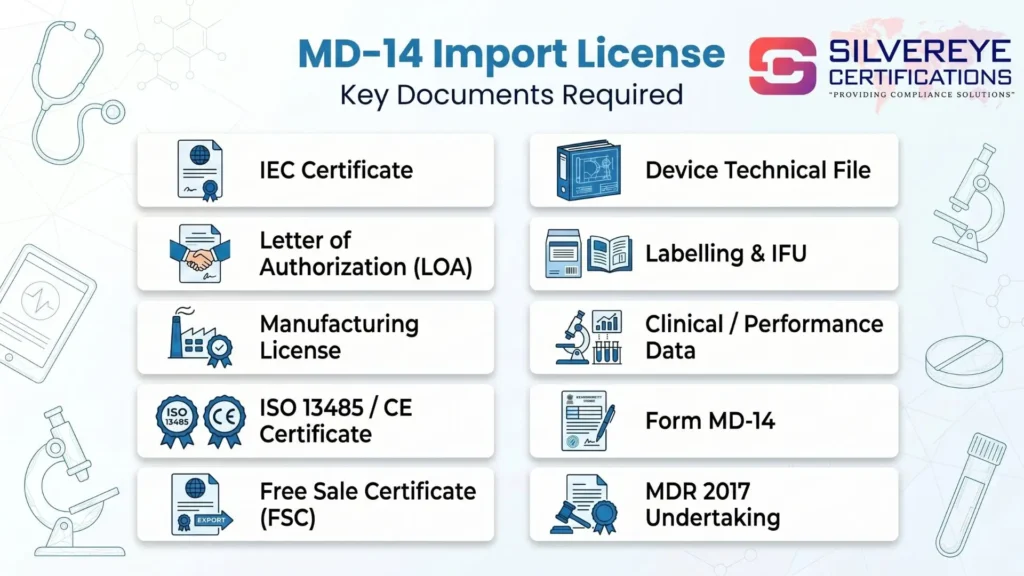
Foreign manufacturers cannot sell X-ray equipment directly in India, regardless of class. They must appoint an Authorized Indian Agent who holds a valid wholesale license (Form MD-42) or manufacturing license, and who files the import application on Form MD-14. CDSCO's Central Licensing Authority reviews the application — with depth proportionate to the equipment's class — and grants the import license on Form MD-15.
Documents Required for MD-14 Application
- Covering letter and duly filled Form MD-14.
- Government fee payment challan.
- Notarized and apostilled Power of Attorney from the foreign manufacturer authorizing the Indian agent.
- Copy of the agent's Wholesale License (MD-42) or Manufacturing License.
- Free Sale Certificate or Marketing Authorization from the regulatory authority of the country of origin.
- Device Master File and Plant Master File of the foreign manufacturing site, including electrical and radiation-safety data appropriate to the equipment's class.
- ISO 13485 certificate and any applicable CE marking or equivalent international approval.
CDSCO Wholesale / Distributor License for X-Ray Equipment (MD-41 & MD-42)
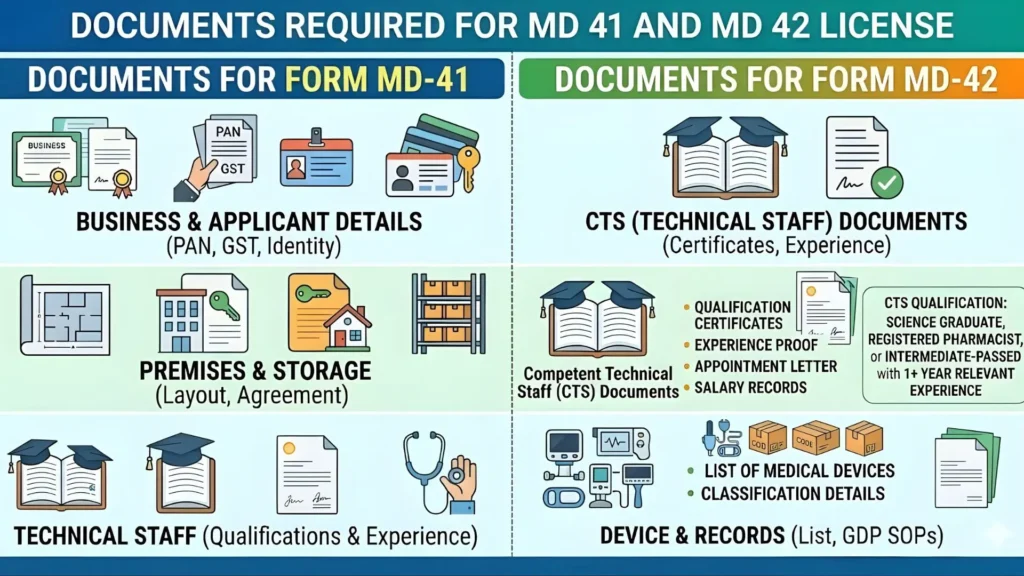
Any business that stocks, exhibits, sells, or distributes X-ray equipment in bulk — including diagnostic imaging equipment distributors and biomedical equipment suppliers — needs a wholesale registration, regardless of the equipment's class. The application is made on Form MD-41, and the State Licensing Authority grants the registration certificate on Form MD-42.
Eligibility and Documents for MD-41/MD-42
- A dedicated storage premise of adequate size with proper shelving, cleanliness, and record-keeping arrangements suitable for sensitive electronic imaging equipment.
- A technically competent person overseeing storage and distribution.
- Duly filled Form MD-41, business constitution proof, premises address proof and layout plan, technical competence proof, and the fee payment receipt.
- A Drug Inspector conducts a physical inspection of the storage premises before the State Licensing Authority issues the registration certificate on Form MD-42.
Fees for X-Ray Equipment Registration
Government fees differ by licence type and risk class, prescribed under the First Schedule of MDR 2017. Class C fees are meaningfully higher than Class A/B, reflecting the deeper technical review involved. Fees are revised from time to time, so always verify the current amount on the SUGAM portal before submitting payment.
| Licence Type | Applicable Fee | Notes |
| Class A/B Manufacturing (MD-3/MD-5) | As per MDR 2017 Schedule I | Lower than Class C; confirm current amount on SUGAM |
| Class C Manufacturing (MD-7/MD-9) | As per MDR 2017 Schedule I | Higher fee reflecting Central Licensing Authority review; applies to most complete X-ray systems |
| Import Licence (MD-14/MD-15) | As per MDR 2017 Schedule I | Applies per manufacturing site and per product/product group |
| Wholesale Licence (MD-41/MD-42) | ₹3,000 per premise (government fee) | Non-refundable; same across all device classes |
Processing Timeline & Validity
| Licence Type | Typical Processing Time | Validity | Renewal |
| MD-5 (Class A/B) | Approx. 3–6 months | 5 years from date of issue | Apply before expiry with retention/renewal fee |
| MD-9 (Class C) | Approx. 6–9 months, including facility inspection | 5 years from date of issue | Apply before expiry with retention/renewal fee |
| MD-15 (Import, any class) | Approx. 3–9 months depending on class and document completeness | Generally continues indefinitely subject to a 5-year retention fee cycle | Pay retention fee every 5 years |
| MD-42 (Wholesale) | Approx. 30–60 days | 5 years from date of issue | Renew before expiry |
As a best practice, begin renewal filing at least 90 days before expiry for Class C X-ray systems, since Central Licensing Authority review depth for imaging equipment can extend the timeline if performance or radiation-safety data needs updating.
Benefits of CDSCO Registration for X-Ray Equipment
- Legal market access: A valid CDSCO authorisation, matched to the correct class, is what allows X-ray equipment to be manufactured, imported, or sold in India.
- Hospital and diagnostic centre procurement eligibility: Government hospitals, diagnostic imaging centres, and procurement tenders require CDSCO documentation before empanelling an X-ray equipment supplier.
- Protection from penalties: Registered businesses avoid the seizure, fines, and legal action that come with selling unregistered medical devices.
- Export credibility: A CDSCO license strengthens your regulatory profile when X-ray equipment is later exported to markets that recognize Indian approvals.
Penalties for Non-Compliance
Manufacturing, importing, or distributing X-ray equipment without the applicable CDSCO authorization is a violation of the Medical Devices Rules, 2017 and the Drugs and Cosmetics Act, 1940. Consequences can include seizure of stock, suspension or cancellation of any related licenses, financial penalties, and prosecution under the Act, which in serious or repeat cases can extend to imprisonment. Because X-ray equipment involves ionizing radiation and directly affects diagnostic accuracy, non-compliance in this category is treated seriously by CDSCO, hospital procurement bodies, and radiation-safety regulators alike.
Common Mistakes to Avoid
- Assuming a complete X-ray imaging system qualifies for the lighter Class A/B pathway — most complete systems are Class C and need the MD-7/MD-9 route.
- Applying under the wrong form — filing MD-3 for a Class C imaging system (which needs MD-7), or MD-7 for a Class A/B component (which only needs MD-3).
- Confusing CDSCO medical device registration with AERB radiation-safety clearance — both are required for X-ray equipment, and neither substitutes for the other.
- Submitting an incomplete Device Master File without electrical safety or radiation-performance data.
- Assuming a single license covers manufacturing, import, and wholesale activity — each role needs its own authorization.
- Not verifying the exact device name and variant against CDSCO's most recent radiology classification notice before filing.
Conclusion
X-ray equipment registration in India comes down to one key distinction: are you registering a complete imaging system, or a standalone component? Complete systems — general-purpose, mammographic, fluoroscopic, and dental X-ray machines — are overwhelmingly Class C and require the MD-7/MD-9 route through CDSCO's Central Licensing Authority, while individual components like cassettes and generators are typically Class A/B and follow the lighter MD-3/MD-5 state-level route. Getting that distinction right, and preparing complete electrical safety and radiation-performance documentation from the outset, is what determines how smoothly your registration proceeds.
The team at Silvereye Certifications specializes in end-to-end CDSCO medical device registration support — from device classification and technical dossier preparation to SUGAM portal submissions and post-approval compliance management for X-ray equipment manufacturers, importers, and distributors across India.
Frequently Asked Questions
Is CDSCO registration mandatory for X-ray equipment in India?
Yes. X-ray systems and their components are notified medical devices under MDR 2017, so manufacturing, importing, or distributing them in India requires the applicable CDSCO licence or registration.
What class does a complete X-ray machine fall under?
Most complete diagnostic X-ray systems — general-purpose, mobile/portable, fluoroscopic, mammographic, and dental — are classified as Class C under CDSCO's most recent radiology classification notice.
Is any X-ray equipment classified as Class D?
Based on CDSCO's most recent radiology classification notice (November 2025), no complete X-ray imaging system is classified as Class D. Class D in the radiology category is reserved for select invasive, catheter-based imaging-adjunct devices rather than X-ray machines themselves.
What is the difference between the MD-3/MD-5 and MD-7/MD-9 manufacturing routes?
MD-3/MD-5 is the manufacturing licence route for Class A/B X-ray components, reviewed and granted by the State Licensing Authority. MD-7/MD-9 is the route for Class C complete X-ray systems, reviewed and granted directly by CDSCO's Central Licensing Authority.
Do I need AERB clearance in addition to CDSCO registration?
Yes, in most cases. X-ray equipment that emits ionising radiation is separately subject to registration and safety compliance under the Atomic Energy Regulatory Board (AERB). CDSCO registration and AERB clearance are separate processes, and both are typically required.
Are X-ray film cassettes and high-voltage generators the same class as the full system?
No. Standalone components like film cassettes, high-voltage generators, tube housings, and beam-limiting devices are generally Class B, a lighter classification than the Class C typically assigned to a complete X-ray imaging system.
How long does CDSCO registration take for X-ray equipment?
Class A/B manufacturing licenses (MD-5) typically take 3–6 months. Class C manufacturing licenses (MD-9) for complete X-ray systems typically take 6–9 months. Wholesale registrations (MD-42) typically take 30–60 days.
What is the validity of a CDSCO X-ray equipment license?
MD-5, MD-9, and MD-42 are generally valid for 5 years from the date of issue. MD-15 import licenses generally continue indefinitely, subject to a 5-year retention fee cycle.
What documents are required for a Class C X-ray system application?
Beyond the standard Device Master File, Class C applications typically require electrical safety testing data (per IEC 60601), radiation-safety and dose-output performance data, and image quality testing data appropriate to the system's imaging modality.
Can one business hold manufacturing, import, and wholesale licenses for X-ray equipment?
Yes, if the business genuinely performs all three activities. Each activity still requires its own separate CDSCO authorization, matched to the equipment's class — holding one license does not automatically cover the others.
What happens if I sell X-ray equipment without CDSCO registration?
You risk stock seizure, financial penalties, cancellation of any existing licenses, and prosecution under the Drugs and Cosmetics Act, 1940, which can include imprisonment in serious cases.
How do I renew a CDSCO X-ray equipment license?
Renewal applications should be filed at least 60 days before expiry for Class A/B licenses, and at least 90 days before expiry for Class C licenses, using the previous license details, updated technical documentation, and the prescribed renewal or retention fee, submitted through the SUGAM portal to the relevant State or Central Licensing Authority.