
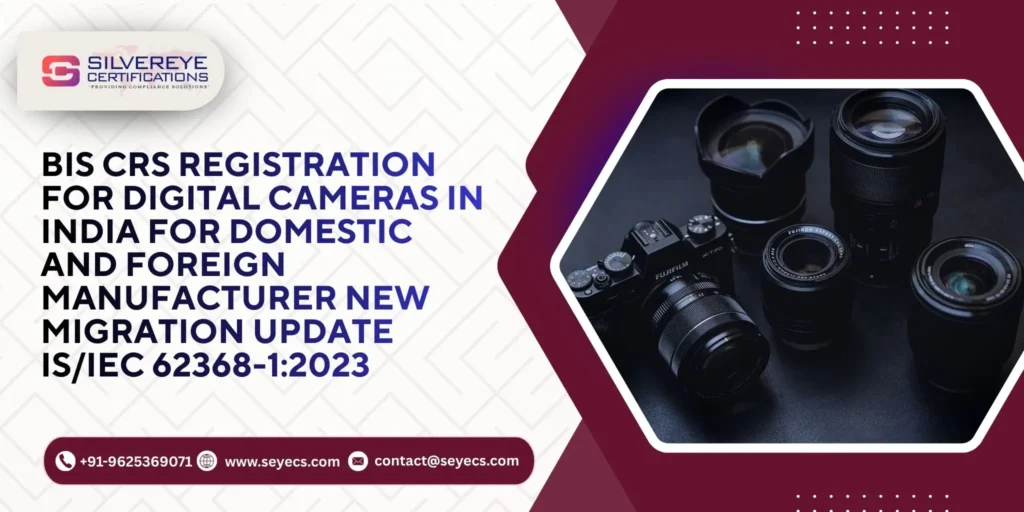
- BIS CRS Registration is mandatory for all Digital Cameras — including DSLRs, mirrorless cameras, compact point-and-shoot cameras, and instant cameras — sold or imported in India under the Electronics and Information Technology Goods (CRO) Order, 2021.
- Unlike Video Cameras (IS 616:2017), Digital Cameras fall under IS 13252 (Part 1):2010 — migrating to IS/IEC 62368-1:2023 by 1 November 2028 per MeitY notification S.O. 4997(E) dated 29 October 2025.
- BIS amended CRS license validity to 5 years effective 25 February 2026 — a significant benefit for camera brands with long product life cycles.
- Digital Cameras with Wi-Fi or Bluetooth connectivity additionally require WPC type approval — a separate mandatory certification from India's Ministry of Communications.
BIS CRS Registration for Digital Cameras
- BIS CRS (Compulsory Registration Scheme) is mandatory government certification for Digital Cameras sold in India, issued by the Bureau of Indian Standards (BIS).
- Digital Cameras are listed at Sl. No. 34 in the BIS migration guidelines (9 March 2026) under the Electronics and Information Technology Goods (CRO) Order, 2021.
- Unlike Video Cameras which fall under IS 616:2017, Digital Cameras fall under IS 13252 (Part 1):2010 — being replaced by IS/IEC 62368-1:2023 with a migration deadline of 1 November 2028.
- Digital Cameras with Wi-Fi or Bluetooth additionally require WPC type approval from India's Ministry of Communications.
- From 25 February 2026, CRS licenses are valid for 5 years. Annual fees must be paid every year in advance to keep the license operative.
- Selling Digital Cameras in India without a valid BIS CRS license is illegal under the BIS Act, 2016.
What is BIS CRS Registration for Digital Cameras?
BIS CRS Registration is the mandatory product certification that every Digital Camera must hold before it can be legally sold, imported, or commercially distributed in India. Issued by the Bureau of Indian Standards (BIS) under the Department of Consumer Affairs, Government of India, it is required under the Electronics and Information Technology Goods (Requirement of Compulsory Registration) Order, 2021 (CRO 2021).

Digital Cameras are listed at Sl. No. 34 in the BIS implementation guidelines dated 9 March 2026 (Ref: Reg/IS/IEC 62368-1:2023/Guidelines/01). The certification is administered under Scheme-II of the BIS (Conformity Assessment) Regulations, 2018.
A critical technical distinction: Digital Cameras fall under IS 13252 (Part 1):2010 — the IT equipment safety standard — while Video Cameras (Sl. No. 35) fall under IS 616:2017. This is because digital cameras are classified as information technology equipment (primarily designed for still image capture with digital processing) rather than pure audio/video apparatus. Understanding this classification prevents one of the most common compliance errors made by imaging product brands in India.

The IS 13252 (Part 1):2010 standard is being superseded by IS/IEC 62368-1:2023 as per MeitY notification S.O. 4997(E) dated 29 October 2025. Both standards run concurrently until 1 November 2028 — after which only IS/IEC 62368-1:2023 is valid for Digital Cameras.
Types of Digital Cameras Covered Under BIS CRS
The BIS CRS notification covers the full range of digital still camera products sold in India. Here is a complete breakdown of the camera types that fall within this certification requirement:
| Digital Camera Type | Description / Use Case | BIS CRS Required? | WPC Required? |
| DSLR Camera | Digital Single-Lens Reflex cameras — interchangeable lens cameras with optical viewfinder, APS-C or full-frame sensor. Used by enthusiasts and professionals. | Yes — mandatory | Yes, if Wi-Fi / BT enabled |
| Mirrorless Camera | Interchangeable lens cameras without mirror mechanism — compact body, electronic viewfinder, APS-C / full-frame / MFT sensors. Fastest growing professional segment. | Yes — mandatory | Yes, if Wi-Fi / BT enabled |
| Compact / Point-and-Shoot Camera | Fixed-lens consumer cameras — pocket-sized, auto-everything, designed for casual photography | Yes — mandatory | Yes, if Wi-Fi / BT enabled |
| Bridge Camera | Super-zoom fixed-lens cameras that bridge the gap between compact and DSLR — long zoom range, manual controls | Yes — mandatory | Yes, if Wi-Fi / BT enabled |
| Medium Format Camera | Large-sensor professional cameras for commercial photography, fashion, architecture — Phase One, Hasselblad, Fujifilm GFX | Yes — mandatory | Yes, if Wi-Fi / BT enabled |
| Instant / Polaroid-Style Camera | Cameras that print photos instantly — Instax, Polaroid Now. Consumer segment growing fast in India. | Yes — mandatory | Yes, if wireless enabled |
| 360-Degree Still Camera | Omnidirectional still cameras for virtual tours, real estate, and immersive content (primary still function) | Yes — mandatory | Yes, if Wi-Fi / BT enabled |
| Underwater Digital Camera | Waterproof or water-resistant cameras for diving, snorkeling, and aquatic photography | Yes — mandatory | Yes, if wireless enabled |
The classification rule for Digital Cameras under BIS CRS: if the product is a standalone, finished digital camera whose primary function is capturing still photographs — with digital image processing and storage — it falls under this category. If the primary function is continuous video recording, it falls under Video Cameras (Sl. No. 35, IS 616:2017). Hybrid cameras that are heavily marketed for both stills and video require careful classification — consult a BIS expert before selecting the product category and testing standard.
Who Needs BIS CRS Certification for Digital Cameras in India?
The BIS CRS certification requirement for Digital Cameras applies to every entity in the supply chain:
- Indian manufacturers producing digital cameras, compact cameras, or instant cameras for the domestic market
- Foreign manufacturers — global camera brands (Canon, Nikon, Sony, Fujifilm, Olympus, Panasonic, Ricoh, Leica, Hasselblad, Phase One) whose products are imported and sold in India
- Authorized Indian Representatives (AIRs) representing foreign camera brands for all BIS CRS compliance purposes in India
- Importers bringing digital cameras into India for commercial distribution, retail, or rental
- OEM brands that source camera hardware and sell it under their own brand name as a finished digital camera product in India
- D2C brands and e-commerce sellers that import and list digital cameras under their own label on Amazon India, Flipkart, or other platforms
- Grey market parallel importers are also subject to BIS CRS — importing without certification is illegal regardless of the channel
India's digital camera market serves a diverse range of buyers — from first-time photographers buying entry-level DSLRs to professional photojournalists, commercial photographers, and hobbyist enthusiasts. Every price point and every professional tier requires BIS CRS certification. The law makes no distinctions based on brand prestige, price, or sales volume.
Digital Cameras vs Video Cameras Under BIS CRS — Critical Classification Difference
This is the most frequently misunderstood compliance distinction for imaging product brands in India. Digital Cameras (Sl. No. 34) and Video Cameras (Sl. No. 35) are listed as separate product categories under the CRS notification — with different applicable safety standards. Applying under the wrong category causes delays, wrong testing, and BIS queries.
| Feature | Digital Cameras (Sl. No. 34) | Video Cameras (Sl. No. 35) |
| Primary Function | Still photography — capturing individual frames / still images | Continuous video recording — capturing moving image sequences |
| Current BIS Standard | IS 13252 (Part 1):2010 (based on IEC 60950-1 — IT equipment standard) | IS 616:2017 (based on IEC 60065:2014 — audio/video apparatus standard) |
| New BIS Standard | IS/IEC 62368-1:2023 (same destination standard for both) | IS/IEC 62368-1:2023 (same destination standard for both) |
| Migration Deadline | 1 November 2028 | 1 November 2028 |
| Examples | DSLR, mirrorless, compact camera, bridge camera, instant camera, medium format camera | Camcorder, action camera, cinema camera, broadcast camera, dashcam, body camera |
| WPC Required? | Yes, if Wi-Fi / Bluetooth enabled | Yes, if Wi-Fi / Bluetooth enabled |
The classification challenge arises with hybrid mirrorless cameras that are marketed equally for stills and video. Many professional mirrorless cameras (Sony Alpha, Canon EOS R, Nikon Z series) are used extensively for both purposes. In these cases, the primary marketed function and product specification should guide classification. When there is genuine ambiguity, consult a BIS compliance expert before deciding which category to register under — an incorrect classification results in testing under the wrong standard and possible BIS rejection of the application.
BIS CRS and WPC Type Approval for Digital Cameras — Dual Compliance
The majority of modern digital cameras — DSLRs, mirrorless cameras, and even many compact cameras — include built-in Wi-Fi and Bluetooth for remote shooting, image transfer, and smartphone connectivity. This makes WPC type approval a mandatory additional compliance requirement for most digital camera brands entering India.
| Digital Camera Type / Connectivity | BIS CRS Required? | WPC Type Approval Required? |
| Digital camera without any wireless (fully wired) | Yes — mandatory | No — not required |
| Digital camera with Bluetooth only (remote shutter, BT image transfer) | Yes — mandatory | Yes — Bluetooth WPC approval |
| Digital camera with Wi-Fi only (wireless image transfer, remote control app) | Yes — mandatory | Yes — Wi-Fi WPC approval |
| Digital camera with both Wi-Fi and Bluetooth | Yes — mandatory | Yes — WPC approval for both modules |
| Digital camera with NFC (Near Field Communication for pairing) | Yes — mandatory | Yes — NFC WPC approval (check current WPC requirements) |
| Medium format / professional camera with wireless tethering | Yes — mandatory | Yes — WPC for wireless tethering module |
WPC (Wireless Planning and Coordination Wing) type approval is issued by the Ministry of Communications, Government of India. It covers the radio frequency parameters, transmission power, and spectrum compliance of wireless modules embedded in digital cameras. BIS CRS and WPC are completely separate compliance requirements — different government bodies, different applications, different fees, different timelines. Running both simultaneously is strongly recommended for wireless digital camera brands to minimise total India market entry time.
Key 2026 Regulatory Updates — BIS CRS for Digital Cameras
BIS Extends CRS License Validity to 5 Years — Amendment Dated 25 February 2026
The Bureau of Indian Standards amended the BIS (Conformity Assessment) Regulations, 2018 on 25 February 2026. This is the most significant administrative change for CRS licence holders — including Digital Camera brands — in recent years. The revised provisions under Scheme-II are:
| Parameter | Previous Rule | New Rule (w.e.f. 25 Feb 2026) |
| Initial Licence Validity | 1 Year | 5 Years |
| Licence Renewal Period | 1 Year | 5 Years |
| Annual Fee Payment | Required annually | Still required annually — paid in advance by prescribed due date |
| Production Details Submission | Annually with fee | Annually with fee — unchanged |
| Non-Payment Consequence | Suspension possible | Suspension / Deferment and Cancellation / Expiry under BIS (CA) Regulations 2018 as amended |
What this means for Digital Camera brands: Your CRS license is now valid for 5 years from the date of grant. This is particularly beneficial for professional camera brands where product models have long market life cycles — a Canon EOS R5 or Nikon Z9 released in one year may sell for 4-5 years without a major update, making the 5-year validity period a natural fit. However, annual fees must still be paid every year in advance, with production details submitted alongside. Missing any annual payment within the 5-year term triggers suspension and can lead to cancellation.
MeitY Notification S.O. 4997(E) Dated 29 October 2025 — IS/IEC 62368-1:2023 Migration
MeitY issued notification S.O. 4997(E) on 29 October 2025, formally amending the CRO 2021 to notify IS/IEC 62368-1:2023 as the replacement standard for Digital Cameras, superseding IS 13252 (Part 1):2010. Digital Cameras are listed at Sl. No. 34 in the BIS implementation guidelines issued on 9 March 2026.
Both IS 13252 (Part 1):2010 and IS/IEC 62368-1:2023 run concurrently for Digital Cameras until 1 November 2028. After this date, IS 13252 (Part 1):2010 is officially withdrawn. All existing CRS licensees must complete migration to IS/IEC 62368-1:2023, and all new applicants post-November 2028 must apply exclusively under IS/IEC 62368-1:2023.
Applicable BIS Standards for Digital Cameras — IS 13252 vs IS/IEC 62368-1:2023
| Standard | Full Name | Technical Basis | Status for Digital Cameras |
| IS 13252 (Part 1):2010 | Information Technology Equipment — Safety — Part 1: General Requirements | Indian adoption of IEC 60950-1:2005 — IT equipment safety standard. Digital cameras classified as IT equipment due to digital processing, storage, and connectivity functions. | Currently valid for Digital Cameras — officially withdrawn after 1 November 2028 |
| IS/IEC 62368-1:2023 | Audio/Video, Information and Communication Technology Equipment — Part 1: Safety Requirements | IEC 62368-1:2023, 3rd Edition — Hazard-Based Safety Engineering (HBSE) approach. Consolidates IEC 60065 and IEC 60950-1 into a single unified framework. | New mandatory standard — all Digital Camera licensees must comply by 1 November 2028 |
Why Digital Cameras fall under IS 13252 (not IS 616): Digital cameras process still images through digital circuits, store images on memory cards or internal storage, and often connect to computers and smartphones — functions that align them with IT equipment (IEC 60950-1 / IS 13252) rather than pure audio/video apparatus (IEC 60065 / IS 616). This is why Digital Cameras at Sl. No. 34 are governed by IS 13252 (Part 1):2010, while Video Cameras at Sl. No. 35 fall under IS 616:2017.
IS/IEC 62368-1:2023 resolves this historical divide by providing a single unified HBSE standard for both IT and audio/video products. After 1 November 2028, all imaging products — Digital Cameras (formerly IS 13252) and Video Cameras (formerly IS 616) — will be certified under the same IS/IEC 62368-1:2023 standard.
India's Digital Camera Market in 2026 — BIS CRS Compliance Context
India's digital camera market is smaller than the global average in unit terms but growing in value — driven by professional photography demand, content creation, wedding photography, travel photography, and a growing enthusiast base. Understanding the market segments helps contextualise the compliance requirement for each brand type.
| Market Segment | BIS CRS Relevance |
| Entry-Level DSLRs and Mirrorless (below Rs. 60,000) | Volume segment — Canon, Nikon entry-level models dominate. BIS CRS mandatory. E-commerce is the primary channel — Amazon India and Flipkart require BIS certification for all camera listings. |
| Mid-Range Professional Mirrorless (Rs. 60,000 – Rs. 2,00,000) | Growing rapidly — Sony Alpha series, Fujifilm X-series, Canon EOS R series. BIS CRS mandatory. Authorised dealer networks require certified products. |
| High-End Professional / Full-Frame (above Rs. 2,00,000) | Nikon Z9, Sony A1, Canon EOS R3. Professional photographers, studios, photojournalists. BIS CRS mandatory even for low-volume professional models. |
| Compact and Point-and-Shoot Cameras | Shrinking segment but still active — travel cameras, beginner cameras. BIS CRS mandatory for all imports. |
| Instant Cameras (Instax, Polaroid) | Fast growing consumer segment — driven by gifting, youth culture, social media. BIS CRS mandatory. High e-commerce volume. |
| Medium Format Cameras | Very high value, very low volume — Phase One, Hasselblad, Fujifilm GFX. BIS CRS mandatory even for small imports. Enterprise and commercial studio buyers. |
| Wedding and Event Photography Market | India has one of the world's largest wedding photography markets — driving DSLR and mirrorless demand. Photographers buy certified products for reliability and professional credibility. |
| Content Creator and Travel Photography | YouTubers, travel bloggers, social media influencers — driving mirrorless and compact camera demand. E-commerce primary channel — BIS CRS critical for platform listing. |
Across every segment of India's digital camera market, BIS CRS certification is the non-negotiable legal entry requirement. Brands that invest in proper certification access the full market — authorised dealers, e-commerce platforms, enterprise buyers, government tenders, and professional users. Brands without certification face customs seizure, marketplace de-listing, and the complete loss of market access.
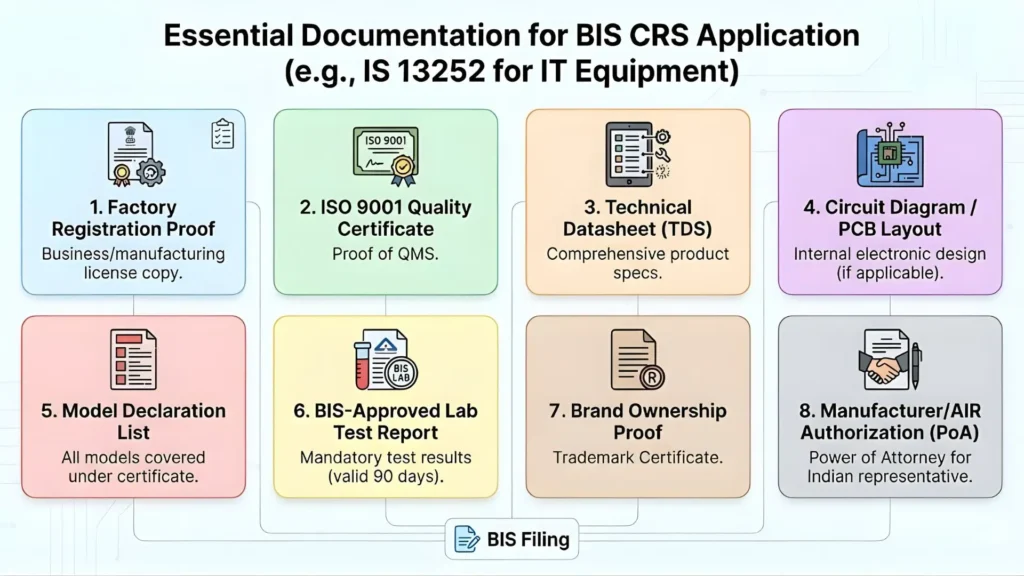
Documents Required for BIS CRS Registration — Digital Cameras
For Indian Manufacturers
- Completed BIS CRS application form — filed via manakonline.in under Scheme-II
- Business registration certificate — Company Incorporation / MSME Certificate / LLP Agreement / Partnership Deed
- GST Registration Certificate
- Manufacturing or assembly facility address proof — ownership deed or lease agreement
- Product details — brand name, model number(s), sensor type, resolution (megapixels), lens type (fixed / interchangeable), connectivity, product description
- Safety Test Report from a BIS-recognized laboratory under IS 13252 (Part 1):2010 or IS/IEC 62368-1:2023
- Product photographs — all angles, lens, LCD screen, controls, connectivity ports, battery compartment, accessories, and packaging
- Packaging specimens showing BIS Standard Mark placement space and Registration Number field
- Technical documentation — circuit diagrams, block diagrams, battery and charger specification, wireless module details (if any), memory card slot specification
- Declaration of conformity signed by the authorized signatory
- Authorized signatory identity documents — PAN, Aadhaar, designation letter
- Bank account details for BIS fee payments
- WPC type approval certificate for wireless module (for Wi-Fi / Bluetooth enabled cameras — can be coordinated simultaneously)
For Foreign Manufacturers / Importers
- All company registration and identity documents of the foreign manufacturer or brand owner
- Authorised Indian Representative (AIR) appointment letter — notarised and signed by the foreign manufacturer
- AIR company registration documents — Indian entity certificate, GST, PAN
- Import Export Code (IEC) of the AIR or Indian importer
- Power of Attorney or MOU between the foreign manufacturer and the Indian AIR
- Safety Test Report from a BIS-recognised or MRA-accredited partner laboratory (IS 13252 (Part 1):2010 or IS/IEC 62368-1:2023)
- Brand / trademark ownership certificate or registration document
- Country of origin certificate for the Digital Camera
- Product photographs — all angles, lens configuration, accessories (battery, charger, strap, memory card slot), and retail packaging
- Packaging and label specimens showing BIS Standard Mark space and Registration Number placeholder
- Technical file — product description, imaging sensor specification, battery specification, bill of materials, wireless module make and model
- Declaration of conformity from the foreign manufacturer
- WPC type approval for wireless modules (for Wi-Fi / Bluetooth enabled camera models)
- Lens specification (for interchangeable lens cameras — the body is certified; lenses sold separately are not covered under the camera's BIS CRS)
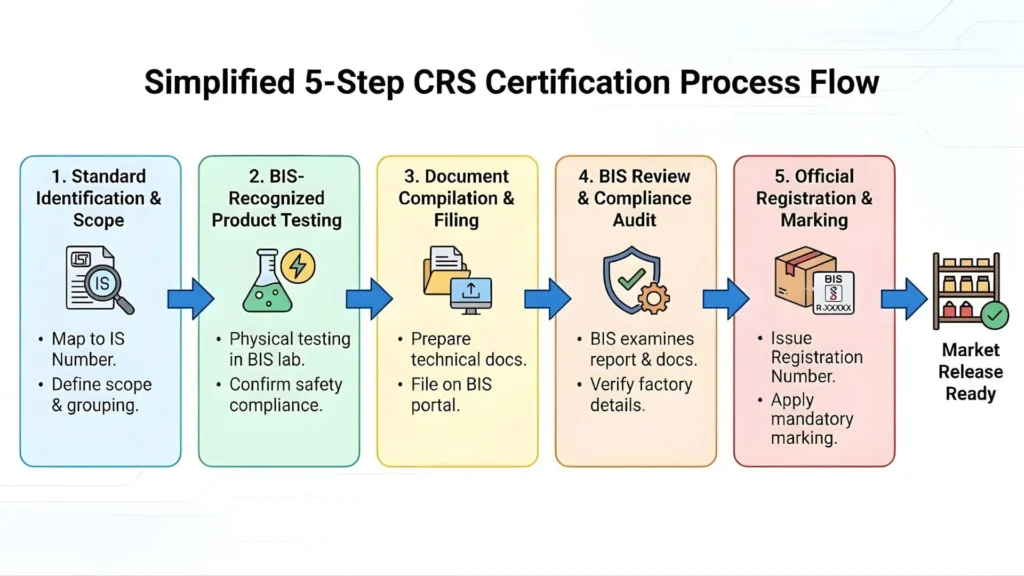
Step-by-Step BIS CRS Registration Process — Digital Cameras
| Step | Stage | Key Details |
| 1 | Product Category Confirmation | Confirm your product is classified as Digital Camera under CRO 2021 — Sl. No. 34 in BIS migration guidelines. Distinguish clearly from Video Camera (Sl. No. 35) |
| 2 | Wireless Compliance Check | Determine if your digital camera has Wi-Fi, Bluetooth, or NFC — if yes, WPC type approval is mandatory alongside BIS CRS. Plan both processes simultaneously. |
| 3 | Standard Selection | Choose IS 13252 (Part 1):2010 or IS/IEC 62368-1:2023 — new applicants strongly advised to apply directly under IS/IEC 62368-1:2023 to future-proof the certification |
| 4 | Laboratory Selection | Identify a BIS-recognised laboratory authorised to test Digital Cameras under IS 13252 (Part 1):2010 or IS/IEC 62368-1:2023 |
| 5 | Sample Submission to Lab | Submit digital camera body samples to the BIS lab — include battery, charger, all in-box accessories, and retail packaging as required by the lab |
| 6 | Safety Testing | Lab tests against IS 13252 (Part 1):2010 or IS/IEC 62368-1:2023 — covers electrical safety, thermal management, fire hazard, battery and charger safety, mechanical safety |
| 7 | Obtain Safety Test Report | Receive safety test report from the BIS-recognised laboratory upon successful test completion |
| 8 | WPC Type Approval (Parallel) | For wireless cameras — simultaneously apply for WPC type approval for Wi-Fi / Bluetooth / NFC modules through the WPC online portal (wpc.gov.in) |
| 9 | Document Compilation | Prepare all required company, product, and compliance documents — including test reports, WPC certificates, brand proof, technical file |
| 10 | Online CRS Application Submission | File BIS CRS application via manakonline.in under Scheme-II — upload all documents and test reports |
| 11 | BIS Application Scrutiny | BIS reviews the application — may raise queries on product classification (Digital vs Video Camera), test scope, battery certification, or technical documentation |
| 12 | CRS Licence Grant | BIS issues the CRS licence — valid for 5 years from the grant date as per the 25 February 2026 amendment |
| 13 | BIS Standard Mark Affixing | Affix ISI Mark and Registration Number R-XXXXXXXX on camera body, packaging, or label — confirm placement meets BIS marking requirements for compact devices |
| 14 | Annual Fee + Production Details | Pay annual licence fee in advance and submit production details every year by the prescribed due date |
| 15 | IS/IEC 62368-1:2023 Migration | For existing licensees — submit updated test reports under IS/IEC 62368-1:2023 for all lead models before 1 November 2028 |
BIS CRS Registration Fees — Digital Cameras
| Fee Component | Description | When Payable |
| Application Processing Fee | One-time fee paid when submitting the BIS CRS application via manakonline.in | At application submission |
| Annual Licence Continuation Fee | Paid every year in advance by the prescribed due date — mandatory throughout the 5-year licence period | Annually (in advance) |
| Safety Testing Fee (Lab) | Charged by BIS-recognised laboratory for Digital Camera safety testing — varies by lab, camera type (body only vs kit), number of models, and test scope | Before or during lab testing |
| Charger / Battery System Testing | Some labs include this in the main test; others charge separately for battery and charger system testing — clarify scope before submission | As applicable during testing |
| Renewal Processing Fee | Applicable at the end of the 5-year licence period when filing for the next 5-year renewal | At 5-year renewal filing |
| Change in Scope Fee | Applicable when adding new camera models, sensor variants, or body/kit combinations to an existing licence scope | At scope change request |
| Late Annual Fee Surcharge | Applies when annual fee is not paid by the prescribed due date — continued non-payment leads to suspension | As and when applicable |
| WPC Type Approval Fee | Separate fee paid to WPC for wireless module type approval — mandatory for Wi-Fi and Bluetooth enabled cameras; outside BIS CRS fee structure | At WPC application submission |
Note: BIS fee amounts are revised periodically. WPC type approval fees are separately governed by the Ministry of Communications. Always verify current fee schedules on bis.gov.in and wpc.gov.in, or contact a certified compliance consultant like Silvereye Certifications before initiating any registration process.
BIS CRS License Validity, Renewal & Annual Compliance — Digital Cameras 2026
Initial License Grant — 5 Years
- Digital Camera CRS license is now granted for an initial period of 5 years from the date of issue (post 25 Feb 2026 amendment)
- Annual fees must be paid in advance by the prescribed due date every year during this 5-year period
- Production details — model-wise quantities of cameras manufactured or imported — must be submitted with each annual fee payment
- BIS Standard Mark and Registration Number must be correctly displayed on all active product batches throughout the licence period
License Renewal — Further 5 Years
- At the end of the 5-year period, the license is renewed for a further 5 years
- Renewal fees follow the same annual payment structure — paid in advance each year
- By the time of first post-2026 renewal, all Digital Camera models in scope must already be IS/IEC 62368-1:2023 compliant
Consequences of Non-Compliance
- Non-payment of annual fee by due date → suspension or deferment of CRS license
- Continued non-payment → cancellation or expiry of license
- Cancelled license → digital cameras cannot be legally sold, imported, or listed on e-commerce platforms in India
- Non-migration to IS/IEC 62368-1:2023 by 1 November 2028 → license inoperative or models deleted from scope
- Reinstating a cancelled license requires a completely fresh application — entire process restarts
IS/IEC 62368-1:2023 Migration — What Digital Camera Brands Must Do
Existing CRS Licensees — Action Required Before 1 November 2028
- Implement IS/IEC 62368-1:2023 compliance for all Digital Camera models in your licence scope by 1 November 2028.
- Submit complete Test Reports from a BIS-recognised laboratory (tested under IS/IEC 62368-1:2023) for all lead models covered under your CRS licence.
- Upload updated test reports through the Standard Revision / Amendment / Essential Requirement provision in your BIS portal login.
- Provide a signed undertaking confirming IS/IEC 62368-1:2023 requirements have been implemented in all series models (variants) within your licence scope.
- BIS will issue a confirmation letter once migration is verified — listing all Digital Camera models for which compliance has been established.
- Failure to complete migration by 1 November 2028 → licence cancellation or deletion of non-compliant models from scope — loss of legal right to sell those cameras in India.
New Applicants — First-Time BIS CRS for Digital Cameras
- Applications where samples have already been submitted under IS 13252 (Part 1):2010 can still be processed under the old standard
- New applications can be filed directly under IS/IEC 62368-1:2023 — strongly recommended to avoid future migration costs
- If applying under IS 13252 (Part 1):2010, a signed declaration committing to IS/IEC 62368-1:2023 migration by 1 November 2028 must be submitted
- After 1 November 2028, no new CRS licence will be granted under IS 13252 (Part 1):2010 for Digital Cameras
Change in Scope — Adding New Camera Models
- Adding new digital camera models to an existing licence scope follows the same guidelines as for new applicants
- Processing scope changes under IS 13252 (Part 1):2010 is permitted only until the licensee's own switchover to IS/IEC 62368-1:2023 or 1 November 2028 — whichever is earlier
Complete List of 38 Products Migrating to IS/IEC 62368-1:2023 Under BIS CRS (2026)
All 38 product categories under BIS CRS migration as per BIS implementation guidelines dated 9 March 2026. Digital Cameras appear at Sl. No. 34:
| Sl. No. | Product Category | Current Standard | New Standard | Deadline |
| 1 | Electronic Games (Video) | IS 616:2017 | IS/IEC 62368-1:2023 | 1 Nov 2028 |
| 2 | Laptops / Notebooks / Tablets | IS 13252 (Part 1):2010 | IS/IEC 62368-1:2023 | 1 Nov 2028 |
| 3 | Plasma / LCD / LED Television | IS 616:2017 & IS 18112:2025 | IS/IEC 62368-1:2023 & IS 18112:2025 | 1 Nov 2028 |
| 4 | Optical Disc Players (200W and above) | IS 616:2017 | IS/IEC 62368-1:2023 | 1 Nov 2028 |
| 5 | Visual Display Units / Video Monitors | IS 13252 (Part 1):2010 | IS/IEC 62368-1:2023 | 1 Nov 2028 |
| 6 | Printers / Multi-Function Devices / Plotters | IS 13252 (Part 1):2010 | IS/IEC 62368-1:2023 | 1 Nov 2028 |
| 7 | Scanners, Barcode Readers, Iris Scanners, Optical Fingerprint Scanners | IS 13252 (Part 1):2010 | IS/IEC 62368-1:2023 | 1 Nov 2028 |
| 8 | Wireless Keyboards | IS 13252 (Part 1):2010 | IS/IEC 62368-1:2023 | 1 Nov 2028 |
| 9 | Telephone Answering Machines | IS 13252 (Part 1):2010 | IS/IEC 62368-1:2023 | 1 Nov 2028 |
| 10 | Amplifiers (2000W and above) | IS 616:2017 | IS/IEC 62368-1:2023 | 1 Nov 2028 |
| 11 | Electronic Musical Systems | IS 616:2017 | IS/IEC 62368-1:2023 | 1 Nov 2028 |
| 12 | Set Top Boxes | IS 13252 (Part 1):2010 | IS/IEC 62368-1:2023 | 1 Nov 2028 |
| 13 | Automatic Data Processing Machines | IS 13252 (Part 1):2010 | IS/IEC 62368-1:2023 | 1 Nov 2028 |
| 14 | Power Adaptors for IT Equipment | IS 13252 (Part 1):2010 | IS/IEC 62368-1:2023 | 1 Nov 2028 |
| 15 | Power Adaptors for Audio / Video Equipment | IS 616:2017 | IS/IEC 62368-1:2023 | 1 Nov 2028 |
| 16 | Mobile Phones | IS 13252 (Part 1):2010 & IS 16333 (Part 3):2022 | IS/IEC 62368-1:2023 & IS 16333 (Part 3):2022 | 1 Nov 2028 |
| 17 | Cash Registers | IS 13252 (Part 1):2010 | IS/IEC 62368-1:2023 | 1 Nov 2028 |
| 18 | Point of Sale Terminals | IS 13252 (Part 1):2010 | IS/IEC 62368-1:2023 | 1 Nov 2028 |
| 19 | Copying Machines / Duplicators | IS 13252 (Part 1):2010 | IS/IEC 62368-1:2023 | 1 Nov 2028 |
| 20 | Smart Card Readers | IS 13252 (Part 1):2010 | IS/IEC 62368-1:2023 | 1 Nov 2028 |
| 21 | Mail / Postage / Franking Machines | IS 13252 (Part 1):2010 | IS/IEC 62368-1:2023 | 1 Nov 2028 |
| 22 | Passport Readers | IS 13252 (Part 1):2010 | IS/IEC 62368-1:2023 | 1 Nov 2028 |
| 23 | Power Bank (Portable Application) | IS 13252 (Part 1):2010 | IS/IEC 62368-1:2023 | 1 Nov 2028 |
| 24 | CCTV Cameras / CCTV Recorders | IS 13252 (Part 1):2010 + IP Security ERs | IS/IEC 62368-1:2023 + IP Security ERs | 1 Nov 2028 |
| 25 | Smart Watches | IS 13252 (Part 1):2010 | IS/IEC 62368-1:2023 | 1 Nov 2028 |
| 26 | Keyboards | IS 13252 (Part 1):2010 | IS/IEC 62368-1:2023 | 1 Nov 2028 |
| 27 | Automatic Teller Cash Dispensing Machines | IS 13252 (Part 1):2010 | IS/IEC 62368-1:2023 | 1 Nov 2028 |
| 28 | USB Type External Hard Disk Drives | IS 13252 (Part 1):2010 | IS/IEC 62368-1:2023 | 1 Nov 2028 |
| 29 | Wireless Headphones and Earphones | IS 616:2017 | IS/IEC 62368-1:2023 | 1 Nov 2028 |
| 30 | USB External Solid-State Storage Devices (above 256 GB) | IS 13252 (Part 1):2010 | IS/IEC 62368-1:2023 | 1 Nov 2028 |
| 31 | Standalone SMPS (output voltage 48V max) | IS 13252 (Part 1):2010 | IS/IEC 62368-1:2023 | 1 Nov 2028 |
| 32 | Televisions other than Plasma / LCD / LED | IS 616:2017 & IS 18112:2025 | IS/IEC 62368-1:2023 & IS 18112:2025 | 1 Nov 2028 |
| 33 | Wireless Microphones | IS 616:2017 | IS/IEC 62368-1:2023 | 1 Nov 2028 |
| 34 | Digital Cameras ★ | IS 13252 (Part 1):2010 | IS/IEC 62368-1:2023 | 1 Nov 2028 |
| 35 | Video Cameras | IS 616:2017 | IS/IEC 62368-1:2023 | 1 Nov 2028 |
| 36 | Webcams (Finished Product) | IS 616:2017 | IS/IEC 62368-1:2023 | 1 Nov 2028 |
| 37 | Smart Speakers (with / without Display) | IS 616:2017 | IS/IEC 62368-1:2023 | 1 Nov 2028 |
| 38 | Bluetooth Speakers | IS 616:2017 | IS/IEC 62368-1:2023 | 1 Nov 2028 |
★ Digital Cameras are listed at Sl. No. 34. Current standard: IS 13252 (Part 1):2010. New mandatory standard: IS/IEC 62368-1:2023. Migration deadline: 1 November 2028. Note the critical distinction from Video Cameras (Sl. No. 35, IS 616:2017) — different product category, different starting standard, same migration destination and deadline.
Key Benefits of BIS CRS Registration for Digital Camera Brands
- Legal right to sell in India: BIS CRS is the mandatory legal entry requirement — no digital camera can be legally sold, imported, or distributed in India without a valid licence
- Customs clearance: BIS Registration Number (R-XXXXXXXX) is required at Indian customs for camera body imports — without it, consignments are detained or rejected
- Authorised dealer network access: Canon, Nikon, Sony, Fujifilm and other major brand authorised dealers in India require BIS CRS for all stocked models
- E-commerce marketplace listings: Amazon India, Flipkart, and all major platforms require BIS certification for digital camera product listings — uncertified products are de-listed
- Government and PSU procurement: Government agencies, defence establishments, research institutions, and PSUs procuring cameras for documentation specify BIS-certified products
- Professional buyer confidence: Professional photographers, photography studios, journalism organisations, and advertising agencies verify BIS certification before equipment procurement
- Photography school and institution supply: Professional photography schools, colleges, and training institutes require certified equipment for student and institution purchases
- Protection from enforcement action: Valid BIS CRS protects your brand from product seizure, import bans, financial penalties, and prosecution under the BIS Act, 2016
- 5-year licence stability (2026): Particularly valuable for premium camera brands where models have long market life cycles — fewer renewal cycles, more stable compliance planning
Eligibility Criteria for BIS CRS Registration — Digital Cameras
| Applicant Type | Eligibility Requirement | Key Condition |
| Indian Manufacturer | Registered business entity in India — Company, LLP, MSME, or Proprietorship | Must have a manufacturing or assembly facility in India producing finished Digital Camera products |
| Foreign Manufacturer | Any registered overseas entity or brand owner | Must appoint a registered Indian entity as Authorised Indian Representative (AIR) before applying for BIS CRS |
| Authorised Indian Representative (AIR) | Indian company, LLP, or individual | Must hold a valid IEC code and a formal written appointment from the foreign manufacturer or brand owner |
| Indian Importer | Registered Indian business entity with valid IEC | Can act as AIR for the foreign digital camera brand and hold the CRS licence on their behalf in India |
| OEM / White-Label Brand | Registered Indian or foreign entity | Must obtain BIS CRS under their own brand name — sourcing cameras from an OEM does not transfer the OEM's CRS licence to the reseller brand |
There is no minimum production volume, capital requirement, or revenue threshold for eligibility. A compact camera startup and a global full-frame mirrorless brand are equally required — and equally eligible — to obtain BIS CRS Registration before their Digital Camera products can legally enter the Indian market.
Silvereye Certifications — India's Trusted BIS CRS Consultant for Digital Camera Brands
BIS CRS Registration for Digital Cameras requires more expertise than simply submitting documents online. The critical distinction between Digital Cameras (IS 13252) and Video Cameras (IS 616), the classification challenge for hybrid mirrorless cameras, the WPC type approval coordination for wireless models, the IS/IEC 62368-1:2023 migration timeline, and the multi-model portfolio management for large brand catalogues — all of this demands expert navigation from day one.
Silvereye Certifications is one of India's most experienced BIS CRS consulting firms, with deep expertise in IT, imaging, and consumer electronics product certification. Their team brings specialist knowledge of the Digital Camera regulatory framework — including the IS 13252 vs IS 616 classification distinction, WPC coordination for wireless cameras, and the full IS/IEC 62368-1:2023 migration pathway — alongside comprehensive understanding of every 2025-2026 regulatory update. For global camera brands, local Indian manufacturers, importers, and distributors — Silvereye delivers the compliance outcomes your brand needs to compete in India.
From your first compliance enquiry through CRS licence grant, WPC type approval, annual renewals, new model additions, and IS/IEC 62368-1:2023 migration — Silvereye Certifications is the compliance partner that keeps your Digital Camera brand fully legal, fully compliant, and fully competitive in India's growing imaging and photography market.
Conclusion
BIS CRS Registration for Digital Cameras is a mandatory legal requirement for every brand — domestic or international — operating in India's photography and imaging market. The 2025-2026 regulatory landscape has brought two significant updates: MeitY's notification mandating migration from IS 13252 (Part 1):2010 to IS/IEC 62368-1:2023 by 1 November 2028, and BIS's amendment extending CRS licence validity to 5 years while keeping annual compliance obligations unchanged. Additionally, the vast majority of modern digital cameras include wireless features that require separate WPC type approval — making this a multi-certification compliance challenge that needs expert management.
India's photography and imaging market — spanning enthusiast photographers, professional studios, wedding photographers, content creators, journalism organisations, and educational institutions — represents a significant and growing commercial opportunity. Only BIS CRS-certified digital camera brands can access this market legally, build distributor and dealer confidence, list on major e-commerce platforms, and win the trust of professional buyers who verify certification before every major purchase.
Frequently Asked Questions
Is BIS CRS Registration mandatory for Digital Cameras sold in India?
Yes, completely mandatory. Digital Cameras are listed under the Electronics and Information Technology Goods (Requirement of Compulsory Registration) Order, 2021 at Sl. No. 34. Every unit sold, imported, or commercially distributed in India must carry a valid BIS CRS licence and the BIS Standard Mark with Registration Number. Selling without certification violates the BIS Act, 2016 and can lead to customs seizure, marketplace de-listing, and prosecution.
What standard applies to Digital Cameras under BIS CRS in 2026?
Digital Cameras currently fall under IS 13252 (Part 1):2010 — the IT equipment safety standard — not IS 616:2017. As per MeitY notification S.O. 4997(E) dated 29 October 2025, IS 13252 (Part 1):2010 is being replaced by IS/IEC 62368-1:2023. Both standards run concurrently until 1 November 2028. After this date, only IS/IEC 62368-1:2023 is valid.
Why do Digital Cameras fall under IS 13252 instead of IS 616 like video cameras?
Digital Cameras are classified as IT equipment (IEC 60950-1 / IS 13252) because their primary function — still image capture, digital image processing, and storage — aligns them with information technology equipment. Video Cameras are classified as audio/video apparatus (IEC 60065 / IS 616) because their primary function is continuous video recording. Both categories migrate to IS/IEC 62368-1:2023 by 1 November 2028
How long is the BIS CRS licence valid for Digital Cameras after the 2026 amendment?
Following the BIS amendment effective 25 February 2026, the CRS licence for Digital Cameras is now valid for 5 years from the date of grant. Renewal is also for 5 years. Annual fees must still be paid every year in advance by the prescribed due date, with production details.
Does my Wi-Fi enabled DSLR or mirrorless camera need WPC type approval?
Yes. Any Digital Camera with Wi-Fi, Bluetooth, or NFC connectivity requires WPC (Wireless Planning and Coordination Wing) type approval for the wireless module, in addition to BIS CRS. Almost all modern DSLRs and mirrorless cameras include Wi-Fi and Bluetooth
My mirrorless camera is used equally for stills and video — is it a Digital Camera or Video Camera for BIS CRS?
This is one of the most common classification questions for hybrid mirrorless cameras. The classification depends on the primary marketed function and the product's technical specification emphasis. If the camera is primarily a still photography camera with video as a secondary feature — it is a Digital Camera (Sl. No. 34, IS 13252). If it is primarily marketed and designed as a video/cinema camera with stills as a secondary feature — it is a Video Camera (Sl. No. 35, IS 616).
What is the IS/IEC 62368-1:2023 migration deadline for Digital Camera brands?
The migration deadline is 1 November 2028. This is the last date of concurrent running of IS 13252 (Part 1):2010 and IS/IEC 62368-1:2023 for Digital Cameras. After this date, IS 13252 (Part 1):2010 is officially withdrawn.
Can camera lenses be registered under the same BIS CRS licence as the camera body?
No. Camera lenses are separate products and are not covered under the Digital Camera BIS CRS licence. Camera bodies are what require BIS CRS certification under the Digital Camera product category.
Can multiple digital camera models — body only and kit variants — be covered under one BIS CRS licence?
Yes. A single BIS CRS licence can cover multiple digital camera models. Lead models are safety tested and formally included in the scope. Series models — variants such as the same body in different colours, or the same body sold as kit with a lens — can be covered through an undertaking if they do not differ in safety-relevant parameters.
What are the penalties for selling Digital Cameras without BIS CRS certification in India?
Selling, importing, stocking, or distributing Digital Cameras in India without a valid BIS CRS licence violates the BIS Act, 2016 and the CRO 2021 notification. Consequences include: customs detention and rejection of camera import consignments, product seizure from retail and distribution channels, de-listing from Amazon India, Flipkart, and other e-commerce platforms, financial penalties from BIS enforcement authorities, and criminal prosecution for repeat or large-scale violations.