
- Mandatory CDSCO license required to manufacture or import any shampoo in India under the Cosmetics Rules 2020.
- COS-1 & COS-5 for manufacturing; COS-2 for import — all leading to a Grant of License on Form COS-8.
- All applications are filed online via the CDSCO SUGAM portal — no physical submission required in 2026.
- License validity: 5 years (manufacturing) / 3 years (import) — renewal must be filed 90 days before expiry.
Introduction
Any business that manufactures or imports shampoo in India must obtain a CDSCO cosmetic license under the Drugs & Cosmetics Act, 1940 and Cosmetics Rules, 2020. Manufacturers apply via Form COS-1 (new license) or COS-5 (adding variants) and receive their license on Form COS-8.
Importers apply via Form COS-2 and also receive a COS-8. Applications are filed exclusively through the CDSCO SUGAM portal. Timelines range from 45 to 90 days for a complete application, fees vary by product count, and licenses are valid for 3 to 5 years.
Why CDSCO Cosmetic Registration for Shampoo Is Mandatory in India
Shampoo is classified as a cosmetic under Schedule S of the Drugs & Cosmetics Act, 1940. The Cosmetics Rules, 2020 — which replaced the earlier Cosmetics, Toiletry and Perfumery rules — created a new licensing framework enforceable from 2021 onward, with CDSCO intensifying enforcement annually. Manufacturing or importing shampoo without a valid COS-8 license carries serious legal consequences:
- Seizure and destruction of goods at factory or port of entry
- Criminal prosecution — fines up to Rs. 1 lakh and/or imprisonment under the Drugs & Cosmetics Act
- Cancellation of Import Export Code (IEC) by DGFT for importers
- Blacklisting on the SUGAM portal, blocking all future license applications
| 2026 Update: CDSCO has strengthened port-level checks at JNPT Mumbai, Chennai, and Delhi Air Cargo. Importers without a valid COS-8 license face immediate detention of shampoo consignments under the Cosmetics Rules, 2020. |
Types of Shampoo Covered Under CDSCO Cosmetic Registration
All varieties of shampoo manufactured or imported for sale in India fall under CDSCO cosmetic licensing. The table below covers the full product scope:
| Shampoo Type / Category | Common Ingredients / Claim | CDSCO Schedule | Licence Required |
| Daily Use / Regular Shampoo | SLS, SLES, conditioning agents | Schedule S | COS-8 |
| Anti-Dandruff Shampoo | Zinc Pyrithione, Selenium Sulphide (cosmetic grade) | Schedule S | COS-8 |
| Baby Shampoo (Tear-free) | Mild surfactants, no sulphates | Schedule S | COS-8 |
| Herbal / Ayurvedic Shampoo | Shikakai, Amla, Reetha, Bhringraj | Schedule S | COS-8 |
| Natural / Organic Shampoo | Plant-based surfactants, essential oils | Schedule S | COS-8 |
| Colour-Protection Shampoo | UV filters, amino acids | Schedule S | COS-8 |
| Protein / Keratin Repair Shampoo | Hydrolysed proteins, keratin | Schedule S | COS-8 |
| Dry Shampoo (Spray/Powder) | Rice starch, tapioca, propellants | Schedule S | COS-8 |
| Sulphate-Free Shampoo | Cocamidopropyl betaine, APG | Schedule S | COS-8 |
| Medicated Shampoo (Cosmetic Grade) | Salicylic acid max 3%, coal tar max 1% | Schedule S | COS-8 |
| 2-in-1 Shampoo + Conditioner | Combined formula | Schedule S | COS-8 |
| Professional / Salon Shampoo | Higher concentration actives | Schedule S | COS-8 |
| K-Beauty Imported Shampoo (Korea) | Peptides, ginseng, fermented ingredients | Schedule S | COS-8 (Import) |
| Imported Premium Shampoo (EU/US/Japan) | Various patented actives | Schedule S | COS-8 (Import) |
| Important: Shampoos containing Ketoconazole at therapeutic concentrations (2% or above) are classified as drugs under Schedule H and require a Drug Manufacturing or Import License — not a cosmetic COS-8 license. Always confirm the regulatory category before applying. |
Understanding COS-1, COS-2, COS-5, and COS-8 — Which Form Do You Need?
The Cosmetics Rules, 2020 introduced a fresh set of forms. Here is a clear, side-by-side breakdown:
| Form | Purpose | Who Uses It | Issued By | Output |
| COS-1 | Application for new cosmetic manufacturing licence | Indian manufacturers (new licence) | State Licensing Authority (SLA) | Form COS-8 |
| COS-2 | Application for cosmetic import licence | Importers, authorised India agents | CDSCO (Central) | Form COS-8 |
| COS-5 | Application to add products to existing mfg licence | Existing COS-8 holders adding new shampoo variants | State Licensing Authority (SLA) | Endorsed on COS-8 |
| COS-8 | Grant of Cosmetic Licence (Mfg or Import) | Issued to applicant after COS-1 or COS-2 approval | SLA (Mfg) / CDSCO (Import) | Final Licence |
COS-1 Application: Cosmetic Manufacturing License for Shampoo
What Is COS-1?
Form COS-1 is the application form under Rule 6 of the Cosmetics Rules, 2020 for obtaining a fresh cosmetic manufacturing license from the State Licensing Authority. Every new shampoo manufacturer — whether producing under their own brand, as a contract manufacturer, or for export — must submit COS-1 before starting commercial production.
Eligibility
- Manufacturing premises must be in India
- Factory must comply with Schedule M-II (GMP norms for cosmetics) under the Cosmetics Rules, 2020
- A Qualified Person — pharmacist or B.Sc. (relevant science) — must be in charge of manufacturing
- Applicant must be owner, director, or authorized signatory of the entity
- No prior conviction under the Drugs & Cosmetics Act in the last 5 years
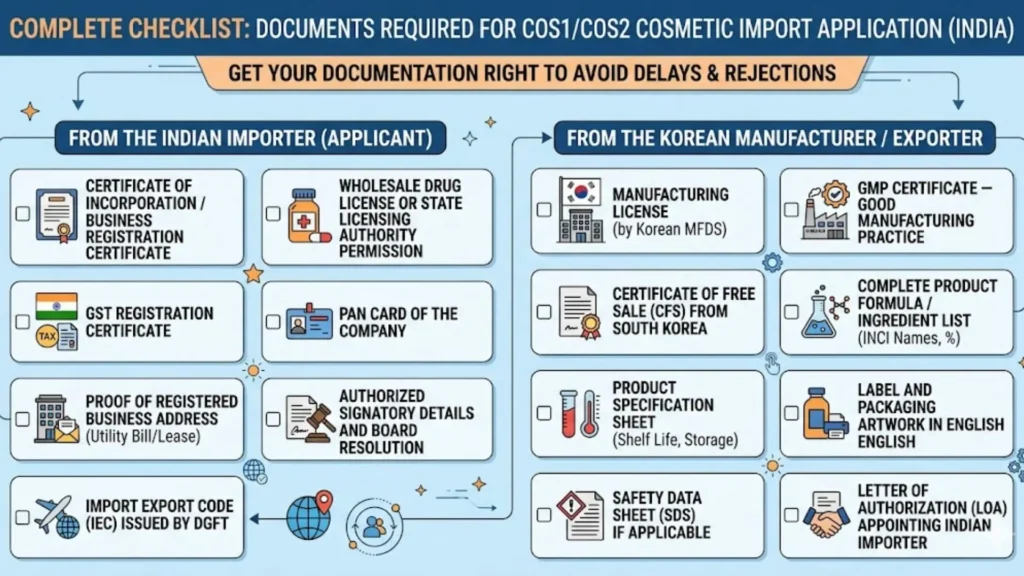
Documents Required for COS-1 & COS-2
| S.No. | Document | Remarks |
| 1 | Duly filled Form COS-1 (online via SUGAM portal) | Signed by authorised person |
| 2 | Site Master File (SMF) / GMP compliance report | As per Schedule M-II |
| 3 | Manufacturing premises layout plan (scaled) | Approved by licensed architect |
| 4 | List of cosmetic products to be manufactured (with INCI names) | All shampoo variants listed |
| 5 | Qualified Person (QP) qualification certificates | B.Sc. / Diploma + experience |
| 6 | Certificate of Incorporation / Partnership Deed / Proprietorship | Entity proof |
| 7 | GST Registration Certificate | Valid GST number |
| 8 | PAN Card of Company | Mandatory |
| 9 | Ownership / rental agreement of manufacturing premises | Notarised |
| 10 | Undertaking on Schedule M-II GMP compliance | On company letterhead |
| 11 | Water analysis report (potable water test) | Accredited lab, not older than 6 months |
| 12 | List of manufacturing equipment with specifications | Shampoo-specific mixing and filling equipment |
| 13 | DD or online payment proof of prescribed application fee | State-specific fee |
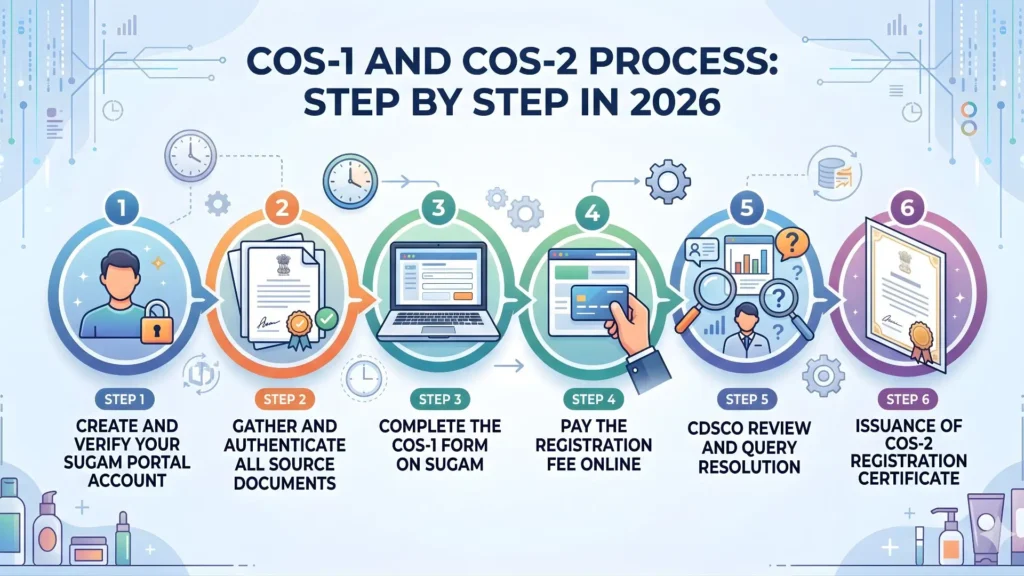
COS-1 & COS-2 Cosmetic Registration Process
- Register or login on CDSCO SUGAM portal
- Select 'Cosmetic Manufacturing License — COS-1' from the cosmetics module
- Fill company details, premises details, product list, and qualified person information
- Upload all required documents in prescribed PDF format
- Pay application fee online via the portal payment gateway
- Application forwarded to State Licensing Authority for review and scrutiny
- SLA schedules a GMP inspection of the manufacturing premises
- If deficiencies are raised, respond within 30 days with additional documents
- On satisfactory inspection, SLA issues Form COS-8 — the manufacturing license
COS-1 & COS-2 Timeline
| Stage | Typical Timeframe |
| Document preparation and SUGAM portal filing | 7 to 14 days |
| SLA acknowledgement and scrutiny | 15 to 30 days |
| GMP inspection scheduling and site visit | 30 to 60 days |
| Deficiency response window (if raised) | 30 days |
| Licence issuance — Form COS-8 | 7 to 15 days post-inspection clearance |
| Overall for a clean application | 45 to 90 days |
COS-5 Application: Adding New Shampoo Variants to an Existing Manufacturing License
What Is COS-5?
Form COS-5 is used by existing cosmetic manufacturing license holders to add new products to their COS-8 license. If you already hold a COS-8 for shampoo and want to add a new variant — a dry shampoo range, an anti-dandruff extension, or a new brand line manufactured at the same facility — you apply on COS-5 rather than filing a new COS-1.
When to Use COS-5 vs COS-1
| Situation | Form to Use |
| New manufacturing unit — no existing cosmetic licence | COS-1 (fresh application) |
| Adding new shampoo variant to already licensed premises | COS-5 (product addition) |
| Adding a different cosmetic category (e.g., conditioner) to same unit | COS-5 (if same SLA jurisdiction) |
| Change in manufacturing premises address | COS-1 (fresh application for new premises) |
| Adding second manufacturing unit in a different state | COS-1 (new SLA jurisdiction) |
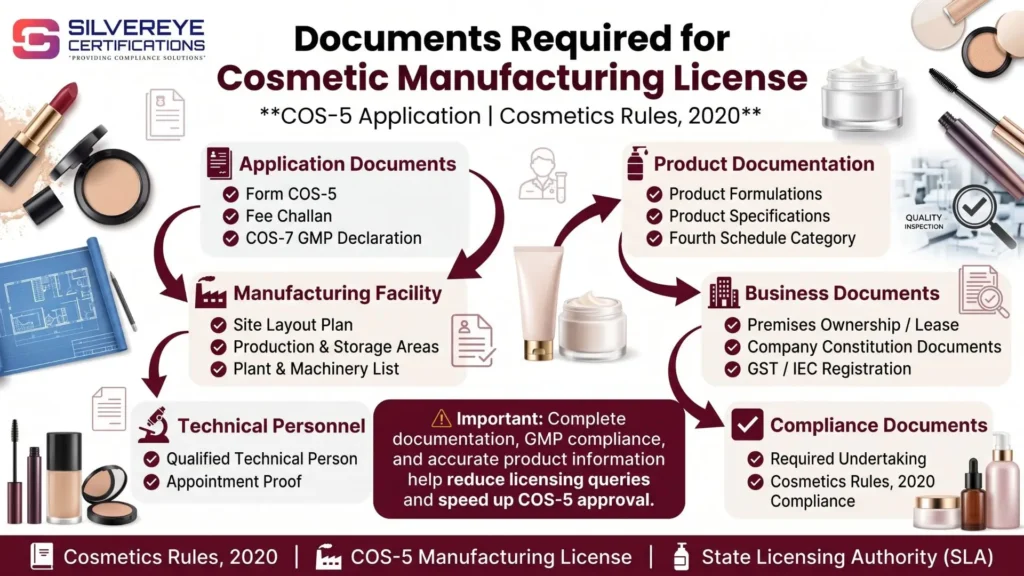
Documents Required for COS-5
- Copy of existing COS-8 license
- List of new shampoo products to be added, with INCI names and formulation type
- Manufacturing process description for new products
- Updated full product list — existing approved products plus new variants
- GMP compliance declaration covering new products
- Application fee payment proof
COS-5 Timeline
COS-5 applications are generally processed faster than COS-1 because no fresh GMP inspection is required unless new premises or significant process changes are involved. Typical timeline: 30 to 60 days from application submission to endorsement on the COS-8 license.
Form COS-8: Grant of Cosmetic License — Manufacturing and Import
Form COS-8 is the official cosmetic license document issued by the competent authority. It is issued by the State Licensing Authority for manufacturing licenses and by CDSCO for import licenses. COS-8 is the license you display at your premises, quote on invoices, and present at customs.
What COS-8 Contains
- Unique license number
- Name and address of the license holder
- Manufacturing premises address (for manufacturing COS-8) or overseas manufacturer details (for import COS-8)
- Complete list of approved cosmetic products — all shampoo variants covered
- License conditions and restrictions (if any)
- Name of the Qualified Person in charge of manufacturing
- Date of issue and date of expiry
COS-8 License Validity
| Licence Type | Validity Period |
| COS-8 Manufacturing Licence | 5 years from date of issue |
| COS-8 Import Licence | 3 years from date of issue |
| Renewal window — manufacturing | 90 days before expiry |
| Renewal window — import | 60 days before expiry |
Labelling Requirements for Shampoo Under Cosmetics Rules, 2020
Your shampoo label must comply with Rule 12 and Schedule P of the Cosmetics Rules, 2020. Incorrect labelling is one of the most common reasons for consignment rejection at customs and show-cause notices from the SLA.
| Mandatory Label Element | Requirement |
| Product name / brand name | Clearly printed on primary and secondary packaging |
| Net quantity / volume | In metric units (ml or g) |
| INCI ingredient list | In descending order of concentration |
| Best Before or Use By date | Mandatory if shelf life is under 30 months |
| Batch or Lot number | Required for traceability |
| Manufacturer name and address | Full address of SLA-licensed premises |
| Importer name and address (imported goods) | Must include COS-8 Import Licence number |
| Country of origin (imported goods) | Mandatory under Customs Act and Legal Metrology |
| Precautions / warnings | If applicable — e.g., keep away from eyes |
| MRP including all taxes | Mandatory under Legal Metrology Act |
GMP Compliance for Shampoo Manufacturers: Schedule M-II
Schedule M-II of the Cosmetics Rules, 2020 lays down Good Manufacturing Practice norms for cosmetics. Shampoo manufacturers must ensure their facility meets these requirements before the State Licensing Authority conducts its GMP inspection as part of the COS-1 process.
Key Schedule M-II Requirements for Shampoo Facilities
- Dedicated production area with controlled access and written entry procedures
- Separate raw material, in-process, and finished goods storage areas
- Documented potable water supply — tested by an accredited lab
- Written Standard Operating Procedures (SOPs) for all manufacturing steps
- Batch manufacturing records maintained for every lot produced
- In-house QC lab or accredited third-party lab access for finished product testing
- Pest control and hygiene maintenance protocols with documentation
- Qualified Person present on-site and responsible for all production
| GMP inspection readiness is the single biggest factor determining how quickly COS-1 is approved. Silvereye Certifications provides a full Schedule M-II gap analysis and mock audit to ensure your facility is inspection-ready before SUGAM portal filing. |
Renewal of COS-8 Cosmetic License for Shampoo
Letting your COS-8 license expire makes all manufacturing or import activities illegal. Here is the renewal framework:
| Licence Type | Renewal Form | Key Renewal Requirements |
| COS-8 Manufacturing | COS-3 (application for renewal) | Continued GMP compliance, QP in place, updated product list, fee payment |
| COS-8 Import | COS-4 (application for renewal) | Valid FSC, updated CoA, continued IEC validity, fee payment |
- Apply at least 90 days (manufacturing) or 60 days (import) before expiry to avoid any lapse in license validity
- If a license lapses, a completely fresh COS-1 or COS-2 application is required — there is no expedited reinstatement route
- Renewal applications are filed exclusively through the CDSCO SUGAM portal — no physical submission
Prohibited and Restricted Ingredients in Shampoo Under Cosmetics Rules, 2020
Schedule V of the Cosmetics Rules, 2020 lists ingredients that are either completely prohibited or restricted to specific concentration limits in cosmetics sold in India. Key examples relevant to shampoo formulations:
| Ingredient | Status | Notes |
| Formaldehyde (as preservative) | Restricted | Max 0.2% as free HCHO; not permitted in aerosol sprays near face |
| Resorcinol | Restricted | Max 0.5% in hair products |
| Lead acetate | Prohibited | Banned in all cosmetics |
| Mercury compounds | Prohibited | Banned completely in all cosmetics |
| Ketoconazole 2% or above | Drug (not cosmetic) | Requires Drug Licence under Schedule H, not COS-8 |
| Minoxidil | Drug | Not permitted in cosmetic shampoo formulations |
| Chloroform | Prohibited | Not permitted in any cosmetic product |
How to Apply on CDSCO SUGAM Portal: Step-by-Step Guide (2026)
- Go to sugam portal and click Register as a new applicant, or login if you have an existing account
- Under the Cosmetics module, select the appropriate form: COS-1, COS-2, or COS-5
- Fill Part A: Applicant and company details — name, address, PAN, GST, IEC for importers
- Fill Part B: Product details — for each shampoo product, enter name, formulation type, intended use, and pack sizes
- Fill Part C: Manufacturing or overseas manufacturer details — premises address, GMP status, qualified person details
- Upload documents — each in PDF format, within the size limits specified on the portal
- Review all entries and submit the application — an application tracking number will be issued
- Make the online fee payment via the portal payment gateway and download your payment receipt
- Track your application status under the My Applications dashboard
- Respond to any CDSCO or SLA queries through the portal messaging system within the specified timeframe
| Common SUGAM portal rejection reasons include: illegible documents, FSC not apostilled, INCI names inconsistent between label and CoA, and incorrect fee payment. A compliance consultant helps you avoid these delays by verifying all documents before upload. |
Common Mistakes to Avoid in CDSCO Shampoo License Applications
- Submitting a Free Sale Certificate that is expired or not apostilled — this leads to automatic query or rejection
- INCI ingredient list on label not matching the Certificate of Analysis submitted — raises product safety queries
- Using the wrong form — COS-1 for importers or COS-2 for Indian manufacturers wastes time and fees
- Premises not GMP-ready at time of SLA inspection — the most common cause of COS-8 delay
- Not listing all shampoo variants in the application — each unapproved variant later requires a separate COS-5
- Paying the incorrect fee amount — SLA or CDSCO will reject payment and stall processing
- Ignoring deficiency letters — applications are closed after 90 days of no response on SUGAM
Frequently Asked Questions (FAQs) — CDSCO Cosmetic Registration for Shampoo
Is a separate CDSCO license required for each shampoo variant?
No. All variants — regular, anti-dandruff, herbal, and so on — can be listed under a single COS-8 license at the time of the COS-1 application. New variants added later require a COS-5 application to endorse them on the existing license.
Can I start manufacturing shampoo while my COS-1 application is under review?
No. Commercial manufacture of shampoo without a valid COS-8 license is a violation of the Drugs & Cosmetics Act, 1940. You must wait for the license to be issued before beginning any commercial production.
How long does it take to get a COS-8 import license through the COS-2 route?
Typically 45 to 90 days for a clean application with all documents in order. Incomplete applications or those receiving queries can take 3 to 6 months. Working with a compliance consultant significantly reduces timelines.
Does a foreign shampoo manufacturer need to be registered with CDSCO?
The foreign manufacturer does not register with CDSCO directly. However, the Indian importer must submit the overseas manufacturer's valid manufacturing license — notarized and apostilled — as part of the COS-2 application.
Is anti-dandruff shampoo with zinc pyrithione treated as a cosmetic or drug in India?
Shampoo containing Zinc Pyrithione at cosmetically accepted concentrations is treated as a cosmetic under Schedule S and requires COS-8. However, if the product is marketed with therapeutic anti-fungal disease claims, it may be reclassified as a drug. Label and marketing claims must be carefully reviewed.
What is the difference between old Form 42 and the new COS-1 for cosmetics?
Form 42 and Form 43 were the application and licence forms under the pre-2020 Cosmetics Toiletry and Perfumery rules. They have been superseded by the COS-1 through COS-12 series under the Cosmetics Rules, 2020. Any licence on old forms needs to be renewed and migrated under the new framework.
Can I import K-beauty (Korean) shampoo into India?
Yes. You need to file Form COS-2 with the Indian importer's details, a Free Sale Certificate from the Korean MFDS, the Korean manufacturer's license, INCI formulation details, and draft India-compliant labels. Korean FSCs are generally accepted by CDSCO.
What are the consequences of selling shampoo in India without a valid COS-8 license?
It is a criminal offence under Section 17 and 18 of the Drugs & Cosmetics Act, 1940. Penalties include seizure of goods, fines up to Rs. 1 lakh, and imprisonment up to 3 years. Repeat offences attract enhanced penalties under the Act.
Do I need a separate license for each of my manufacturing locations?
Yes. Each manufacturing premises requires a separate COS-8 manufacturing license from the respective State Licensing Authority. However, one SLA-issued COS-8 can cover all products manufactured at that single premises.
How do I renew my COS-8 import license before it expires?
File Form COS-4 at least 60 days before expiry via the SUGAM portal, along with an updated Free Sale Certificate, Certificate of Analysis, valid IEC, and renewal fee. CDSCO typically processes renewals within 30 to 45 days for complete and correctly filed applications.