- All general hospital medical devices sold in India must be registered under CDSCO as per MDR 2017 — no exceptions.
- Devices are categorized into Class A (low risk), Class B (low-moderate risk), and Class C (moderate-high risk) — each with a different registration path and fee structure.
- Manufacturers and importers must apply through the SUGAM portal with the correct Form MD-14, MD-15, or MD-9 depending on the device class.
- Non-compliance with CDSCO registration can result in product recall, import ban, or penalties under the Drugs and Cosmetics Act — ensure your device is listed before entering the market.
What Is CDSCO License for General Hospital Medical Device?
The Central Drugs Standard Control Organization (CDSCO), under the Ministry of Health & Family Welfare, is India's apex regulatory authority for medical devices. Any general hospital medical device — whether manufactured in India or imported — must obtain CDSCO registration before it can be marketed, sold, or distributed in the country.
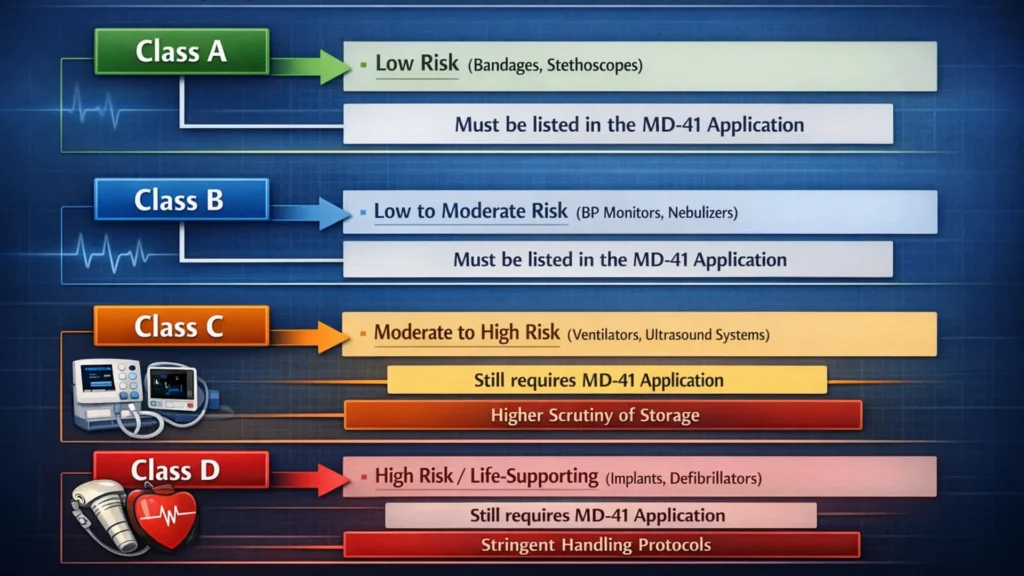
This requirement is governed by the Medical Devices Rules (MDR), 2017, which came into full effect for most device categories by 2022. The rules classify all medical devices into four risk-based classes: A, B, C, and D — with Class A being the lowest risk and Class D the highest.
For general hospital medical devices — which include everything from patient beds and thermometers to sterilizers, infusion pumps, and blood bank equipment — CDSCO registration is mandatory regardless of whether you are a domestic manufacturer or a foreign manufacturer importing into India.
If you are asking 'how to register a medical device with CDSCO in India' or 'what documents are needed for CDSCO registration', this guide covers every aspect of the process, specifically for general hospital and clinical-use devices.
Why Is CDSCO Registration Important for Hospital Medical Devices?
Hospitals, clinics, and healthcare facilities in India can only procure devices that carry valid CDSCO registration. This makes regulatory compliance a business necessity — not just a legal formality.
- Ensures patient safety and device quality through pre-market review.
- Mandatory for listing devices on government procurement portals like GeM (Government e-Marketplace).
- Required for hospital accreditation under NABH standards.
- Protects importers and manufacturers from product seizure, recalls, and market withdrawal.
- Builds trust with hospitals, distributors, and procurement committees.
Understanding CDSCO Device Classification: Class A, B, C, and D
Under MDR 2017, all medical devices are classified based on their intended use, risk level, duration of contact, and invasiveness. For general hospital medical devices, Classes A, B, and C are most relevant. Class D devices involve the highest risk and are not covered in this segment.
| Class | Risk Level | Registration Type | Regulatory Path | Form Used |
| Class A | Low Risk | Mandatory Registration | Self-declaration + CDSCO submission | Form MD-1 / MD-9 |
| Class B | Low-Moderate Risk | Mandatory Registration | CDSCO review and approval | Form MD-5 / MD-9 |
| Class C | Moderate-High Risk | Mandatory Registration | Detailed CDSCO technical review | Form MD-5 / MD-9 |
| Class D | High Risk | Mandatory Registration + Clinical data | Strictest regulatory scrutiny | Form MD-5 / MD-9 |
Complete List of General Hospital Medical Devices by CDSCO Classification
Below is the official classification of general hospital medical devices as notified by CDSCO. This list is based on the MD-64 to MD-67 device classification schedule and has been organized by risk class for easy reference.
Class A — General Hospital Medical Devices (Low Risk)
Class A devices are the lowest-risk category. While they still require mandatory registration under MDR 2017, the process is relatively straightforward. These devices primarily serve supportive, monitoring, or non-invasive functions.
| S.No. | Device Name | Class | Clinical Use |
| 1 | Liquid crystal forehead temperature strip | A | Temperature monitoring |
| 2 | Bed exit monitor / Fall prevention | A | Patient safety |
| 3 | Stand-on patient scale | A | Patient weighing |
| 4 | Patient scale (under-bed type) | A | Patient weighing |
| 5 | Clinical color change thermometer | A | Body temperature |
| 6 | Apgar timer | A | Neonatal assessment |
| 7 | Hydraulic adjustable hospital bed | A | Patient support |
| 8 | Manual adjustable hospital bed | A | Patient support |
| 9 | Nonpowered flotation therapy mattress | A | Pressure ulcer prevention |
| 10 | Therapeutic medical binder | A | Wound/body support |
| 11 | Burn sheet | A | Wound care |
| 12 | Neonatal eye pad | A | Neonatal protection |
| 13 | Nipple shield | A | Nursing aid |
| 14 | Lamb feeding nipple | A | Neonatal feeding |
| 15 | Cardiopulmonary resuscitation board | A | CPR support |
| 16 | Medical insole | A | Foot care |
| 17 | Skin pressure protectors | A | Pressure ulcer prevention |
| 18 | Body waste receptacle | A | Patient hygiene |
| 19 | Suction snakebite kit | A | First aid |
| 20 | Therapeutic scrotal support | A | Urological support |
| 21 | Umbilical occlusion device | A | Neonatal care |
| 22 | Hand-carried stretcher | A | Patient transport |
| 23 | Liquid crystal vein locator | A | Venous access |
| 24 | Heat-sealing device (blood bags) | A | Blood banking |
| 25 | Blood grouping slides | A | Blood banking |
| 26 | Blood bank pipettes | A | Blood banking |
| 27 | Blood mixing and blood weighing devices | A | Blood banking |
| 28 | Blood bank centrifuge | A | Blood component separation |
Class B — General Hospital Medical Devices (Low-Moderate Risk)
Class B devices carry a moderate level of patient risk. They typically involve electrical operation, direct patient contact, or use in procedures that require clinical monitoring. Registration requires CDSCO technical review and approval.
| S.No. | Device Name | Class | Clinical Use |
| 1 | Electrically powered spinal fluid pressure monitor | B | Neurological monitoring |
| 2 | Spinal fluid manometer | B | Neurological monitoring |
| 3 | Sterilization process indicator (Biological) | B | Sterilization assurance |
| 4 | Sterilization process indicator (Physical/chemical) | B | Sterilization assurance |
| 5 | Clinical electronic thermometer | B | Temperature monitoring |
| 6 | Clinical mercury thermometer | B | Temperature monitoring |
| 7 | Pediatric medical crib | B | Pediatric care |
| 8 | Medical bassinet | B | Neonatal care |
| 9 | Pressure infusor for I.V. bag | B | IV therapy |
| 10 | Intravascular administration set (auto air removal) | B | IV therapy |
| 11 | Patient care reverse isolation chamber | B | Infection control |
| 12 | Patient lift (electrically powered) | B | Patient handling |
| 13 | Neonatal phototherapy unit | B | Jaundice treatment |
| 14 | Ultrasonic cleaner for medical instruments | B | Instrument cleaning |
| 15 | Sharps needle destruction device | B | Biomedical waste |
| 16 | Surgical light (single or multi dome) | B | Surgical illumination |
| 17 | Medical examination light | B | Clinical examination |
| 18 | Medical ultraviolet air purifier | B | Air disinfection |
| 19 | Vacuum-powered body fluid suction apparatus | B | Aspiration |
| 20 | Washers for body waste receptacles | B | Hospital hygiene |
| 21 | Sterilization wrap | B | Sterilization packaging |
| 22 | General purpose disinfectants | B | Surface disinfection |
| 23 | Medical washer | B | Instrument reprocessing |
| 24 | Remote Medication Management System | B | Medication safety |
| 25 | Blood Vacutainer | B | Blood collection |
Class C — General Hospital Medical Devices (Moderate-High Risk)
Class C devices are used in critical clinical environments — such as neonatal intensive care, sterilization, blood banking, and controlled drug delivery. These require the most thorough CDSCO review, including technical documentation, performance data, and in some cases, clinical evidence.
| S.No. | Device Name | Class | Clinical Use |
| 1 | Electronic monitor for gravity flow infusion systems | C | IV monitoring |
| 2 | Infant radiant warmer | C | Neonatal thermoregulation |
| 3 | Neonatal incubator | C | Neonatal intensive care |
| 4 | Neonatal transport incubator | C | Neonatal transport |
| 5 | Jet lavage | C | Wound management |
| 6 | Chemical cold pack snakebite kit | C | Emergency first aid |
| 7 | Ingestible event marker | C | Medication compliance |
| 8 | Ultraviolet (UV) radiation chamber disinfection device | C | Surface disinfection |
| 9 | Ethylene oxide gas sterilizer | C | Sterilization |
| 10 | Dry-heat sterilizer | C | Sterilization |
| 11 | Steam sterilizer (Autoclave) | C | Sterilization |
| 12 | Liquid chemical sterilants/high level disinfectants | C | Critical device reprocessing |
| 13 | Medical washer-disinfector | C | Instrument reprocessing |
| 14 | Hydrogen Peroxide Gas Plasma Sterilization System | C | Sterilization |
| 15 | Wheeled stretcher | C | Patient transport |
| 16 | Infusion pump | C | Drug delivery |
| 17 | Environmental chamber for platelet concentrate | C | Blood storage |
| 18 | Blood storage refrigerator | C | Blood storage |
| 19 | Automated blood cell separator | C | Blood banking |
Who Needs to Apply for CDSCO Medical Device Registration?
The registration obligation applies to all entities involved in manufacturing, importing, or distributing medical devices in India. Specifically:
- Indian Manufacturers: Any company or entity that manufactures a notified medical device in India must hold a valid Manufacturing License and product registration with CDSCO.
- Importers: Foreign manufacturers must appoint an Authorized Indian Representative (AIR) who applies on their behalf. The AIR is legally responsible for regulatory compliance in India.
- Distributors and Wholesalers: While they do not register devices themselves, they can only stock and sell devices with valid CDSCO registration numbers.
- Hospitals and Institutions: They must procure only CDSCO-registered devices. In-house fabricated devices used within a healthcare facility may have different rules — consult your State Licensing Authority.
Documents Required for CDSCO Registration of General Hospital Medical Devices
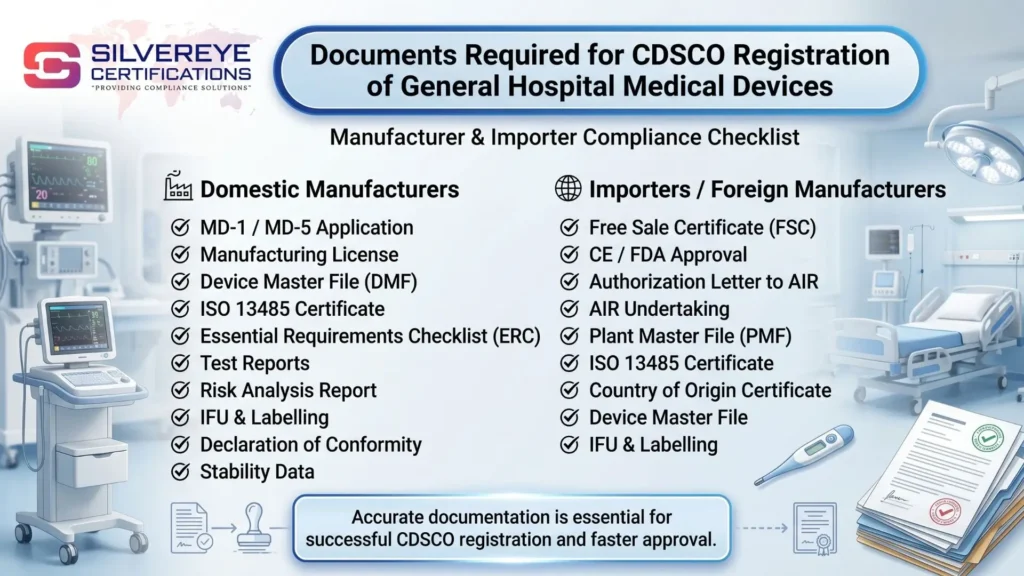
The document checklist varies by device class and applicant type (domestic manufacturer vs. importer). Here is a consolidated list of commonly required documents:
For Domestic Manufacturers (All Classes)
| Document | Details |
| Form MD-1 / MD-5 application | Filled and signed online via SUGAM portal |
| Manufacturing License | State Licensing Authority (SLA) issued license under MDR 2017 |
| Device Master File (DMF) | Technical documentation with specifications, materials, design |
| ISO 13485 Certificate | Quality Management System certification |
| Essential Requirements Checklist (ERC) | Compliance checklist as per Schedule 1 of MDR 2017 |
| Test/Performance Reports | From NABL-accredited or notified labs |
| Risk Analysis Report | As per ISO 14971 |
| Labeling and IFU (Instructions for Use) | In English; must comply with MDR 2017 labeling rules |
| Declaration of Conformity | Signed declaration by the authorized signatory |
| Shelf Life and Stability Data | For devices with expiry relevance |
Additional Documents for Importers / Foreign Manufacturers
| Document | Details |
| Free Sale Certificate (FSC) | From the country of origin — certifies device is legally marketed there |
| CE Certificate or US FDA 510(k)/PMA | International approvals (adds credibility and reduces review time) |
| Authorization Letter to AIR | Notarized and apostilled authorization from foreign manufacturer |
| Undertaking by AIR | In the prescribed CDSCO format |
| Plant Master File | Foreign facility details, address, scope of manufacture |
| Valid ISO 13485 (international facility) | Must cover the device being imported |
| Country of Origin Certificate | For customs and import compliance |
Step-by-Step CDSCO Registration Process for General Hospital Medical Devices
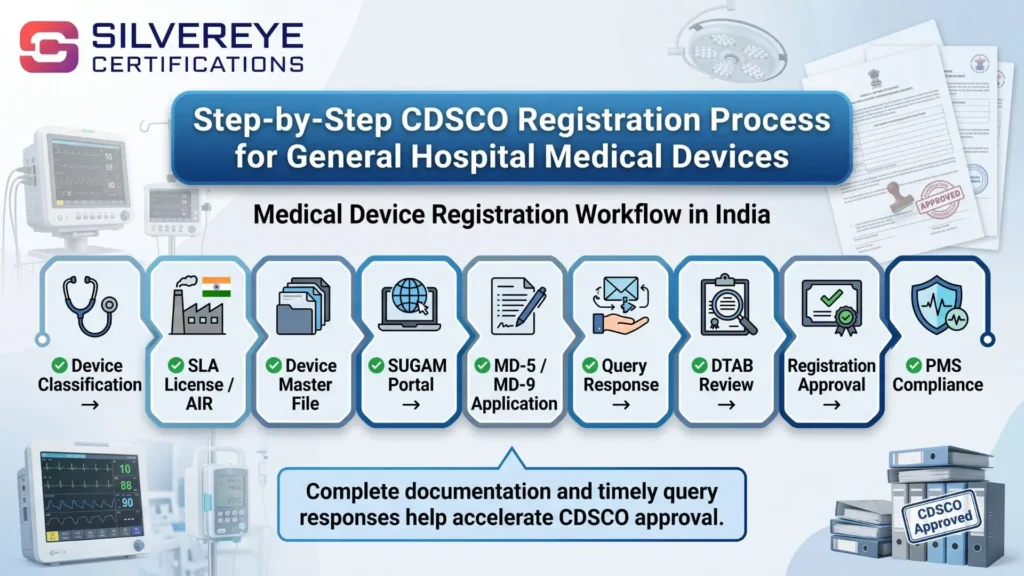
The registration process in India is conducted entirely through CDSCO's online SUGAM portal. Here is the complete step-by-step process:
- Step 1: Determine Device Classification — Identify your device's class (A, B, or C) based on the CDSCO classification schedule and MDR 2017 rules.
- Step 2: Obtain Manufacturing License (Domestic Manufacturers) — Apply to the State Licensing Authority (SLA) for a manufacturing license under MDR 2017 before applying to CDSCO.
- Step 3: Appoint an Authorized Indian Representative (Importers) — Foreign manufacturers must designate and authorize an AIR based in India.
- Step 4: Prepare Technical Documentation — Compile the full device master file, test reports, risk analysis, labeling, and quality certificates.
- Step 5: Register on SUGAM Portal — Create an account on the SUGAM portal and complete your applicant profile.
- Step 6: File the Application (Form MD-5 for Class B/C or MD-9 for certain categories) — Upload all documents and pay the applicable government fee online.
- Step 7: Deficiency Letter Response — CDSCO may issue a deficiency letter requesting additional information. Respond within the specified timeframe (usually 30–90 days).
- Step 8: Technical Scrutiny & DTAB Review — Class C devices may require review by the Drugs Technical Advisory Board (DTAB) or expert committee.
- Step 9: Grant of Registration Certificate — Upon successful review, CDSCO issues a Registration Certificate (RC) along with a unique registration number.
- Step 10: Post-Market Surveillance (PMS) — After registration, manufacturers must maintain vigilance reports, adverse event reporting, and periodic performance reviews.
CDSCO Registration Fees for General Hospital Medical Devices
Government fees are prescribed under Schedule IV of MDR 2017 and vary based on the applicant type (Indian manufacturer vs. importer) and device class. Note: Fees are subject to periodic revision; always verify on the SUGAM portal before filing.
| Device Class | Indian Manufacturer (INR) | Importer (INR) | Notes |
| Class A | Rs. 2,500 per device | Rs. 5,000 per device | Self-certification track |
| Class B | Rs. 5,000 per device | Rs. 20,000 per device | CDSCO review required |
| Class C | Rs. 10,000 per device | Rs. 40,000 per device | Full technical scrutiny |
| Class D | Rs. 15,000 per device | Rs. 50,000 per device | Not in general hospital scope typically |
Note: These are indicative government filing fees. Professional consultation charges, laboratory testing costs, certification fees (ISO 13485, CE marking), and other preparation costs are separate and depend on the complexity of the device.
Processing Timeline for CDSCO Medical Device Registration
| Device Class | Standard Processing Time | With Deficiency Response | Remarks |
| Class A | 30–45 working days | 60–90 working days | Mostly self-declaration; fastest track |
| Class B | 60–90 working days | 90–150 working days | CDSCO desk review required |
| Class C | 90–180 working days | 6–12 months | May involve expert committee review |
Timelines above are indicative. Delays can occur due to document deficiencies, portal technical issues, or regulatory queue. Engaging a CDSCO regulatory consultant can help reduce deficiency rates and improve turnaround.
Validity and Renewal of CDSCO Registration Certificate
CDSCO Registration Certificates for medical devices are granted for a period of 5 years from the date of issue. After 5 years, you must apply for renewal to continue marketing the device.
Key Points on Validity and Renewal
- Renewal Application: Must be filed at least 9 months before the expiry date of the existing certificate.
- Renewal Form: Form MD-7 (for domestic manufacturers) or Form MD-14 (for importers) as applicable.
- Renewal Fees: Similar to initial registration fees — check the SUGAM portal for current rates.
- Continuous Marketing Rights: If renewal is filed on time, the existing registration remains valid until the renewed certificate is issued.
- Post-Expiry Penalty: Devices marketed after registration expiry attract penalties under the Drugs and Cosmetics Act.
- Changes During Validity: Any major change to device design, intended use, labeling, or manufacturing site requires a fresh approval or variation application.
Benefits of Getting CDSCO Registration for Your Hospital Medical Device
- Legal Market Access: Only CDSCO-registered devices can be legally sold in India's Rs. 90,000+ crore medical device market.
- Government Tender Eligibility: CDSCO registration is mandatory for all Central and State government procurement tenders under public health programmes.
- GeM Portal Listing: Products must carry CDSCO registration to be listed on the Government e-Marketplace.
- NABH Compliance: NABH-accredited hospitals are required to procure CDSCO-registered devices — giving your product a competitive edge.
- Export Credibility: Indian CDSCO registration strengthens your product's credibility in neighboring markets that accept Indian regulatory approvals.
- Brand Protection: Registered devices are protected under Indian law — counterfeit or substandard products can be actioned against by CDSCO enforcement.
- Investor Confidence: Regulatory-compliant device companies attract higher investor interest, especially in the MedTech startup ecosystem.
Common Mistakes to Avoid in CDSCO Medical Device Registration
- Incorrect device classification — always verify against the official CDSCO notified list before filing.
- Incomplete technical documentation — missing ISO 13485, test reports, or risk analysis leads to deficiency letters and delays.
- Expired Free Sale Certificate — FSC must be valid at the time of CDSCO submission for importers.
- Labeling non-compliance — product labels must meet MDR 2017 Schedule III requirements, including net quantity, batch number, manufacturer details, and storage conditions.
- Wrong form selection — using MD-1 instead of MD-5 (or vice versa) causes rejection at the intake stage.
- Missing State License — domestic manufacturers who apply to CDSCO without a valid State Manufacturing License will have the application rejected.
- Not tracking deficiency deadlines — ignoring CDSCO's deficiency letter within the stipulated response window can result in application abandonment.
Conclusion: Get Your General Hospital Medical Device CDSCO Registered in 2026
Navigating CDSCO registration for general hospital medical devices can be complex — but with the right documentation, correct device classification, and a systematic approach, it is a manageable process. Whether you are launching a new product, entering the Indian market as an importer, or renewing an existing registration, compliance with MDR 2017 is non-negotiable.
The Indian medical device market is growing rapidly, driven by government health programmes, hospital infrastructure expansion, and rising healthcare awareness. CDSCO registration is your gateway to this market — and this guide gives you the complete roadmap.
If you need expert support for CDSCO registration, technical documentation preparation, ISO 13485 certification, or regulatory strategy for general hospital medical devices, connect with a CDSCO-experienced regulatory consultant to avoid delays and errors in your application.
Frequently Asked Questions
Is CDSCO registration mandatory for all general hospital medical devices in India?
Yes. Under the Medical Devices Rules 2017, all notified medical devices — including general hospital devices like thermometers, beds, infusion pumps, sterilizers, and blood bank equipment — must be registered with CDSCO before they can be manufactured for sale, imported, or distributed in India.
What is the difference between Class A, B, and C hospital medical devices?
Class A devices are low risk (e.g., patient scales, hospital beds). Class B devices are low-to-moderate risk (e.g., electronic thermometers, phototherapy units). Class C devices carry moderate-to-high risk and include critical equipment like neonatal incubators, infusion pumps, and sterilizers.
How long does CDSCO registration take for a Class B hospital device?
Typically, Class B device registration takes 60–90 working days if documents are complete. If CDSCO raises a deficiency letter, the process can extend to 90–150 working days. Proper document preparation reduces deficiency rates significantly.
Can a foreign manufacturer register a medical device directly with CDSCO?
No. Foreign manufacturers must appoint an Authorized Indian Representative (AIR) who submits the application on their behalf. The AIR is legally accountable for regulatory compliance in India and must be a resident Indian individual or company.
What is the SUGAM portal and how is it used for CDSCO registration?
SUGAM is CDSCO's official online portal for submitting medical device registration applications. All applications, document uploads, fee payments, and status tracking are done through this portal. A registered applicant account is mandatory before filing.
What is the validity of a CDSCO medical device registration certificate?
A CDSCO registration certificate is valid for 5 years from the date of issue. Renewal must be applied for at least 9 months before expiry using the prescribed renewal form and fees.
Is ISO 13485 certification mandatory for CDSCO device registration?
Yes, for Class B and Class C devices, ISO 13485 certification (Quality Management System) is mandatory. For Class A devices, it is strongly recommended and may be required by state licensing authorities for the manufacturing license.
What is Form MD-5 in CDSCO registration?
Form MD-5 is the application form for obtaining a license to import or manufacture Class B, C, or D medical devices in India. It is filed through the SUGAM portal and requires comprehensive technical documentation including device master files, test reports, and ISO 13485 certificate.
Are hospital beds and patient scales also required to be CDSCO registered?
Yes. Hospital beds (hydraulic and manual adjustable), patient scales, and other basic hospital equipment that are notified under MDR 2017 must be CDSCO registered. These fall under Class A with a relatively simpler registration pathway.
What happens if I sell an unregistered medical device in India?
Selling, importing, or distributing an unregistered notified medical device is a punishable offence under the Drugs and Cosmetics Act, 1940 and MDR 2017. Penalties include product seizure, market withdrawal, fines, and in serious cases, criminal prosecution. CDSCO enforcement actions have been increasingly active since 2022.